
Periodic Developmental Reviews PDR Sin Conner Quality Office

- Slides: 20
Periodic Developmental Reviews (PDR) Siân Conner Quality Office University of Leicester September 2014 www. le. ac. uk
What is a PDR? • PDRs are an important means by which the University satisfies itself that departments, schools and collaborative partners are fulfilling the requirements for the maintenance of academic standards and teaching quality. • Reviews happen on a cyclical basis (normally every 6 years) • In line with QAA Quality Code, Chapter B 8: Programme Monitoring and Review • University’s Code of Practice – currently under review
What is a PDR (cont. )? • PDRs are normally day-long events (can be longer for schools/departments with large or complex provision) • During the day, a Panel will conduct interviews with the Head of School/Department and a range of staff and students from the School/Department • A report follows the review, with key findings. These are often in the form of commendations, recommendations and requirements for action
The Panel • All PDRs are conducted by a panel made up of: – A Pro-Vice Chancellor (Chair) – An External Assessor(s) – Academic Director – Member of Academic Policy Committee – Lay member of Council – Member of the SU Sabbatical Team – Member of Quality Office (Secretary)
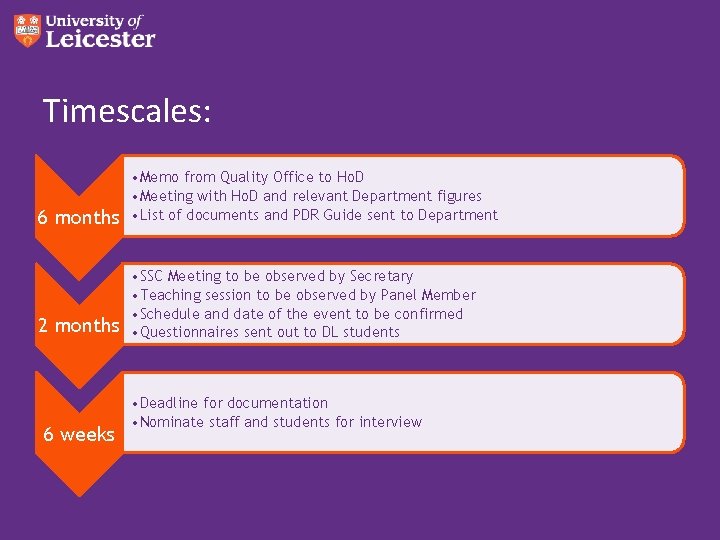
Timescales: 6 months • Memo from Quality Office to Ho. D • Meeting with Ho. D and relevant Department figures • List of documents and PDR Guide sent to Department 2 months • SSC Meeting to be observed by Secretary • Teaching session to be observed by Panel Member • Schedule and date of the event to be confirmed • Questionnaires sent out to DL students 6 weeks • Deadline for documentation • Nominate staff and students for interview
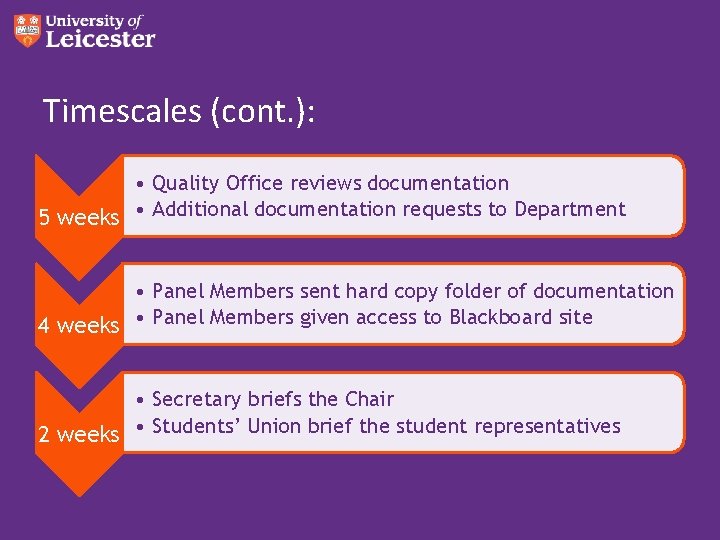
Timescales (cont. ): • Quality Office reviews documentation 5 weeks • Additional documentation requests to Department • Panel Members sent hard copy folder of documentation 4 weeks • Panel Members given access to Blackboard site • Secretary briefs the Chair 2 weeks • Students’ Union brief the student representatives
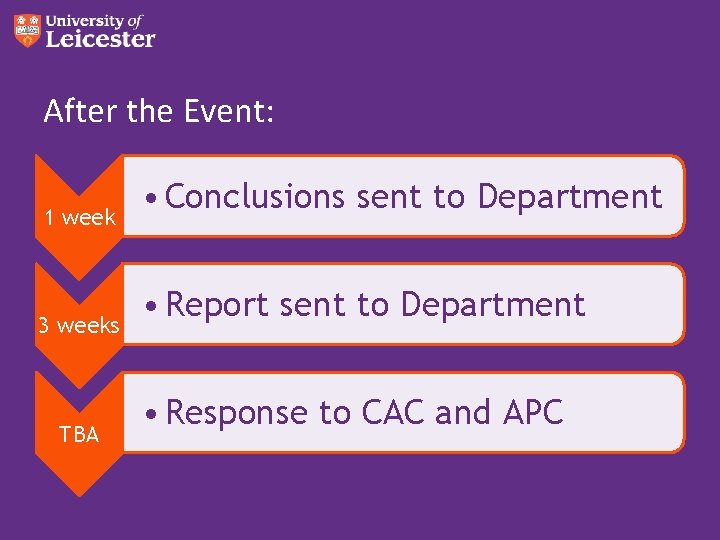
After the Event: 1 week 3 weeks TBA • Conclusions sent to Department • Report sent to Department • Response to CAC and APC
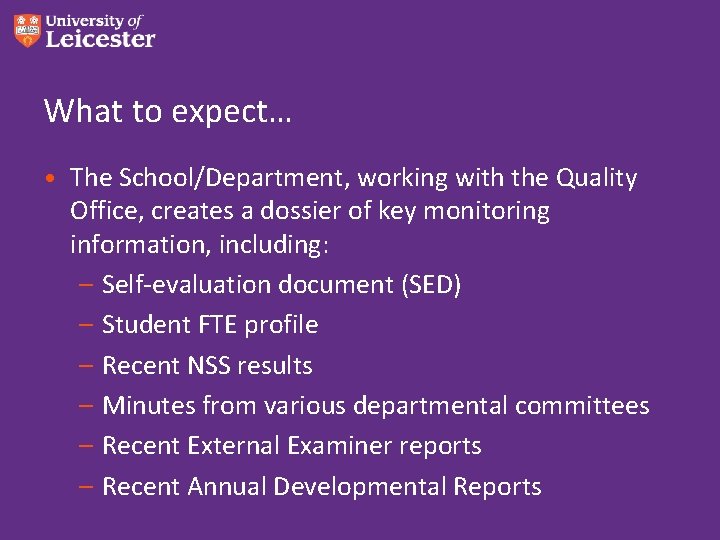
What to expect… • The School/Department, working with the Quality Office, creates a dossier of key monitoring information, including: – Self-evaluation document (SED) – Student FTE profile – Recent NSS results – Minutes from various departmental committees – Recent External Examiner reports – Recent Annual Developmental Reports
Documentation: • Department’s responsibility to create Blackboard site – ‘Department X PDR’ – Design of Bb site – up to Department – Give access to Secretary – Department needs to give access to the Panel members • Secretary will indicate the information that is to be uploaded by Department and Quality Office in premeeting
Self-Evaluation Document (SED) • Purpose: – Reflect upon provision – Helps set the agenda for the event – Forms the basis of a dialogue • Not a detailed description of what you do – background information is useful but SED needs to be reflective and evaluative (e. g. how effective/successful is the Department? ) • It also needs to identify key areas for development and improvement
Self-Evaluation Document (SED) cont. • No formal requirement of length • Six sections: 1. 2. 3. 4. 5. Strategic and Department Overview Curriculum and Award Standards Teaching, Learning and Assessment Student Support, Development and Employability Research 6. Issues for discussion
SED 1: Strategic and Departmental Overview • Overview of provision and organisational structure • Quality Enhancement and Assurance • Strategies • Overview of approach to curriculum development and e. Learning • Overview of Collaborative Provision • Management of Learning Resources • Aims and Context
SED 2: Curriculum and Award Standards • Reflect on structure and content of programmes • Progression and completion rates • Employability and graduate destination statistics
SED 3: Teaching, Learning and Assessment • Learning and Teaching – Range of teaching methods – Opportunities for innovation • Assessment – Effectiveness in promoting student learning • Feedback – Mechanisms in place – Student representation
SED 4: Student Support, Development and Employability • Recruitment and Induction • Student Support • Student Experience • Learning Resources • Learning and Study Skills • Employability • Work Placements • International Study (Year Abroad, etc)
SED 5: Research • Recruitment • Studentships and awards • Supervision and special arrangements • Research training course • Resources • Student progress • Submission and completion rates • Graduate assistants
SED 6: Issues for discussion • The Panel or the PDR process cannot always answer every question raised, however the process is designed to be a dialogue and should therefore be reflected as such.
After the Event • Conclusions sent to the Department within one week • Report published within 3 weeks of the event • Initial response to the report to be sent to APC, normally within 2 months of the report publication • Full response to be sent to APC within one year of the report publication
Useful documents: • QAA Quality Code, Chapter B 8: Programme Monitoring and Review • Code of Practice for Annual and Periodic Developmental Review [currently under review]
Any Questions