
Period 6 1865 1898 Chapters 16 19 The











- Slides: 78
Period 6 1865 -1898 Chapters 16 -19 The transformation of the United States from an agricultural to an increasingly industrialized and urbanized society brought about significant economic, political, diplomatic, social, environmental, and cultural changes. Key Concept 6. 1: The rise of big business in the United States encouraged massive migrations and urbanization, sparked government and popular efforts to reshape the U. S. economy and environment, and renewed debates over U. S. national identity. Key Concept 6. 2: The emergence of an industrial culture in the United States led to both greater opportunities for, and restrictions on, immigrants, minorities, and women. Key Concept 6. 3: The “Gilded Age” witnesses new cultural and intellectual movements in tandem with political debates over economic and social policies.
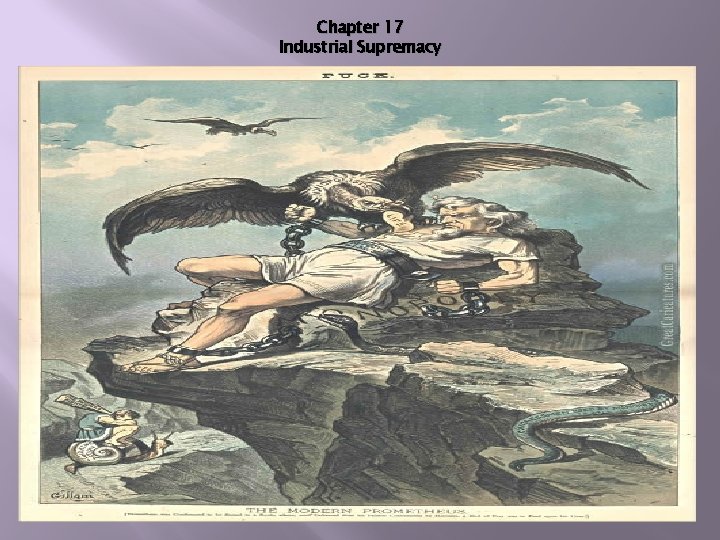
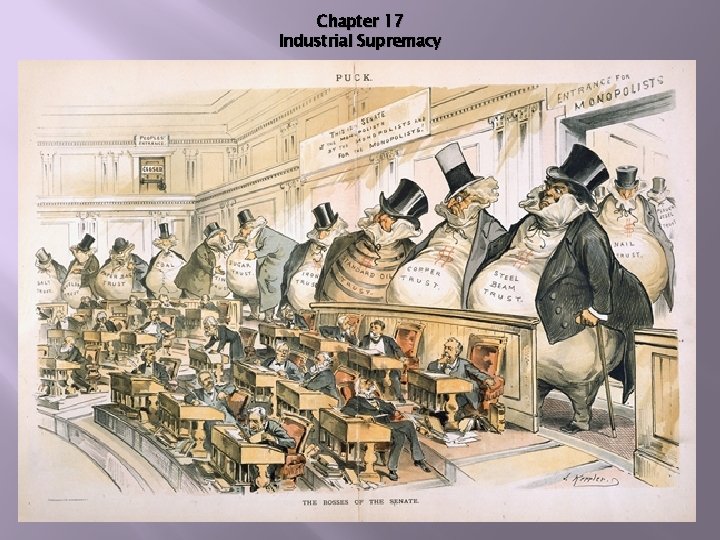
Chapter 17 Industrial Supremacy 1865 -1900 Although some economists place the industrial "take-off" of America in the years before the Civil War, it was in the three decades following that great conflict that the United States became the world's leading industrial power. A fortunate combination of sufficient raw materials, adequate labor, enviable technological accomplishments, effective business leadership, nationwide markets, and supportive state and national governments boosted America past its international rivals. The industrial transformation had a profound impact on the lives of the millions of workers who made the production revolution possible. Some who were distrustful of industrial power turned toward socialism; others tried to organize workers into powerful unions. But, in these early years of industrial conflict, the forces of business usually triumphed. Long Essay Exam Tips Free-Response questions often address the Industrial Revolution, and especially its effects on workers and the working class. Also familiarize yourself with both the ideological support for and criticism of free-enterprise capitalism. Learn about several specific industries and their representative tycoons such as Carnegie, Rockefeller, and Morgan. That will provide you with specific evidence about business practices to use in an essay.
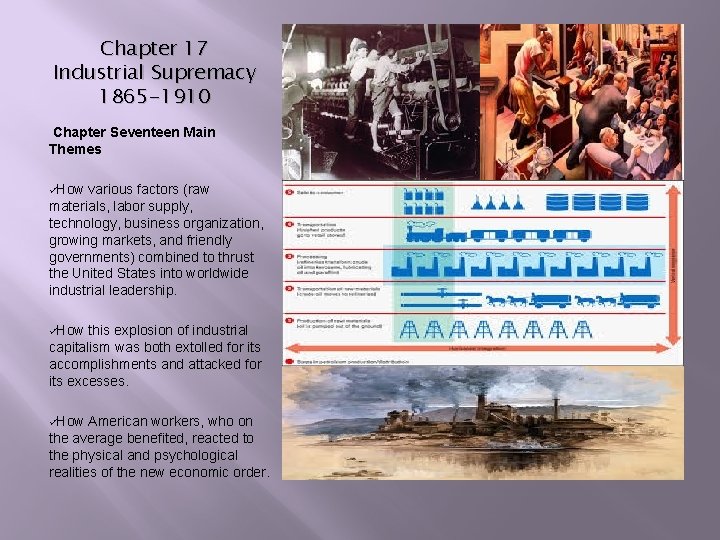
Chapter 17 Industrial Supremacy 1865 -1910 Chapter Seventeen Main Themes üHow various factors (raw materials, labor supply, technology, business organization, growing markets, and friendly governments) combined to thrust the United States into worldwide industrial leadership. üHow this explosion of industrial capitalism was both extolled for its accomplishments and attacked for its excesses. üHow American workers, who on the average benefited, reacted to the physical and psychological realities of the new economic order.
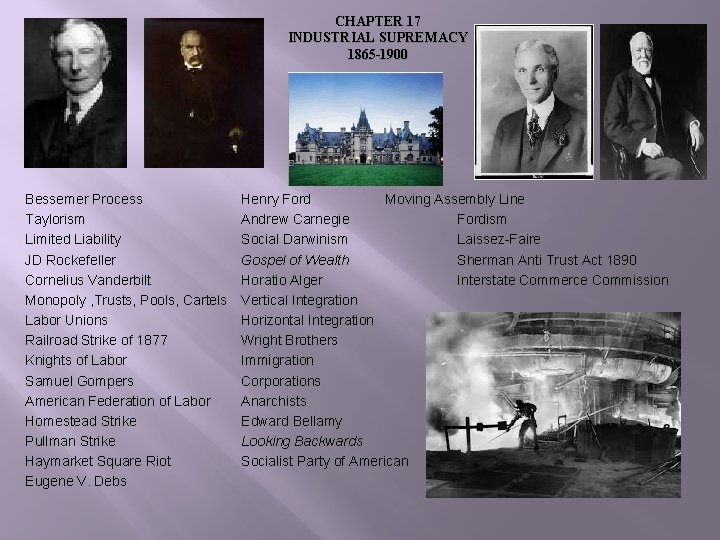
CHAPTER 17 INDUSTRIAL SUPREMACY 1865 -1900 Bessemer Process Taylorism Limited Liability JD Rockefeller Cornelius Vanderbilt Monopoly , Trusts, Pools, Cartels Labor Unions Railroad Strike of 1877 Knights of Labor Samuel Gompers American Federation of Labor Homestead Strike Pullman Strike Haymarket Square Riot Eugene V. Debs Henry Ford Moving Assembly Line Andrew Carnegie Fordism Social Darwinism Laissez-Faire Gospel of Wealth Sherman Anti Trust Act 1890 Horatio Alger Interstate Commerce Commission Vertical Integration Horizontal Integration Wright Brothers Immigration Corporations Anarchists Edward Bellamy Looking Backwards Socialist Party of American
Industrial Supremacy 1865 -1910 1. What were the reasons for rapid industrial development of the United States in the late nineteenth century? 2. Describe impact of technological innovations in promoting industrial expansion. 3. What were the roles of the individual entrepreneur in developing particular industries? 4. How was the use of classical economics and Social Darwinism to justify and defend the new industrial capitalism? 5. Who were the critics of the new industrial capitalism and the solutions they proposed? 6. Describe the conditions of immigrants, women, and children in the work force. 7. Explain the efforts of organized labor to form national associations.
Chapter 17 Industrial Supremacy Discussion notes
Chapter 17 Industrial Supremacy
Chapter 17 Industrial Supremacy
Chapter 18 The Age of the City 1865 -1910 In the years after the Civil War, America’s cities boomed as people left the rural areas of Europe and the United States to seek jobs and other attractions offered by American cities. The rapid growth of cities caused many problems in housing, transportation, and health. Technological attacks on these problems barely kept pace, and city governments often resorted to boss rule to cope. The booming cities were places of intellectual ferment and cultural change. Urban dwellers found many ways to enjoy increased leisure time. Many Americans wanted to prove to skeptical Europeans that the nation had cultural as well as economic accomplishments to admire. American culture became more uniform through free public education, mass-market journalism, and standardized sports. Higher education, especially new state universities, reached out to a wider market. More and more women attended college in coeducational and single-sex institutions. Long Essay Exam Tips Questions from the Civil War on will frequently use photographs and other visual sources (political cartoons, advertisements) as documents. Use the same criteria for assessing them you would use for written sources. Who is the author? What is the author trying to convince you about? What symbols or images does the author use to covey the message? Late-nineteenth century questions will often include documents that deal with the growing gap between rich and poor (keep in mind, though, that the growth of the middle class was extremely significant during this period). The growth of organized labor, intellectual trends such as the growth of Social Darwinism, and changing ideas about time and place (the increasing separation between work and leisure time and between home and workplace) are all things to keep in mind during this period.
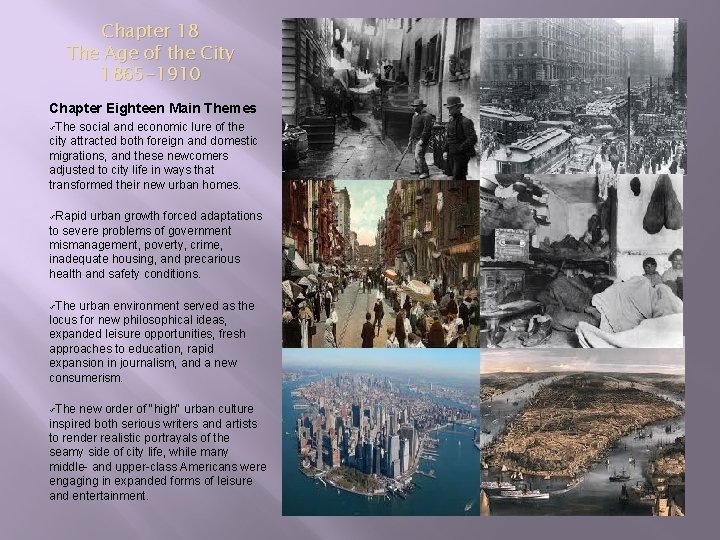
Chapter 18 The Age of the City 1865 -1910 Chapter Eighteen Main Themes üThe social and economic lure of the city attracted both foreign and domestic migrations, and these newcomers adjusted to city life in ways that transformed their new urban homes. üRapid urban growth forced adaptations to severe problems of government mismanagement, poverty, crime, inadequate housing, and precarious health and safety conditions. üThe urban environment served as the locus for new philosophical ideas, expanded leisure opportunities, fresh approaches to education, rapid expansion in journalism, and a new consumerism. üThe new order of "high" urban culture inspired both serious writers and artists to render realistic portrayals of the seamy side of city life, while many middle- and upper-class Americans were engaging in expanded forms of leisure and entertainment.
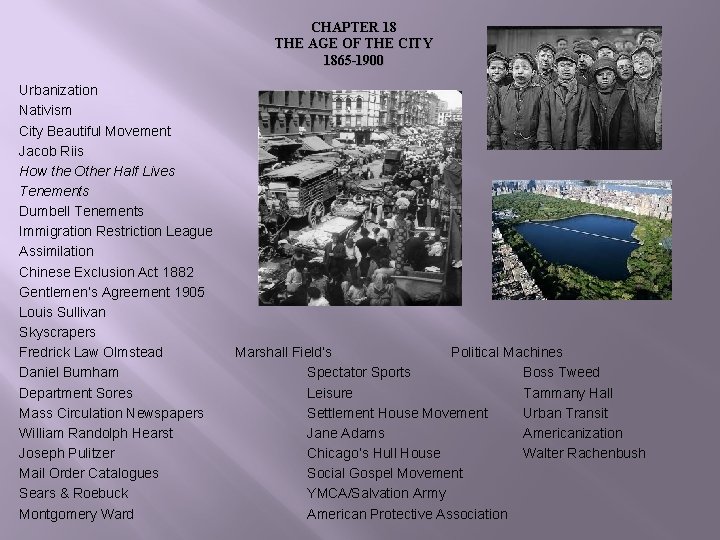
CHAPTER 18 THE AGE OF THE CITY 1865 -1900 Urbanization Nativism City Beautiful Movement Jacob Riis How the Other Half Lives Tenements Dumbell Tenements Immigration Restriction League Assimilation Chinese Exclusion Act 1882 Gentlemen’s Agreement 1905 Louis Sullivan Skyscrapers Fredrick Law Olmstead Daniel Burnham Department Sores Mass Circulation Newspapers William Randolph Hearst Joseph Pulitzer Mail Order Catalogues Sears & Roebuck Montgomery Ward Marshall Field’s Political Machines Spectator Sports Boss Tweed Leisure Tammany Hall Settlement House Movement Urban Transit Jane Adams Americanization Chicago’s Hull House Walter Rachenbush Social Gospel Movement YMCA/Salvation Army American Protective Association
Chapter 18 The Age of the City 1865 -1910 1. Discuss the changes in urbanization and immigration patterns in the late 19 th century 2. Describe the new economic and social problems created by urbanization. 3. Explain the rise of boss rule. 4. How did Increasing mass consumption impact on American life-especially for women? 5. Identify changes in leisure and entertainment and the growth of mass-culture opportunities. 6. Discuss new trends in literature and art. 7. Explain the impact of the Darwinian theory of evolution on the intellectual life of America. 8. Discuss the new developments in American educational opportunities.
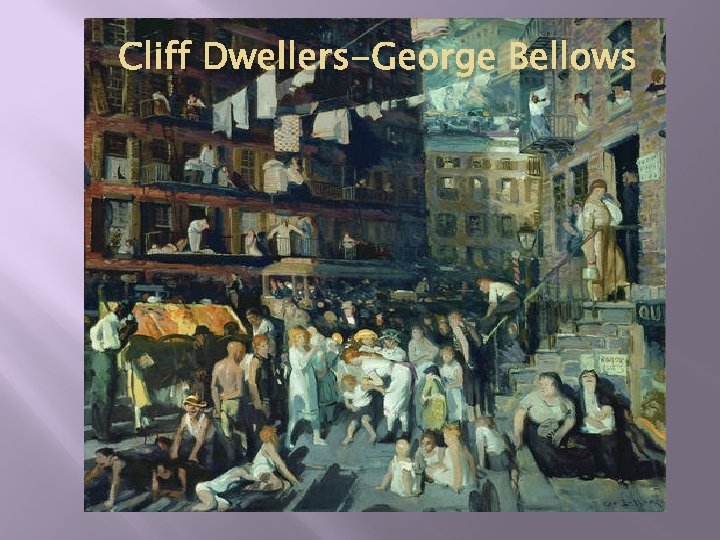
Cliff Dwellers-George Bellows
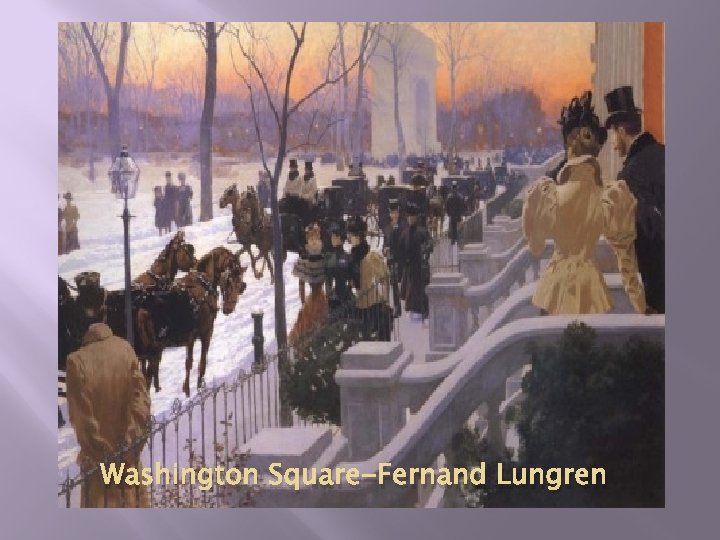
Washington Square-Fernand Lungren
Chapter 18 The Age of the City Discussion notes
Chapter 19 From Crisis to Empire 1875 -1900 Close elections and shifting control of the White House and Congress characterized the politics of the period from 1876 to 1900. Regional, ethno -cultural, and economic factors helped determine party affiliation and elections often turned on consideration of personality. But there were real issues too. Tariff, currency, and civil-service questions arose in almost every election. Discontented farmers in the People's party briefly challenged the Republicans and Democrats, but the two-party system remained intact. The election of 1896, the great battle between the gold standard and the silver standard, firmly established the Republican Party as the majority party in the United States. Agrarian and mining interests were unable to convince voters that currency inflation through the free coinage of silver would lead the nation out of the depression of the 1890 s. By fusing with the Democrats, the Populists ended any chance they might have had to become a major force in American politics. By the end of the nineteenth century, business forces had triumphed. They had secured a gold-based currency and a rigorously protective tariff. Efforts to regulate railroads and trusts were half-hearted to begin with and were weakened even further by court decisions.
Chapter 19 From Crisis to Empire 1875 -1900 Long Essay Exam Tips Questions covering this period often look at the role of the federal government and the growing challenges to the belief that the government should not play an active role in American society. The issue of whether or not the government in fact pursued a laissez-faire approach is a significant theme, while self-help, individualistic American ideology meant that government provided no direct assistance to the poor and dispossessed, American business could not have succeeded to the degree that they did without significant help from the federal government. The degree to which economic issues motivate political participation is another theme to consider. Despite relatively weak federal government and uninspiring presidential candidates in the late nineteenth century, Americans divided over what historians call “ethno-cultural” issues (Sabbath observance, temperance, English-only education) participated actively in elections at both the local and national levels.
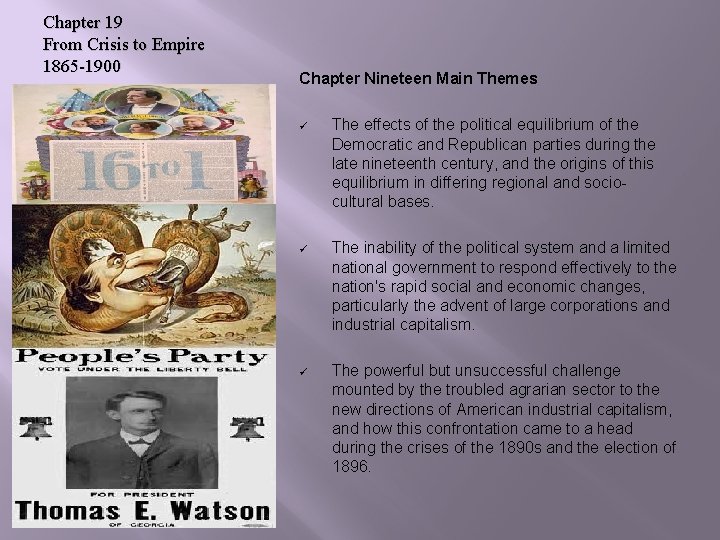
Chapter 19 From Crisis to Empire 1865 -1900 Chapter Nineteen Main Themes ü The effects of the political equilibrium of the Democratic and Republican parties during the late nineteenth century, and the origins of this equilibrium in differing regional and sociocultural bases. ü The inability of the political system and a limited national government to respond effectively to the nation's rapid social and economic changes, particularly the advent of large corporations and industrial capitalism. ü The powerful but unsuccessful challenge mounted by the troubled agrarian sector to the new directions of American industrial capitalism, and how this confrontation came to a head during the crises of the 1890 s and the election of 1896.
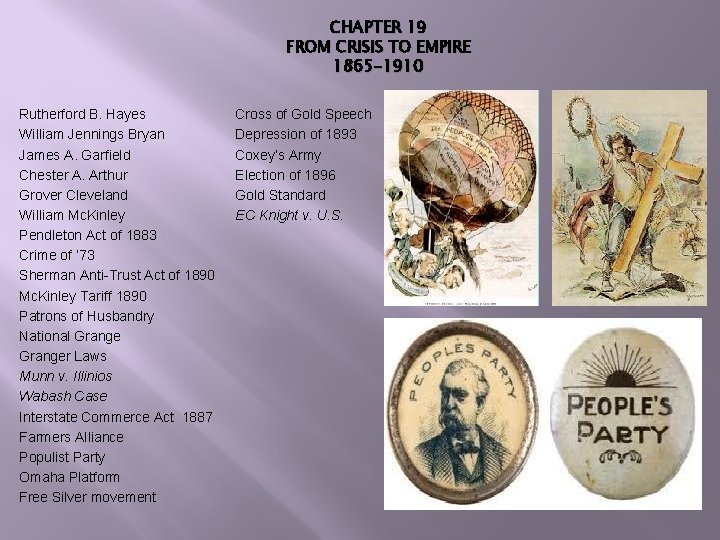
CHAPTER 19 FROM CRISIS TO EMPIRE 1865 -1910 Rutherford B. Hayes William Jennings Bryan James A. Garfield Chester A. Arthur Grover Cleveland William Mc. Kinley Pendleton Act of 1883 Crime of ’ 73 Sherman Anti-Trust Act of 1890 Mc. Kinley Tariff 1890 Patrons of Husbandry National Granger Laws Munn v. Illinios Wabash Case Interstate Commerce Act 1887 Farmers Alliance Populist Party Omaha Platform Free Silver movement Cross of Gold Speech Depression of 1893 Coxey’s Army Election of 1896 Gold Standard EC Knight v. U. S.
Chapter 19 From Crisis to Empire 1865 -1910 1. Explain the nature of American party politics. 2. Discuss problems of political patronage in the various presidential administrations that led to the passage of the Pendleton Act. 3. Outline origins, purposes, and effectiveness of the Interstate Commerce Act and the Sherman Antitrust Act. 4. What were the two major parties’ positions on the tariff question and the trend of tariff legislation in the 1880 s and 1890 s. 5. Discuss the rise of agrarian discontent-especially the Granger movement, the Farmers' Alliances, and the populist movement-and the decline of agrarian discontent after 1898. 6. Outline rise of the silver question from the "Crime of '73" through the Gold Standard Act of 1900. 7. Analyze the significance of the presidential campaign and election of 1896. Each of the questions above contributes to a comprehensive understanding of the way in which party politics influenced the American political system, the inability of the political system to respond effectively to the nation's rapid social and economic changes, and the agrarian sector’s powerful but unsuccessful challenge to industrial capitalism.
Chapter 19 From Crisis to Empire Discussion notes
Period 7 1890 -1945 Chapters 20 -26 An increasingly pluralistic United States faced profound domestic and global challenges, debated the proper degree of government activism, and sought to define its international role. Key Concept 7. 1: Governmental, political, and social organizations struggled to address the effects of large-scale industrialization, economic uncertainty, and related social changes such as urbanization and mass migration. Key Concept 7. 2: A revolution in communications and transportation technology helped to create a new mass culture and spread “modern” values and ideas, even as cultural conflicts between groups increased under the pressure of migration, world wars, and economic distress. Key Concept 7. 3: Global conflicts over resources, territories, and ideologies renewed debates over the nation’s values and its role in the world while simultaneously propelling the United States into a dominant international military, political, cultural, and economic position.
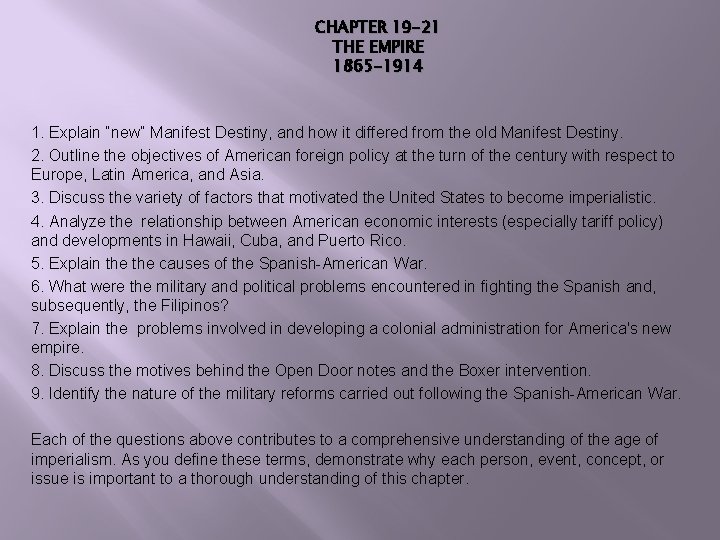
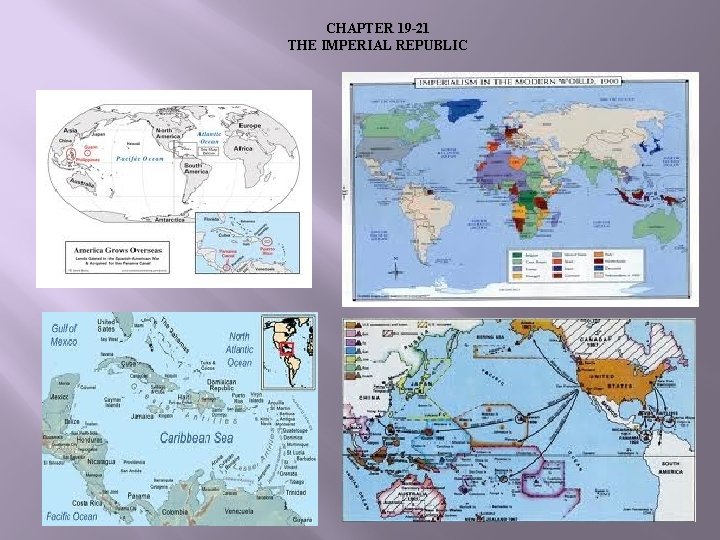
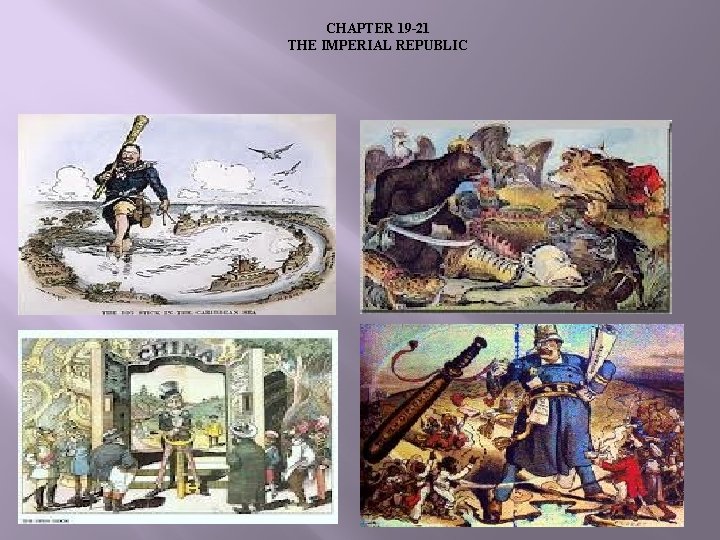
Chapter 19 -21 The Empire 1865 -1920 Turning its interest from the continental United States to the world at large, America in the years after the Civil War fought a war with Spain and acquired a far-flung empire. By 1900, American possessions included Alaska, Hawaii, the Philippines, Puerto Rico, and a string of Pacific islands. In addition, Cuba was essentially an American protectorate. The United States suddenly found itself a world power, with worldwide responsibilities and burdens. The empire had been acquired for economic and philosophical reasons including expansionism, which could provide an outlet for a perceived glut of American goods and an arena in which to demonstrate the superiority of Western civilization. To accommodate its new role, the nation had to devise ways to improve its military establishment and govern its overseas territories. Long Essay Exam Tips Free-response questions from this period could address the extent to which American foreign policy in the 1890 s represented a break from earlier United States expansion. The influence of and balance between economic, strategic, and ideological factors in support for the Spanish-American War and the territorial gains that followed is another central theme. DBQ Exam Tips Debates over American foreign policy at key junctures have brought about key questions about America’s fundamental national mission and goals. Key questions include variations on the following themes: To what degree should the United States seek to spread its institutions abroad? Should the United States concentrate its resources at home or abroad? Many of the questions that emerge during the debate over imperialism in the 1890 s reemerge during and after WWI and WWII and during the cold war.
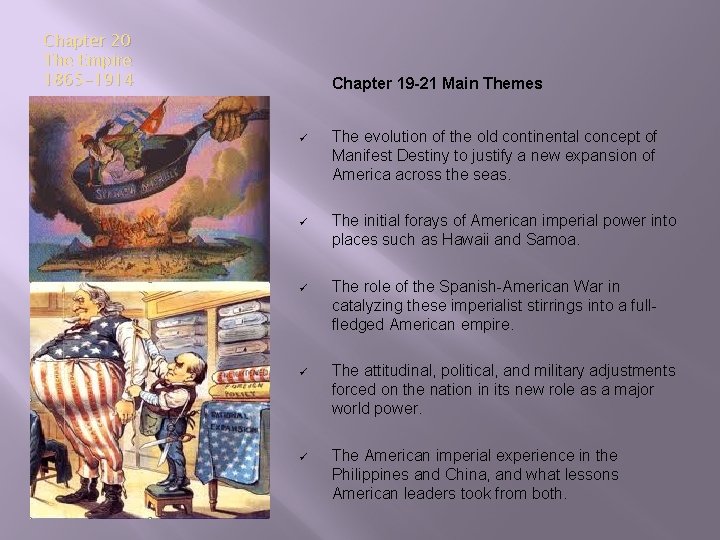
Chapter 20 The Empire 1865 -1914 Chapter 19 -21 Main Themes ü The evolution of the old continental concept of Manifest Destiny to justify a new expansion of America across the seas. ü The initial forays of American imperial power into places such as Hawaii and Samoa. ü The role of the Spanish-American War in catalyzing these imperialist stirrings into a fullfledged American empire. ü The attitudinal, political, and military adjustments forced on the nation in its new role as a major world power. ü The American imperial experience in the Philippines and China, and what lessons American leaders took from both.
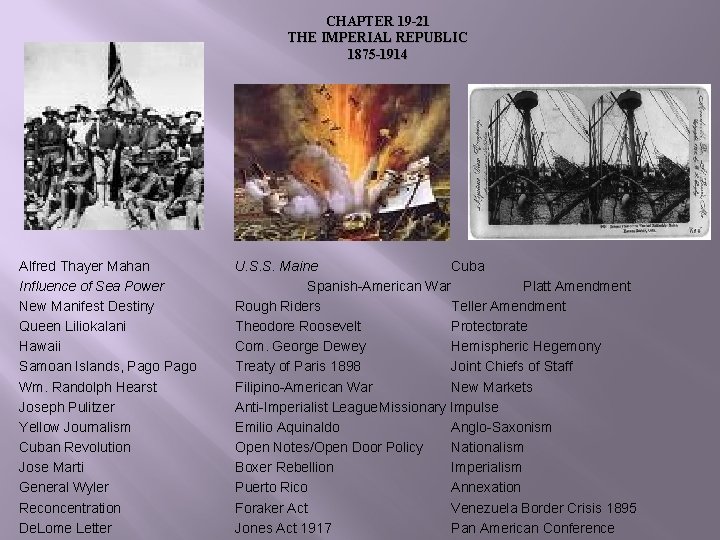
CHAPTER 19 -21 THE IMPERIAL REPUBLIC 1875 -1914 Alfred Thayer Mahan Influence of Sea Power New Manifest Destiny Queen Liliokalani Hawaii Samoan Islands, Pago Wm. Randolph Hearst Joseph Pulitzer Yellow Journalism Cuban Revolution Jose Marti General Wyler Reconcentration De. Lome Letter U. S. S. Maine Cuba Spanish-American War Platt Amendment Rough Riders Teller Amendment Theodore Roosevelt Protectorate Com. George Dewey Hemispheric Hegemony Treaty of Paris 1898 Joint Chiefs of Staff Filipino-American War New Markets Anti-Imperialist League. Missionary Impulse Emilio Aquinaldo Anglo-Saxonism Open Notes/Open Door Policy Nationalism Boxer Rebellion Imperialism Puerto Rico Annexation Foraker Act Venezuela Border Crisis 1895 Jones Act 1917 Pan American Conference
CHAPTER 19 -21 THE EMPIRE 1865 -1914 1. Explain “new” Manifest Destiny, and how it differed from the old Manifest Destiny. 2. Outline the objectives of American foreign policy at the turn of the century with respect to Europe, Latin America, and Asia. 3. Discuss the variety of factors that motivated the United States to become imperialistic. 4. Analyze the relationship between American economic interests (especially tariff policy) and developments in Hawaii, Cuba, and Puerto Rico. 5. Explain the causes of the Spanish-American War. 6. What were the military and political problems encountered in fighting the Spanish and, subsequently, the Filipinos? 7. Explain the problems involved in developing a colonial administration for America's new empire. 8. Discuss the motives behind the Open Door notes and the Boxer intervention. 9. Identify the nature of the military reforms carried out following the Spanish-American War. Each of the questions above contributes to a comprehensive understanding of the age of imperialism. As you define these terms, demonstrate why each person, event, concept, or issue is important to a thorough understanding of this chapter.
CHAPTER 19 -21 THE IMPERIAL REPUBLIC
CHAPTER 19 -21 THE IMPERIAL REPUBLIC
Chapter 19 -21 The Imperial Republic Discussion notes
Chapter 20 The Progressives 1890 -1920 Convinced that rapid industrialization and urbanization had created serious problems and disorder, Progressives shared an optimistic vision that organized private and government action could improve society. Progressivism sought to control monopoly, build social cohesion, and promote efficiency. Muckrakers exposed social ills that Social Gospel reformers, settlement house workers, and other Progressives attacked. Meanwhile, increasing standards of training and expertise were creating a new middle class of educated professionals including some women. The Progressives tried to rationalize politics by reducing the influence of political parties in municipal and state affairs. Many of the nation's problems could be solved, some Progressives believed, if alcohol were banned, immigration were restricted, and women were allowed to vote. Educated blacks teamed with sympathetic whites to form the NAACP and began the movement that eventually wiped away Jim Crow. Other Progressives stressed the need for fundamental economic transformation through socialism or through milder forms of antitrust action and regulation.
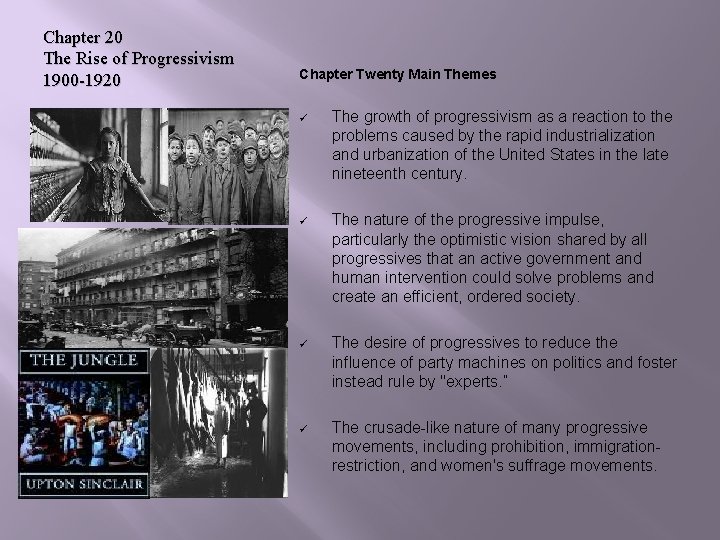
Chapter 20 The Rise of Progressivism 1900 -1920 Chapter Twenty Main Themes ü The growth of progressivism as a reaction to the problems caused by the rapid industrialization and urbanization of the United States in the late nineteenth century. ü The nature of the progressive impulse, particularly the optimistic vision shared by all progressives that an active government and human intervention could solve problems and create an efficient, ordered society. ü The desire of progressives to reduce the influence of party machines on politics and foster instead rule by "experts. ” ü The crusade-like nature of many progressive movements, including prohibition, immigrationrestriction, and women's suffrage movements.
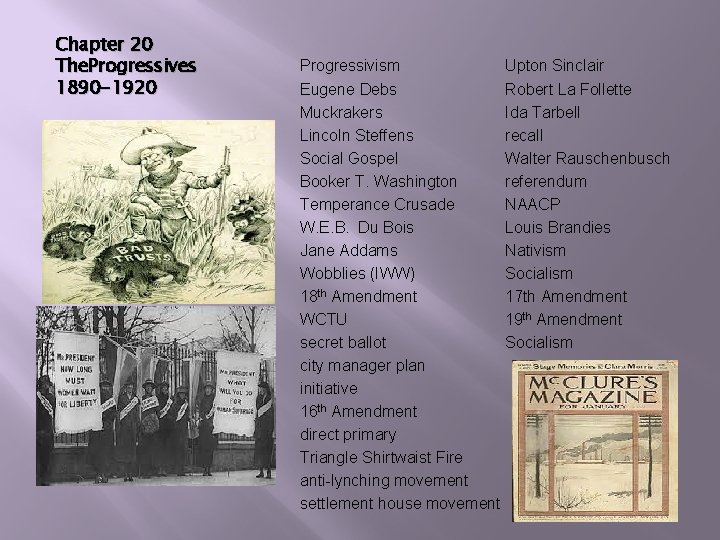
Chapter 20 The. Progressives 1890 -1920 Progressivism Upton Sinclair Eugene Debs Robert La Follette Muckrakers Ida Tarbell Lincoln Steffens recall Social Gospel Walter Rauschenbusch Booker T. Washington referendum Temperance Crusade NAACP W. E. B. Du Bois Louis Brandies Jane Addams Nativism Wobblies (IWW) Socialism 18 th Amendment 17 th Amendment WCTU 19 th Amendment secret ballot Socialism city manager plan initiative 16 th Amendment direct primary Triangle Shirtwaist Fire anti-lynching movement settlement house movement
CHAPTER 20 THE RISE OF PROGRESSIVISM 1890 -1920 Defining the chapter terms in your journals will help you better understand: üThe origins and varieties of the progressive impulse. üThe social justice reforms of the period, and the role of the church in carrying out the Social Gospel. üThe progressive emphasis on scientific expertise, organizational reform, and professionalism. üThe role of women and women's organizations in promoting reform. üThe significance of the women's suffrage movement. üThe desire of the progressives to limit the role of political party organizations, and the measures they advocated to accomplish this goal. üThe temperance movement and its relationship to other progressive reforms. üThe origins of the NAACP and the importance of W. E. B. Du. Bois. üThe movement to restrict immigration and how restricting immigration was regarded as a reform. üThe alternate approaches to the problems of the trusts: socialism, regulation, or trust busting.
The Rise of Progressivism Discussion notes FRQ Exam Tip Questions from this period often deal with the impulses behind progressive reform. One key idea to consider is whether progressive reform was a grassroots movement with wide spread popular support, especially among the lower classes, or whether it was a movement by middle and upper class Americans to impose a degree of control on an increasingly chaotic industrial economy.
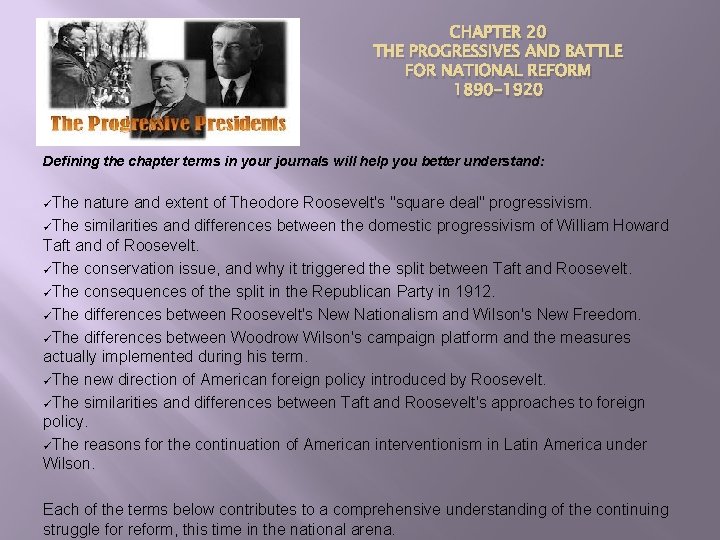
Chapter 20 The Progressives and Battle for National Reform 1901 -1920 Theodore Roosevelt became president as a consequence of the assassination of William Mc. Kinley, but he quickly moved to make the office his own. In many ways, Roosevelt was the preeminent progressive, yet it sometimes seemed that for him reform was more a style than a dogma. Although Roosevelt clearly envisioned a more activist national government, the shifts and contradictions embodied in his policies toward trusts, labor, and conservation reflected the complexity and diversity of progressivism. Despite being Roosevelt's hand picked successor, President William Howard Taft managed to alienate Roosevelt and other progressive Republicans by his actions regarding tariffs, conservation, foreign policy, trusts, and other matters. In 1912, Roosevelt decided to challenge Taft for the presidency. When he failed to secure the Republican nomination, Roosevelt formed his own Progressive party. With the Republicans divided, Woodrow Wilson won the presidency. In actuality, Wilson's domestic program turned out to be much like the one Roosevelt had advocated. In the Caribbean, Wilson continued the pattern of intervention that Roosevelt and Taft had established.
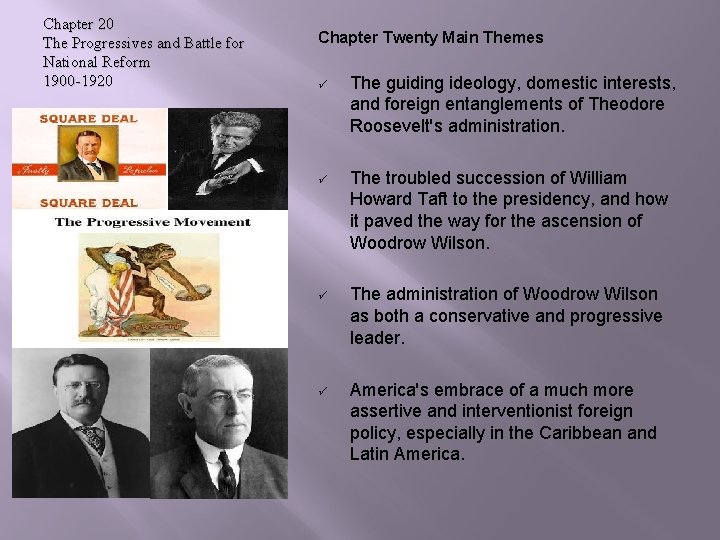
Chapter 20 The Progressives and Battle for National Reform 1900 -1920 Chapter Twenty Main Themes ü The guiding ideology, domestic interests, and foreign entanglements of Theodore Roosevelt's administration. ü The troubled succession of William Howard Taft to the presidency, and how it paved the way for the ascension of Woodrow Wilson. ü The administration of Woodrow Wilson as both a conservative and progressive leader. ü America's embrace of a much more assertive and interventionist foreign policy, especially in the Caribbean and Latin America.
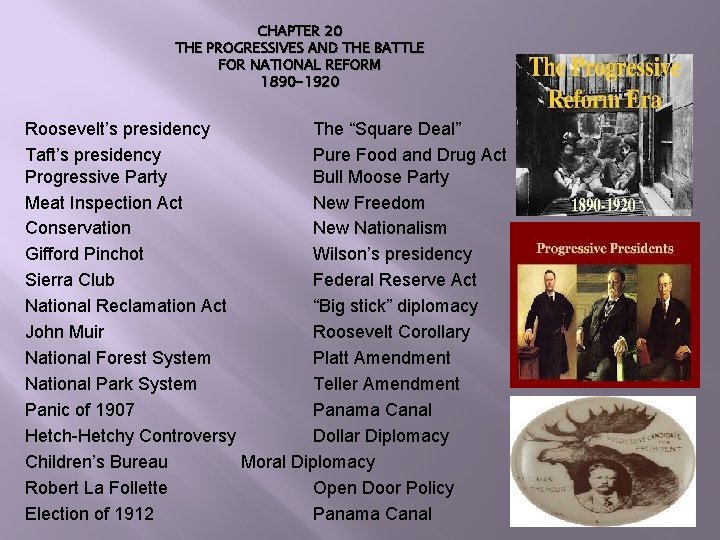
CHAPTER 20 THE PROGRESSIVES AND THE BATTLE FOR NATIONAL REFORM 1890 -1920 Roosevelt’s presidency The “Square Deal” Taft’s presidency Pure Food and Drug Act Progressive Party Bull Moose Party Meat Inspection Act New Freedom Conservation New Nationalism Gifford Pinchot Wilson’s presidency Sierra Club Federal Reserve Act National Reclamation Act “Big stick” diplomacy John Muir Roosevelt Corollary National Forest System Platt Amendment National Park System Teller Amendment Panic of 1907 Panama Canal Hetch-Hetchy Controversy Dollar Diplomacy Children’s Bureau Moral Diplomacy Robert La Follette Open Door Policy Election of 1912 Panama Canal
CHAPTER 20 THE PROGRESSIVES AND BATTLE FOR NATIONAL REFORM 1890 -1920 Defining the chapter terms in your journals will help you better understand: üThe nature and extent of Theodore Roosevelt's "square deal" progressivism. üThe similarities and differences between the domestic progressivism of William Howard Taft and of Roosevelt. üThe conservation issue, and why it triggered the split between Taft and Roosevelt. üThe consequences of the split in the Republican Party in 1912. üThe differences between Roosevelt's New Nationalism and Wilson's New Freedom. üThe differences between Woodrow Wilson's campaign platform and the measures actually implemented during his term. üThe new direction of American foreign policy introduced by Roosevelt. üThe similarities and differences between Taft and Roosevelt's approaches to foreign policy. üThe reasons for the continuation of American interventionism in Latin America under Wilson. Each of the terms below contributes to a comprehensive understanding of the continuing struggle for reform, this time in the national arena.
The Progressives and the Battle for National Reform Discussion notes
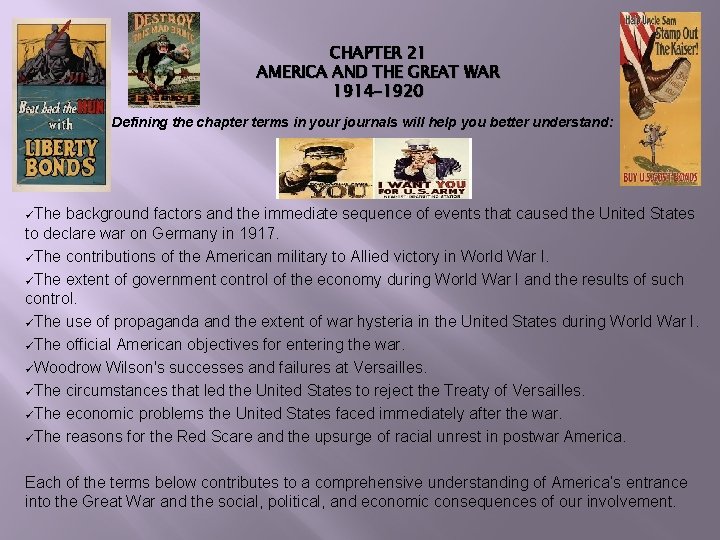
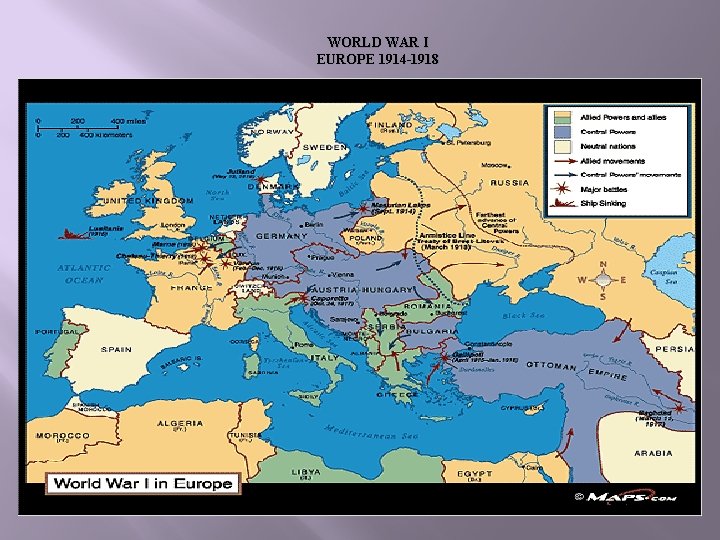
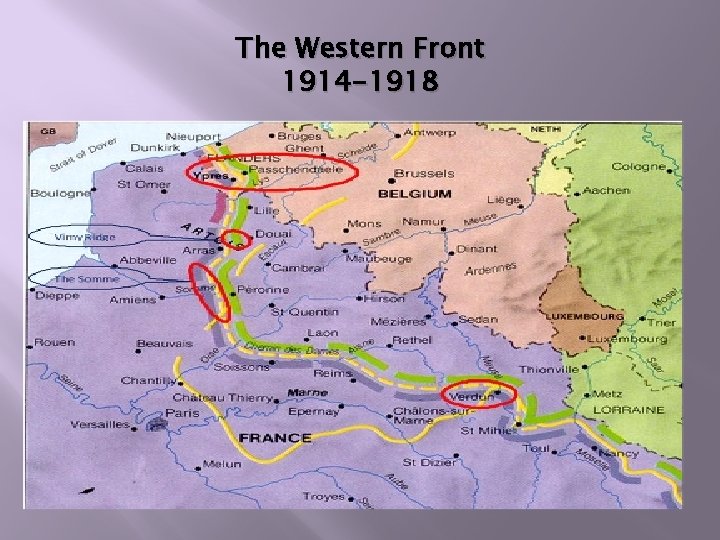
Chapter 21 The America and the Great War 1914 -120 Following two and a half years of pro-Allied "neutrality, " the United States entered World War I because of economic and cultural factors, as well as German submarine warfare. The armies and civilians of Europe had already suffered mightily by the time the United States finally entered. American forces, initially at sea and then on land, proved the margin of victory for the Allies. To mount its total effort, the United States turned to an array of unprecedented measures: sharply graduated taxes, conscription for a foreign war, bureaucratic management of the economy, and a massive propaganda and anti-sedition campaign. Women entered the work force in record numbers and the hopes of African Americans were raised by military service and war-related jobs in the North. President Woodrow Wilson formulated American war aims in his famous Fourteen Points, but he was unable to convince either Europe or the United States to accept them fully as the basis for peace. By 1920, the American people, tired from nearly three decades of turmoil, had repudiated Wilson's precious League of Nations in favor of an illusion called "normalcy. "
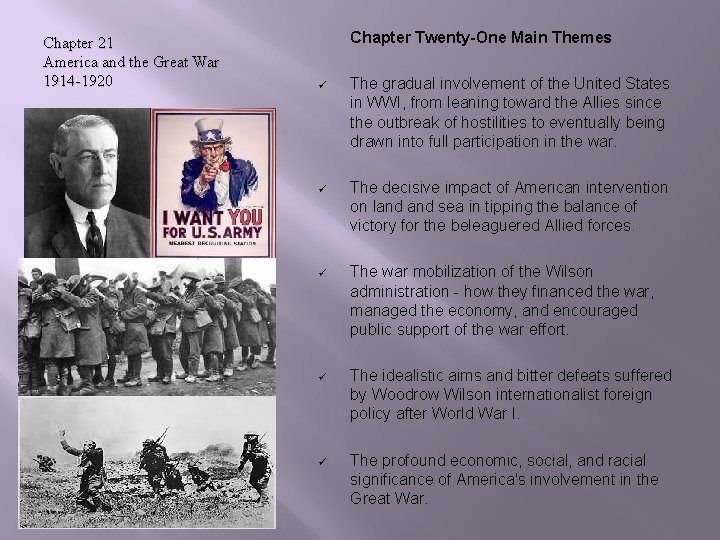
Chapter 21 America and the Great War 1914 -1920 Chapter Twenty-One Main Themes ü The gradual involvement of the United States in WWI, from leaning toward the Allies since the outbreak of hostilities to eventually being drawn into full participation in the war. ü The decisive impact of American intervention on land sea in tipping the balance of victory for the beleaguered Allied forces. ü The war mobilization of the Wilson administration - how they financed the war, managed the economy, and encouraged public support of the war effort. ü The idealistic aims and bitter defeats suffered by Woodrow Wilson internationalist foreign policy after World War I. ü The profound economic, social, and racial significance of America's involvement in the Great War.
CHAPTER 21 AMERICA AND THE GREAT WAR 1914 -1920 Nationalism League of Nations Imperialism Bolshevik Revolution Alliance system Big Four Militarism reparations Central Powers Henry Cabot Lodge Allies Reservationists Total War Great Migration Neutrality Marcus Garvey Lusitania Red Scare Zimmerman Telegram Palmer Raids War without Victory Sacco-Vanzetti Trail Liberty Bonds pacifists 14 Points Unrestricted submarine warfare Treaty of Versailles trench warfare Triple Entente chemical warfare Triple Alliance stalemate and attrition Armistice Committee on Public Information Liberty Bonds post war race riots Espionage Act 1917 War Industries Board Sedition Act 1918 General John Pershing American Expeditionary Force Selective Service Act
CHAPTER 21 AMERICA AND THE GREAT WAR 1914 -1920 Defining the chapter terms in your journals will help you better understand : üThe background factors and the immediate sequence of events that caused the United States to declare war on Germany in 1917. üThe contributions of the American military to Allied victory in World War I. üThe extent of government control of the economy during World War I and the results of such control. üThe use of propaganda and the extent of war hysteria in the United States during World War I. üThe official American objectives for entering the war. üWoodrow Wilson's successes and failures at Versailles. üThe circumstances that led the United States to reject the Treaty of Versailles. üThe economic problems the United States faced immediately after the war. üThe reasons for the Red Scare and the upsurge of racial unrest in postwar America. Each of the terms below contributes to a comprehensive understanding of America’s entrance into the Great War and the social, political, and economic consequences of our involvement.
WORLD WAR I EUROPE 1914 -1918
The Western Front 1914 -1918
America and the Great War Discussion notes
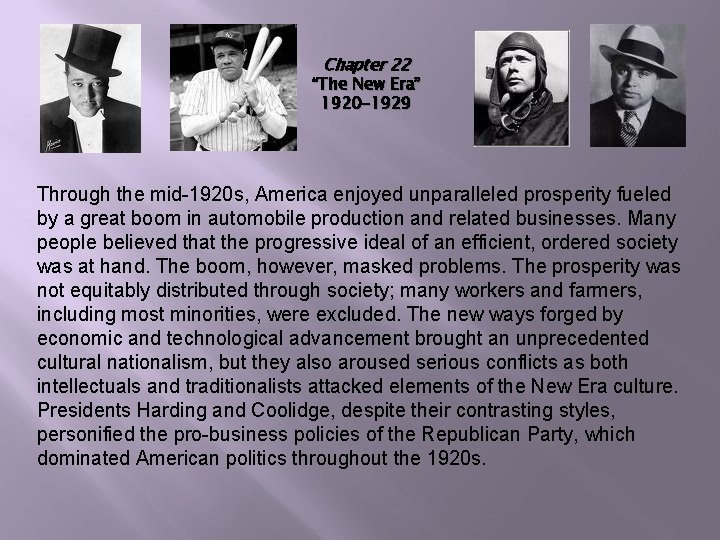
Chapter 22 “The New Era” 1920 -1929 Through the mid-1920 s, America enjoyed unparalleled prosperity fueled by a great boom in automobile production and related businesses. Many people believed that the progressive ideal of an efficient, ordered society was at hand. The boom, however, masked problems. The prosperity was not equitably distributed through society; many workers and farmers, including most minorities, were excluded. The new ways forged by economic and technological advancement brought an unprecedented cultural nationalism, but they also aroused serious conflicts as both intellectuals and traditionalists attacked elements of the New Era culture. Presidents Harding and Coolidge, despite their contrasting styles, personified the pro-business policies of the Republican Party, which dominated American politics throughout the 1920 s.
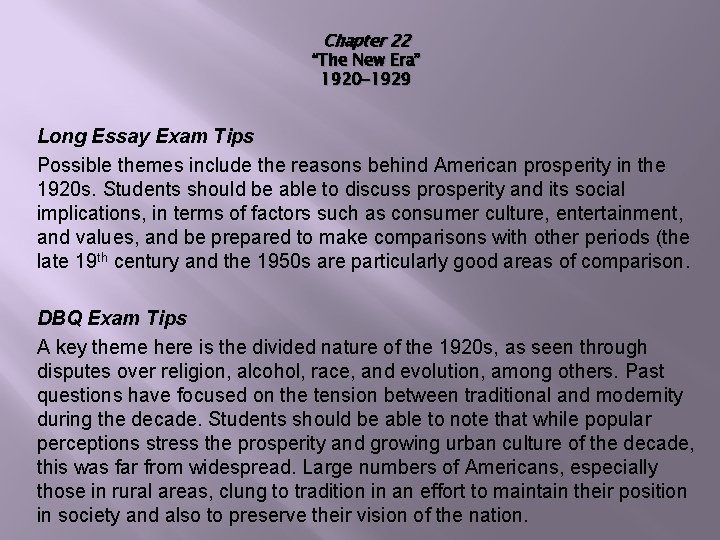
Chapter 22 “The New Era” 1920 -1929 Long Essay Exam Tips Possible themes include the reasons behind American prosperity in the 1920 s. Students should be able to discuss prosperity and its social implications, in terms of factors such as consumer culture, entertainment, and values, and be prepared to make comparisons with other periods (the late 19 th century and the 1950 s are particularly good areas of comparison. DBQ Exam Tips A key theme here is the divided nature of the 1920 s, as seen through disputes over religion, alcohol, race, and evolution, among others. Past questions have focused on the tension between traditional and modernity during the decade. Students should be able to note that while popular perceptions stress the prosperity and growing urban culture of the decade, this was far from widespread. Large numbers of Americans, especially those in rural areas, clung to tradition in an effort to maintain their position in society and also to preserve their vision of the nation.
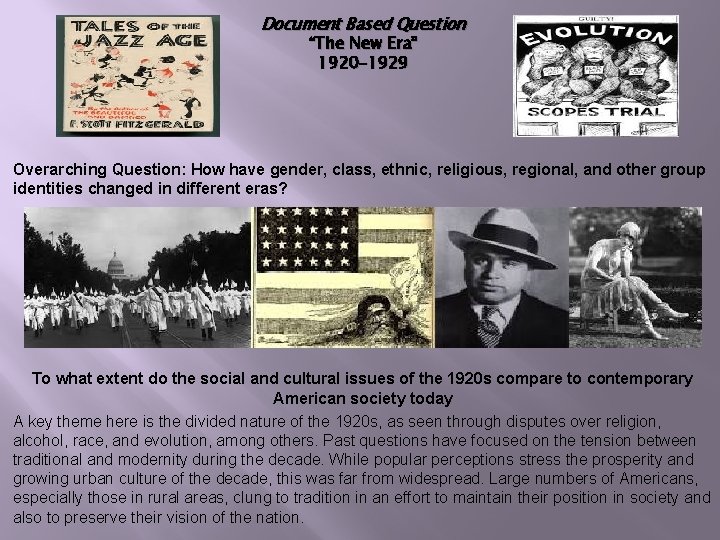
Document Based Question “The New Era” 1920 -1929 Overarching Question: How have gender, class, ethnic, religious, regional, and other group identities changed in different eras? To what extent do the social and cultural issues of the 1920 s compare to contemporary American society today A key theme here is the divided nature of the 1920 s, as seen through disputes over religion, alcohol, race, and evolution, among others. Past questions have focused on the tension between traditional and modernity during the decade. While popular perceptions stress the prosperity and growing urban culture of the decade, this was far from widespread. Large numbers of Americans, especially those in rural areas, clung to tradition in an effort to maintain their position in society and also to preserve their vision of the nation.
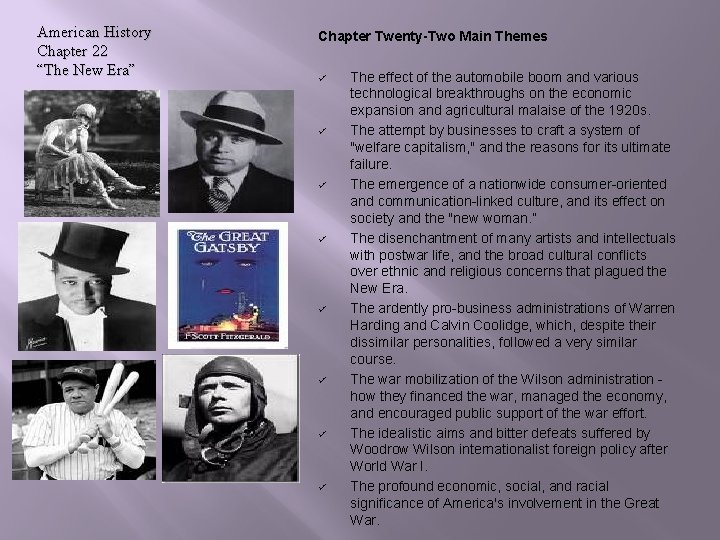
American History Chapter 22 “The New Era” Chapter Twenty-Two Main Themes ü ü ü ü The effect of the automobile boom and various technological breakthroughs on the economic expansion and agricultural malaise of the 1920 s. The attempt by businesses to craft a system of "welfare capitalism, " and the reasons for its ultimate failure. The emergence of a nationwide consumer-oriented and communication-linked culture, and its effect on society and the "new woman. ” The disenchantment of many artists and intellectuals with postwar life, and the broad cultural conflicts over ethnic and religious concerns that plagued the New Era. The ardently pro-business administrations of Warren Harding and Calvin Coolidge, which, despite their dissimilar personalities, followed a very similar course. The war mobilization of the Wilson administration - how they financed the war, managed the economy, and encouraged public support of the war effort. The idealistic aims and bitter defeats suffered by Woodrow Wilson internationalist foreign policy after World War I. The profound economic, social, and racial significance of America's involvement in the Great War.
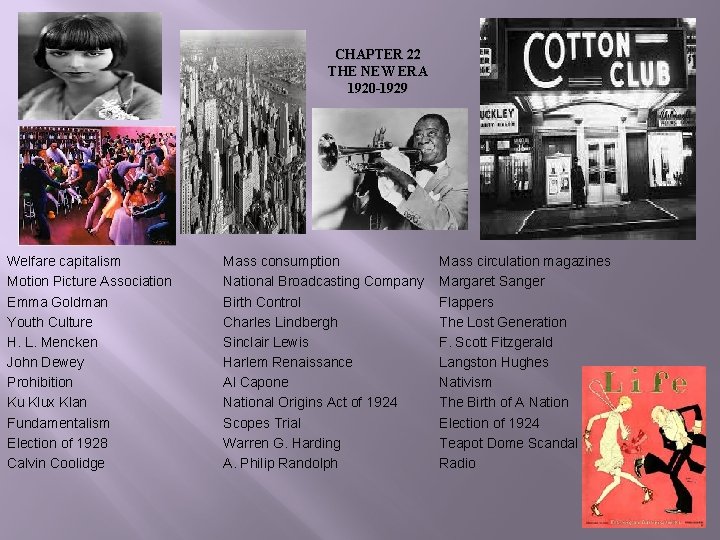
CHAPTER 22 THE NEW ERA 1920 -1929 Welfare capitalism Motion Picture Association Emma Goldman Youth Culture H. L. Mencken John Dewey Prohibition Ku Klux Klan Fundamentalism Election of 1928 Calvin Coolidge Mass consumption National Broadcasting Company Birth Control Charles Lindbergh Sinclair Lewis Harlem Renaissance Al Capone National Origins Act of 1924 Scopes Trial Warren G. Harding A. Philip Randolph Mass circulation magazines Margaret Sanger Flappers The Lost Generation F. Scott Fitzgerald Langston Hughes Nativism The Birth of A Nation Election of 1924 Teapot Dome Scandal Radio
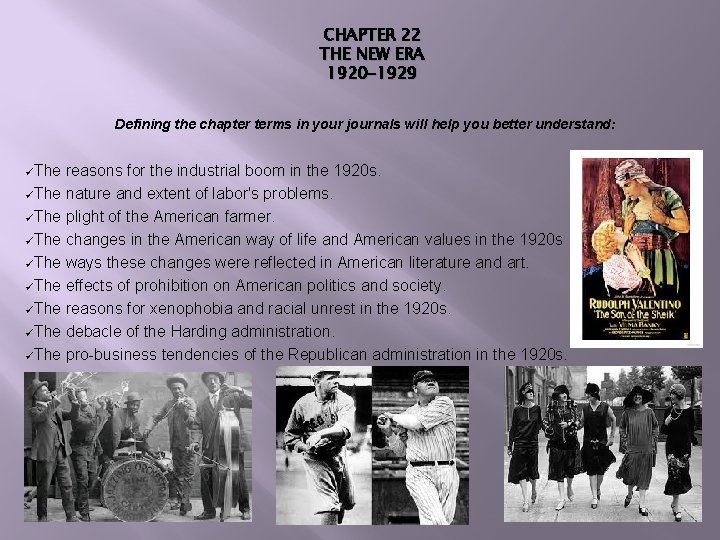
CHAPTER 22 THE NEW ERA 1920 -1929 Defining the chapter terms in your journals will help you better understand: üThe reasons for the industrial boom in the 1920 s. üThe nature and extent of labor's problems. üThe plight of the American farmer. üThe changes in the American way of life and American values in the 1920 s üThe ways these changes were reflected in American literature and art. üThe effects of prohibition on American politics and society. üThe reasons for xenophobia and racial unrest in the 1920 s. üThe debacle of the Harding administration. üThe pro-business tendencies of the Republican administration in the 1920 s.
The New Era Discussion notes
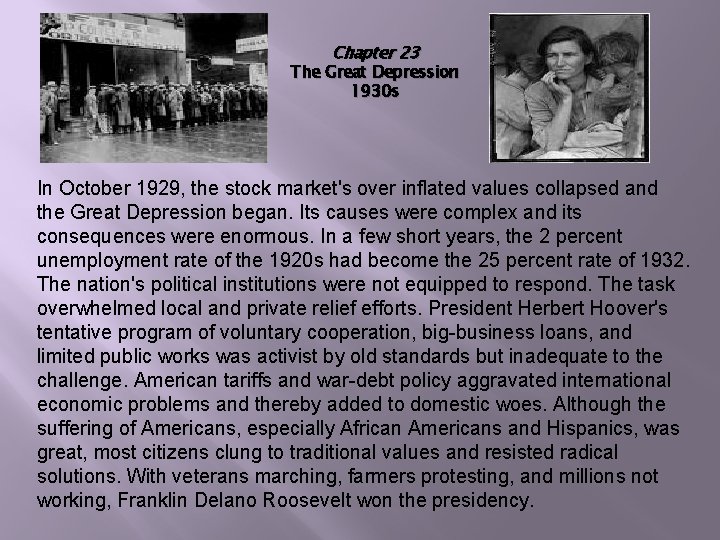
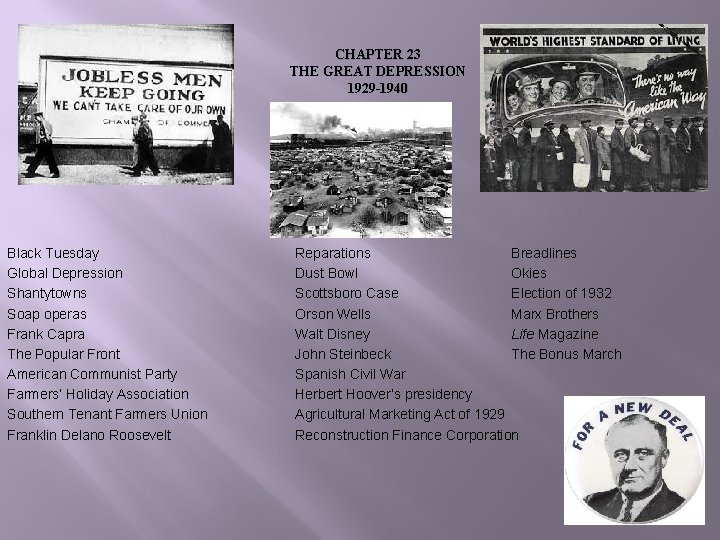
Chapter 23 The Great Depression 1930 s In October 1929, the stock market's over inflated values collapsed and the Great Depression began. Its causes were complex and its consequences were enormous. In a few short years, the 2 percent unemployment rate of the 1920 s had become the 25 percent rate of 1932. The nation's political institutions were not equipped to respond. The task overwhelmed local and private relief efforts. President Herbert Hoover's tentative program of voluntary cooperation, big-business loans, and limited public works was activist by old standards but inadequate to the challenge. American tariffs and war-debt policy aggravated international economic problems and thereby added to domestic woes. Although the suffering of Americans, especially African Americans and Hispanics, was great, most citizens clung to traditional values and resisted radical solutions. With veterans marching, farmers protesting, and millions not working, Franklin Delano Roosevelt won the presidency.
Chapter 23 The Great Depression 1930 s Long Essay Exam Tips The causes of the Great Depression and the federal government’s response to the Depression are central themes for the Long Essay. You should be able to account for the relationship between the stock market crash and the ensuing Depression and be able to discuss why the Depression lasted as long as it did. Consider the Hoover administration’s response to the Depression, both in terms of how it represented an expansion of the federal government’s role in American life as well as the factors that limited further action. DBQ Exam Tips The comparison between Herbert Hoover and Franklin Roosevelt in their responses to the Depression is a natural one. Past questions have asked students to assess whether the labels “conservative” and “liberal apply to the two men. Bases for comparison could include their attitudes on government spending, relief for the unemployed, and whether or not each viewed the Depression as primarily international or domestic in its causes.
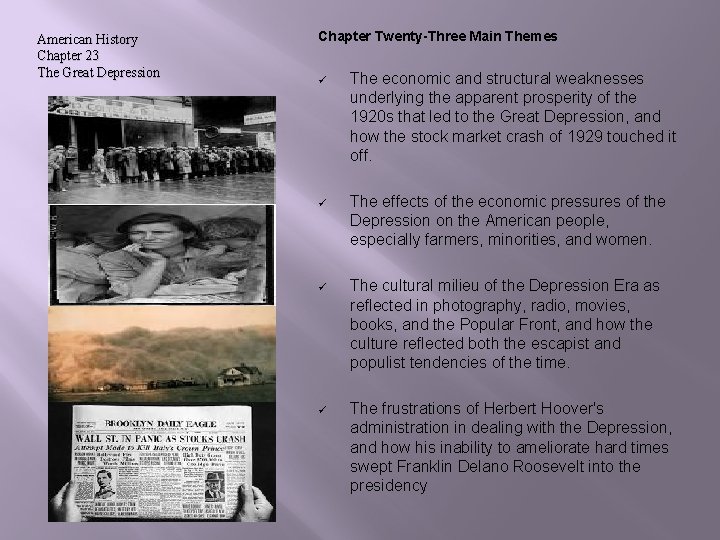
American History Chapter 23 The Great Depression Chapter Twenty-Three Main Themes ü The economic and structural weaknesses underlying the apparent prosperity of the 1920 s that led to the Great Depression, and how the stock market crash of 1929 touched it off. ü The effects of the economic pressures of the Depression on the American people, especially farmers, minorities, and women. ü The cultural milieu of the Depression Era as reflected in photography, radio, movies, books, and the Popular Front, and how the culture reflected both the escapist and populist tendencies of the time. ü The frustrations of Herbert Hoover's administration in dealing with the Depression, and how his inability to ameliorate hard times swept Franklin Delano Roosevelt into the presidency
CHAPTER 23 THE GREAT DEPRESSION 1929 -1940 Black Tuesday Global Depression Shantytowns Soap operas Frank Capra The Popular Front American Communist Party Farmers’ Holiday Association Southern Tenant Farmers Union Franklin Delano Roosevelt Reparations Breadlines Dust Bowl Okies Scottsboro Case Election of 1932 Orson Wells Marx Brothers Walt Disney Life Magazine John Steinbeck The Bonus March Spanish Civil War Herbert Hoover’s presidency Agricultural Marketing Act of 1929 Reconstruction Finance Corporation
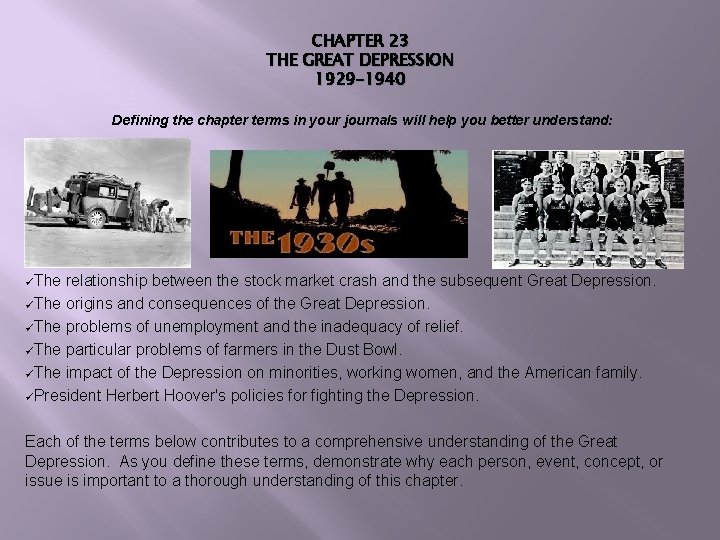
CHAPTER 23 THE GREAT DEPRESSION 1929 -1940 Defining the chapter terms in your journals will help you better understand: üThe relationship between the stock market crash and the subsequent Great Depression. üThe origins and consequences of the Great Depression. üThe problems of unemployment and the inadequacy of relief. üThe particular problems of farmers in the Dust Bowl. üThe impact of the Depression on minorities, working women, and the American family. üPresident Herbert Hoover's policies for fighting the Depression. Each of the terms below contributes to a comprehensive understanding of the Great Depression. As you define these terms, demonstrate why each person, event, concept, or issue is important to a thorough understanding of this chapter.
The Great Depression Discussion notes
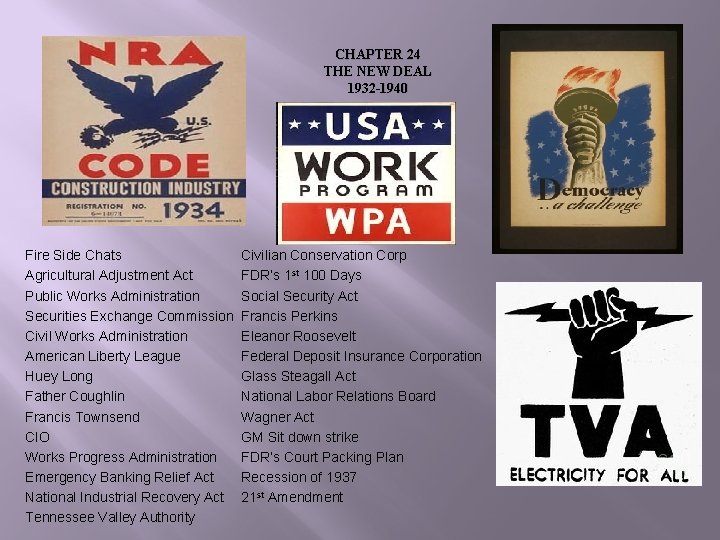
Chapter 24 The New Deal 1932 -1938 Franklin D. Roosevelt was bound by traditional economic ideas, but unlike Herbert Hoover, he was willing to experiment with the economy and was able to show compassion to those suffering most desperately from the depression. During the first two years of his New Deal, the groundwork was laid for a new relationship between government and the economy. Roosevelt sought temporary relief for the unemployed, and long-term recovery and reform measures for industry and finance. Not all of his plan proved effective and the depression continued, but Roosevelt got the country moving again. In 1935, frustrated and facing pressures from all sides, Roosevelt launched a new set of programs called the Second New Deal. The new programs were less conciliatory to big business and more favorable to the needs of workers and consumers than were those of the New Deal of 1933. Roosevelt was swept to reelection in 1936 by a new coalition of workers, African Americans, and liberals. Soon, however, Roosevelt's political blunders in the Supreme Court fight and congressional purge effort combined with growing conservative opposition to halt virtually all New Deal momentum. The legacy of the New Deal was a more activist national government poised to serve as the broker among society's various interests
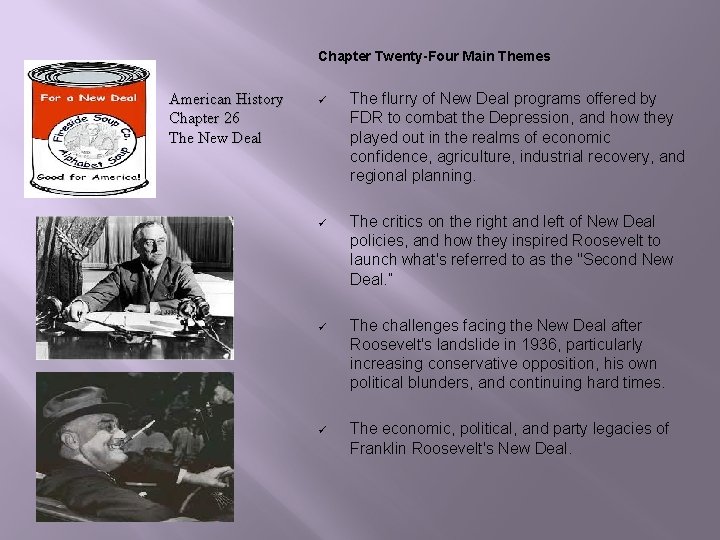
Chapter Twenty-Four Main Themes American History Chapter 26 The New Deal ü The flurry of New Deal programs offered by FDR to combat the Depression, and how they played out in the realms of economic confidence, agriculture, industrial recovery, and regional planning. ü The critics on the right and left of New Deal policies, and how they inspired Roosevelt to launch what's referred to as the "Second New Deal. ” ü The challenges facing the New Deal after Roosevelt's landslide in 1936, particularly increasing conservative opposition, his own political blunders, and continuing hard times. ü The economic, political, and party legacies of Franklin Roosevelt's New Deal.
CHAPTER 24 THE NEW DEAL 1932 -1940 Fire Side Chats Agricultural Adjustment Act Public Works Administration Securities Exchange Commission Civil Works Administration American Liberty League Huey Long Father Coughlin Francis Townsend CIO Works Progress Administration Emergency Banking Relief Act National Industrial Recovery Act Tennessee Valley Authority Civilian Conservation Corp FDR’s 1 st 100 Days Social Security Act Francis Perkins Eleanor Roosevelt Federal Deposit Insurance Corporation Glass Steagall Act National Labor Relations Board Wagner Act GM Sit down strike FDR’s Court Packing Plan Recession of 1937 21 st Amendment
Chapter 24 The New Deal Discussion notes
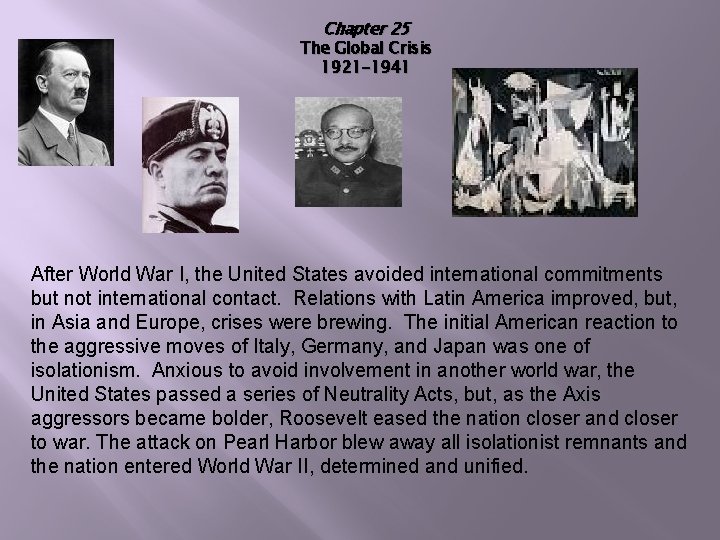
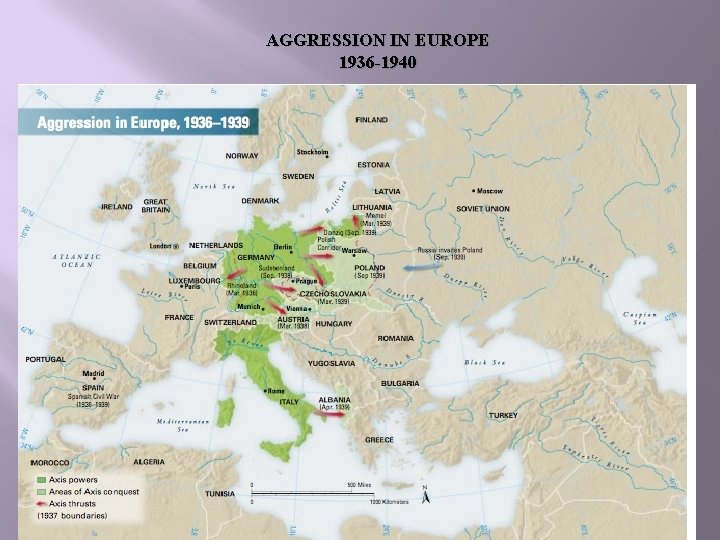
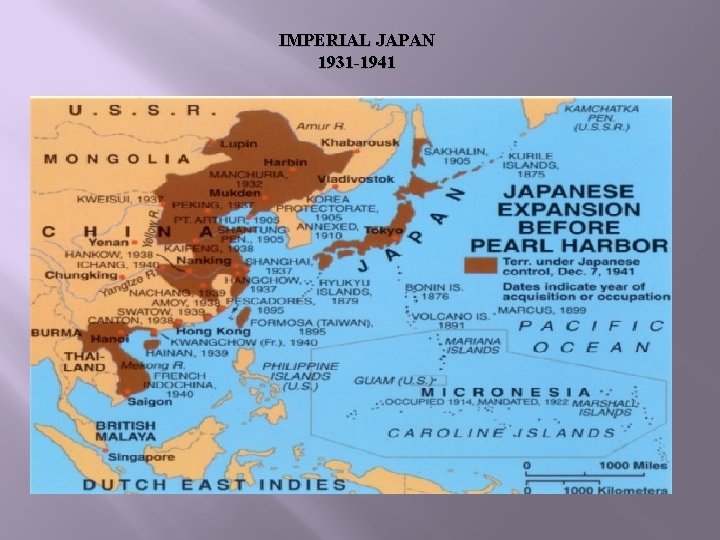
Chapter 25 The Global Crisis 1921 -1941 After World War I, the United States avoided international commitments but not international contact. Relations with Latin America improved, but, in Asia and Europe, crises were brewing. The initial American reaction to the aggressive moves of Italy, Germany, and Japan was one of isolationism. Anxious to avoid involvement in another world war, the United States passed a series of Neutrality Acts, but, as the Axis aggressors became bolder, Roosevelt eased the nation closer and closer to war. The attack on Pearl Harbor blew away all isolationist remnants and the nation entered World War II, determined and unified.
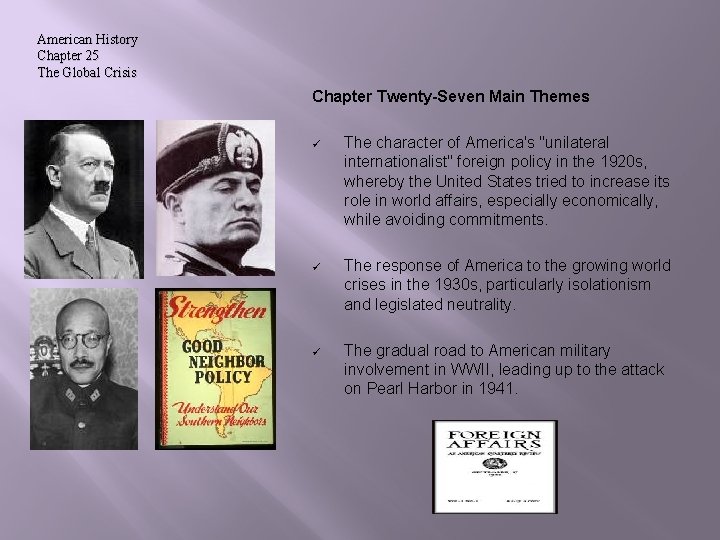
American History Chapter 25 The Global Crisis Chapter Twenty-Seven Main Themes ü The character of America's "unilateral internationalist" foreign policy in the 1920 s, whereby the United States tried to increase its role in world affairs, especially economically, while avoiding commitments. ü The response of America to the growing world crises in the 1930 s, particularly isolationism and legislated neutrality. ü The gradual road to American military involvement in WWII, leading up to the attack on Pearl Harbor in 1941.
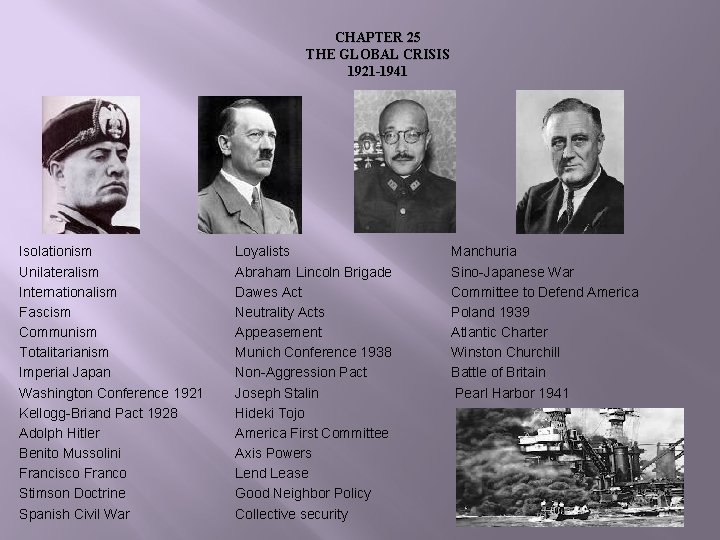
CHAPTER 25 THE GLOBAL CRISIS 1921 -1941 Isolationism Unilateralism Internationalism Fascism Communism Totalitarianism Imperial Japan Washington Conference 1921 Kellogg-Briand Pact 1928 Adolph Hitler Benito Mussolini Francisco Franco Stimson Doctrine Spanish Civil War Loyalists Abraham Lincoln Brigade Dawes Act Neutrality Acts Appeasement Munich Conference 1938 Non-Aggression Pact Joseph Stalin Hideki Tojo America First Committee Axis Powers Lend Lease Good Neighbor Policy Collective security Manchuria Sino-Japanese War Committee to Defend America Poland 1939 Atlantic Charter Winston Churchill Battle of Britain Pearl Harbor 1941
AGGRESSION IN EUROPE 1936 -1940
IMPERIAL JAPAN 1931 -1941
The Global Crisis Discussion notes s
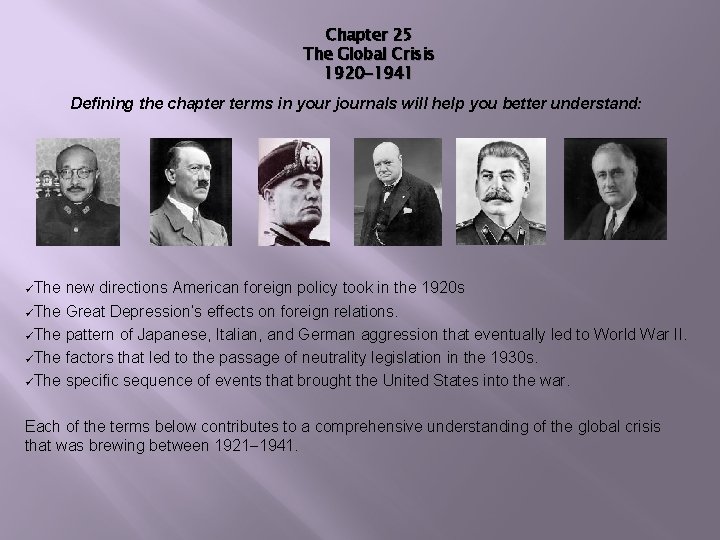
Chapter 25 The Global Crisis 1920 -1941 Defining the chapter terms in your journals will help you better understand: üThe new directions American foreign policy took in the 1920 s üThe Great Depression’s effects on foreign relations. üThe pattern of Japanese, Italian, and German aggression that eventually led to World War II. üThe factors that led to the passage of neutrality legislation in the 1930 s. üThe specific sequence of events that brought the United States into the war. Each of the terms below contributes to a comprehensive understanding of the global crisis that was brewing between 1921 1941.
THE GLOBAL CRISIS 1920 -1940 Long Essay Exam Tips The experience of World War I had a significant influence on both the American public and American policy makers during the pre-1941 period. Congress passed neutrality legislation during the 1930 s in and explicit attempt to prevent a repeat of the experiences that led to involvement of the United States in World War I. This is a good place to consider the use of historical analogies to guide decision-making, and students should be able to consider key similarities and differences between the conditions that led to American involvement in each war. DBQ Exam Tips A major theme from the interwar period is the issue of isolationism. Historians once used the term to describe American foreign policy from the end of World War I until the outbreak of World War II. Many historians prefer terms such as “independent internationalism” to describe American policy during the 1920 s, noting the degree to which American foreign investment involved the United States with other nations.
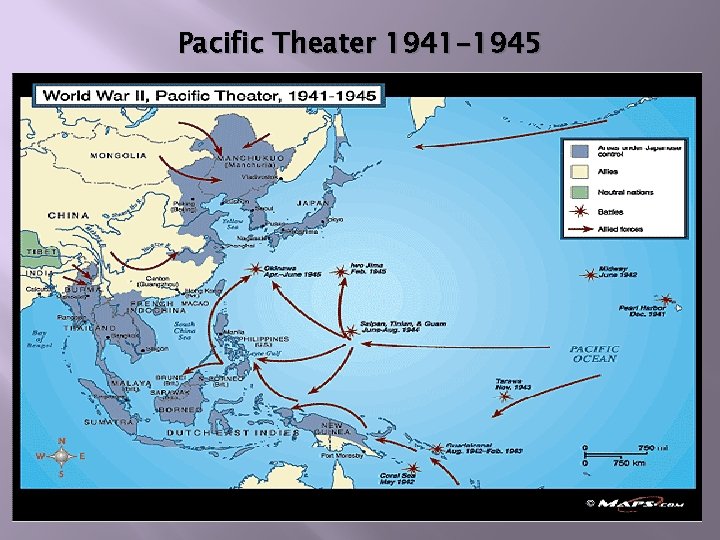
Chapter 26 America in a World War 1941 -1945 The United States entered World War II ideologically unified but militarily illprepared. A corporate-government partnership solved most of the production and manpower problems, and the massive wartime output brought an end to the Great Depression. Labor troubles, racial friction, and social tensions were not absent, but they were kept to a minimum. Roosevelt and the American generals made the decision that Germany must be defeated first, since it presented a more serious threat than Japan. Gradually, American production and American military might turned the tide in the Pacific and on the western front in Europe. The key to victory in Europe was the invasion of France, which coincided with the Russian offensive on the eastern front. Less than a year after D-Day, the war in Europe was over. In the Pacific, American forces, with some aid from the British and Australians, first stopped the Japanese advance and then went on the offensive. The strategy for victory involved long leaps from island to island that bypassed and isolated large enemy concentrations and drew progressively closer to the Japanese homeland. Conventional bombing raids pulverized Japanese cities, and American forces were readied for an invasion that the atomic bomb made unnecessary.
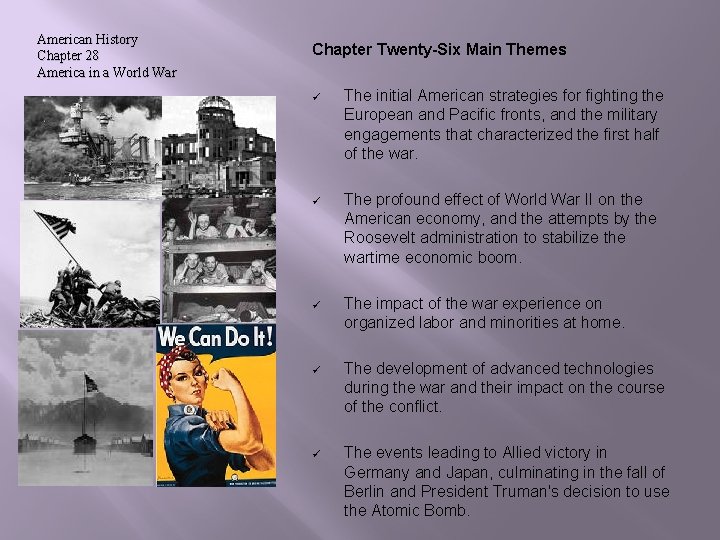
American History Chapter 28 America in a World War Chapter Twenty-Six Main Themes ü The initial American strategies for fighting the European and Pacific fronts, and the military engagements that characterized the first half of the war. ü The profound effect of World War II on the American economy, and the attempts by the Roosevelt administration to stabilize the wartime economic boom. ü The impact of the war experience on organized labor and minorities at home. ü The development of advanced technologies during the war and their impact on the course of the conflict. ü The events leading to Allied victory in Germany and Japan, culminating in the fall of Berlin and President Truman's decision to use the Atomic Bomb.
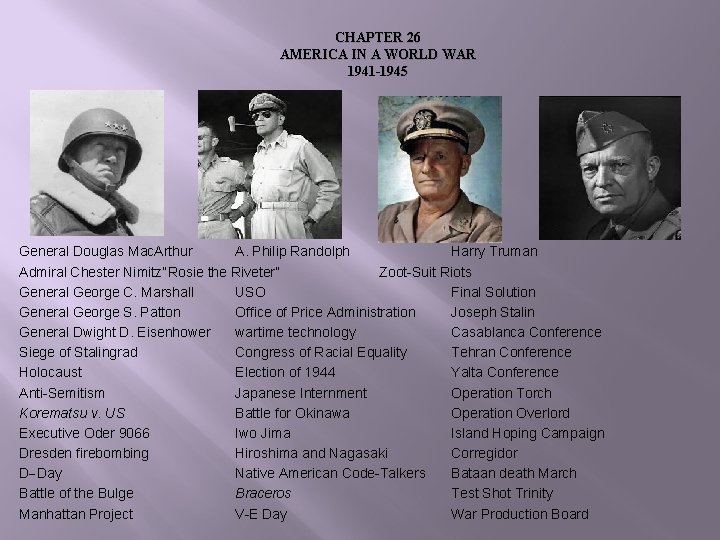
CHAPTER 26 AMERICA IN A WORLD WAR 1941 -1945 General Douglas Mac. Arthur A. Philip Randolph Harry Truman Admiral Chester Nimitz“Rosie the Riveter” Zoot-Suit Riots General George C. Marshall USO Final Solution General George S. Patton Office of Price Administration Joseph Stalin General Dwight D. Eisenhower wartime technology Casablanca Conference Siege of Stalingrad Congress of Racial Equality Tehran Conference Holocaust Election of 1944 Yalta Conference Anti-Semitism Japanese Internment Operation Torch Korematsu v. US Battle for Okinawa Operation Overlord Executive Oder 9066 Iwo Jima Island Hoping Campaign Dresden firebombing Hiroshima and Nagasaki Corregidor D Day Native American Code-Talkers Bataan death March Battle of the Bulge Braceros Test Shot Trinity Manhattan Project V-E Day War Production Board
Pacific Theater 1941 -1945
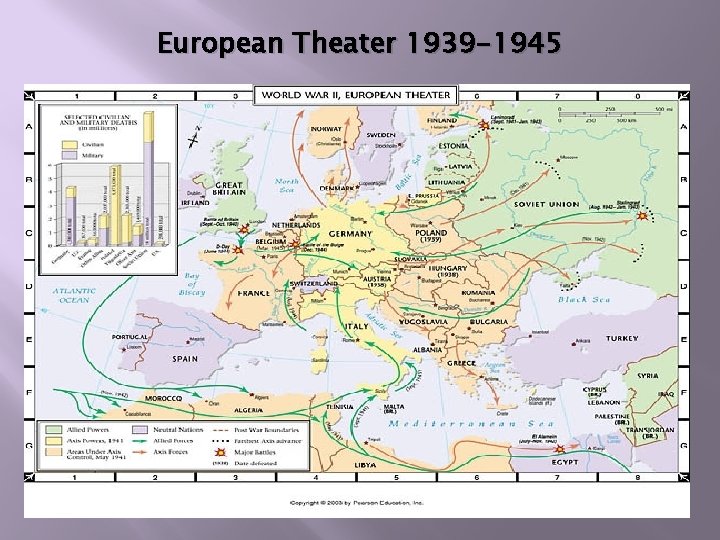
European Theater 1939 -1945
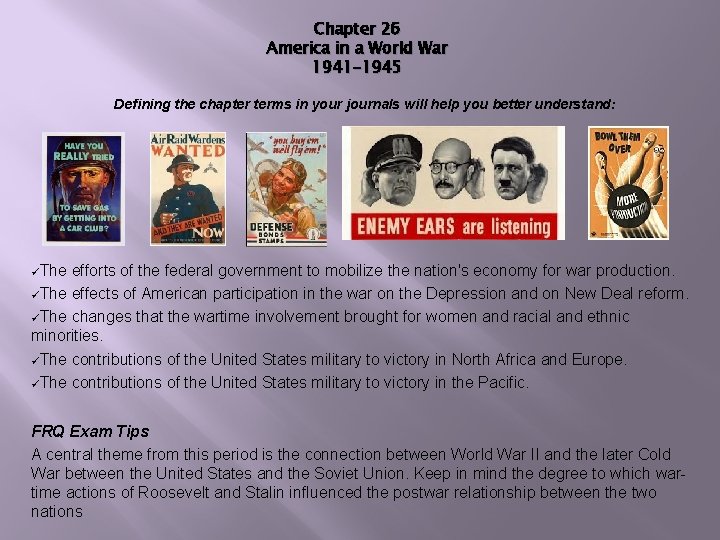
Chapter 26 America in a World War 1941 -1945 Defining the chapter terms in your journals will help you better understand: üThe efforts of the federal government to mobilize the nation's economy for war production. üThe effects of American participation in the war on the Depression and on New Deal reform. üThe changes that the wartime involvement brought for women and racial and ethnic minorities. üThe contributions of the United States military to victory in North Africa and Europe. üThe contributions of the United States military to victory in the Pacific. FRQ Exam Tips A central theme from this period is the connection between World War II and the later Cold War between the United States and the Soviet Union. Keep in mind the degree to which wartime actions of Roosevelt and Stalin influenced the postwar relationship between the two nations
Chapter 28 America in a World War s 1941 -1945 Discussion notes