
Period 4 Global Interactions c 1450 to c
Period 4: Global Interactions, c. 1450 to c. 1750 Key Concept 4. 1. Globalizing Networks of Communication and Exchange The interconnection of the Eastern and Western hemispheres made possible by transoceanic voyaging marked a key transformation of his period. Technological innovations helped to make transoceanic connections possible. Changing patterns of long distance trade included the global circulation of some commodities and the formation of new regional markets and financial centers. Increased transregional and global trade networks facilitated the spread of religion and other elements of culture as well as the migration of large numbers of people. Germs carried to the Americas ravaged the indigenous peoples, while the global exchange of crops and animals altered agriculture, diets, and populations around the planet. I. In the context of the new global circulation of goods, there was an intensification of all existing regional trade networks that brought prosperity and economic disruption to the merchants and governments in the trading regions of the Indian Ocean, Mediterranean, Sahara, and overland Eurasia. II. European technological developments in cartography and navigation built on previous knowledge developed in the classical, Islamic, and Asian worlds, and included the production of new tools, innovations in ship designs, and an improved understanding of global wind and currents patterns — all of which made transoceanic travel and trade possible.
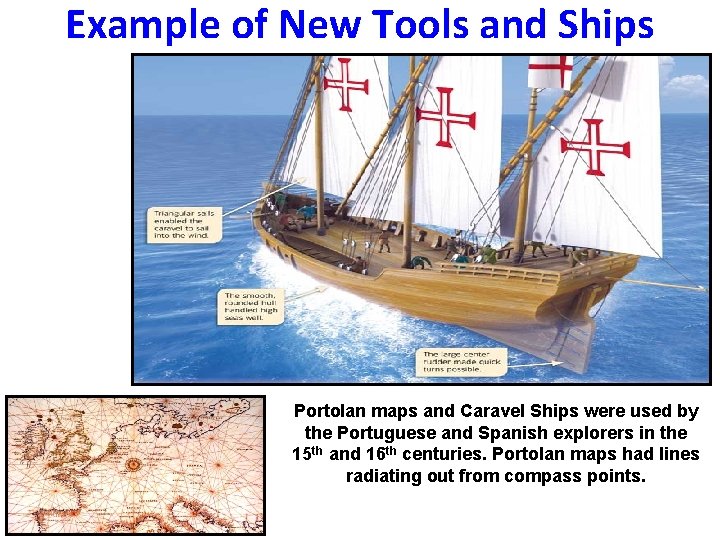
Example of New Tools and Ships Portolan maps and Caravel Ships were used by the Portuguese and Spanish explorers in the 15 th and 16 th centuries. Portolan maps had lines radiating out from compass points.
Key Concept 4. 1. III. Remarkable new transoceanic maritime reconnaissance occurred in this period. A. Official Chinese maritime activity expanded into the Indian Ocean region with the naval voyages led by Ming Admiral Zheng He, which enhanced Chinese prestige. B. Portuguese development of a school for navigation led to increased travel to and trade with West Africa, and resulted in the construction of a global trading post empire. C. Spanish sponsorship of the first Columbian and subsequent voyages across the Atlantic and Pacific dramatically increased European interest in transoceanic travel and trade. D. Northern Atlantic crossings for fishing and settlements continued and spurred European searches for multiple routes to Asia. E. In Oceania and Polynesia, established exchange and communication networks were not dramatically affected because of infrequent European reconnaissance in the Pacific Ocean. IV. The new global circulation of goods was facilitated by royal chartered European monopoly companies that took silver from Spanish colonies in the Americas to purchase Asian goods for the Atlantic markets, but regional markets continued to flourish in Afro Eurasia by using established commercial practices and new transoceanic shipping services developed by European merchants.
Key Concept 4. 1. A. European merchants’ role in Asian trade was characterized mostly by transporting goods from one Asian country to another market in Asia or the Indian Ocean region. B. Commercialization and the creation of a global economy were intimately connected to new global circulation of silver from the Americas. C. Influenced by mercantilism, joint stock companies were new methods used by European rulers to control their domestic and colonial economies and by European merchants to compete against one another in global trade. D. The Atlantic system involved the movement of goods, wealth, and free and unfree laborers, and the mixing of African, American, and European cultures and peoples. V. The new connections between the Eastern and Western hemispheres resulted in the Columbian Exchange. A. European colonization of the Americas led to the spread of diseases — including smallpox, measles, and influenza — that were endemic in the Eastern Hemisphere among Amerindian populations and the unintentional transfer of vermin, including mosquitoes and rats. B. American foods became staple crops in various parts of Europe, Asia, and Africa. Cash crops were grown primarily on plantations with coerced labor and were exported mostly to Europe and the Middle East in this period.
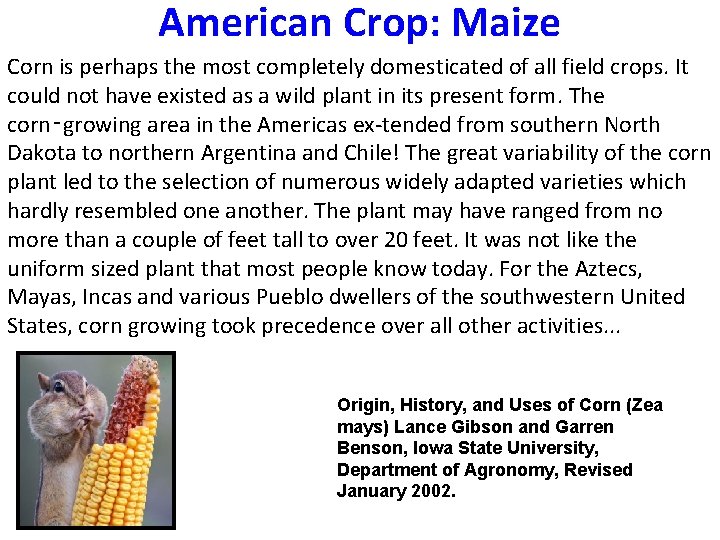
American Crop: Maize Corn is perhaps the most completely domesticated of all field crops. It could not have existed as a wild plant in its present form. The corn‑growing area in the Americas ex tended from southern North Dakota to northern Argentina and Chile! The great variability of the corn plant led to the selection of numerous widely adapted varieties which hardly resembled one another. The plant may have ranged from no more than a couple of feet tall to over 20 feet. It was not like the uniform sized plant that most people know today. For the Aztecs, Mayas, Incas and various Pueblo dwellers of the southwestern United States, corn growing took precedence over all other activities. . . Origin, History, and Uses of Corn (Zea mays) Lance Gibson and Garren Benson, Iowa State University, Department of Agronomy, Revised January 2002.
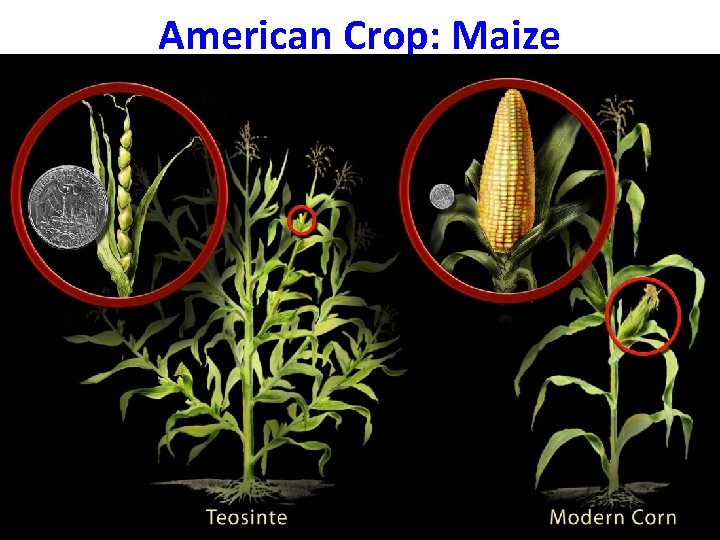
American Crop: Maize
Cash Crop: Sugar! White Gold, as British colonists called it, was the engine of the slave trade that brought millions of Africans to the Americas beginning in the early 16 th century… During those three centuries, sugar was by far the most important of the overseas commodities that accounted for a third of Europe's entire economy. As technologies got more efficient and diversified, adding molasses and rum to the plantation byproducts, sugar barons from St. Kitts to Jamaica became enormously wealthy. . . Britain lost its 13 American colonies to independence in part because its military was busy protecting its sugar islands, many historians have argued. As opposed to the slaves working plantations in the U. S. South, Africans on Caribbean sugar plantations (and the islands themselves) outnumbered their European owners by a wide margin. The British planters lived in constant fear of revolt and demanded soldiers for protection. Several decisive battles of the Revolutionary War would have turned out differently had Britain thrown its full might behind the war, experts believe. Sizable garrisons were also stationed in the West Indies to guard the few sugar holdings Britain had left at the end of the Seven Years' War in 1763. In carving up the Americas after the fighting stopped, King George III had decided to cede a few of his Caribbean sugar islands to France in order to secure a sizable chunk of North America. In swapping sweet and profitable Guadeloupe for the barren, sugar free wasteland of Canada, plus most of the land east of the Mississippi River, many Englishmen thought the King got a raw deal. http: //www. livescience. com/4949 -sugar-changed-world. html
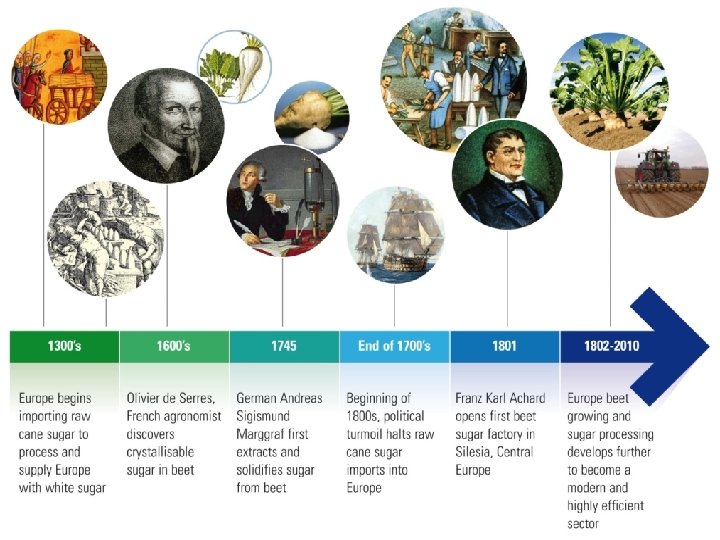

Cash Crop: Sugar! Continued…
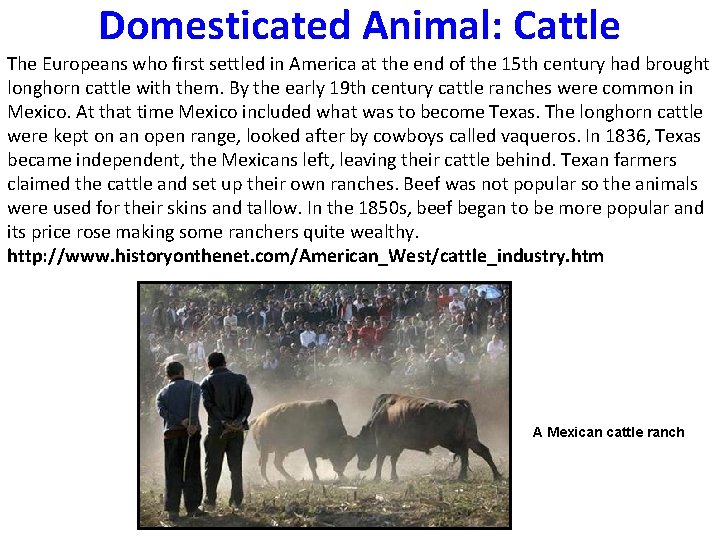
Domesticated Animal: Cattle The Europeans who first settled in America at the end of the 15 th century had brought longhorn cattle with them. By the early 19 th century cattle ranches were common in Mexico. At that time Mexico included what was to become Texas. The longhorn cattle were kept on an open range, looked after by cowboys called vaqueros. In 1836, Texas became independent, the Mexicans left, leaving their cattle behind. Texan farmers claimed the cattle and set up their own ranches. Beef was not popular so the animals were used for their skins and tallow. In the 1850 s, beef began to be more popular and its price rose making some ranchers quite wealthy. http: //www. historyonthenet. com/American_West/cattle_industry. htm A Mexican cattle ranch
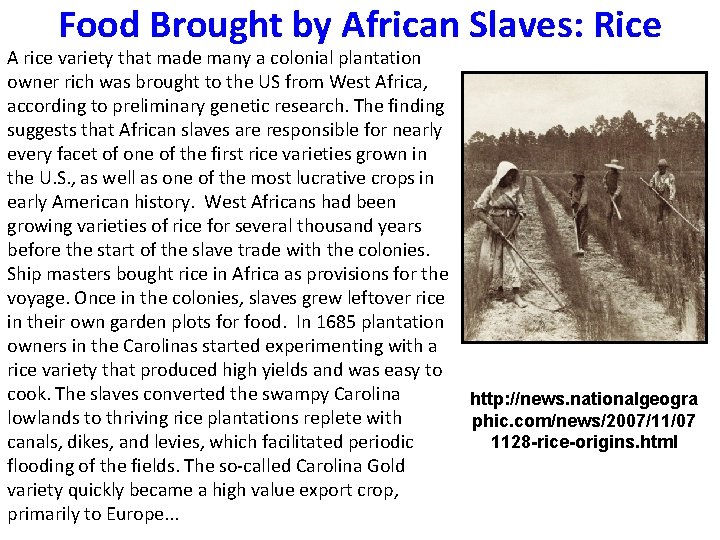
Food Brought by African Slaves: Rice A rice variety that made many a colonial plantation owner rich was brought to the US from West Africa, according to preliminary genetic research. The finding suggests that African slaves are responsible for nearly every facet of one of the first rice varieties grown in the U. S. , as well as one of the most lucrative crops in early American history. West Africans had been growing varieties of rice for several thousand years before the start of the slave trade with the colonies. Ship masters bought rice in Africa as provisions for the voyage. Once in the colonies, slaves grew leftover rice in their own garden plots for food. In 1685 plantation owners in the Carolinas started experimenting with a rice variety that produced high yields and was easy to cook. The slaves converted the swampy Carolina lowlands to thriving rice plantations replete with canals, dikes, and levies, which facilitated periodic flooding of the fields. The so called Carolina Gold variety quickly became a high value export crop, primarily to Europe. . . http: //news. nationalgeogra phic. com/news/2007/11/07 1128 -rice-origins. html
Key Concept 4. 1. C. Afro Eurasian fruit trees, grains, sugar, and domesticated animals were brought by Europeans to the Americas, while other foods were brought by African slaves. D. Populations in Afro Eurasia benefited nutritionally from the increased diversity of American food crops. E. European colonization and the introduction of European agriculture and settlements practices in the Americas often affected the physical environment through deforestation and soil depletion. VI. The increase in interactions between newly connected hemispheres and intensification of connections within hemispheres expanded the spread and reform of existing religions and created syncretic belief systems and practices. A. As Islam spread to new settings in Afro Eurasia, believers adapted it to local cultural practices. The split between the Sunni and Shi’a traditions of Islam intensified, and Sufi practices became more widespread. B. The practice of Christianity continued to spread throughout the world and was increasingly diversified by the process of diffusion and the Reformation. C. Buddhism spread within Asia. D. Syncretic and new forms of religion developed. VII. As merchants’ profits increased and governments collected more taxes, funding for the visual and performing arts, even for popular audiences, increased. A. Innovations in visual and performing arts were seen all over the world. B. Literacy expanded and was accompanied by the proliferation of popular authors, literary forms, and works of literature in Afro-Eurasia.
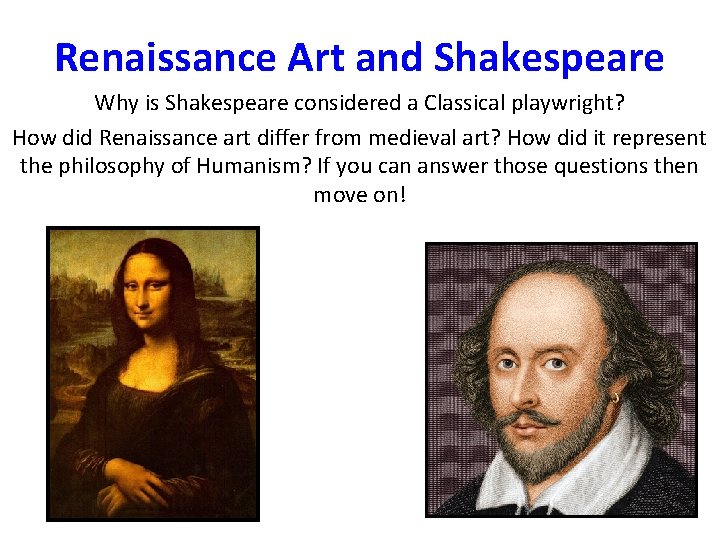
Renaissance Art and Shakespeare Why is Shakespeare considered a Classical playwright? How did Renaissance art differ from medieval art? How did it represent the philosophy of Humanism? If you can answer those questions then move on!
Key Concept 4. 2 New Forms of Social Organization and Modes of Production Although the world’s productive systems continued to be heavily centered on agricultural production throughout this period, major changes occurred in agricultural labor, the systems and locations of manufacturing, gender and social structures, and environmental processes. A surge in agricultural productivity resulted from new methods in crop and field rotation and the introduction of new crops. Economic growth also depended on new forms of manufacturing and new commercial patterns, especially in long distance trade. Political and economic centers within regions shifted, and merchants’ social status tended to rise in various states. Demographic growth — even in areas such as the Americas, where disease had ravaged the population — was restored by the eighteenth century and surged in many regions, especially with the introduction of American food crops throughout the Eastern Hemisphere. The Columbian Exchange led to new ways of humans interacting with their environments. New forms of coerced and semi coerced labor emerged in Europe, Africa, and the Americas, and affected ethnic and racial classifications and gender roles. I. Traditional peasant agriculture increased and changed, plantations expanded, and demand for labor increased. These changes both fed and responded to growing global demand for raw materials and finished products. A. Peasant labor intensified in many regions.
Frontier Peasant Settlements in Siberia “…The American West and Russia's Far East both were just across a mountain barrier from their country's original area of settlement. Both were immense, sparsely populated regions that tempted the adventurous and restless. In the 19 th century, the US enticed settlers to its western territories via the Homestead Act. The Czars similarly offered Russian peasants the inducement of free land on the Siberian frontier. . . Both Siberia and the American West were first explored by "mountain men" fur traders. . . Until merchant adventurers began shipping back Siberian pelts, Russia was a poor nation on the fringe of European affairs. But in the 17 th century, a fur hat was the mark of a European gentleman, and the Siberian sable an animal the ancient Greeks called the "golden fleece" gave Russia its first export commodity. "This small animal that was scarcely larger than a house cat became the magnet that pulled the Russians across the entire Eurasian continent before 1650, " Dr. Lincoln notes. . . When they'd exhausted Siberia's animal stock, Russian fur traders hopped across the narrow straits separating Asia from North America. For a brief moment, the Russians tested the possibility of expanding south to the Hawaiian Islands, thinking them a fertile place from which to draw food stocks badly needed by Siberia's population… Only when they'd finished exploiting Alaska's fur trading possibilities did the Czars sell off their North American territories to the United States.
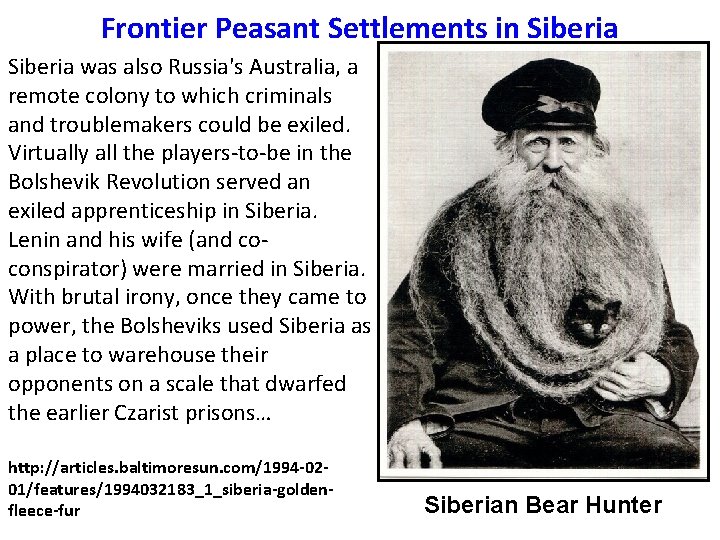
Frontier Peasant Settlements in Siberia was also Russia's Australia, a remote colony to which criminals and troublemakers could be exiled. Virtually all the players to be in the Bolshevik Revolution served an exiled apprenticeship in Siberia. Lenin and his wife (and co conspirator) were married in Siberia. With brutal irony, once they came to power, the Bolsheviks used Siberia as a place to warehouse their opponents on a scale that dwarfed the earlier Czarist prisons… http: //articles. baltimoresun. com/1994 -0201/features/1994032183_1_siberia-goldenfleece-fur Siberian Bear Hunter
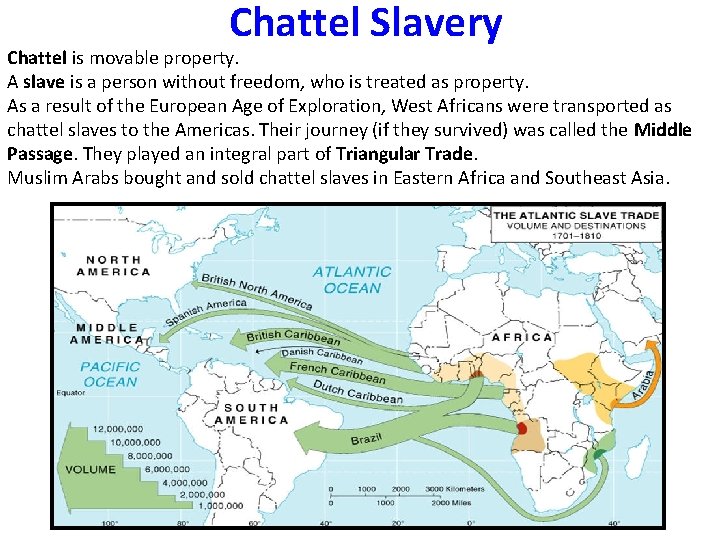
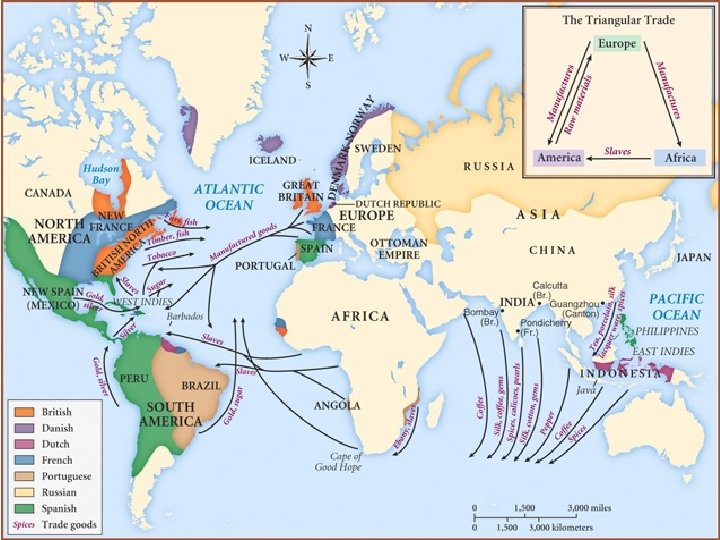
Chattel Slavery Chattel is movable property. A slave is a person without freedom, who is treated as property. As a result of the European Age of Exploration, West Africans were transported as chattel slaves to the Americas. Their journey (if they survived) was called the Middle Passage. They played an integral part of Triangular Trade. Muslim Arabs bought and sold chattel slaves in Eastern Africa and Southeast Asia.
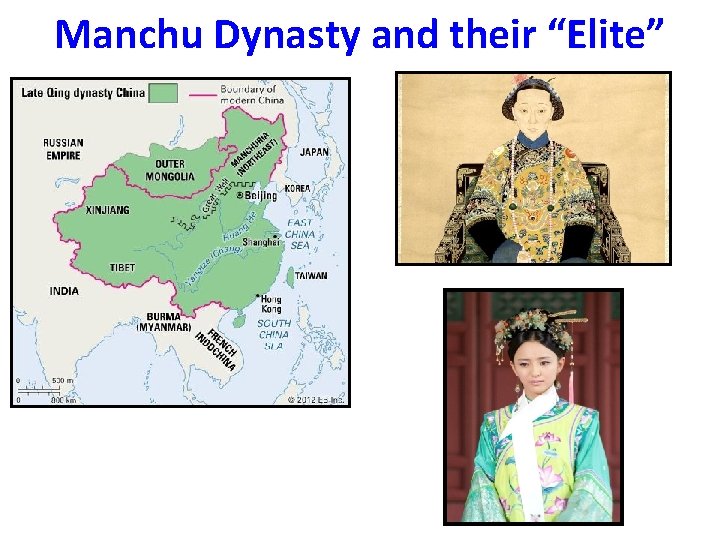
Manchu Dynasty and their “Elite”
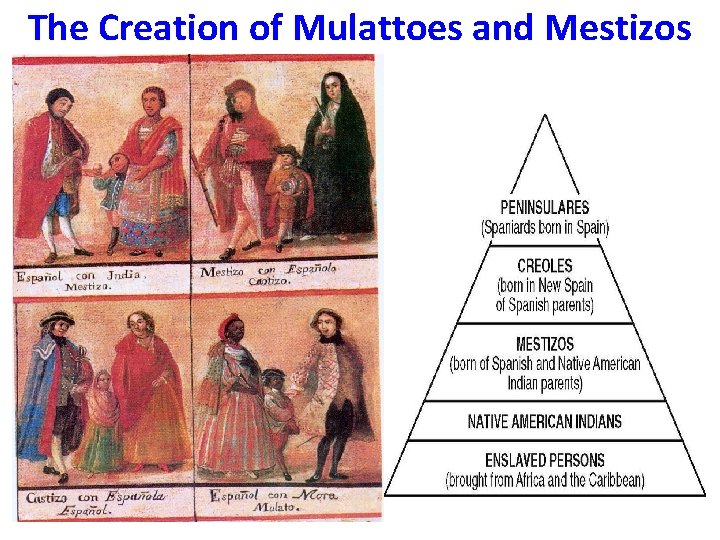
The Creation of Mulattoes and Mestizos
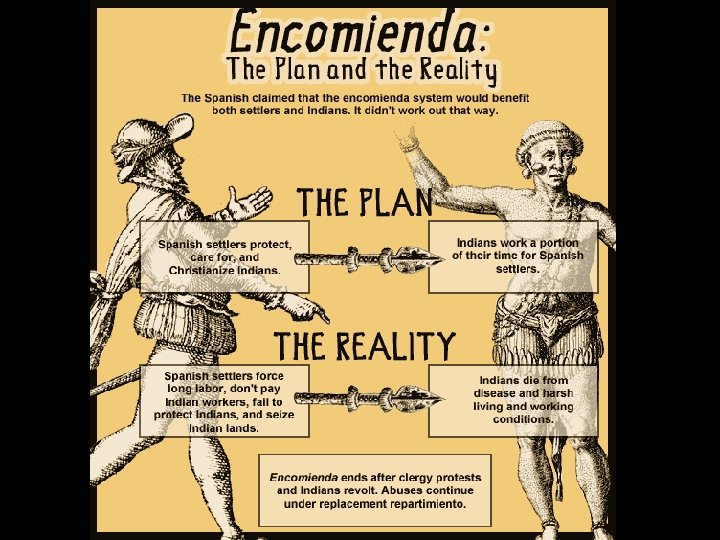
Key Concept 4. 2 B. Slavery in Africa continued both the traditional incorporation of slaves into households and the export of slaves to the Mediterranean and the Indian Ocean. C. The growth of the plantation economy increased the demand for slaves in the Americas. D. Colonial economies in the Americas depended on a range of coerced labor. II. As new social and political elites changed, they also restructured new ethnic, racial, and gender hierarchies. A. Both imperial conquests and widening global economic opportunities contributed to the formation of new political and economic elites. B. The power of existing political and economic elites fluctuated as they confronted new challenges to their ability to affect the policies of the increasingly powerful monarchs and leaders. C. Some notable gender and family restructuring occurred, including the demographic changes in Africa that resulted from the slave trades. D. The massive demographic changes in the Americas resulted in new ethnic and racial classifications.
Key Concept 4. 3. State Consolidation and Imperial Expansion Empires expanded and conquered new peoples around the world, but they often had difficulties incorporating culturally, ethnically, and religiously diverse subjects, and administrating widely dispersed territories. Agents of the European powers moved into existing trade networks around the world. In Africa and the greater Indian Ocean, nascent European empires consisted mainly of interconnected trading posts and enclaves. In the Americas, European empires moved more quickly to settlement and territorial control, responding to local demographic and commercial conditions. Moreover, the creation of European empires in the Americas quickly fostered a new Atlantic trade system that included the trans Atlantic slave trade. Around the world, empires and states of varying sizes pursued strategies of centralization, including more efficient taxation systems that placed strains on peasant producers, sometimes prompting local rebellions. Rulers used public displays of art and architecture to legitimize state power. African states shared certain characteristics with larger Eurasian empires. Changes in African and global trading patterns strengthened some West and Central African states — especially on the coast; this led to the rise of new states and contributed to the decline of states on both the coast and in the interior. I. Rulers used a variety of methods to legitimize and consolidate their power. A. Rulers used the arts to display political power and to legitimize their rule. B. Rulers continued to use religious ideas to legitimize their rule; i. e. Aztec human sacrifice. Ouch!
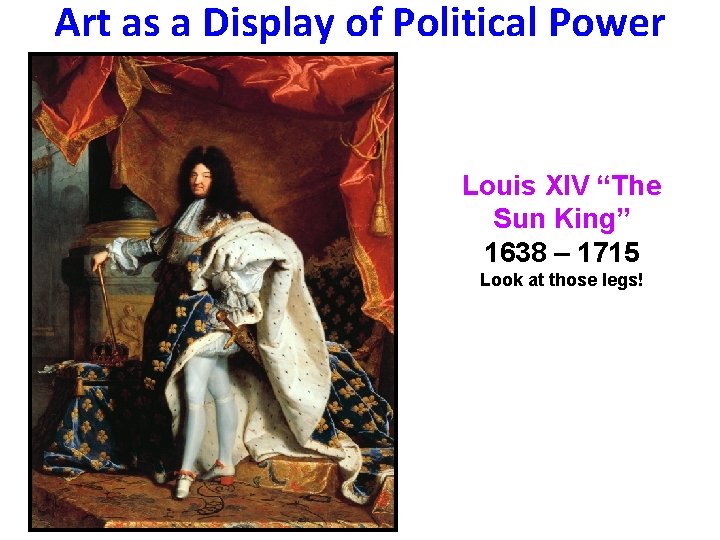
Art as a Display of Political Power Louis XIV “The Sun King” 1638 – 1715 Look at those legs!
Key Concept 4. 3 C. States treated different ethnic and religious groups in ways that utilized their economic contributions while limiting their ability to challenge the authority of the state. D. Recruitment and use of bureaucratic elites, as well as the development of military professionals, became more common among rulers who wanted to maintain centralized control over their populations and resources. E. Rulers used tribute collection and tax farming to generate revenue for territorial expansion. II. Imperial expansion relied on the increased use of gunpowder, cannons, and armed trade to establish large empires in both hemispheres. A. Europeans established new trading post empires in Africa and Asia, which proved profitable for the rulers and merchants involved in new global trade networks, but these empires also affected the power of the states in interior West and Central Africa. B. Land empires expanded dramatically in size. Examples of land empires: • Manchus • Mughals • Ottomans • Russians
Key Concept 4. 3 Continued… C. European states established new maritime empires in the Americas. Examples of maritime empires: • Portuguese • Spanish • Dutch • French • British III. Competition over trade routes, state rivalries, and local resistance all provided significant challenges to state consolidation and expansion.
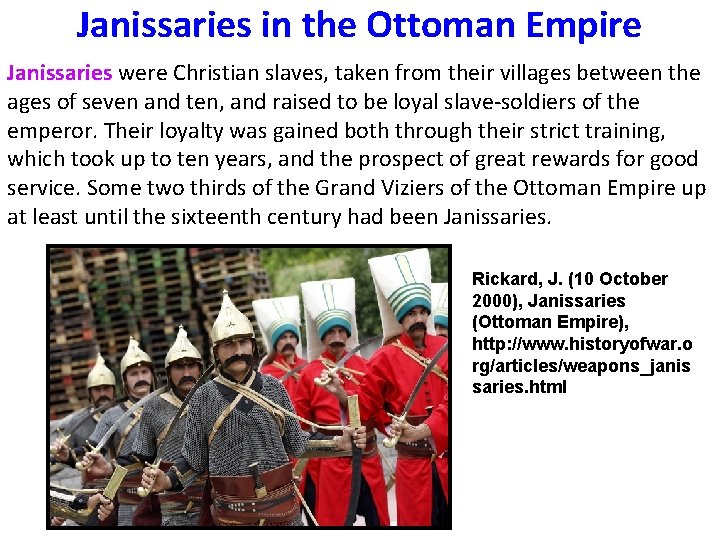
Janissaries in the Ottoman Empire Janissaries were Christian slaves, taken from their villages between the ages of seven and ten, and raised to be loyal slave soldiers of the emperor. Their loyalty was gained both through their strict training, which took up to ten years, and the prospect of great rewards for good service. Some two thirds of the Grand Viziers of the Ottoman Empire up at least until the sixteenth century had been Janissaries. Rickard, J. (10 October 2000), Janissaries (Ottoman Empire), http: //www. historyofwar. o rg/articles/weapons_janis saries. html
Chinese Exam System Imperial China was famous for its civil service examination system, which had its beginnings in the Sui dynasty (581 618 CE) but was fully developed during the Qing dynasty. The system continued to play a major role, not only in education and government, but also in society itself, throughout Qing times. The civil service examination system was squarely based upon the Confucian classics. . . Only those from wealthier families or showing exceptional promise and having wealthy sponsors who were impressed by their potential could continue their studies and compete in the examination system. The civil service examinations were conducted at every level of the Chinese administrative hierarchy. The lowest level of the Chinese imperial administration was the county seat, and in the county seat one took the preliminary examination, which, if passed, qualified one to take the examination at the second level, which was at the district seat. The third level examinations were given in the provincial capitol, and the fourth and highest level of examinations were given in the imperial palace itself. In addition to his many other functions, the emperor was in fact the “grand tutor” of China. Theoretically, he was to proctor the palace exams, although in practice he sent someone to represent him in that capacity. Those who passed the imperial palace examinations at the highest level (jinshi) became the most important people in China’s educated class…
Chinese Exam System Continued… The civil service examination system was an important vehicle of social mobility in imperial China. Even a youth from the poorest family could theoretically join the ranks of the educated elite by succeeding in the examination system. This assurance of success in the examinations dependent only on one’s ability rather than one’s social position helped circulate the key ideas of Confucianism concerning proper behavior, rituals, relationships, etc. through all levels of Chinese society. The hope of social mobility through success in this system was the motivation for going to school in the first place, whether one was the son of a scholar or a farmer. But even for the farmer’s son who did not do well enough to take the exams even at the lowest level, going to school had the major payoff of working literacy, and this literacy was acquired through mastery of the same basic texts that others who went on to pass the examinations at the highest level also studied… http: //afe. easia. columbia. edu/cosmos/irc/classics. htm
Piracy in the Caribbean The “Golden Age of piracy” occurred from the 1650 s 1730 s. Shipments of valuable cargo from Europe increased. Many men and women turned to piracy to live the life of freedom and wealth. Many pirates recruited crew members from ships they captured. Very few reluctantly joined a pirate's crew, especially if they worked for little or no pay on a merchant or cargo ship. Despite the anarchy portrayed by pirates, there were rules to be obeyed. For instance, crew members could not steal from one another and women could not come aboard a pirate ship. Pirates had to follow every rule or else they faced punishment. Violators faced marooning, walking the plank, or being hanged. Pirates flew a skull and crossbones flag on their ships to intimidate nearby ships to surrender. Pirates traveled in different styles of ships, notably the galleon (with multiple decks) and junk ships (flat bottom and bow, ideal for quick maneuvering). The signing of the Treaty of Utrecht bolstered piracy due to the increase in trained sailors who could not find employment. The increase in piracy placed a greater strain on trade for European nations. This caused these same nations to bolster their navies to offer greater protection for merchants. Officials considered pirates outlaws, meaning they faced death or life imprisonment. Officials caught Capt. William Kidd and sentenced him to death in 1701. Blackbeard died while trying to rob a naval ship. Naval officials severed Blackbeard's head from his body and mounted it to the naval vessel to warn other pirates. http: //stlucianow. com/info/the-history-of-piracy-in-the -caribbean
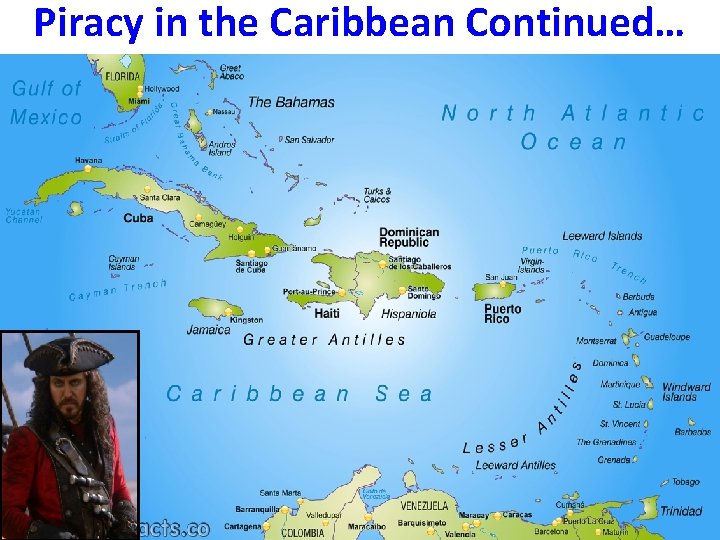
Piracy in the Caribbean Continued…
Dutch Maritime Empire The Dutch Republic was originally controlled by Charles V, Holy Roman Emperor and (as "Carlos I") King of Spain, who had inherited it in 1543. In 1566, a Protestant revolt broke out against Catholic Spain, which led to Dutch independence in 1648. Financiers and traders emigrated from Flanders to Dutch cities, particularly Amsterdam, which became Europe's foremost center for shipping, banking, and insurance. With new sources of capital, the Dutch began to expand their trade routes. The Dutch East India Company was founded in 1602. The charter awarded to the Company by the States General granted it sole rights, for an initial period of 21 years, to Dutch trade and navigation east of the Cape of Good Hope and west of the Straits of Magellan. The directors of the company, the "Heeren XVII", were given the legal authority to establish "fortresses and strongholds", to sign treaties, to enlist both an army and a navy, and to wage defensive war. The Netherlands lost many of its colonial possessions, as well as its global power status, to the British when Holland fell to French armies during the Revolutionary Wars. . .
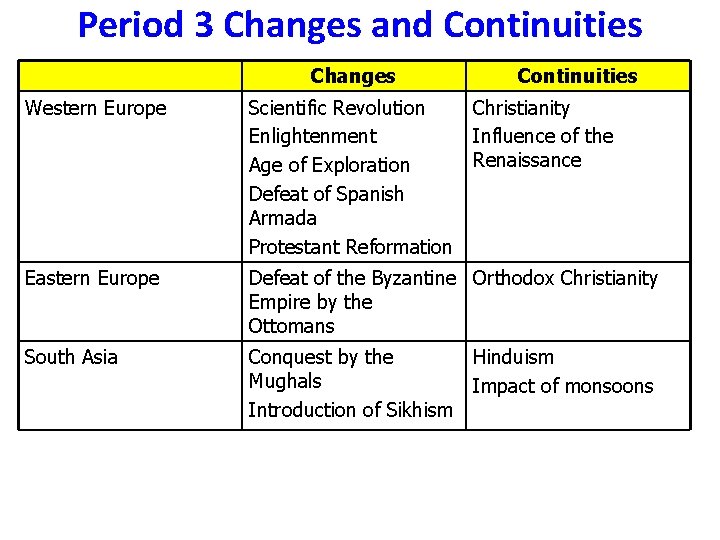
Period 3 Changes and Continuities Changes Continuities Western Europe Scientific Revolution Christianity Enlightenment Influence of the Renaissance Age of Exploration Defeat of Spanish Armada Protestant Reformation Eastern Europe Defeat of the Byzantine Orthodox Christianity Empire by the Ottomans South Asia Conquest by the Hinduism Mughals Impact of monsoons Introduction of Sikhism
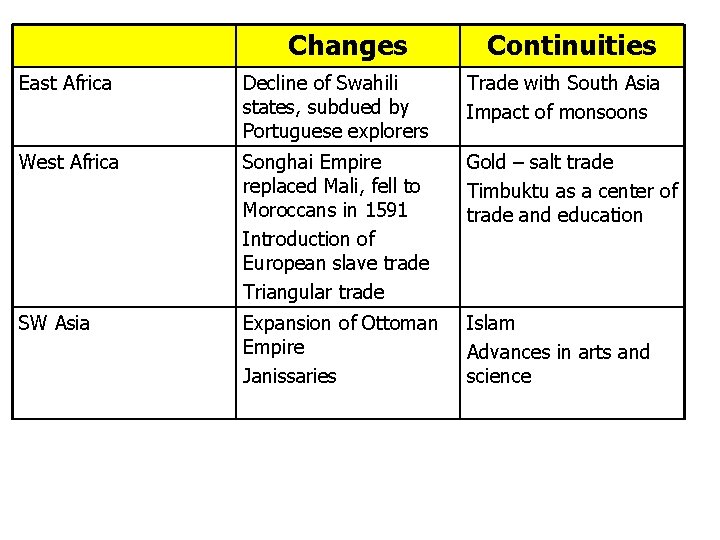
Changes Continuities East Africa Decline of Swahili states, subdued by Portuguese explorers Trade with South Asia Impact of monsoons West Africa Songhai Empire replaced Mali, fell to Moroccans in 1591 Introduction of European slave trade Triangular trade Gold – salt trade Timbuktu as a center of trade and education SW Asia Expansion of Ottoman Empire Janissaries Islam Advances in arts and science
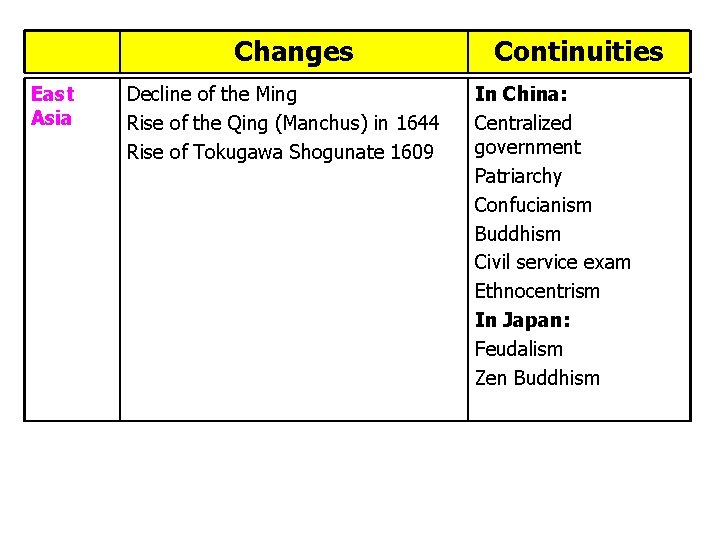
Changes East Asia Decline of the Ming Rise of the Qing (Manchus) in 1644 Rise of Tokugawa Shogunate 1609 Continuities In China: Centralized government Patriarchy Confucianism Buddhism Civil service exam Ethnocentrism In Japan: Feudalism Zen Buddhism
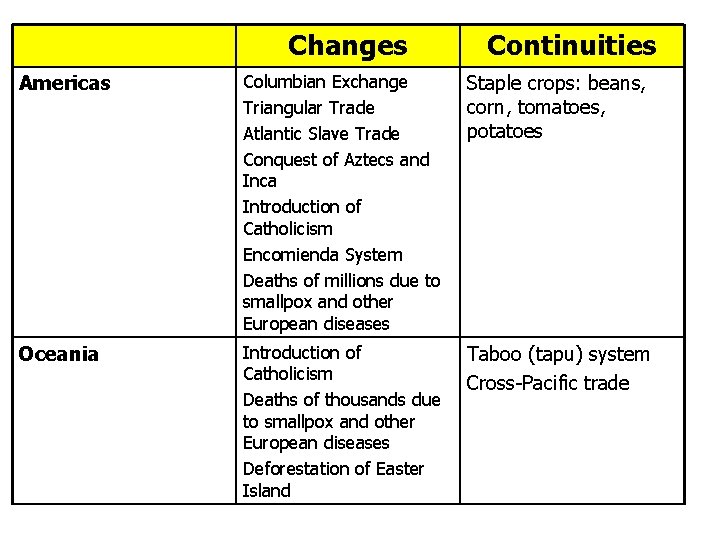
Changes Continuities Americas Columbian Exchange Triangular Trade Atlantic Slave Trade Conquest of Aztecs and Inca Introduction of Catholicism Encomienda System Deaths of millions due to smallpox and other European diseases Staple crops: beans, corn, tomatoes, potatoes Oceania Introduction of Catholicism Deaths of thousands due to smallpox and other European diseases Deforestation of Easter Island Taboo (tapu) system Cross-Pacific trade
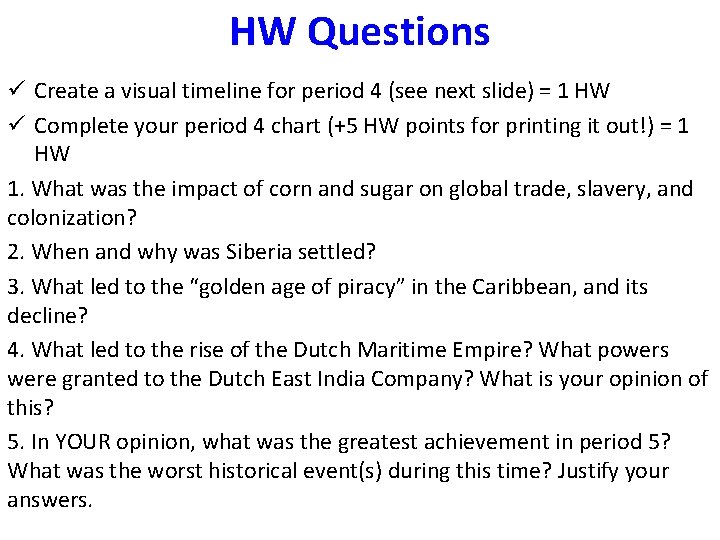
HW Questions ü Create a visual timeline for period 4 (see next slide) = 1 HW ü Complete your period 4 chart (+5 HW points for printing it out!) = 1 HW 1. What was the impact of corn and sugar on global trade, slavery, and colonization? 2. When and why was Siberia settled? 3. What led to the “golden age of piracy” in the Caribbean, and its decline? 4. What led to the rise of the Dutch Maritime Empire? What powers were granted to the Dutch East India Company? What is your opinion of this? 5. In YOUR opinion, what was the greatest achievement in period 5? What was the worst historical event(s) during this time? Justify your answers.
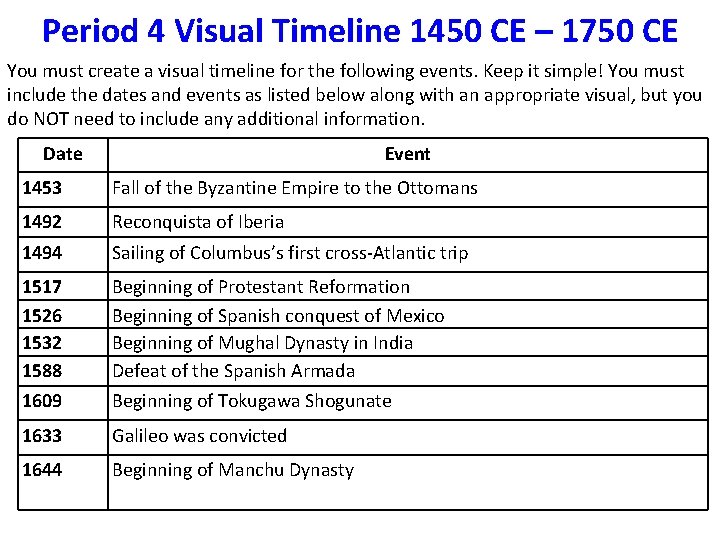
Period 4 Visual Timeline 1450 CE – 1750 CE You must create a visual timeline for the following events. Keep it simple! You must include the dates and events as listed below along with an appropriate visual, but you do NOT need to include any additional information. Date Event 1453 Fall of the Byzantine Empire to the Ottomans 1492 Reconquista of Iberia 1494 Sailing of Columbus’s first cross Atlantic trip 1517 1526 1532 1588 1609 Beginning of Protestant Reformation Beginning of Spanish conquest of Mexico Beginning of Mughal Dynasty in India Defeat of the Spanish Armada Beginning of Tokugawa Shogunate 1633 Galileo was convicted 1644 Beginning of Manchu Dynasty
- Slides: 38