
Period 1 0 THE LATER MIDDLE AGES 1300
- Slides: 37
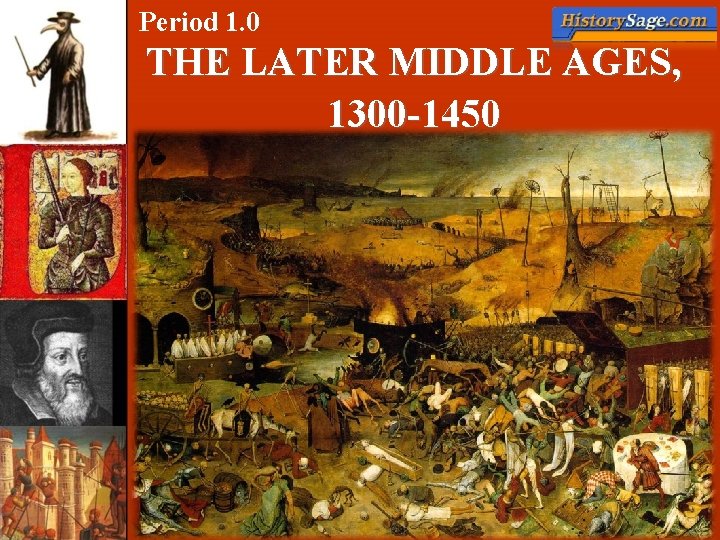
Period 1. 0 THE LATER MIDDLE AGES, 1300 -1450
Learning Objective: Students will understand the evolution of European society from antiquity through the Later Middle Ages and analyze the ways in which religious, economic, and social upheaval affected late-Medieval society.
Period 1. 0 Major Periods in European History I. Ancient Greece/Rome (c. 500 BCE-500 CE) II. Middle Ages- 5 th Century CE to approx. 1450 A. Early Middle Ages (476 CE to 900 CE) B. High Middle Ages (1050 - 1300) C. Later Middle Ages (1300 - 1450) III. Modern Era (1450 to the present) 1. Renaissance: 1450 - 1600 (1300 -1527 in Italy) 2. 17 th – 21 st centuries
I. Black Death (1347) A. Causes 1. The Bubonic plague was carried by fleas on Asian black rats and brought to Europe on ships returning from Asia. 2. Overcrowding in cities and homes facilitated the spread of the disease. 3. Poor sanitation in cities: garbagefilled streets, human excrement, and dead animals
4. Widespread malnutrition prior to the plague led to poor health (e. g. lower immune systems) that made people more susceptible to the disease. • 25% harvests in the early 14 th century were poor as torrential rains destroyed wheat, oats, and hay crops; some instances of cannibalism occurred. 5. Poor hygiene also played a significant role. • Many people believed (correctly) that their water was contaminated and
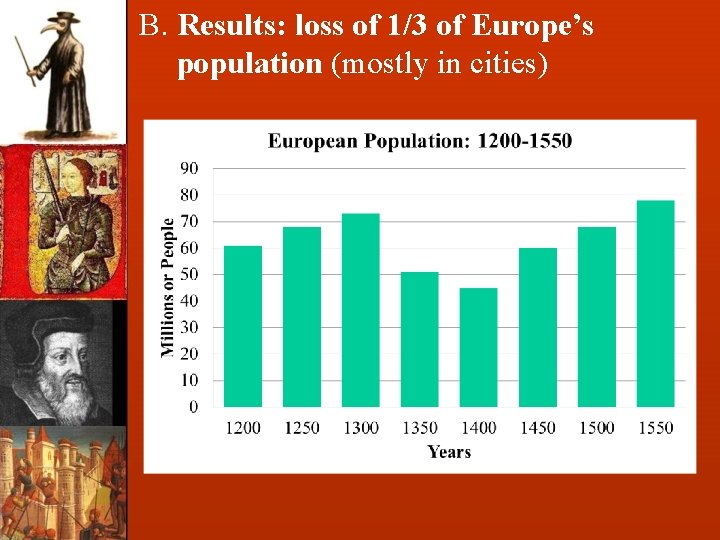
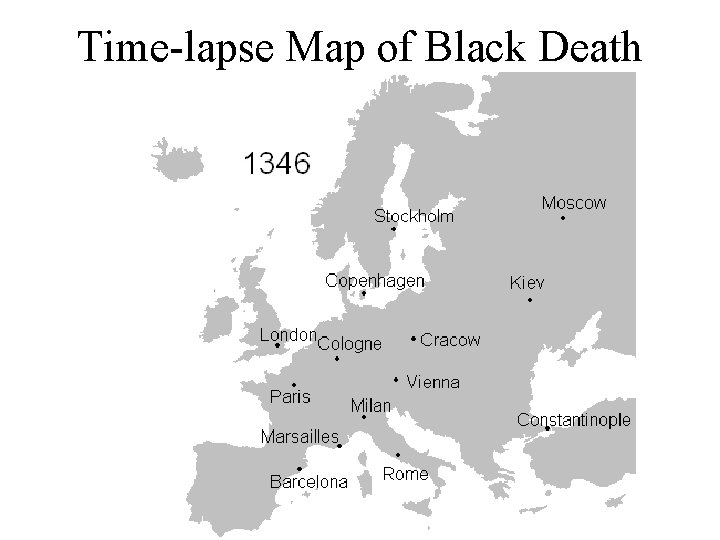
B. Results: loss of 1/3 of Europe’s population (mostly in cities)
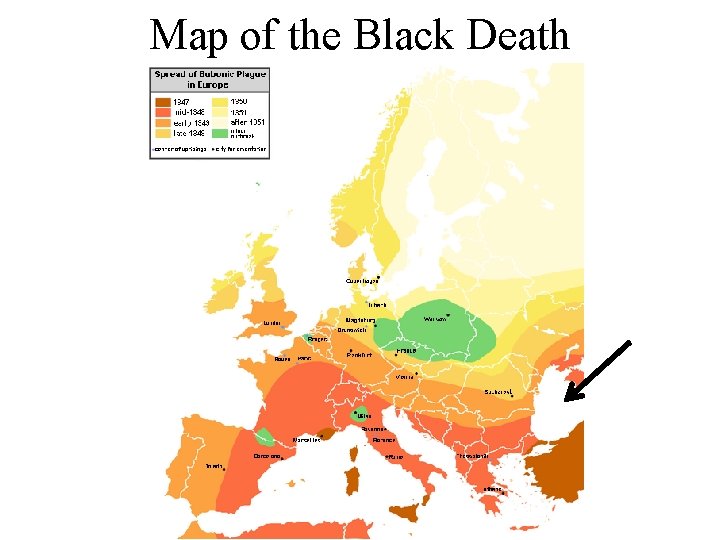
Map of the Black Death
Time-lapse Map of Black Death
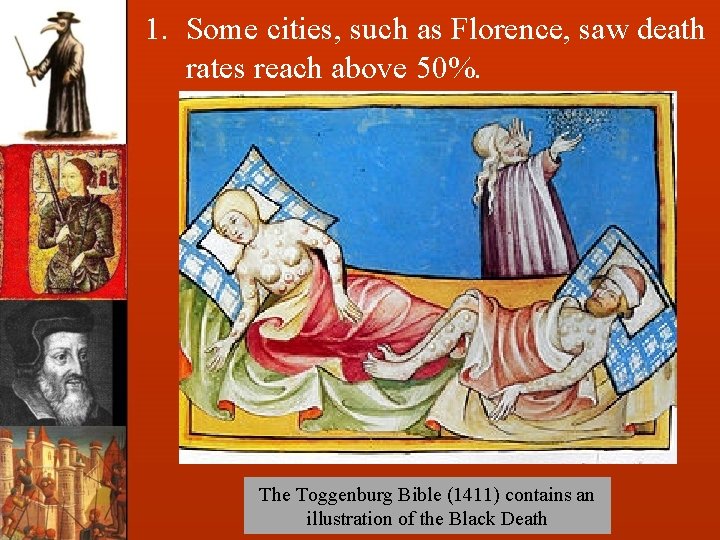
1. Some cities, such as Florence, saw death rates reach above 50%. The Toggenburg Bible (1411) contains an illustration of the Black Death
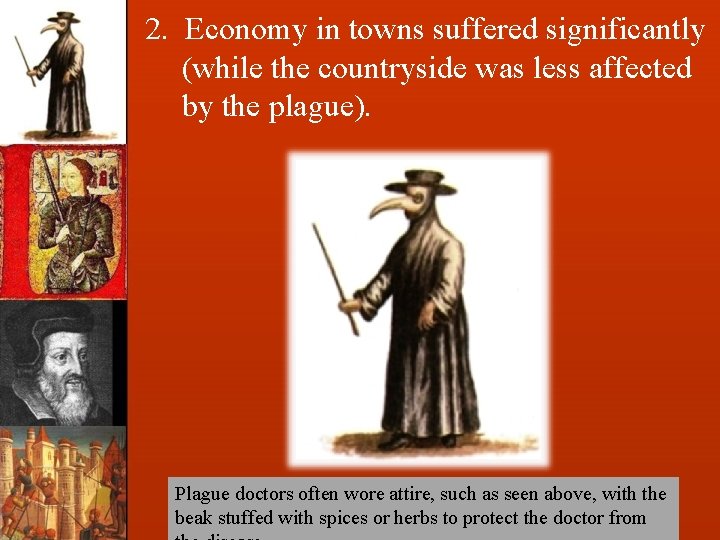
2. Economy in towns suffered significantly (while the countryside was less affected by the plague). Plague doctors often wore attire, such as seen above, with the beak stuffed with spices or herbs to protect the doctor from
3. In some areas, workers enjoyed higher wages as the supply of workers was depleted. 4. Impact on the peasantry a. Serfdom ended in many areas of western Europe. b. Major peasant revolts occurred in England France.
5. The first enclosure of fields in Britain occurred as landowners needed better agricultural production with fewer farm hands; this was largely done for sheep herding. 6. The best of the clergy died (as they stayed behind to help the sick). 7. Jews were often blamed for the plague and thus persecuted. • This continued the age-old phenomenon of anti-Semitism in Europe.
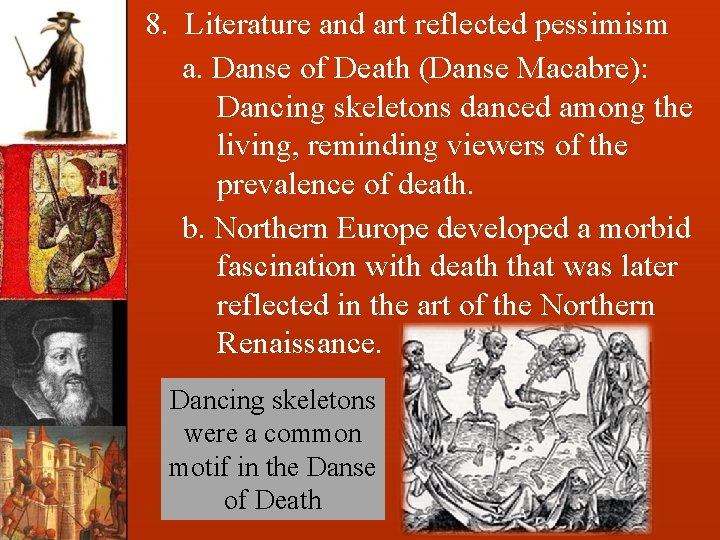
8. Literature and art reflected pessimism a. Danse of Death (Danse Macabre): Dancing skeletons danced among the living, reminding viewers of the prevalence of death. b. Northern Europe developed a morbid fascination with death that was later reflected in the art of the Northern Renaissance. Dancing skeletons were a common motif in the Danse of Death
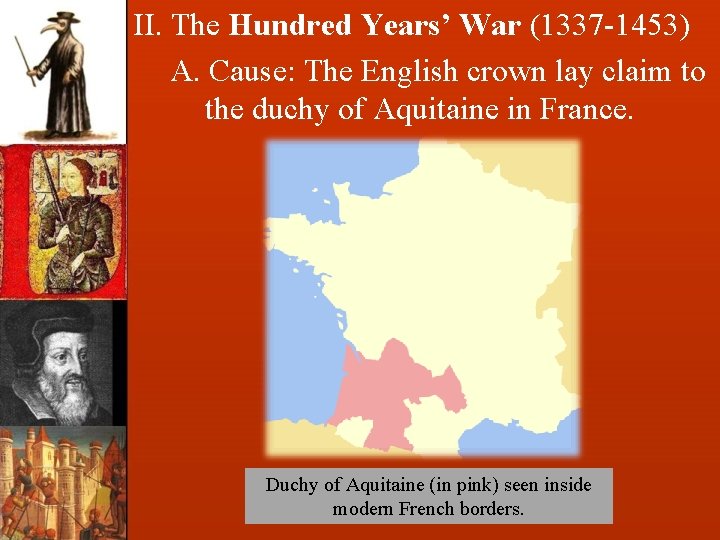
II. The Hundred Years’ War (1337 -1453) A. Cause: The English crown lay claim to the duchy of Aquitaine in France. Duchy of Aquitaine (in pink) seen inside modern French borders.
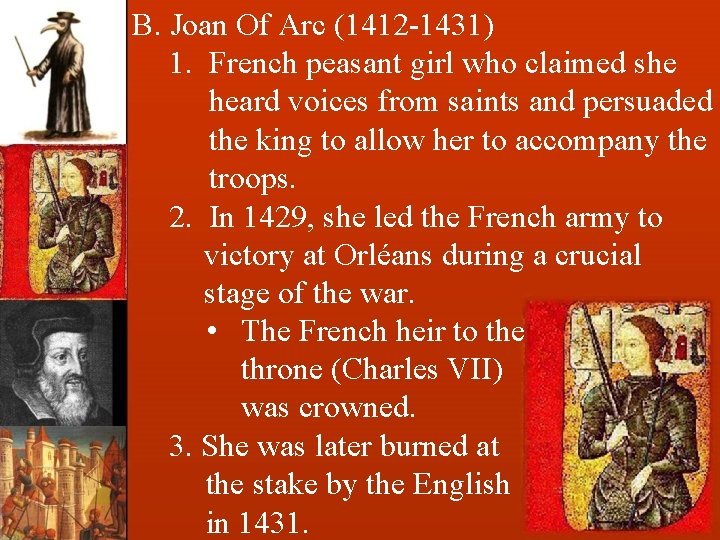
B. Joan Of Arc (1412 -1431) 1. French peasant girl who claimed she heard voices from saints and persuaded the king to allow her to accompany the troops. 2. In 1429, she led the French army to victory at Orléans during a crucial stage of the war. • The French heir to the throne (Charles VII) was crowned. 3. She was later burned at the stake by the English in 1431.
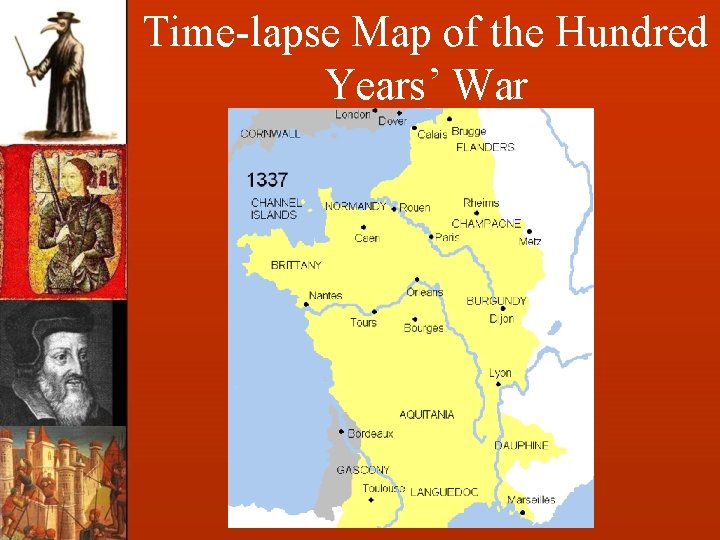
Time-lapse Map of the Hundred Years’ War
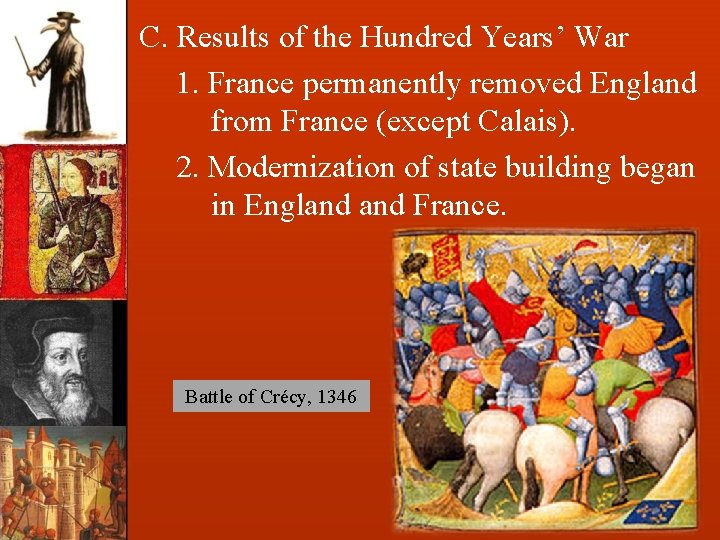
C. Results of the Hundred Years’ War 1. France permanently removed England from France (except Calais). 2. Modernization of state building began in England France. Battle of Crécy, 1346
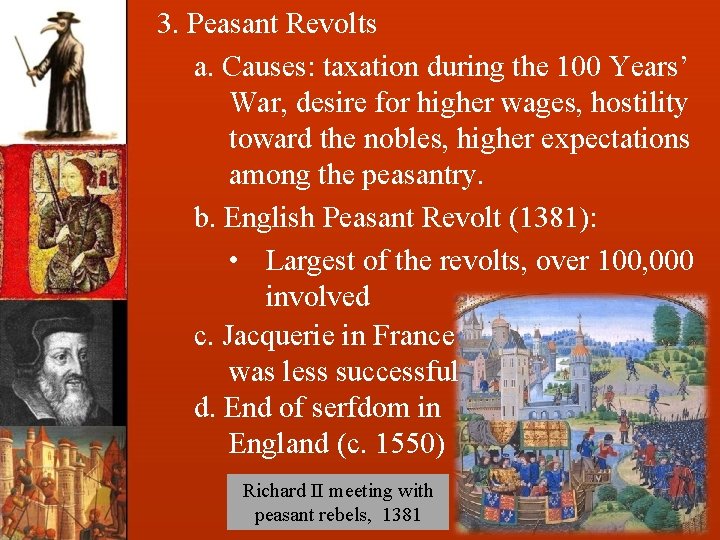
3. Peasant Revolts a. Causes: taxation during the 100 Years’ War, desire for higher wages, hostility toward the nobles, higher expectations among the peasantry. b. English Peasant Revolt (1381): • Largest of the revolts, over 100, 000 involved c. Jacquerie in France was less successful d. End of serfdom in England (c. 1550) Richard II meeting with peasant rebels, 1381
III. Crisis in the Catholic Church A. Background 1. Western and central Europe was dominated by the Catholic church since the fall of the Roman Empire. a. Religious authorities in many regions were more powerful than secular authorities. b. Popes, at times, were the most powerful political figures in all of Europe.
2. The Middle Ages were characterized by religious unity under the Catholic church. a. Meanwhile, the Greek Orthodox Church (Eastern Orthodox Church) was dominant in the Byzantine Empire in the modern -day Balkans and parts of eastern Europe, including Russia. b. There was little cooperation between the Catholic and Orthodox churches.
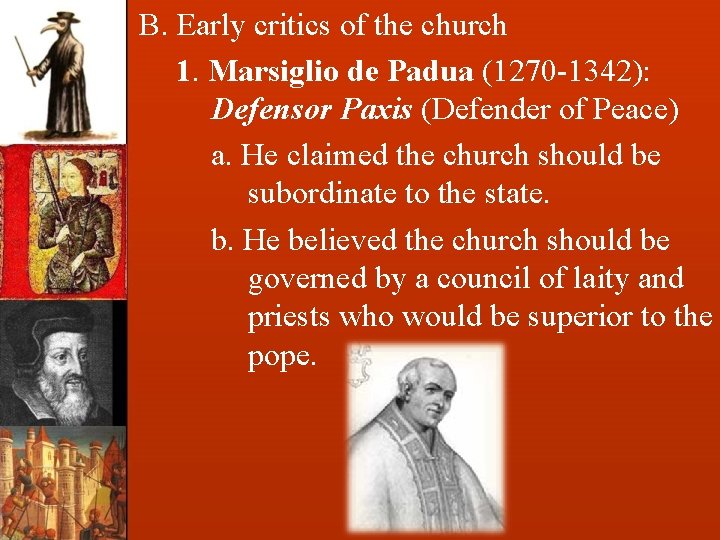
B. Early critics of the church 1. Marsiglio de Padua (1270 -1342): Defensor Paxis (Defender of Peace) a. He claimed the church should be subordinate to the state. b. He believed the church should be governed by a council of laity and priests who would be superior to the pope.
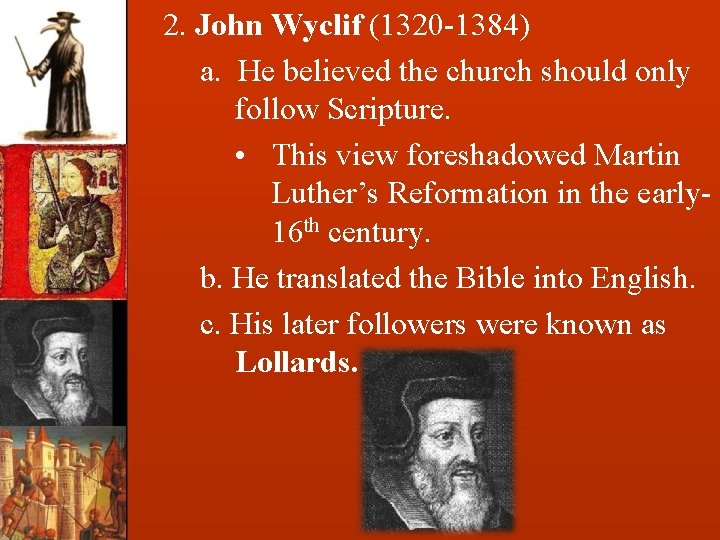
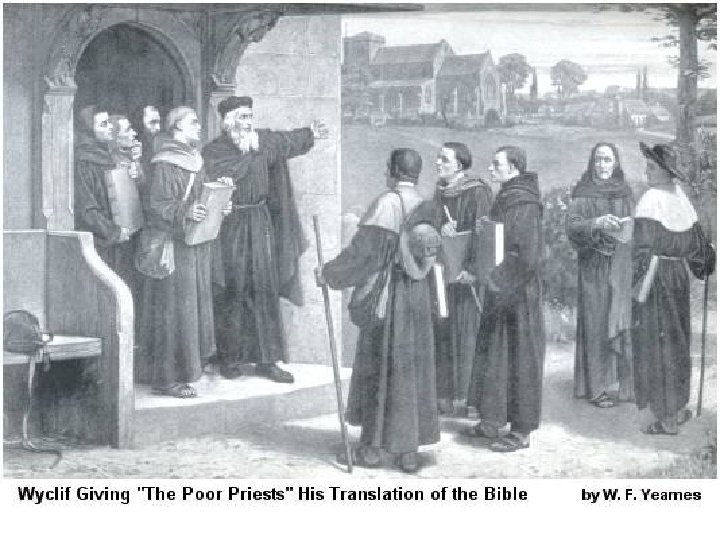
2. John Wyclif (1320 -1384) a. He believed the church should only follow Scripture. • This view foreshadowed Martin Luther’s Reformation in the early 16 th century. b. He translated the Bible into English. c. His later followers were known as Lollards.
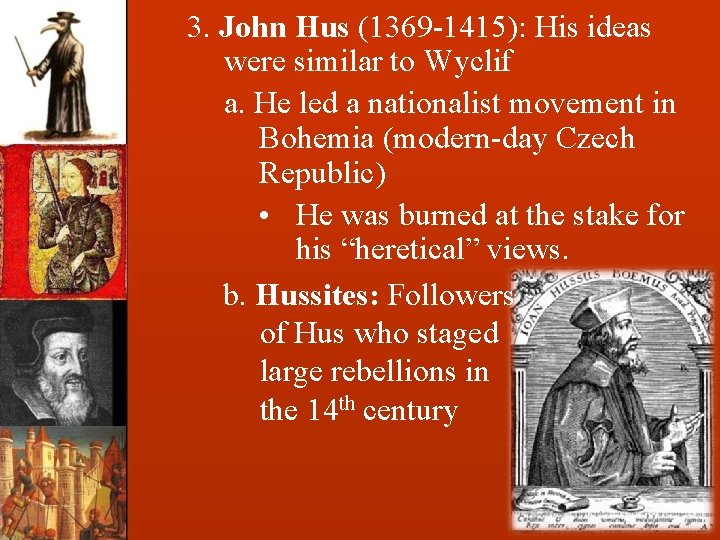
3. John Hus (1369 -1415): His ideas were similar to Wyclif a. He led a nationalist movement in Bohemia (modern-day Czech Republic) • He was burned at the stake for his “heretical” views. b. Hussites: Followers of Hus who staged large rebellions in the 14 th century
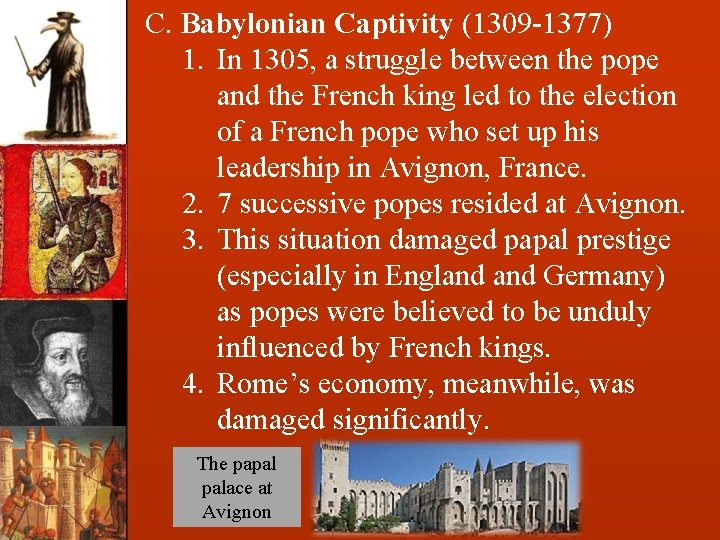
C. Babylonian Captivity (1309 -1377) 1. In 1305, a struggle between the pope and the French king led to the election of a French pope who set up his leadership in Avignon, France. 2. 7 successive popes resided at Avignon. 3. This situation damaged papal prestige (especially in England Germany) as popes were believed to be unduly influenced by French kings. 4. Rome’s economy, meanwhile, was damaged significantly. The papal palace at Avignon
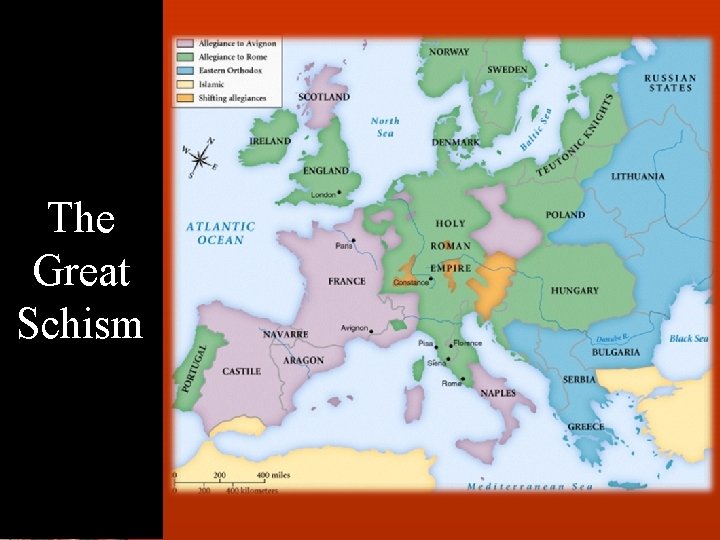
D. The Great Schism (c. 1377 -1417) 1. Further conflict occurred in 1377 when two popes were elected—one in Rome, one in France—neither of whom recognized the other. 2. This further damaged the prestige of the church.
The Great Schism
E. Conciliar Movement (1409 -1418): ended the Great Schism 1. It sought to reform the church by creating a council of cardinals that would be more powerful than the pope. 2. It failed as a movement; the newlyelected Pope Martin V ensured papal power still remained supreme.
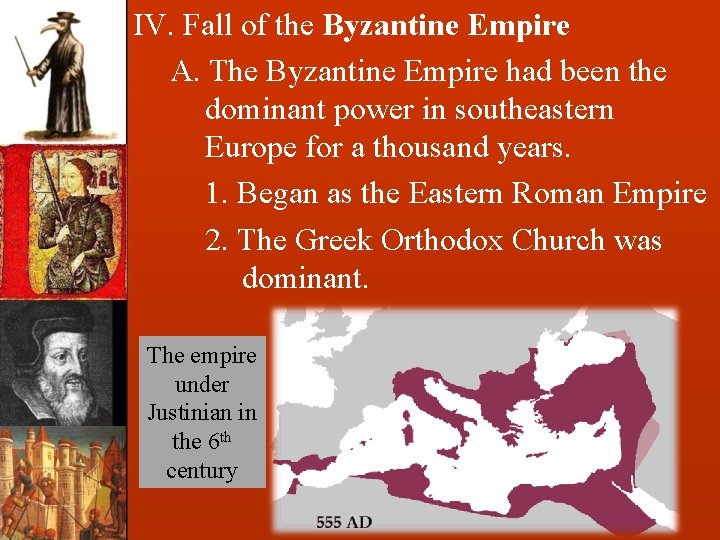
IV. Fall of the Byzantine Empire A. The Byzantine Empire had been the dominant power in southeastern Europe for a thousand years. 1. Began as the Eastern Roman Empire 2. The Greek Orthodox Church was dominant. The empire under Justinian in the 6 th century
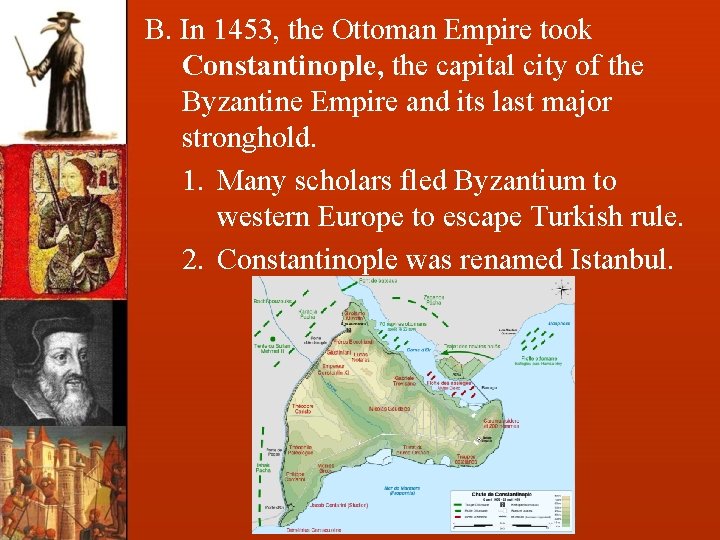
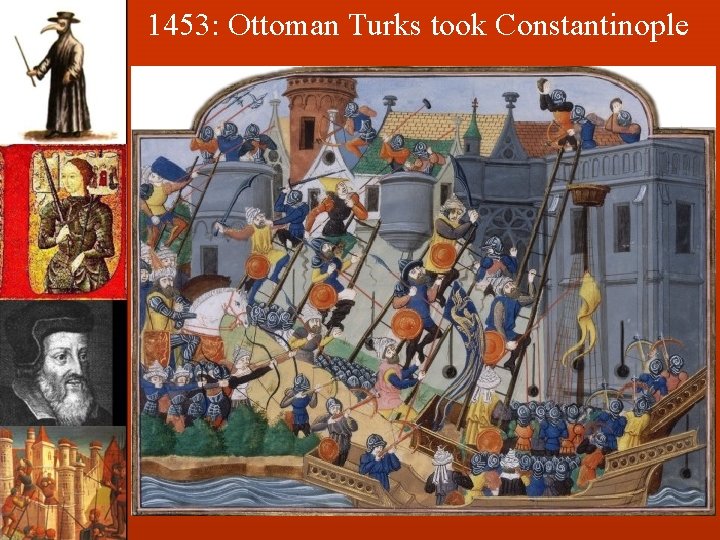
B. In 1453, the Ottoman Empire took Constantinople, the capital city of the Byzantine Empire and its last major stronghold. 1. Many scholars fled Byzantium to western Europe to escape Turkish rule. 2. Constantinople was renamed Istanbul.
1453: Ottoman Turks took Constantinople
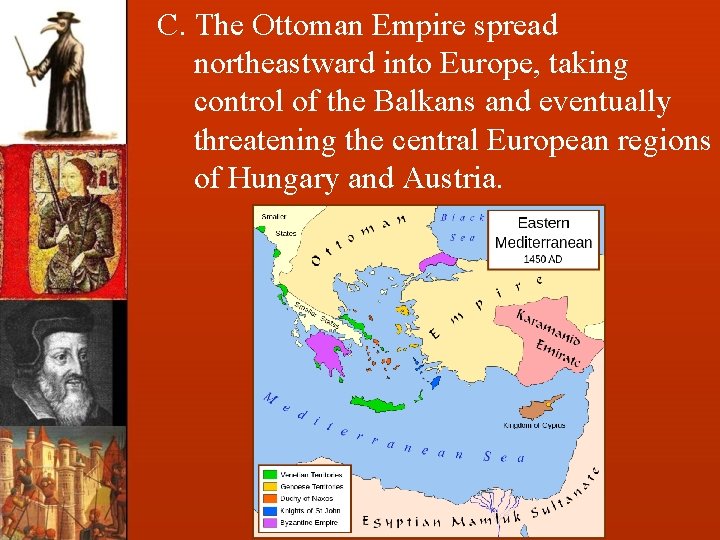
C. The Ottoman Empire spread northeastward into Europe, taking control of the Balkans and eventually threatening the central European regions of Hungary and Austria.
V. Nationalist literature of the Later Middle Ages A. Rise in the use of the vernacular (national language) B. Dante Alighieri (1265 -1321), The Divine Comedy C. Geoffrey Chaucer (1340 -1400): Canterbury Tales portrayed English life D. Francois Villon (1431 -1463): 1. Grand Testament (1461): Portrayed ordinary French life with humor and emotion. 2. Greatest poet of Medieval France
VI. Life in the Later Middle Ages A. Marriage 1. Average for men: mid-20 s; for women: 16 -18 years of age 2. Economic reasons were most important for marriage (love was not paramount until the 18 th-19 th centuries). 3. Divorce was unheard of in Catholic countries. 4. Prostitution existed in cities (customers were often young middle-class men who didn’t marry until later).
B. Work 1. Agricultural cycles and church ritual were closely linked. 2. A small percentage of men were artisans in towns and were protected by guilds. 3. Serfdom was reduced in many areas. C. Recreation 1. Aristocracy: jousting tournaments 2. Common people: archery, wrestling, bull-baiting, bear baiting, alcohol consumption D. The laity increasingly managed church
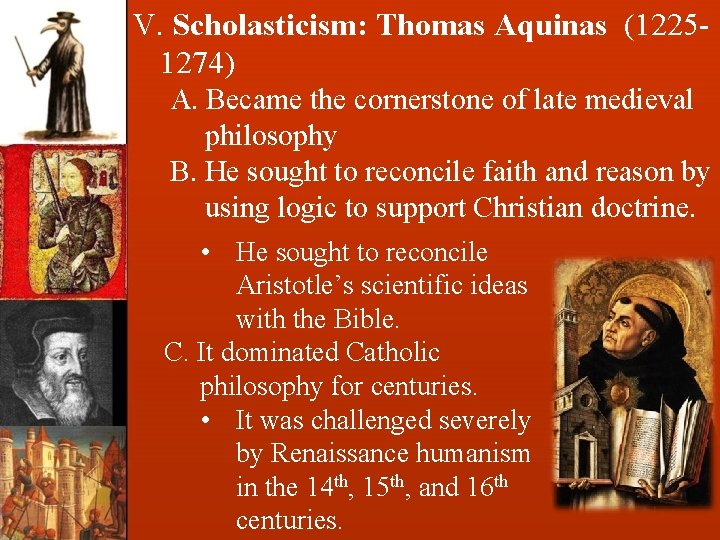
V. Scholasticism: Thomas Aquinas (12251274) A. Became the cornerstone of late medieval philosophy B. He sought to reconcile faith and reason by using logic to support Christian doctrine. • He sought to reconcile Aristotle’s scientific ideas with the Bible. C. It dominated Catholic philosophy for centuries. • It was challenged severely by Renaissance humanism in the 14 th, 15 th, and 16 th centuries.