
Perio TOU Topics Classification PerioSystemic Modifying Risk Factors

- Slides: 40
Perio TOU
Topics -Classification -Perio-Systemic -Modifying Risk Factors -Predisposing Risk Factors -SPT
Classification -Gingivitis -NUG -Periodontitis -Aggressive -Chronic -Mild, moderate severe -Localised (<30%), generalised (>30%)
Gingivitis -Non-specific infection due to presence of plaque -No bone loss -Pocket <3 mm -Treatment involves scale and clean + OHI -Maybe prophy, mouthrinses
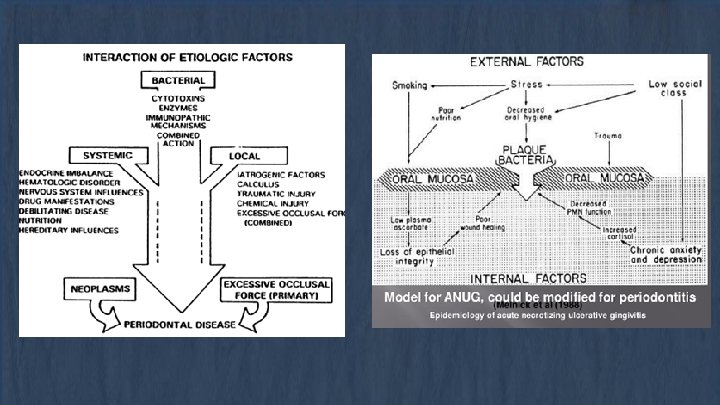
Necrotising Ulcerative Gingivitis -Complex aetiology -Local factors -Poor oral hygiene -Plaque retentive factors e. g. overhangs, crowded teeth, calculus -Cigarette smoking -Systemic -Stress -Poor nutrition -Hormonal imbalance -Systemic disease affecting immune responsiveness e. g. HIV
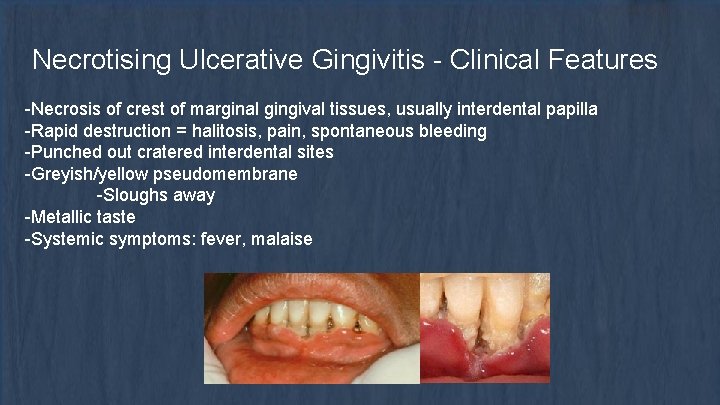
Necrotising Ulcerative Gingivitis - Clinical Features -Necrosis of crest of marginal gingival tissues, usually interdental papilla -Rapid destruction = halitosis, pain, spontaneous bleeding -Punched out cratered interdental sites -Greyish/yellow pseudomembrane -Sloughs away -Metallic taste -Systemic symptoms: fever, malaise
Necrotising Ulcerative Gingivitis - Treatment -Debridement under LA while irrigating with CHX 0. 2% or Hydrogen Peroxide 3% -Remove plaque and debris -Smoking Cessation -Analgesics -Metronidazole 400 mg bds, 5/7 OR tinidazole 2 g (4 x 500 mg) once orally if pt compliance an issue -PLUS in all pt CHX 0. 2% 10 m. L for 1 minute 8 -12 hourly until pain goes away -OR CHX 0. 12%, 15 m. L for 1 minute 8 -12 hourly until pain goes away -If immunocompromised or unresponsive refer to specialist -Metro as before -Plus amoxycillin 500 mg, tds, 5/7 -OR phenoxymethylpenicillin 500 mg orally 6 -hourly 5/7 -If allergic Clindamycin 300 mg, tds, 5/7
Necrotising Ulcerative Periodontitis -Bone + PDL undergoes necrosis as well -Bone may come out in spicules -Usually found in people with systemic conditions e. g. HIV, severe malnutrition and immunosuppression
Chronic Periodontitis -Inflammation of gingiva, resorption of alveolar bone, degeneration of PDL -Variable rate of progression -Various factors can affect disease -Often find calculus + plaque -Chronic perio more common (up to 60% of population) -Damage proportional to amount of calc + plaque -Due to red complex bacteria -Can lead to tooth loss -Treatment is full mouth debridement (supra and subgingival) + possible surgery if patient does not respond -In general mild shouldn’t require surgery, moderate aend severe may require surgery
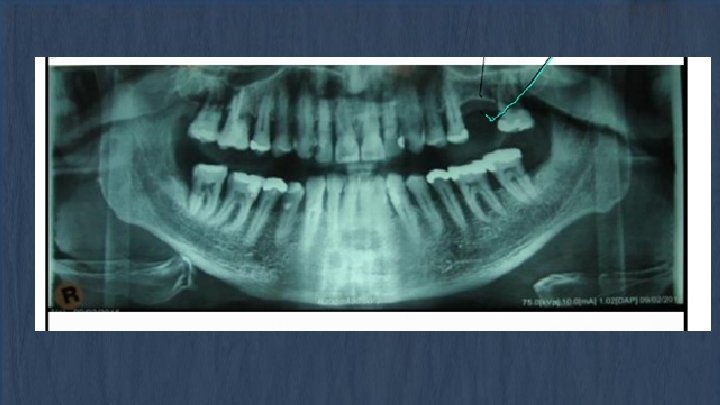
Aggressive Periodontitis -Usually affects people under 30 years of age -Seen as large amount of bone loss in younger patients -Family history -Medical history usually clear Treatment: -Thorough debridement with/without flaps -Antibiotics and chemical control essential -OHI reinforcement -Recall 3 -6 months with full scaling and root planing every 2 -3 years -Usually referred to specialists due to technical complexity of surgical procedures + close monitoring
Modifying Risk Factors -Modify disease expression by altering host protective mechanisms -Basically something the patient has/does that changes the disease -Smoking -Genetics -Stress -Neutrophil dysfunction (e. g. HIV)
Smoking -Highest risk factor for perio tissue destruction -Causes catecholamines which induce vasoconstriction in peripheral circulatory system -7 fewer teeth compared to non-smokers by age 70 -Alters -Bacterial flora -Host tissues -Host vasculature -Host immune response -Host inflammatory response -Healing of periodontal connective tissue
Effects on bacterial flora -Smokers have more plaque and virulent types of periodontal bacteria -More likely to have subgingival infection with perio pathogens e. g. A. A. , B forsythus and P. gingivalis -More anaerobic bacteria -More red complex species present in current smokers
Effects on PMNs and Antibodies -Smokers have increased neutrophils in circulation but reduced amount of PMN in sulcus -Suggested to be due to vasoconstriction decreasing blood flow -Smoking impairs the function of PMNs -Decreases serum Ig. G, increases Ig. E and proinflammatory cytokines
Effects on Cytokines -Increases level of PGE 2, IL-4, IL-8 and TNF-α in GCF but decreased IL-6 -IL-6 is anti-inflammatory cytokine
Effects on Cells Epithelial: -Increases proliferation of gingival keratinocytes therefore increased levels of keratin Fibroblasts: -Impaired adhesion to root surfaces, affects periodontal regen -Prevents seal forming therefore reduced healing
Effects on Vasculature -Smoking reduces gingival redness and BOP -Reduction in blood flow reduces number of erythrocytes, oxygen and other blood constituents -Therefore reduces capacity to remove tissue waste products -Overall smokers have worse outcome for non-surgical and surgical therapy and worse outcome for implant therapy
Diabetes -Suffer from xerostomia therefore increased caries, opportunistic infections -Increased gingival bleeding -Makes perio worse -Perio is 6 th complication of diabetes
Modification of Host/Bacteria Relationship -Non-enzymatic glycosylation -When exposed to large amounts of glucose collagen changes shape -Alters structure and turnover rate of collage -Implications in attachment -Collagen forms too quickly and in too thick layers -Thickening of basement membrane impairing oxygen and nutrient diffusion, waste elimination, leukocyte migration
Vascular Changes -Interferes with delivery of nutrients and oxygen, removal of waste, leukocyte migration -Basically reduced blood flow means less stuff gets transferred -Monocytes have altered response -Could prevent development of macrophages associated with repair
PMN and Cytokine production -PMN migration decreased -Neutrophils also cannot ingest pathogens as well -Increased release of cytokines such as IL-1, PGE-2, TNF-α
Poor Wound Healing -Due to cumulative effects and tissue modification -Hyperglycemia results in decreased cellular proliferation and growth of fibroblast -Reduced collagen production + glycosylation of existing collagen results in defective remodelling, degradation of new collagen -No wound healing and therefore infection
Periodontitis and Diabetes -Perio makes it harder to control diabetes and diabetes worsens perio (reciprocal) -Perio treatment is only successful in well controlled diabetes -Diabetes also impairs neutrophil function therefore more susceptible to bacterial infection
Stress -Associated with concurrent activation of hypothalamic-pituitary-adrenal axis -Stress releases hormones causing glucocorticoids to be released which increase production of pro-inflammatory cytokines -Essentially stress causes release of pro-inflammatory cytokines = bad -Difficult to treat stress
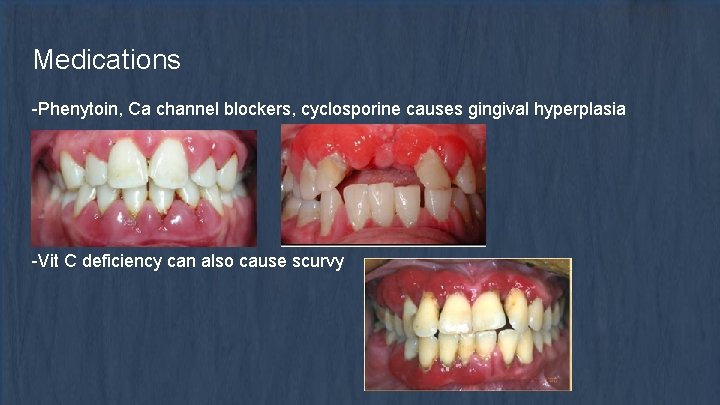
Medications -Phenytoin, Ca channel blockers, cyclosporine causes gingival hyperplasia -Vit C deficiency can also cause scurvy
Genetics -May affect immunity -Essentially how body responds to bacterial invasion -Perio suggested to have family history
HIV -Associated with linear gingival erythema, NUG or severe localised perio -CD 4 positive T cell count of less than 200 may have severe and extensive chronic perio
Other -Periods of hormone change e. g. menstruation, puberty and pregnancy alters permeability of blood vessels -Especially progesterone --> also increases collagen prodcution + increased chemotaxis of PMN -Increases risk of perio -Osteoporosis --> affects density of bone which reduces strength and mass making it more susceptible to perio -Especially in menopause where pro-inflammatory cytokines produced as a response to oestrogen withdrawal
Predisposing Risk Factors -Factors that interfere with host’s ability to reduce plaque which may increase risk of perio progression -Basically something that stops someone from removing plaque -Oral hygiene -Calculus -Dentures -Tooth malposition -Gingival contour -Local environment e. g. if subgingival biofilm left undisturbed, gram negative anaerobes flourish
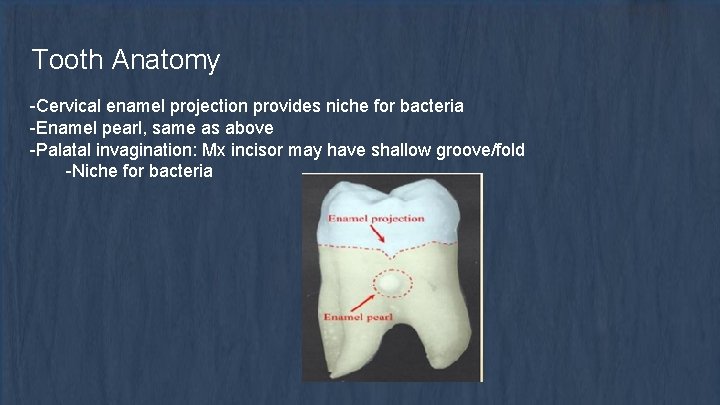
Tooth Anatomy -Cervical enamel projection provides niche for bacteria -Enamel pearl, same as above -Palatal invagination: Mx incisor may have shallow groove/fold -Niche for bacteria
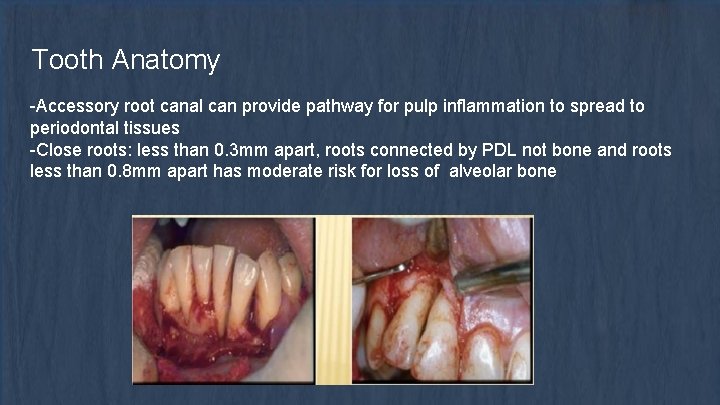
Tooth Anatomy -Accessory root canal can provide pathway for pulp inflammation to spread to periodontal tissues -Close roots: less than 0. 3 mm apart, roots connected by PDL not bone and roots less than 0. 8 mm apart has moderate risk for loss of alveolar bone
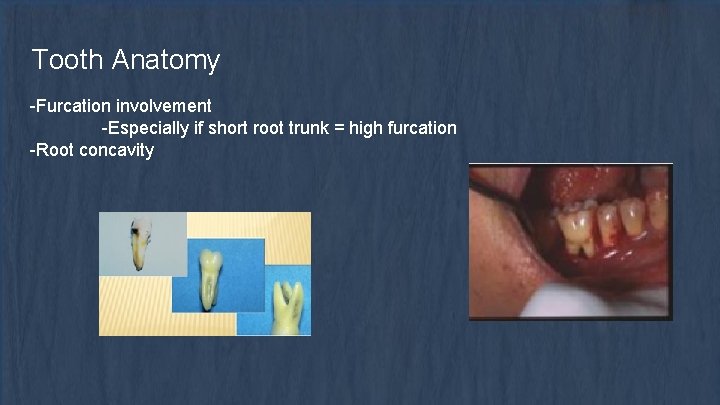
Tooth Anatomy -Furcation involvement -Especially if short root trunk = high furcation -Root concavity
Overhanging Margins -Accumulates plaque + food -Increased number of G-ve anaerobes -Causes bone loss
Dentures -Partial dentures only -Increases amount of pathogenic bacteria due to easier calculus formation
OH/Plaque and Calculus -More plaque = more bacteria -Calculus makes it easier for bacteria to proliferate + form biofilms
Tooth Malposition + Gingival Contour -May create niches for bacteria to grow -If malposition causes roots to be pushed closer together have issues of root proximity -High frenal attachment can cause recession
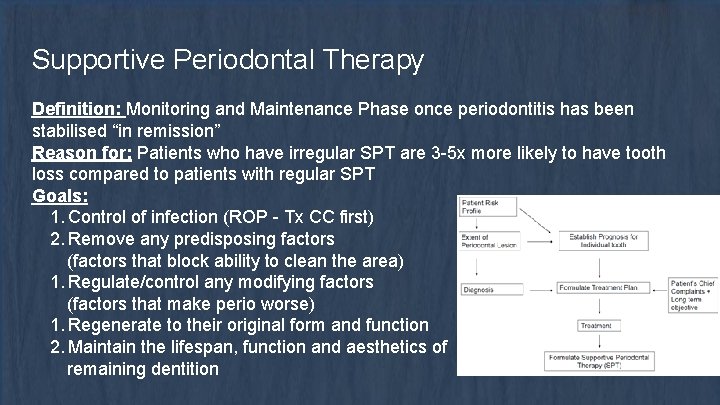
Supportive Periodontal Therapy Definition: Monitoring and Maintenance Phase once periodontitis has been stabilised “in remission” Reason for: Patients who have irregular SPT are 3 -5 x more likely to have tooth loss compared to patients with regular SPT Goals: 1. Control of infection (ROP - Tx CC first) 2. Remove any predisposing factors (factors that block ability to clean the area) 1. Regulate/control any modifying factors (factors that make perio worse) 1. Regenerate to their original form and function 2. Maintain the lifespan, function and aesthetics of remaining dentition
Supportive Periodontal Therapy Appointment Steps 1. Examination and re-evaluation - Patient factors - Oral factors - Site factors 1. Motivation, re-instruction and instrumentation 2. Treatment of reinfected sites 3. Polish, application of fluoride and determination of future SPT Periodontal Risk Assessment: Spider web thing that inc. factors (environment, BL/Age, tooth loss, PD>5 mm, BOP) Review times for patients after SPT: 8 -12 weeks after initial periodontal therapy - No probing/exam before that - healing - Re-probe at SPT appointment → rechart, debride areas with no response - Maintenance phase decided after debridement - Monitor 1 month, 3 month, 6 month, 1 year