
PERIMETER PATTERNS The University of Texas at Dallas

- Slides: 33
PERIMETER PATTERNS The University of Texas at Dallas
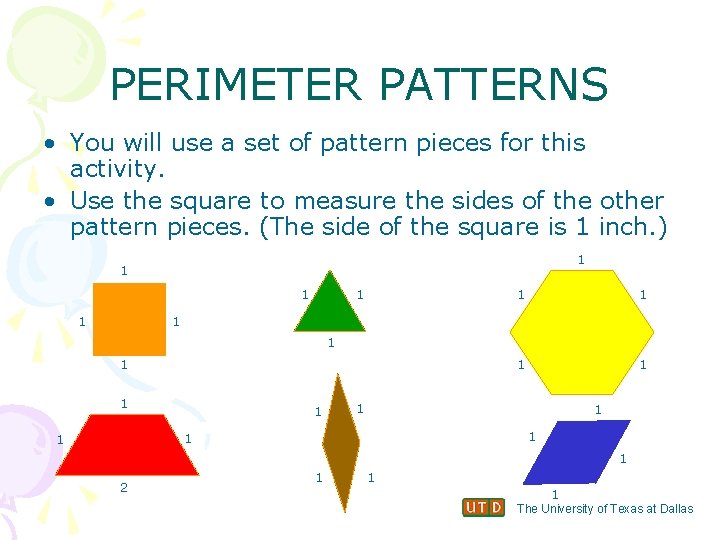
PERIMETER PATTERNS • You will use a set of pattern pieces for this activity. • Use the square to measure the sides of the other pattern pieces. (The side of the square is 1 inch. ) 1 1 1 1 1 2 1 1 1 The University of Texas at Dallas
PERIMETER PATTERNS • Use the squares to create a sequence. • Record your results in a table. Number of squares perimeter 1 2 4 6 3 4 1+1+1+1=4 5 6 Remember that perimeter is the sum of the sides of a polygon 1+1+1+1=6 Complete the table! The University of Texas at Dallas
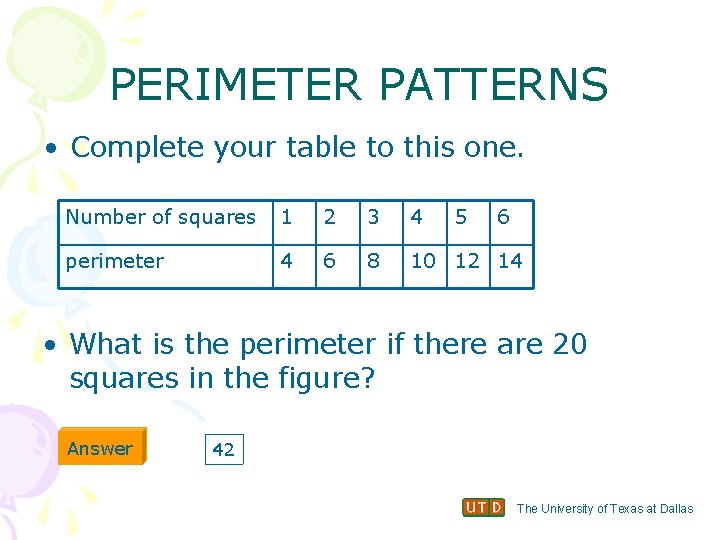
PERIMETER PATTERNS • Complete your table to this one. Number of squares 1 2 3 4 5 6 perimeter 4 6 8 10 12 14 • What is the perimeter if there are 20 squares in the figure? Answer 42 The University of Texas at Dallas
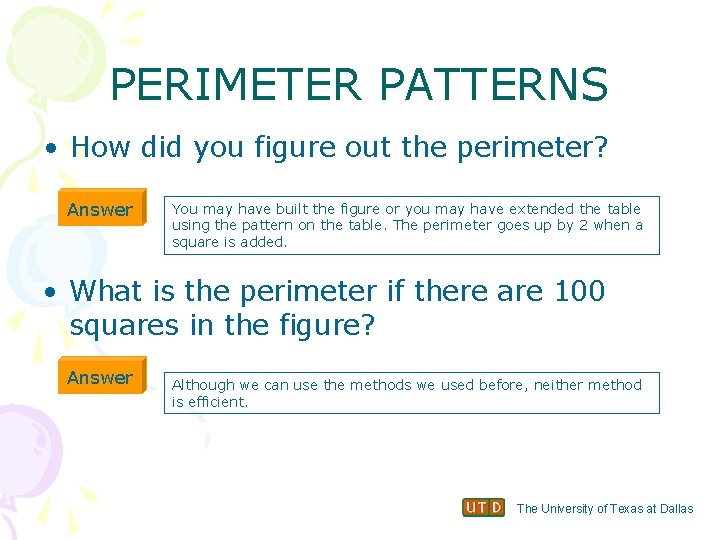
PERIMETER PATTERNS • How did you figure out the perimeter? Answer You may have built the figure or you may have extended the table using the pattern on the table. The perimeter goes up by 2 when a square is added. • What is the perimeter if there are 100 squares in the figure? Answer Although we can use the methods we used before, neither method is efficient. The University of Texas at Dallas
PERIMETER PATTERNS • Let’s look for a pattern based on how many squares are used in the sequence. • We know that adding a square adds 2 to the perimeter. • Think about that pattern. The University of Texas at Dallas
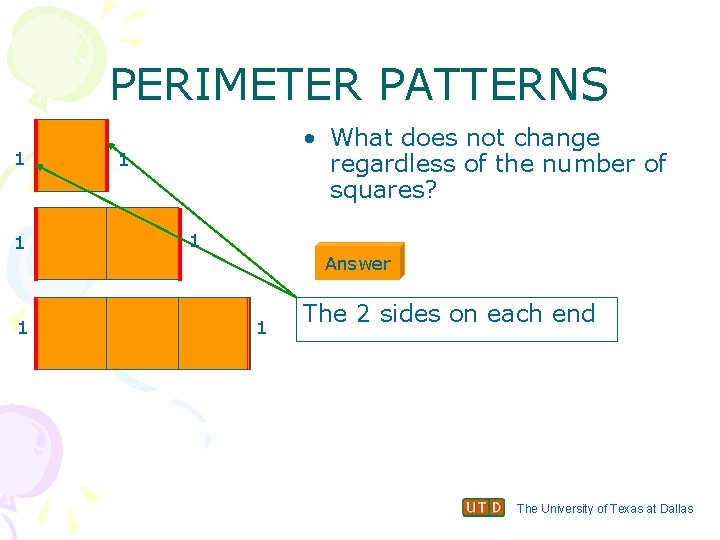
PERIMETER PATTERNS 1 1 1 • What does not change regardless of the number of squares? 1 1 Answer 1 The 2 sides on each end The University of Texas at Dallas
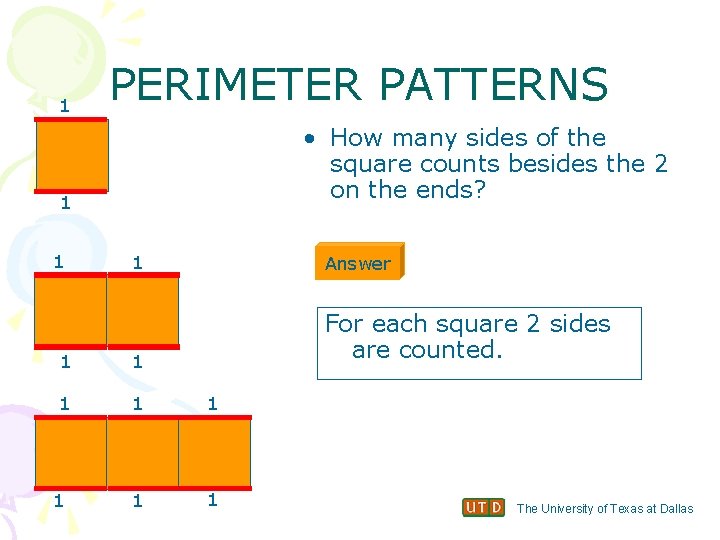
1 PERIMETER PATTERNS • How many sides of the square counts besides the 2 on the ends? 1 1 1 Answer 1 1 For each square 2 sides are counted. 1 1 1 The University of Texas at Dallas
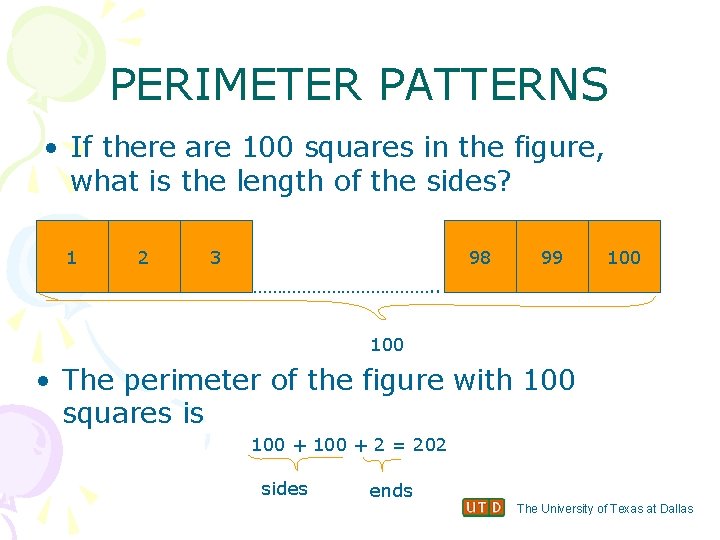
PERIMETER PATTERNS • If there are 100 squares in the figure, what is the length of the sides? 1 2 3 98 99 100 ………………. . 100 • The perimeter of the figure with 100 squares is 100 + 2 = 202 sides ends The University of Texas at Dallas
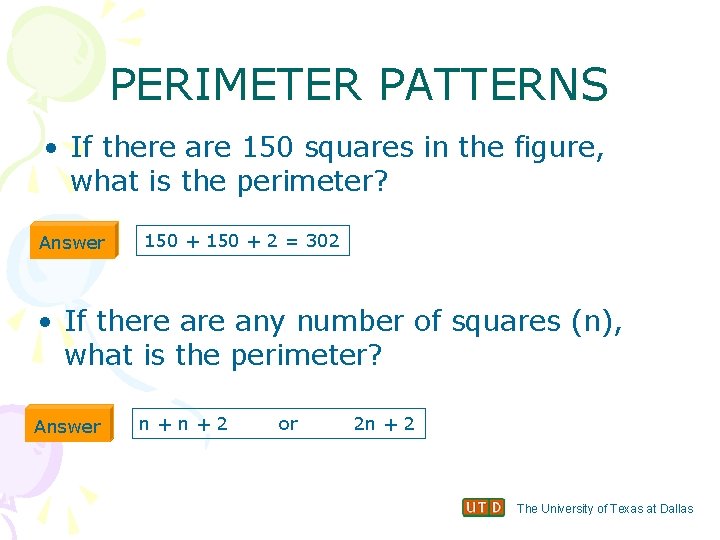
PERIMETER PATTERNS • If there are 150 squares in the figure, what is the perimeter? Answer 150 + 2 = 302 • If there any number of squares (n), what is the perimeter? Answer n+n+2 or 2 n + 2 The University of Texas at Dallas
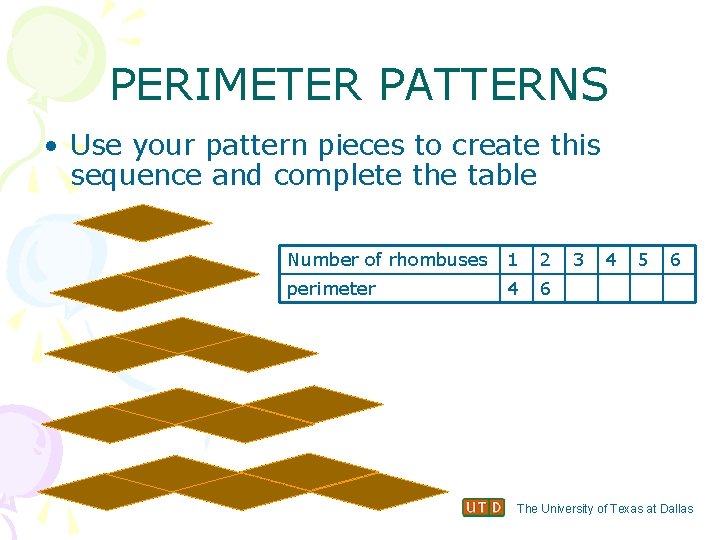
PERIMETER PATTERNS • Use your pattern pieces to create this sequence and complete the table Number of rhombuses 1 2 perimeter 4 6 3 4 5 6 The University of Texas at Dallas
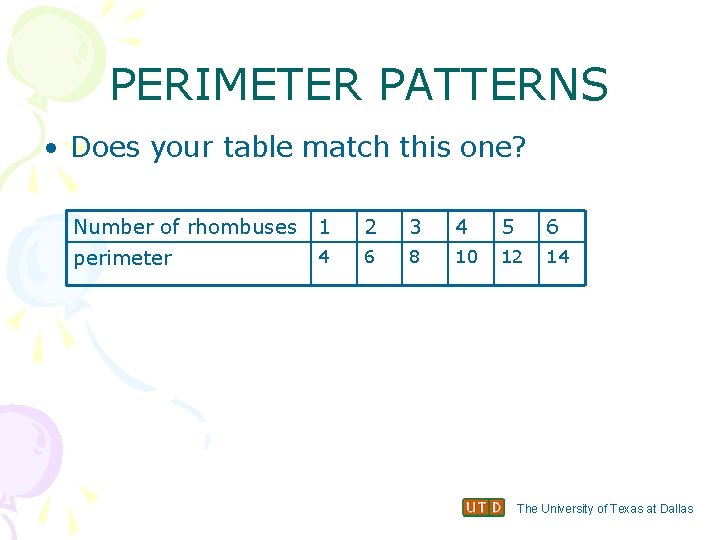
PERIMETER PATTERNS • Does your table match this one? Number of rhombuses 1 2 3 4 5 6 perimeter 4 6 8 10 12 14 The University of Texas at Dallas
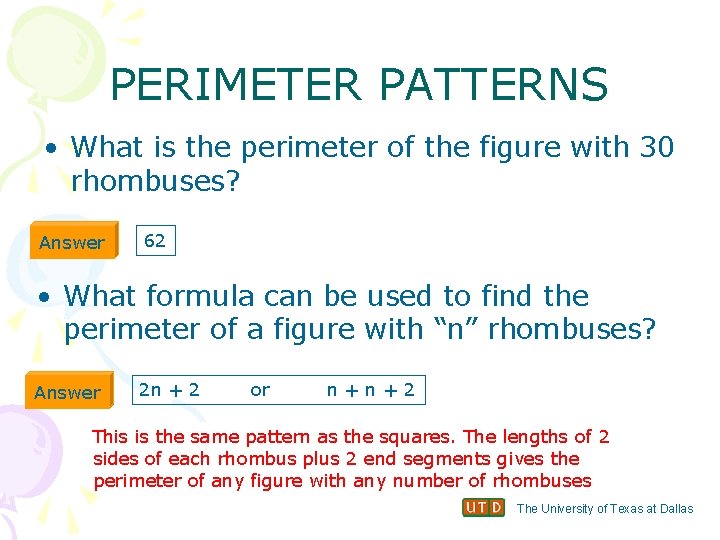
PERIMETER PATTERNS • What is the perimeter of the figure with 30 rhombuses? Answer 62 • What formula can be used to find the perimeter of a figure with “n” rhombuses? Answer 2 n + 2 or n+n+2 This is the same pattern as the squares. The lengths of 2 sides of each rhombus plus 2 end segments gives the perimeter of any figure with any number of rhombuses The University of Texas at Dallas
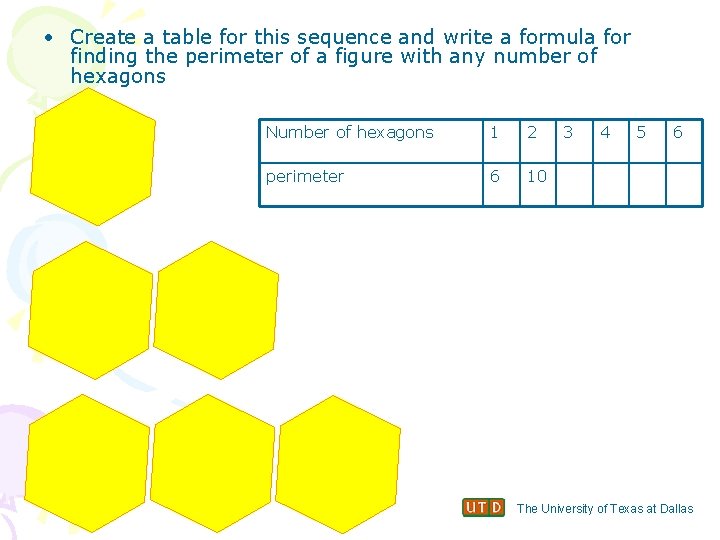
• Create a table for this sequence and write a formula for finding the perimeter of a figure with any number of hexagons Number of hexagons 1 2 perimeter 6 10 3 4 5 6 The University of Texas at Dallas
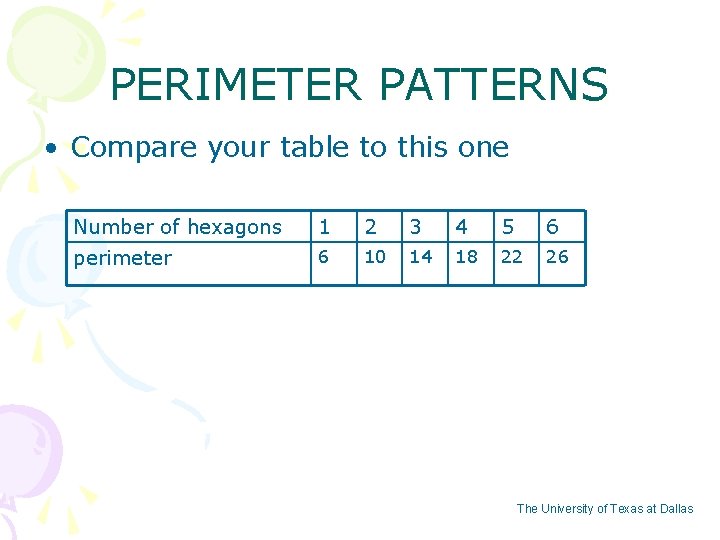
PERIMETER PATTERNS • Compare your table to this one Number of hexagons 1 2 3 4 5 6 perimeter 6 10 14 18 22 26 The University of Texas at Dallas
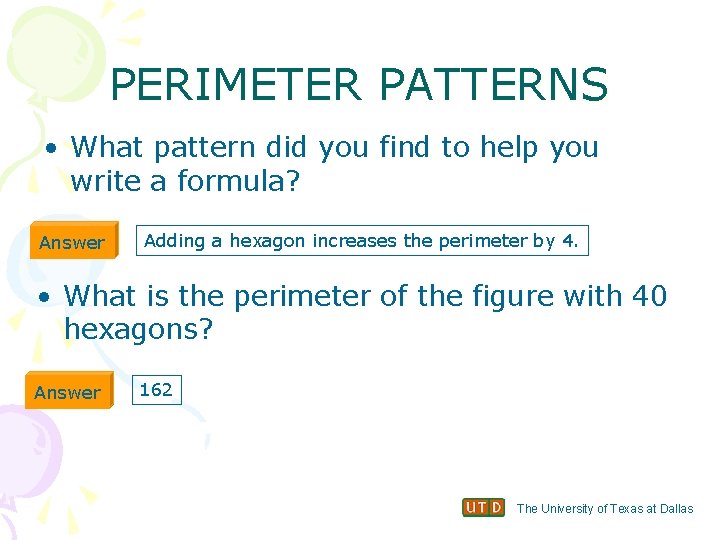
PERIMETER PATTERNS • What pattern did you find to help you write a formula? Answer Adding a hexagon increases the perimeter by 4. • What is the perimeter of the figure with 40 hexagons? Answer 162 The University of Texas at Dallas
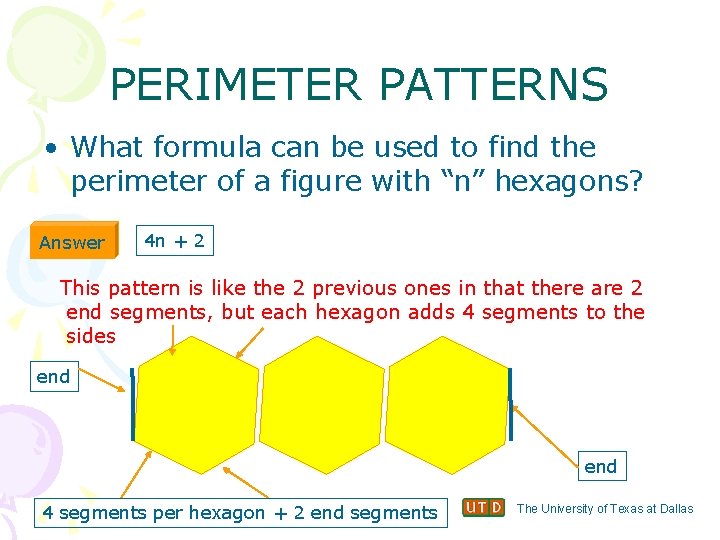
PERIMETER PATTERNS • What formula can be used to find the perimeter of a figure with “n” hexagons? Answer 4 n + 2 This pattern is like the 2 previous ones in that there are 2 end segments, but each hexagon adds 4 segments to the sides end 4 segments per hexagon + 2 end segments The University of Texas at Dallas
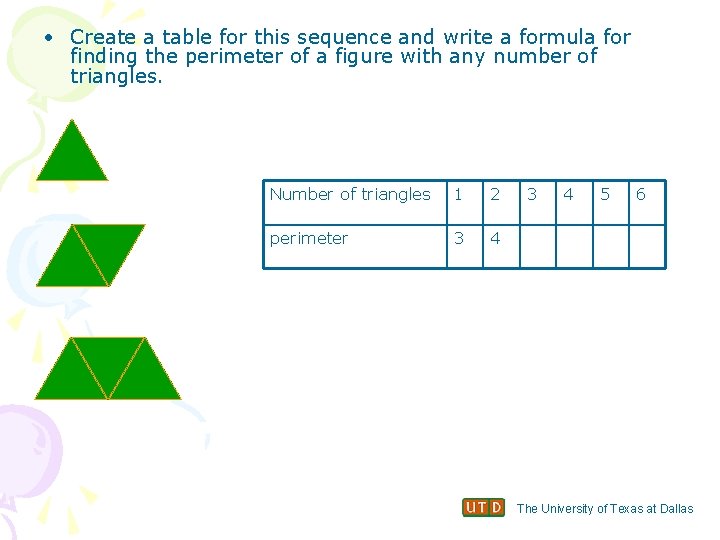
• Create a table for this sequence and write a formula for finding the perimeter of a figure with any number of triangles. Number of triangles 1 2 perimeter 3 4 5 6 The University of Texas at Dallas
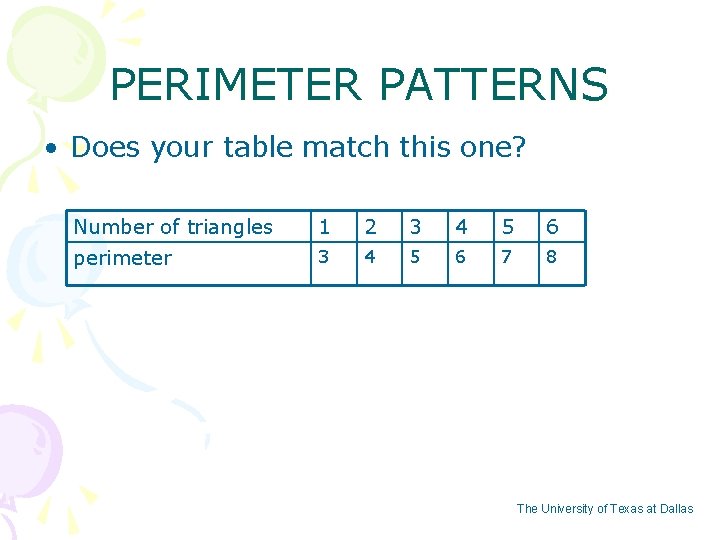
PERIMETER PATTERNS • Does your table match this one? Number of triangles 1 2 3 4 5 6 perimeter 3 4 5 6 7 8 The University of Texas at Dallas
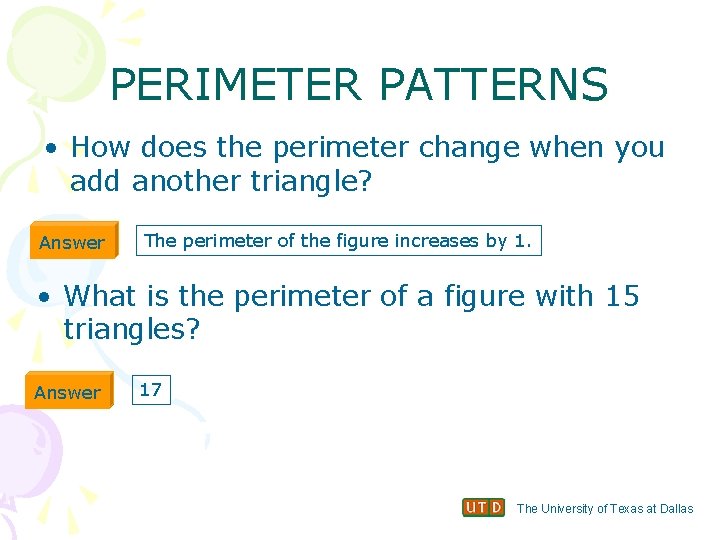
PERIMETER PATTERNS • How does the perimeter change when you add another triangle? Answer The perimeter of the figure increases by 1. • What is the perimeter of a figure with 15 triangles? Answer 17 The University of Texas at Dallas
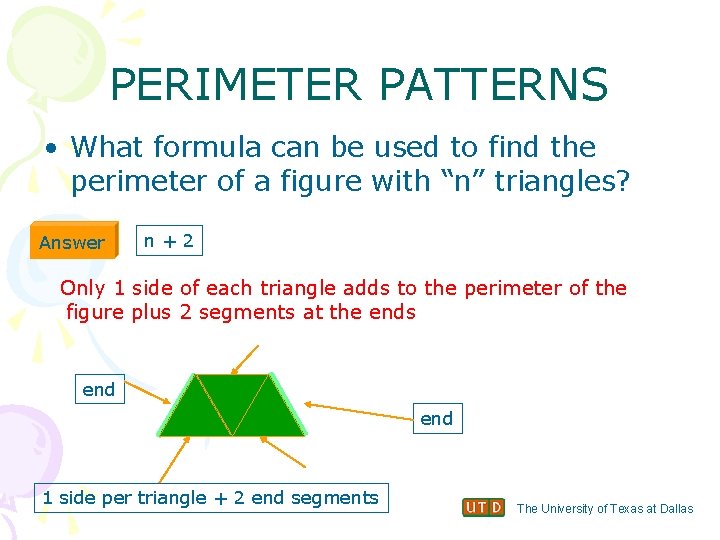
PERIMETER PATTERNS • What formula can be used to find the perimeter of a figure with “n” triangles? Answer n+2 Only 1 side of each triangle adds to the perimeter of the figure plus 2 segments at the ends end 1 side per triangle + 2 end segments The University of Texas at Dallas
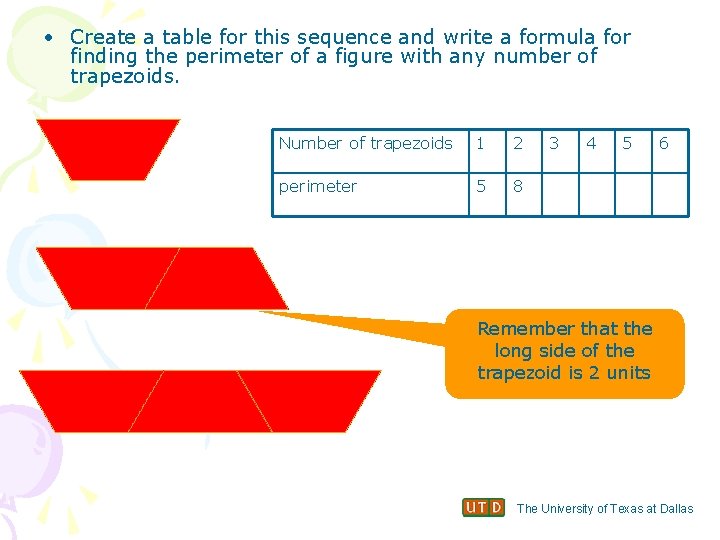
• Create a table for this sequence and write a formula for finding the perimeter of a figure with any number of trapezoids. Number of trapezoids 1 2 perimeter 5 8 3 4 5 6 Remember that the long side of the trapezoid is 2 units The University of Texas at Dallas
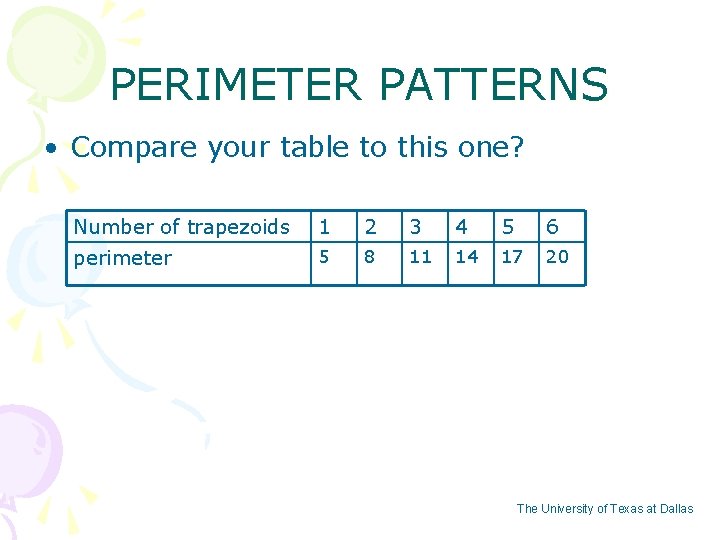
PERIMETER PATTERNS • Compare your table to this one? Number of trapezoids 1 2 3 4 5 6 perimeter 5 8 11 14 17 20 The University of Texas at Dallas
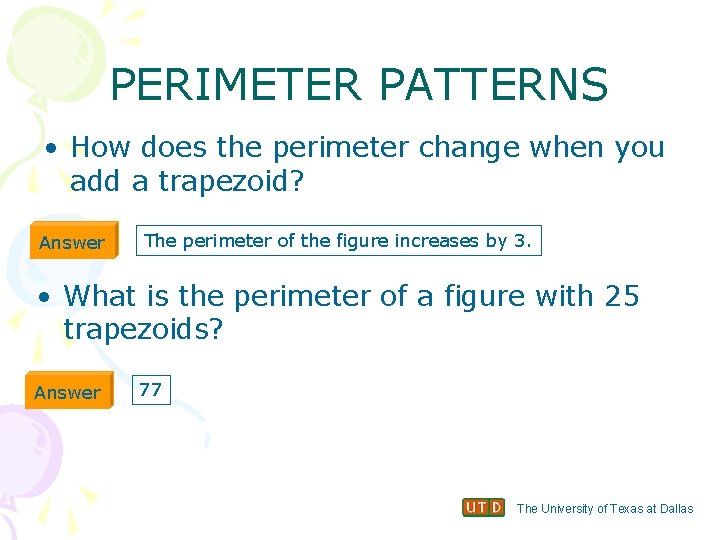
PERIMETER PATTERNS • How does the perimeter change when you add a trapezoid? Answer The perimeter of the figure increases by 3. • What is the perimeter of a figure with 25 trapezoids? Answer 77 The University of Texas at Dallas
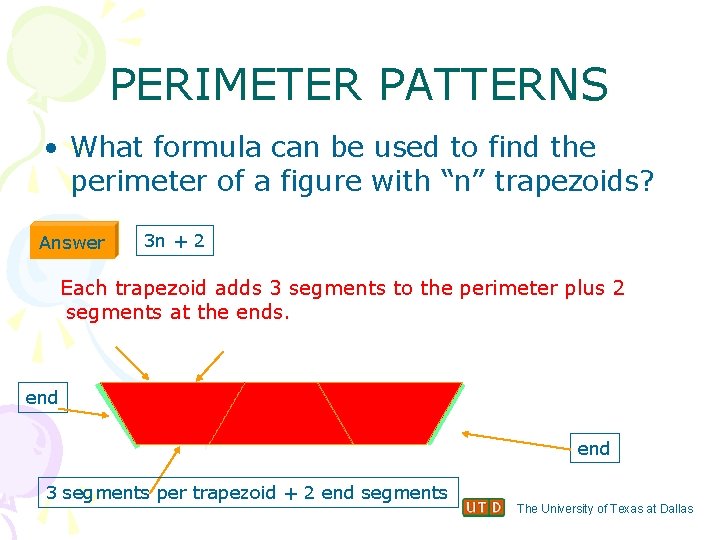
PERIMETER PATTERNS • What formula can be used to find the perimeter of a figure with “n” trapezoids? Answer 3 n + 2 Each trapezoid adds 3 segments to the perimeter plus 2 segments at the ends. end 3 segments per trapezoid + 2 end segments The University of Texas at Dallas
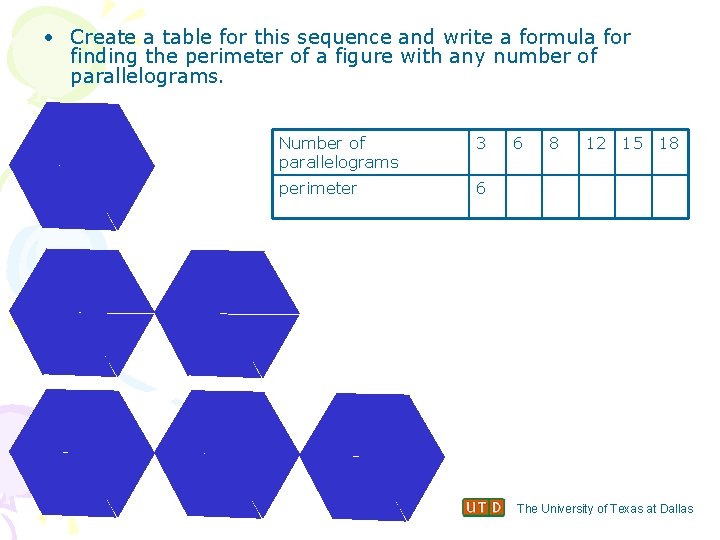
• Create a table for this sequence and write a formula for finding the perimeter of a figure with any number of parallelograms. Number of parallelograms 3 perimeter 6 6 8 12 15 18 The University of Texas at Dallas
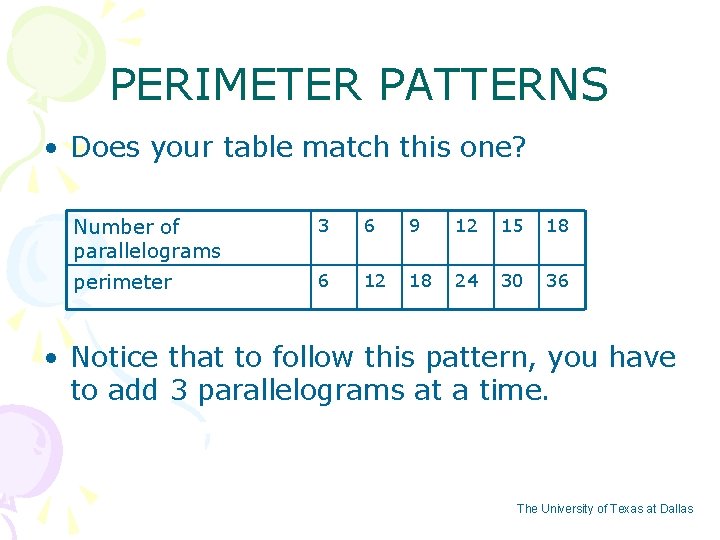
PERIMETER PATTERNS • Does your table match this one? Number of parallelograms 3 6 9 12 15 18 perimeter 6 12 18 24 30 36 • Notice that to follow this pattern, you have to add 3 parallelograms at a time. The University of Texas at Dallas
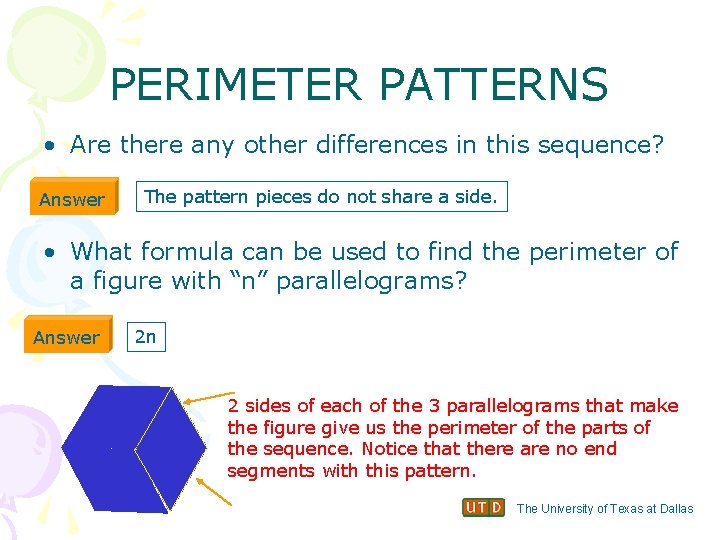
PERIMETER PATTERNS • Are there any other differences in this sequence? Answer The pattern pieces do not share a side. • What formula can be used to find the perimeter of a figure with “n” parallelograms? Answer 2 n 2 sides of each of the 3 parallelograms that make the figure give us the perimeter of the parts of the sequence. Notice that there are no end segments with this pattern. The University of Texas at Dallas
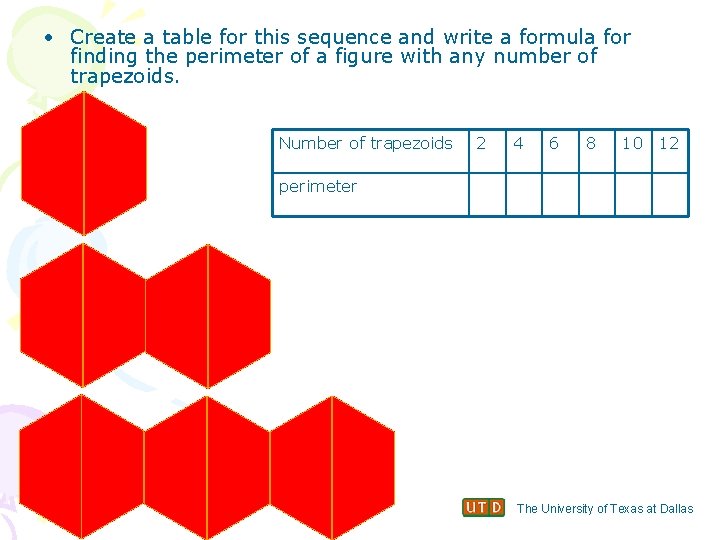
• Create a table for this sequence and write a formula for finding the perimeter of a figure with any number of trapezoids. Number of trapezoids 2 4 6 8 10 12 perimeter The University of Texas at Dallas
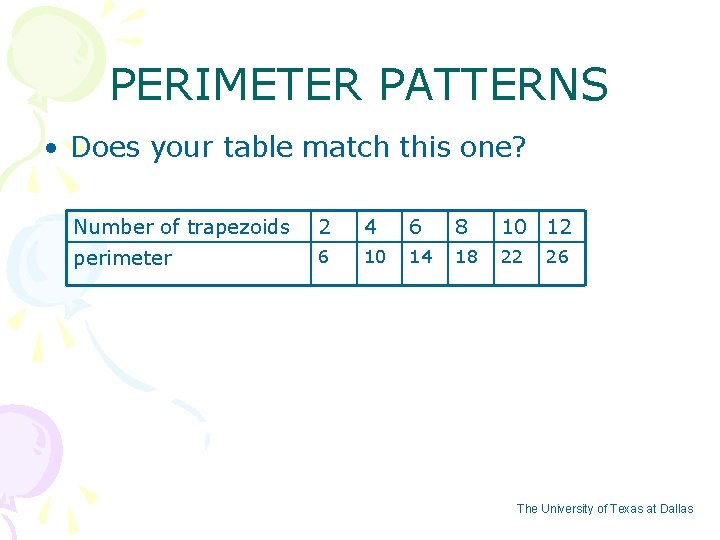
PERIMETER PATTERNS • Does your table match this one? Number of trapezoids 2 4 6 8 10 12 perimeter 6 10 14 18 22 26 The University of Texas at Dallas
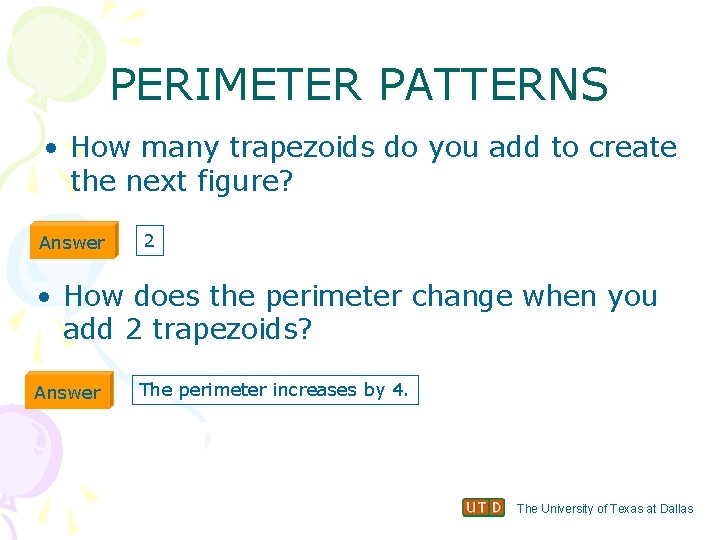
PERIMETER PATTERNS • How many trapezoids do you add to create the next figure? Answer 2 • How does the perimeter change when you add 2 trapezoids? Answer The perimeter increases by 4. The University of Texas at Dallas
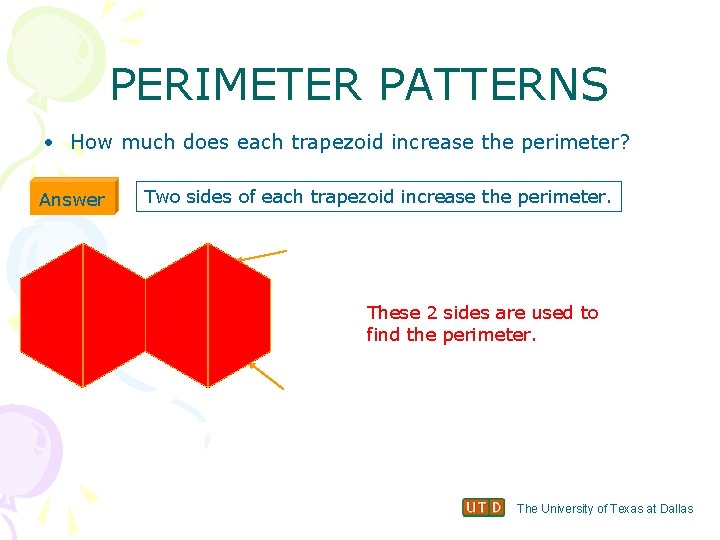
PERIMETER PATTERNS • How much does each trapezoid increase the perimeter? Answer Two sides of each trapezoid increase the perimeter. These 2 sides are used to find the perimeter. The University of Texas at Dallas
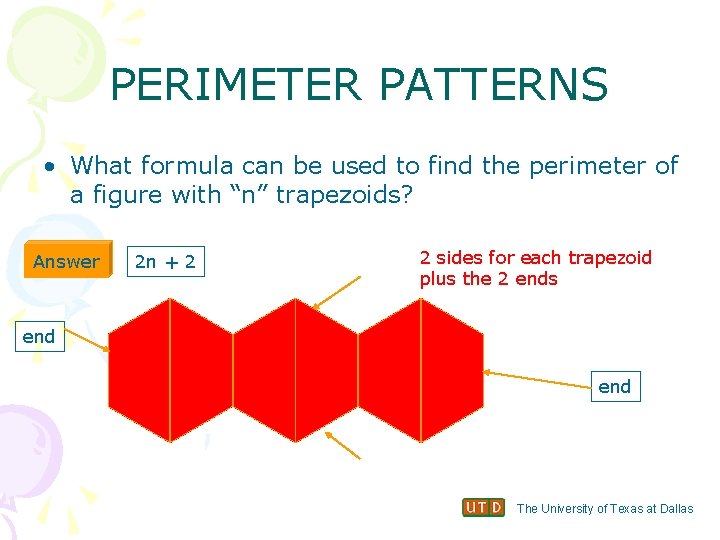
PERIMETER PATTERNS • What formula can be used to find the perimeter of a figure with “n” trapezoids? Answer 2 n + 2 2 sides for each trapezoid plus the 2 ends end The University of Texas at Dallas