
PERFROMANCE IMPROVEMENT OF HIGH BYPASS TURBOFAN ENGINE THROUGH
PERFROMANCE IMPROVEMENT OF HIGH BYPASS TURBOFAN ENGINE THROUGH OPTIMIZATION OF HIGHPRESSURE COMPRESSOR BLADE – A CASE STUDY Presented by: Vlad Mandzyuk

Acknowledgements • I would like to give thanks and appreciation to my faculty advisor Dr. Adeel Khalid for introducing me to this topic and the field of research. • Additional extensions of gratitude to Kennesaw State University for this opportunity to present at this years KSU Symposium Spring 2021.
Presentation Overview • • • Introduction Background and Theory Methodology CFD Analysis Parametric Cycle Analysis Results Validation Future Work Questions
Introduction • The engine of study is the GEnx-1 B turbofan engine. • Applications: B 787 -Dreamliner [1]. • Focus are the blades of the first rotor stage of the highpressure compressor. • Goal is to perform a comparative analysis of varying blade characteristics and their corresponding compressor pressure ratio values.
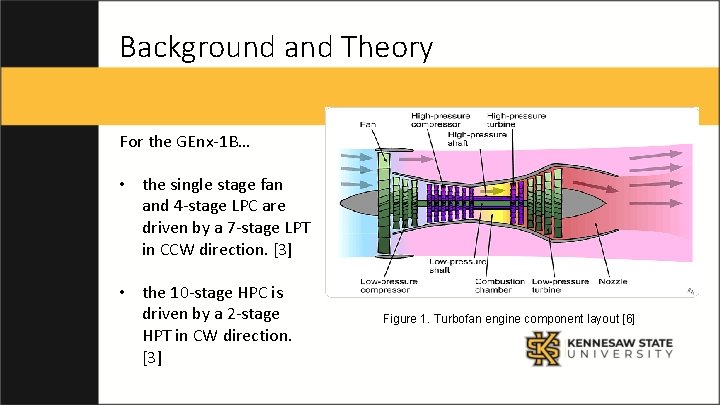
Background and Theory For the GEnx-1 B… • the single stage fan and 4 -stage LPC are driven by a 7 -stage LPT in CCW direction. [3] • the 10 -stage HPC is driven by a 2 -stage HPT in CW direction. [3] Figure 1. Turbofan engine component layout [6]
![High-Pressure Compressor • Table 1: HPC Blade Characteristics [2] Baseline HPC Specifications Span 7.](http://slidetodoc.com/presentation_image_h2/75edc1d5f059ebaaa800f525b77bf251/image-6.jpg "High-Pressure Compressor • Table 1: HPC Blade Characteristics [2] Baseline HPC Specifications Span 7.")
High-Pressure Compressor • Table 1: HPC Blade Characteristics [2] Baseline HPC Specifications Span 7. 68 in. Chord 7. 17 in. Angle of Incidence 49. 6º Number of blades 33 Taper Ratio 0. 0 Twist 0º
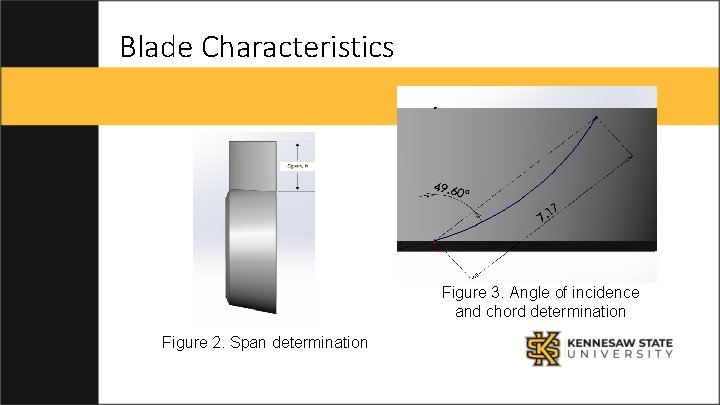
Blade Characteristics Figure 3. Angle of incidence and chord determination Figure 2. Span determination
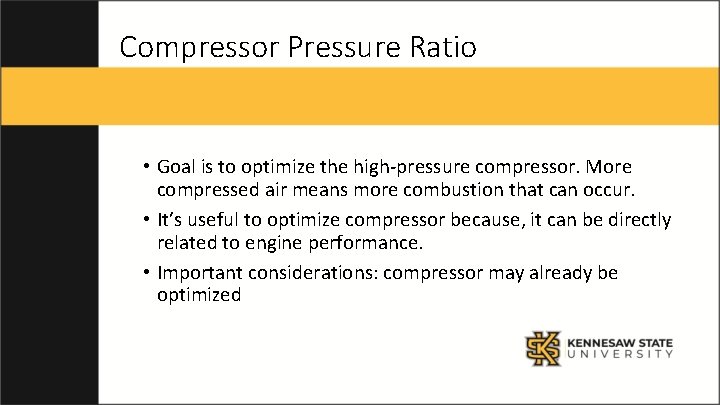
Compressor Pressure Ratio • Goal is to optimize the high-pressure compressor. More compressed air means more combustion that can occur. • It’s useful to optimize compressor because, it can be directly related to engine performance. • Important considerations: compressor may already be optimized
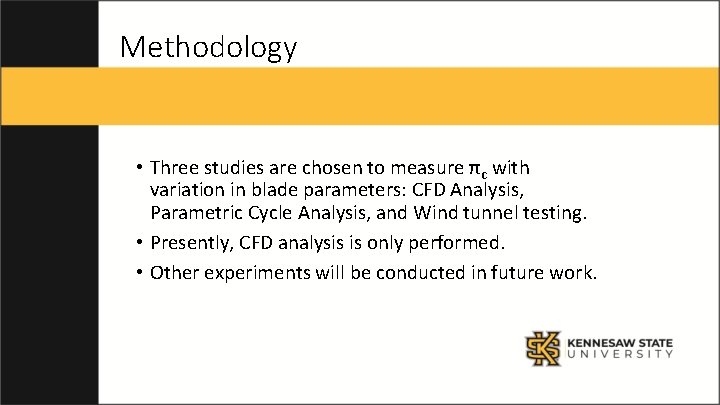
Methodology • Three studies are chosen to measure πc with variation in blade parameters: CFD Analysis, Parametric Cycle Analysis, and Wind tunnel testing. • Presently, CFD analysis is only performed. • Other experiments will be conducted in future work.
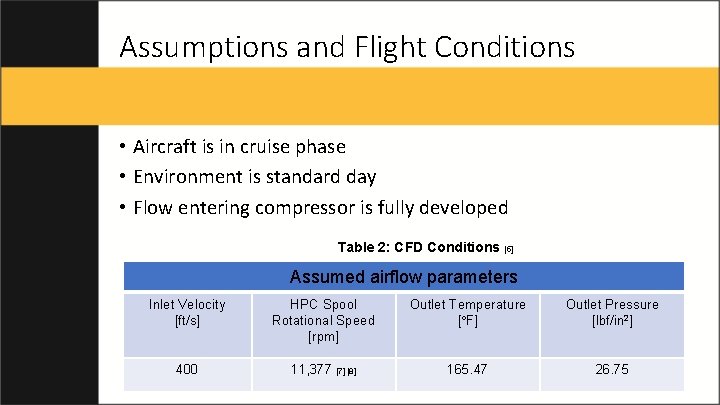
Assumptions and Flight Conditions • Aircraft is in cruise phase • Environment is standard day • Flow entering compressor is fully developed Table 2: CFD Conditions [5] Assumed airflow parameters Inlet Velocity [ft/s] HPC Spool Rotational Speed [rpm] Outlet Temperature [ºF] Outlet Pressure [lbf/in 2] 400 11, 377 [7] [8] 165. 47 26. 75
![CFD Analysis Figure 4: 1 st Stage HPC Solid. Works model [2] Figure 5:](http://slidetodoc.com/presentation_image_h2/75edc1d5f059ebaaa800f525b77bf251/image-11.jpg "CFD Analysis Figure 4: 1 st Stage HPC Solid. Works model [2] Figure 5:")
CFD Analysis Figure 4: 1 st Stage HPC Solid. Works model [2] Figure 5: HPC Dimensions [2]

CFD Analysis Figures 6 -8. Flow simulation setup
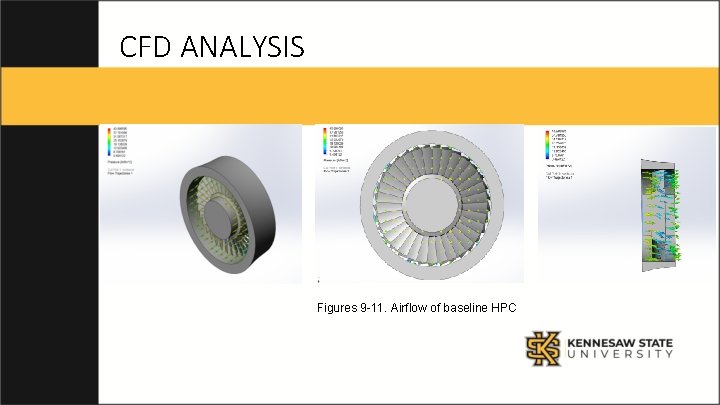
CFD ANALYSIS Figures 9 -11. Airflow of baseline HPC
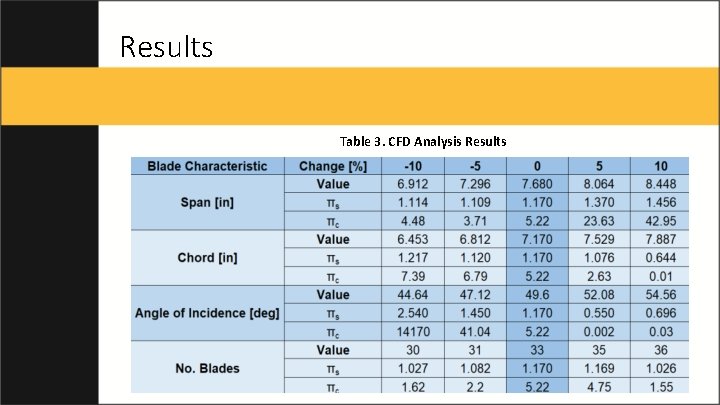
Results Table 3. CFD Analysis Results
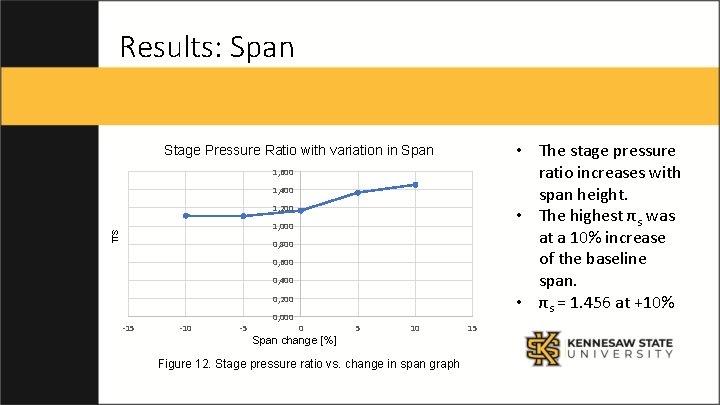
Results: Span • The stage pressure ratio increases with span height. • The highest πs was at a 10% increase of the baseline span. • πs = 1. 456 at +10% Stage Pressure Ratio with variation in Span 1, 600 1, 400 1, 200 πs 1, 000 0, 800 0, 600 0, 400 0, 200 -15 -10 -5 0, 000 0 5 10 Span change [%] Figure 12. Stage pressure ratio vs. change in span graph 15
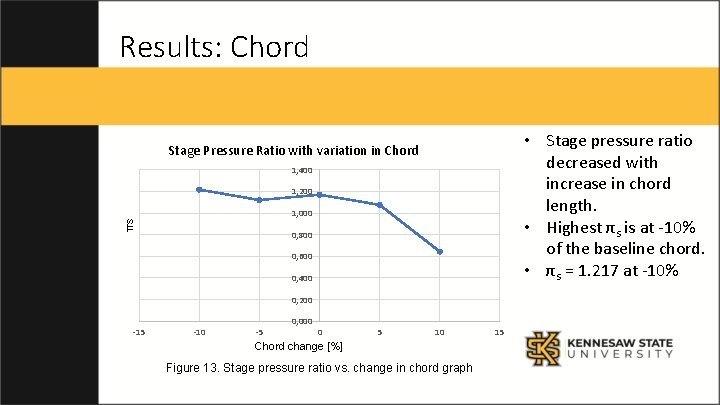
Results: Chord • Stage pressure ratio decreased with increase in chord length. • Highest πs is at -10% of the baseline chord. • πs = 1. 217 at -10% Stage Pressure Ratio with variation in Chord 1, 400 1, 200 πs 1, 000 0, 800 0, 600 0, 400 0, 200 -15 -10 -5 0, 000 0 5 10 Chord change [%] Figure 13. Stage pressure ratio vs. change in chord graph 15
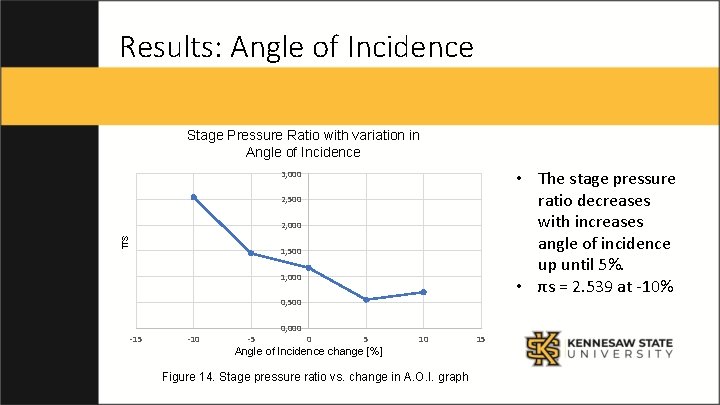
Results: Angle of Incidence Stage Pressure Ratio with variation in Angle of Incidence • The stage pressure ratio decreases with increases angle of incidence up until 5%. • πs = 2. 539 at -10% 3, 000 2, 500 πs 2, 000 1, 500 1, 000 0, 500 -15 -10 -5 0, 000 0 5 10 Angle of Incidence change [%] Figure 14. Stage pressure ratio vs. change in A. O. I. graph 15
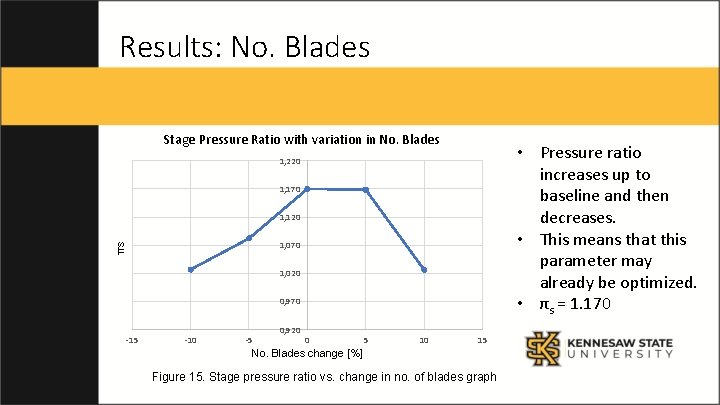
Results: No. Blades Stage Pressure Ratio with variation in No. Blades • Pressure ratio increases up to baseline and then decreases. • This means that this parameter may already be optimized. • πs = 1. 170 1, 220 1, 170 1, 120 πs 1, 070 1, 020 0, 970 -15 -10 -5 0, 920 0 5 10 15 No. Blades change [%] Figure 15. Stage pressure ratio vs. change in no. of blades graph
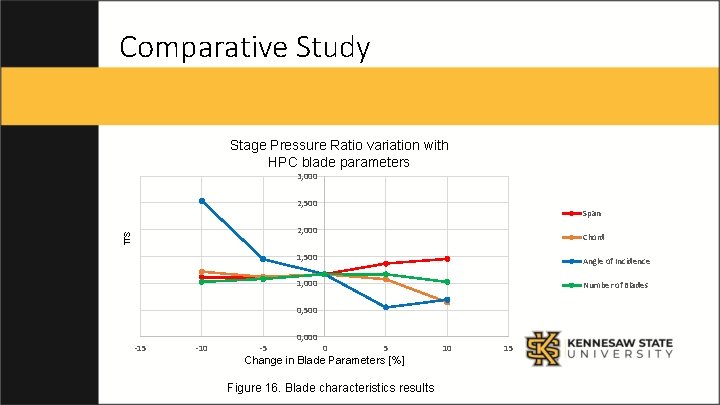
Comparative Study Stage Pressure Ratio variation with HPC blade parameters 3, 000 2, 500 Span πs 2, 000 Chord 1, 500 Angle of Incidence 1, 000 Number of Blades 0, 500 -15 -10 -5 0, 000 0 5 Change in Blade Parameters [%] Figure 16. Blade characteristics results 10 15
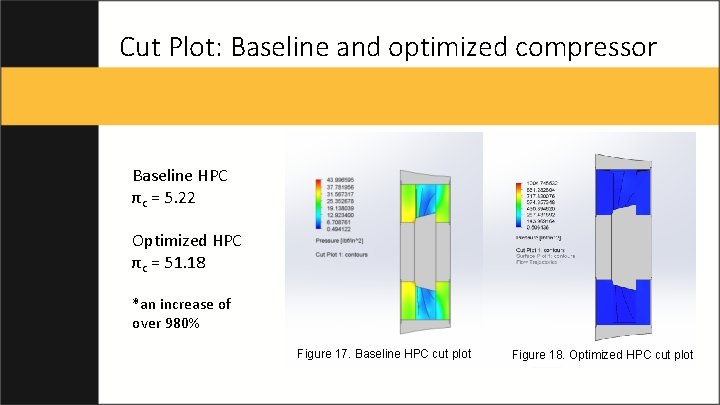
Cut Plot: Baseline and optimized compressor Baseline HPC πc = 5. 22 Optimized HPC πc = 51. 18 *an increase of over 980% Figure 17. Baseline HPC cut plot Figure 18. Optimized HPC cut plot
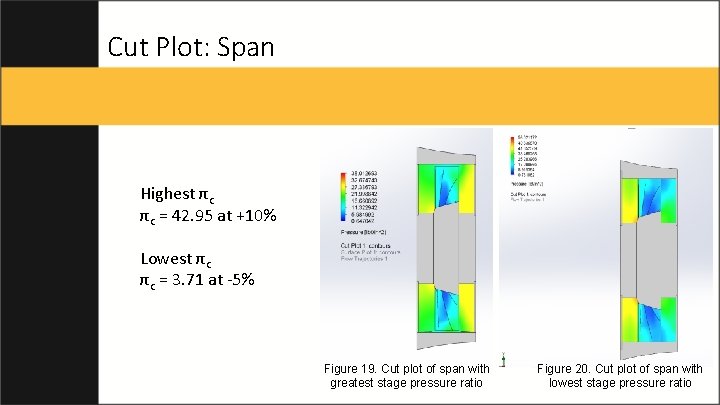
Cut Plot: Span Highest πc πc = 42. 95 at +10% Lowest πc πc = 3. 71 at -5% Figure 19. Cut plot of span with greatest stage pressure ratio Figure 20. Cut plot of span with lowest stage pressure ratio
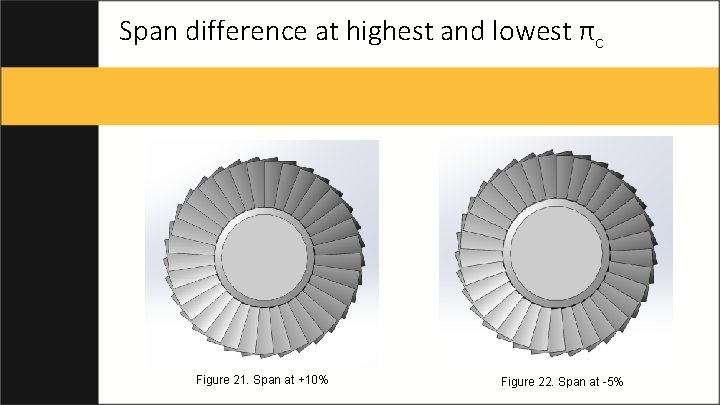
Span difference at highest and lowest πc Figure 21. Span at +10% Figure 22. Span at -5%
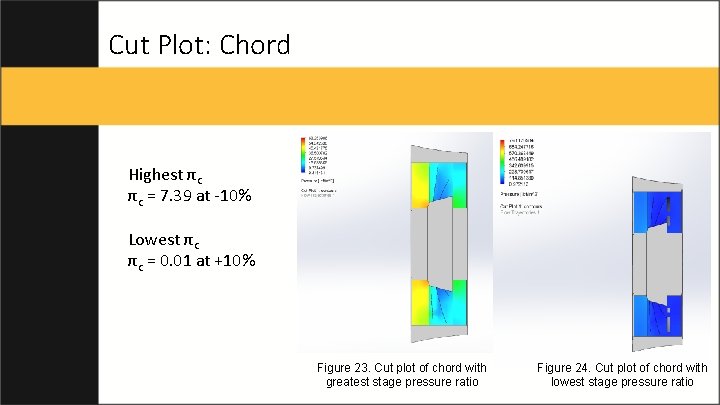
Cut Plot: Chord Highest πc πc = 7. 39 at -10% Lowest πc πc = 0. 01 at +10% Figure 23. Cut plot of chord with greatest stage pressure ratio Figure 24. Cut plot of chord with lowest stage pressure ratio
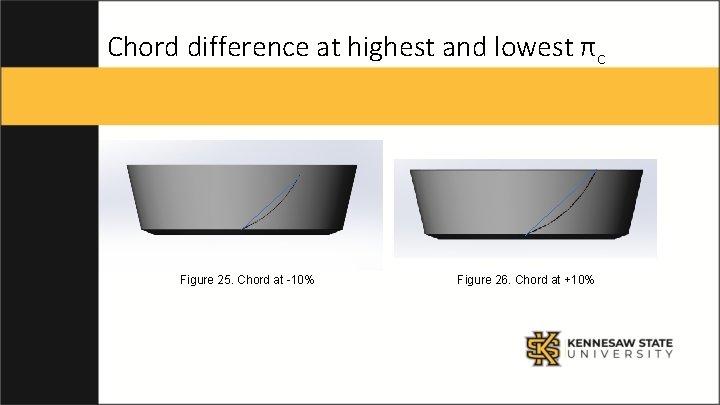
Chord difference at highest and lowest πc Figure 25. Chord at -10% Figure 26. Chord at +10%
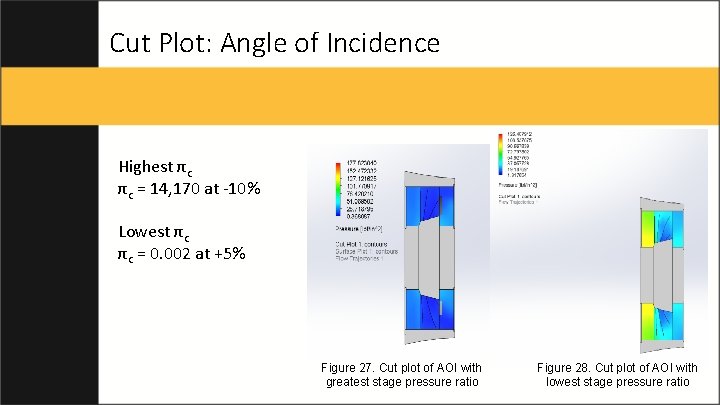
Cut Plot: Angle of Incidence Highest πc πc = 14, 170 at -10% Lowest πc πc = 0. 002 at +5% Figure 27. Cut plot of AOI with greatest stage pressure ratio Figure 28. Cut plot of AOI with lowest stage pressure ratio
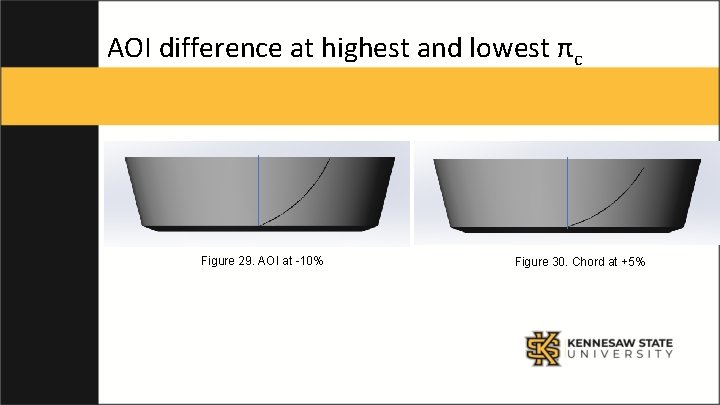
AOI difference at highest and lowest πc Figure 29. AOI at -10% Figure 30. Chord at +5%
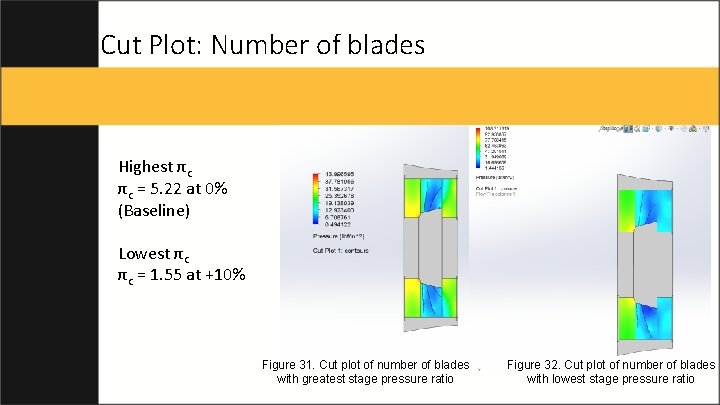
Cut Plot: Number of blades Highest πc πc = 5. 22 at 0% (Baseline) Lowest πc πc = 1. 55 at +10% Figure 31. Cut plot of number of blades with greatest stage pressure ratio Figure 32. Cut plot of number of blades with lowest stage pressure ratio
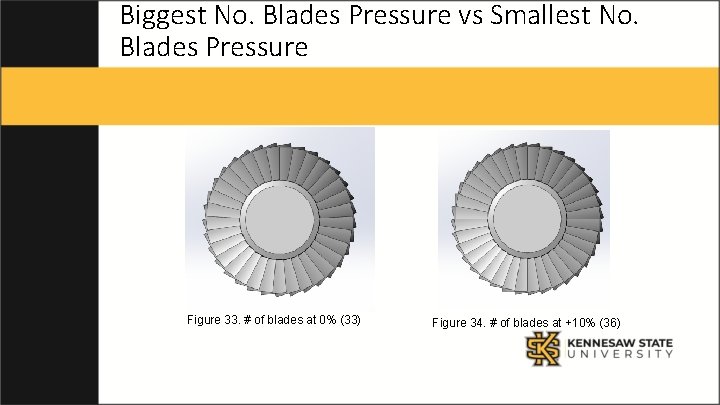
Biggest No. Blades Pressure vs Smallest No. Blades Pressure Figure 33. # of blades at 0% (33) Figure 34. # of blades at +10% (36)
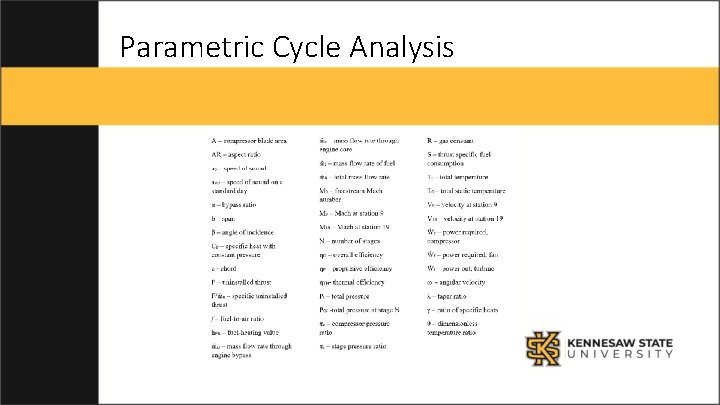
Parametric Cycle Analysis
![Parametric Cycle Analysis Figure 36. Station numbering for PCA [1][3] Figure 35. PCA input](http://slidetodoc.com/presentation_image_h2/75edc1d5f059ebaaa800f525b77bf251/image-30.jpg "Parametric Cycle Analysis Figure 36. Station numbering for PCA [1][3] Figure 35. PCA input")
Parametric Cycle Analysis Figure 36. Station numbering for PCA [1][3] Figure 35. PCA input values [1] [3] [5]
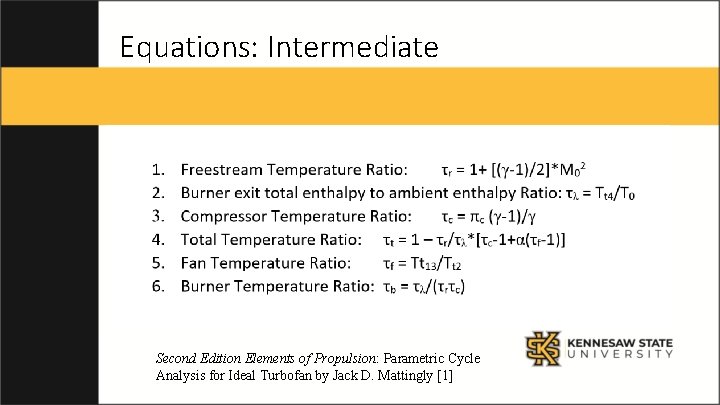
Equations: Intermediate Second Edition Elements of Propulsion: Parametric Cycle Analysis for Ideal Turbofan by Jack D. Mattingly [1]
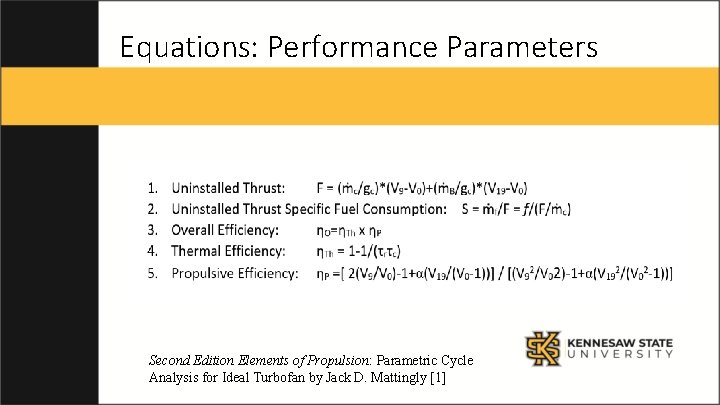
Equations: Performance Parameters Second Edition Elements of Propulsion: Parametric Cycle Analysis for Ideal Turbofan by Jack D. Mattingly [1]
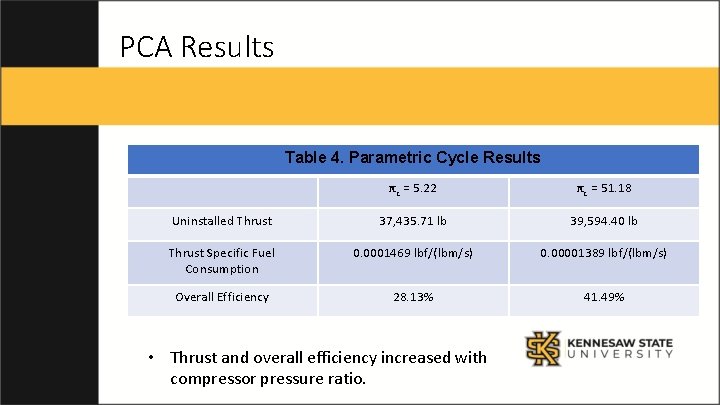
PCA Results Table 4. Parametric Cycle Results πc = 5. 22 πc = 51. 18 Uninstalled Thrust 37, 435. 71 lb 39, 594. 40 lb Thrust Specific Fuel Consumption 0. 0001469 lbf/(lbm/s) 0. 00001389 lbf/(lbm/s) Overall Efficiency 28. 13% 41. 49% • Thrust and overall efficiency increased with compressor pressure ratio.
Validation and Accuracy • Unlike an actual turbofan engine, there were many things unaccounted for. This includes friction, heat conduction, and temperature losses. • As a result, pressure ratio values suffered in accuracy. (GEnx-1 B baseline πc = 23. 9 and not πc = 5. 22) • However, since this was a comparative study, this was not an issue. • Future PCA and wind tunnel testing will help validate these findings.
Conclusion • Based on CFD analysis (for span, chord, angle of incidence, and number of blades) altering blade characteristics influences the compressor pressure ratio. • A point of interest is that altering only one variable can have a more significant effect on πc compared to combining all optimized values at once. • Optimizing πc led to an increase in thrust and efficiency while TSFC decreased.
Future Work • Finish CFD analysis for taper ratio and twist variables. • Mathematical/PCA study for varying HPC blade variables to compare to CFD analysis. • Wind tunnel testing with 3 D printed compressor blades. • Literature review to further explain results.
![References • [1] Mattingly, J. D. , Elements of Gas Turbine Propulsion, Mc. Graw](http://slidetodoc.com/presentation_image_h2/75edc1d5f059ebaaa800f525b77bf251/image-37.jpg "References • [1] Mattingly, J. D. , Elements of Gas Turbine Propulsion, Mc. Graw")
References • [1] Mattingly, J. D. , Elements of Gas Turbine Propulsion, Mc. Graw Hill Inc. , New York, pp. 2 -5, 12 -20, 299 -316, 355 -364, 811. • [2] Klisz, P. (2016, December 5). Free CAD Designs, Files & 3 D Models: The Grab. CAD Community Library. Free CAD Designs, Files & 3 D Models | The Grab. CAD Community Library. https: //grabcad. com/library/genx-1 b-modified-v-1 -0 -1. • [3] General Electric Company, U. S. Department of Transportation, & Federal Aviation Administration. (2011, April). Type Certificate Data Sheet E 00078 NE (No. 3). http: //large. stanford. edu/courses/2016/ph 240/ginsberg 2/docs/E 00078 NERev 3. pdf • [4] Clark, S. F. (2012, March). 787 Propulsion System. Boeing. https: //www. boeing. com/commercial/aeromagazine/articles/2012_q 3/2/ • [5] Ahmed F. El-Sayed, Mohamed S. Emeara and Mohamed K. Fayed (2017) Performance Analysis of Cold Sections of High BYPASS Ratio Turbofan Aeroengine. J Robot Mech Engr Research 2(1): 18 -27. • [6]Marsh, G. (2006, December 22). Composites get in deep with new-generation engine. Materials Today. https: //www. materialstoday. com/composite-industry/features/composites-get-in-deep-with-new-generation-engine/ • [7] General Electric Company. (2019, December). Type-Certificate Data Sheet (No. 10). European Union Aviation Safety Agency. https: //www. easa. europa. eu/sites/default/files/dfu/TCDS%20 IM%20 E%20102_issue 10_20191213. pdf • [8] General Electric Company, U. S. Department of Transportation, & Federal Aviation Administration. (2011, April). Type Certificate Data Sheet E 00078 NE (No. 3). http: //large. stanford. edu/courses/2016/ph 240/ginsberg 2/docs/E 00078 NERev 3. pdf

Questions
- Slides: 38