
PerformanceBased Contracting PIPS Performance Information Procurement System PerformanceBased
Performance-Based Contracting PIPS Performance Information Procurement System
Performance-Based Contracting According to: . com • In the performance-based approach, an agency says what problem needs to be solved and allows contractors to make bids detailing their proposed solutions.
What does the PIPS approach offer? • Identifies Suppliers who can see the entire project through completion • Allows identification of all associated risks and provides for a comprehensive mitigation plan to address each risk • Process efficiencies provide win/win environment • Shifts contract management supplier to enable profit maximization • Suppliers with superior expertise can differentiate themselves • Relies on dominant information to minimize decision making
What is dominant information? • It is simple • It is accurate • It is measurable • It stands out • It minimizes decision making • It predicts the future outcome • It is clearly understandable among all parties • It shows the supplier’s understanding what are required
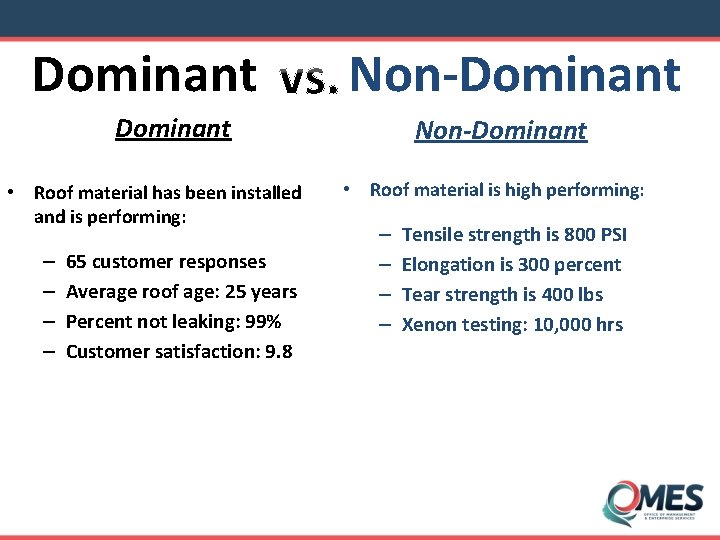
Dominant Non-Dominant • Roof material has been installed and is performing: – – 65 customer responses Average roof age: 25 years Percent not leaking: 99% Customer satisfaction: 9. 8 Non-Dominant • Roof material is high performing: – – Tensile strength is 800 PSI Elongation is 300 percent Tear strength is 400 lbs Xenon testing: 10, 000 hrs
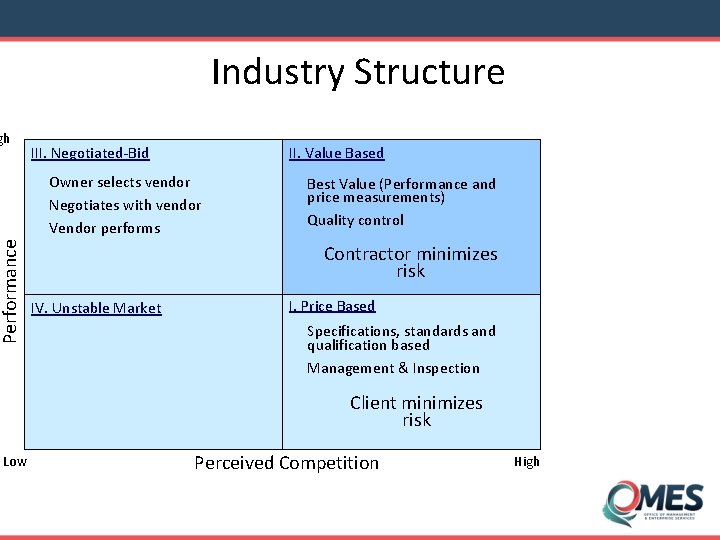
Industry Structure gh III. Negotiated-Bid II. Value Based Performance Owner selects vendor Negotiates with vendor Vendor performs Best Value (Performance and price measurements) Quality control Contractor minimizes risk IV. Unstable Market I. Price Based Specifications, standards and qualification based Management & Inspection Client minimizes risk Low Perceived Competition High
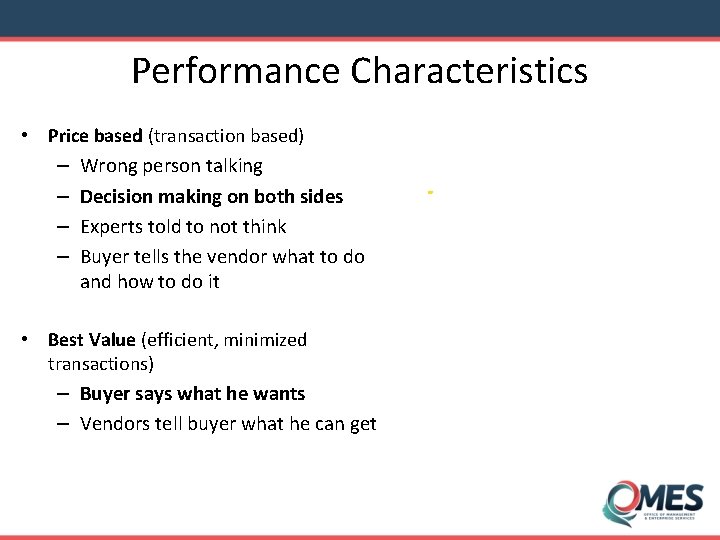
Performance Characteristics • Price based (transaction based) – Wrong person talking – Decision making on both sides – Experts told to not think – Buyer tells the vendor what to do and how to do it • Best Value (efficient, minimized transactions) – Buyer says what he wants – Vendors tell buyer what he can get
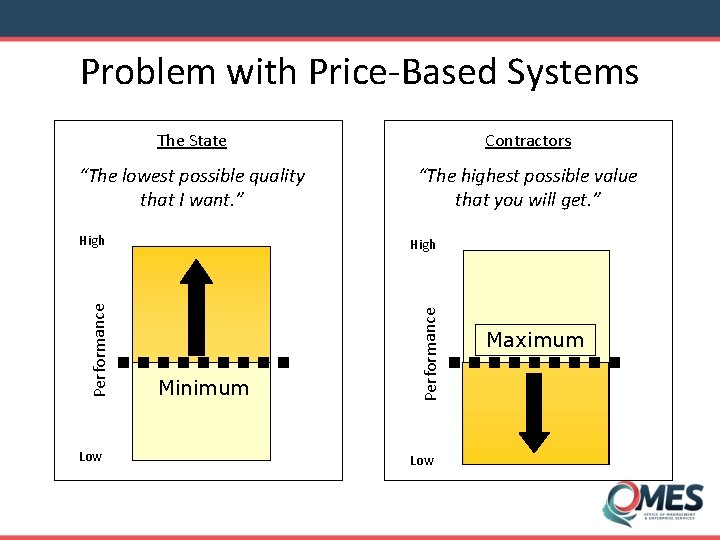
Problem with Price-Based Systems The State Contractors “The lowest possible quality that I want. ” “The highest possible value that you will get. ” Low High Minimum Performance High Low Maximum
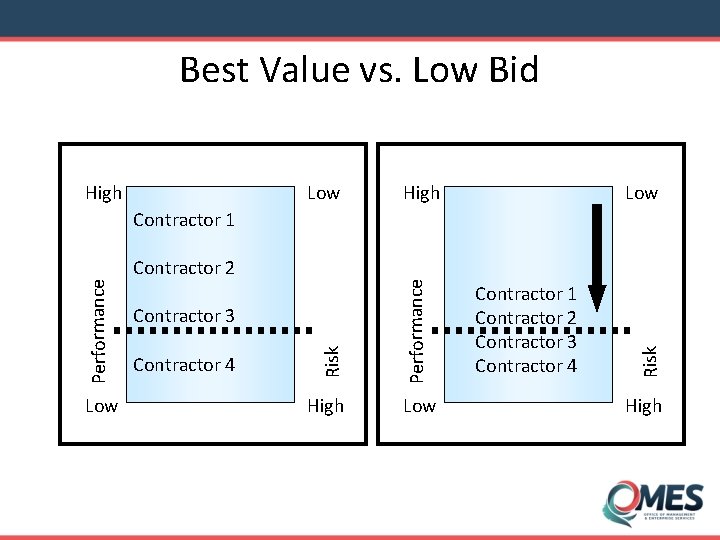
Best Value vs. Low Bid High Low Low Contractor 4 High Low Contractor 1 Contractor 2 Contractor 3 Contractor 4 Risk Contractor 3 Performance Contractor 2 Risk Performance Contractor 1 High

PIPS Approach • Identifies suppliers who can see the entire project through completion • Focus on what is needed rather than how it will be accomplished • Process efficiencies provide win/win environment • Allows identification of all associated risks and provides for a comprehensive mitigation plan to address each risk • Suppliers with superior expertise can differentiate themselves • Shifts contract management supplier to enable profit maximization • Relies on dominant information to minimize decision making
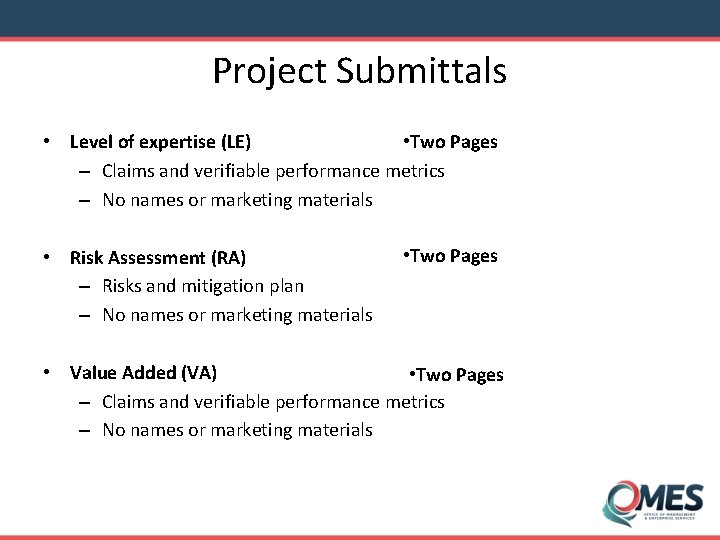
Project Submittals • Level of expertise (LE) • Two Pages – Claims and verifiable performance metrics – No names or marketing materials • Risk Assessment (RA) – Risks and mitigation plan – No names or marketing materials • Two Pages • Value Added (VA) • Two Pages – Claims and verifiable performance metrics – No names or marketing materials
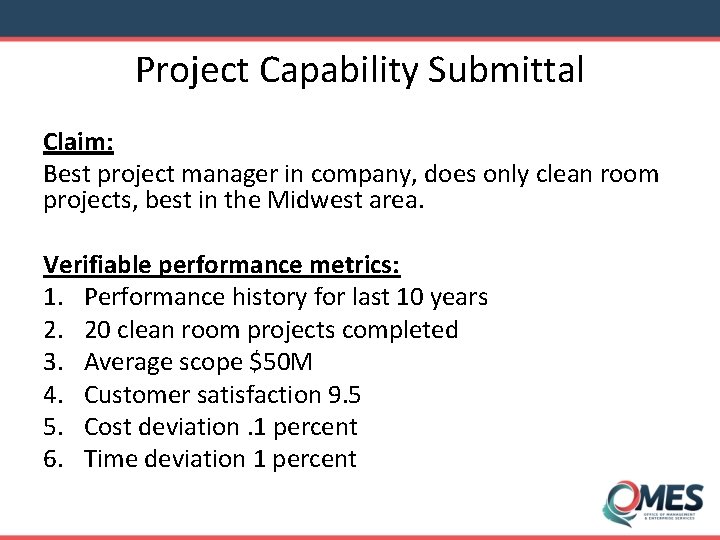
Project Capability Submittal Claim: Best project manager in company, does only clean room projects, best in the Midwest area. Verifiable performance metrics: 1. Performance history for last 10 years 2. 20 clean room projects completed 3. Average scope $50 M 4. Customer satisfaction 9. 5 5. Cost deviation. 1 percent 6. Time deviation 1 percent
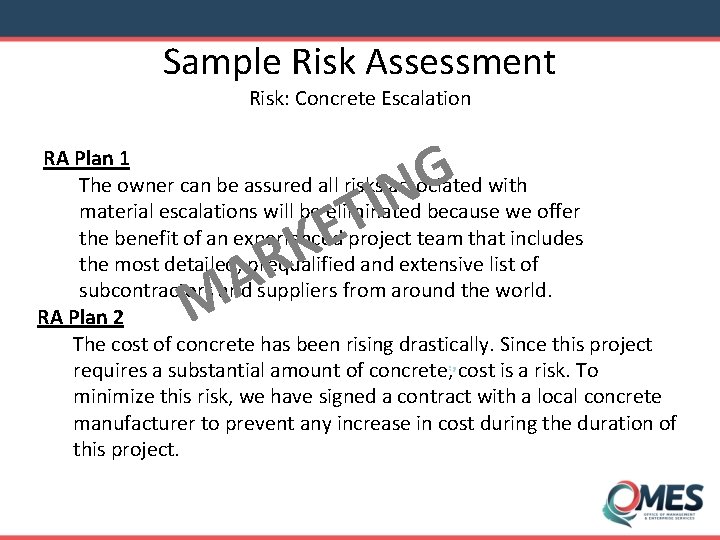
Sample Risk Assessment Risk: Concrete Escalation G N I T RA Plan 1 The owner can be assured all risks associated with material escalations will be eliminated because we offer the benefit of an experienced project team that includes the most detailed, prequalified and extensive list of subcontractors and suppliers from around the world. RA Plan 2 The cost of concrete has been rising drastically. Since this project requires a substantial amount of concrete, cost is a risk. To minimize this risk, we have signed a contract with a local concrete manufacturer to prevent any increase in cost during the duration of this project. M R A E K
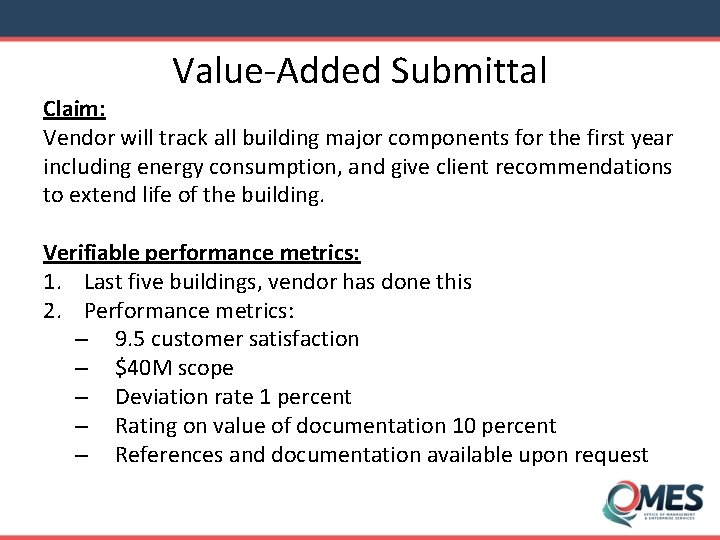
Value-Added Submittal Claim: Vendor will track all building major components for the first year including energy consumption, and give client recommendations to extend life of the building. Verifiable performance metrics: 1. Last five buildings, vendor has done this 2. Performance metrics: – 9. 5 customer satisfaction – $40 M scope – Deviation rate 1 percent – Rating on value of documentation 10 percent – References and documentation available upon request
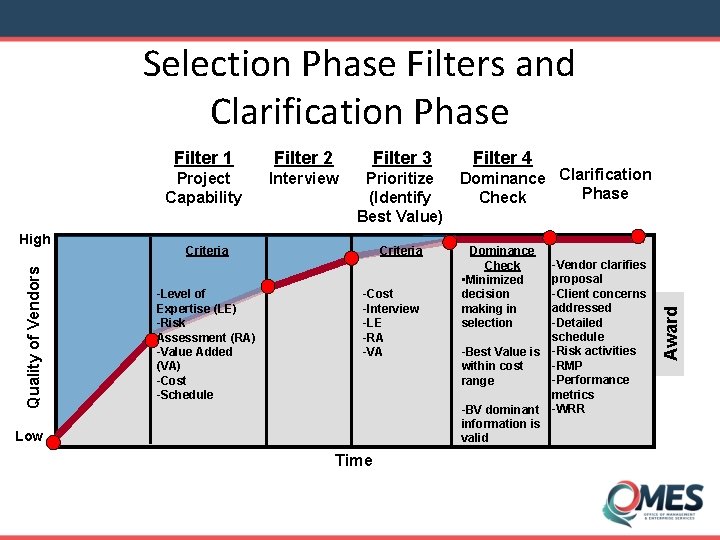
Selection Phase Filters and Clarification Phase Filter 2 Filter 3 Project Capability Interview Prioritize (Identify Best Value) Criteria -Level of Expertise (LE) -Risk Assessment (RA) -Value Added (VA) -Cost -Schedule Criteria -Cost -Interview -LE -RA -VA Low Time Filter 4 Dominance Clarification Phase Check Dominance Check • Minimized decision making in selection -Vendor clarifies proposal -Client concerns addressed -Detailed schedule -Best Value is -Risk activities -RMP within cost -Performance range metrics -BV dominant -WRR information is valid Award Quality of Vendors High Filter 1
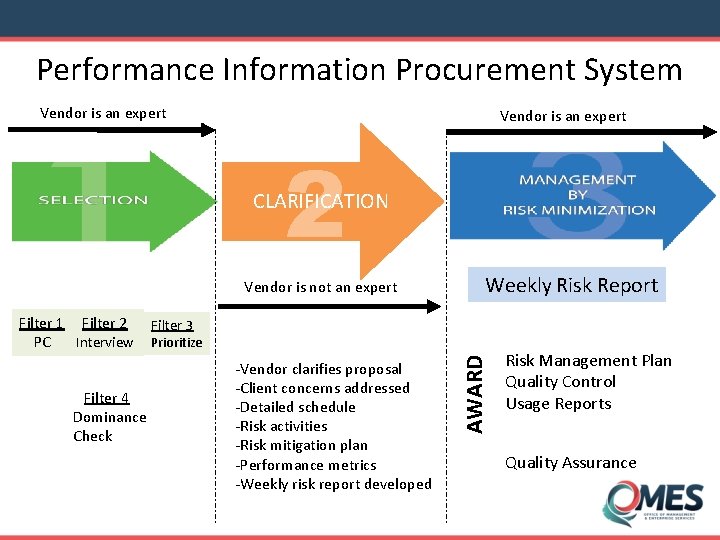
Performance Information Procurement System Vendor is an expert 2 CLARIFICATION Vendor is not an expert Filter 4 Dominance Check Filter 3 Prioritize -Vendor clarifies proposal -Client concerns addressed -Detailed schedule -Risk activities -Risk mitigation plan -Performance metrics -Weekly risk report developed AWARD Filter 1 Filter 2 PC Interview Weekly Risk Report Risk Management Plan Quality Control Usage Reports Quality Assurance
Selection Criteria • Considering: – Pass/fail criteria (required forms) – Scored and weighted criteria (level of expertise, risk assessment, value add, interview) – Weighted criteria (price) • Select potential best value supplier • One supplier, the potential best value, will move forward into the clarification phase
Interview The interview of key personnel is the event when the selection committee can get the most dominant information to identify a best value supplier. The interview is different in the following ways: • • The key person who will do the work is the one who will be interviewed. The interview is searching for an "expert“. The interview is non-technical. The interview is searching for an individual who can lead a team. The interview should have the following characteristics: • • Be as short as possible. A 20 minutes duration is sufficient. The number of questions should be limited to a few questions, and clarifications can be asked if the key personnel do not respond in a dominant fashion.
Interview Objectives • Can the individual see into the future? • Does the individual know what they are looking for? • Does the individual see the project as complex or simple? • Is the person quick, concise, very perceptive and polite? • Can a project manager quickly identify what to do on a project?
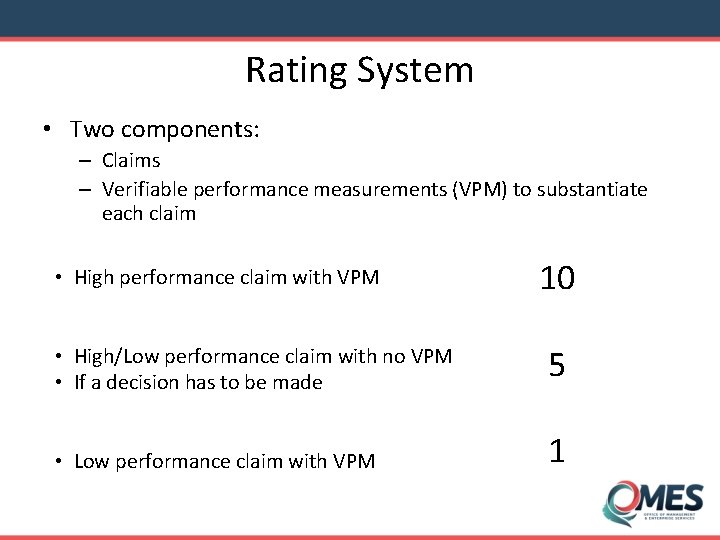
Rating System • Two components: – Claims – Verifiable performance measurements (VPM) to substantiate each claim • High performance claim with VPM 10 • High/Low performance claim with no VPM • If a decision has to be made 5 • Low performance claim with VPM 1
Clarification Phase Deliverables • • • Scope of work (what is “in” and “out”) Executive summary of project Detailed project schedule Detailed cost schedule Weekly risk report – Risk activities – Performance measurements – Risk mitigation plan – Milestone schedule
Managing Supplier Performance Weekly Risk Reports • • • Performance metrics Usage reports Risk management plan
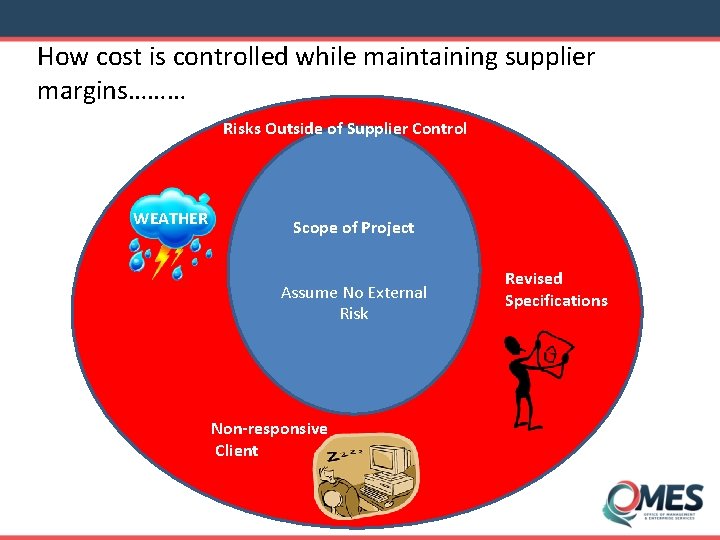
How cost is controlled while maintaining supplier margins……… Risks Outside of Supplier Control WEATHER Scope of Project Assume No External Risk Non-responsive Client Revised Specifications
Useful Tips • Include any legal exceptions, objections, or additions • Include verification sources for claims made in submission • No identifying information • Weekly risk report is for the clarification phase
QUESTIONS? This publication is issued by the Office of Management and Enterprise Services as authorized by Title 62, Section 34. Copies have not been printed but are available through the agency website. This work is licensed under a Creative Attribution-Non. Commercial-No. Derivs 3. 0 Unported License.
- Slides: 25