
Performance Scalability of my SAP com Bernd F
Performance & Scalability of my. SAP. com Bernd F. Lober SAP AG
Agenda Characteristics of scalability n Performance indicators Standard Application Benchmarks n Characteristics n Published benchmark results ã SAP AG 2002, Bernd F. Lober Page 2
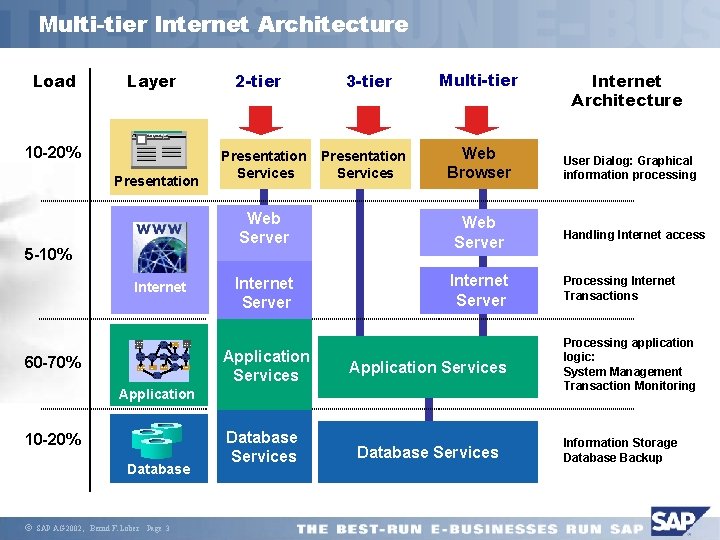
Multi-tier Internet Architecture Load Layer 2 -tier 10 -20% Presentation 5 -10% Internet Customer Service Rep 60 -70% Create Plant Production Personnel Orders Accept Customer Order Explode Bill-of. Material Customer Order Part Release Build Reserve Production Products Material Orders Schedule Material Production Task Confirm Delivery Presentation Services 3 -tier Presentation Services Multi-tier Web Browser Web Server Internet Server Application Services Database Services Application 10 -20% Database ã SAP AG 2002, Bernd F. Lober Page 3 Internet Architecture User Dialog: Graphical information processing Handling Internet access Processing Internet Transactions Processing application logic: System Management Transaction Monitoring Information Storage Database Backup
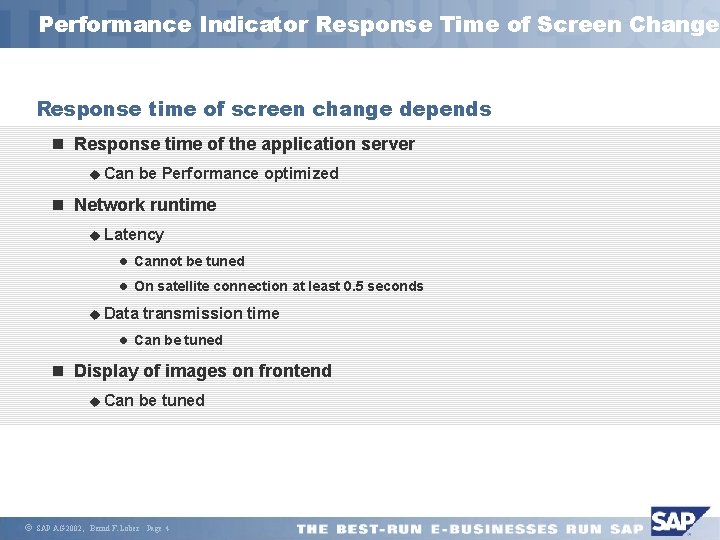
Performance Indicator Response Time of Screen Change Response time of screen change depends n Response time of the application server u Can be Performance optimized n Network runtime u Latency l Cannot be tuned l On satellite connection at least 0. 5 seconds u Data transmission time l Can be tuned n Display of images on frontend u Can ã be tuned SAP AG 2002, Bernd F. Lober Page 4
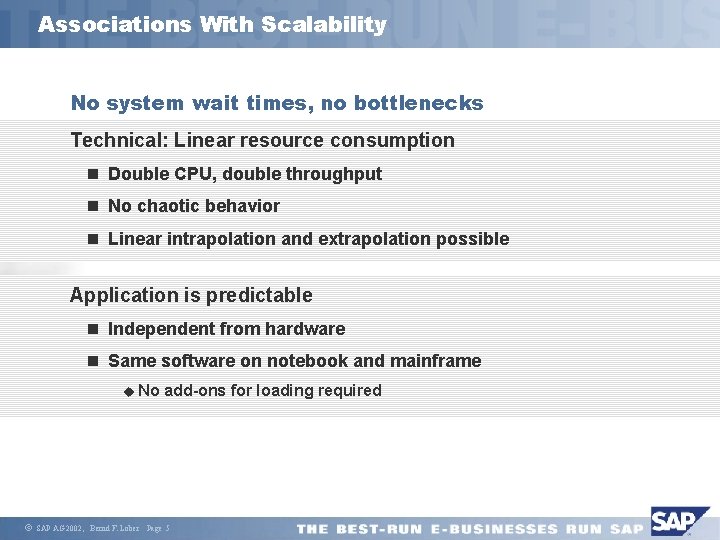
Associations With Scalability No system wait times, no bottlenecks Technical: Linear resource consumption n Double CPU, double throughput n No chaotic behavior n Linear intrapolation and extrapolation possible Application is predictable n Independent from hardware n Same software on notebook and mainframe u No ã add-ons for loading required SAP AG 2002, Bernd F. Lober Page 5
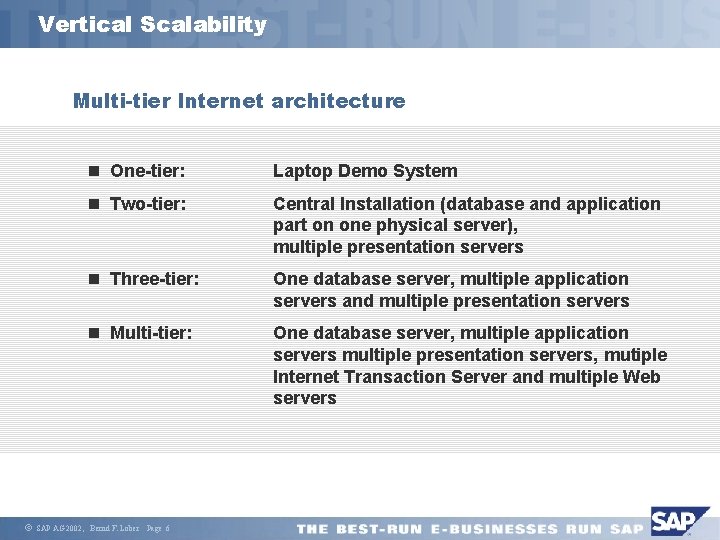
Vertical Scalability Multi-tier Internet architecture ã n One-tier: Laptop Demo System n Two-tier: Central Installation (database and application part on one physical server), multiple presentation servers n Three-tier: One database server, multiple application servers and multiple presentation servers n Multi-tier: One database server, multiple application servers multiple presentation servers, mutiple Internet Transaction Server and multiple Web servers SAP AG 2002, Bernd F. Lober Page 6

Horizontal Scalability Presentation Layer n More than 47, 000 very active users connected to one database have been tested Internet Transaction Server and Web Server n More than 100 hits /sec Application Layer n Up to 161 application servers have been tested successfully n The highest number of physical application servers at customer installations is less than 32 Database Layer n Scalability through SMP architecture of the database server n More than 120 CPUs and more than 10 TB Database size n Scalability through parallel databases n Scalability through Components ã SAP AG 2002, Bernd F. Lober Page 7
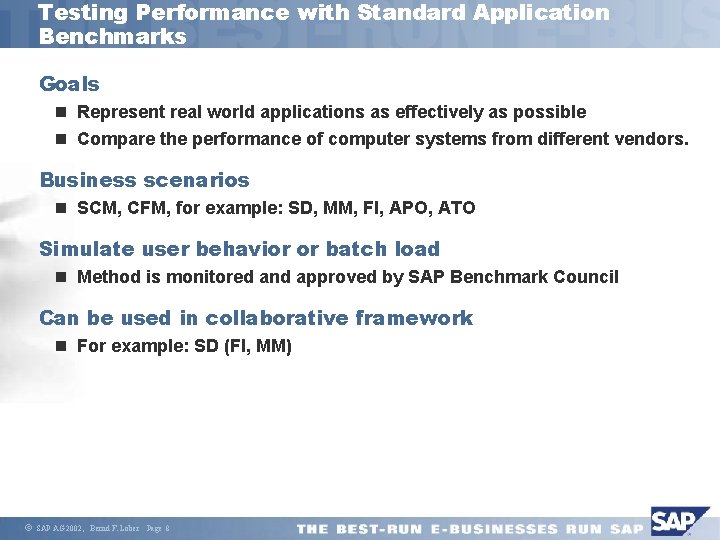
Testing Performance with Standard Application Benchmarks Goals n Represent real world applications as effectively as possible n Compare the performance of computer systems from different vendors. Business scenarios n SCM, CFM, for example: SD, MM, FI, APO, ATO Simulate user behavior or batch load n Method is monitored and approved by SAP Benchmark Council Can be used in collaborative framework n For example: SD (FI, MM) ã SAP AG 2002, Bernd F. Lober Page 8
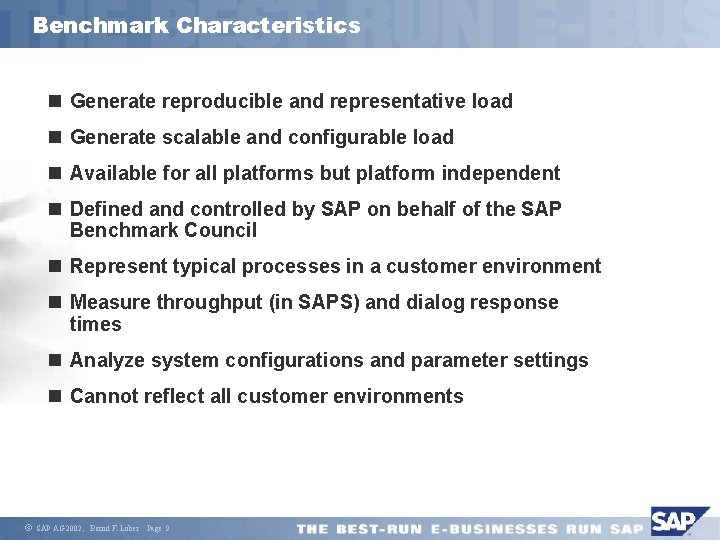
Benchmark Characteristics n Generate reproducible and representative load n Generate scalable and configurable load n Available for all platforms but platform independent n Defined and controlled by SAP on behalf of the SAP Benchmark Council n Represent typical processes in a customer environment n Measure throughput (in SAPS) and dialog response times n Analyze system configurations and parameter settings n Cannot reflect all customer environments ã SAP AG 2002, Bernd F. Lober Page 9
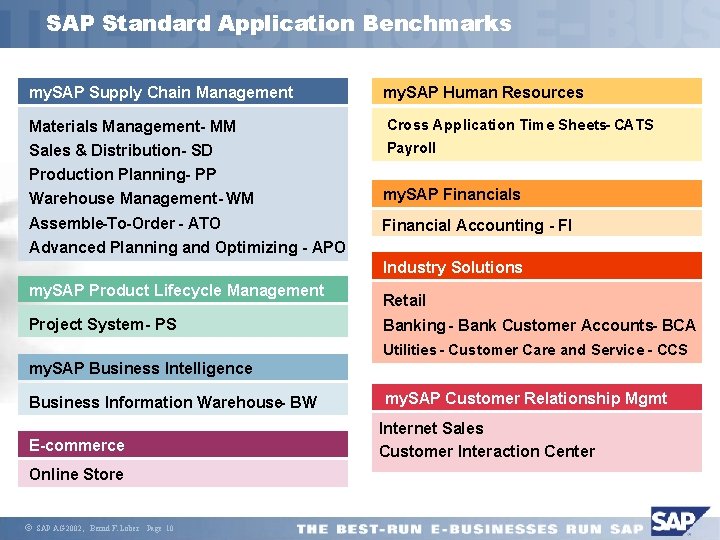
SAP Standard Application Benchmarks my. SAP Supply Chain Management my. SAP Human Resources Materials Management- MM Cross Application Time Sheets- CATS Sales & Distribution- SD Payroll Production Planning- PP Warehouse Management - WM my. SAP Financials Assemble-To-Order - ATO Financial Accounting - FI Advanced Planning and Optimizing - APO Industry Solutions my. SAP Product Lifecycle Management Project System - PS Retail Banking - Bank Customer Accounts- BCA Utilities - Customer Care and Service - CCS my. SAP Business Intelligence Business Information Warehouse- BW E-commerce Online Store ã SAP AG 2002, Bernd F. Lober Page 10 my. SAP Customer Relationship Mgmt Internet Sales Customer Interaction Center
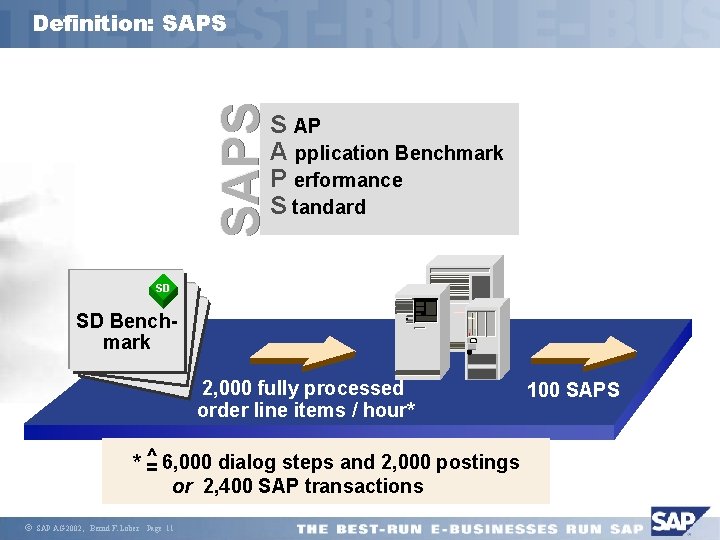
SAPS Definition: SAPS S AP A pplication Benchmark P erformance S tandard SD SD Benchmark 2, 000 fully processed order line items / hour* *^ = 6, 000 dialog steps and 2, 000 postings or 2, 400 SAP transactions ã SAP AG 2002, Bernd F. Lober Page 11 100 SAPS
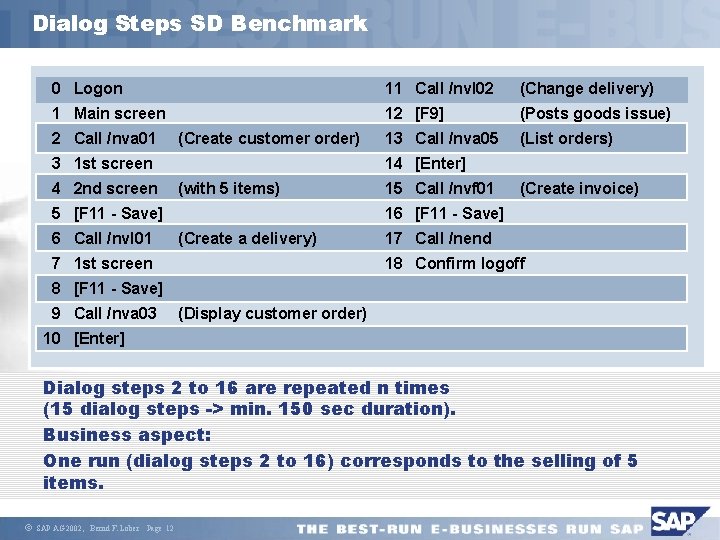
Dialog Steps SD Benchmark 0 Logon 11 Call /nvl 02 (Change delivery) 1 Main screen 12 [F 9] (Posts goods issue) 13 Call /nva 05 (List orders) 2 Call /nva 01 (Create customer order) 3 1 st screen 4 2 nd screen 14 [Enter] (with 5 items) 5 [F 11 - Save] 6 Call /nvl 01 15 Call /nvf 01 (Create invoice) 16 [F 11 - Save] (Create a delivery) 7 1 st screen 17 Call /nend 18 Confirm logoff 8 [F 11 - Save] 9 Call /nva 03 (Display customer order) 10 [Enter] Dialog steps 2 to 16 are repeated n times (15 dialog steps -> min. 150 sec duration). Business aspect: One run (dialog steps 2 to 16) corresponds to the selling of 5 items. ã SAP AG 2002, Bernd F. Lober Page 12
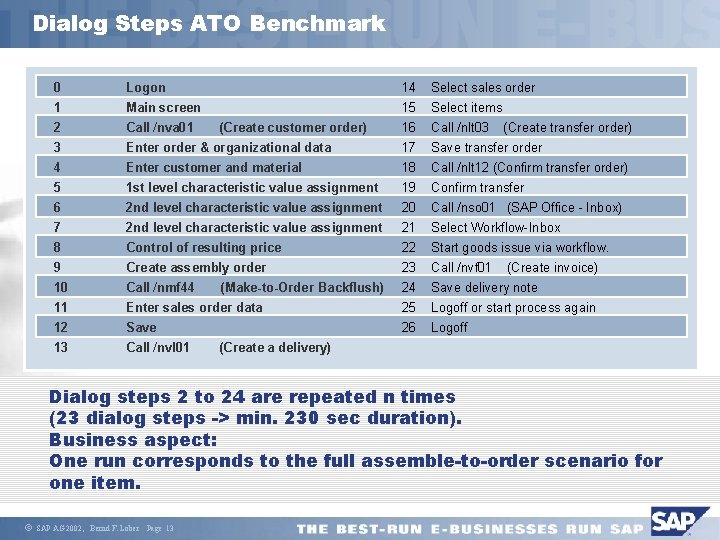
Dialog Steps ATO Benchmark 0 Logon 14 Select sales order 1 Main screen 15 Select items 2 Call /nva 01 16 Call /nlt 03 3 Enter order & organizational data 17 Save transfer order 4 Enter customer and material 18 Call /nlt 12 (Confirm transfer order) 5 1 st level characteristic value assignment 19 Confirm transfer 6 2 nd level characteristic value assignment 20 Call /nso 01 (SAP Office - Inbox) 7 2 nd level characteristic value assignment 21 Select Workflow-Inbox 8 Control of resulting price 22 Start goods issue via workflow. 9 Create assembly order 23 Call /nvf 01 10 Call /nmf 44 24 Save delivery note 11 Enter sales order data 25 Logoff or start process again 12 Save 26 Logoff 13 Call /nvl 01 (Create customer order) (Make-to-Order Backflush) (Create transfer order) (Create invoice) (Create a delivery) Dialog steps 2 to 24 are repeated n times (23 dialog steps -> min. 230 sec duration). Business aspect: One run corresponds to the full assemble-to-order scenario for one item. ã SAP AG 2002, Bernd F. Lober Page 13
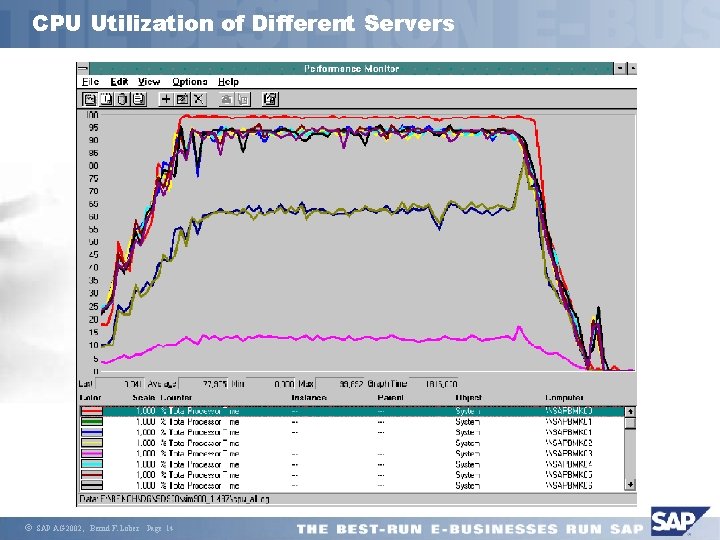
CPU Utilization of Different Servers ã SAP AG 2002, Bernd F. Lober Page 14
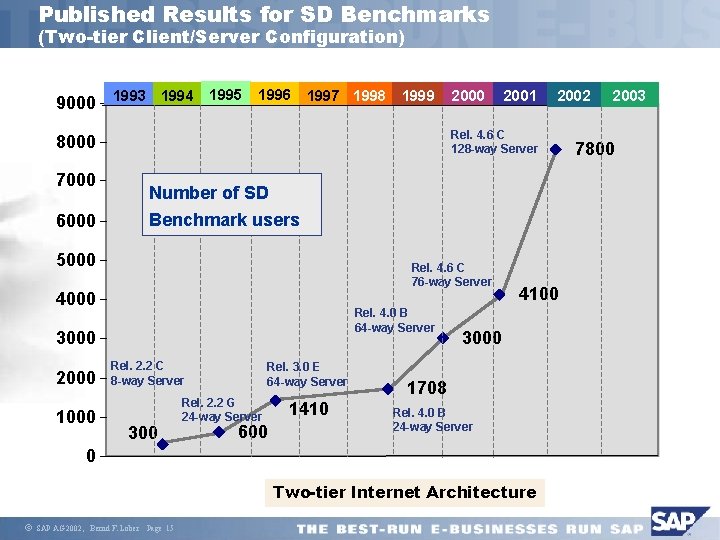
Published Results for SD Benchmarks (Two-tier Client/Server Configuration) 9000 1993 1994 1995 1996 1997 1998 1999 2000 6000 Number of SD Benchmark users 5000 Rel. 4. 6 C 76 -way Server 4000 Rel. 4. 0 B 64 -way Server 3000 2000 1000 Rel. 2. 2 C 8 -way Server 300 Rel. 3. 0 E 64 -way Server Rel. 2. 2 G 24 -way Server 600 1410 4100 3000 1708 Rel. 4. 0 B 24 -way Server 0 Two-tier Internet Architecture ã 2002 Rel. 4. 6 C 128 -way Server 8000 7000 2001 SAP AG 2002, Bernd F. Lober Page 15 2003 7800
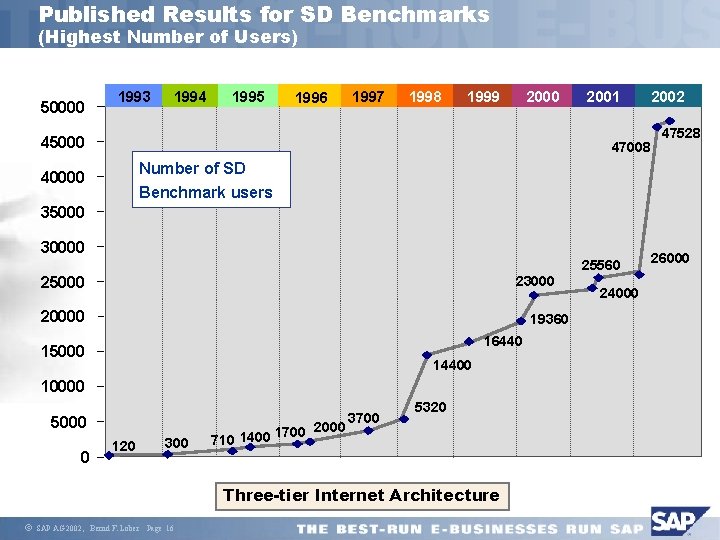
Published Results for SD Benchmarks (Highest Number of Users) 50000 1993 1994 1995 1996 1997 1998 2000 1999 45000 2001 25560 47008 2002 47528 Number of SD Benchmark users 40000 35000 30000 23000 25000 20000 19360 16440 15000 14400 10000 5000 0 120 300 1700 710 1400 2000 3700 5320 Three-tier Internet Architecture ã SAP AG 2002, Bernd F. Lober Page 16 25560 24000 26000
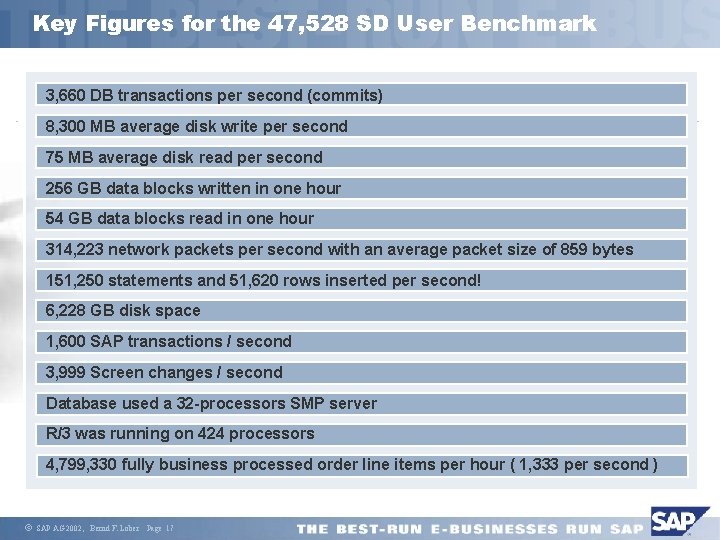
Key Figures for the 47, 528 SD User Benchmark 3, 660 DB transactions per second (commits) 8, 300 MB average disk write per second 75 MB average disk read per second 256 GB data blocks written in one hour 54 GB data blocks read in one hour 314, 223 network packets per second with an average packet size of 859 bytes 151, 250 statements and 51, 620 rows inserted per second! 6, 228 GB disk space 1, 600 SAP transactions / second 3, 999 Screen changes / second Database used a 32 -processors SMP server R/3 was running on 424 processors 4, 799, 330 fully business processed order line items per hour ( 1, 333 per second ) ã SAP AG 2002, Bernd F. Lober Page 17
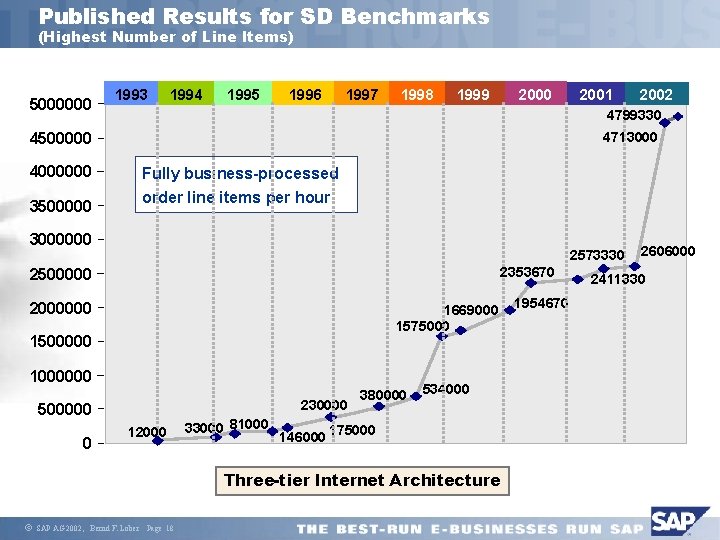
Published Results for SD Benchmarks (Highest Number of Line Items) 5000000 1993 1994 1995 1996 1997 1998 1999 2000 3500000 4713000 Fully business-processed order line items per hour 3000000 2573330 2353670 2500000 2000000 1669000 1575000 1500000 1000000 230000 500000 0 12000 33000 81000 380000 534000 146000 175000 Three-tier Internet Architecture ã 2002 4799330 4500000 4000000 2001 SAP AG 2002, Bernd F. Lober Page 18 1954670 2606000 2411330
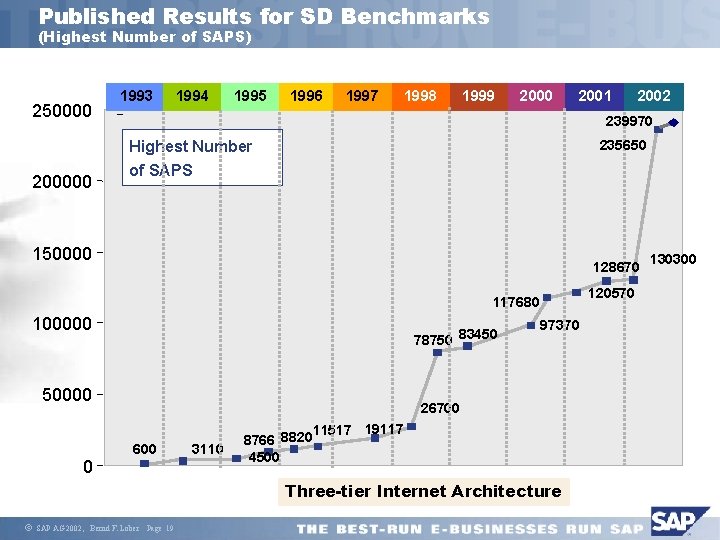
Published Results for SD Benchmarks (Highest Number of SAPS) 250000 200000 1993 1994 1995 1996 1997 1998 1999 2000 2001 239970 235650 Highest Number of SAPS 150000 128670 120570 117680 100000 78750 83450 50000 0 97370 26700 600 3110 8766 8820 4500 11517 19117 Three-tier Internet Architecture ã 2002 SAP AG 2002, Bernd F. Lober Page 19 130300
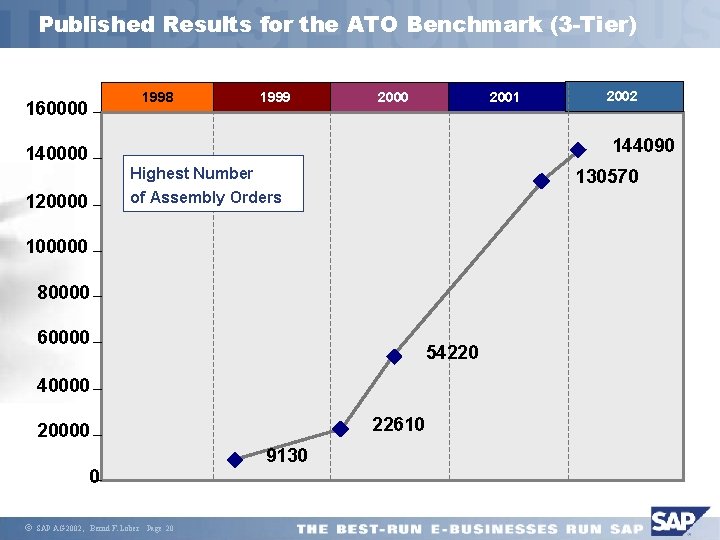
Published Results for the ATO Benchmark (3 -Tier) 1998 160000 1999 2000 2001 144090 140000 Highest Number of Assembly Orders 120000 130570 100000 80000 60000 54220 40000 22610 20000 0 ã 2002 SAP AG 2002, Bernd F. Lober Page 20 9130
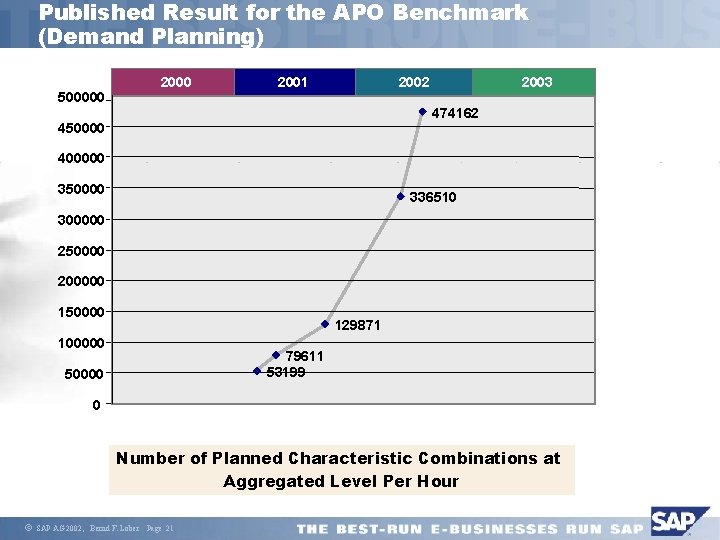
Published Result for the APO Benchmark (Demand Planning) 500000 2001 2002 2003 474162 450000 400000 350000 336510 300000 250000 200000 150000 129871 100000 79611 53199 50000 0 Number of Planned Characteristic Combinations at Aggregated Level Per Hour ã SAP AG 2002, Bernd F. Lober Page 21
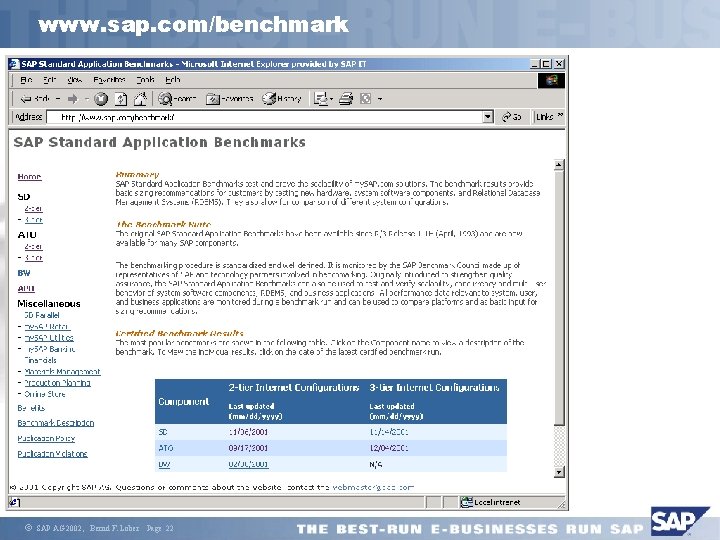
www. sap. com/benchmark ã SAP AG 2002, Bernd F. Lober Page 22
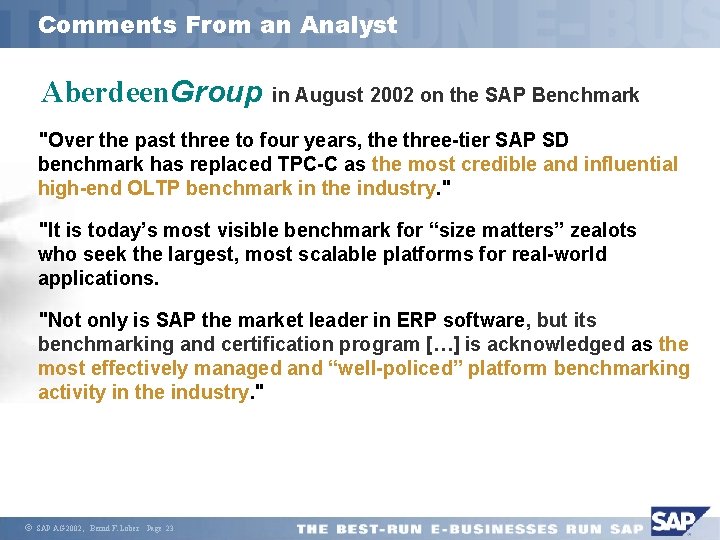
Comments From an Analyst Aberdeen. Group in August 2002 on the SAP Benchmark "Over the past three to four years, the three-tier SAP SD benchmark has replaced TPC-C as the most credible and influential high-end OLTP benchmark in the industry. " "It is today’s most visible benchmark for “size matters” zealots who seek the largest, most scalable platforms for real-world applications. "Not only is SAP the market leader in ERP software, but its benchmarking and certification program […] is acknowledged as the most effectively managed and “well-policed” platform benchmarking activity in the industry. " ã SAP AG 2002, Bernd F. Lober Page 23
Summary Proven Scalability - with enough potential for future growth my. SAP. com exploits the latest available components Useful addresses: http: //www. sap. com/benchmark http: //service. sap. com/performance http: //service. sap. com/sizing ã SAP AG 2002, Bernd F. Lober Page 24
Questions And Answers ã SAP AG 2002, Bernd F. Lober Page 25
Copyright 2002 SAP AG. All rights reserved ã n No part of this publication may be reproduced or transmitted in any form or for any purpose without the express permission of SAP AG. The information contained herein may be changed without prior notice. n Some software products marketed by SAP AG and its distributors contain proprietary software components of other software vendors. n Microsoft®, WINDOWS®, NT®, EXCEL®, Word®, Power. Point® and SQL Server® are registered trademarks of Microsoft Corporation. n IBM®, DB 2®, OS/2®, DB 2/6000®, Parallel Sysplex®, MVS/ESA®, RS/6000®, AIX®, S/390®, AS/400®, OS/390®, and OS/400® are registered trademarks of IBM Corporation. n ORACLE® is a registered trademark of ORACLE Corporation. n INFORMIX®-On. Line for SAP and Informix® Dynamic Server. TM are registered trademarks of Informix Software Incorporated. n UNIX®, X/Open®, OSF/1®, and Motif® are registered trademarks of the Open Group. n Citrix®, the Citrix logo, ICA®, Program Neighborhood ®, Meta. Frame®, Win. Frame®, Video. Frame®, Multi. Win® and other Citrix product names referenced herein are trademarks of Citrix Systems, Inc. n HTML, DHTML, XHTML are trademarks or registered trademarks of W 3 C®, World Wide Web Consortium, Massachusetts Institute of Technology. n JAVA® is a registered trademark of Sun Microsystems, Inc. n JAVASCRIPT® is a registered trademark of Sun Microsystems, Inc. , used under license for technology invented and implemented by Netscape. n SAP, SAP Logo, R/2, RIVA, R/3, SAP Archive. Link, SAP Business Workflow, Web. Flow, SAP Early. Watch, BAPI, SAPPHIRE, Management Cockpit, my. SAP. com Logo and my. SAP. com are trademarks or registered trademarks of SAP AG in Germany and in several other countries all over the world. All other products mentioned are trademarks or registered trademarks of their respective companies. SAP AG 2002, Bernd F. Lober Page 26
- Slides: 26