
Performance Review Process Setting Goals Expectations Managers Welcome
- Slides: 19
Performance Review Process Setting Goals & Expectations Managers
Welcome If you are in a room with multiple people or have signed in using only your first name, please send an email to Ashley Smith (ajs 6938@psu. edu).
Housekeeping items Session is being recorded. Use the chat box to ask questions at any time. Please silence phones and minimize background noise. Inform your co-workers that you’re attending this session.
Today will help you to Understand effective performance management and recognize its importance Identify your role and responsibilities related to performance management Learn best practices of goal setting
Performance Management A Definition The process of setting expectations, aligning goals, assessing results, and focusing on staff development through ongoing conversations between managers and their direct report(s).
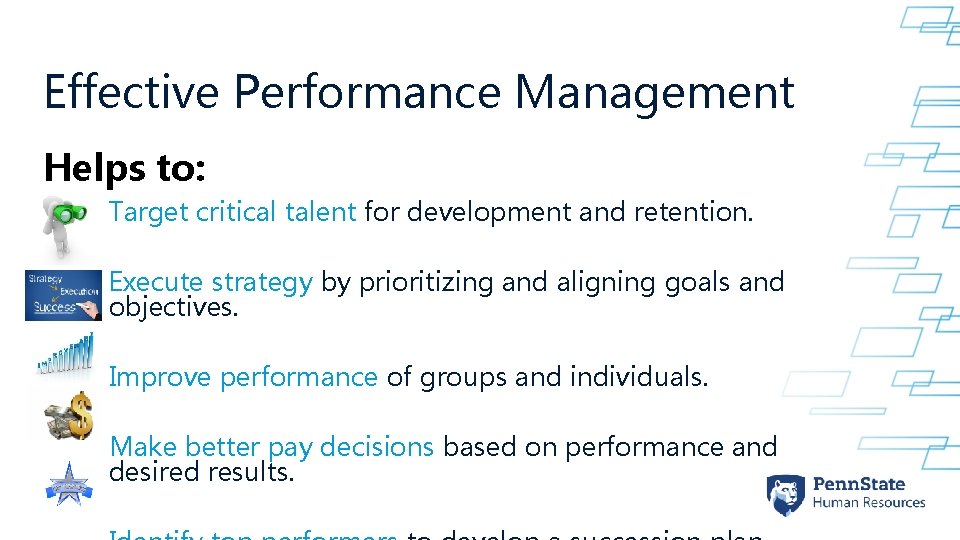
Effective Performance Management Helps to: Target critical talent for development and retention. Execute strategy by prioritizing and aligning goals and objectives. Improve performance of groups and individuals. Make better pay decisions based on performance and desired results.
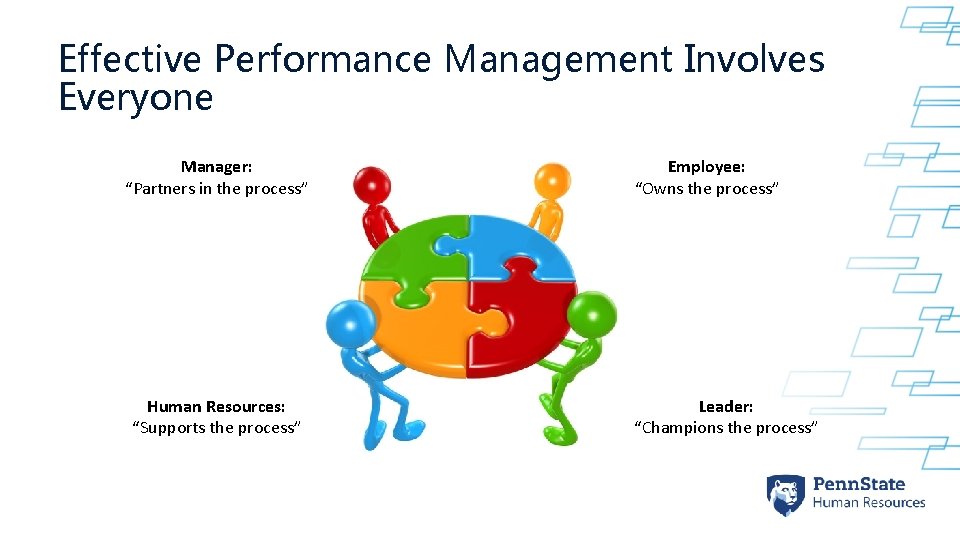
Effective Performance Management Involves Everyone Manager: “Partners in the process” Human Resources: “Supports the process” Employee: “Owns the process” Leader: “Champions the process”
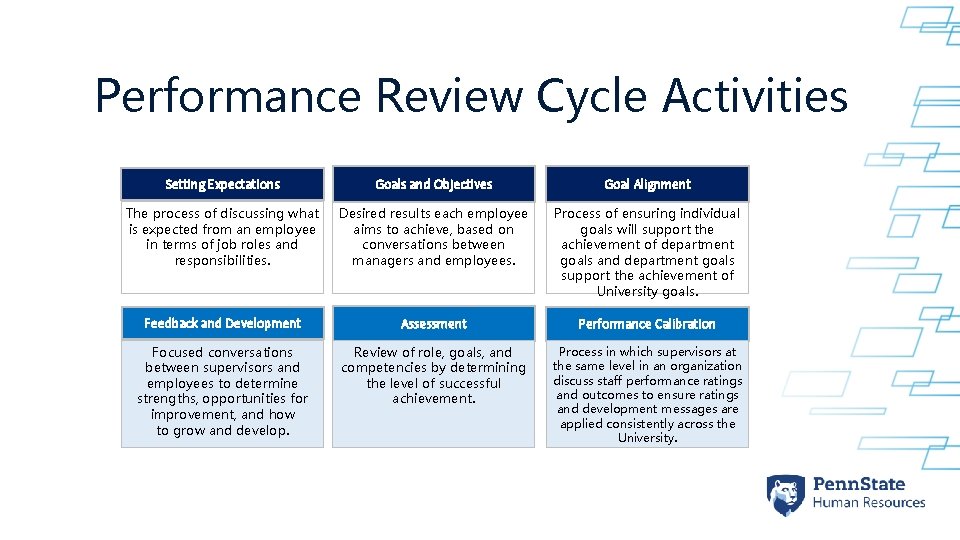
Performance Review Cycle Activities Setting Expectations Goals and Objectives Goal Alignment The process of discussing what is expected from an employee in terms of job roles and responsibilities. Desired results each employee aims to achieve, based on conversations between managers and employees. Process of ensuring individual goals will support the achievement of department goals and department goals support the achievement of University goals. Feedback and Development Assessment Performance Calibration Focused conversations between supervisors and employees to determine strengths, opportunities for improvement, and how to grow and develop. Review of role, goals, and competencies by determining the level of successful achievement. Process in which supervisors at the same level in an organization discuss staff performance ratings and outcomes to ensure ratings and development messages are applied consistently across the University.
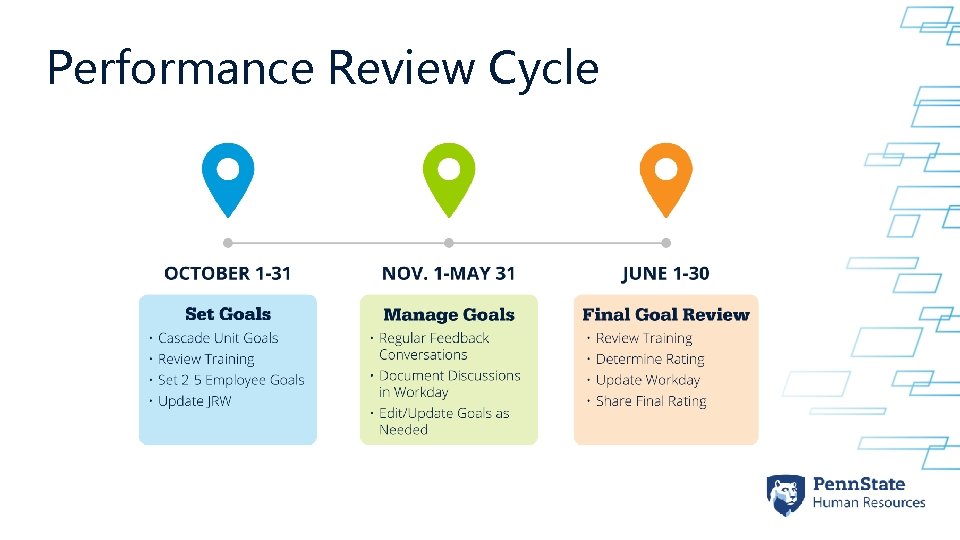
Performance Review Cycle
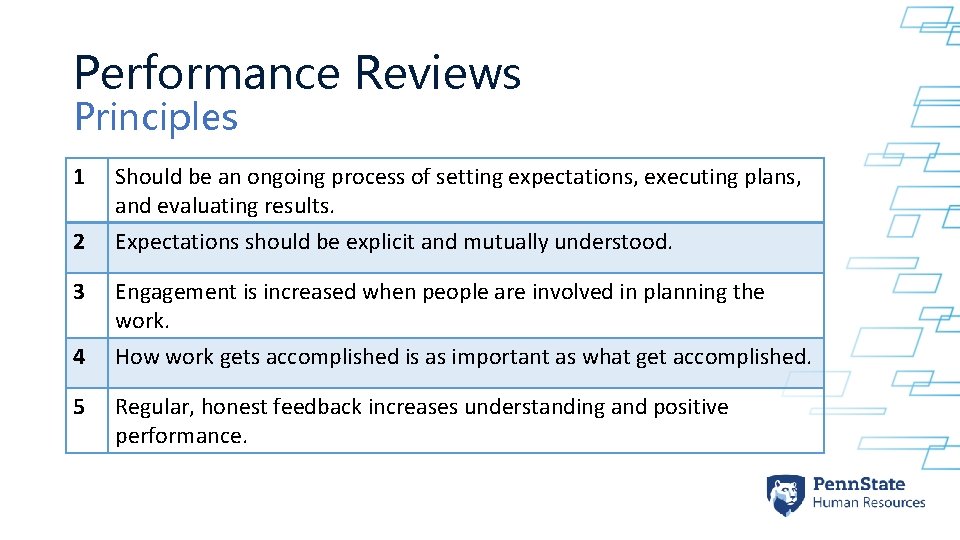
Performance Reviews Principles 1 Should be an ongoing process of setting expectations, executing plans, and evaluating results. 2 Expectations should be explicit and mutually understood. 3 Engagement is increased when people are involved in planning the work. 4 How work gets accomplished is as important as what get accomplished. 5 Regular, honest feedback increases understanding and positive performance.
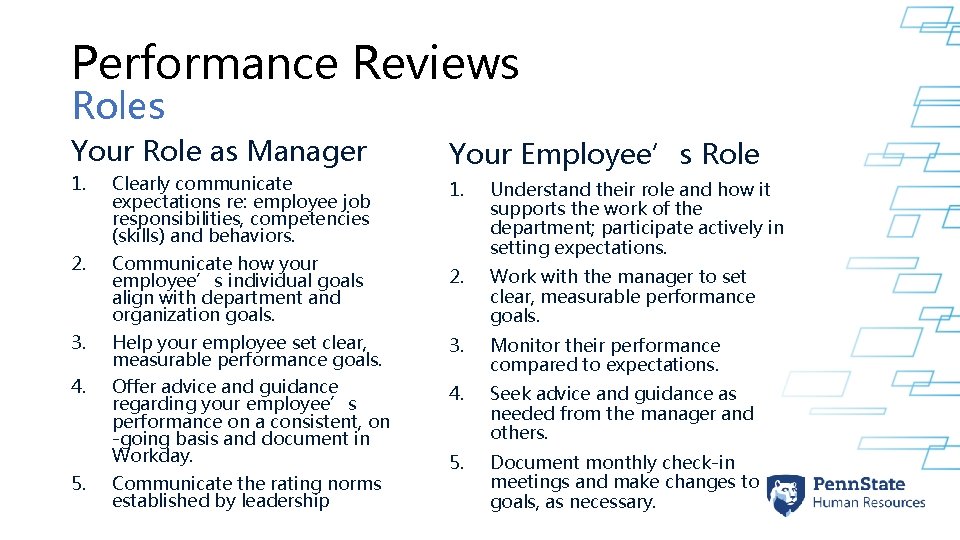
Performance Reviews Roles Your Role as Manager 1. Clearly communicate expectations re: employee job responsibilities, competencies (skills) and behaviors. 2. Communicate how your employee’s individual goals align with department and organization goals. 3. 4. 5. Your Employee’s Role 1. Understand their role and how it supports the work of the department; participate actively in setting expectations. 2. Work with the manager to set clear, measurable performance goals. Help your employee set clear, measurable performance goals. 3. Offer advice and guidance regarding your employee’s performance on a consistent, on -going basis and document in Workday. Monitor their performance compared to expectations. 4. Seek advice and guidance as needed from the manager and others. 5. Document monthly check-in meetings and make changes to goals, as necessary. Communicate the rating norms established by leadership
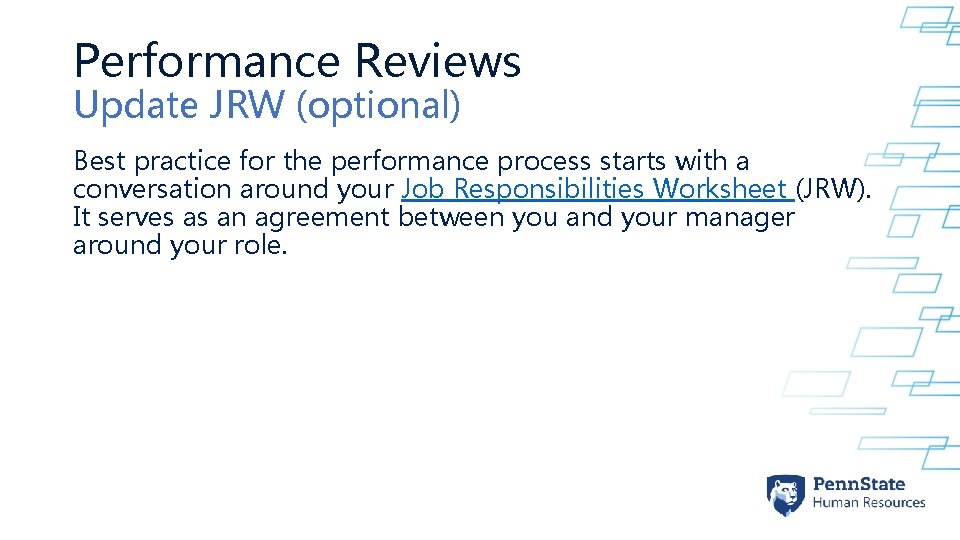
Performance Reviews Update JRW (optional) Best practice for the performance process starts with a conversation around your Job Responsibilities Worksheet (JRW). It serves as an agreement between you and your manager around your role.
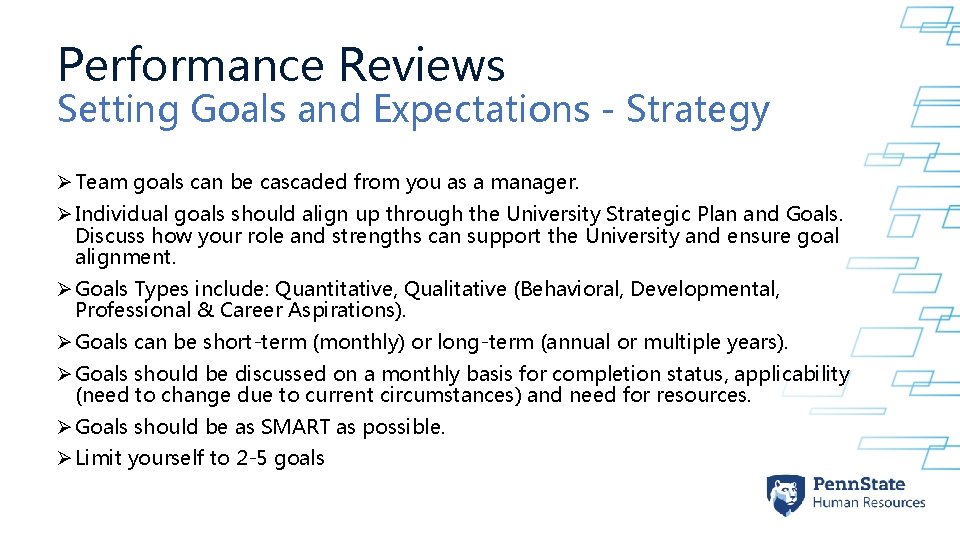
Performance Reviews Setting Goals and Expectations - Strategy Ø Team goals can be cascaded from you as a manager. Ø Individual goals should align up through the University Strategic Plan and Goals. Discuss how your role and strengths can support the University and ensure goal alignment. Ø Goals Types include: Quantitative, Qualitative (Behavioral, Developmental, Professional & Career Aspirations). Ø Goals can be short-term (monthly) or long-term (annual or multiple years). Ø Goals should be discussed on a monthly basis for completion status, applicability (need to change due to current circumstances) and need for resources. Ø Goals should be as SMART as possible. Ø Limit yourself to 2 -5 goals
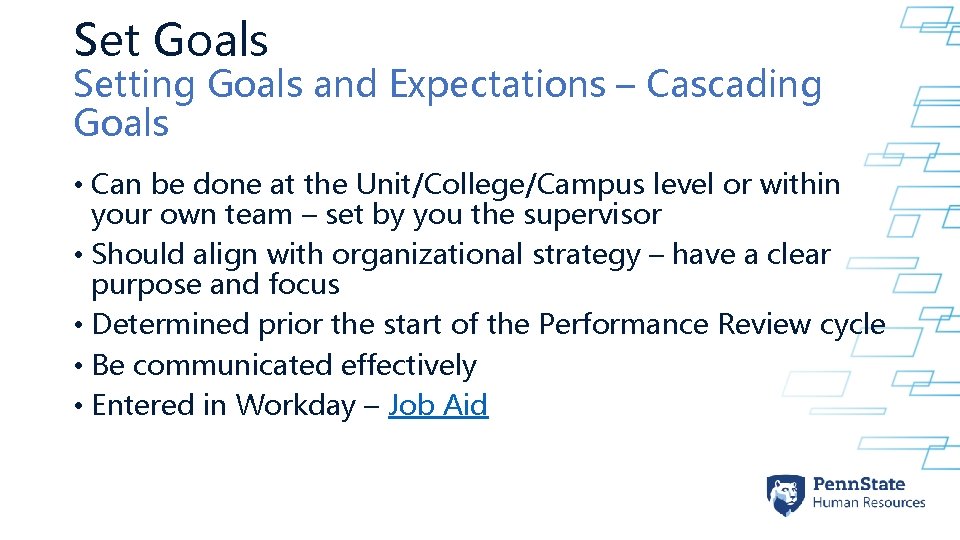
Set Goals Setting Goals and Expectations – Cascading Goals • Can be done at the Unit/College/Campus level or within your own team – set by you the supervisor • Should align with organizational strategy – have a clear purpose and focus • Determined prior the start of the Performance Review cycle • Be communicated effectively • Entered in Workday – Job Aid
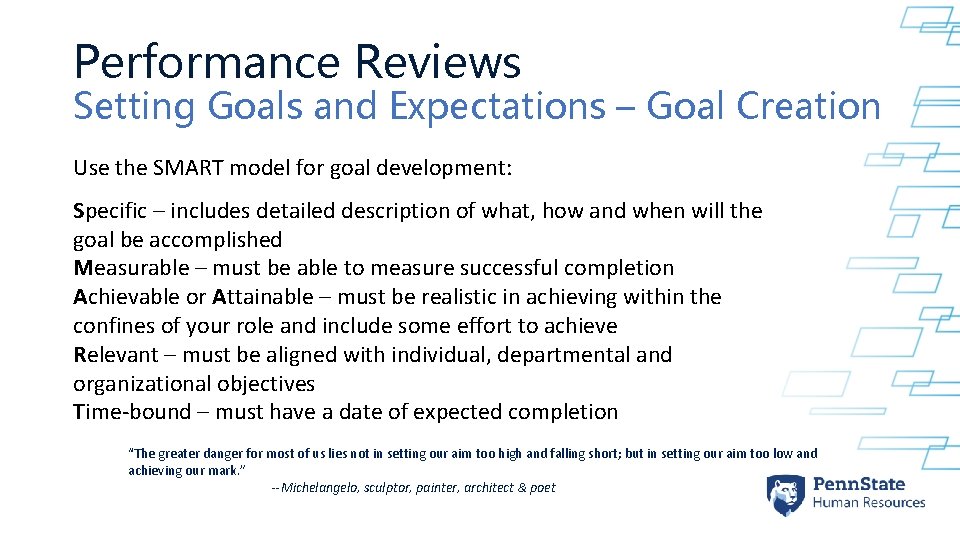
Performance Reviews Setting Goals and Expectations – Goal Creation Use the SMART model for goal development: Specific – includes detailed description of what, how and when will the goal be accomplished Measurable – must be able to measure successful completion Achievable or Attainable – must be realistic in achieving within the confines of your role and include some effort to achieve Relevant – must be aligned with individual, departmental and organizational objectives Time-bound – must have a date of expected completion “The greater danger for most of us lies not in setting our aim too high and falling short; but in setting our aim too low and achieving our mark. ” --Michelangelo, sculptor, painter, architect & poet
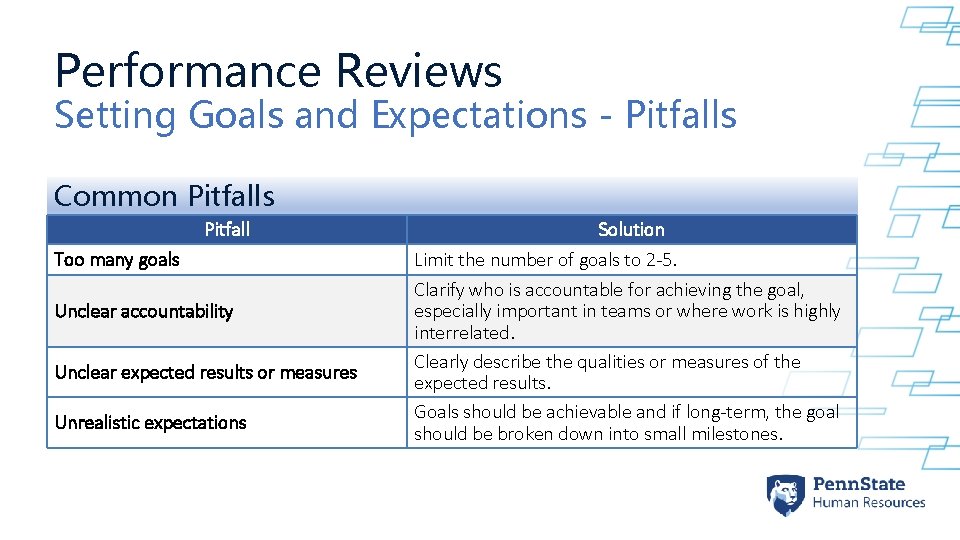
Performance Reviews Setting Goals and Expectations - Pitfalls Common Pitfalls Pitfall Too many goals Unclear accountability Unclear expected results or measures Unrealistic expectations Solution Limit the number of goals to 2 -5. Clarify who is accountable for achieving the goal, especially important in teams or where work is highly interrelated. Clearly describe the qualities or measures of the expected results. Goals should be achievable and if long-term, the goal should be broken down into small milestones.
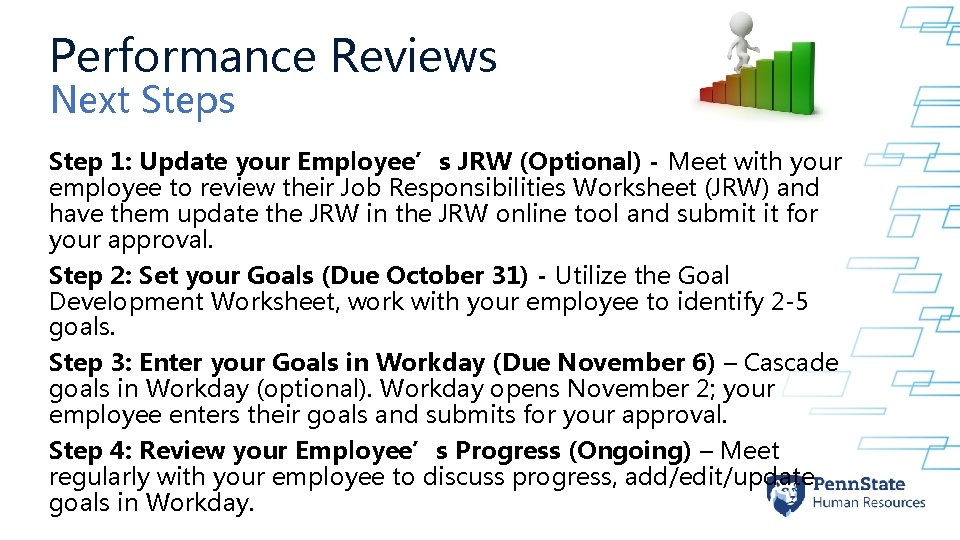
Performance Reviews Next Steps Step 1: Update your Employee’s JRW (Optional) - Meet with your employee to review their Job Responsibilities Worksheet (JRW) and have them update the JRW in the JRW online tool and submit it for your approval. Step 2: Set your Goals (Due October 31) - Utilize the Goal Development Worksheet, work with your employee to identify 2 -5 goals. Step 3: Enter your Goals in Workday (Due November 6) – Cascade goals in Workday (optional). Workday opens November 2; your employee enters their goals and submits for your approval. Step 4: Review your Employee’s Progress (Ongoing) – Meet regularly with your employee to discuss progress, add/edit/update goals in Workday.
Performance Reviews Additional Resources Workday Tutorial Other Resources
Questions? Workday Tutorial. Course Evaluation Jen Clouser Human Resource Specialist Talent Management jel 33@psu. edu “It’s better to be at the bottom of the ladder you want to climb than at the top of the one you don’t. ” – Stephen Kellogg