
Performance Plans Outcomes How to develop and implement

- Slides: 13
Performance Plans
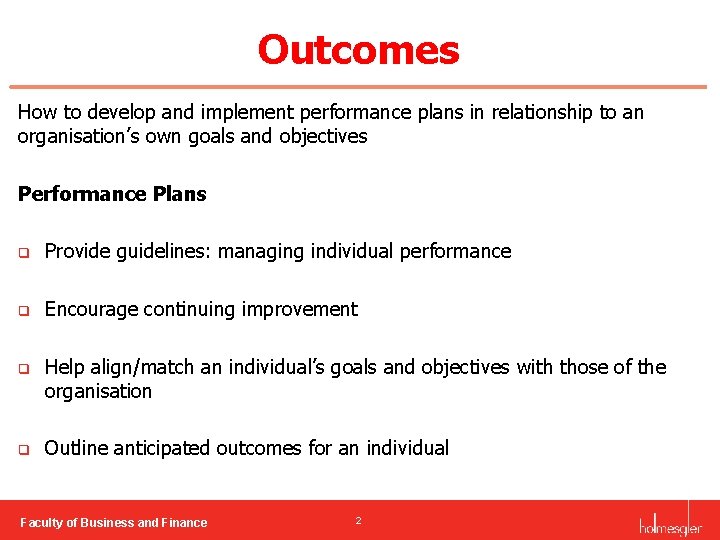
Outcomes How to develop and implement performance plans in relationship to an organisation’s own goals and objectives Performance Plans q Provide guidelines: managing individual performance q Encourage continuing improvement q Help align/match an individual’s goals and objectives with those of the organisation q Outline anticipated outcomes for an individual Faculty of. Business and Finance Faculty of Design & IT 2
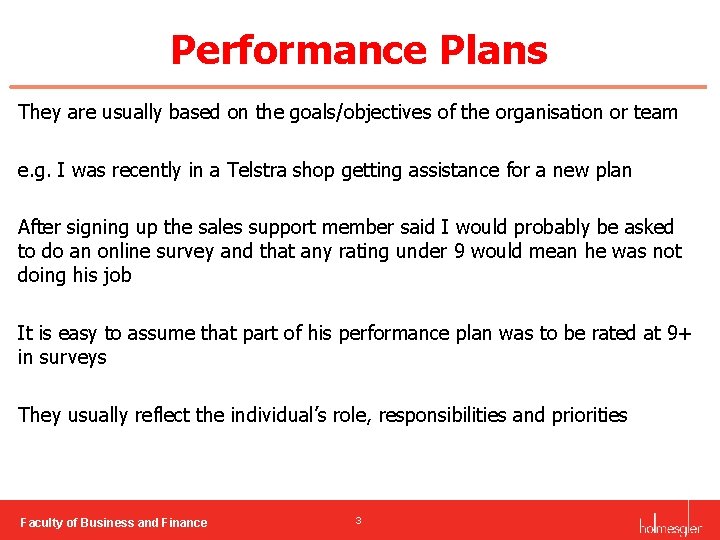
Performance Plans They are usually based on the goals/objectives of the organisation or team e. g. I was recently in a Telstra shop getting assistance for a new plan After signing up the sales support member said I would probably be asked to do an online survey and that any rating under 9 would mean he was not doing his job It is easy to assume that part of his performance plan was to be rated at 9+ in surveys They usually reflect the individual’s role, responsibilities and priorities Faculty of. Business and Finance Faculty of Design & IT 3
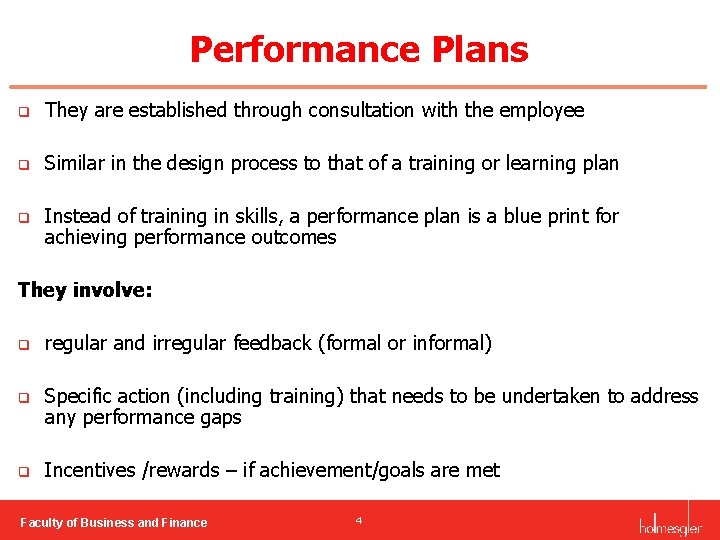
Performance Plans q They are established through consultation with the employee q Similar in the design process to that of a training or learning plan q Instead of training in skills, a performance plan is a blue print for achieving performance outcomes They involve: q regular and irregular feedback (formal or informal) q Specific action (including training) that needs to be undertaken to address any performance gaps q Incentives /rewards – if achievement/goals are met Faculty of. Business and Finance Faculty of Design & IT 4
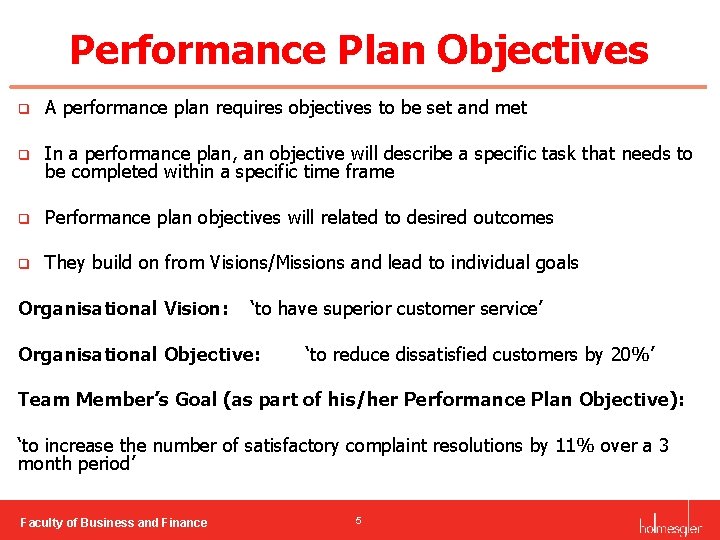
Performance Plan Objectives q A performance plan requires objectives to be set and met q In a performance plan, an objective will describe a specific task that needs to be completed within a specific time frame q Performance plan objectives will related to desired outcomes q They build on from Visions/Missions and lead to individual goals Organisational Vision: ‘to have superior customer service’ Organisational Objective: ‘to reduce dissatisfied customers by 20%’ Team Member’s Goal (as part of his/her Performance Plan Objective): ‘to increase the number of satisfactory complaint resolutions by 11% over a 3 month period’ Faculty of. Business and Finance Faculty of Design & IT 5
The language of Performance Plan Objectives Use active words such as verbs in writing Performance Plan Objectives: ¢ Complete ¢ Maintain ¢ Demonstrate ¢ Plan ¢ Achieve ¢ Design Faculty of. Business and Finance Faculty of Design & IT 6
The language of Performance Plan Objectives will usually address: q Performance: ¢ q Standards: ¢ q the expectations of what the employee should be able to do, achieve, product the quality, quantity or timeframe that should be achieved Conditions: ¢ the workplace/environmental conditions in which the performance happens Faculty of. Business and Finance Faculty of Design & IT 7
Steps to Developing a Performance Plan There are steps or sequences involved in developing a Performance Plan 1. List all the tasks and activities that the employee performs 2. Group the items into broad headings 3. Examine each heading 4. Work out how you and the employee will work out that a task (within the list in 1 above) has been done successfully. This is usually via KPIs (previously discussed) or a range of qualitative or quantitative measures 5. Discuss the finalised performance plan 6. Implement and review the performance plan Faculty of. Business and Finance Faculty of Design & IT 8
Steps to Developing a Performance Plan 1. List all the tasks and activities that the employee performs: ¢ How would you get this information? q There a number of existing documents (again refer back to Develop Teams and Individuals if this helps) ¢ Job descriptions ¢ Workplace policies ¢ Completed tasks ¢ Actual workload Faculty of. Business and Finance Faculty of Design & IT 9
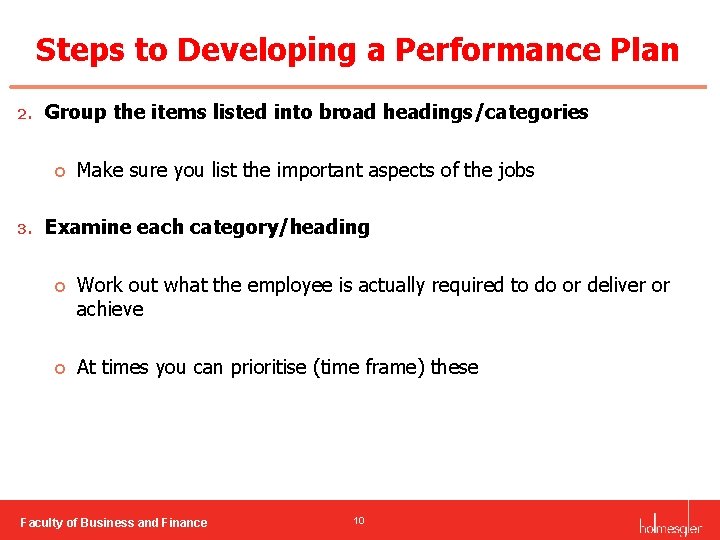
Steps to Developing a Performance Plan 2. Group the items listed into broad headings/categories ¢ 3. Make sure you list the important aspects of the jobs Examine each category/heading ¢ Work out what the employee is actually required to do or deliver or achieve ¢ At times you can prioritise (time frame) these Faculty of. Business and Finance Faculty of Design & IT 10
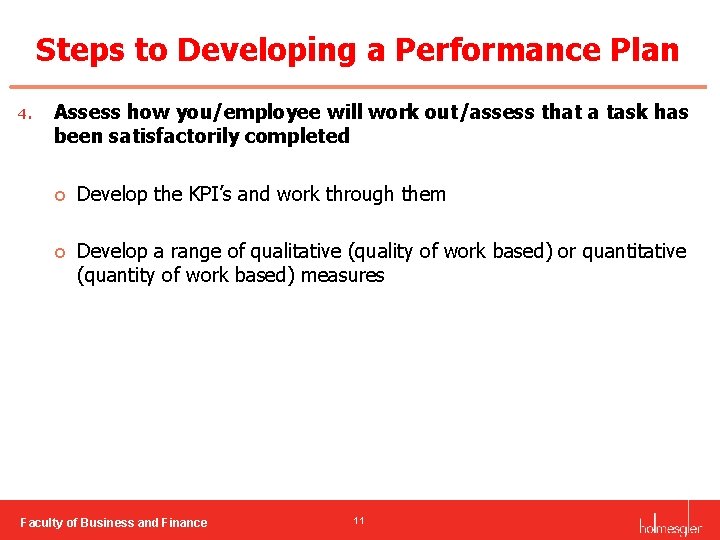
Steps to Developing a Performance Plan 4. Assess how you/employee will work out/assess that a task has been satisfactorily completed ¢ Develop the KPI’s and work through them ¢ Develop a range of qualitative (quality of work based) or quantitative (quantity of work based) measures Faculty of. Business and Finance Faculty of Design & IT 11
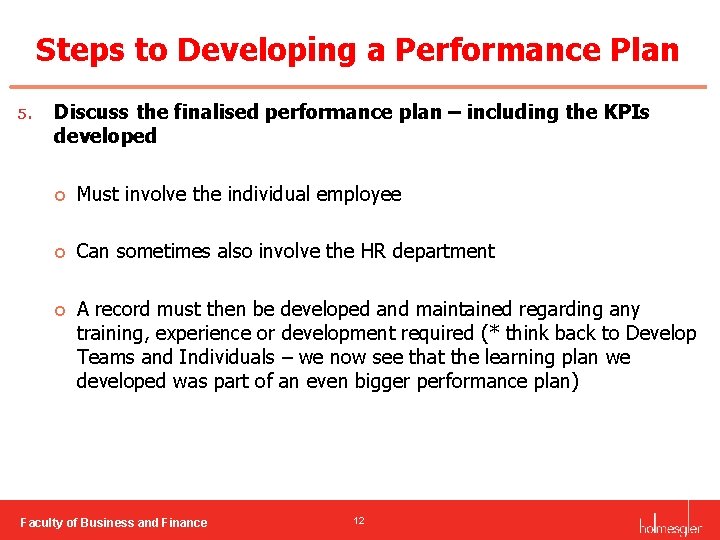
Steps to Developing a Performance Plan 5. Discuss the finalised performance plan – including the KPIs developed ¢ Must involve the individual employee ¢ Can sometimes also involve the HR department ¢ A record must then be developed and maintained regarding any training, experience or development required (* think back to Develop Teams and Individuals – we now see that the learning plan we developed was part of an even bigger performance plan) Faculty of. Business and Finance Faculty of Design & IT 12
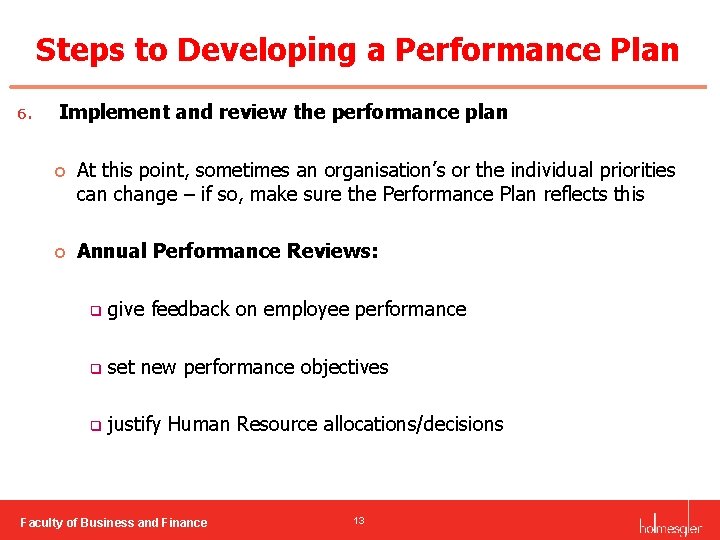
Steps to Developing a Performance Plan 6. Implement and review the performance plan ¢ At this point, sometimes an organisation’s or the individual priorities can change – if so, make sure the Performance Plan reflects this ¢ Annual Performance Reviews: q give feedback on employee performance q set new performance objectives q justify Human Resource allocations/decisions Faculty of. Business and Finance Faculty of Design & IT 13