
Performance Performance is fundamentally limited by Size of
Performance • Performance is fundamentally limited by: – Size of data – Where the data is stored – Type of processing – Processing software – Hardware available
Real Performance Limitations • Rasters: Size of the data and number of files • Points: Number of rows, number of size of attributes • Network access, especially services • Arc. GIS tools • Mistakes in processing • Hardware
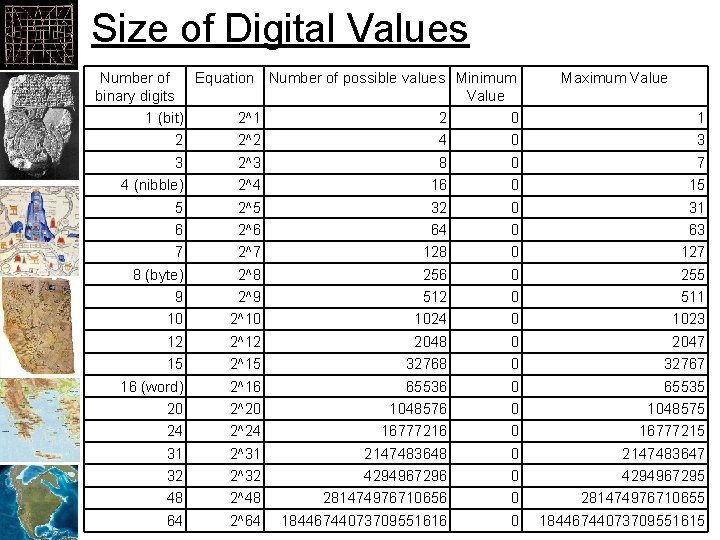
Size of Digital Values Number of Equation Number of possible values Minimum binary digits Value 1 (bit) 2^1 2 0 2 2^2 4 0 3 2^3 8 0 4 (nibble) 2^4 16 0 5 2^5 32 0 6 2^6 64 0 7 2^7 128 0 8 (byte) 2^8 256 0 9 2^9 512 0 10 2^10 1024 0 12 2^12 2048 0 15 2^15 32768 0 16 (word) 2^16 65536 0 20 2^20 1048576 0 24 2^24 16777216 0 31 2^31 2147483648 0 32 2^32 4294967296 0 48 2^48 281474976710656 0 64 2^64 18446744073709551616 0 Maximum Value 1 3 7 15 31 63 127 255 511 1023 2047 32767 65535 1048575 16777215 2147483647 4294967295 281474976710655 18446744073709551615
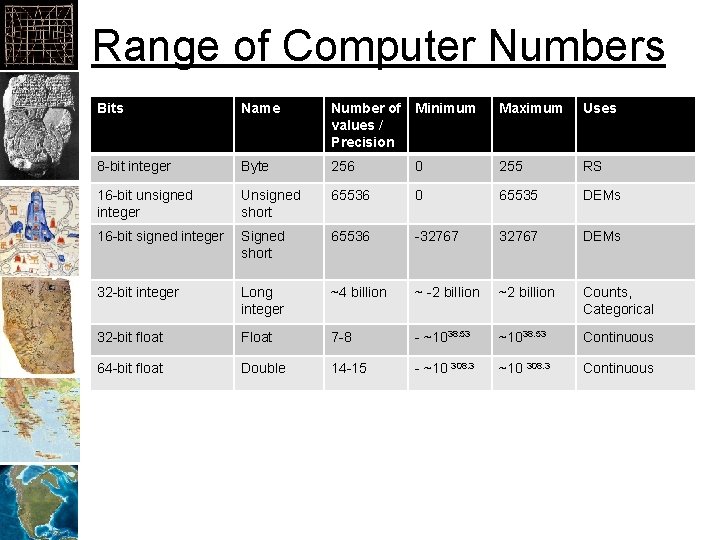
Range of Computer Numbers Bits Name Number of values / Precision Minimum Maximum Uses 8 -bit integer Byte 256 0 255 RS 16 -bit unsigned integer Unsigned short 65536 0 65535 DEMs 16 -bit signed integer Signed short 65536 -32767 DEMs 32 -bit integer Long integer ~4 billion ~ -2 billion ~2 billion Counts, Categorical 32 -bit float Float 7 -8 - ~1038. 53 Continuous 64 -bit float Double 14 -15 - ~10 308. 3 Continuous
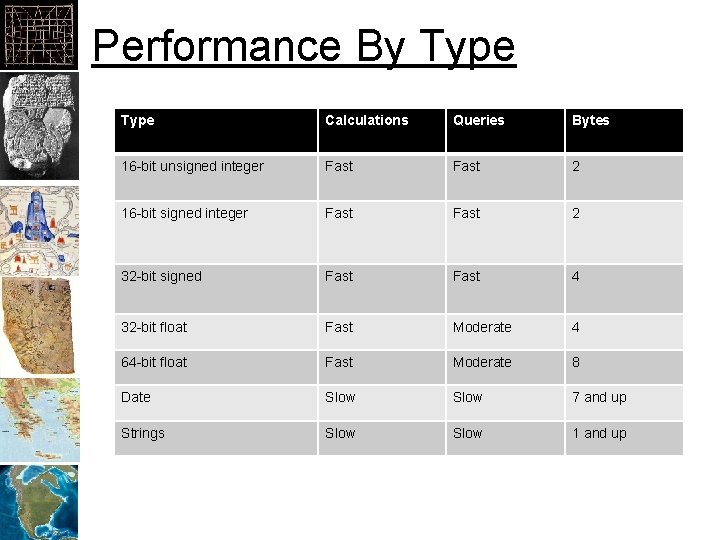
Performance By Type Calculations Queries Bytes 16 -bit unsigned integer Fast 2 16 -bit signed integer Fast 2 32 -bit signed Fast 4 32 -bit float Fast Moderate 4 64 -bit float Fast Moderate 8 Date Slow 7 and up Strings Slow 1 and up
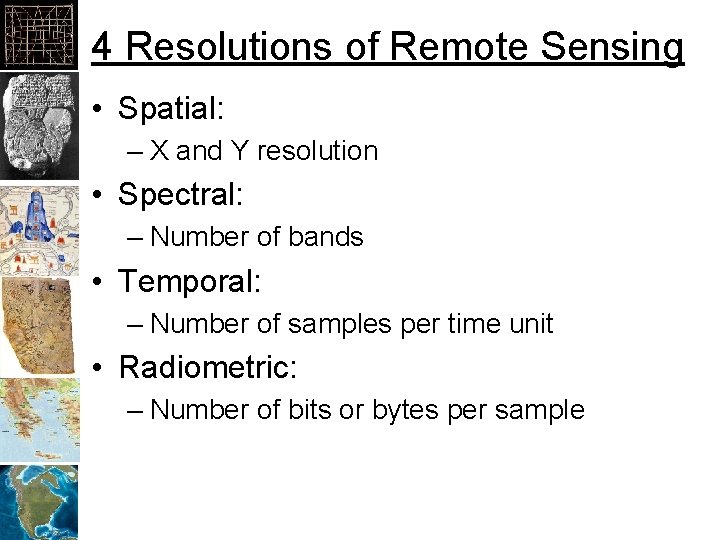
4 Resolutions of Remote Sensing • Spatial: – X and Y resolution • Spectral: – Number of bands • Temporal: – Number of samples per time unit • Radiometric: – Number of bits or bytes per sample
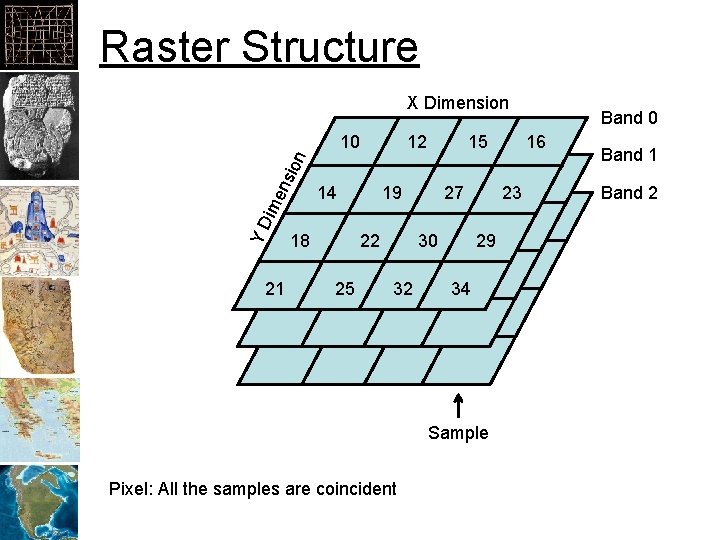
Raster Structure X Dimension 16 15 12 YD ime nsi on 10 21 14 18 25 29 30 22 32 23 27 19 34 Sample Pixel: All the samples are coincident Band 0 Band 1 Band 2
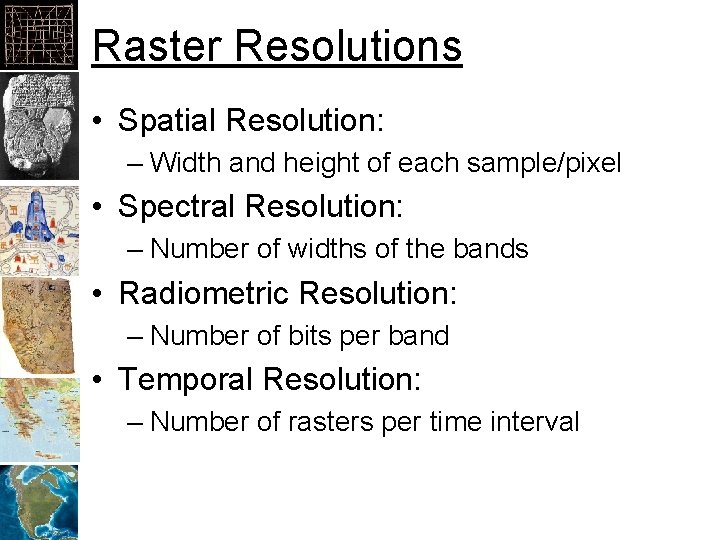
Raster Resolutions • Spatial Resolution: – Width and height of each sample/pixel • Spectral Resolution: – Number of widths of the bands • Radiometric Resolution: – Number of bits per band • Temporal Resolution: – Number of rasters per time interval
Raster Resolutions • Spatial: – 10 cm to 1 km • Spectral (Number of Bands): – 3 for photos, 7 for Landsat, for 256 MODIS • Temporal: – Daily for MODIS, 15 days for Landsat, every few years for SRTM • Radiometric (Sample Depth): – 8 bits=0 to 255 (256 shades)
Raster Size in Bytes = Width of the area * Resolution * Height of the area * Resolution * Bytes per band * Number of bands * Number of Temporal Slices
Landsat TM Scene • Sensor type: opto-mechanical • Spatial Resolution: 30 m (120 m thermal) • Spectral Range: 0. 45 - 12. 5 µm • Number of Bands: 7 • Temporal Resolution: 16 days • Image Size: 185 km X 172 km • Swath: 185 km • Programmable: yes http: //landsat. gsfc. nasa. gov/about/tm. html
Improving Performance • It used to be storing the data was a major problem • Today, the problem is getting the computer processor “close” to the data
Improving Performance • • Resample rasters to the size desired Clip rasters to the area of interest Only use the bands required Store or “cache” rasters to the computer doing the processing • Include performance evaluation as part of the modeling design
- Slides: 13