
Performance of Track and Vertex Reconstruction and BTagging

Performance of Track and Vertex Reconstruction and B-Tagging Studies with CMS in pp Collisions at sqrt(s)=7 Te. V Boris Mangano University of California, San Diego On behalf of the CMS collaboration
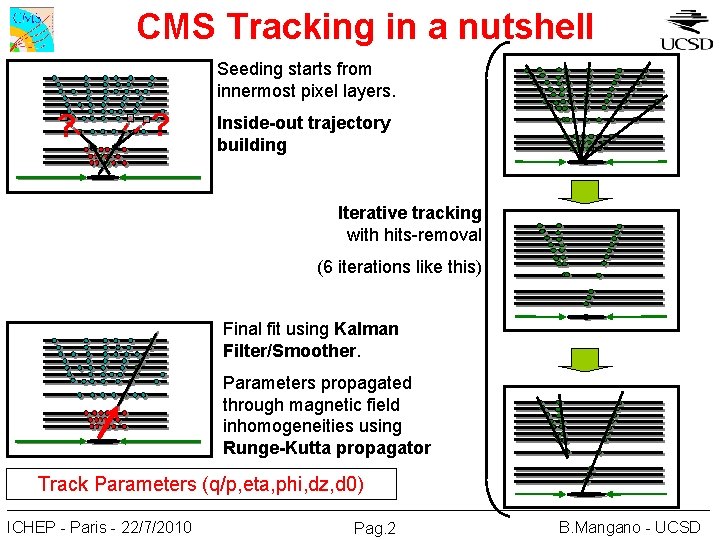
CMS Tracking in a nutshell Seeding starts from innermost pixel layers. ? ? Inside-out trajectory building Iterative tracking with hits-removal (6 iterations like this) Final fit using Kalman Filter/Smoother. Parameters propagated through magnetic field inhomogeneities using Runge-Kutta propagator Track Parameters (q/p, eta, phi, dz, d 0) ICHEP - Paris - 22/7/2010 Pag. 2 B. Mangano - UCSD

Tracking Efficiency for muons Probe (from J/ ) muon Tag muon Is the track reconstructed J/ ? Tracker Probes passing the matching Probes failing the matching Muon system Reconstruction efficiency in the Tracker is estimated from the ratio of the yields of probes that either pass or fail the matching with a Tracker track. random matching Tracking efficiency ICHEP - Paris - 22/7/2010 Measured tracking efficiency close to 99% and compatible with simulation Pag. 3 B. Mangano - UCSD
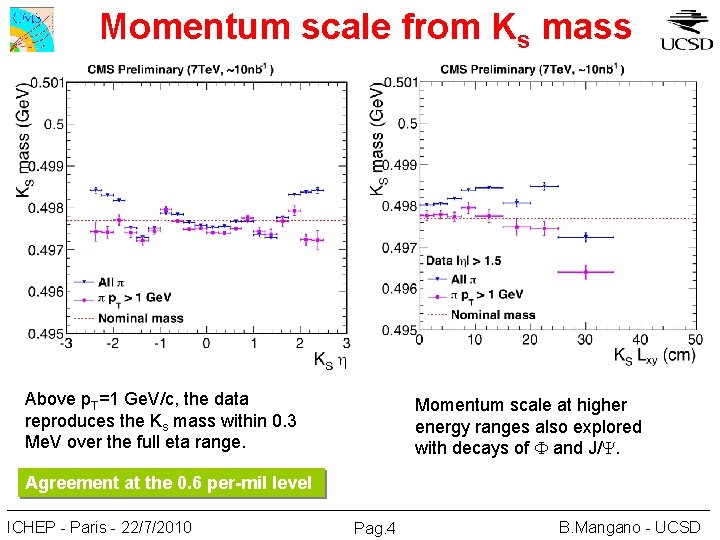
Momentum scale from Ks mass Above p. T=1 Ge. V/c, the data reproduces the Ks mass within 0. 3 Me. V over the full eta range. Momentum scale at higher energy ranges also explored with decays of and J/ Agreement at the 0. 6 per-mil level ICHEP - Paris - 22/7/2010 Pag. 4 B. Mangano - UCSD
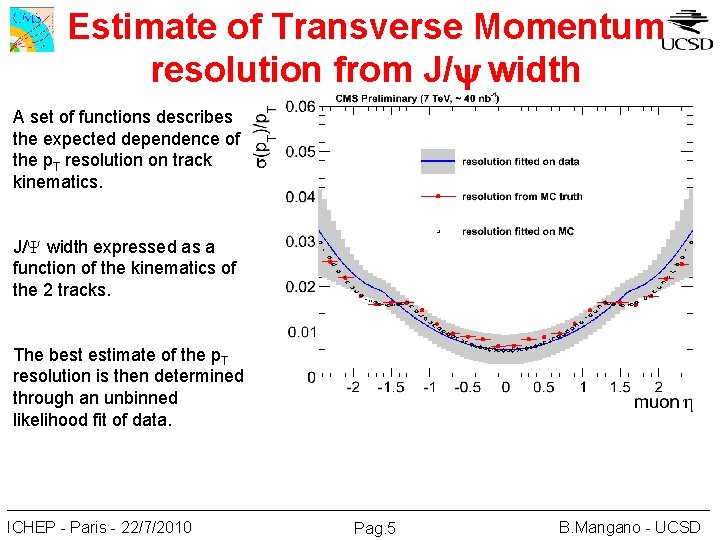
Estimate of Transverse Momentum resolution from J/ width A set of functions describes the expected dependence of the p. T resolution on track kinematics. J/ width expressed as a function of the kinematics of the 2 tracks. The best estimate of the p. T resolution is then determined through an unbinned likelihood fit of data. ICHEP - Paris - 22/7/2010 Pag. 5 B. Mangano - UCSD
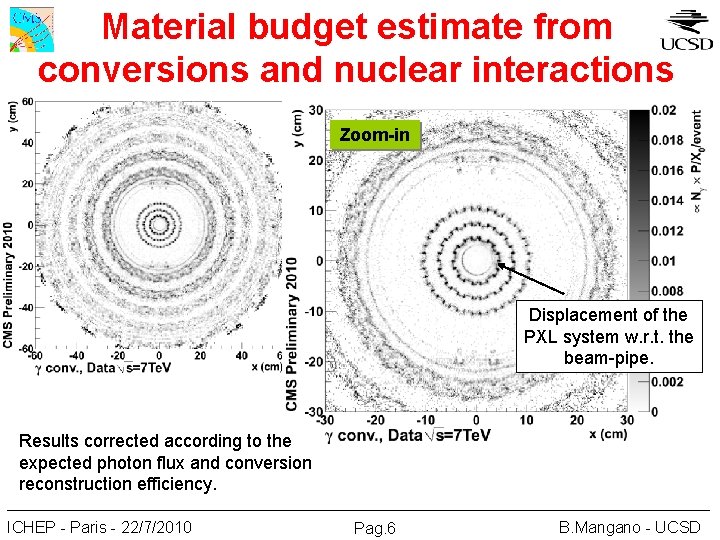
Material budget estimate from conversions and nuclear interactions Zoom-in Displacement of the PXL system w. r. t. the beam-pipe. Results corrected according to the expected photon flux and conversion reconstruction efficiency. ICHEP - Paris - 22/7/2010 Pag. 6 B. Mangano - UCSD
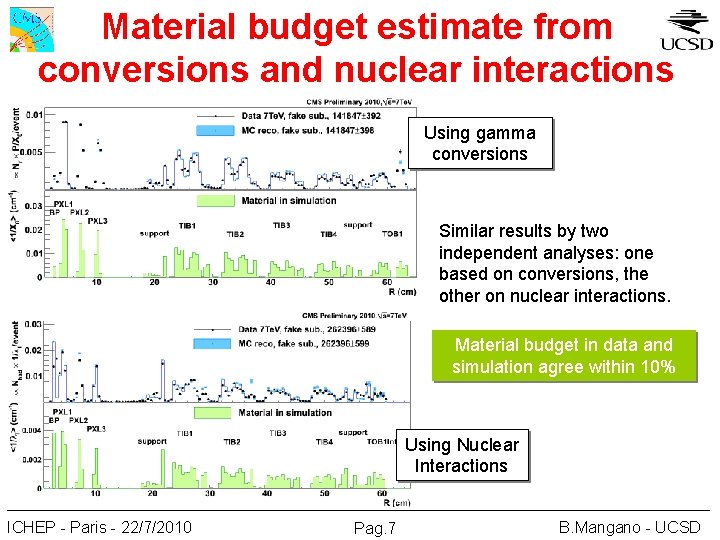
Material budget estimate from conversions and nuclear interactions Using gamma conversions Similar results by two independent analyses: one based on conversions, the other on nuclear interactions. Material budget in data and simulation agree within 10% Using Nuclear Interactions ICHEP - Paris - 22/7/2010 Pag. 7 B. Mangano - UCSD
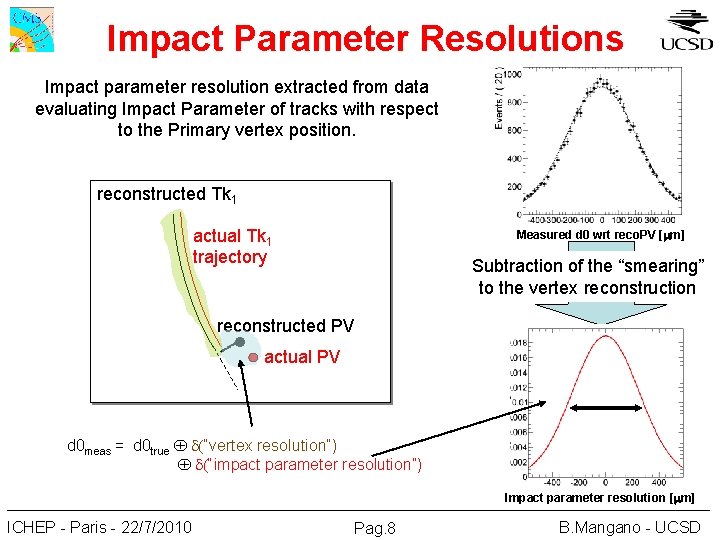
Impact Parameter Resolutions Impact parameter resolution extracted from data evaluating Impact Parameter of tracks with respect to the Primary vertex position. reconstructed Tk 1 actual Tk 1 trajectory Measured d 0 wrt reco. PV [ m] Subtraction of the “smearing” to the vertex reconstruction reconstructed PV actual PV d 0 meas = d 0 true “vertex resolution”) “impact parameter resolution”) Impact parameter resolution [ m] ICHEP - Paris - 22/7/2010 Pag. 8 B. Mangano - UCSD
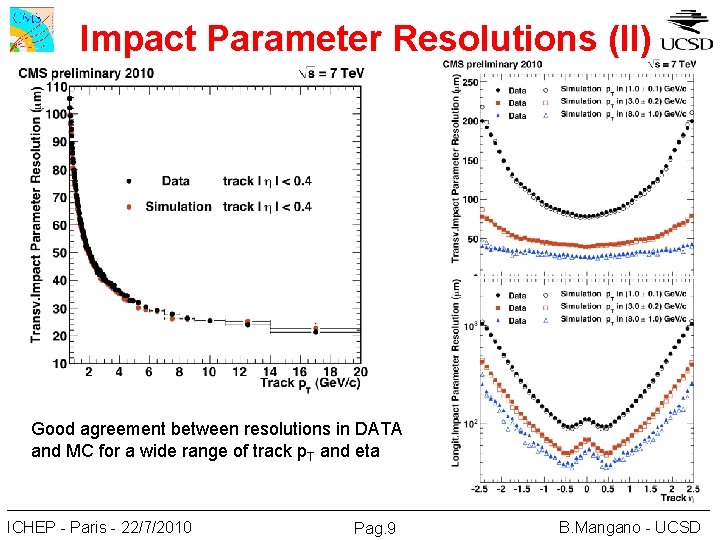
Impact Parameter Resolutions (II) Good agreement between resolutions in DATA and MC for a wide range of track p. T and eta ICHEP - Paris - 22/7/2010 Pag. 9 B. Mangano - UCSD
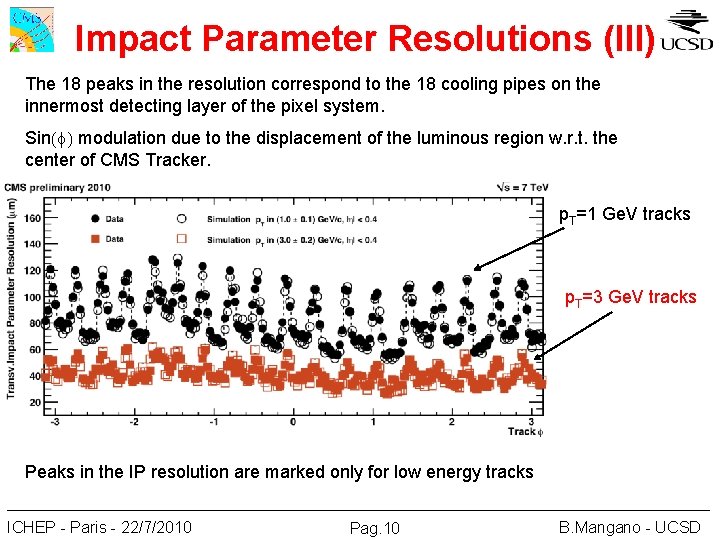
Impact Parameter Resolutions (III) The 18 peaks in the resolution correspond to the 18 cooling pipes on the innermost detecting layer of the pixel system. Sin ) modulation due to the displacement of the luminous region w. r. t. the center of CMS Tracker. p. T=1 Ge. V tracks p. T=3 Ge. V tracks Peaks in the IP resolution are marked only for low energy tracks ICHEP - Paris - 22/7/2010 Pag. 10 B. Mangano - UCSD

Primary Vertex: Position Resolution Single vertex reconstructed using “all” the tracks Same collision point reconstructed twice using half of the tracks The position of one vertex is compared to the position of the other. Repeating for many events, the intrinsic resolution of the primary vertex fitter is estimated directly from data. Not shown: Pull distributions have widths equal to 1 within 10% ICHEP - Paris - 22/7/2010 Pag. 11 B. Mangano - UCSD

Primary Vertex (II) Reconstruction Efficiency Same technique also used to estimate, from DATA, the PV reconstruction efficiency. Tag Vertex Is there a probe vertex ? PV efficiency = #probes / #tags ICHEP - Paris - 22/7/2010 Pag. 12 B. Mangano - UCSD
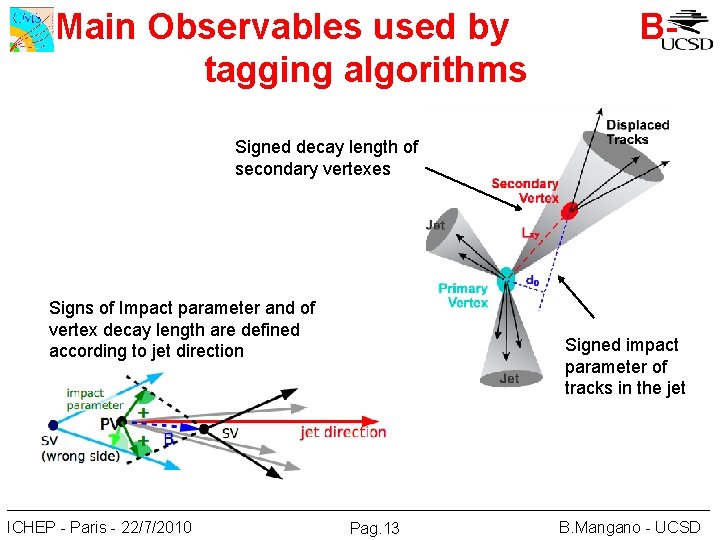
Main Observables used by tagging algorithms B- Signed decay length of secondary vertexes Signs of Impact parameter and of vertex decay length are defined according to jet direction ICHEP - Paris - 22/7/2010 Signed impact parameter of tracks in the jet Pag. 13 B. Mangano - UCSD
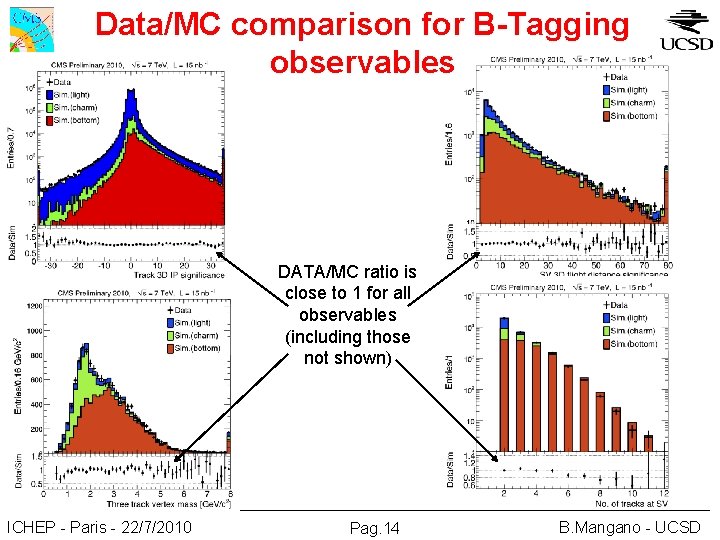
Data/MC comparison for B-Tagging observables DATA/MC ratio is close to 1 for all observables (including those not shown) ICHEP - Paris - 22/7/2010 Pag. 14 B. Mangano - UCSD
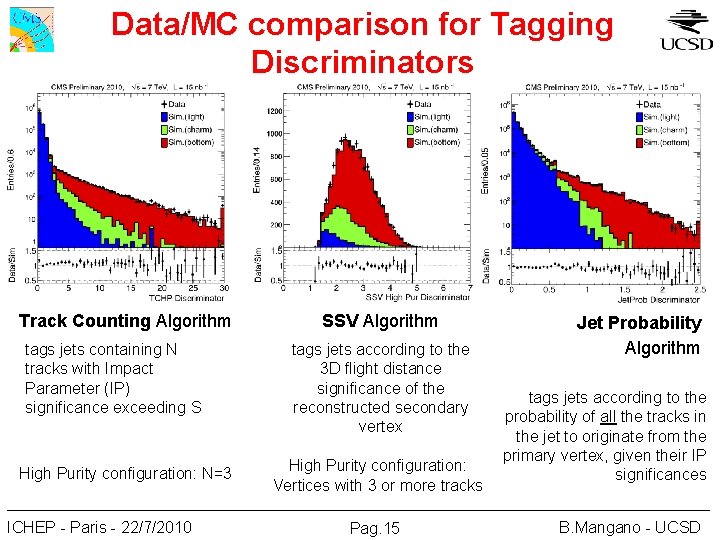
Data/MC comparison for Tagging Discriminators Track Counting Algorithm tags jets containing N tracks with Impact Parameter (IP) significance exceeding S High Purity configuration: N=3 ICHEP - Paris - 22/7/2010 SSV Algorithm tags jets according to the 3 D flight distance significance of the reconstructed secondary vertex High Purity configuration: Vertices with 3 or more tracks Pag. 15 Jet Probability Algorithm tags jets according to the probability of all the tracks in the jet to originate from the primary vertex, given their IP significances B. Mangano - UCSD

B-Tagging Efficiency extraction from muon jets Efficiency is estimated from data fitting the p. Trel distribution of muons in muon jets. B-Tagged muon jets Anti-tagged muon jets Light flavor+c fraction B fraction ICHEP - Paris - 22/7/2010 B-fraction is extracted from the fit of data using distribution templates based on MC Tagger+Operating Point Scale factor SSV algorithm High Purity configuration 0. 98 ± 0. 08± 0. 18 Track Counting algorithm High Purity configuration 0. 95 ± 0. 06± 0. 19 Pag. 16 B. Mangano - UCSD
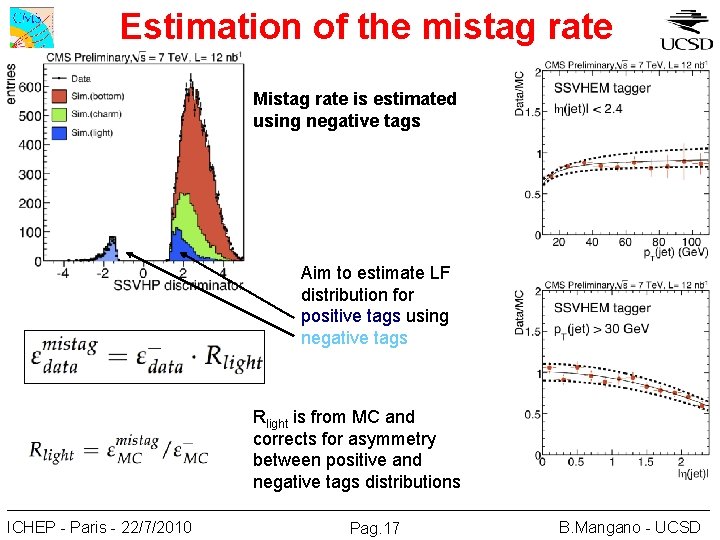
Estimation of the mistag rate Mistag rate is estimated using negative tags Aim to estimate LF distribution for positive tags using negative tags Rlight is from MC and corrects for asymmetry between positive and negative tags distributions ICHEP - Paris - 22/7/2010 Pag. 17 B. Mangano - UCSD
Conclusions The CMS Tracker and the reconstruction algorithms worked from “day 1” of LHC operation at 7 Te. V. The extended period of commissioning with cosmic rays was really valuable for achieving this. As the integrated luminosity collected by CMS increases, tracking performances are estimated from data in further and further detail. After collecting about 100 /nb, we have a good understanding of tracking efficiency, momentum and impact parameter resolutions and vertex reconstruction performance. Both B-tagging observables and the performance of B-taggers have been analyzed in data and compared to simulation. In both the context of pure track/vertex reconstruction and also in that of B-tagging, the agreement between data and simulation has been found excellent. ICHEP - Paris - 22/7/2010 Pag. 18 B. Mangano - UCSD
BACKUP SLIDES ICHEP - Paris - 22/7/2010 Pag. 19 B. Mangano - UCSD
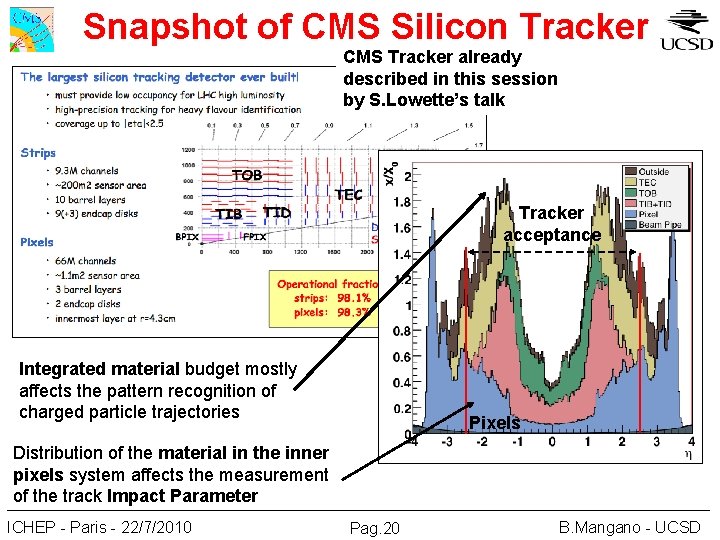
Snapshot of CMS Silicon Tracker CMS Tracker already described in this session by S. Lowette’s talk Tracker acceptance Integrated material budget mostly affects the pattern recognition of charged particle trajectories Pixels Distribution of the material in the inner pixels system affects the measurement of the track Impact Parameter ICHEP - Paris - 22/7/2010 Pag. 20 B. Mangano - UCSD
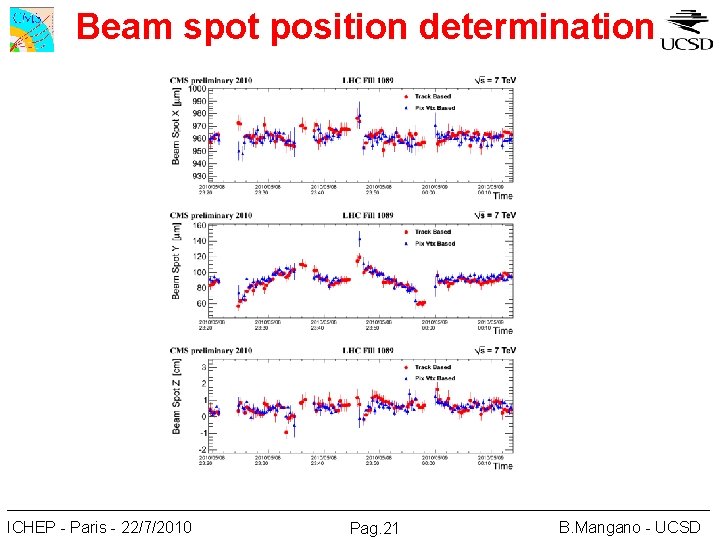
Beam spot position determination ICHEP - Paris - 22/7/2010 Pag. 21 B. Mangano - UCSD
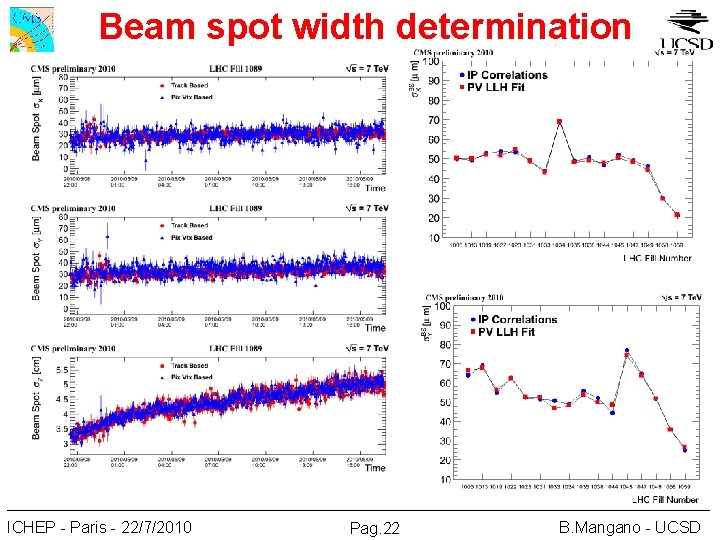
Beam spot width determination ICHEP - Paris - 22/7/2010 Pag. 22 B. Mangano - UCSD
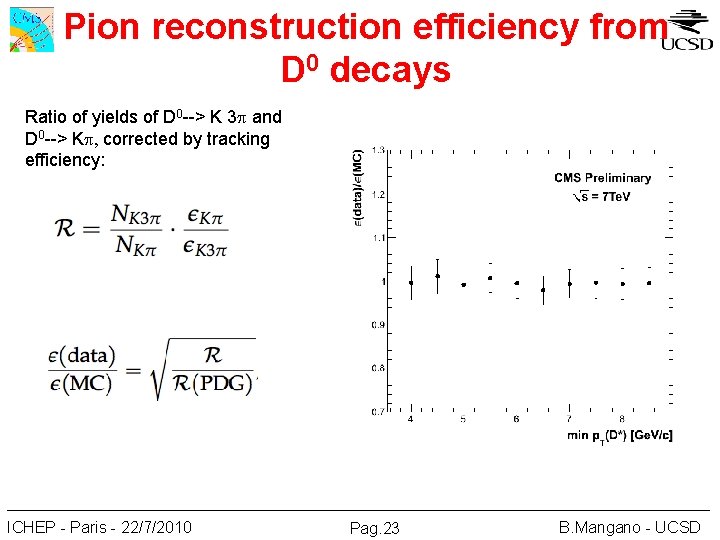
Pion reconstruction efficiency from D 0 decays Ratio of yields of D 0 --> K 3 and D 0 --> K corrected by tracking efficiency: ICHEP - Paris - 22/7/2010 Pag. 23 B. Mangano - UCSD
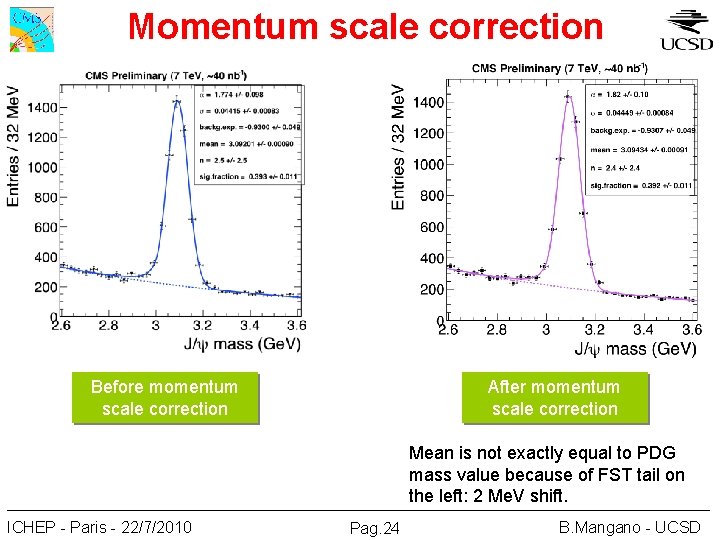
Momentum scale correction Before momentum scale correction After momentum scale correction Mean is not exactly equal to PDG mass value because of FST tail on the left: 2 Me. V shift. ICHEP - Paris - 22/7/2010 Pag. 24 B. Mangano - UCSD
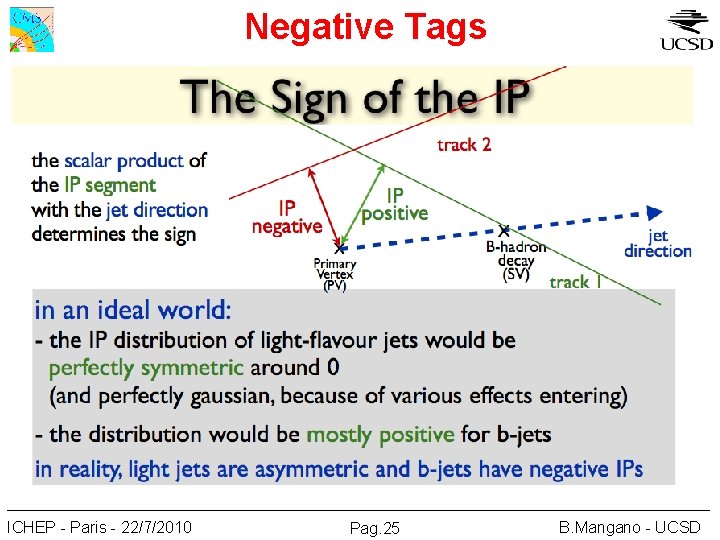
Negative Tags ICHEP - Paris - 22/7/2010 Pag. 25 B. Mangano - UCSD
- Slides: 25