
Performance of the Advanced Photon Source 350 MHz

- Slides: 23
Performance of the Advanced Photon Source 350 -MHz 1 MW CW Klystrons Doug Horan RF Group Accelerator Systems Division CWRF 08 Workshop March 25 -28, 2008
PRESENTATION OUTLINE 1. Review of APS 350 -MHz RF System Topology 2. APS 350 -MHz RF System Operation 3. APS 350 -MHz Klystron Inventory 4. APS 350 -MHz Klystron Operation 2006 -2008 5. Klystron Problems and Corrective Action 2
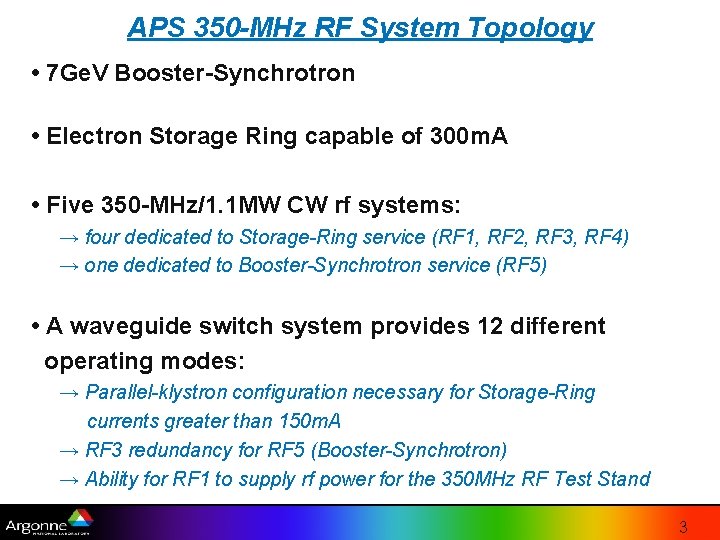
APS 350 -MHz RF System Topology • 7 Ge. V Booster-Synchrotron • Electron Storage Ring capable of 300 m. A • Five 350 -MHz/1. 1 MW CW rf systems: → four dedicated to Storage-Ring service (RF 1, RF 2, RF 3, RF 4) → one dedicated to Booster-Synchrotron service (RF 5) • A waveguide switch system provides 12 different operating modes: → Parallel-klystron configuration necessary for Storage-Ring currents greater than 150 m. A → RF 3 redundancy for RF 5 (Booster-Synchrotron) → Ability for RF 1 to supply rf power for the 350 MHz RF Test Stand 3
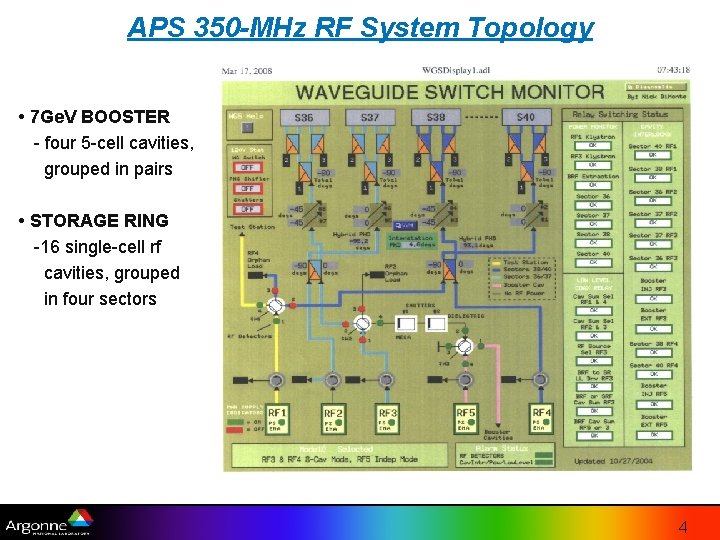
APS 350 -MHz RF System Topology • 7 Ge. V BOOSTER - four 5 -cell cavities, grouped in pairs • STORAGE RING -16 single-cell rf cavities, grouped in four sectors 4
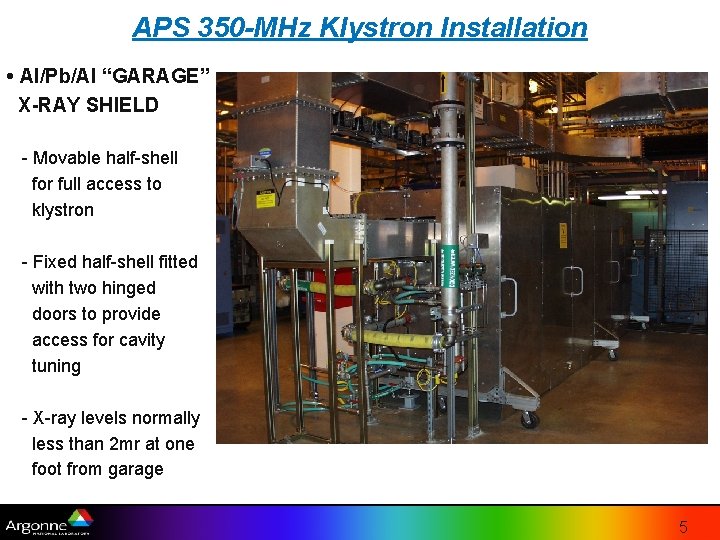
APS 350 -MHz Klystron Installation • Al/Pb/Al “GARAGE” X-RAY SHIELD - Movable half-shell for full access to klystron - Fixed half-shell fitted with two hinged doors to provide access for cavity tuning - X-ray levels normally less than 2 mr at one foot from garage 5
APS 350 -MHz RF System Operating Levels • Normal Storage Ring operation is 103 m. A in “Top-Up” Mode -- Requires two rf stations (RF 1 -RF 4) operating at 600 -700 k. W CW rf output, depending on gap voltage required -- Beam voltage set to 80 k. V (where possible!) to improve operating efficiency -- RF drive power as high as possible for highest efficiency (~ 50 -52%), limited by klystron stability issues • Normal Booster-Synchrotron operation at 7 Ge. V -- Requires one rf station (RF 3 or RF 5) operating at 400 -500 k. W peak rf power, depending on gap voltage required -- 253 ms ramp from 5 k. W to 420 k. W, at 2 Hz rate -- Klystron operating class A, ramped rf drive, 68 k. V@~12. 5 A. 6
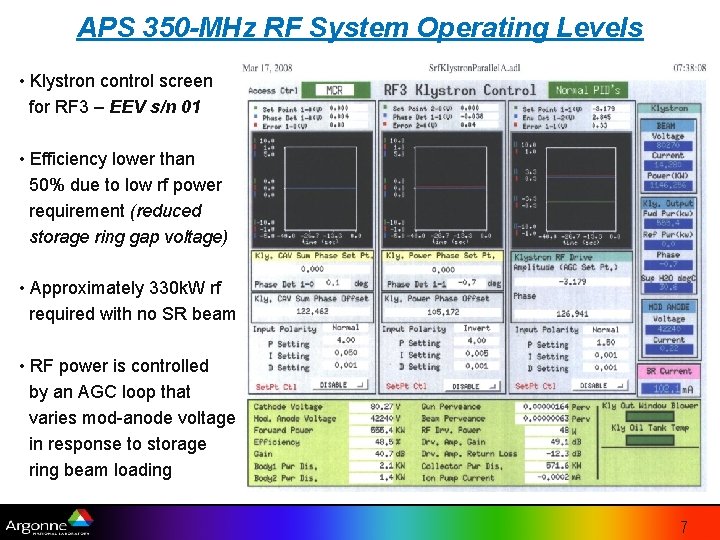
APS 350 -MHz RF System Operating Levels • Klystron control screen for RF 3 – EEV s/n 01 • Efficiency lower than 50% due to low rf power requirement (reduced storage ring gap voltage) • Approximately 330 k. W rf required with no SR beam • RF power is controlled by an AGC loop that varies mod-anode voltage in response to storage ring beam loading 7
APS 350 -MHz RF System “Hot Standby” Mode • RF stations not providing rf power to the storage ring or 350 -MHz RF Test Stand are operated in “diode mode” (no RF) at 70 k. V/5 A -- RF stations are routinely switched in/out of standby mode approximately every 30 days -- Maintains gun conditioning and vacuum in klystron -- Maintains HVPS crowbar conditioning and general reliability -- Ok with all klystrons except Thales s/n 089041; a problem with excessive body power dissipation requires 70 k. V/6. 2 A diode operation. 8
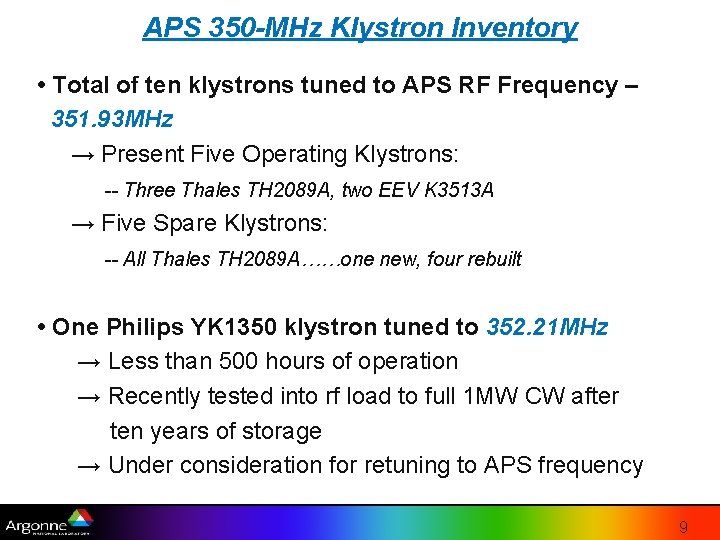
APS 350 -MHz Klystron Inventory • Total of ten klystrons tuned to APS RF Frequency – 351. 93 MHz → Present Five Operating Klystrons: -- Three Thales TH 2089 A, two EEV K 3513 A → Five Spare Klystrons: -- All Thales TH 2089 A……one new, four rebuilt • One Philips YK 1350 klystron tuned to 352. 21 MHz → Less than 500 hours of operation → Recently tested into rf load to full 1 MW CW after ten years of storage → Under consideration for retuning to APS frequency 9
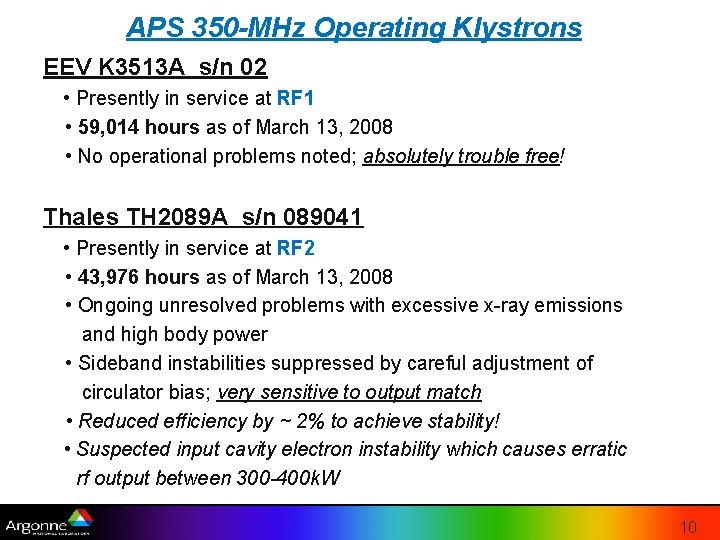
APS 350 -MHz Operating Klystrons EEV K 3513 A s/n 02 • Presently in service at RF 1 • 59, 014 hours as of March 13, 2008 • No operational problems noted; absolutely trouble free! Thales TH 2089 A s/n 089041 • Presently in service at RF 2 • 43, 976 hours as of March 13, 2008 • Ongoing unresolved problems with excessive x-ray emissions and high body power • Sideband instabilities suppressed by careful adjustment of circulator bias; very sensitive to output match • Reduced efficiency by ~ 2% to achieve stability! • Suspected input cavity electron instability which causes erratic rf output between 300 -400 k. W 10
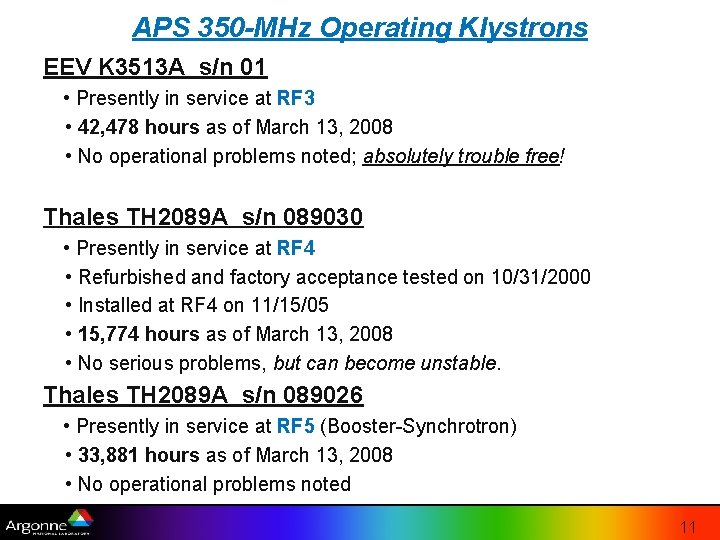
APS 350 -MHz Operating Klystrons EEV K 3513 A s/n 01 • Presently in service at RF 3 • 42, 478 hours as of March 13, 2008 • No operational problems noted; absolutely trouble free! Thales TH 2089 A s/n 089030 • Presently in service at RF 4 • Refurbished and factory acceptance tested on 10/31/2000 • Installed at RF 4 on 11/15/05 • 15, 774 hours as of March 13, 2008 • No serious problems, but can become unstable. Thales TH 2089 A s/n 089026 • Presently in service at RF 5 (Booster-Synchrotron) • 33, 881 hours as of March 13, 2008 • No operational problems noted 11
APS 350 -MHz Spare Klystrons Thales TH 2089 A s/n 089043 • Last NEW klystron purchased, delivered to APS on 12/5/01 • Presently in spares storage Thales TH 2089 A s/n 089036 • Refurbished; factory acceptance tested on 12/13/02 • Presently in spares storage Thales TH 2089 A s/n 089029 • Refurbished; factory acceptance tested on 12/8/03 • Presently in spares storage 12
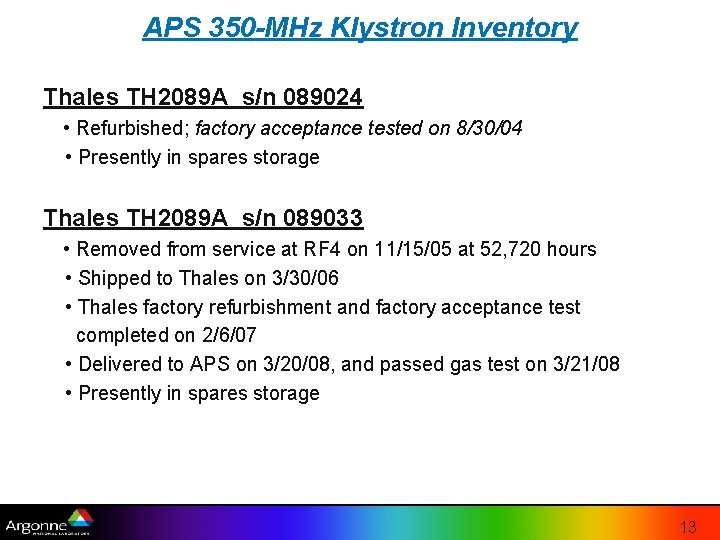
APS 350 -MHz Klystron Inventory Thales TH 2089 A s/n 089024 • Refurbished; factory acceptance tested on 8/30/04 • Presently in spares storage Thales TH 2089 A s/n 089033 • Removed from service at RF 4 on 11/15/05 at 52, 720 hours • Shipped to Thales on 3/30/06 • Thales factory refurbishment and factory acceptance test completed on 2/6/07 • Delivered to APS on 3/20/08, and passed gas test on 3/21/08 • Presently in spares storage 13
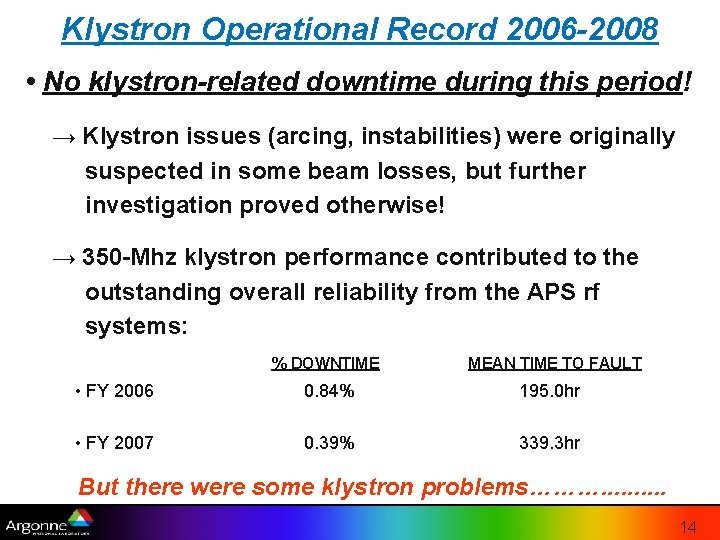
Klystron Operational Record 2006 -2008 • No klystron-related downtime during this period! → Klystron issues (arcing, instabilities) were originally suspected in some beam losses, but further investigation proved otherwise! → 350 -Mhz klystron performance contributed to the outstanding overall reliability from the APS rf systems: % DOWNTIME MEAN TIME TO FAULT • FY 2006 0. 84% 195. 0 hr • FY 2007 0. 39% 339. 3 hr But there were some klystron problems………. . 14
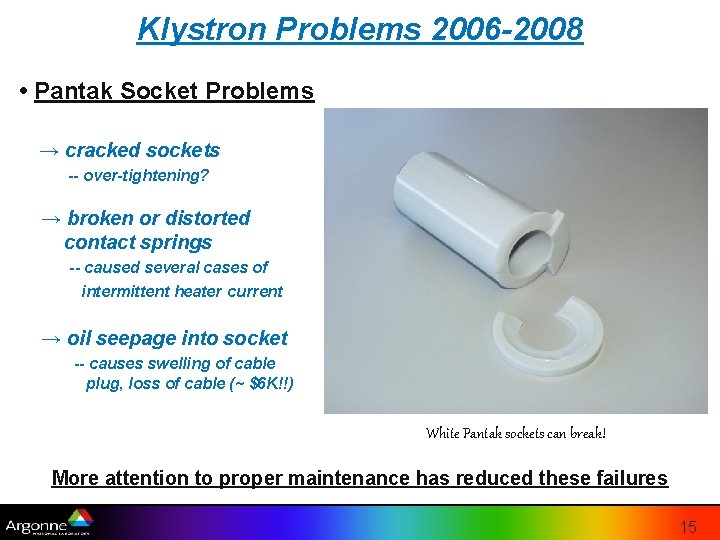
Klystron Problems 2006 -2008 • Pantak Socket Problems → cracked sockets -- over-tightening? → broken or distorted contact springs -- caused several cases of intermittent heater current → oil seepage into socket -- causes swelling of cable plug, loss of cable (~ $6 K!!) White Pantak sockets can break! More attention to proper maintenance has reduced these failures 15
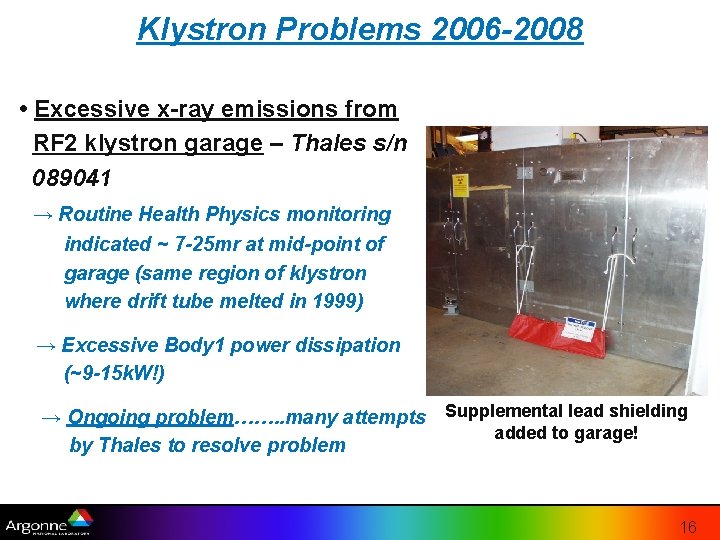
Klystron Problems 2006 -2008 • Excessive x-ray emissions from RF 2 klystron garage – Thales s/n 089041 → Routine Health Physics monitoring indicated ~ 7 -25 mr at mid-point of garage (same region of klystron where drift tube melted in 1999) → Excessive Body 1 power dissipation (~9 -15 k. W!) → Ongoing problem……. . many attempts Supplemental lead shielding added to garage! by Thales to resolve problem 16
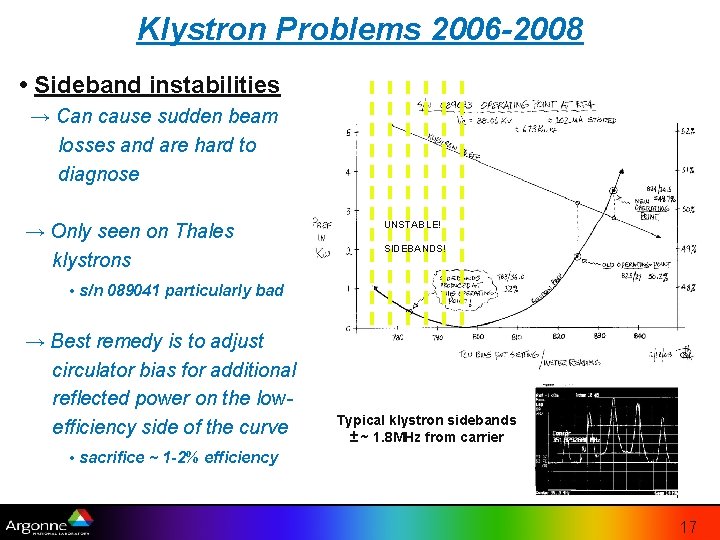
Klystron Problems 2006 -2008 • Sideband instabilities → Can cause sudden beam losses and are hard to diagnose → Only seen on Thales klystrons UNSTABLE! SIDEBANDS! • s/n 089041 particularly bad → Best remedy is to adjust circulator bias for additional reflected power on the lowefficiency side of the curve Typical klystron sidebands ± ~ 1. 8 MHz from carrier • sacrifice ~ 1 -2% efficiency 17
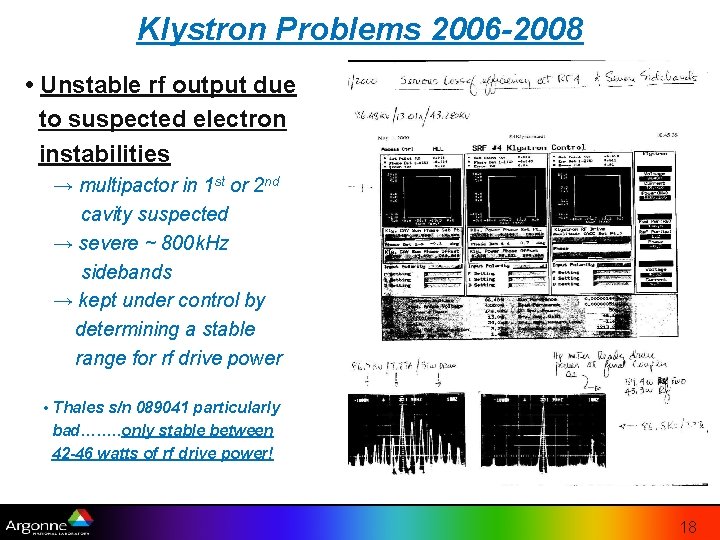
Klystron Problems 2006 -2008 • Unstable rf output due to suspected electron instabilities → multipactor in 1 st or 2 nd cavity suspected → severe ~ 800 k. Hz sidebands → kept under control by determining a stable range for rf drive power • Thales s/n 089041 particularly bad……. . only stable between 42 -46 watts of rf drive power! 18
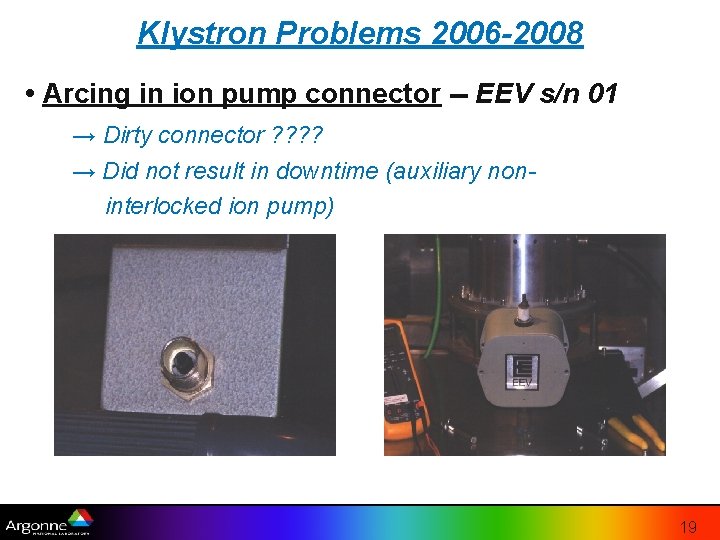
Klystron Problems 2006 -2008 • Arcing in ion pump connector -- EEV s/n 01 → Dirty connector ? ? → Did not result in downtime (auxiliary noninterlocked ion pump) 19
Klystron Problems 2006 -2008 • Output window arc detector trip on RF 1 -- EEV s/n 02 → Only one arc event (appeared to be a real arc) → Ran klystron into load at ~ 700 -800 k. W for four hours with no problems → Placed back into SR service with no further problems for over a year 20
APS 350 -MHz Klystron Maintenance • Adjust the rf system for best possible stability and performance ……. . then leave the klystron alone if it is happy! • Weekly analysis of operating parameters → Watch for changes in efficiency, body losses, mod-anode current, perveance • Monitor and alarm on klystron sideband instabilities • Thorough visual inspection of klystron every shutdown, including Pantak plugs and sockets • Check oil quality every shutdown (30 k. V or greater breakdown) 21
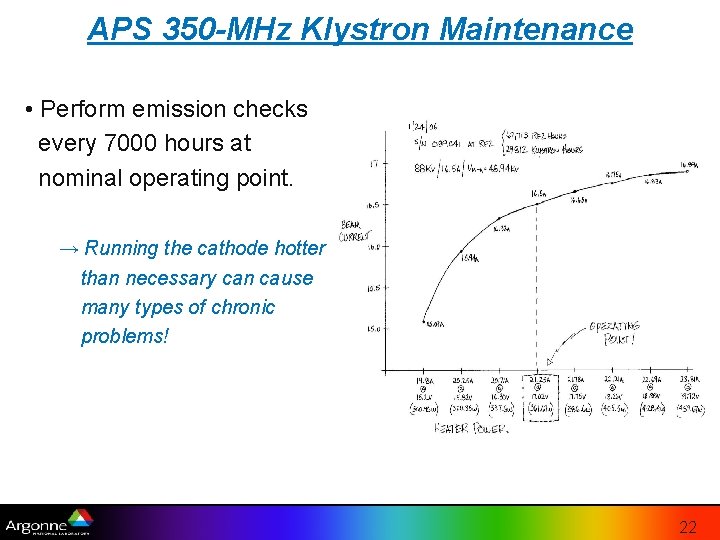
APS 350 -MHz Klystron Maintenance • Perform emission checks every 7000 hours at nominal operating point. → Running the cathode hotter than necessary can cause many types of chronic problems! 22
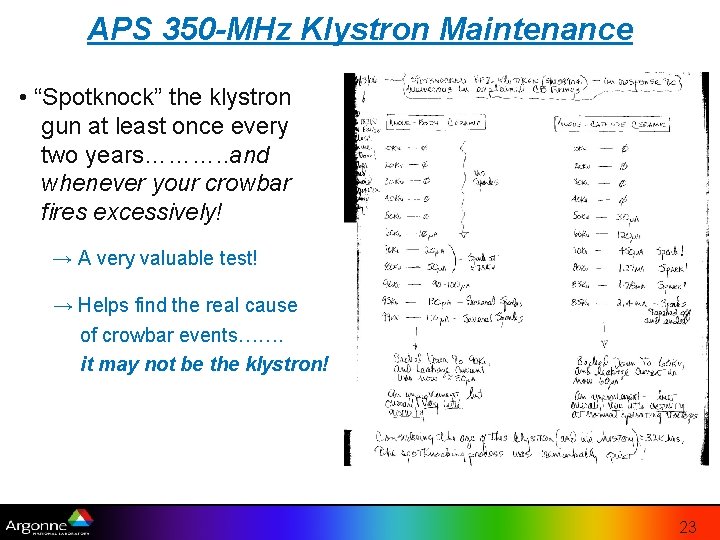
APS 350 -MHz Klystron Maintenance • “Spotknock” the klystron gun at least once every two years………. . and whenever your crowbar fires excessively! → A very valuable test! → Helps find the real cause of crowbar events……. it may not be the klystron! 23