
Performance of Network of Queues with Traffic Modeled

- Slides: 20
Performance of Network of Queues with Traffic Modeled by Heavy-tailed Distributions Weldisson Ferreira Ruas José Marcos C. Brito Inatel – National Institute of Telecommunications
Introduction • Traffic in telecommunications networks has evolved from voice traffic to multimedia traffic, including voice, data and video. • In this new scenario, the traditional Markov models are not suitable to characterize the traffic in the network.
Introduction • Several works demonstrates that traffic in some telecommunications networks is statistically self-similar • New models to characterize traffic can be classified in three categories: – a) Based on measurements. – b) Based on fractal models. – c) Based on generic models.
Generic Models • Less complex than fractal models • Arrival processes is modeled by a heavytailed distribution – Pareto, Lognornal or Weibull distributions • Service time can be modeled by: – Exponential distribution (G/M/1 queue) – Heavy-tailed distribution (G/G/1 queue) – Considered constant (G/D/1 queue).
Introduction • Several works have analyzed the performance of isolated single server queues with the traffic modeled by a heavy-tailed distribution, but there is a lack of analysis for networks of queues in this scenario.
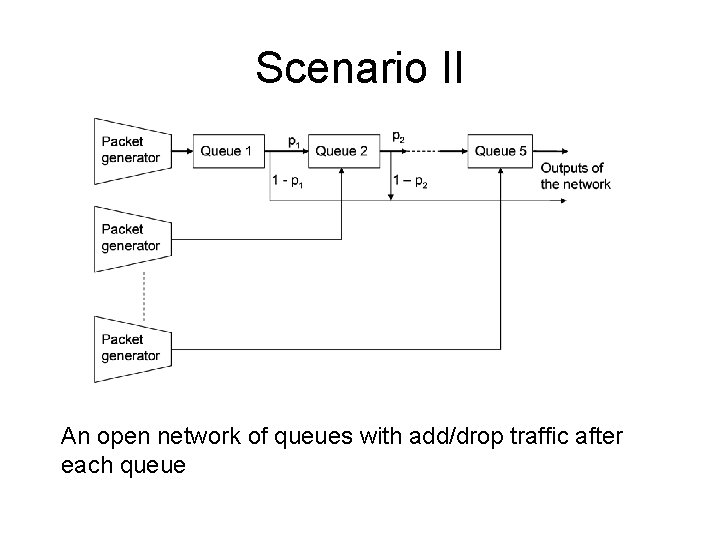
Goal of this paper • Evaluate, based on simulations, the performance of networks of queues with the traffic modeled by Pareto, Lognormal and Weibull distributions. – Software ARENA for simulations • Two scenarios have been considered: – a) Scenario I: an open network of queues without add/drop traffic. – b) Scenario II: an open network of queues with add/drop traffic after each queue.
Performance Parameters • Mean waiting time of each queue, as a function of the position of the queue • Total network delay – For both parameters, we present the results as a function of the utilization factor in each queue – To vary the utilization factor we vary the service time of the server
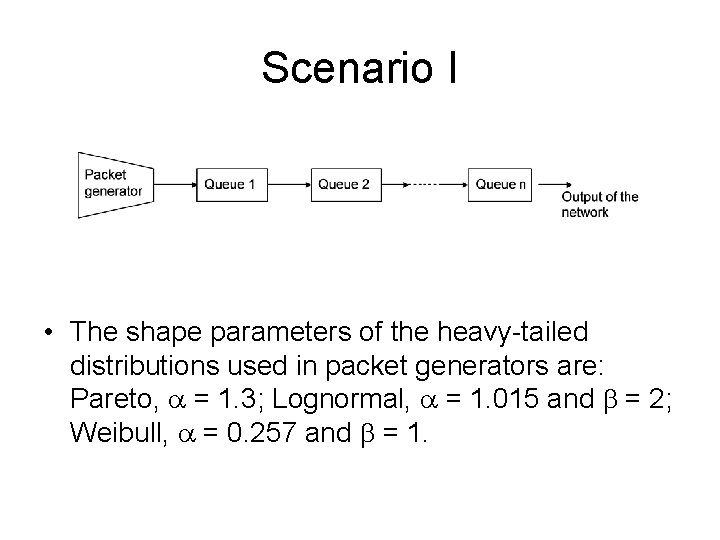
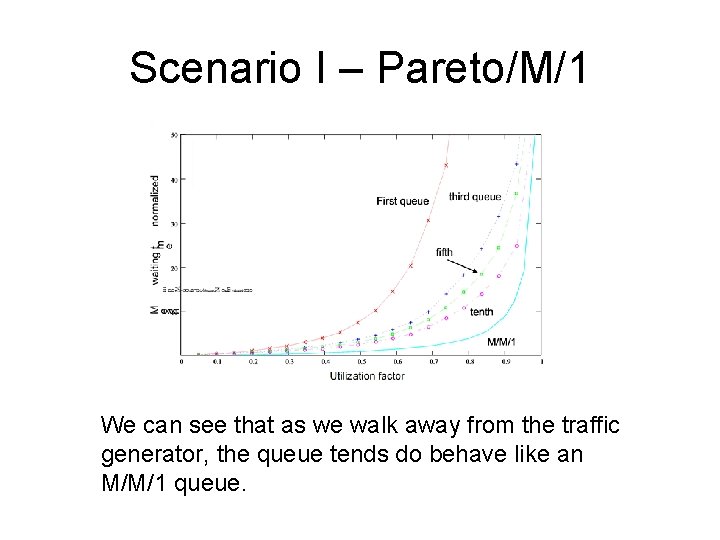
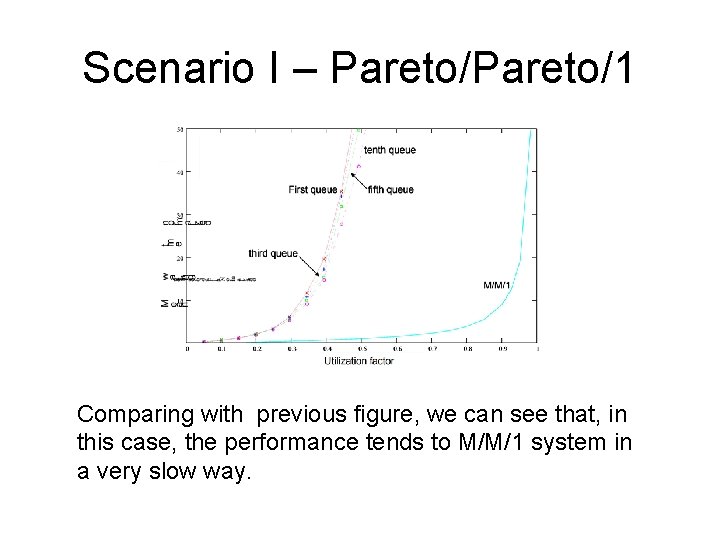
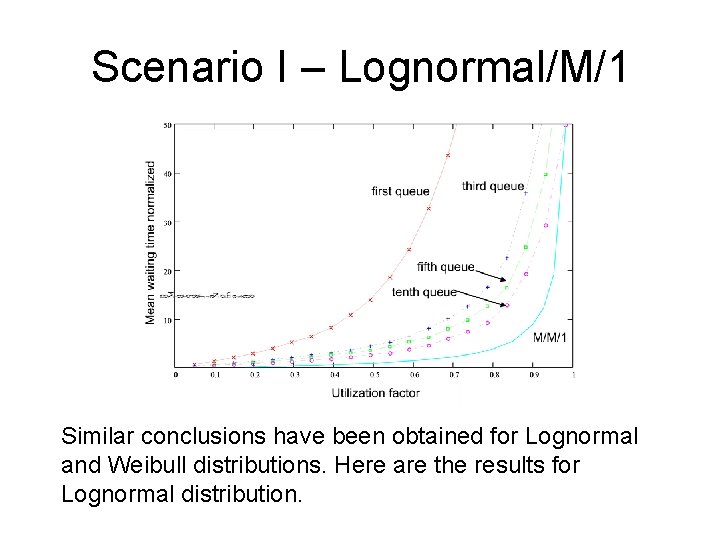
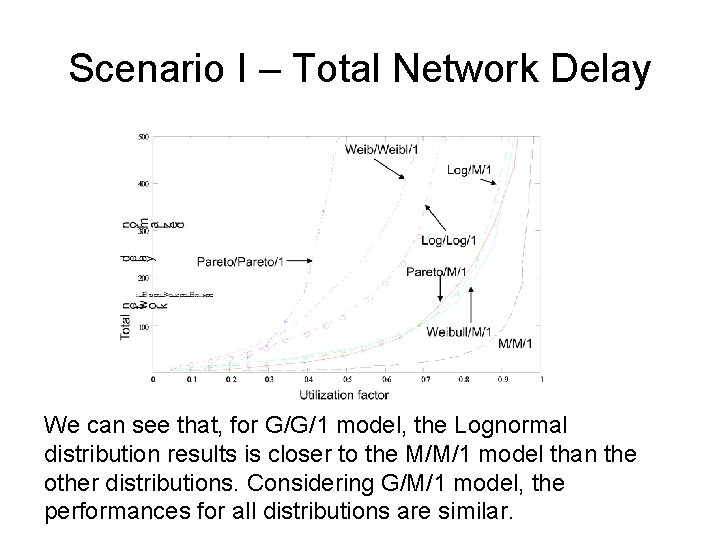
Scenario I • The shape parameters of the heavy-tailed distributions used in packet generators are: Pareto, = 1. 3; Lognormal, = 1. 015 and = 2; Weibull, = 0. 257 and = 1.
Scenario I – Pareto/M/1 We can see that as we walk away from the traffic generator, the queue tends do behave like an M/M/1 queue.
Scenario I – Pareto/1 Comparing with previous figure, we can see that, in this case, the performance tends to M/M/1 system in a very slow way.
Scenario I – Lognormal/M/1 Similar conclusions have been obtained for Lognormal and Weibull distributions. Here are the results for Lognormal distribution.
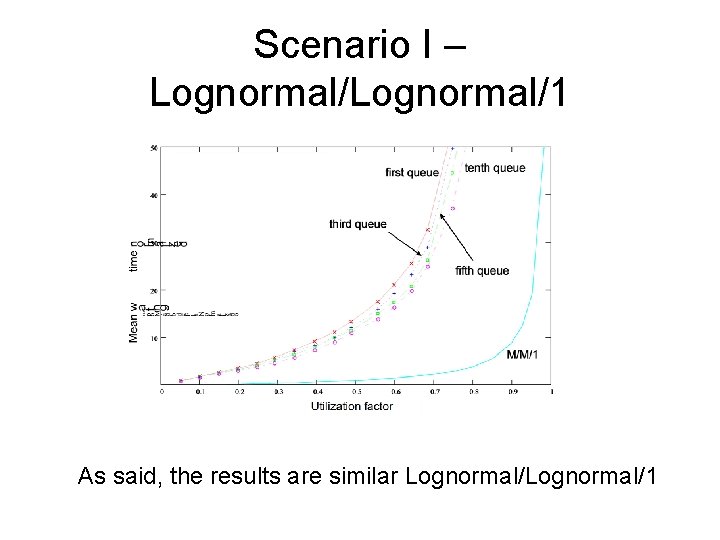
Scenario I – Lognormal/1 As said, the results are similar Lognormal/1
Scenario I – Total Network Delay We can see that, for G/G/1 model, the Lognormal distribution results is closer to the M/M/1 model than the other distributions. Considering G/M/1 model, the performances for all distributions are similar.
Scenario II An open network of queues with add/drop traffic after each queue
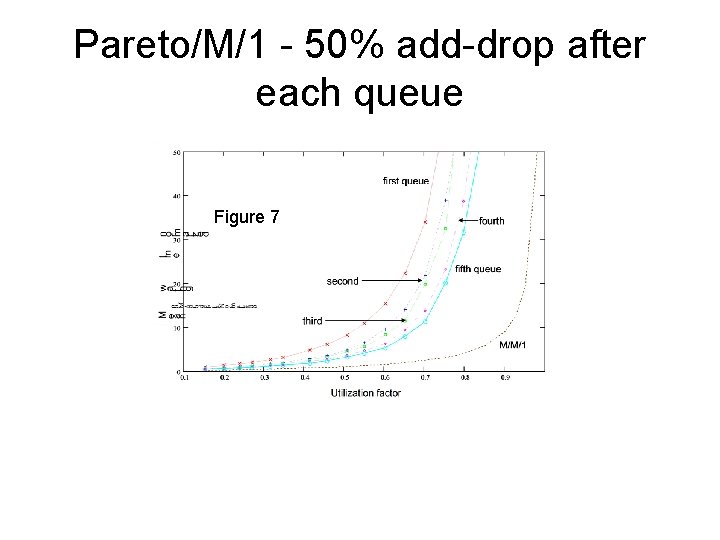
Pareto/M/1 - 50% add-drop after each queue Figure 7
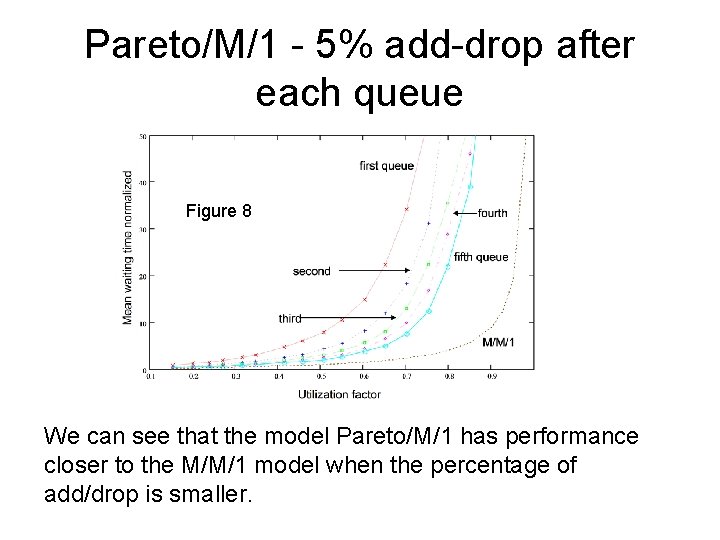
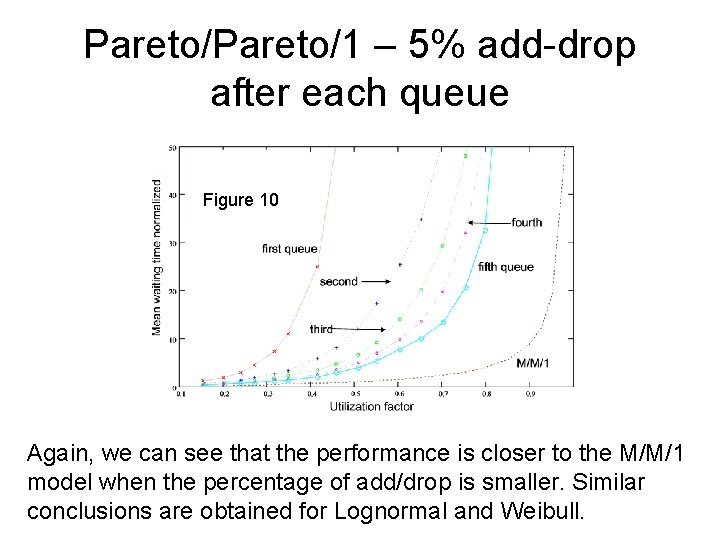
Pareto/M/1 - 5% add-drop after each queue Figure 8 We can see that the model Pareto/M/1 has performance closer to the M/M/1 model when the percentage of add/drop is smaller.
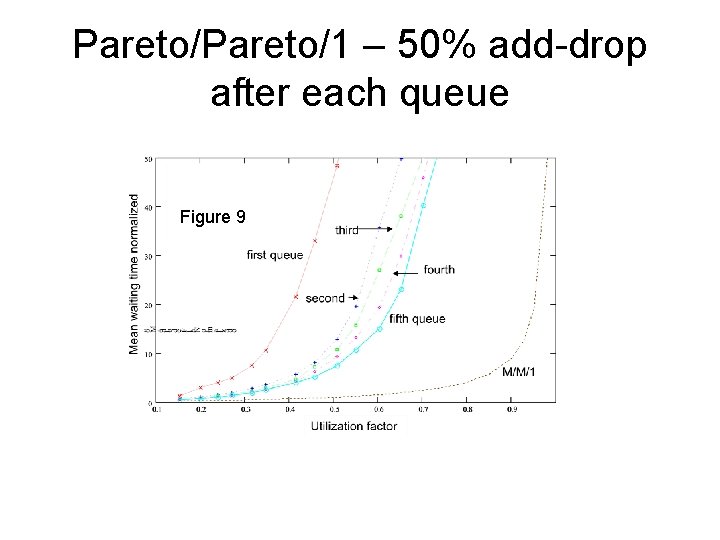
Pareto/1 – 50% add-drop after each queue Figure 9
Pareto/1 – 5% add-drop after each queue Figure 10 Again, we can see that the performance is closer to the M/M/1 model when the percentage of add/drop is smaller. Similar conclusions are obtained for Lognormal and Weibull.
Conclusions • In this paper we analyzed the performance of networks of queues under traffic modeled by heavy-tailed distributions. • We consider open networks with and without add/drop traffic after each queue. • The mean waiting time in each queue tends to the performance of a M/M/1 system as we move away from the first traffic source, with the velocity of the trend depending of the type of the queue (G/M/1 or G/G/1), of the type of the distribution and of the percentage of the add/drop traffic.
Thank You