
PERFORMANCE OF NATIONAL WEATHER SERVICE FORECASTS VERSUS MODEL
- Slides: 17
PERFORMANCE OF NATIONAL WEATHER SERVICE FORECASTS VERSUS MODEL OUTPUT STATISTICS Jeff Baars Cliff Mass Mark Albright University of Washington, Seattle, Washington This work was supported in part by the Do. D Multidisciplinary University Research Initiative (MURI) program administered by the Office of Naval Research Under Grant N 00014 -01 -10745.
The point of it all… Vislocky and Fritsch (1997), using 1990 -1992 data, saw that an average of 2 or more MOS’s (CMOS) outperformed individual MOS’s and many human forecasters in a forecasting competition. How has the story changed since then? And how well do CMOS, MOS & the NWS perform during extreme conditions? In different seasons? In different regions?
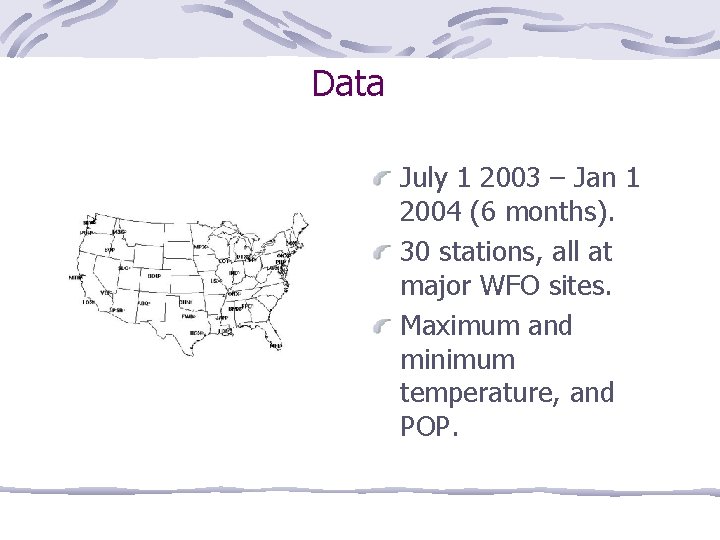
Data July 1 2003 – Jan 1 2004 (6 months). 30 stations, all at major WFO sites. Maximum and minimum temperature, and POP.
Data (con’t) Consensus MOS (CMOS)– simply an average of 4 MOS’s: AMOS, EMOS, MMOS, NMOS. 12 Z-issued forecast from NWS matched against previous 00 Z forecast from models. NWS has 00 Z model data available, and has added advantage of watching conditions develop since 00 Z. Models of course can’t look at NWS, but NWS looks at models. Forecasts going out 48 (60) hours, so in the analysis there are: Two maximum temperatures (MAX-T), Two minimum temperatures (MIN-T), and Four 12 -hr POP forecasts.
Data (con’t) NWS MOS definition for MAX-T and MIN-T and for POP. Observed precipitation data converted to binary rain/no-rain data for Brier Score calculations.
Maximum and Minimum Temperature
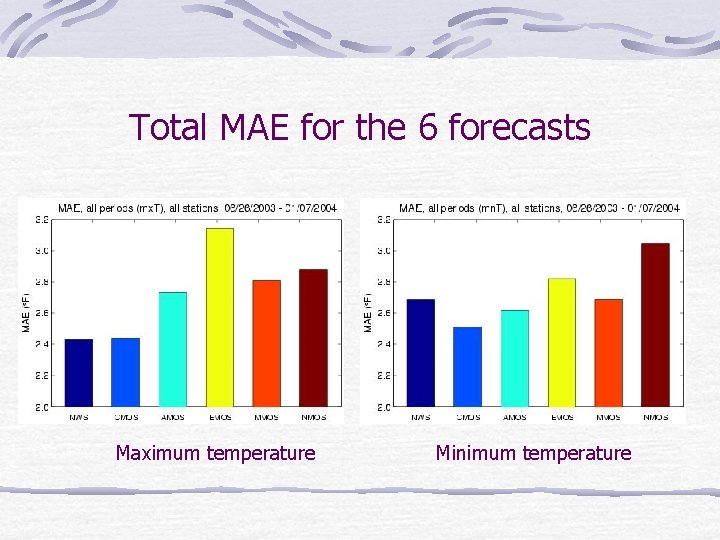
Total MAE for the 6 forecasts Maximum temperature Minimum temperature
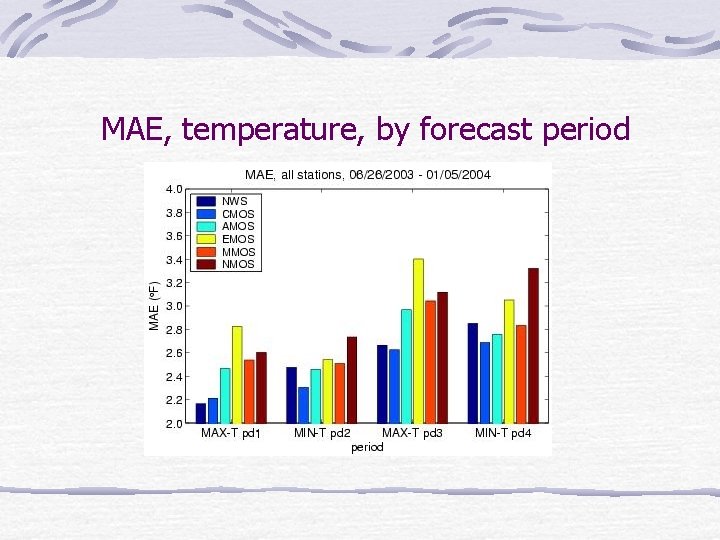
MAE, temperature, by forecast period
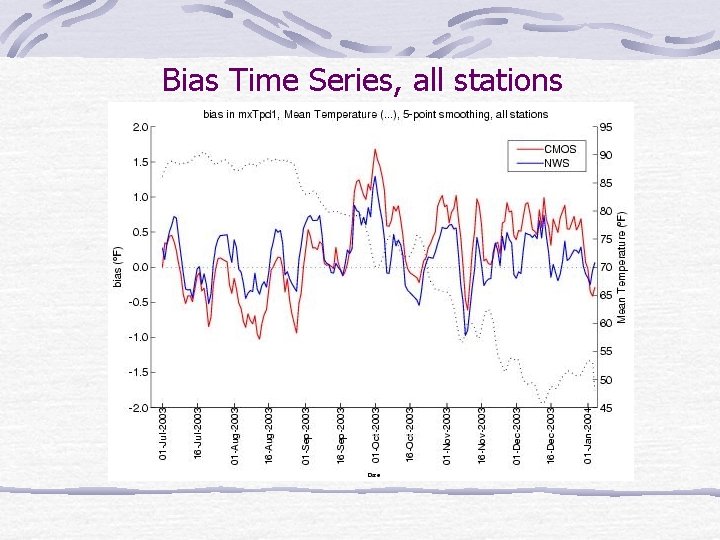
Bias Time Series, all stations
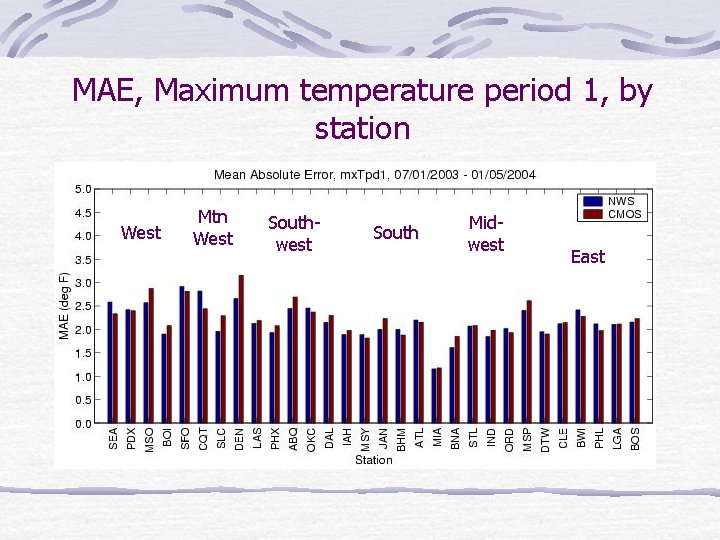
MAE, Maximum temperature period 1, by station West Mtn West Southwest South Midwest East
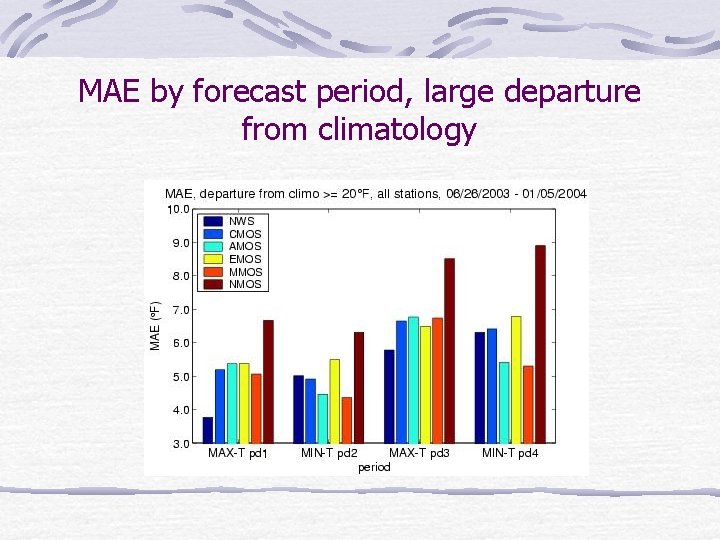
MAE by forecast period, large departure from climatology
Probability of Precipitation
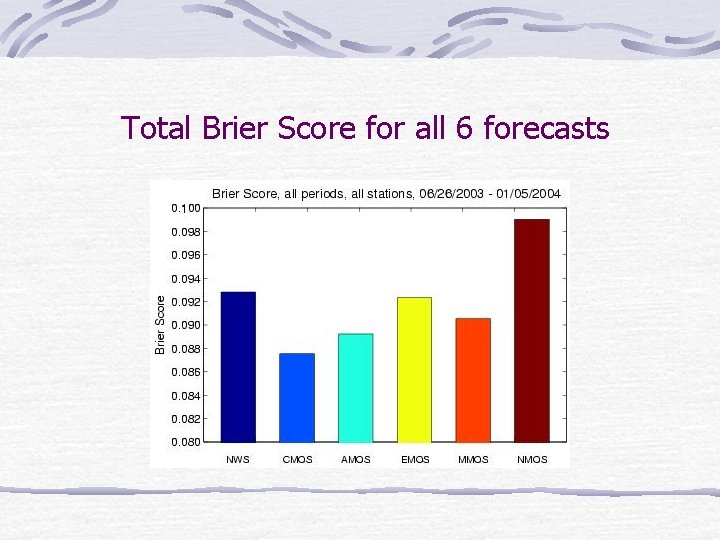
Total Brier Score for all 6 forecasts
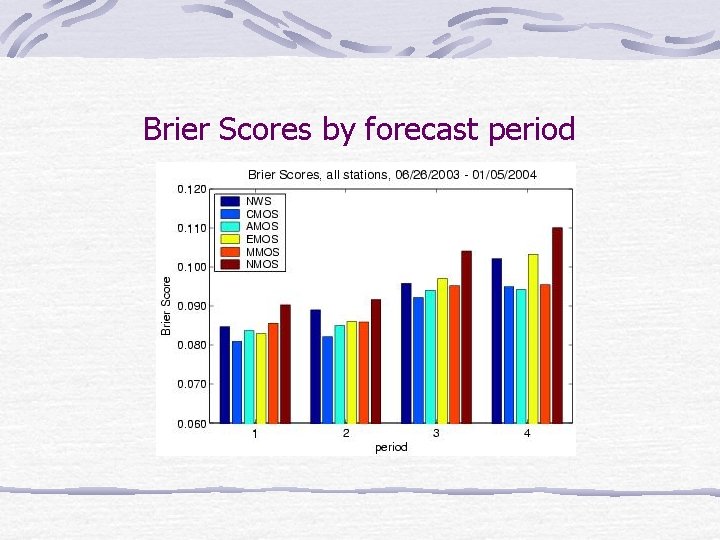
Brier Scores by forecast period
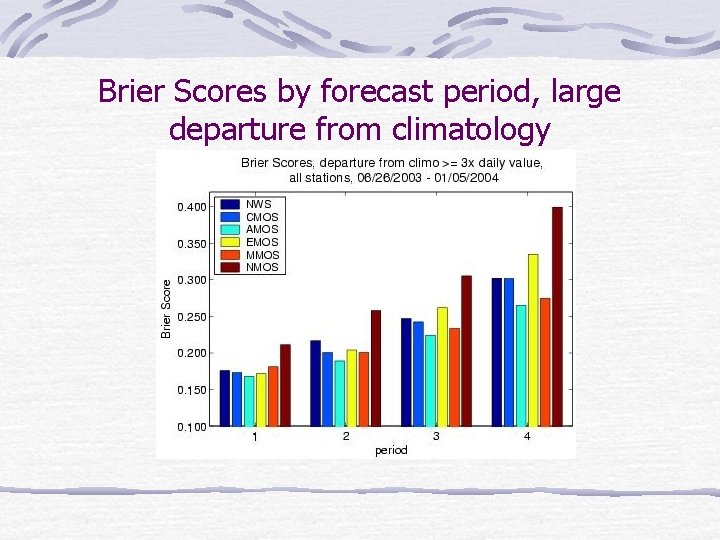
Brier Scores by forecast period, large departure from climatology
Conclusion CMOS shows equal or superior forecast skill compared to NWS and individual MOS’s when all time periods are considered. True for max and min temperatures and POPs. The NWS forecasts show superior forecast skill for max. temperatures during large departures from climatology. http: //www. atmos. washington. edu/~jbaars/ mos_vs_nws. html
Future Work Simple weighting correction to CMOS. Remove worst model from CMOS.