
Performance of Multiple Types of Numerical MR Simulation

- Slides: 25
Performance of Multiple Types of Numerical MR Simulation using MRi. Lab Fang Liu 1, Alexey Samsonov 1, Richard Kijowski 2, and Walter F. Block 1, 3 Contact: leoliuf@gmail. com 1 Department of Medical Physics, University of Wisconsin-Madison, United States of Radiology, University of Wisconsin-Madison, United States 3 Department of Biomedical Engineering, University of Wisconsin-Madison, United States 2 Department ISMRM 2014 Milan, Italy
Declaration of Conflict of Interest or Relationship Presenter Name: Fang Liu I have no conflicts of interest to disclose with regard to the subject matter of this presentation.
MRI Simulation § Digital simulation can dramatically speed the understanding and development of new MR imaging methods. § To numerically simulate spin evolution for large spin system, current available simulation packages typically employ dedicated computation architecture (e. g. computer grid and cluster) which is expensive and thus limited for convenient use. § Limited functions were provided in previous tools for modeling multiple receiving and transmitting coil relevant experiments. § No tools were provided capable of simulating complex spin models such as those existing in realistic tissue exhibiting multi-pool water exchange environment.
MRI Lab - MRi. Lab We have developed a novel simulation package named ‘MRi. Lab’ for performing fast 3 D parallelized MRI numerical simulation on a simple desktop computer. MRi. Lab features: q. Highly interactive program-free graphic user-interface q. RF and gradient modules for B 1 and B 0 field analysis q. Graphical pulse sequences design and analysis q. Fast parallelized simulation for tissue response in 3 D q. Low computation power requirement
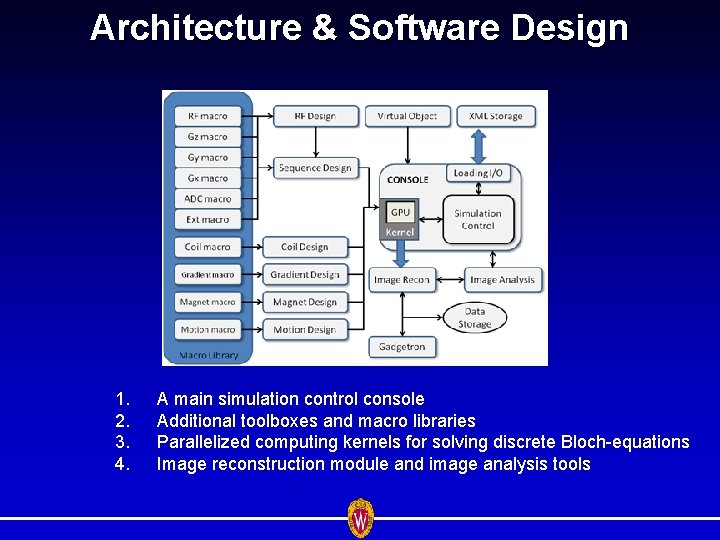
Architecture & Software Design 1. 2. 3. 4. A main simulation control console Additional toolboxes and macro libraries Parallelized computing kernels for solving discrete Bloch-equations Image reconstruction module and image analysis tools
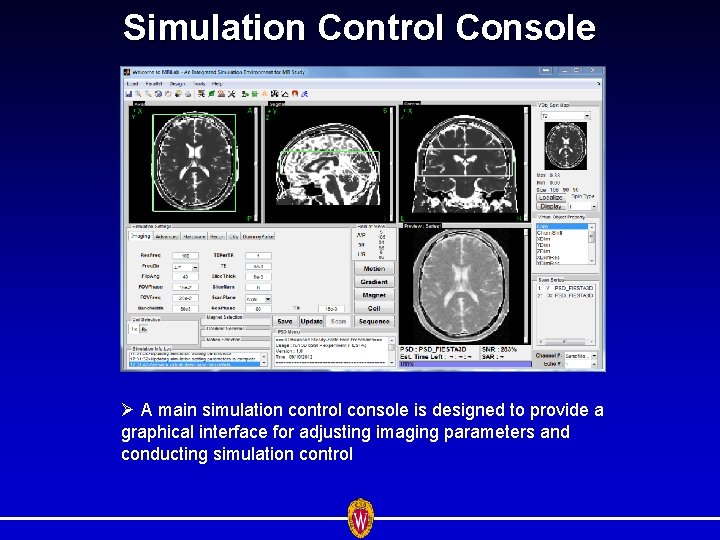
Simulation Control Console Ø A main simulation control console is designed to provide a graphical interface for adjusting imaging parameters and conducting simulation control
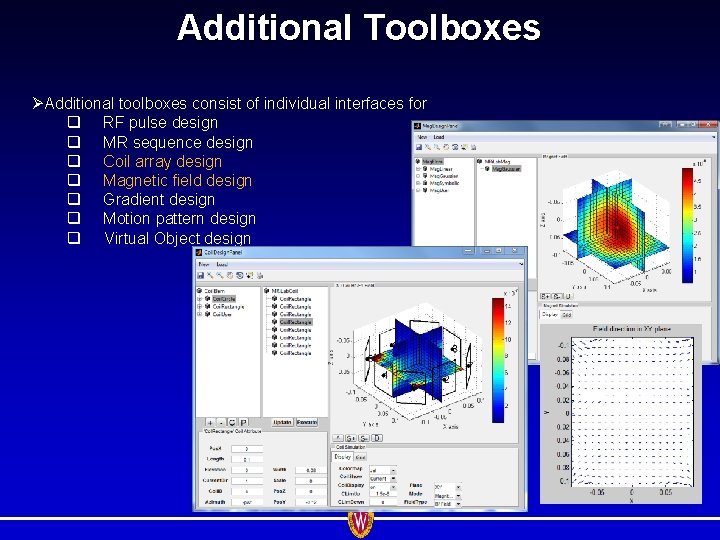
Additional Toolboxes ØAdditional toolboxes consist of individual interfaces for q RF pulse design q MR sequence design q Coil array design q Magnetic field design q Gradient design q Motion pattern design
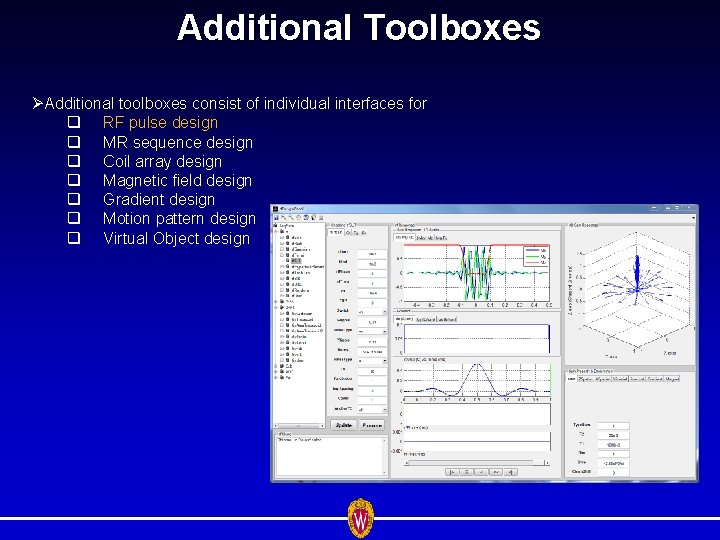
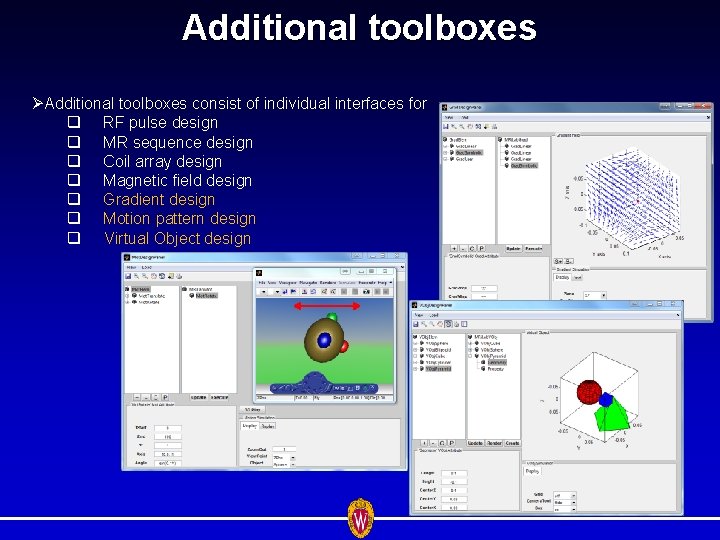
Additional Toolboxes ØAdditional toolboxes consist of individual interfaces for q RF pulse design q MR sequence design q Coil array design q Magnetic field design q Gradient design q Motion pattern design q Virtual Object design
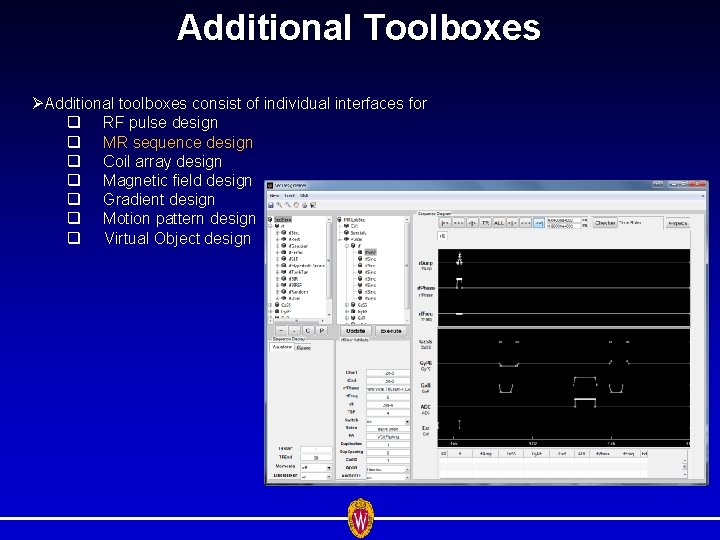
Additional Toolboxes ØAdditional toolboxes consist of individual interfaces for q RF pulse design q MR sequence design q Coil array design q Magnetic field design q Gradient design q Motion pattern design q Virtual Object design
Additional Toolboxes ØAdditional toolboxes consist of individual interfaces for q RF pulse design q MR sequence design q Coil array design q Magnetic field design q Gradient design q Motion pattern design q Virtual Object design
Additional toolboxes ØAdditional toolboxes consist of individual interfaces for q RF pulse design q MR sequence design q Coil array design q Magnetic field design q Gradient design q Motion pattern design q Virtual Object design
Parallelized Computing Kernels ØThe MRi. Lab computing kernels are designed using C++ language for high computing performance for solution of discrete Bloch-equations including q Standard Bloch-equations q Bloch-Mc. Connell equations for multiple spin exchange model q Bloch-equations with Magnetization Transfer (MT) exchange ØThe computing kernels are memory and time efficient, are capable of handling large scale multi-dimensional multi-spin system for mimicking realistic tissue response at given MR experimental setup
Parallelized Computing Kernels ØThe MRi. Lab computing kernels are parallelized by implementing latest GPU computing model and multithreading CPU model q Nvidia CUDA q Open. MP q Intel Integrated Performance Primitives q AMD Framewave ØThe MRi. Lab rendering engines are optimized by using high-performance graphical libraries q Kitware Visualization Toolkit (VTK) q Java Swing Components q Matlab 3 D rednering
Image Reconstruction Module ØThe MRi. Lab provides built-in image reconstruction module which reconstructs Cartesian (e. g. FSE, EPI) and Non. Cartesian (e. g. Radial, Spiral) k-space data. q Support multi-species multi-dimensional images q Support multi-echo multi-channel images q Support multiple RF transmitting ØThe MRi. Lab also provides functions to link MRi. Lab reconstruction with external image reconstruction methods (e. g. Gadgetron)
Image Reconstruction Module ØThe MRi. Lab provides built-in image reconstruction module which reconstructs Cartesian (e. g. FSE, EPI) and Non. Cartesian (e. g. Radial, Spiral) k-space data. q Support multi-species multi-dimensional images q Support multi-echo multi-channel images q Support multiple RF transmitting ØThe MRi. Lab also provides functions to link MRi. Lab reconstruction with external image reconstruction methods (e. g. Gadgetron)
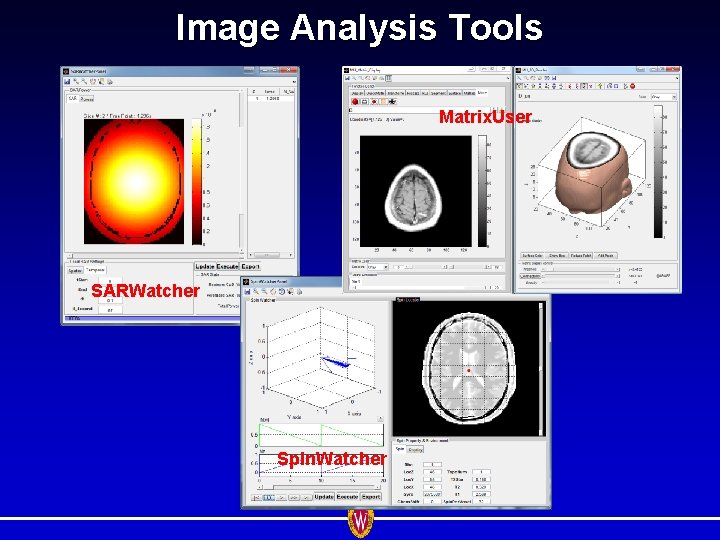
Image Analysis Tools Ø Matrix. User manipulating and analyzing multidimensional imaging space data Ø Spin. Watcher monitoring signal evolution of spins in a single voxel Ø SARWatcher monitoring local SAR distribution Ø array. Show * evaluate complex k-space data *Courtesy of Tilman Johannes Surmpf, Ph. D
Image Analysis Tools Matrix. User SARWatcher Spin. Watcher
Simulation Examples
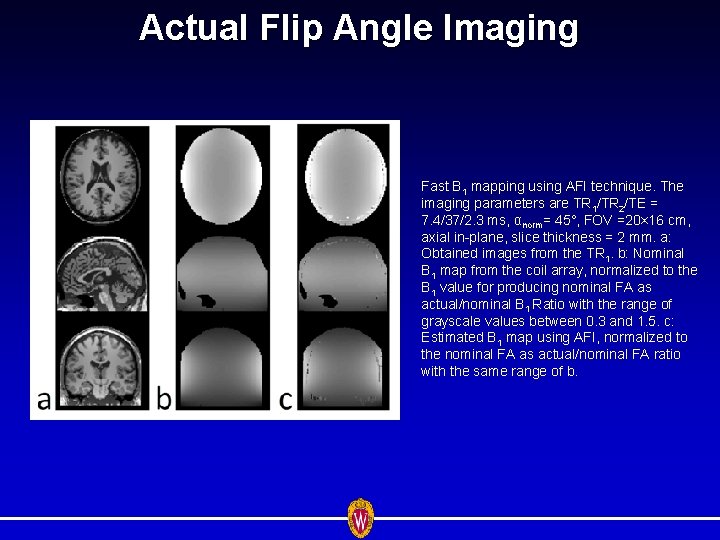
Actual Flip Angle Imaging Fast B 1 mapping using AFI technique. The imaging parameters are TR 1/TR 2/TE = 7. 4/37/2. 3 ms, αnorm= 45°, FOV =20× 16 cm, axial in-plane, slice thickness = 2 mm. a: Obtained images from the TR 1. b: Nominal B 1 map from the coil array, normalized to the B 1 value for producing nominal FA as actual/nominal B 1 Ratio with the range of grayscale values between 0. 3 and 1. 5. c: Estimated B 1 map using AFI, normalized to the nominal FA as actual/nominal FA ratio with the same range of b.
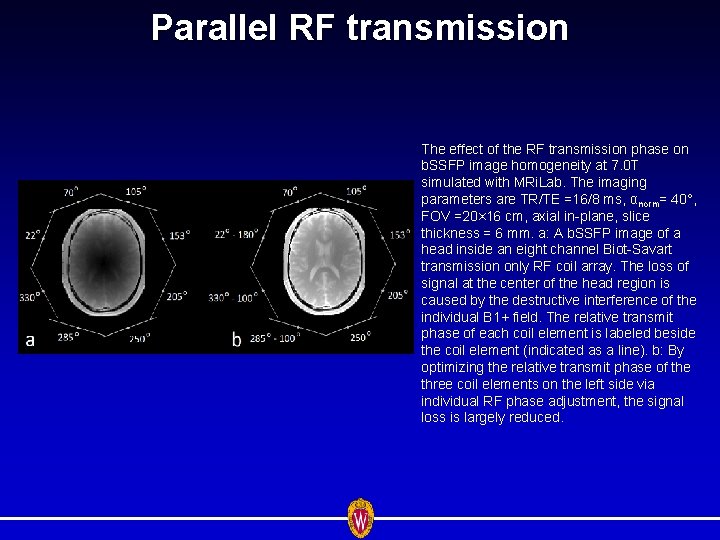
Parallel RF transmission The effect of the RF transmission phase on b. SSFP image homogeneity at 7. 0 T simulated with MRi. Lab. The imaging parameters are TR/TE =16/8 ms, αnorm= 40°, FOV =20× 16 cm, axial in-plane, slice thickness = 6 mm. a: A b. SSFP image of a head inside an eight channel Biot-Savart transmission only RF coil array. The loss of signal at the center of the head region is caused by the destructive interference of the individual B 1+ field. The relative transmit phase of each coil element is labeled beside the coil element (indicated as a line). b: By optimizing the relative transmit phase of the three coil elements on the left side via individual RF phase adjustment, the signal loss is largely reduced.
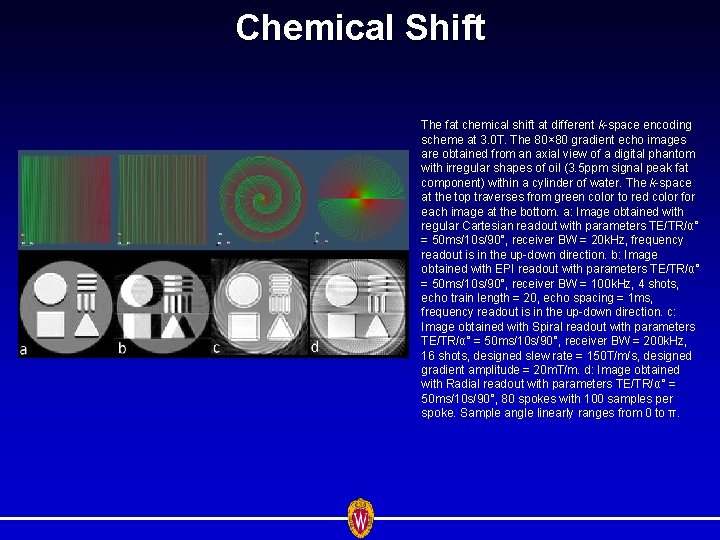
Chemical Shift The fat chemical shift at different k-space encoding scheme at 3. 0 T. The 80× 80 gradient echo images are obtained from an axial view of a digital phantom with irregular shapes of oil (3. 5 ppm signal peak fat component) within a cylinder of water. The k-space at the top traverses from green color to red color for each image at the bottom. a: Image obtained with regular Cartesian readout with parameters TE/TR/α° = 50 ms/10 s/90°, receiver BW = 20 k. Hz, frequency readout is in the up-down direction. b: Image obtained with EPI readout with parameters TE/TR/α° = 50 ms/10 s/90°, receiver BW = 100 k. Hz, 4 shots, echo train length = 20, echo spacing = 1 ms, frequency readout is in the up-down direction. c: Image obtained with Spiral readout with parameters TE/TR/α° = 50 ms/10 s/90°, receiver BW = 200 k. Hz, 16 shots, designed slew rate = 150 T/m/s, designed gradient amplitude = 20 m. T/m. d: Image obtained with Radial readout with parameters TE/TR/α° = 50 ms/10 s/90°, 80 spokes with 100 samples per spoke. Sample angle linearly ranges from 0 to π.
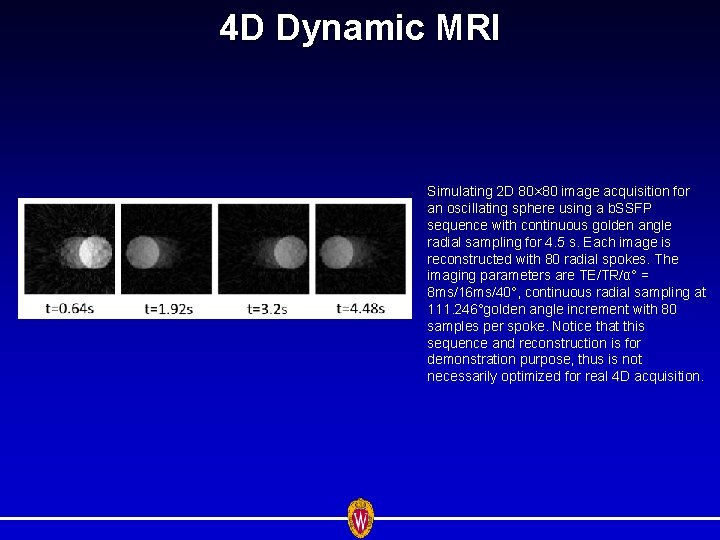
4 D Dynamic MRI Simulating 2 D 80× 80 image acquisition for an oscillating sphere using a b. SSFP sequence with continuous golden angle radial sampling for 4. 5 s. Each image is reconstructed with 80 radial spokes. The imaging parameters are TE/TR/α° = 8 ms/16 ms/40°, continuous radial sampling at 111. 246°golden angle increment with 80 samples per spoke. Notice that this sequence and reconstruction is for demonstration purpose, thus is not necessarily optimized for real 4 D acquisition.
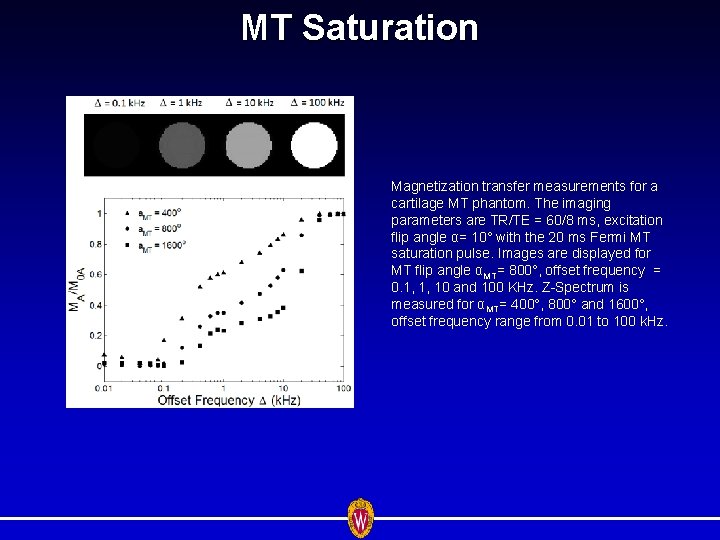
MT Saturation Magnetization transfer measurements for a cartilage MT phantom. The imaging parameters are TR/TE = 60/8 ms, excitation flip angle α= 10° with the 20 ms Fermi MT saturation pulse. Images are displayed for MT flip angle αMT= 800°, offset frequency = 0. 1, 1, 10 and 100 KHz. Z-Spectrum is measured for αMT= 400°, 800° and 1600°, offset frequency range from 0. 01 to 100 k. Hz.
Conclusion § Demonstrate the features of MRi. Lab simulation for : q simulating various types of MR phenomena q capable of handling efficient simulation in parallel q enriched functions for MR experiment design, image reconstruction and analysis q finally, a fun tool to use § The MRi. Lab is released as an open source free software, and can be downloaded at http: //mrilab. sourceforge. net/
Thank you Wisconsin Institute for Medical Research University of Wisconsin - Madison Contact: leoliuf@gmail. com