
Performance of Exposed Aggregate Surface of Composite Pavements


- Slides: 15
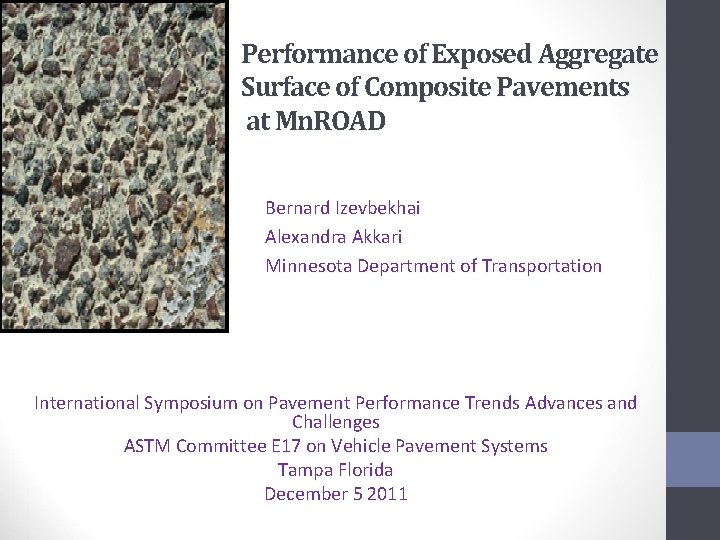
Performance of Exposed Aggregate Surface of Composite Pavements at Mn. ROAD Bernard Izevbekhai Alexandra Akkari Minnesota Department of Transportation International Symposium on Pavement Performance Trends Advances and Challenges ASTM Committee E 17 on Vehicle Pavement Systems Tampa Florida December 5 2011
OUTLINE Introduction Layout Mix Design Performance Evaluation Results Conclusion Potentials
MNROAD MAINLINE Interstate 94 Westbound Live Traffic 28, 000 AADT Mainline Passing Lane Vs. Driving Lane 50 -50 Traffic; 80 -20 ESALs • Total Truck Volume 15% approx. • •
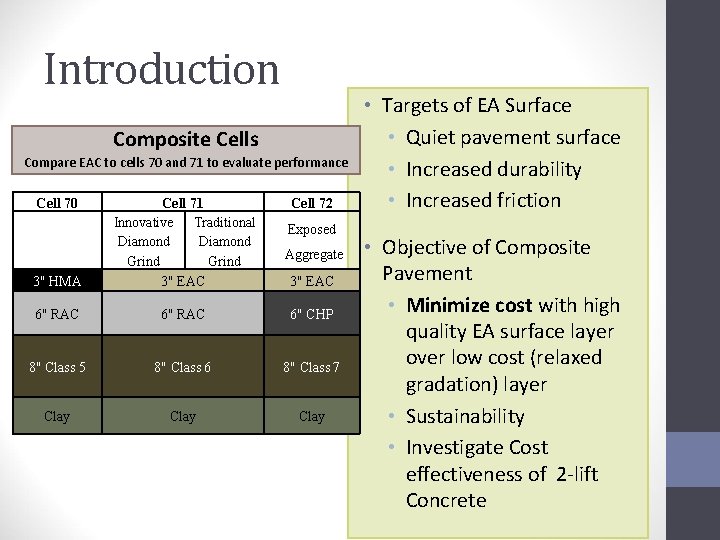
Introduction Composite Cells Compare EAC to cells 70 and 71 to evaluate performance Cell 70 3" HMA Cell 71 Innovative Traditional Diamond Grind 3" EAC Cell 72 6" RAC 6" CHP 8" Class 5 8" Class 6 8" Class 7 Clay Exposed Aggregate 3" EAC • Targets of EA Surface • Quiet pavement surface • Increased durability • Increased friction • Objective of Composite Pavement • Minimize cost with high quality EA surface layer over low cost (relaxed gradation) layer • Sustainability • Investigate Cost effectiveness of 2 -lift Concrete
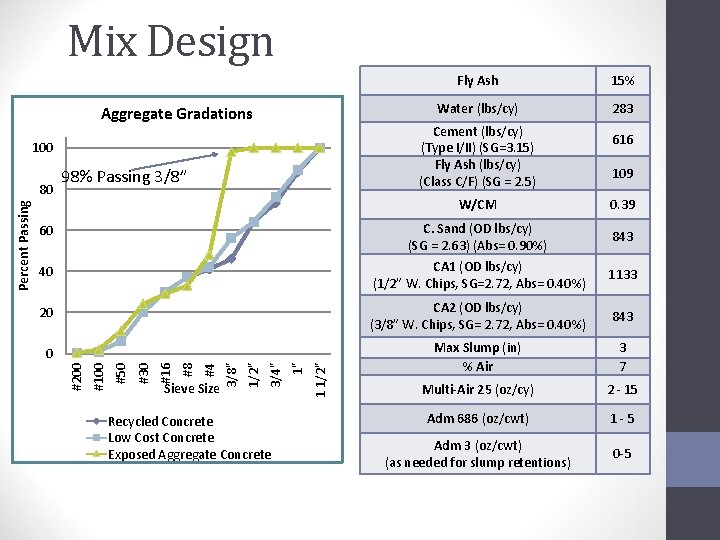
Mix Design Aggregate Gradations 98% Passing 3/8” Water (lbs/cy) 283 616 109 0 Max Slump (in) % Air 3 7 Multi-Air 25 (oz/cy) 2 - 15 Adm 686 (oz/cwt) 1 -5 Adm 3 (oz/cwt) (as needed for slump retentions) 0 -5 Sieve Size Recycled Concrete Low Cost Concrete Exposed Aggregate Concrete 1 1/2" 843 1" CA 2 (OD lbs/cy) (3/8” W. Chips, SG= 2. 72, Abs= 0. 40%) 3/4" 20 1/2" 1133 3/8" CA 1 (OD lbs/cy) (1/2” W. Chips, SG=2. 72, Abs= 0. 40%) #4 40 #8 843 #16 C. Sand (OD lbs/cy) (SG = 2. 63) (Abs= 0. 90%) #30 60 #50 0. 39 #100 W/CM #200 Percent Passing 15% Cement (lbs/cy) (Type I/II) (SG=3. 15) Fly Ash (lbs/cy) (Class C/F) (SG = 2. 5) 100 80 Fly Ash
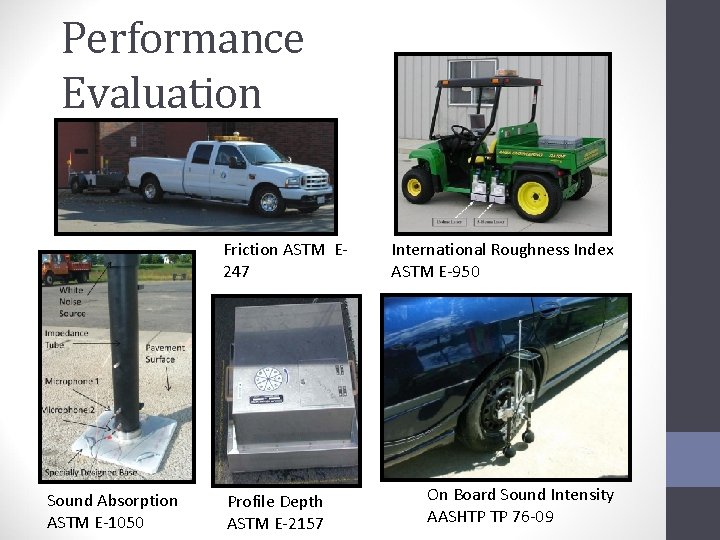
Performance Evaluation Friction ASTM E 247 Sound Absorption ASTM E-1050 Profile Depth ASTM E-2157 International Roughness Index ASTM E-950 On Board Sound Intensity AASHTP TP 76 -09
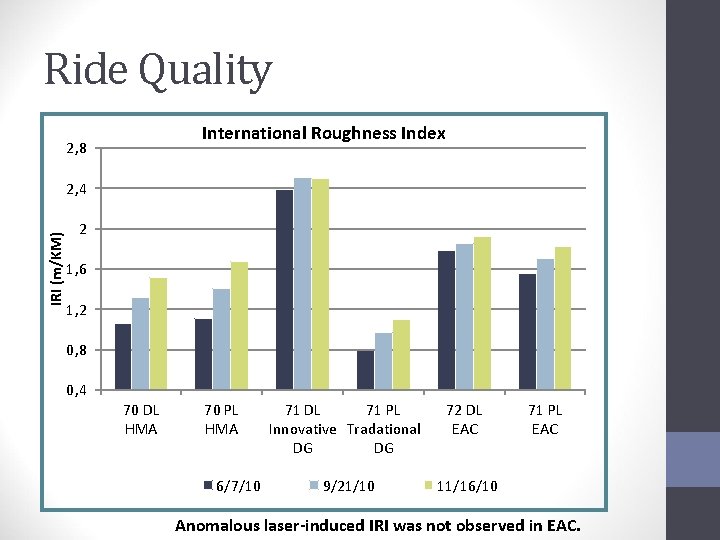
Ride Quality International Roughness Index 2, 8 IRI (m/KM) 2, 4 2 1, 6 1, 2 0, 8 0, 4 70 DL HMA 70 PL HMA 6/7/10 71 DL 71 PL Innovative Tradational DG DG 72 DL EAC 9/21/10 11/16/10 71 PL EAC Anomalous laser-induced IRI was not observed in EAC.
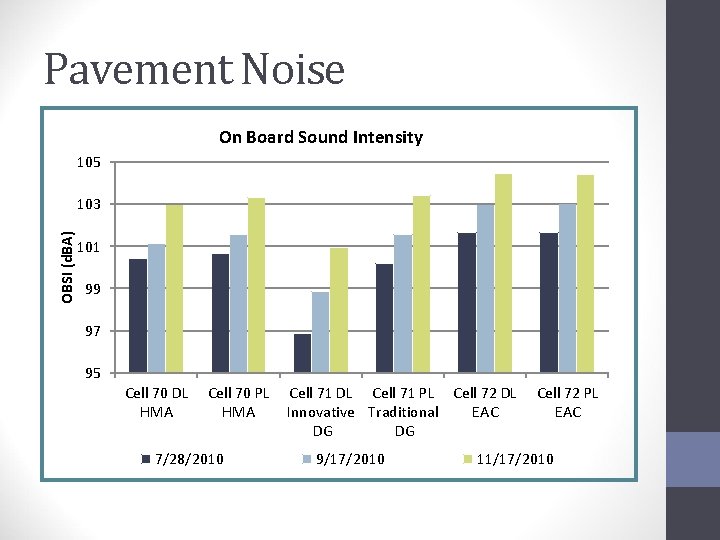
Pavement Noise On Board Sound Intensity 105 OBSI (d. BA) 103 101 99 97 95 Cell 70 DL HMA Cell 70 PL HMA 7/28/2010 Cell 71 DL Cell 71 PL Cell 72 DL Innovative Traditional EAC DG DG 9/17/2010 Cell 72 PL EAC 11/17/2010
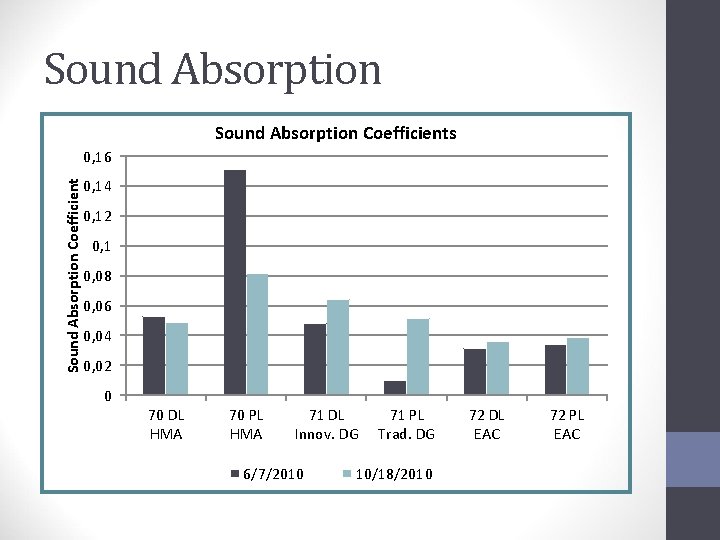
Sound Absorption Coefficients Sound Absorption Coefficient 0, 16 0, 14 0, 12 0, 1 0, 08 0, 06 0, 04 0, 02 0 70 DL HMA 70 PL HMA 71 DL Innov. DG 6/7/2010 71 PL Trad. DG 10/18/2010 72 DL EAC 72 PL EAC
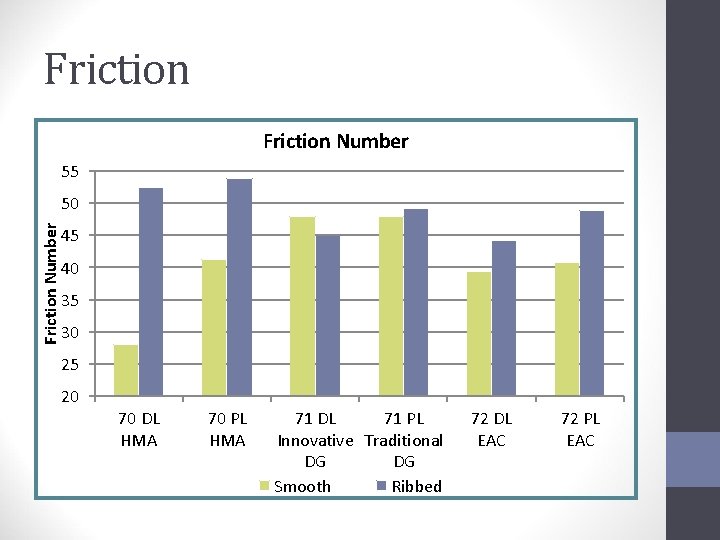
Friction Number 55 Friction Number 50 45 40 35 30 25 20 70 DL HMA 70 PL HMA 71 DL 71 PL Innovative Traditional DG DG Smooth Ribbed 72 DL EAC 72 PL EAC
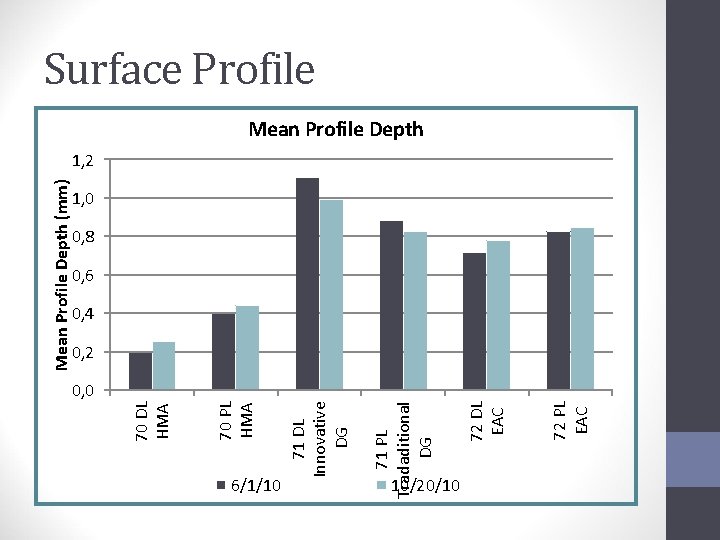
6/1/10 10/20/10 72 PL EAC 72 DL EAC 71 PL Tradaditional DG 71 DL Innovative DG 70 PL HMA 70 DL HMA Mean Profile Depth (mm) Surface Profile Mean Profile Depth 1, 2 1, 0 0, 8 0, 6 0, 4 0, 2 0, 0
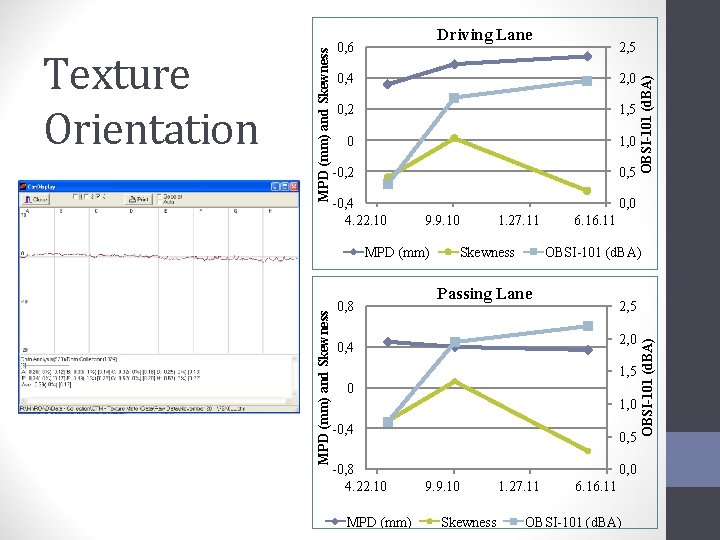
0, 2 1, 5 0 1, 0 -0, 2 0, 5 -0, 4 4. 22. 10 0, 0 9. 9. 10 0, 8 1. 27. 11 Skewness 6. 11 OBSI-101 (d. BA) Passing Lane 2, 5 2, 0 0, 4 1, 5 0 1, 0 -0, 4 -0, 8 4. 22. 10 MPD (mm) 0, 5 0, 0 9. 9. 10 Skewness OBSI-101 (d. BA) 2, 0 1. 27. 11 6. 11 OBSI-101 (d. BA) MPD (mm) and Skewness 2, 5 0, 4 MPD (mm) and Skewness Texture Orientation Driving Lane 0, 6
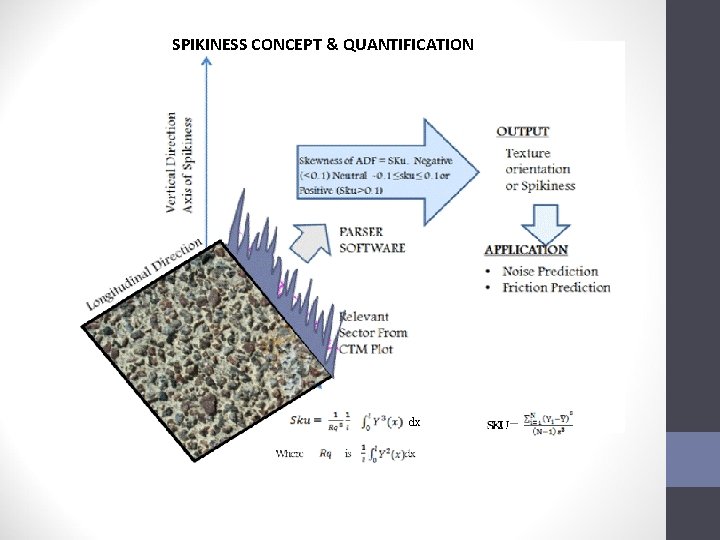
SPIKINESS CONCEPT & QUANTIFICATION dx
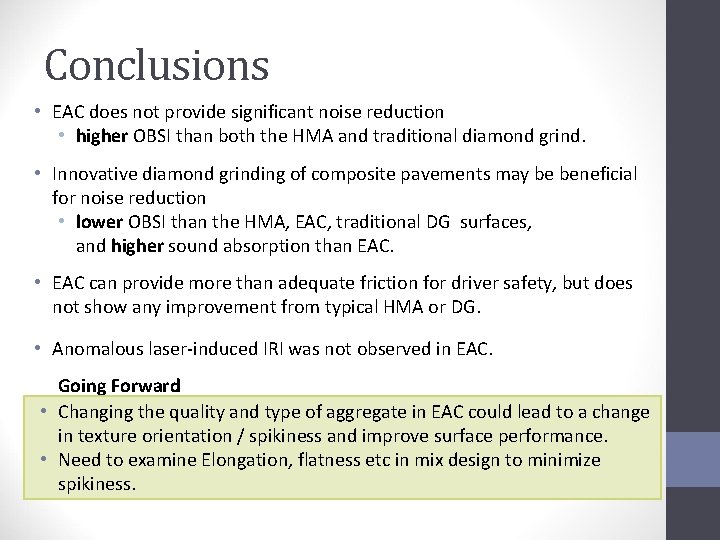
Conclusions • EAC does not provide significant noise reduction • higher OBSI than both the HMA and traditional diamond grind. • Innovative diamond grinding of composite pavements may be beneficial for noise reduction • lower OBSI than the HMA, EAC, traditional DG surfaces, and higher sound absorption than EAC. • EAC can provide more than adequate friction for driver safety, but does not show any improvement from typical HMA or DG. • Anomalous laser-induced IRI was not observed in EAC. Going Forward • Changing the quality and type of aggregate in EAC could lead to a change in texture orientation / spikiness and improve surface performance. • Need to examine Elongation, flatness etc in mix design to minimize spikiness.
QUESTIONS K AN I TH EE TH