
Performance of dairy cattle clones and evaluation of
- Slides: 14
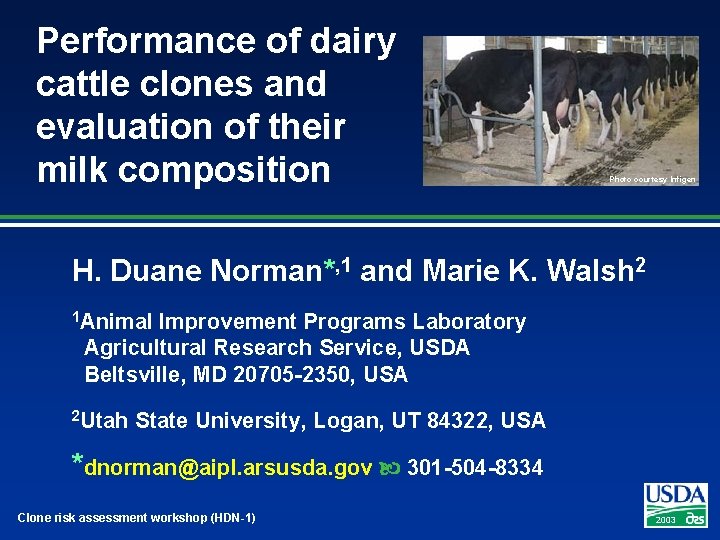
Performance of dairy cattle clones and evaluation of their milk composition Photo courtesy Infigen H. Duane Norman*, 1 and Marie K. Walsh 2 1 Animal Improvement Programs Laboratory Agricultural Research Service, USDA Beltsville, MD 20705 -2350, USA 2 Utah State University, Logan, UT 84322, USA *dnorman@aipl. arsusda. gov 301 -504 -8334 Clone risk assessment workshop (HDN-1) 2003
Cloning biotechnology l Embryo splitting l Nuclear transfer 0 Embryo 0 Somatic cell · Fetal · Adult Clone risk assessment workshop (HDN-2) 2003
Normal performance? l Animal health (developmental issues) l Mitochondrial DNA differences l Genotype identification (bloodtyping) l Genetic merit l Food safety Clone risk assessment workshop (HDN-3) 2003
Research studies l Norman, Lawlor, and Wright (2002). Proceedings of 7 th World Congress on Genetics Applied to Livestock Production 33, 699 -702. l Norman, Lawlor, and Wright (2003). Journal of Dairy Science (in press). l Walsh, Lucey, Govindasamy-Lucey, et al. (2003). Cloning and Stem Cells 5, 213 -219. Clone risk assessment workshop (HDN-4) 2003
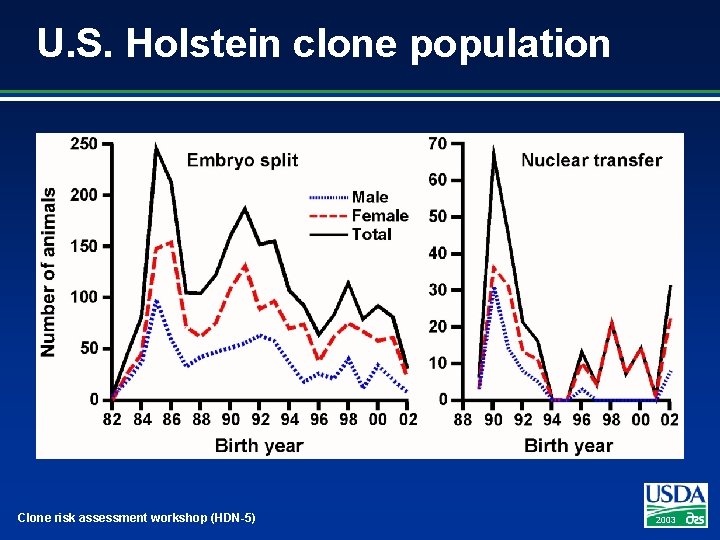
U. S. Holstein clone population Clone risk assessment workshop (HDN-5) 2003
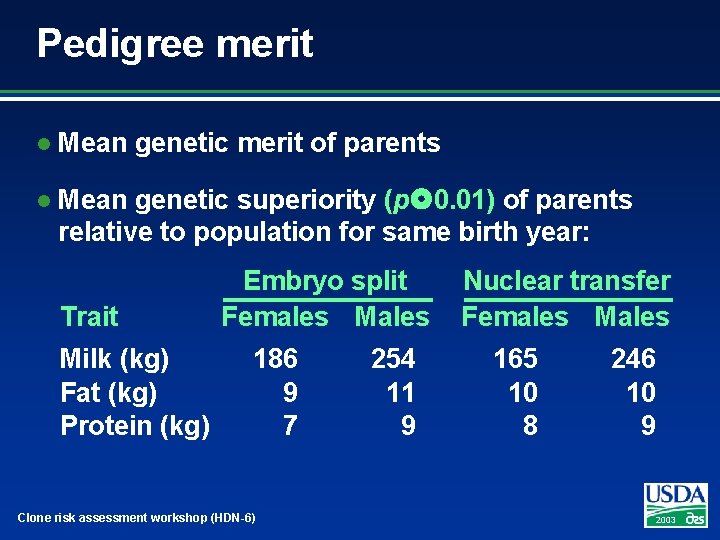
Pedigree merit l Mean genetic merit of parents l Mean genetic superiority (p 0. 01) of parents relative to population for same birth year: Trait Milk (kg) Fat (kg) Protein (kg) Embryo split Females Males 186 9 7 Clone risk assessment workshop (HDN-6) 254 11 9 Nuclear transfer Females Males 165 10 8 246 10 9 2003
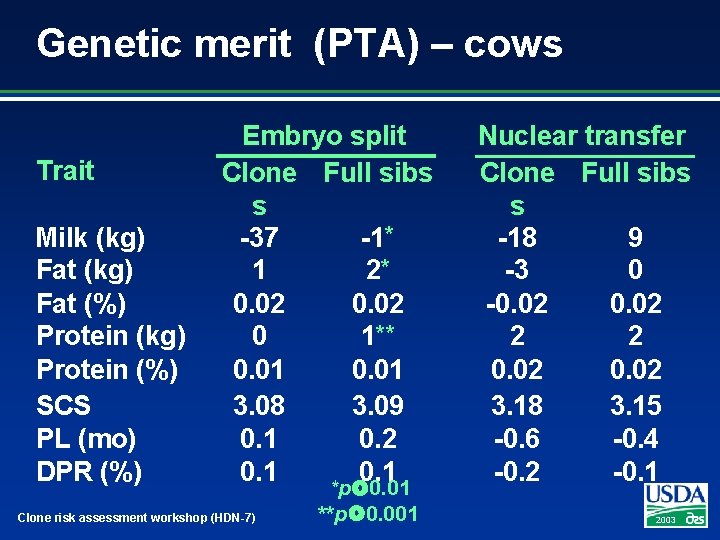
Genetic merit (PTA) – cows Trait Milk (kg) Fat (%) Protein (kg) Protein (%) SCS PL (mo) DPR (%) Embryo split Clone Full sibs s -37 -1* 1 2* 0. 02 0 1** 0. 01 3. 08 3. 09 0. 1 0. 2 0. 1 Clone risk assessment workshop (HDN-7) *p 0. 01 **p 0. 001 Nuclear transfer Clone Full sibs s -18 9 -3 0 -0. 02 2 2 0. 02 3. 18 3. 15 -0. 6 -0. 4 -0. 2 -0. 1 2003
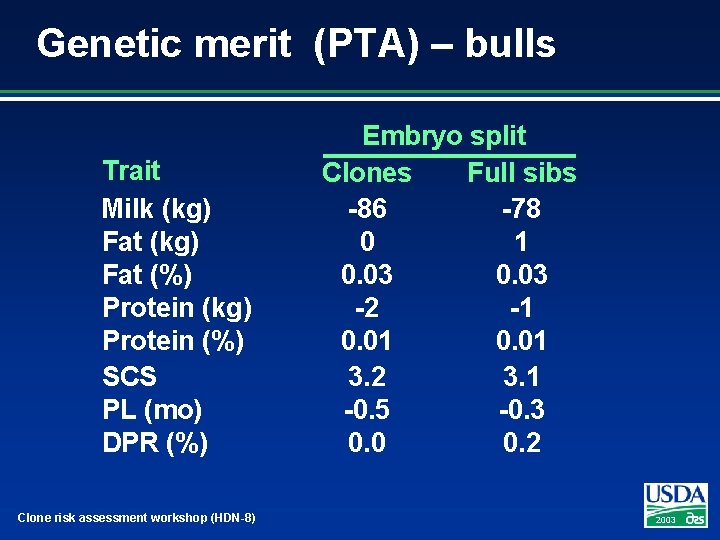
Genetic merit (PTA) – bulls Trait Milk (kg) Fat (%) Protein (kg) Protein (%) SCS PL (mo) DPR (%) Clone risk assessment workshop (HDN-8) Embryo split Clones Full sibs -86 -78 0 1 0. 03 -2 -1 0. 01 3. 2 3. 1 -0. 5 -0. 3 0. 0 0. 2 2003
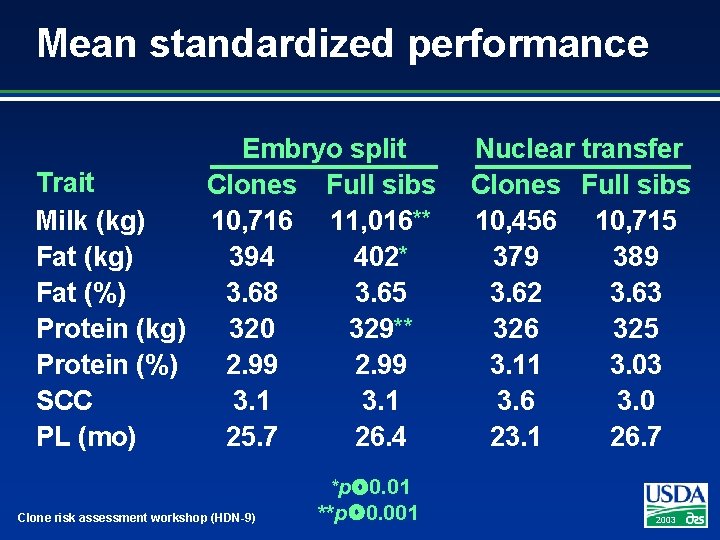
Mean standardized performance Embryo split Trait Clones Full sibs Milk (kg) 10, 716 11, 016** Fat (kg) 394 402* Fat (%) 3. 68 3. 65 Protein (kg) 320 329** Protein (%) 2. 99 SCC 3. 1 PL (mo) 25. 7 26. 4 Clone risk assessment workshop (HDN-9) *p 0. 01 **p 0. 001 Nuclear transfer Clones Full sibs 10, 456 10, 715 379 389 3. 62 3. 63 326 325 3. 11 3. 03 3. 6 3. 0 23. 1 26. 7 2003
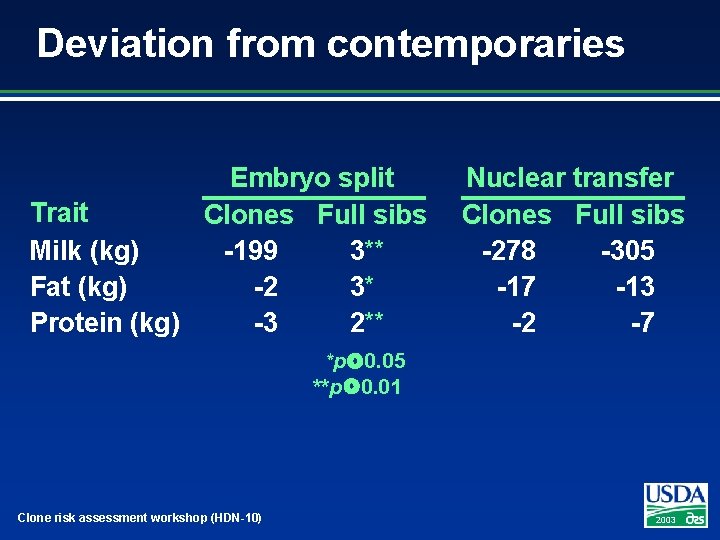
Deviation from contemporaries Embryo split Trait Clones Full sibs Milk (kg) -199 3** Fat (kg) -2 3* Protein (kg) -3 2** Nuclear transfer Clones Full sibs -278 -305 -17 -13 -2 -7 *p 0. 05 **p 0. 01 Clone risk assessment workshop (HDN-10) 2003
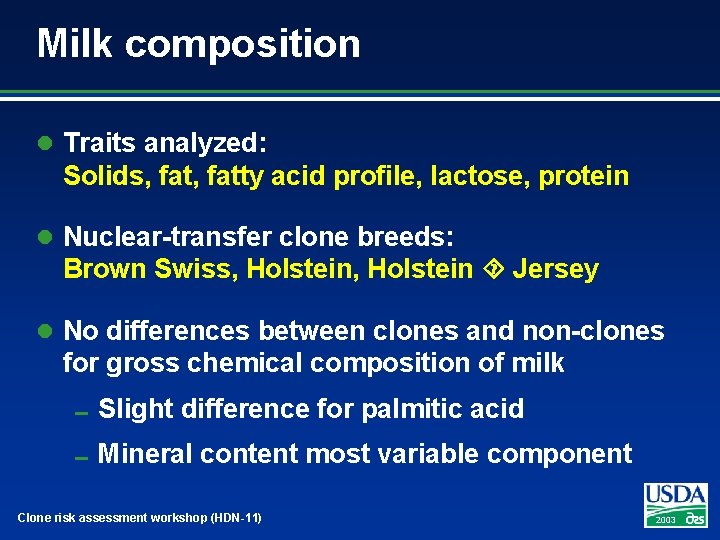
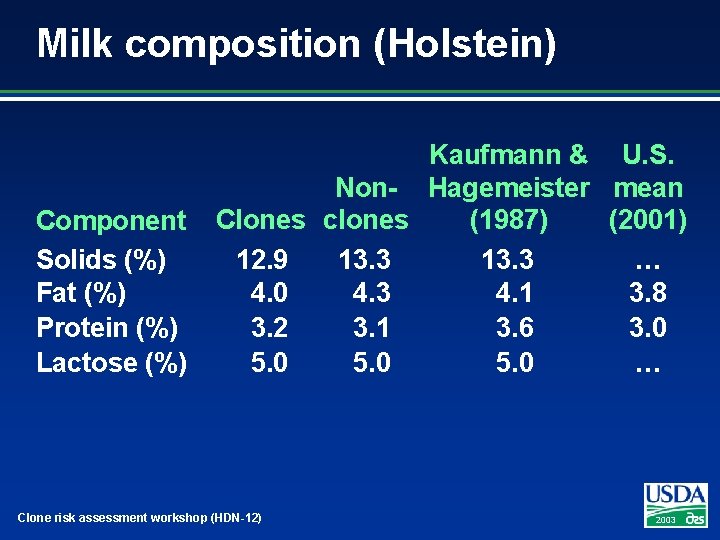
Milk composition l Traits analyzed: Solids, fatty acid profile, lactose, protein l Nuclear-transfer clone breeds: Brown Swiss, Holstein Jersey l No differences between clones and non-clones for gross chemical composition of milk 0 Slight difference for palmitic acid 0 Mineral content most variable component Clone risk assessment workshop (HDN-11) 2003
Milk composition (Holstein) Component Solids (%) Fat (%) Protein (%) Lactose (%) Kaufmann & U. S. Non- Hagemeister mean Clones clones (1987) (2001) 12. 9 13. 3 … 4. 0 4. 3 4. 1 3. 8 3. 2 3. 1 3. 6 3. 0 5. 0 … Clone risk assessment workshop (HDN-12) 2003
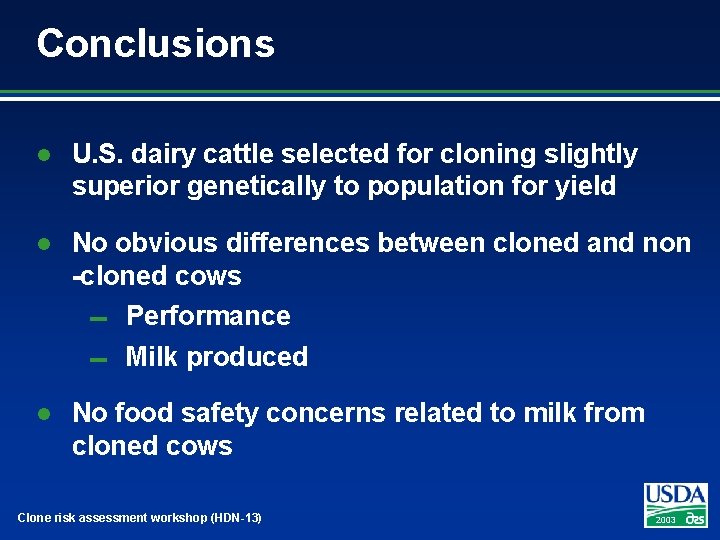
Conclusions l U. S. dairy cattle selected for cloning slightly superior genetically to population for yield l No obvious differences between cloned and non -cloned cows 0 Performance 0 Milk produced l No food safety concerns related to milk from cloned cows Clone risk assessment workshop (HDN-13) 2003
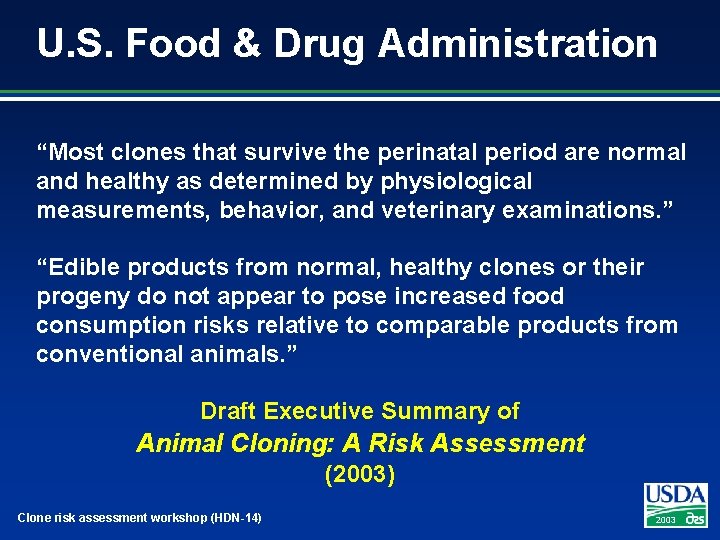
U. S. Food & Drug Administration “Most clones that survive the perinatal period are normal and healthy as determined by physiological measurements, behavior, and veterinary examinations. ” “Edible products from normal, healthy clones or their progeny do not appear to pose increased food consumption risks relative to comparable products from conventional animals. ” Draft Executive Summary of Animal Cloning: A Risk Assessment (2003) Clone risk assessment workshop (HDN-14) 2003