
Performance of Anomalous Signal Detection with HMM Approach
![EM wave data and anomalous signal Density of magnetic flux[ ] Time[days] Observation signal](https://slidetodoc.com/presentation_image/488ab5ecc977fcc08f96d4b94a4ac0b1/image-9.jpg "EM wave data and anomalous signal Density of magnetic flux[ ] Time[days] Observation signal")


![Conventional technique Scale of image False detection rate [%] X-axis Y-axis [days] [](https://slidetodoc.com/presentation_image/488ab5ecc977fcc08f96d4b94a4ac0b1/image-26.jpg "Conventional technique Scale of image False detection rate [%] X-axis Y-axis [days] [")
- Slides: 29
Performance of Anomalous Signal Detection with HMM Approach in Electromagnetic Wave Observation Using Moving Window Yoshinao ITO†, Akitoshi ITAI†, Hiroshi YASUKAWA†, Ichi TAKUMI‡, Masayasu HATA‡‡ †Aichi Prefectural University ‡Nagoya Institute of Technology ‡‡Chubu University 1
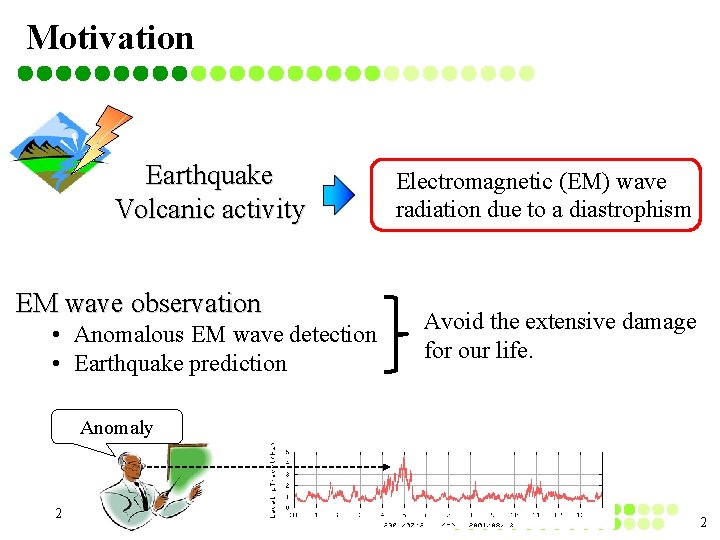
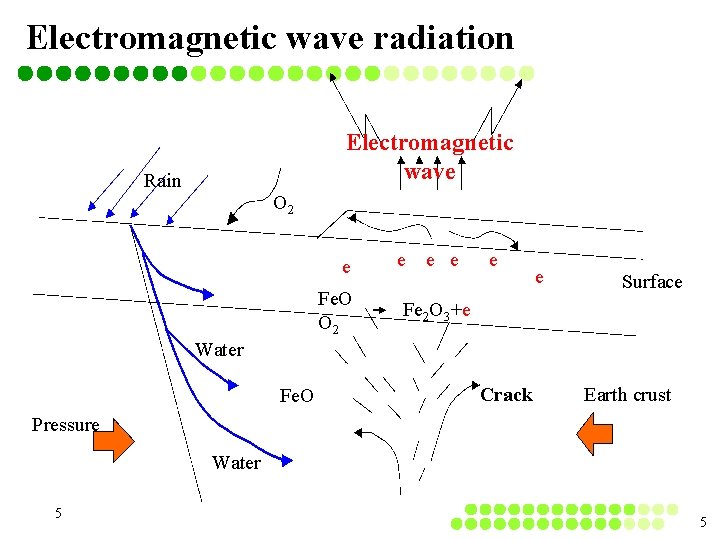
Motivation Earthquake Volcanic activity EM wave observation • Anomalous EM wave detection • Earthquake prediction Electromagnetic (EM) wave radiation due to a diastrophism Avoid the extensive damage for our life. Anomaly 2 2
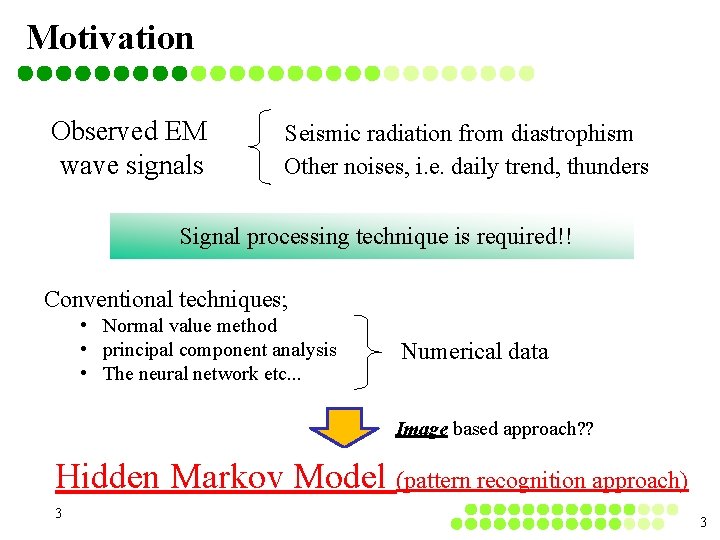
Motivation Observed EM wave signals Seismic radiation from diastrophism Other noises, i. e. daily trend, thunders Signal processing technique is required!! Conventional techniques; • Normal value method • principal component analysis • The neural network etc. . . Numerical data Image based approach? ? Hidden Markov Model (pattern recognition approach) 3 3
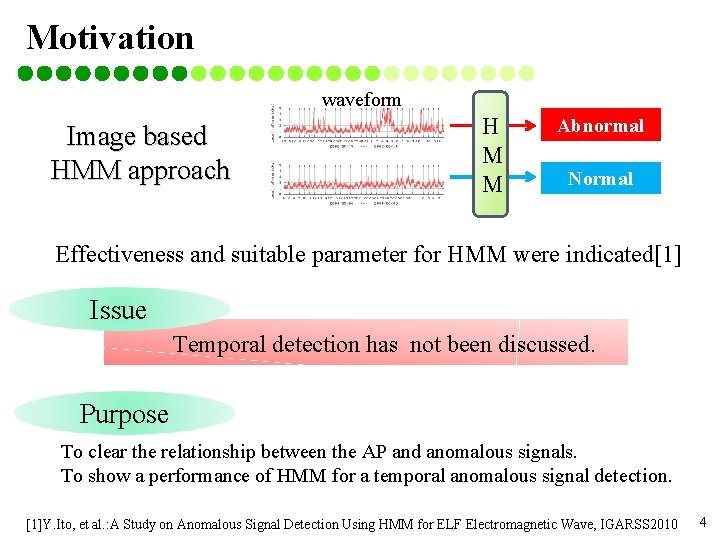
Motivation waveform Image based HMM approach H M M Abnormal Normal Effectiveness and suitable parameter for HMM were indicated[1] Issue Temporal detection has not been discussed. Purpose To clear the relationship between the AP and anomalous signals. To show a performance of HMM for a temporal anomalous signal detection. [1]Y. Ito, et al. : A Study on Anomalous Signal Detection Using HMM for ELF Electromagnetic Wave, IGARSS 2010 4
Electromagnetic wave radiation Electromagnetic wave Rain O 2 e Fe. O O 2 e e e Surface Fe 2 O 3+e Water Fe. O Crack Earth crust Pressure Water 5 Pressure 5
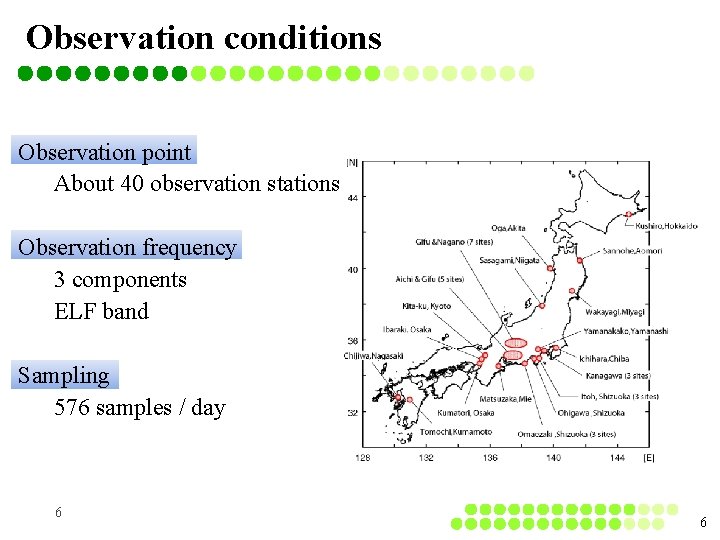
Observation conditions Observation point About 40 observation stations Observation frequency 3 components ELF band Sampling 576 samples / day 6 6
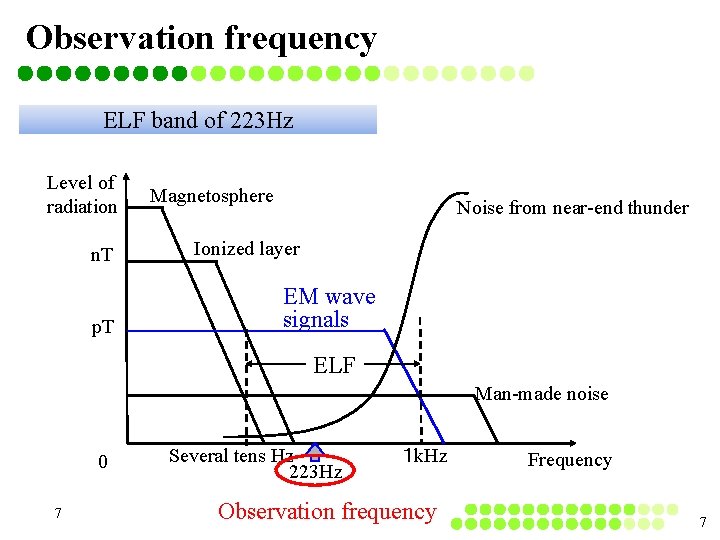
Observation frequency ELF band of 223 Hz Level of radiation n. T p. T Magnetosphere Noise from near-end thunder Ionized layer EM wave signals ELF Man-made noise 0 7 Several tens Hz 223 Hz 1 k. Hz Observation frequency Frequency 7
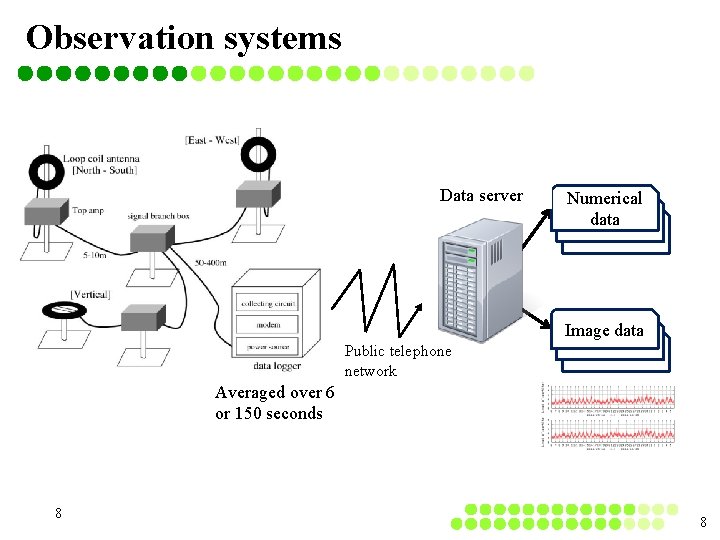
Observation systems Data server Numerical data Image data Public telephone network Averaged over 6 or 150 seconds 8 8
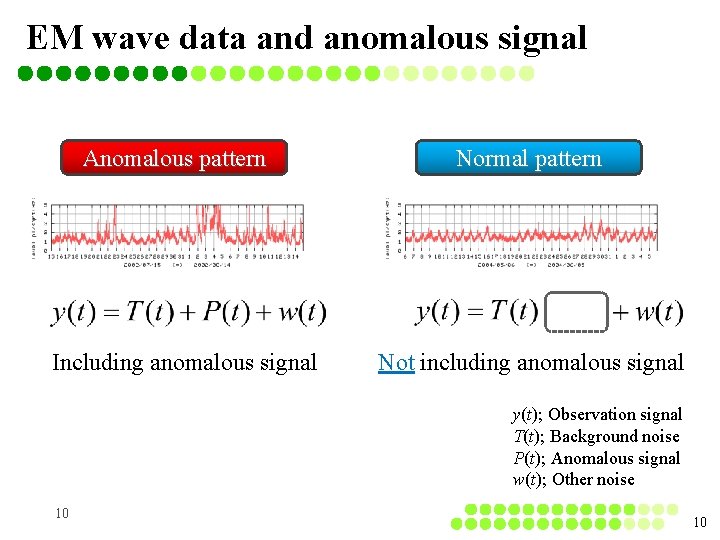
EM wave data and anomalous signal Density of magnetic flux[ ] Time[days] Observation signal Anomalous signal Earthquake Background noise Other noise Our goal is to detect the P(t) accurately 9 9
EM wave data and anomalous signal Anomalous pattern Including anomalous signal Normal pattern Not including anomalous signal y(t); Observation signal T(t); Background noise P(t); Anomalous signal w(t); Other noise 10 10
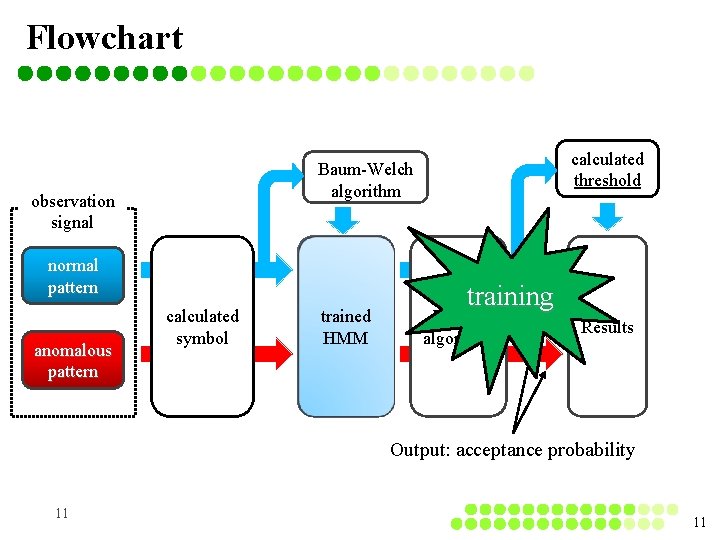
Flowchart observation signal normal pattern anomalous pattern calculated threshold Baum-Welch algorithm calculated symbol trained HMM training Viterbi algorithm Results Output: acceptance probability 11 11
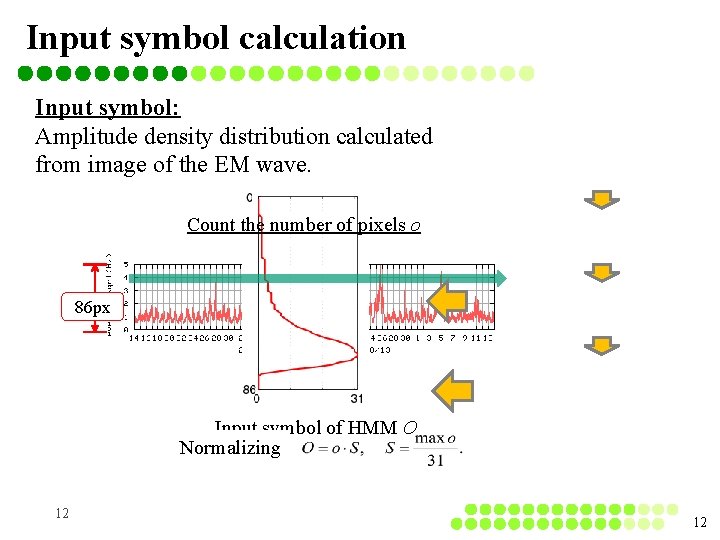
Input symbol calculation Input symbol: Amplitude density distribution calculated from image of the EM wave. Count the number of pixels o 86 px Input symbol of HMM O Normalizing 12 12
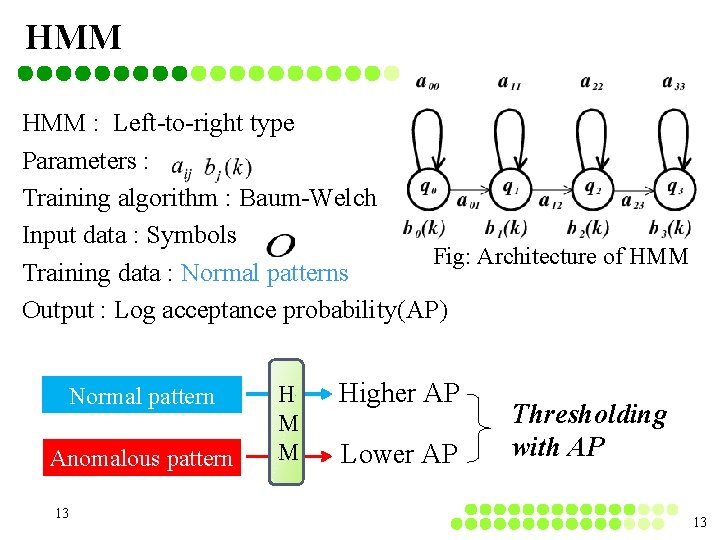
HMM : Left-to-right type Parameters : Training algorithm : Baum-Welch Input data : Symbols Fig: Architecture of HMM Training data : Normal patterns Output : Log acceptance probability(AP) Normal pattern Anomalous pattern 13 H M M Higher AP Lower AP Thresholding with AP 13
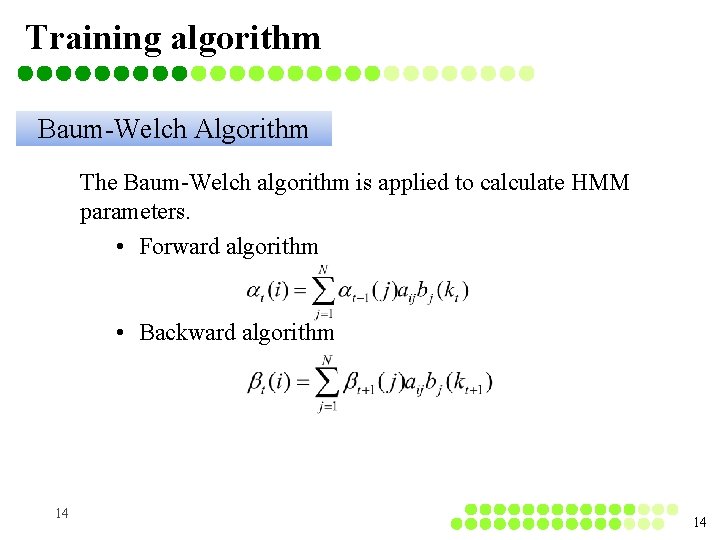
Training algorithm Baum-Welch Algorithm The Baum-Welch algorithm is applied to calculate HMM parameters. • Forward algorithm • Backward algorithm 14 14
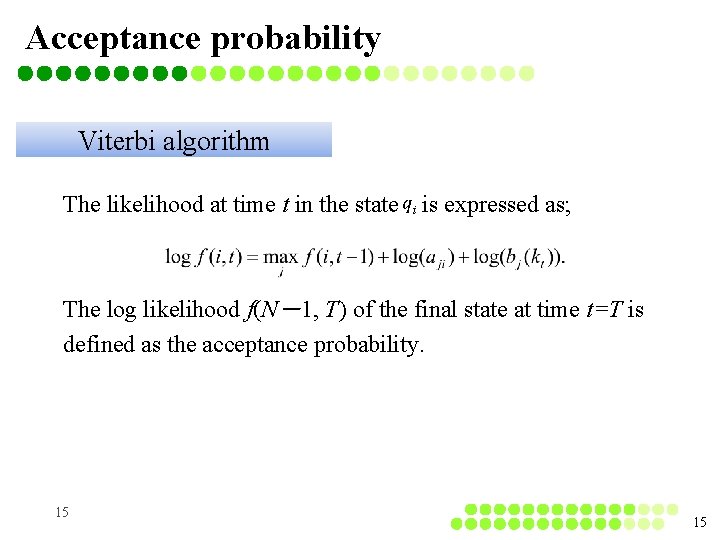
Acceptance probability Viterbi algorithm The likelihood at time t in the state is expressed as; The log likelihood f(N-1, T) of the final state at time t=T is defined as the acceptance probability. 15 15
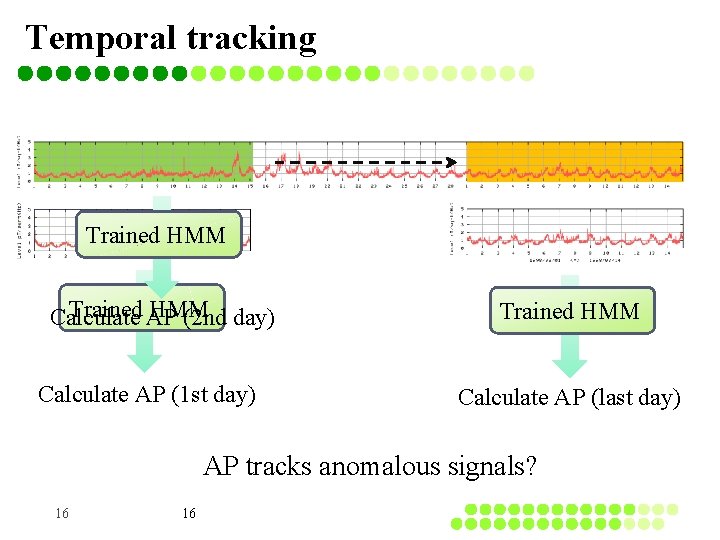
Temporal tracking Trained HMM Trained AP HMM Calculate (2 nd day) Calculate AP (1 st day) Trained HMM Calculate AP (last day) AP tracks anomalous signals? 16 16
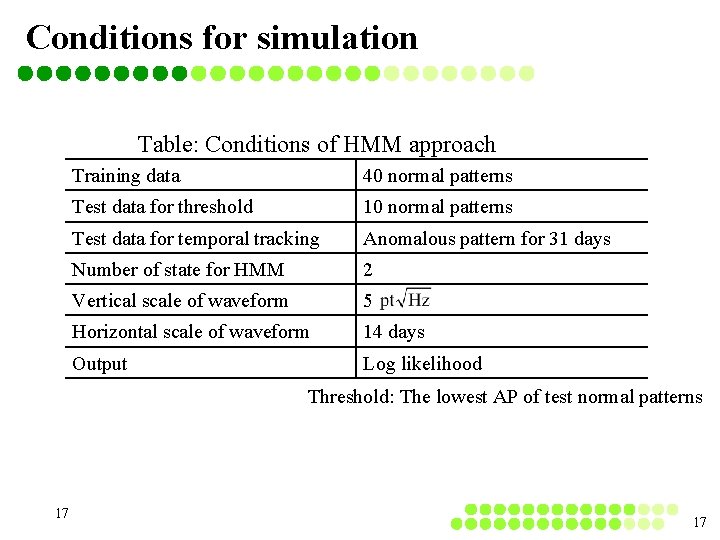
Conditions for simulation Table: Conditions of HMM approach Training data 40 normal patterns Test data for threshold 10 normal patterns Test data for temporal tracking Anomalous pattern for 31 days Number of state for HMM 2 Vertical scale of waveform 5 Horizontal scale of waveform 14 days Output Log likelihood Threshold: The lowest AP of test normal patterns 17 17
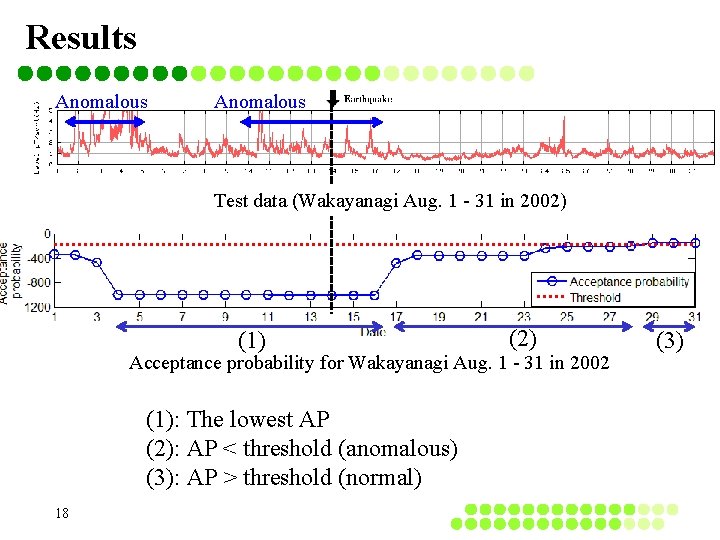
Results Anomalous Test data (Wakayanagi Aug. 1 - 31 in 2002) (1) (2) Acceptance probability for Wakayanagi Aug. 1 - 31 in 2002 (1): The lowest AP (2): AP < threshold (anomalous) (3): AP > threshold (normal) 18 (3)
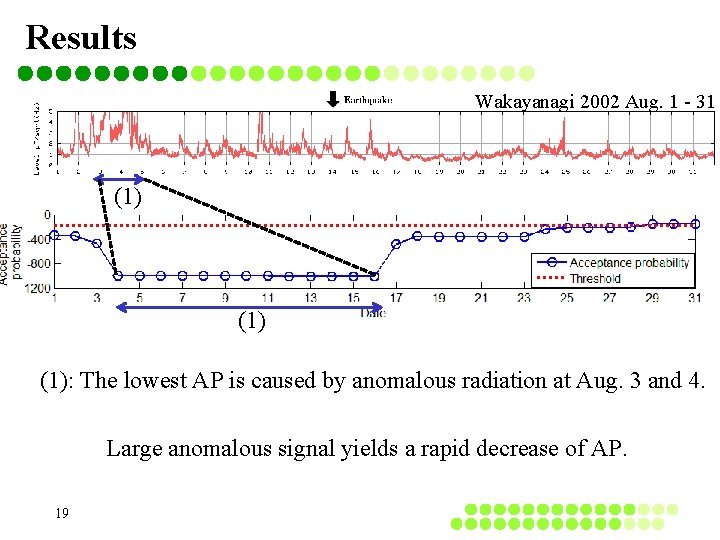
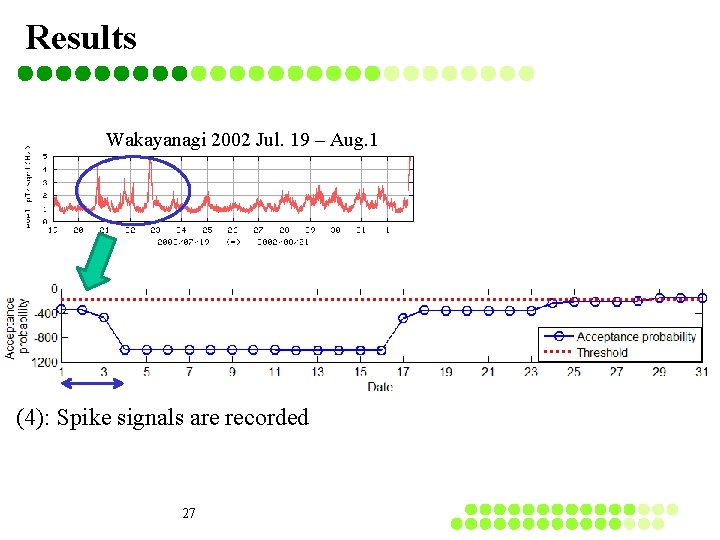
Results Wakayanagi 2002 Aug. 1 - 31 (1) (1): The lowest AP is caused by anomalous radiation at Aug. 3 and 4. Large anomalous signal yields a rapid decrease of AP. 19
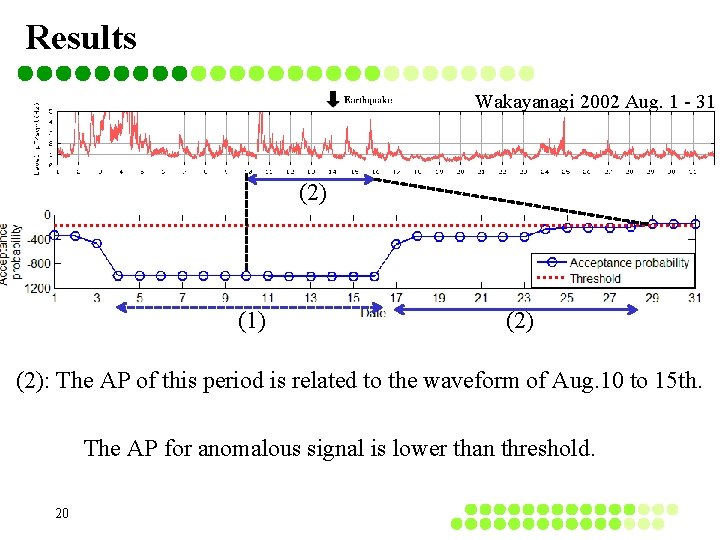
Results Wakayanagi 2002 Aug. 1 - 31 (2) (1) (2): The AP of this period is related to the waveform of Aug. 10 to 15 th. The AP for anomalous signal is lower than threshold. 20
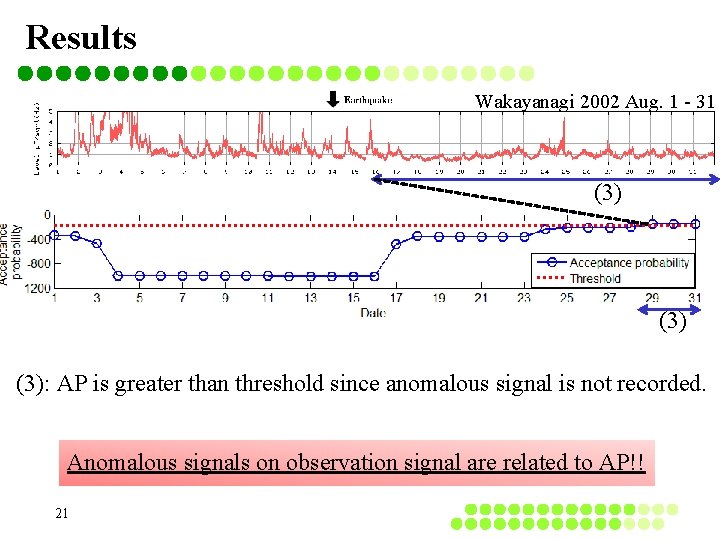
Results Wakayanagi 2002 Aug. 1 - 31 (3) (3): AP is greater than threshold since anomalous signal is not recorded. Anomalous signals on observation signal are related to AP!! 21
Conclusion • We focused on a temporal change of AP calculated from trained HMM. • AP has the relationships among the date of occurrence, period and strength of an anomalous signal. • HMM approach has a possibility of achieving the anomalous signal detection by tracking a temporal change of the AP. Future works • Achieve the temporal anomalous signal detection. 22 22
Thank you for your attention! 23 23
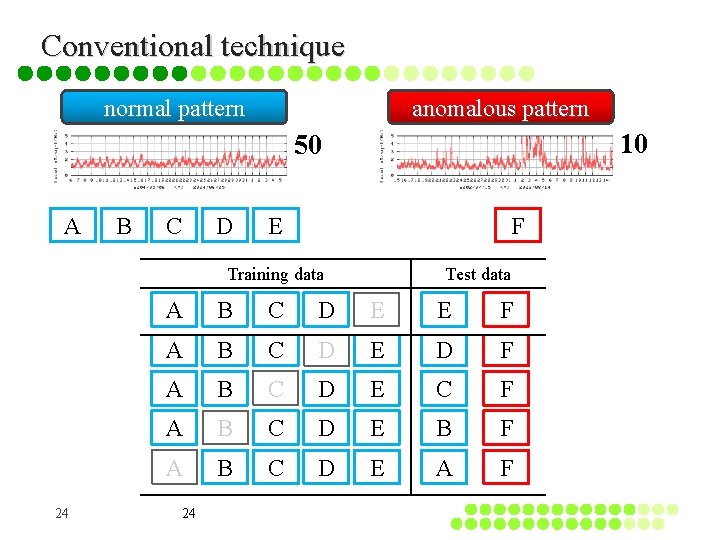
Conventional technique normal pattern anomalous pattern 10 50 A B C D E F Training data 学習データ 24 Test data テストデータ A B C D E E F A B C D E D F A B C D E C F A B C D E B F A B C D E A F 24
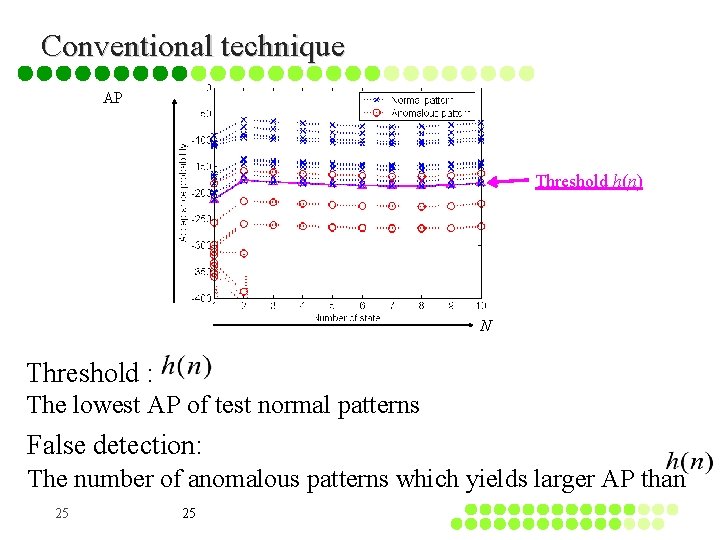
Conventional technique AP Threshold h(n) N Threshold : The lowest AP of test normal patterns False detection: The number of anomalous patterns which yields larger AP than 25 25
Conventional technique Scale of image False detection rate [%] X-axis Y-axis [days] [ ] Number of state 7 14 30 60 1 2 3 4 5 6 7 8 9 10 5 14 12 12 12 10 18 16 16 16 5 0 2 2 2 2 2 10 10 10 5 20 22 22 20 20 20 10 18 16 16 16 5 22 24 24 28 28 28 26 26 10 20 20 20 Horizontal scale 14[days],vartical scale 5 [ Number of state: 2 26 26 ]
Results Wakayanagi 2002 Jul. 19 – Aug. 1 (4): Spike signals are recorded 27
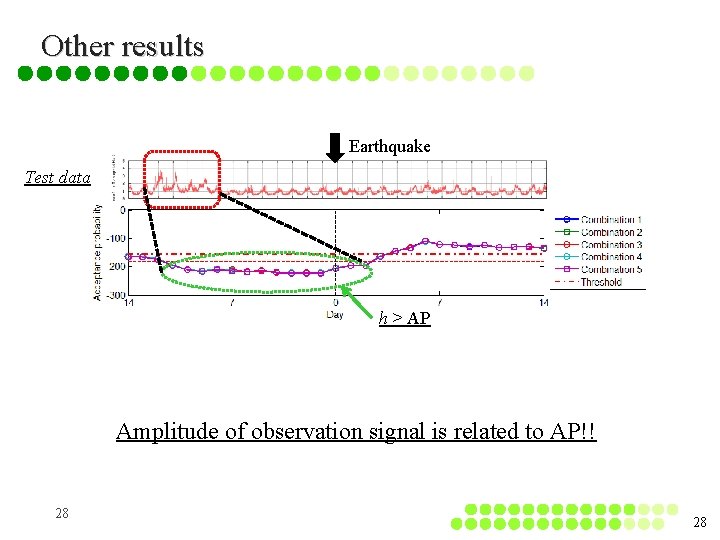
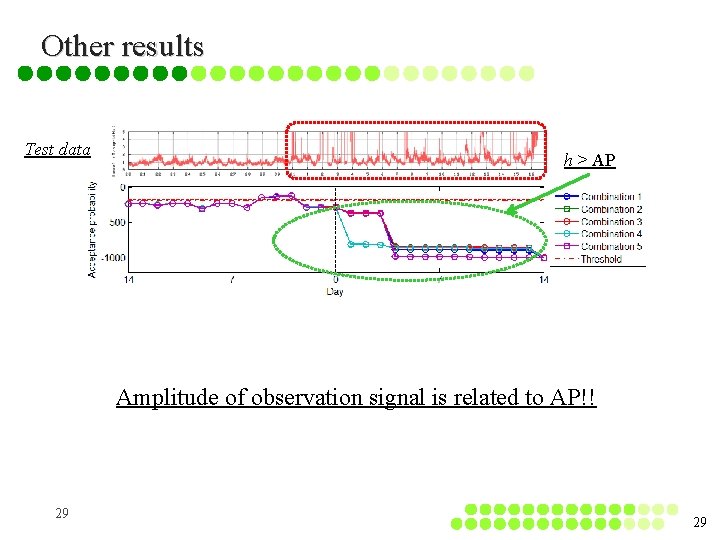
Other results Earthquake Test data h > AP Amplitude of observation signal is related to AP!! 28 28
Other results Test data h > AP Amplitude of observation signal is related to AP!! 29 29