
Performance of an Inert Selfaspirating Micro flow Nebulizer

Performance of an Inert Selfaspirating Micro flow Nebulizer Salar Samii, Jonathan A. Levine, Kaveh Kahen, and Akbar Montaser The George Washington University Department of Chemistry Washington, DC 20052 Jerry Dulude and Bobby Brezni Glass Expansion Melbourne, Australia
Introduction In recent years, nebulizers used in inductively coupled plasma (ICP) spectrometry, particularly in ICPMS, operate at lower uptake rates to enhance the transport efficiency and to reduce oxide formation. In this study, a new PFA nebulizer (Glass Expansion) is examined, in terms of droplet size and velocity distributions, at a self-aspirating rate of 10 ml/min. The results are compared to data obtained for several concentric glass nebulizer.
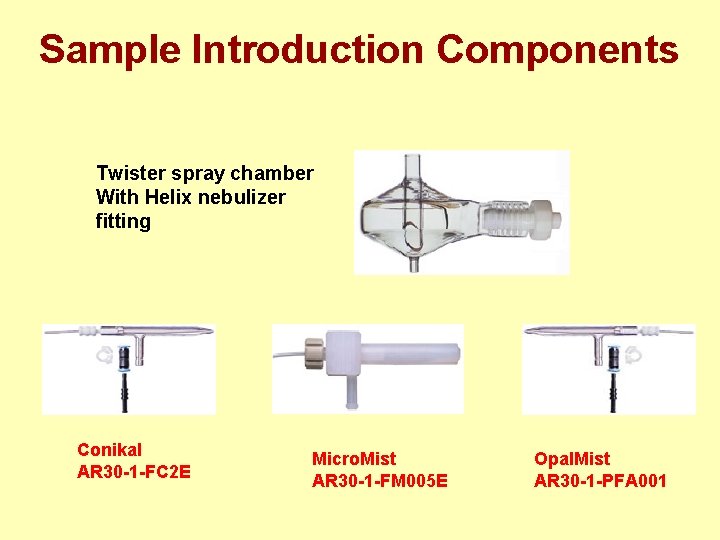
Sample Introduction Components Twister spray chamber With Helix nebulizer fitting Conikal AR 30 -1 -FC 2 E Micro. Mist AR 30 -1 -FM 005 E Opal. Mist AR 30 -1 -PFA 001
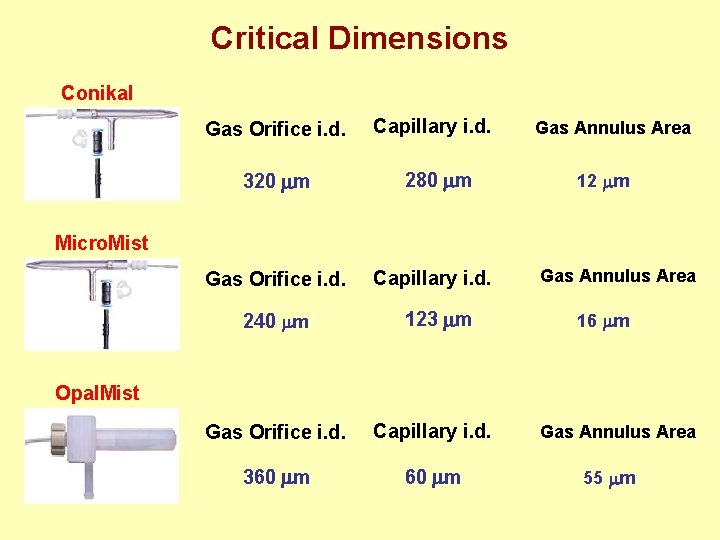
Critical Dimensions Conikal Gas Orifice i. d. 320 mm Capillary i. d. 280 mm Gas Annulus Area 12 mm Micro. Mist Gas Orifice i. d. 240 mm Capillary i. d. 123 mm Gas Annulus Area 16 mm Opal. Mist Gas Orifice i. d. Capillary i. d. 360 mm Gas Annulus Area 55 mm
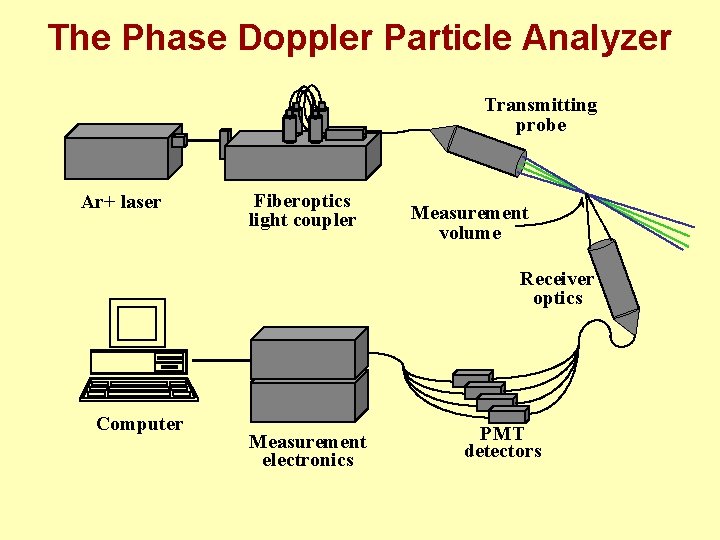
The Phase Doppler Particle Analyzer Transmitting probe Ar+ laser Fiberoptics light coupler Measurement volume Receiver optics Computer Measurement electronics PMT detectors
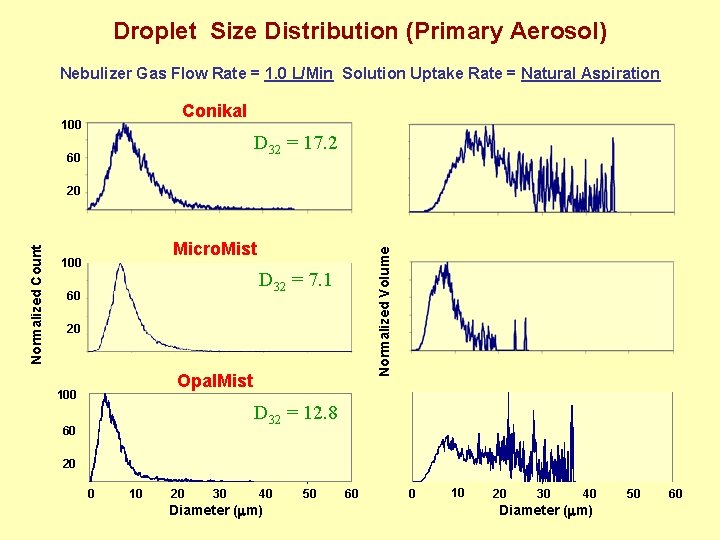
Droplet Size Distribution (Primary Aerosol) Nebulizer Gas Flow Rate = 1. 0 L/Min Solution Uptake Rate = Natural Aspiration Conikal 100 D 32 = 17. 2 60 Micro. Mist 100 Normalized Volume Normalized Count 20 D 32 = 7. 1 60 20 Opal. Mist 100 D 32 = 12. 8 60 20 0 10 20 30 40 Diameter (mm) 50 60
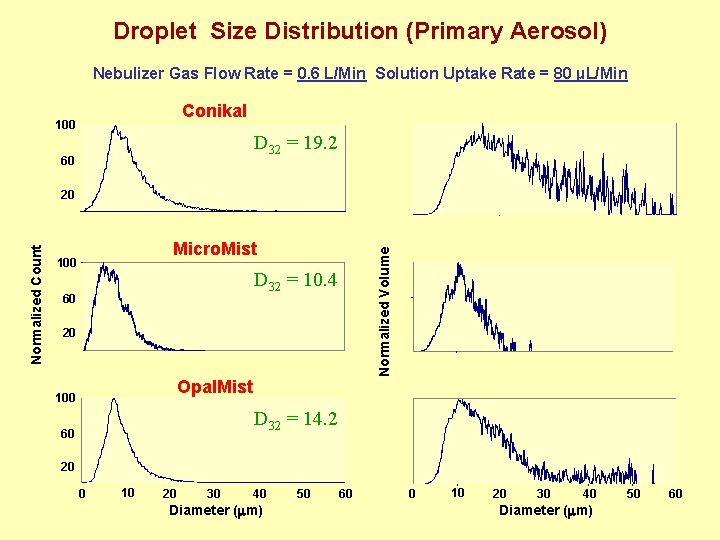
Droplet Size Distribution (Primary Aerosol) Nebulizer Gas Flow Rate = 0. 6 L/Min Solution Uptake Rate = 80 µL/Min Conikal 100 D 32 = 19. 2 60 Micro. Mist 100 Normalized Volume Normalized Count 20 D 32 = 10. 4 60 20 Opal. Mist 100 D 32 = 14. 2 60 20 0 10 20 30 40 Diameter (mm) 50 60
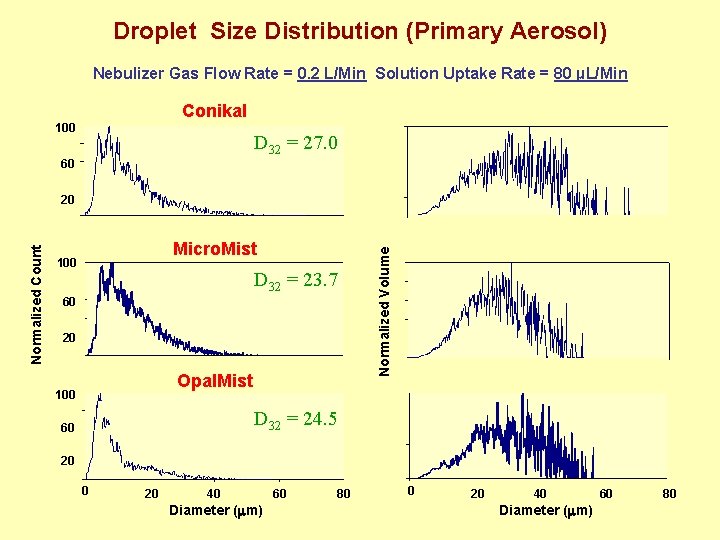
Droplet Size Distribution (Primary Aerosol) Nebulizer Gas Flow Rate = 0. 2 L/Min Solution Uptake Rate = 80 µL/Min Conikal 100 D 32 = 27. 0 60 Micro. Mist 100 D 32 = 23. 7 60 20 Opal. Mist 100 Normalized Volume Normalized Count 20 D 32 = 24. 5 60 20 40 Diameter (mm) 60 80
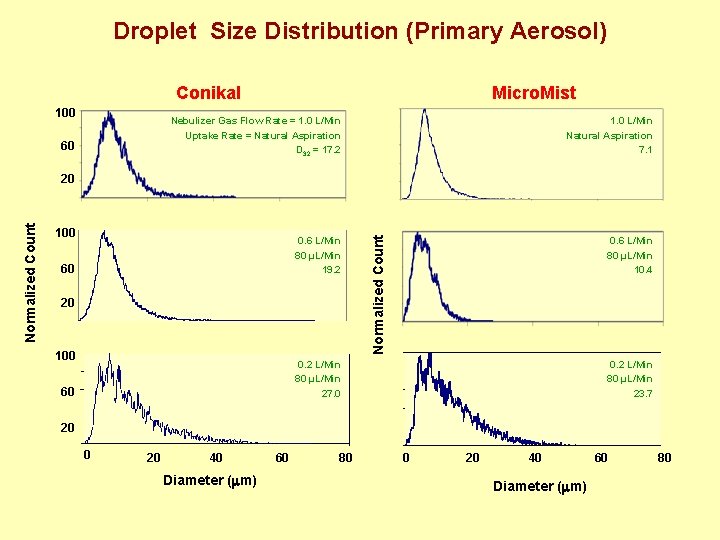
Droplet Size Distribution (Primary Aerosol) Conikal 100 Micro. Mist Nebulizer Gas Flow Rate = 1. 0 L/Min Uptake Rate = Natural Aspiration D 32 = 17. 2 60 1. 0 L/Min Natural Aspiration 7. 1 100 0. 6 L/Min 80 µL/Min 19. 2 60 20 100 Normalized Count 20 0. 6 L/Min 80 µL/Min 10. 4 0. 2 L/Min 80 µL/Min 27. 0 60 0. 2 L/Min 80 µL/Min 23. 7 20 0 20 40 Diameter (mm) 60 80
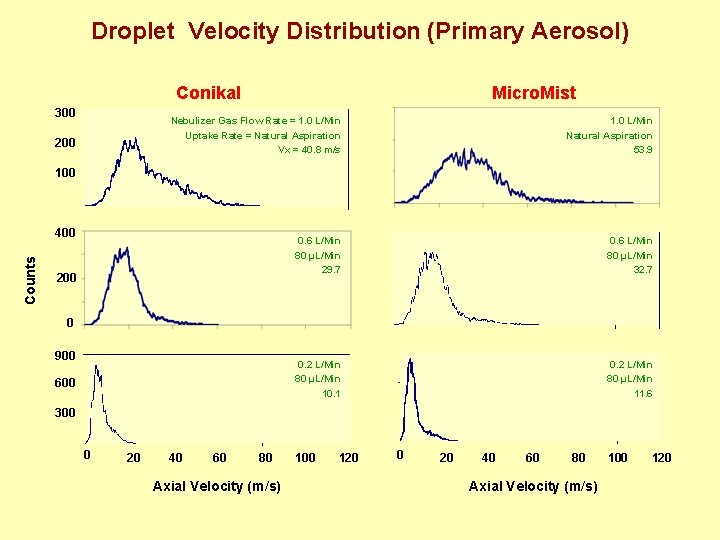
Droplet Velocity Distribution (Primary Aerosol) Conikal 300 200 Micro. Mist Nebulizer Gas Flow Rate = 1. 0 L/Min Uptake Rate = Natural Aspiration Vx = 40. 8 m/s 1. 0 L/Min Natural Aspiration 53. 9 0. 6 L/Min 80 µL/Min 29. 7 0. 6 L/Min 80 µL/Min 32. 7 0. 2 L/Min 80 µL/Min 10. 1 0. 2 L/Min 80 µL/Min 11. 6 100 Counts 400 200 0 900 600 300 0 20 40 60 80 Axial Velocity (m/s) 100 120
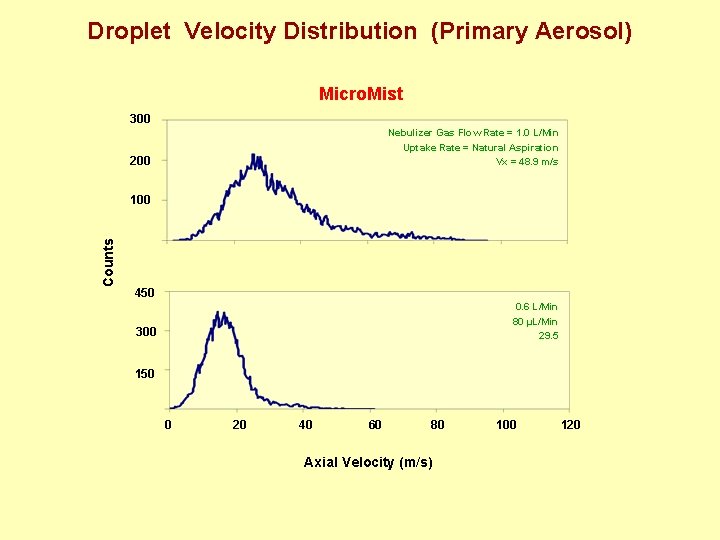
Droplet Velocity Distribution (Primary Aerosol) Micro. Mist 300 Nebulizer Gas Flow Rate = 1. 0 L/Min Uptake Rate = Natural Aspiration Vx = 48. 9 m/s 200 Counts 100 450 0. 6 L/Min 80 µL/Min 29. 5 300 150 0 20 40 60 80 Axial Velocity (m/s) 100 120
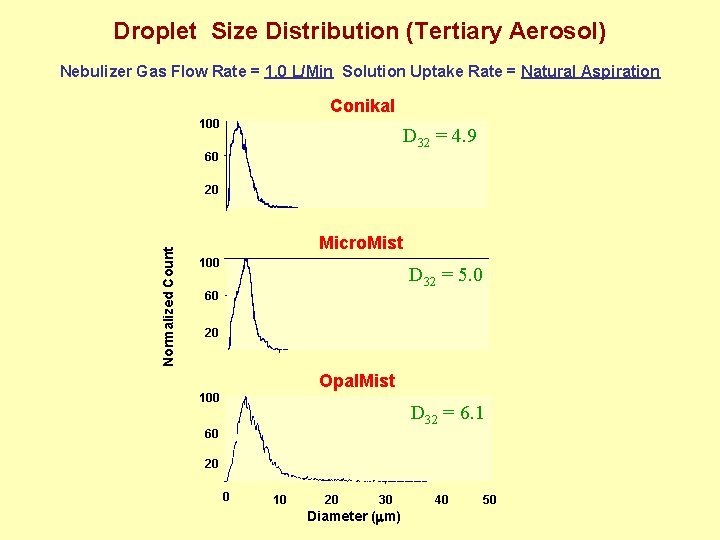
Droplet Size Distribution (Tertiary Aerosol) Nebulizer Gas Flow Rate = 1. 0 L/Min Solution Uptake Rate = Natural Aspiration Conikal 100 D 32 = 4. 9 60 Normalized Count 20 Micro. Mist 100 D 32 = 5. 0 60 20 Opal. Mist 100 D 32 = 6. 1 60 20 0 10 20 30 Diameter (mm) 40 50
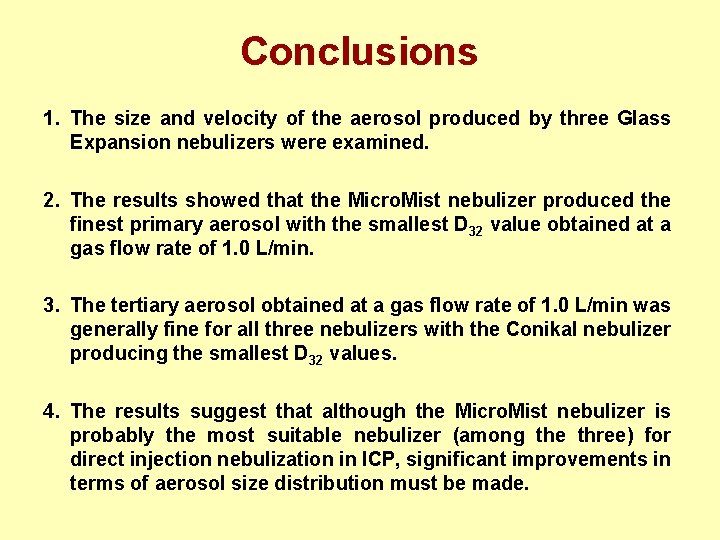
Conclusions 1. The size and velocity of the aerosol produced by three Glass Expansion nebulizers were examined. 2. The results showed that the Micro. Mist nebulizer produced the finest primary aerosol with the smallest D 32 value obtained at a gas flow rate of 1. 0 L/min. 3. The tertiary aerosol obtained at a gas flow rate of 1. 0 L/min was generally fine for all three nebulizers with the Conikal nebulizer producing the smallest D 32 values. 4. The results suggest that although the Micro. Mist nebulizer is probably the most suitable nebulizer (among the three) for direct injection nebulization in ICP, significant improvements in terms of aerosol size distribution must be made.
- Slides: 13