
Performance of a stock assessment model with misspecified


- Slides: 31
Performance of a stock assessment model with misspecified time-varying growth 1 Yi-Jay Chang 2 Brian Langseth 3 Mark Maunder 1 Felipe Carvalho 1 – JIMAR, PIFSC, NOAA (JIMAR) 2 – PIFSC, NOAA 3 – IATTC CAPAM, 3 -7 Nov, 2014
Overview • Examples of time‐varying growth in fish populations • Objectives of this study • Operating model (Individual‐based model) – Cohort‐specific and year‐specific time‐varying growth • Stock assessment model • Results – Cohort‐specific K vs Linf – Cohort‐specific vs year‐specific – Comparison of time‐varying methods • Discussion 2
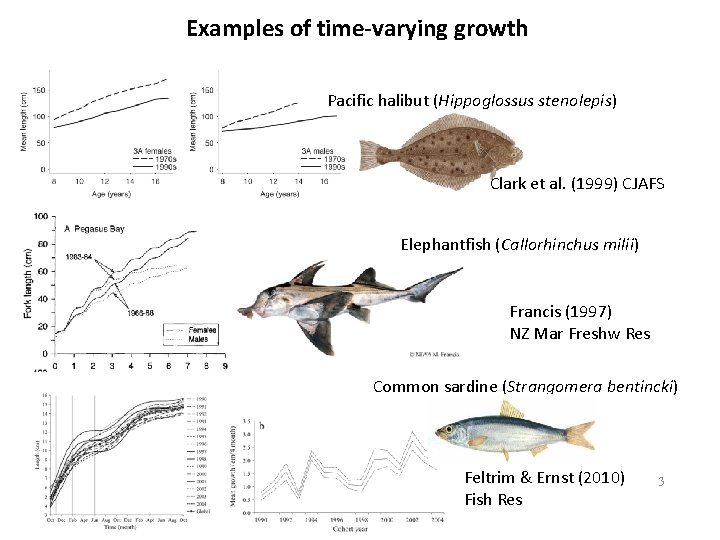
Examples of time-varying growth Pacific halibut (Hippoglossus stenolepis) Clark et al. (1999) CJAFS Elephantfish (Callorhinchus milii) Francis (1997) NZ Mar Freshw Res Common sardine (Strangomera bentincki) Feltrim & Ernst (2010) Fish Res 3
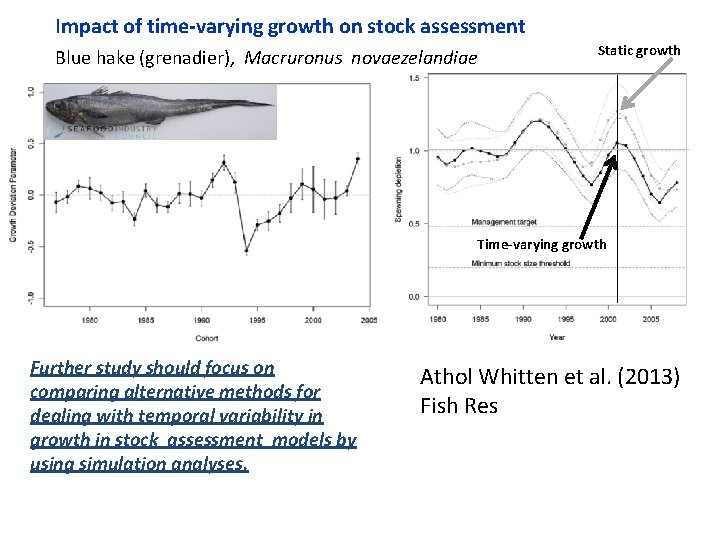
Impact of time-varying growth on stock assessment Blue hake (grenadier), Macruronus novaezelandiae Static growth Time-varying growth Further study should focus on comparing alternative methods for dealing with temporal variability in growth in stock assessment models by using simulation analyses. Athol Whitten et al. (2013) Fish Res
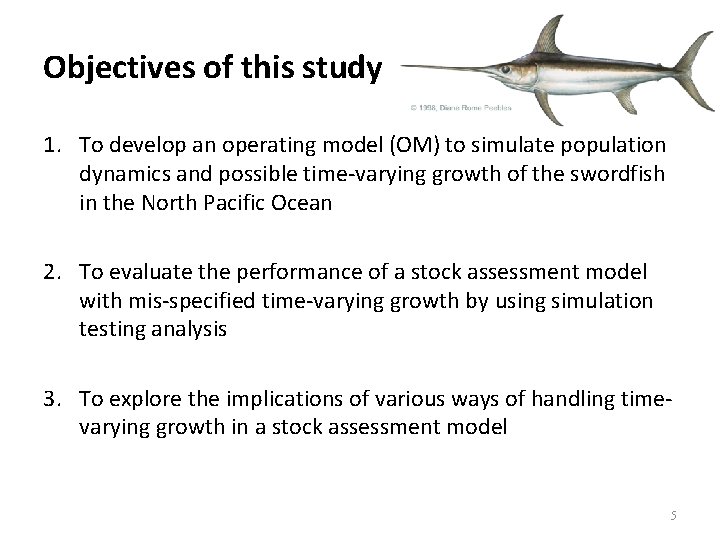
Objectives of this study 1. To develop an operating model (OM) to simulate population dynamics and possible time‐varying growth of the swordfish in the North Pacific Ocean 2. To evaluate the performance of a stock assessment model with mis‐specified time‐varying growth by using simulation testing analysis 3. To explore the implications of various ways of handling time‐ varying growth in a stock assessment model 5
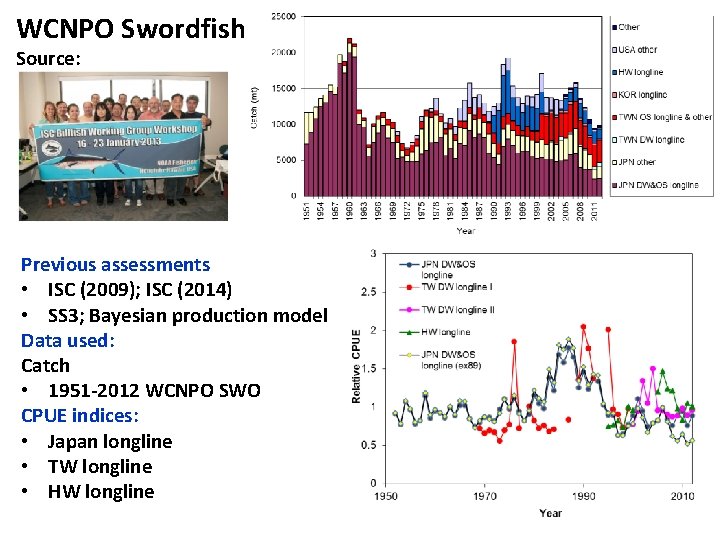
WCNPO Swordfish Source: Previous assessments • ISC (2009); ISC (2014) • SS 3; Bayesian production model Data used: Catch • 1951 -2012 WCNPO SWO CPUE indices: • Japan longline • TW longline • HW longline 6
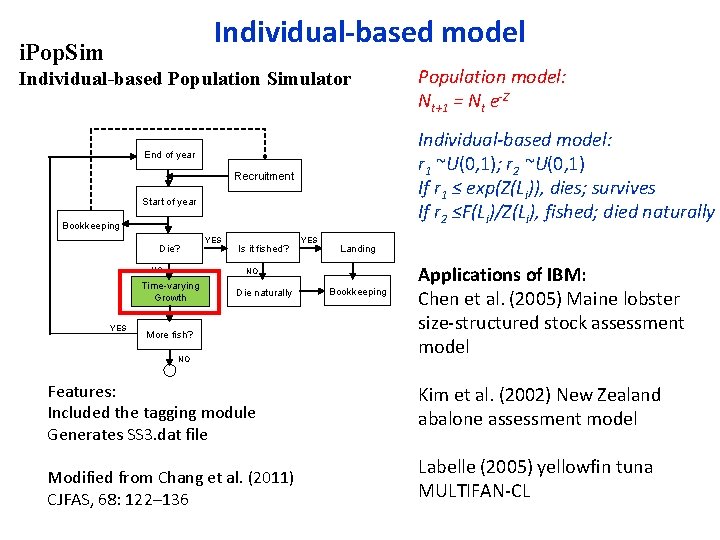
Individual-based model i. Pop. Sim Individual-based Population Simulator Individual-based model: r 1 ~U(0, 1); r 2 ~U(0, 1) If r 1 ≤ exp(Z(Li)), dies; survives If r 2 ≤F(Li)/Z(Li), fished; died naturally End of year Recruitment Start of year Bookkeeping Die? NO Is it fished? YES Landing NO Time-varying Growth YES Die naturally More fish? NO Features: Included the tagging module Generates SS 3. dat file Modified from Chang et al. (2011) CJFAS, 68: 122– 136 Population model: Nt+1 = Nt e-Z Bookkeeping Applications of IBM: Chen et al. (2005) Maine lobster size‐structured stock assessment model Kim et al. (2002) New Zealand abalone assessment model Labelle (2005) yellowfin tuna MULTIFAN‐CL
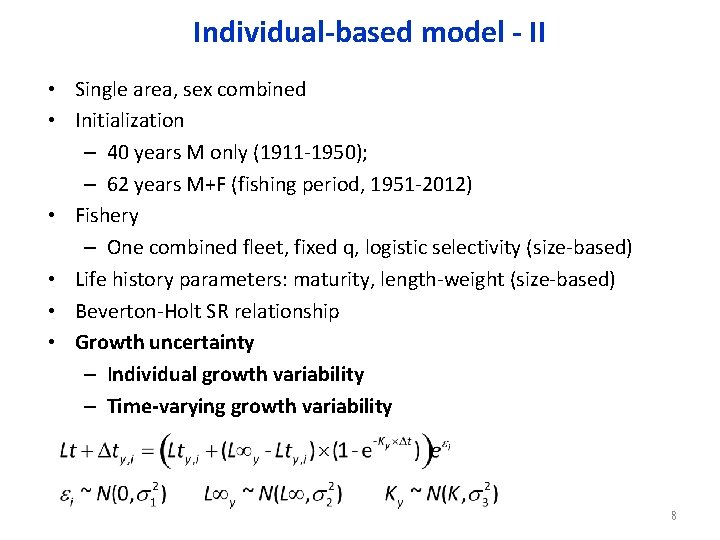
Individual-based model - II • Single area, sex combined • Initialization – 40 years M only (1911‐ 1950); – 62 years M+F (fishing period, 1951‐ 2012) • Fishery – One combined fleet, fixed q, logistic selectivity (size‐based) • Life history parameters: maturity, length‐weight (size‐based) • Beverton‐Holt SR relationship • Growth uncertainty – Individual growth variability – Time-varying growth variability 8
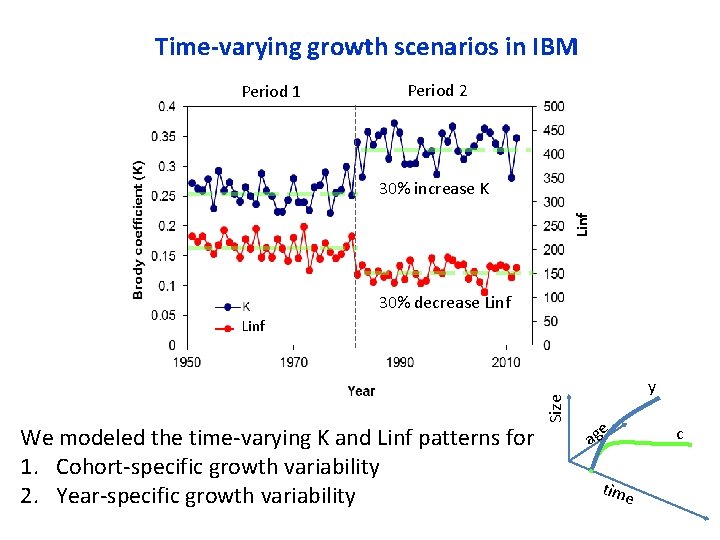
Time-varying growth scenarios in IBM Period 1 Period 2 Linf 30% increase K 30% decrease Linf Size We modeled the time‐varying K and Linf patterns for 1. Cohort‐specific growth variability 2. Year‐specific growth variability y ag e time c
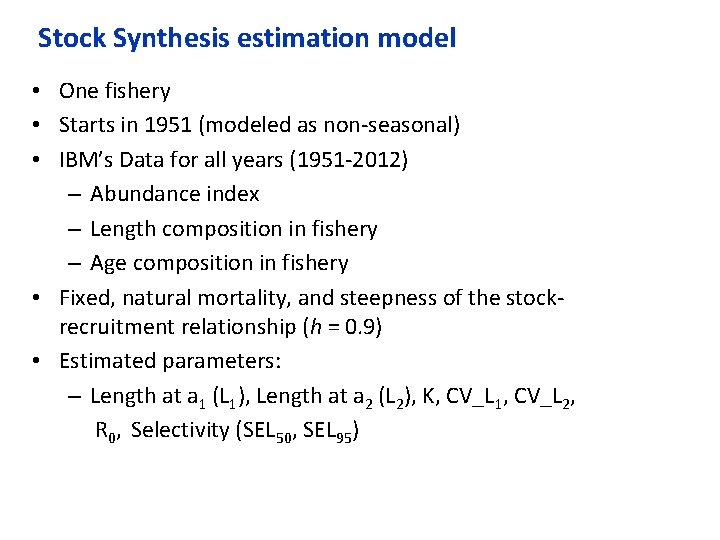
Stock Synthesis estimation model • One fishery • Starts in 1951 (modeled as non‐seasonal) • IBM’s Data for all years (1951‐ 2012) – Abundance index – Length composition in fishery – Age composition in fishery • Fixed, natural mortality, and steepness of the stock‐ recruitment relationship (h = 0. 9) • Estimated parameters: – Length at a 1 (L 1), Length at a 2 (L 2), K, CV_L 1, CV_L 2, R 0, Selectivity (SEL 50, SEL 95)
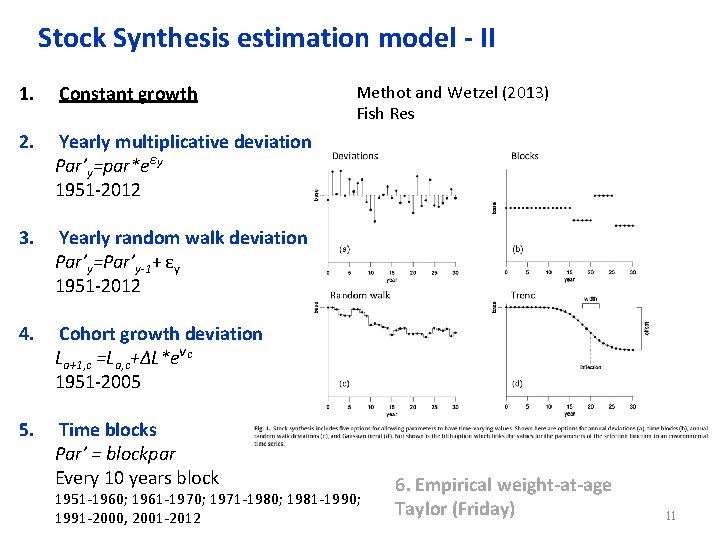
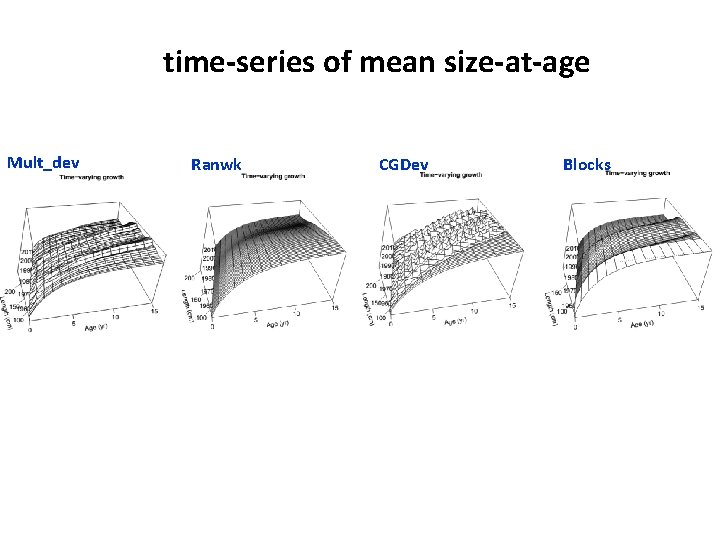
Stock Synthesis estimation model - II 1. Constant growth 2. Yearly multiplicative deviation Par’y=par*eεy 1951‐ 2012 3. Yearly random walk deviation Par’y=Par’y-1+ εy 1951‐ 2012 4. Cohort growth deviation La+1, c =La, c+∆L*evc 1951‐ 2005 5. Time blocks Par’ = blockpar Every 10 years block Methot and Wetzel (2013) Fish Res 1951‐ 1960; 1961‐ 1970; 1971‐ 1980; 1981‐ 1990; 1991‐ 2000, 2001‐ 2012 6. Empirical weight-at-age Taylor (Friday) 11
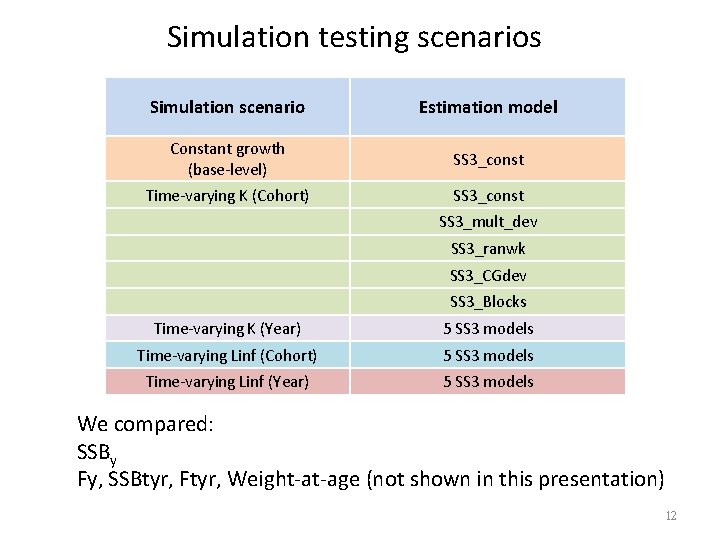
Simulation testing scenarios Simulation scenario Estimation model Constant growth (base‐level) SS 3_const Time‐varying K (Cohort) SS 3_const SS 3_mult_dev SS 3_ranwk SS 3_CGdev SS 3_Blocks Time‐varying K (Year) 5 SS 3 models Time‐varying Linf (Cohort) 5 SS 3 models Time‐varying Linf (Year) 5 SS 3 models We compared: SSBy Fy, SSBtyr, Ftyr, Weight‐at‐age (not shown in this presentation) 12
Result 13
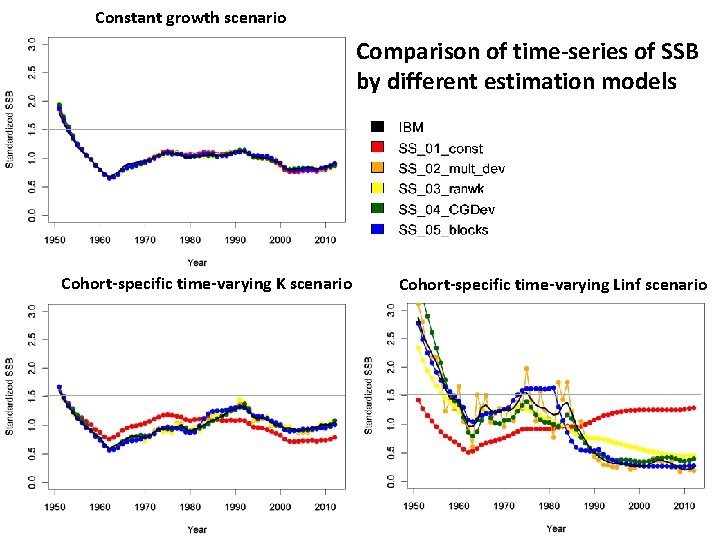
Constant growth scenario Comparison of time-series of SSB by different estimation models Cohort-specific time-varying K scenario Cohort-specific time-varying Linf scenario
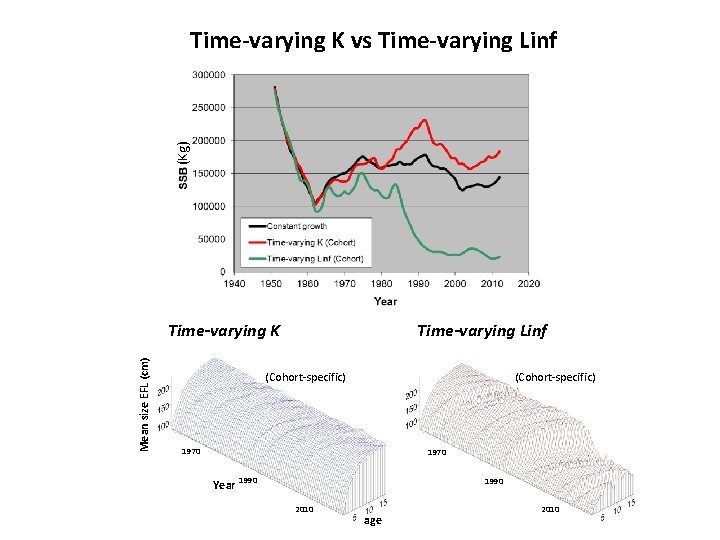
(Kg) Time-varying K vs Time-varying Linf Mean size EFL (cm) Time-varying K Time-varying Linf (Cohort‐specific) 1970 Year 1990 2010 age 2010
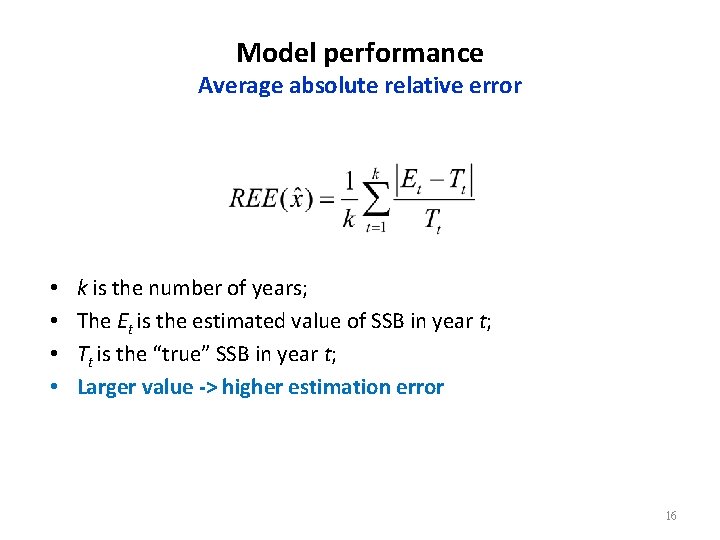
Model performance Average absolute relative error • • k is the number of years; The Et is the estimated value of SSB in year t; Tt is the “true” SSB in year t; Larger value -> higher estimation error 16
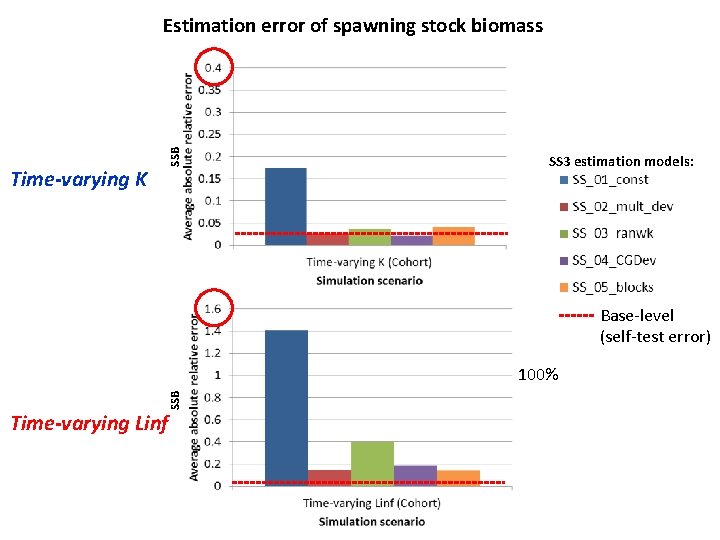
Time-varying K SSB Estimation error of spawning stock biomass SS 3 estimation models: Base‐level (self‐test error) SSB 100% Time-varying Linf
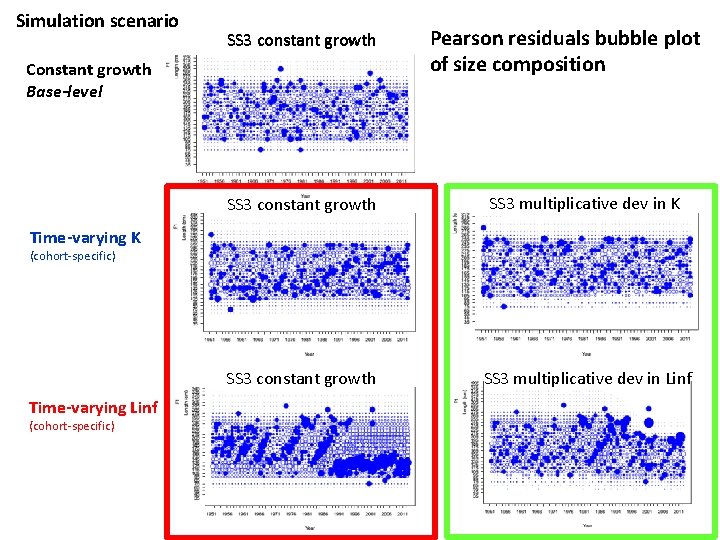
Simulation scenario SS 3 constant growth Constant growth Base-level Pearson residuals bubble plot of size composition SS 3 constant growth SS 3 multiplicative dev in K SS 3 constant growth SS 3 multiplicative dev in Linf Time-varying K (cohort‐specific) Time-varying Linf (cohort‐specific)
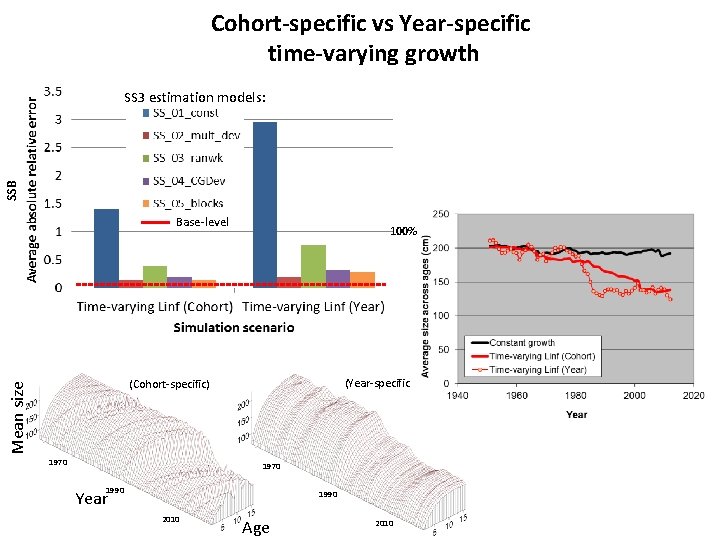
Cohort-specific vs Year-specific time-varying growth SSB SS 3 estimation models: Base‐level 100% (Year‐specific) Mean size (Cohort‐specific) 1970 1990 Year 1990 2010 Age 2010
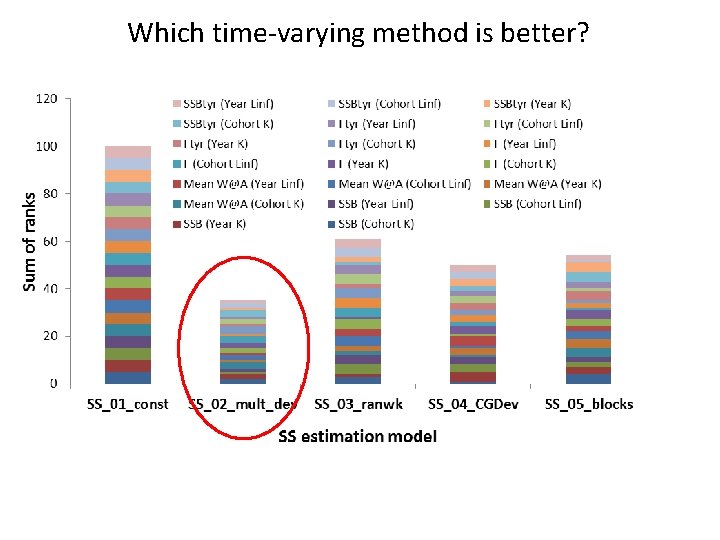
Which time‐varying method is better?
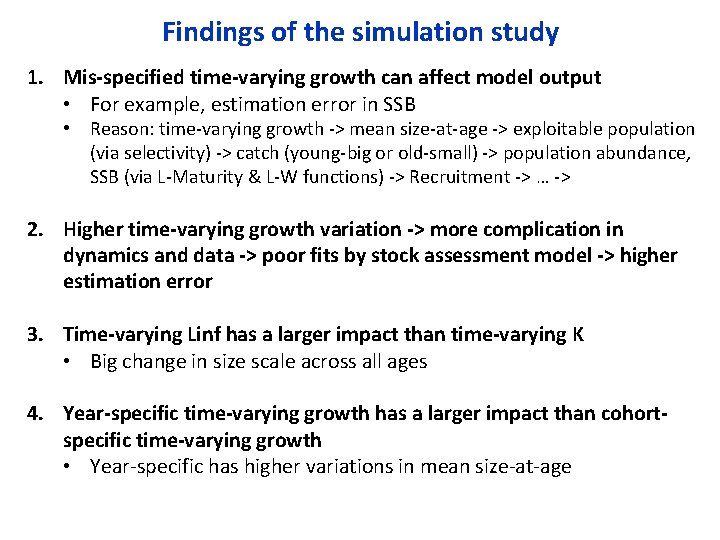
Findings of the simulation study 1. Mis-specified time-varying growth can affect model output • For example, estimation error in SSB • Reason: time‐varying growth ‐> mean size‐at‐age ‐> exploitable population (via selectivity) ‐> catch (young‐big or old‐small) ‐> population abundance, SSB (via L‐Maturity & L‐W functions) ‐> Recruitment ‐> … ‐> 2. Higher time-varying growth variation -> more complication in dynamics and data -> poor fits by stock assessment model -> higher estimation error 3. Time-varying Linf has a larger impact than time-varying K • Big change in size scale across all ages 4. Year-specific time-varying growth has a larger impact than cohortspecific time-varying growth • Year‐specific has higher variations in mean size‐at‐age
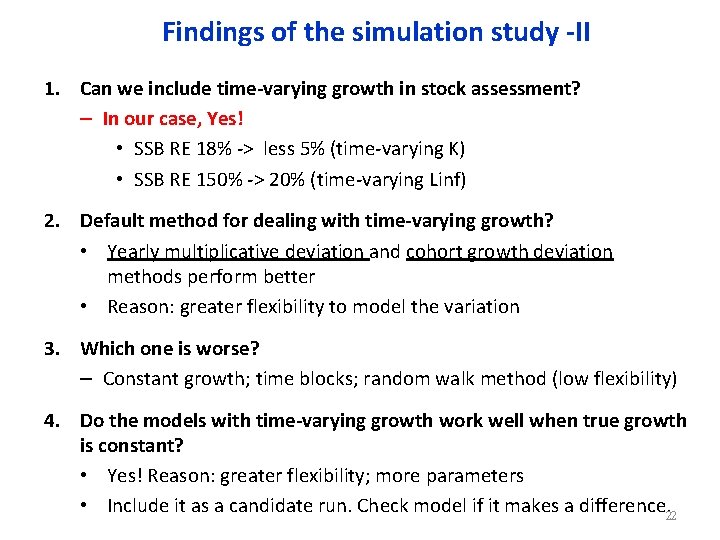
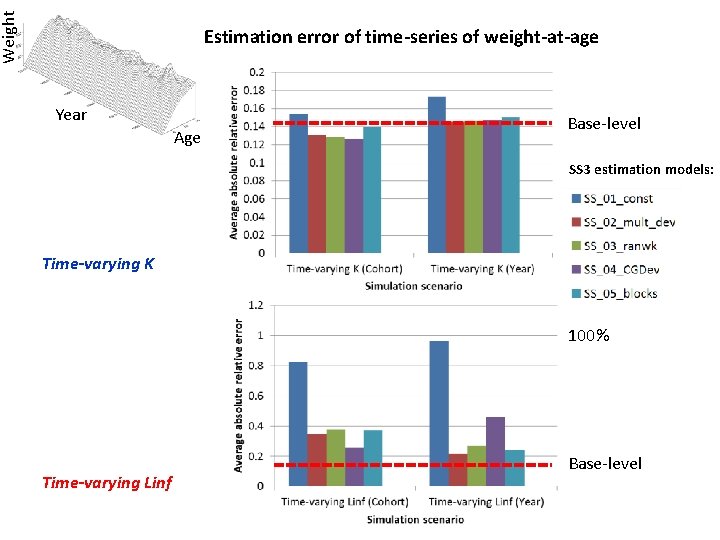
Findings of the simulation study -II 1. Can we include time-varying growth in stock assessment? – In our case, Yes! • SSB RE 18% ‐> less 5% (time‐varying K) • SSB RE 150% ‐> 20% (time‐varying Linf) 2. Default method for dealing with time-varying growth? • Yearly multiplicative deviation and cohort growth deviation methods perform better • Reason: greater flexibility to model the variation 3. Which one is worse? – Constant growth; time blocks; random walk method (low flexibility) 4. Do the models with time-varying growth work well when true growth is constant? • Yes! Reason: greater flexibility; more parameters • Include it as a candidate run. Check model if it makes a difference. 22
Acknowledgments CAPAM workshop conveners ISC Billfish Working Group Jon Brodziak Rick Methot Yong Chen Hui-Hua Lee Questions? ? 23
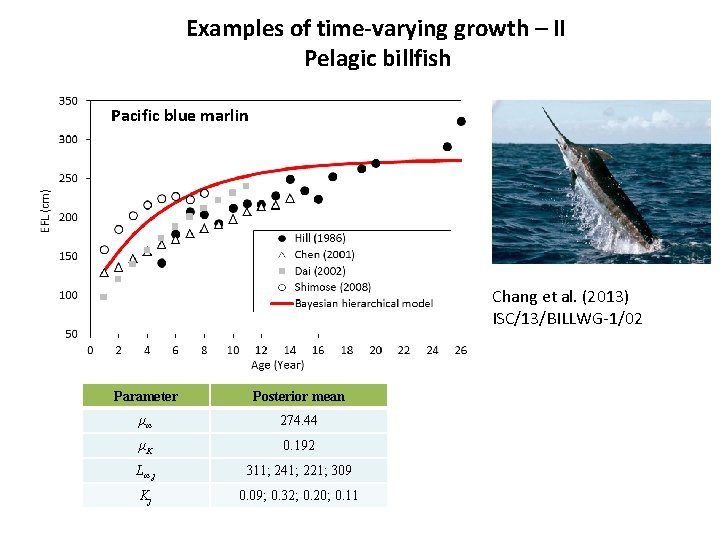
Examples of time-varying growth – II Pelagic billfish Pacific blue marlin Chang et al. (2013) ISC/13/BILLWG‐ 1/02 Parameter Posterior mean μ∞ 274. 44 μK 0. 192 L∞, j 311; 241; 221; 309 Kj 0. 09; 0. 32; 0. 20; 0. 11
Weight Estimation error of time-series of weight-at-age Year Age Base‐level SS 3 estimation models: Time-varying K 100% Time-varying Linf Base‐level
time-series of mean size-at-age Mult_dev Ranwk CGDev Blocks 26
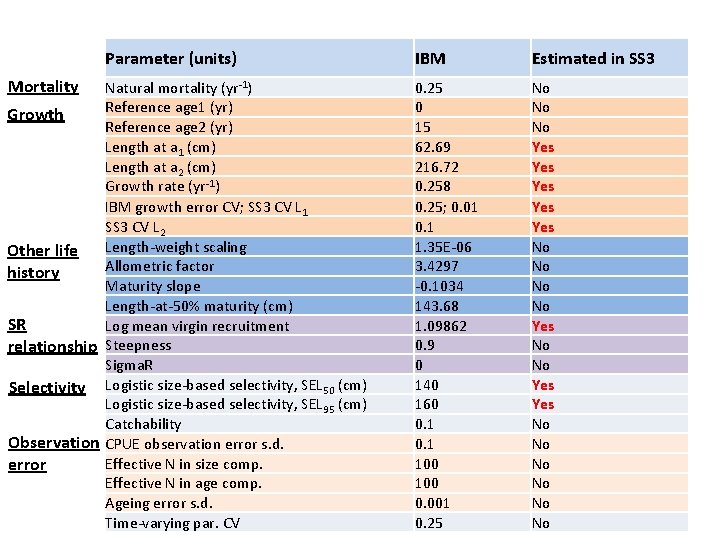
Parameter (units) Mortality Natural mortality (yr‐ 1) Reference age 1 (yr) Growth Reference age 2 (yr) Length at a 1 (cm) Length at a 2 (cm) Growth rate (yr‐ 1) IBM growth error CV; SS 3 CV L 1 SS 3 CV L 2 Length‐weight scaling Other life Allometric factor history Maturity slope Length‐at‐ 50% maturity (cm) SR Log mean virgin recruitment relationship Steepness Sigma. R Selectivity Logistic size‐based selectivity, SEL 50 (cm) Logistic size‐based selectivity, SEL 95 (cm) Catchability Observation CPUE observation error s. d. Effective N in size comp. error Effective N in age comp. Ageing error s. d. Time‐varying par. CV IBM Estimated in SS 3 0. 25 0 15 62. 69 216. 72 0. 258 0. 25; 0. 01 0. 1 1. 35 E‐ 06 3. 4297 ‐ 0. 1034 143. 68 1. 09862 0. 9 0 140 160 0. 1 100 0. 001 0. 25 No No No Yes Yes Yes No No Yes No No No 27
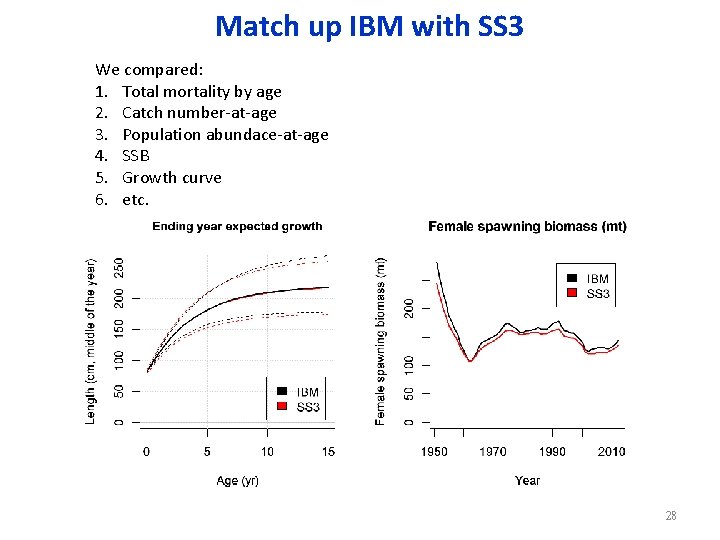
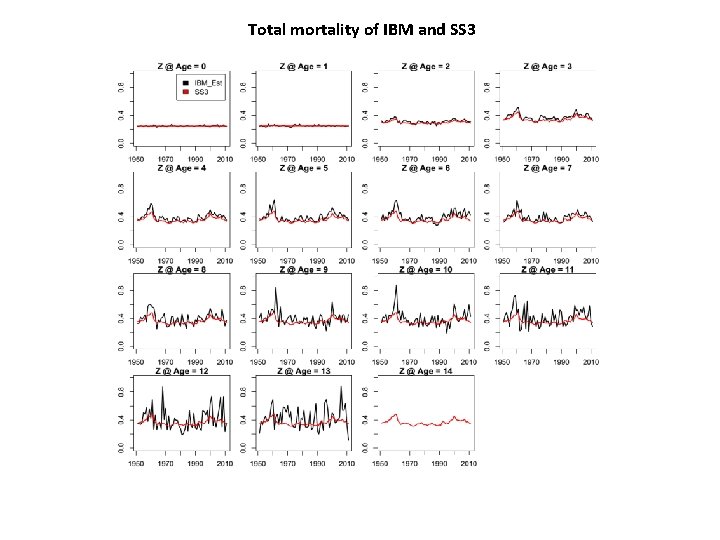
Match up IBM with SS 3 We compared: 1. Total mortality by age 2. Catch number‐at‐age 3. Population abundace‐at‐age 4. SSB 5. Growth curve 6. etc. 28
Total mortality of IBM and SS 3
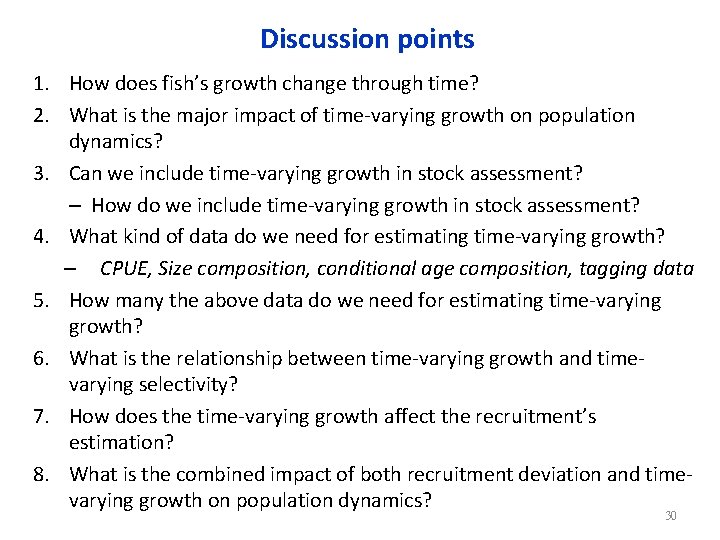
Discussion points 1. How does fish’s growth change through time? 2. What is the major impact of time‐varying growth on population dynamics? 3. Can we include time‐varying growth in stock assessment? – How do we include time‐varying growth in stock assessment? 4. What kind of data do we need for estimating time‐varying growth? – CPUE, Size composition, conditional age composition, tagging data 5. How many the above data do we need for estimating time‐varying growth? 6. What is the relationship between time‐varying growth and time‐ varying selectivity? 7. How does the time‐varying growth affect the recruitment’s estimation? 8. What is the combined impact of both recruitment deviation and time‐ varying growth on population dynamics? 30
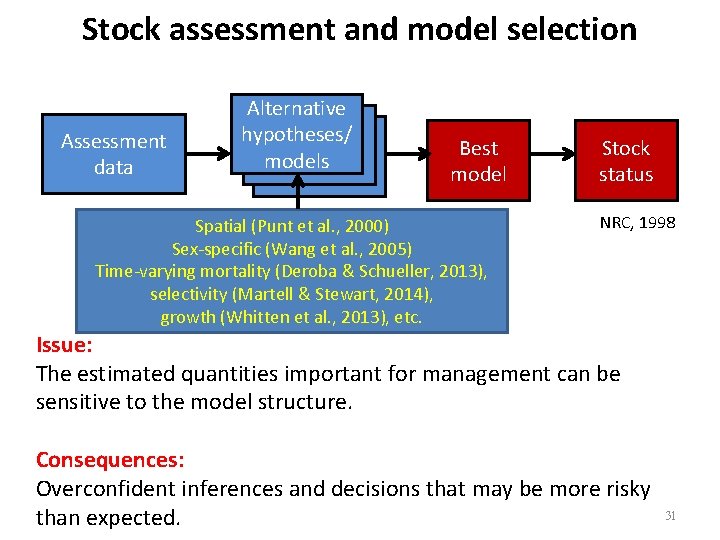
Stock assessment and model selection Assessment data Alternative hypotheses/ models Best model Spatial (Punt et al. , 2000) Sex‐specific (Wang et al. , 2005) Time‐varying mortality (Deroba & Schueller, 2013), selectivity (Martell & Stewart, 2014), growth (Whitten et al. , 2013), etc. Stock status NRC, 1998 Issue: The estimated quantities important for management can be sensitive to the model structure. Consequences: Overconfident inferences and decisions that may be more risky than expected. 31