
Performance Monitoring of MPC Based on Dynamic Principal
Performance Monitoring of MPC Based on Dynamic Principal Component Analysis Professor Xue-Min Tian Co-author: Gong-Quan Chen, Yu-Ping Cao, Sheng Chen College of Information and Control Engineering China University of Petroleum Qingdao 266555, China E-mail: tianxm@upc. edu. cn

Outline Introduction Performance assessment using dynamic PCA Performance diagnosis using unified weighted dynamic PCA similarity Performance monitoring procedure Case study Conclusions
1. Introduction The increasing popularity of model predictive control (MPC) in industrial applications has led to a high demand for performance monitoring. The research for the performance monitoring of MPC controllers is not studied as comprehensive as that for conventional feedback controllers. It mainly focus on performance assessment. A unified framework based on the dynamic principal component analysis (PCA) is proposed for performance assessment and diagnosis of constrained multi-variable model predictive control systems.
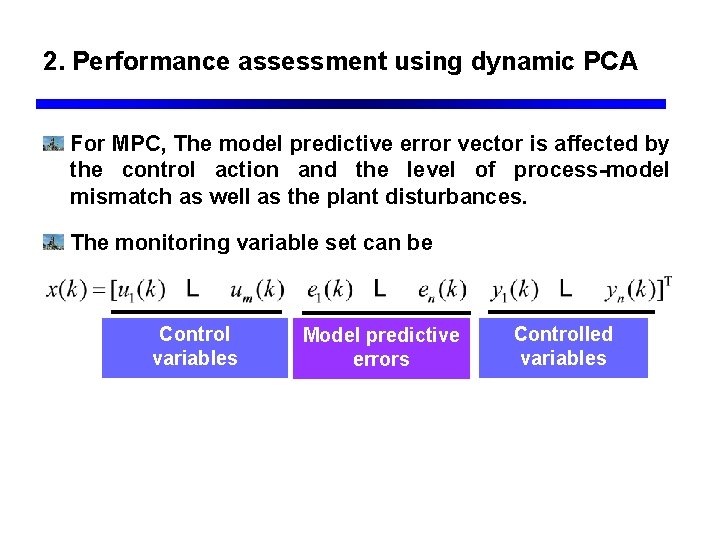
2. Performance assessment using dynamic PCA For MPC, The model predictive error vector is affected by the control action and the level of process-model mismatch as well as the plant disturbances. The monitoring variable set can be Control variables Model predictive errors Controlled variables

2. Performance assessment using dynamic PCA For dynamic systems, not only the correlation of the process variables but also the correlation of the dynamic time series should be taken into account. The traditional PCA is based on analyzing Extending the training data to the previous ks steps leads to the augmented data set Dynamic PCA training data
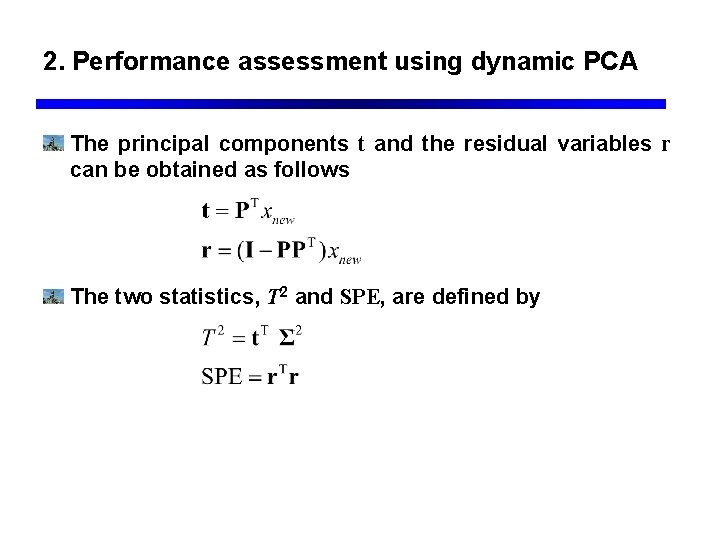
2. Performance assessment using dynamic PCA The principal components t and the residual variables r can be obtained as follows The two statistics, T 2 and SPE, are defined by
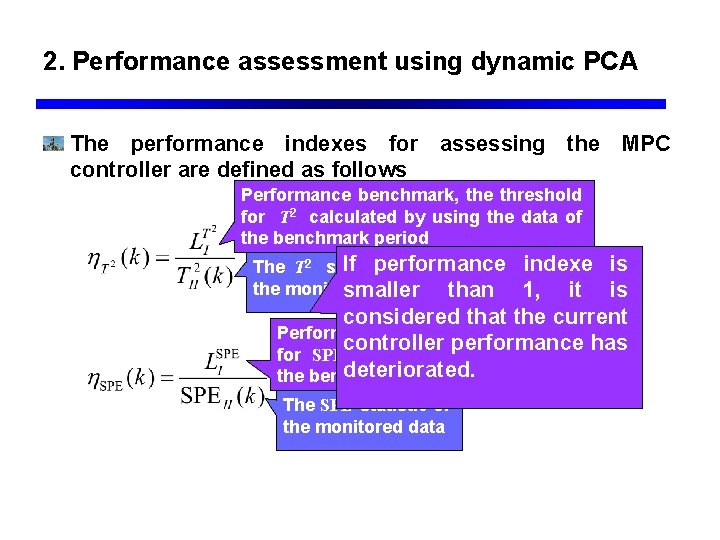
2. Performance assessment using dynamic PCA The performance indexes for assessing the MPC controller are defined as follows Performance benchmark, the threshold for T 2 calculated by using the data of the benchmark period If performance The T 2 statistic of the monitored data smaller than indexe is 1, it is considered that the current Performance benchmark, the threshold controller performance has for SPE calculated by using the data of deteriorated. the benchmark period The SPE statistic of the monitored data
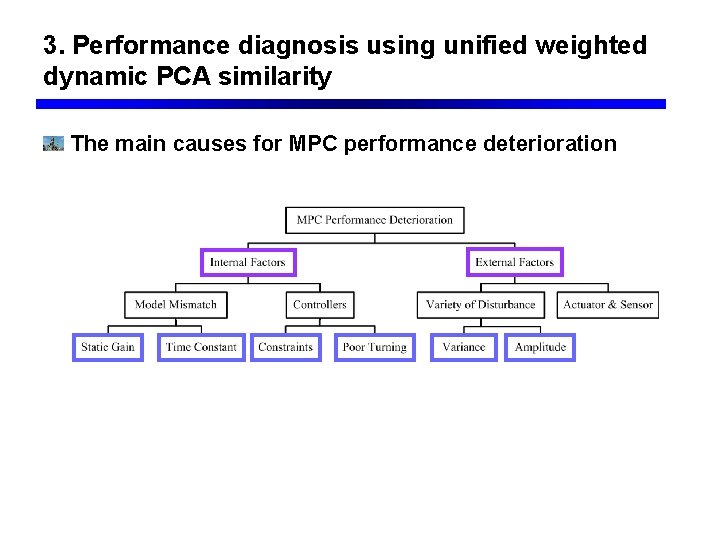
3. Performance diagnosis using unified weighted dynamic PCA similarity The main causes for MPC performance deterioration
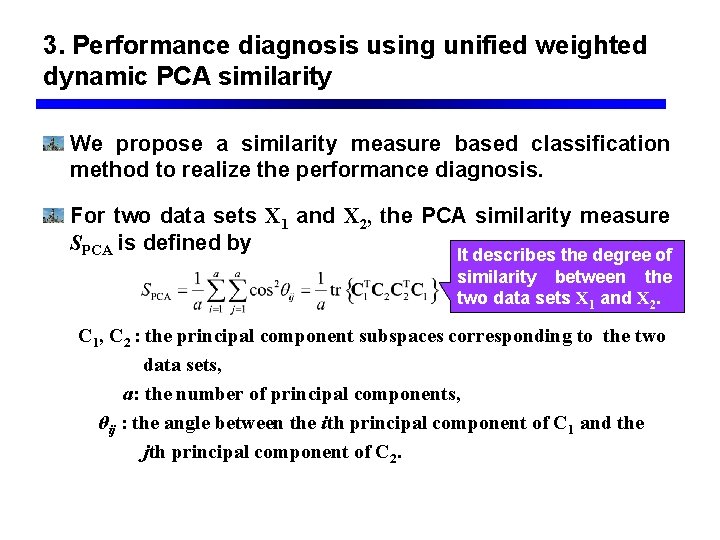
3. Performance diagnosis using unified weighted dynamic PCA similarity We propose a similarity measure based classification method to realize the performance diagnosis. For two data sets X 1 and X 2, the PCA similarity measure SPCA is defined by It describes the degree of similarity between the two data sets X 1 and X 2. C 1, C 2 : the principal component subspaces corresponding to the two data sets, a: the number of principal components, θij : the angle between the ith principal component of C 1 and the jth principal component of C 2.

3. Performance diagnosis using unified weighted dynamic PCA similarity Let being the first a eigenvalues of The weighted PCA (WPCA) similarity measure is defined as The more consistent the two data sets are in the principal component subspaces, the closer to 1 the WPCA similarity measure is. If the DPCA is applied to the two augmented data sets and , we obtain the weighted DPCA (WDPCA) similarity measure
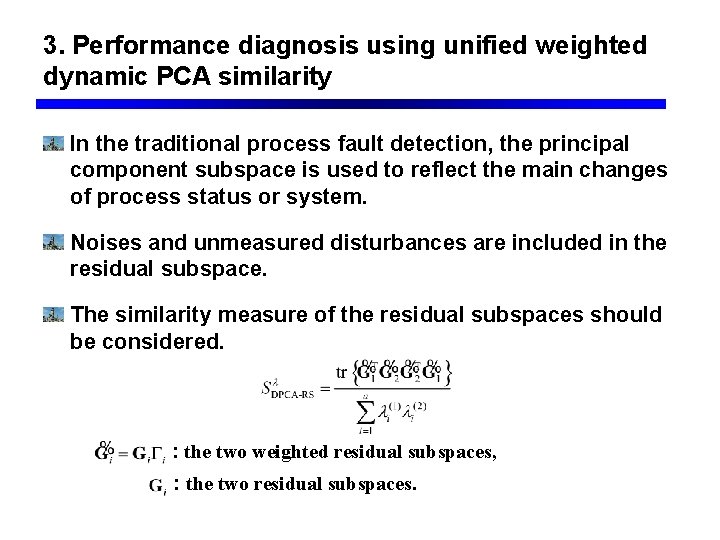
3. Performance diagnosis using unified weighted dynamic PCA similarity In the traditional process fault detection, the principal component subspace is used to reflect the main changes of process status or system. Noises and unmeasured disturbances are included in the residual subspace. The similarity measure of the residual subspaces should be considered. : the two weighted residual subspaces, : the two residual subspaces.

3. Performance diagnosis using unified weighted dynamic PCA similarity We are now introduce the proposed unified-weighted DPCA (UWDPCA) similarity measure β : the weighting factor, should appropriately be selected according to the specified monitored process. Therefore, not only the similarity of the principal component subspaces, but also the similarity of the residual subspaces, are considered.
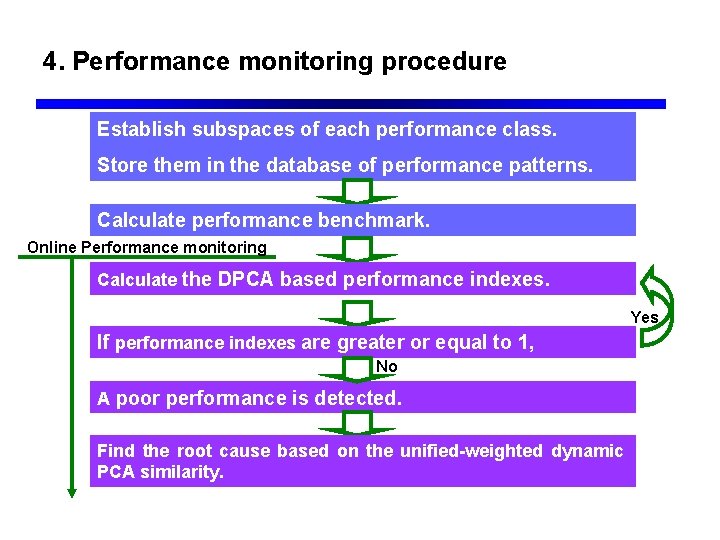
4. Performance monitoring procedure Establish subspaces of each performance class. Store them in the database of performance patterns. Calculate performance benchmark. Online Performance monitoring Calculate the DPCA based performance indexes. Yes If performance indexes are greater or equal to 1, No A poor performance is detected. Find the root cause based on the unified-weighted dynamic PCA similarity.
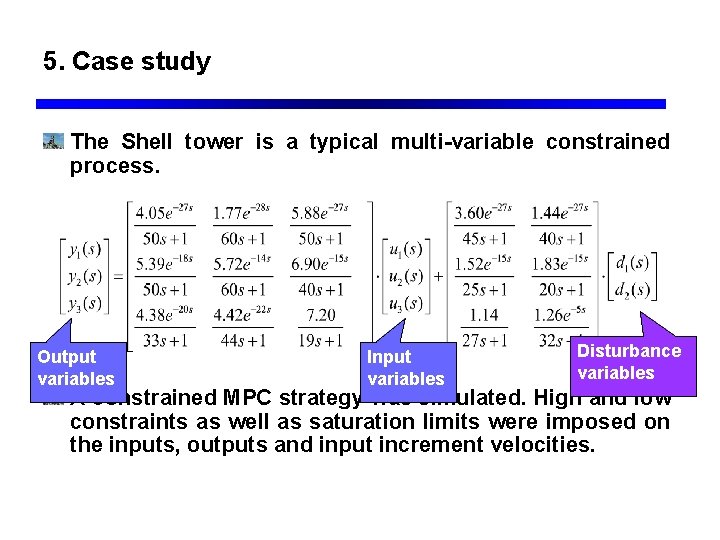
5. Case study The Shell tower is a typical multi-variable constrained process. Output variables Input variables Disturbance variables A constrained MPC strategy was simulated. High and low constraints as well as saturation limits were imposed on the inputs, outputs and input increment velocities.
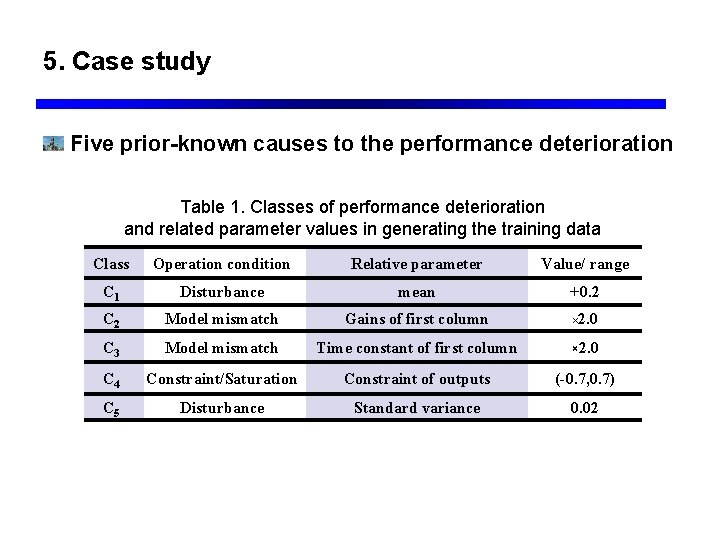
5. Case study Five prior-known causes to the performance deterioration Table 1. Classes of performance deterioration and related parameter values in generating the training data Class Operation condition Relative parameter Value/ range C 1 Disturbance mean +0. 2 C 2 Model mismatch Gains of first column × 2. 0 C 3 Model mismatch Time constant of first column × 2. 0 C 4 Constraint/Saturation Constraint of outputs (-0. 7, 0. 7) C 5 Disturbance Standard variance 0. 02
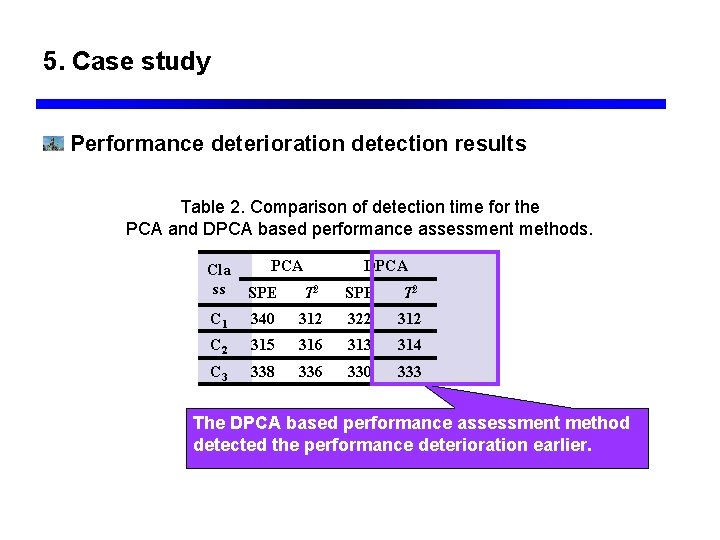
5. Case study Performance deterioration detection results Table 2. Comparison of detection time for the PCA and DPCA based performance assessment methods. PCA DPCA Cla ss SPE T 2 C 1 340 312 322 312 C 2 315 316 313 314 C 3 338 336 330 333 The DPCA based performance assessment method detected the performance deterioration earlier.
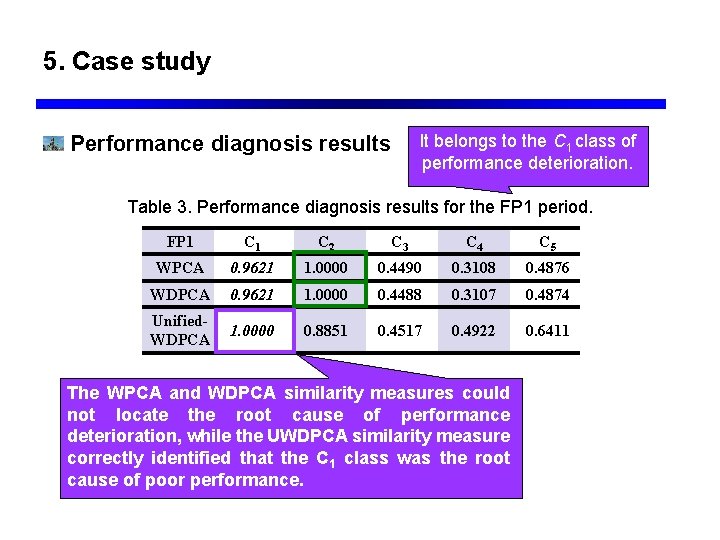
5. Case study It belongs to the C 1 class of performance deterioration. Performance diagnosis results Table 3. Performance diagnosis results for the FP 1 period. FP 1 C 2 C 3 C 4 C 5 WPCA 0. 9621 1. 0000 0. 4490 0. 3108 0. 4876 WDPCA 0. 9621 1. 0000 0. 4488 0. 3107 0. 4874 Unified. WDPCA 1. 0000 0. 8851 0. 4517 0. 4922 0. 6411 The WPCA and WDPCA similarity measures could not locate the root cause of performance deterioration, while the UWDPCA similarity measure correctly identified that the C 1 class was the root cause of poor performance.
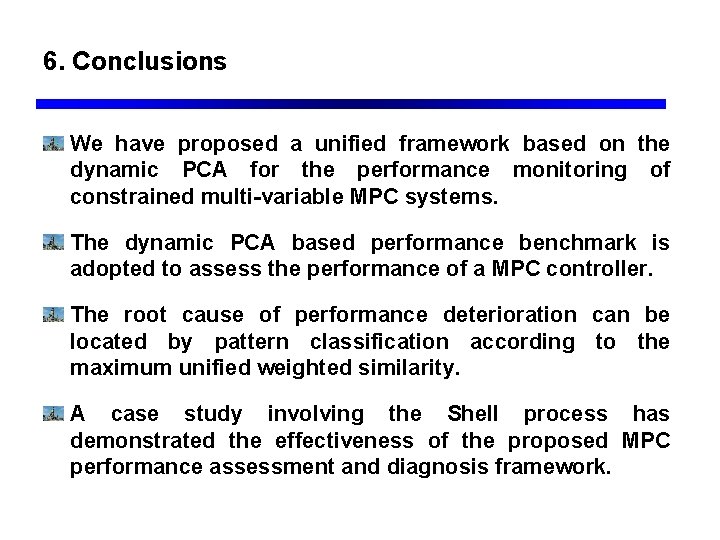
6. Conclusions We have proposed a unified framework based on the dynamic PCA for the performance monitoring of constrained multi-variable MPC systems. The dynamic PCA based performance benchmark is adopted to assess the performance of a MPC controller. The root cause of performance deterioration can be located by pattern classification according to the maximum unified weighted similarity. A case study involving the Shell process has demonstrated the effectiveness of the proposed MPC performance assessment and diagnosis framework.

College of Information and Control Engineering China University of Petroleum Qingdao 266555, China E-mail: tianxm@upc. edu. cn
- Slides: 19