
Performance Modeling of Stochastic Capacity Networks Carey Williamson
![Effect of Relative Time Scale R = E[call arrivals/capacity change] Can. Queue September 15,](https://slidetodoc.com/presentation_image_h2/6e9d9838c4054c35c21ebc83faa236f5/image-39.jpg "Effect of Relative Time Scale R = E[call arrivals/capacity change] Can. Queue September 15,")
- Slides: 45
Performance Modeling of Stochastic Capacity Networks Carey Williamson i. CORE Chair Department of Computer Science University of Calgary Can. Queue September 15, 2006 1
Introduction There exist many practical systems in which the system capacity varies unpredictably with time ¡ These systems are complicated to model and understand ¡ Main focus of this talk: ¡ l l l Stochastic capacity networks Lots of modeling issues and questions A few answers (mostly from simulation) Can. Queue September 15, 2006 2
Some Examples ¡ ¡ ¡ ¡ ¡ Queueing systems Safeway checkout line Variable-rate servers Loss systems Load-dependent servers Grid computing center Priority-based reservation networks Wireless Local Area Networks (WLANs) Wireless media streaming scenarios Handoffs in mobile cellular networks “Soft capacity” cellular networks Can. Queue September 15, 2006 3
Some Examples ¡ ¡ ¡ ¡ ¡ Queueing systems Safeway checkout line Variable-rate servers Loss systems Load-dependent servers Grid computing center Priority-based reservation networks Wireless Local Area Networks (WLANs) Wireless media streaming scenarios Handoffs in mobile cellular networks “Soft capacity” cellular networks Can. Queue September 15, 2006 4
Grid Computing Example Jobs of random sizes arrive at random times to central dispatcher, and are then sent to one of M possible computing nodes ¡ If a computing node fails, then all jobs that are currently in progress on that node are irretrievably lost ¡ Performance impacts: ¡ l l Lost work needs to be redone Increased queue delay for waiting jobs Can. Queue September 15, 2006 5
Wireless LAN (WLAN) Example ¡ An IEEE 802. 11 b WLAN (“Wi. Fi”) supports four different physical transmission rates: l ¡ ¡ 1 Mbps, 2 Mbps, 5. 5 Mbps, 11 Mbps Stations can dynamically switch between these rates on a per-frame basis depending on signal strength and perceived channel error rate Performance impacts: l The presence of one low-rate station actually degrades throughput for all WLAN users [Pilosof et al. IEEE INFOCOM 2003] Can. Queue September 15, 2006 6
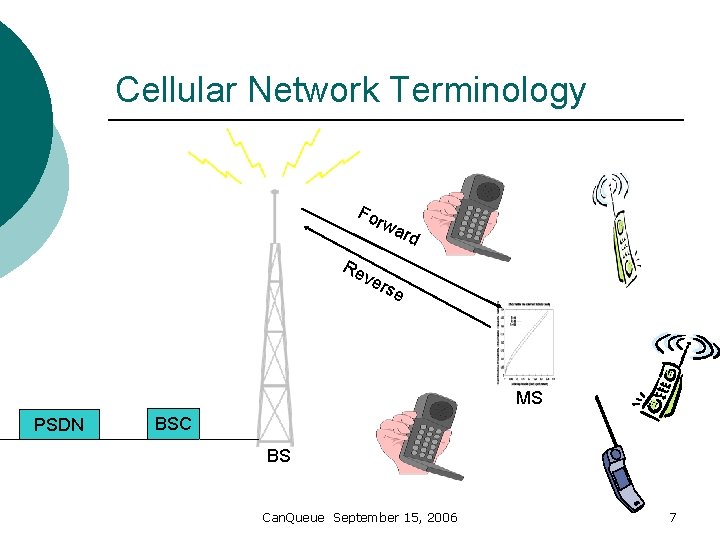
Cellular Network Terminology Fo rwa Re rd ver se MS PSDN BSC BS Can. Queue September 15, 2006 7
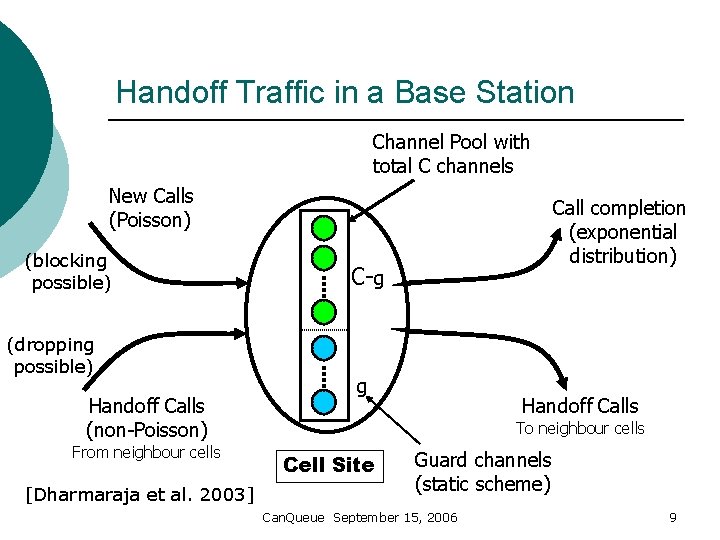
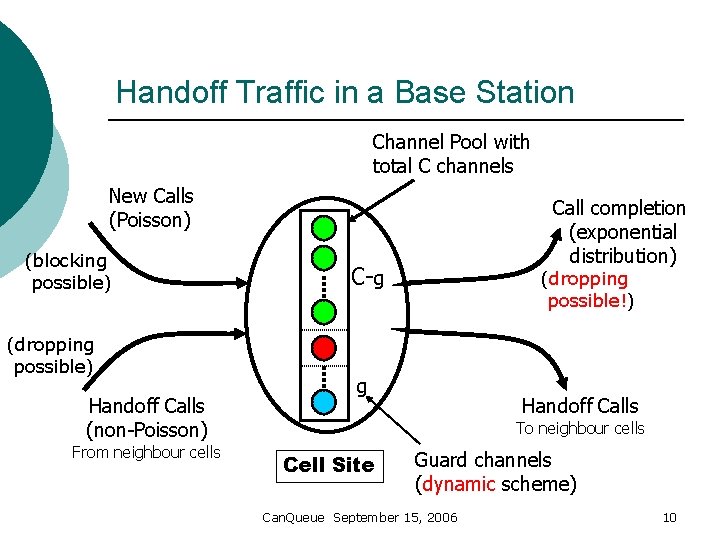
Cellular Handoff Example Mobile phones communicate via a cellular base station (BS) ¡ Movement of active users beyond the coverage area of current BS necessitates handoff to another BS ¡ If no resources available, drop call ¡ Possible strategies: ¡ l l Guard channels (static or dynamic) Power control, “soft handoff”, etc. Can. Queue September 15, 2006 8
Handoff Traffic in a Base Station Channel Pool with total C channels New Calls (Poisson) (blocking possible) (dropping possible) Handoff Calls (non-Poisson) From neighbour cells [Dharmaraja et al. 2003] Call completion (exponential distribution) C-g g Handoff Calls To neighbour cells Cell Site Guard channels (static scheme) Can. Queue September 15, 2006 9
Handoff Traffic in a Base Station Channel Pool with total C channels New Calls (Poisson) (blocking possible) (dropping possible) Handoff Calls (non-Poisson) From neighbour cells Call completion (exponential distribution) C-g (dropping possible!) g Handoff Calls To neighbour cells Cell Site Guard channels (dynamic scheme) Can. Queue September 15, 2006 10
“Soft Capacity” Example Problem originally motivated by research project with TELUS Mobility ¡ Q: How many users at a time can be supported by one BS? - CLW ¡ A: “It depends” - MW ¡ CDMA cellular systems are typically interference-limited rather than channel limited (i. e. , time varying) ¡ Intra-cell and inter-cell interference ¡ Can. Queue September 15, 2006 12
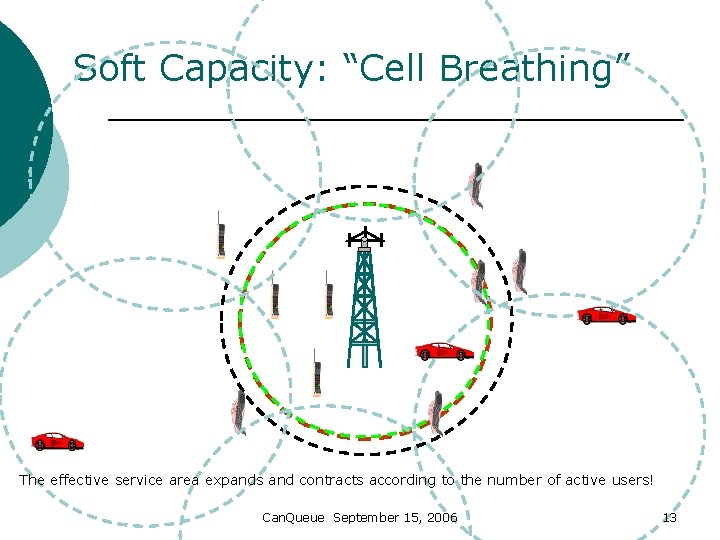
Soft Capacity: “Cell Breathing” The effective service area expands and contracts according to the number of active users! Can. Queue September 15, 2006 13
Observation and Motivation Networks with time-varying capacity tend to exhibit higher call blocking rates and higher outage (dropping) probabilities than regular networks ¡ Investigating performance in such systems requires consideration of the traffic process as well as the capacity variation process (and interactions between these two processes) ¡ Can. Queue September 15, 2006 14
Research Questions What are the performance characteristics observed in stochastic capacity networks? ¡ How sensitive are the results to the parameters of the stochastic capacity variation process? ¡ Can one develop an “effective capacity” model for such networks? ¡ Can. Queue September 15, 2006 15
Background: Erlang Blocking Formula ¡ The Erlang B formula expresses the relationship between call blocking, offered load, and the number of channels in a circuit-based network Can. Queue September 15, 2006 16
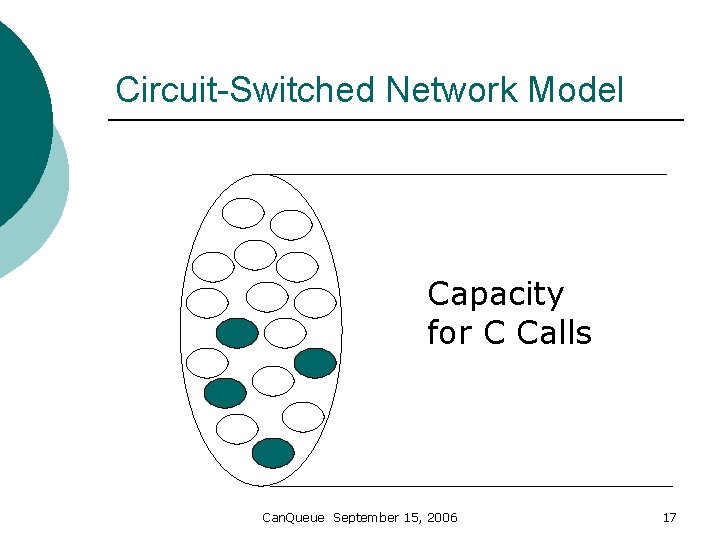
Circuit-Switched Network Model Capacity for C Calls Can. Queue September 15, 2006 17
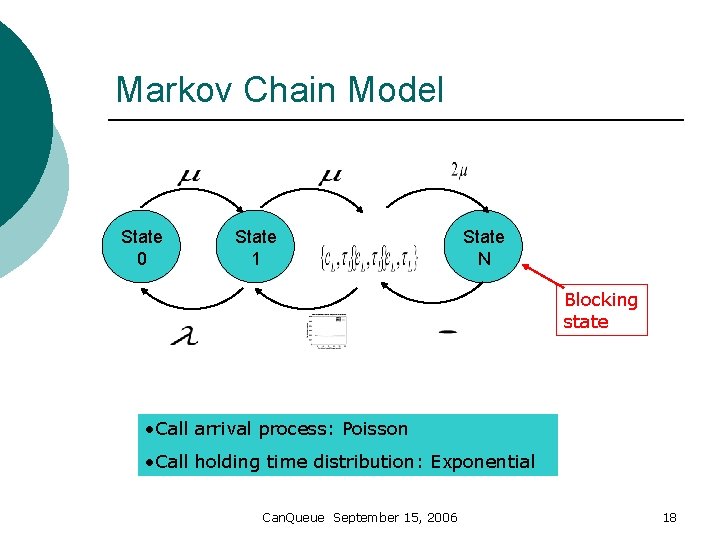
Markov Chain Model State 0 State 1 State N Blocking state • Call arrival process: Poisson • Call holding time distribution: Exponential Can. Queue September 15, 2006 18
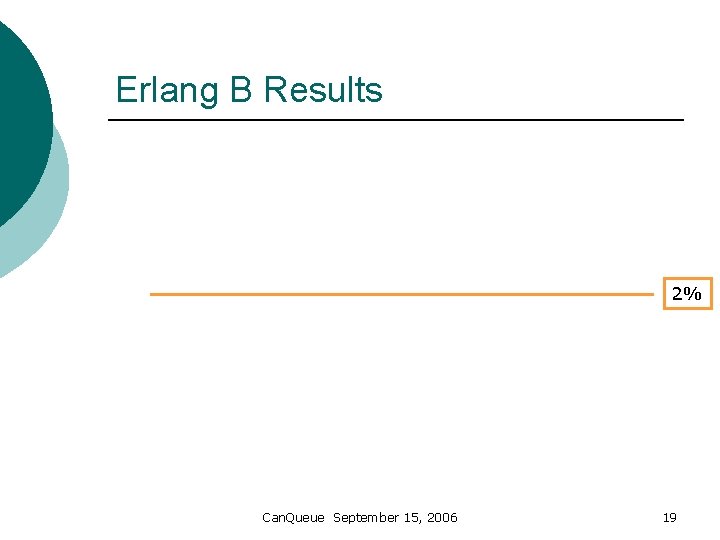
Erlang B Results 2% Can. Queue September 15, 2006 19
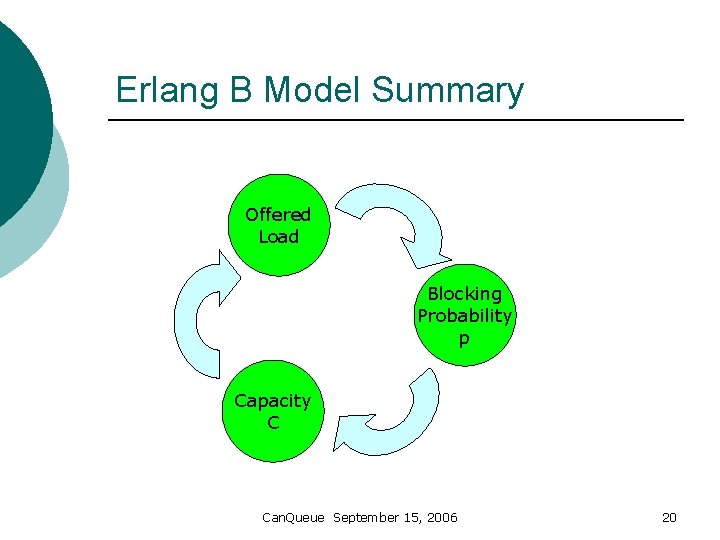
Erlang B Model Summary Offered Load Blocking Probability p Capacity C Can. Queue September 15, 2006 20
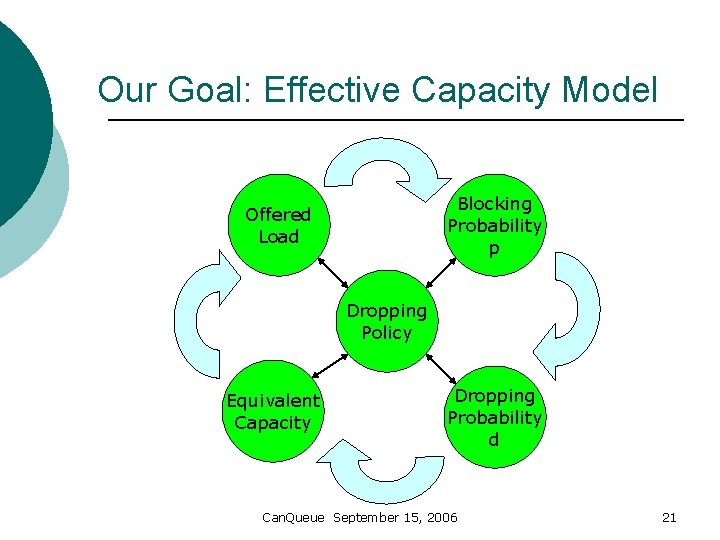
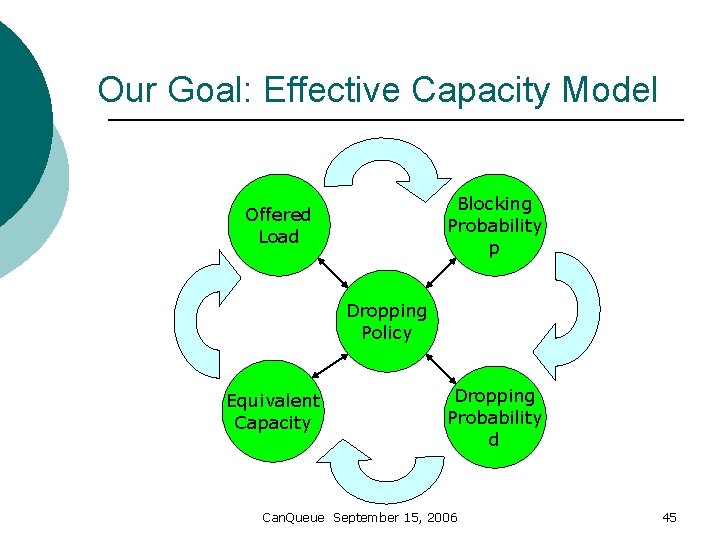
Our Goal: Effective Capacity Model Blocking Probability p Offered Load Dropping Policy Equivalent Capacity Dropping Probability d Can. Queue September 15, 2006 21
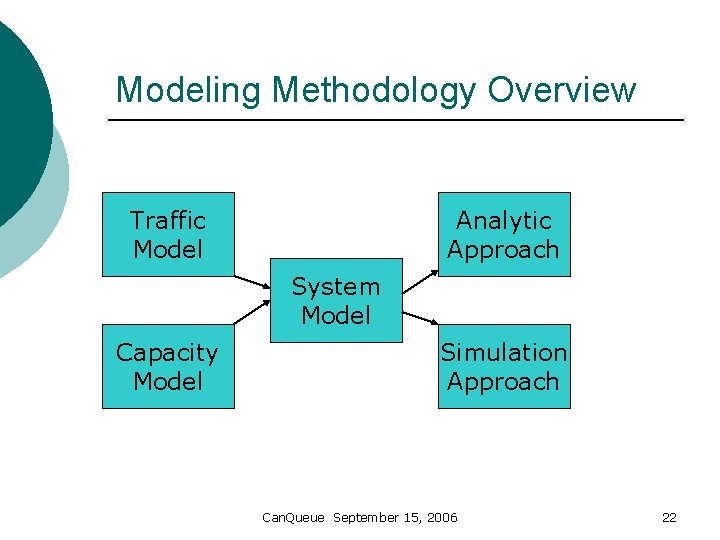
Modeling Methodology Overview Traffic Model Analytic Approach System Model Capacity Model Simulation Approach Can. Queue September 15, 2006 22
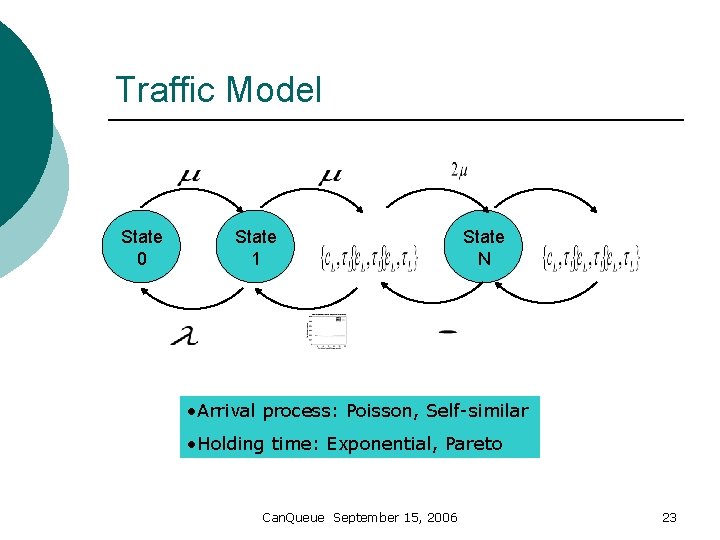
Traffic Model State 0 State 1 State N • Arrival process: Poisson, Self-similar • Holding time: Exponential, Pareto Can. Queue September 15, 2006 23
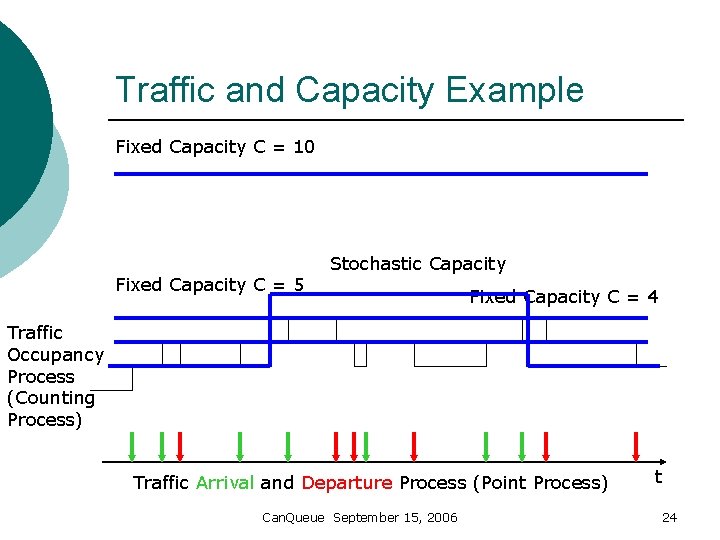
Traffic and Capacity Example Fixed Capacity C = 10 Fixed Capacity C = 5 Stochastic Capacity Fixed Capacity C = 4 Traffic Occupancy Process (Counting Process) Traffic Arrival and Departure Process (Point Process) Can. Queue September 15, 2006 t 24
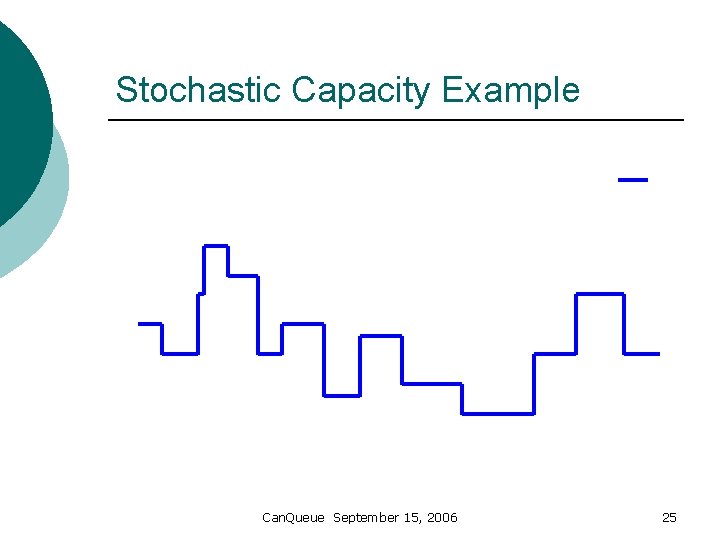
Stochastic Capacity Example Can. Queue September 15, 2006 25
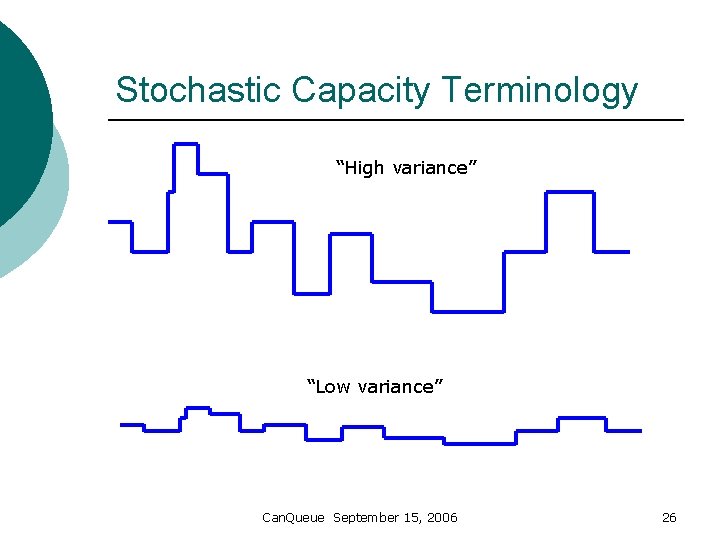
Stochastic Capacity Terminology “High variance” “Low variance” Can. Queue September 15, 2006 26
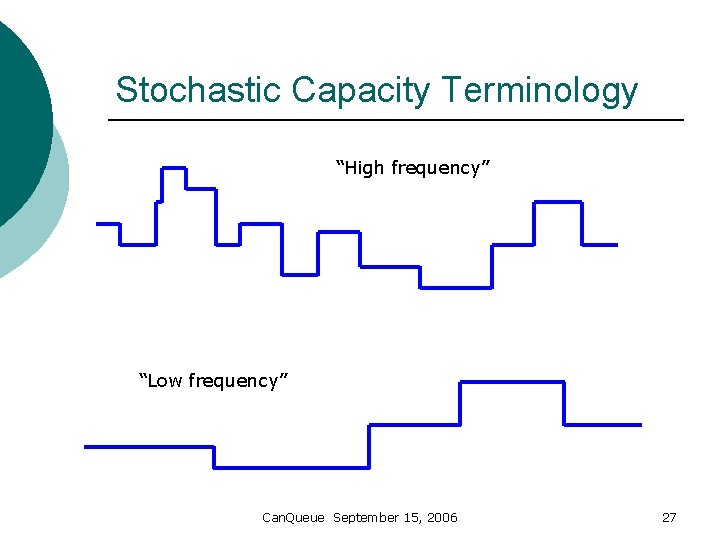
Stochastic Capacity Terminology “High frequency” “Low frequency” Can. Queue September 15, 2006 27
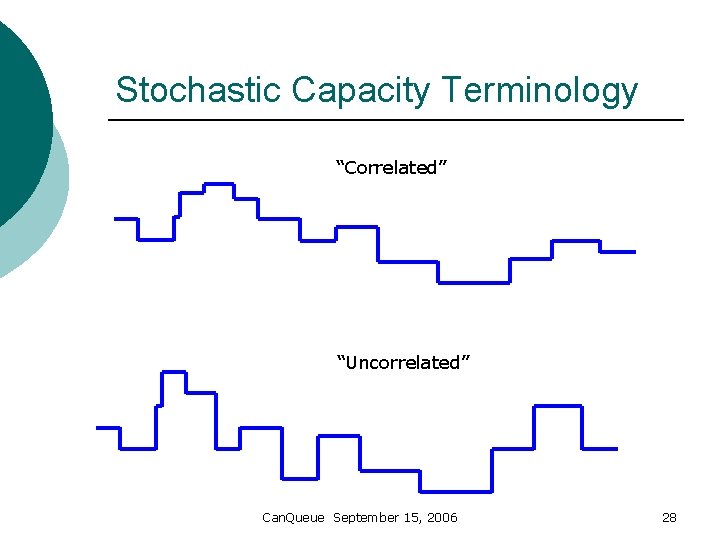
Stochastic Capacity Terminology “Correlated” “Uncorrelated” Can. Queue September 15, 2006 28
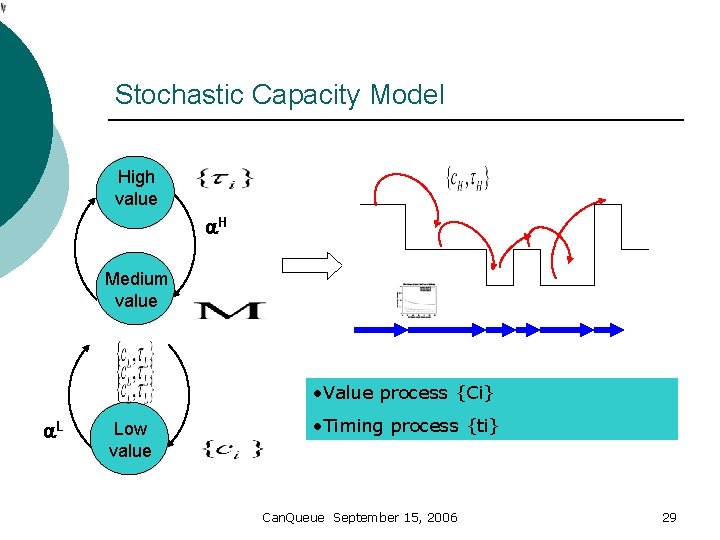
Stochastic Capacity Model High value H Medium value • Value process {Ci} L Low value • Timing process {ti} Can. Queue September 15, 2006 29
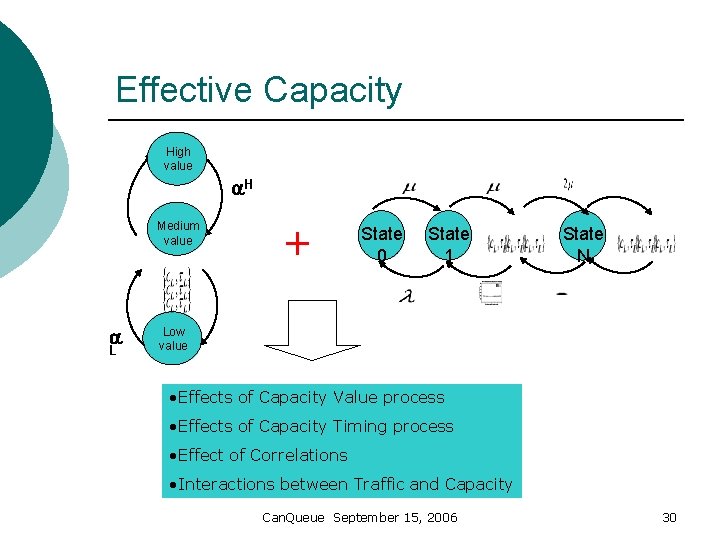
Effective Capacity High value H Medium value L + State 0 State 1 State N Low value • Effects of Capacity Value process • Effects of Capacity Timing process • Effect of Correlations • Interactions between Traffic and Capacity Can. Queue September 15, 2006 30
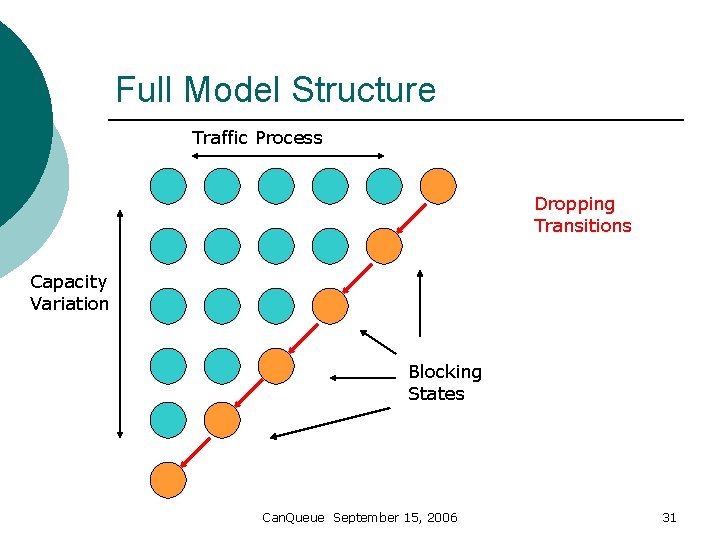
Full Model Structure Traffic Process Dropping Transitions Capacity Variation Blocking States Can. Queue September 15, 2006 31
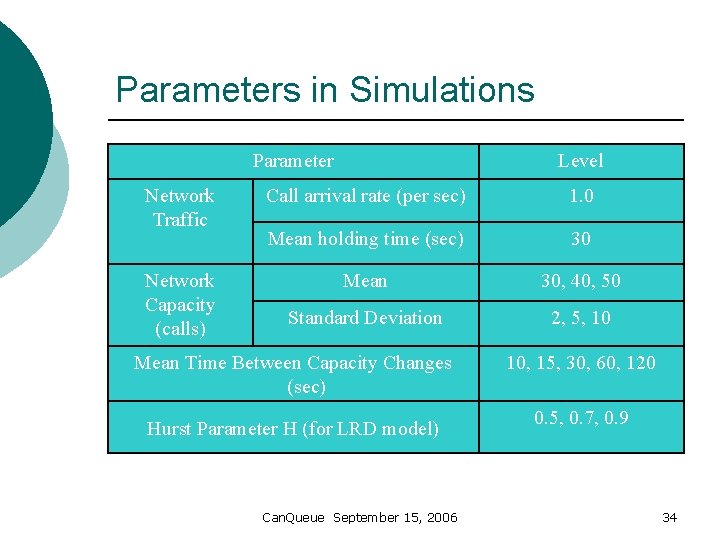
Parameters in Simulations Parameter Level Network Traffic Call arrival rate (per sec) 1. 0 Mean holding time (sec) 30 Network Capacity (calls) Mean 30, 40, 50 Standard Deviation 2, 5, 10 Mean Time Between Capacity Changes (sec) Hurst Parameter H (for LRD model) Can. Queue September 15, 2006 10, 15, 30, 60, 120 0. 5, 0. 7, 0. 9 34
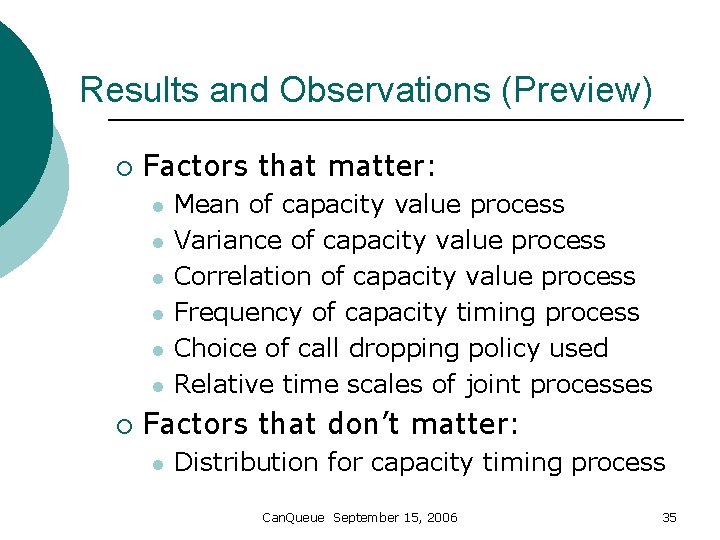
Results and Observations (Preview) ¡ Factors that matter: l l l ¡ Mean of capacity value process Variance of capacity value process Correlation of capacity value process Frequency of capacity timing process Choice of call dropping policy used Relative time scales of joint processes Factors that don’t matter: l Distribution for capacity timing process Can. Queue September 15, 2006 35
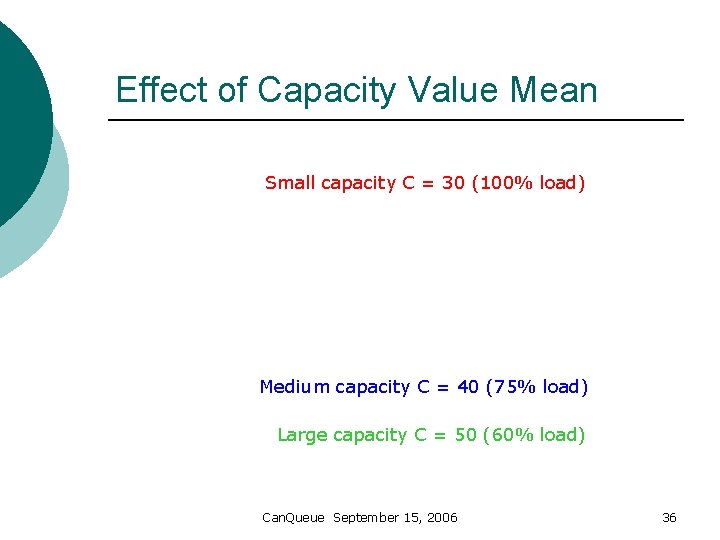
Effect of Capacity Value Mean Small capacity C = 30 (100% load) Medium capacity C = 40 (75% load) Large capacity C = 50 (60% load) Can. Queue September 15, 2006 36
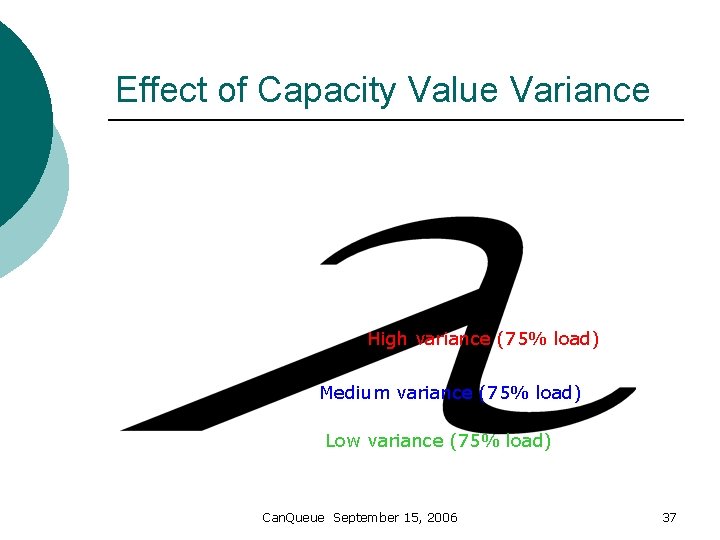
Effect of Capacity Value Variance High variance (75% load) Medium variance (75% load) Low variance (75% load) Can. Queue September 15, 2006 37
Effect of Capacity Correlation Uncorrelated Can. Queue September 15, 2006 38
Effect of Capacity Timing Process Can. Queue September 15, 2006 39
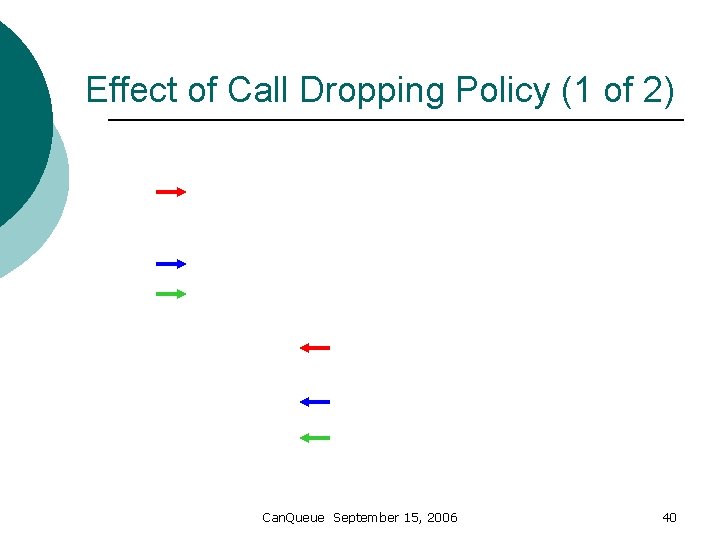
Effect of Call Dropping Policy (1 of 2) Can. Queue September 15, 2006 40
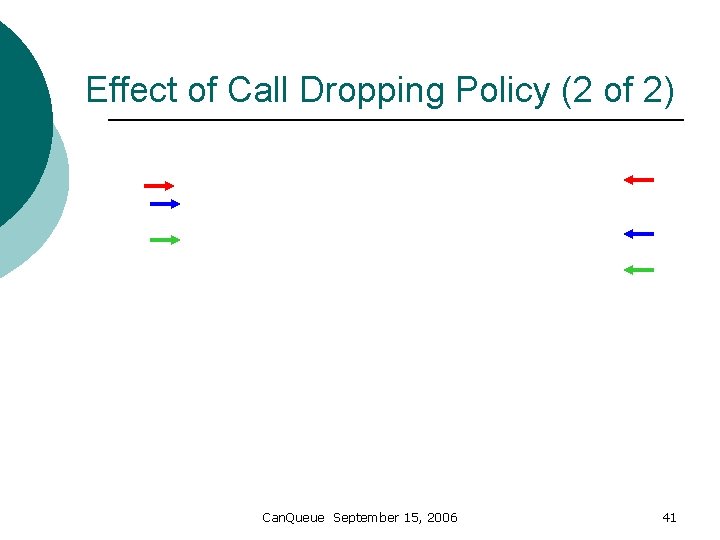
Effect of Call Dropping Policy (2 of 2) Can. Queue September 15, 2006 41
Effect of Relative Time Scale R = E[call arrivals/capacity change] Can. Queue September 15, 2006 42
Results and Observations (Recap) ¡ Factors that matter: l l l ¡ Mean of capacity value process Variance of capacity value process Correlation of capacity value process Frequency of capacity timing process Choice of call dropping policy used Relative time scales of joint processes Factors that don’t matter: l Distribution for capacity timing process Can. Queue September 15, 2006 43
Summary and Conclusion ¡ ¡ ¡ Studied call-level performance in a network with stochastic capacity variation Shows influences from the properties of the stochastic capacity variation process Shows that mean and variance of capacity process have the largest impact, as do the correlation structure and timing Shows impact of interactions between traffic and capacity processes One step closer to our goal, but the hard part is still ahead! Can. Queue September 15, 2006 44
Our Goal: Effective Capacity Model Blocking Probability p Offered Load Dropping Policy Equivalent Capacity Dropping Probability d Can. Queue September 15, 2006 45
References ¡ ¡ H. Sun and C. Williamson, “Simulation Evaluation of Call Dropping Policies for Stochastic Capacity Networks”, Proceedings of SCS SPECTS 2005, Philadelphia, PA, pp. 327 -336, July 2005. H. Sun and C. Williamson, “On Effective Capacity in Time-Varying Wireless Networks”, Proceedings of SCS SPECTS 2006, Calgary, AB, July 2006. H. Sun, Q. Wu, and C. Williamson, “Impact of Stochastic Traffic Characteristics on Effective Capacity in CDMA Networks”, to appear, Proceedings of P 2 MNet, Tampa, FL, Nov. 2006. H. Sun and C. Williamson, “On the Role of Call Dropping Controls in Stochastic Capacity Networks”, submitted for publication, 2006. Can. Queue September 15, 2006 46
Related Work ¡ ¡ S. Dharmaraja, K. Trivedi, and D. Logothetis, “Performance Modelling of Wireless Networks with Generally Distributed Hand-off Interarrival Times”, Computer Communications, Vol. 26, No. 15, pp. 1747 -1755, 2003. V. Gupta, M. Harchol-Balter, A. Scheller-Wolf, and U. Yechiali, “Fundamental Characteristics of Queues with Fluctuating Load”, Proceedings of ACM SIGMETRICS 2006, St. Malo, France, June 2006. G. Haring, R. Marie, R. Puigjaner, and K. Trivedi, “Loss Formulae and Optimization for Cellular Networks”, IEEE Transactions on Vehicular Technology, Vol. 50, No. 3, pp. 664 -673, 2001. B. Haverkort, R. Marie, R. Gerardo, and K. Trivedi, Performability Modeling: Techniques and Tools, 2001. Can. Queue September 15, 2006 47
Thanks! Questions? ¡ Credits: ¡ l l ¡ Hongxia Sun Jingxiang Luo Qian Wu S. Dharmaraja For more information: l l Email carey@cpsc. ucalgary. ca http: //www. cpsc. ucalgary. ca/~carey Can. Queue September 15, 2006 48