
Performance Metrics OBJECTIVE Develop an understanding of how

Performance Metrics OBJECTIVE Develop an understanding of how to assess the financial and strategic performance of strategic performance an e-business company. Assist. Prof. Dr. Özgen 20. 12. 2011

4231 views and mentions of your viral marketing campaign on the first day ◦ 4231 is a measurement. ◦ Without a context, it is just a number Consider goals and expectations of your company and your competitors’ effort

Performance Metrics translate the company’s vision, mission or e-business model into components with measurable outcomes. ◦ The performance metrics must be easy to understand use ◦ Metrics must be actionable ◦ When employee evaluations are tied to metrics, people will be motivated to make decisions that lead the desired outcomes


Metrics Framework Financial Metrics Customer-Based Metrics Objectives Implementation Metrics

Financial and Other Metrics of Overall Performance Financial Metrics Performance Relative to Competitors Sales Market Share Revenue Relative Return on Investment Gross Margins Profits Marketing Spend
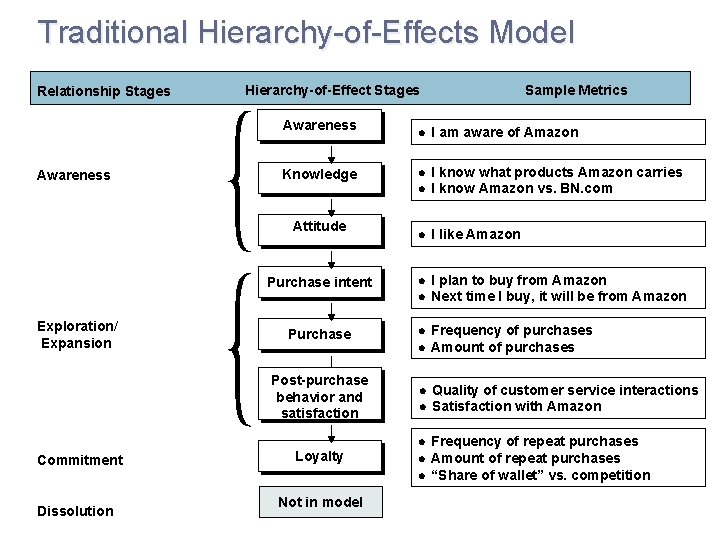
Traditional Hierarchy-of-Effects Model Relationship Stages Hierarchy-of-Effect Stages Awareness Knowledge Attitude Purchase intent I am aware of Amazon I know what products Amazon carries I know Amazon vs. BN. com I like Amazon I plan to buy from Amazon Next time I buy, it will be from Amazon Exploration/ Expansion Purchase Post-purchase behavior and satisfaction Commitment Loyalty Dissolution Not in model Sample Metrics Frequency of purchases Amount of purchases Quality of customer service interactions Satisfaction with Amazon Frequency of repeat purchases Amount of repeat purchases “Share of wallet” vs. competition
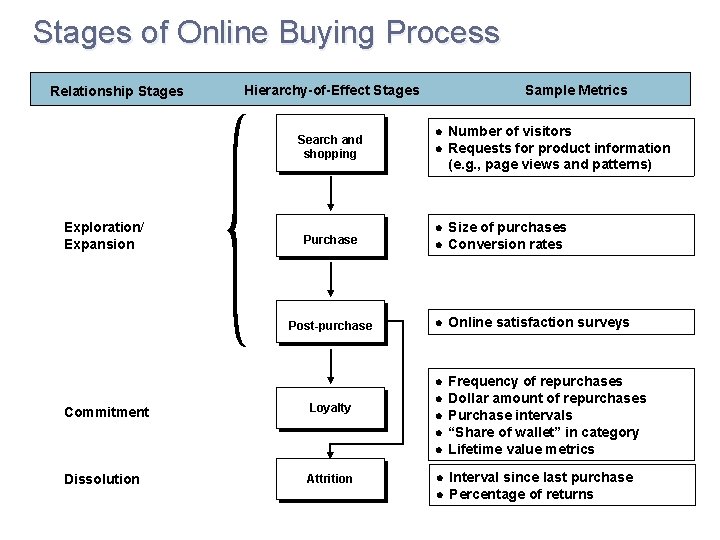
Stages of Online Buying Process Relationship Stages Hierarchy-of-Effect Stages Search and shopping Exploration/ Expansion Purchase Post-purchase Commitment Loyalty Sample Metrics Size of purchases Conversion rates Online satisfaction surveys Frequency of repurchases Dollar amount of repurchases Purchase intervals “Share of wallet” in category Lifetime value metrics Dissolution Attrition Number of visitors Requests for product information (e. g. , page views and patterns) Interval since last purchase Percentage of returns
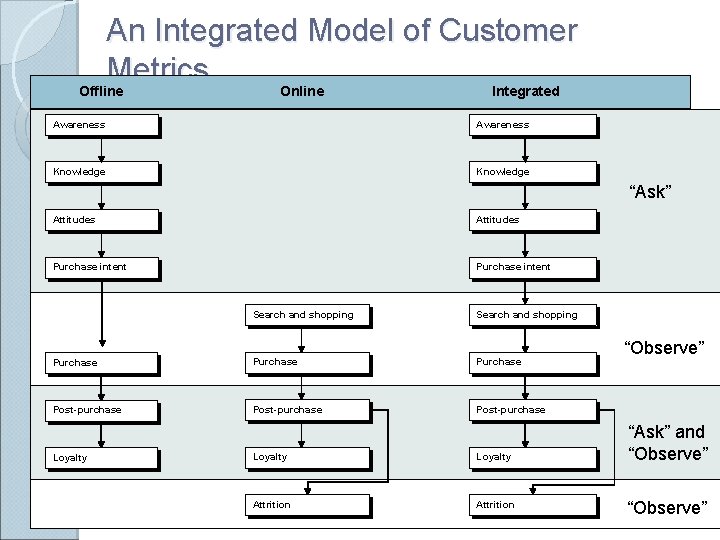
An Integrated Model of Customer Metrics Offline Online Integrated Awareness Knowledge “Ask” Attitudes Purchase intent Search and shopping Purchase Post-purchase Loyalty Attrition “Observe” “Ask” and “Observe”
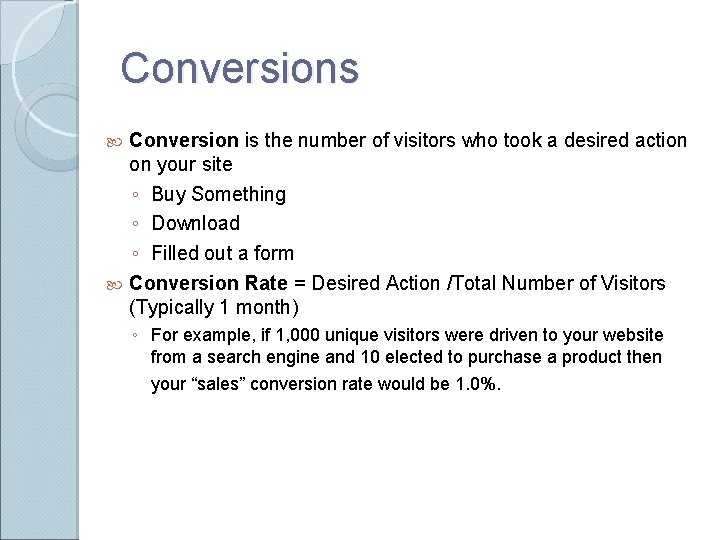
Conversions Conversion is the number of visitors who took a desired action on your site ◦ Buy Something ◦ Download ◦ Filled out a form Conversion Rate = Desired Action /Total Number of Visitors (Typically 1 month) ◦ For example, if 1, 000 unique visitors were driven to your website from a search engine and 10 elected to purchase a product then your “sales” conversion rate would be 1. 0%.
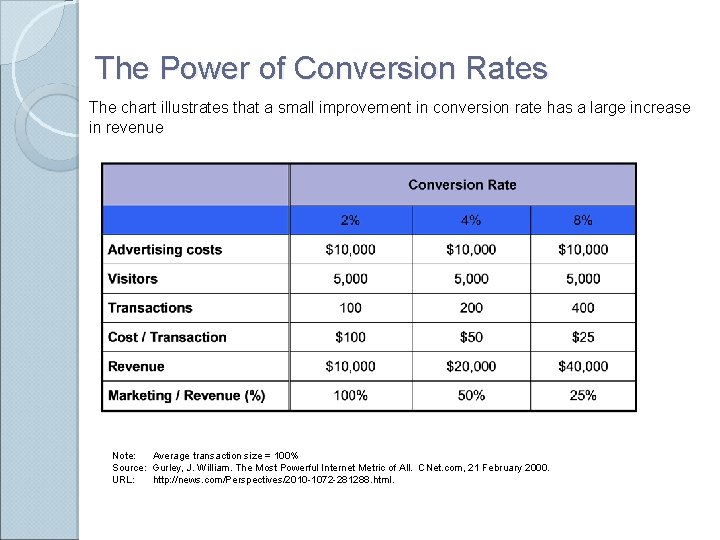
The Power of Conversion Rates The chart illustrates that a small improvement in conversion rate has a large increase in revenue Note: Average transaction size = 100% Source: Gurley, J. William. The Most Powerful Internet Metric of All. CNet. com, 21 February 2000. URL: http: //news. com/Perspectives/2010 -1072 -281288. html.
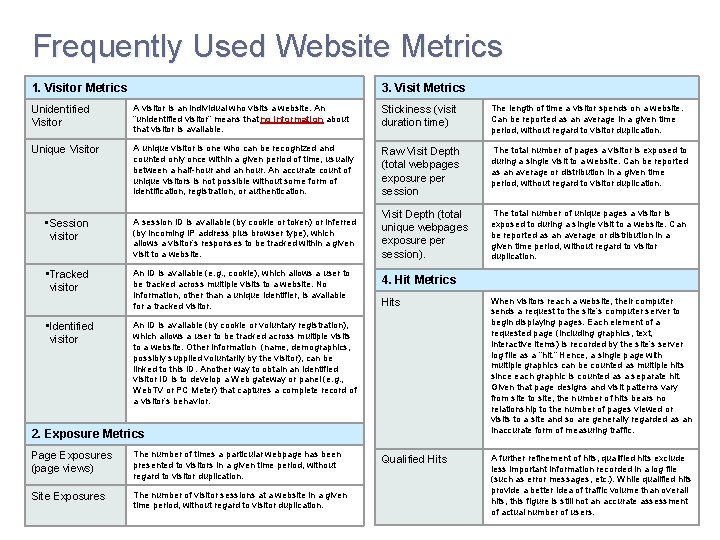
Frequently Used Website Metrics 1. Visitor Metrics 3. Visit Metrics Unidentified Visitor A visitor is an individual who visits a website. An “unidentified visitor” means that no information about that visitor is available. Stickiness (visit duration time) The length of time a visitor spends on a website. Can be reported as an average in a given time period, without regard to visitor duplication. Unique Visitor A unique visitor is one who can be recognized and counted only once within a given period of time, usually between a half-hour and an hour. An accurate count of unique visitors is not possible without some form of identification, registration, or authentication. Raw Visit Depth (total webpages exposure per session The total number of pages a visitor is exposed to during a single visit to a website. Can be reported as an average or distribution in a given time period, without regard to visitor duplication. • Session visitor A session ID is available (by cookie or token) or inferred (by incoming IP address plus browser type), which allows a visitor’s responses to be tracked within a given visit to a website. Visit Depth (total unique webpages exposure per session). The total number of unique pages a visitor is exposed to during a single visit to a website. Can be reported as an average or distribution in a given time period, without regard to visitor duplication. • Tracked visitor An ID is available (e. g. , cookie), which allows a user to be tracked across multiple visits to a website. No information, other than a unique identifier, is available for a tracked visitor. • Identified visitor 4. Hit Metrics Hits When visitors reach a website, their computer sends a request to the site’s computer server to begin displaying pages. Each element of a requested page (including graphics, text, interactive items) is recorded by the site’s server log file as a “hit. ” Hence, a single page with multiple graphics can be counted as multiple hits since each graphic is counted as a separate hit. Given that page designs and visit patterns vary from site to site, the number of hits bears no relationship to the number of pages viewed or visits to a site and so are generally regarded as an inaccurate form of measuring traffic. Qualified Hits A further refinement of hits, qualified hits exclude less important information recorded in a log file (such as error messages, etc. ). While qualified hits provide a better idea of traffic volume than overall hits, this figure is still not an accurate assessment of actual number of users. An ID is available (by cookie or voluntary registration), which allows a user to be tracked across multiple visits to a website. Other information (name, demographics, possibly supplied voluntarily by the visitor), can be linked to this ID. Another way to obtain an identified visitor ID is to develop a Web gateway or panel (e. g. , Web. TV or PC Meter) that captures a complete record of a visitor’s behavior. 2. Exposure Metrics Page Exposures (page views) The number of times a particular webpage has been presented to visitors in a given time period, without regard to visitor duplication. Site Exposures The number of visitor sessions at a website in a given time period, without regard to visitor duplication.
www. onlinewebstats. com
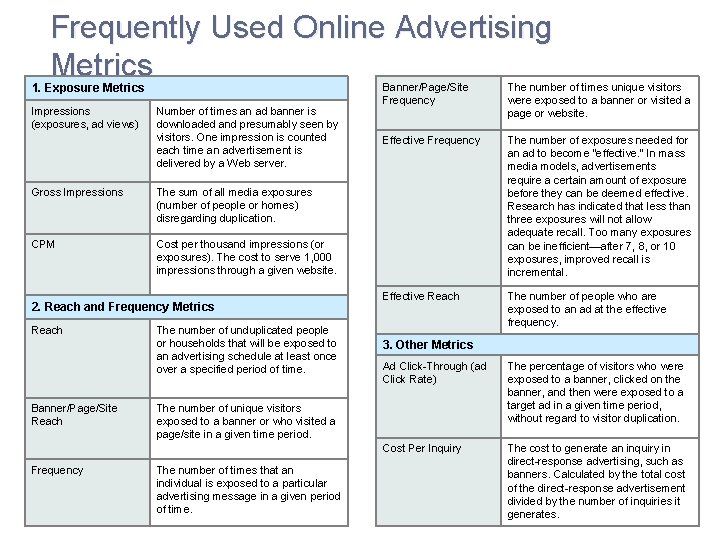
Frequently Used Online Advertising Metrics 1. Exposure Metrics Impressions (exposures, ad views) Number of times an ad banner is downloaded and presumably seen by visitors. One impression is counted each time an advertisement is delivered by a Web server. Gross Impressions The sum of all media exposures (number of people or homes) disregarding duplication. CPM Cost per thousand impressions (or exposures). The cost to serve 1, 000 impressions through a given website. 2. Reach and Frequency Metrics Reach Banner/Page/Site Reach Frequency The number of unduplicated people or households that will be exposed to an advertising schedule at least once over a specified period of time. Banner/Page/Site Frequency The number of times unique visitors were exposed to a banner or visited a page or website. Effective Frequency The number of exposures needed for an ad to become “effective. ” In mass media models, advertisements require a certain amount of exposure before they can be deemed effective. Research has indicated that less than three exposures will not allow adequate recall. Too many exposures can be inefficient—after 7, 8, or 10 exposures, improved recall is incremental. Effective Reach The number of people who are exposed to an ad at the effective frequency. 3. Other Metrics Ad Click-Through (ad Click Rate) The percentage of visitors who were exposed to a banner, clicked on the banner, and then were exposed to a target ad in a given time period, without regard to visitor duplication. Cost Per Inquiry The cost to generate an inquiry in direct-response advertising, such as banners. Calculated by the total cost of the direct-response advertisement divided by the number of inquiries it generates. The number of unique visitors exposed to a banner or who visited a page/site in a given time period. The number of times that an individual is exposed to a particular advertising message in a given period of time.
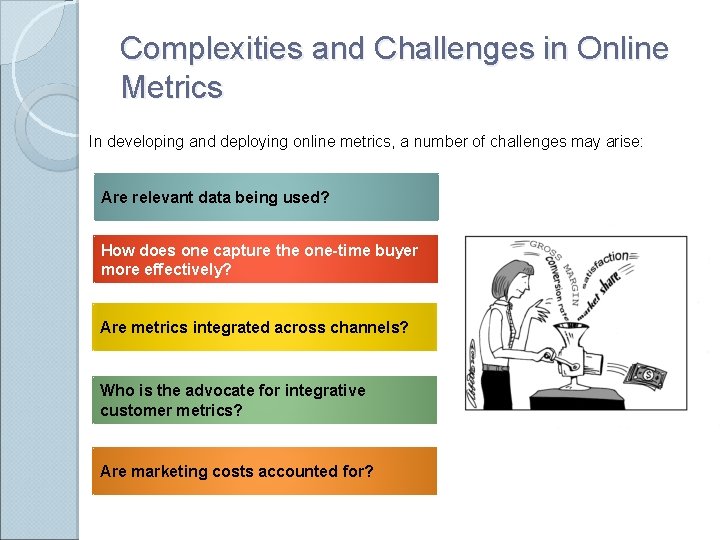
Complexities and Challenges in Online Metrics In developing and deploying online metrics, a number of challenges may arise: Are relevant data being used? How does one capture the one-time buyer more effectively? Are metrics integrated across channels? Who is the advocate for integrative customer metrics? Are marketing costs accounted for?
Social Media Metrics Social media leads. Track web traffic breakdowns from all social media sources, and chart the top few sources over time. Membership Activity increase and active network size ratio. ◦ How active is your company’s collective social network? Compare the ratio of active members vs total members

Social Media Metrics Conversions Brand mentions in social media Virality. Social members might be sharing Twitter tweets and Facebook updates relevant to your company, but is this info being reshared by their networks? How soon afterwards are they resharing? How many Friends of Friends are resharing your links and content?
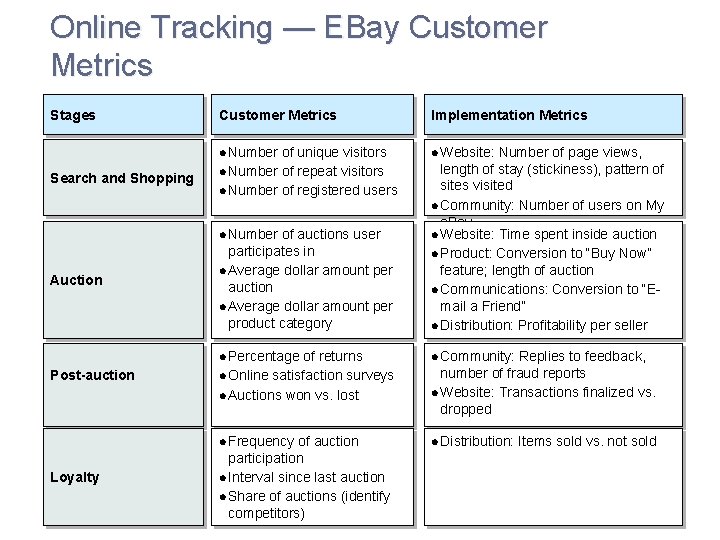
Online Tracking — EBay Customer Metrics Stages Search and Shopping Customer Metrics Implementation Metrics Number Website: of unique visitors Number of repeat visitors Number of registered users of auctions user participates in Average dollar amount per auction Average dollar amount per product category Number of page views, length of stay (stickiness), pattern of sites visited Community: Number of users on My e. Bay Website: Time spent inside auction Product: Conversion to “Buy Now” feature; length of auction Communications: Conversion to “Email a Friend” Distribution: Profitability per seller Percentage of returns Online satisfaction surveys Auctions won vs. lost Community: Frequency Distribution: Number Auction Post-auction Loyalty of auction participation Interval since last auction Share of auctions (identify competitors) Replies to feedback, number of fraud reports Website: Transactions finalized vs. dropped Items sold vs. not sold
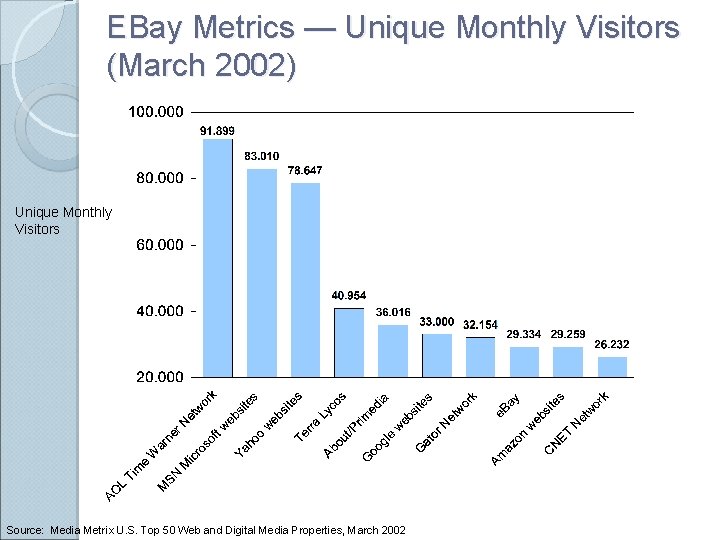
EBay Metrics — Unique Monthly Visitors (March 2002) Unique Monthly Visitors Source: Media Metrix U. S. Top 50 Web and Digital Media Properties, March 2002
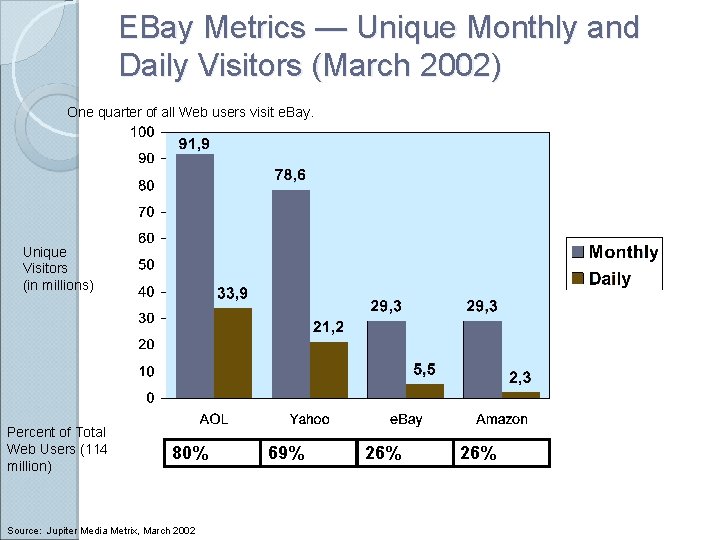
EBay Metrics — Unique Monthly and Daily Visitors (March 2002) One quarter of all Web users visit e. Bay. Unique Visitors (in millions) Percent of Total Web Users (114 million) 80% Source: Jupiter Media Metrix, March 2002 69% 26%
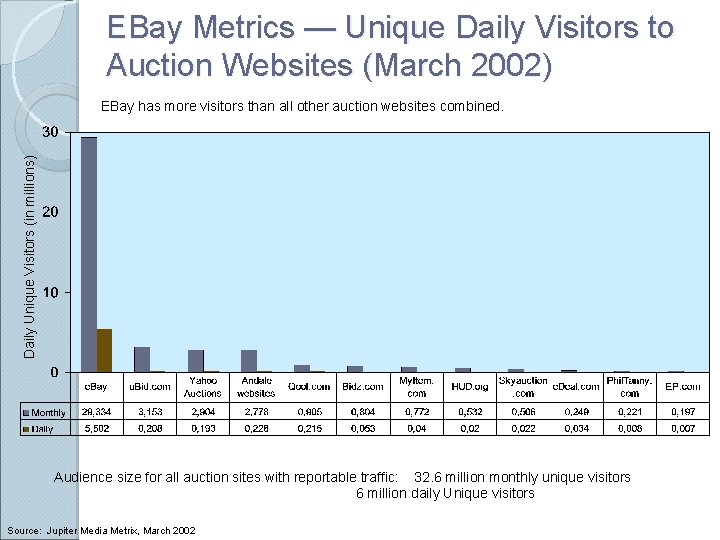
EBay Metrics — Unique Daily Visitors to Auction Websites (March 2002) Daily Unique Visitors (in millions) EBay has more visitors than all other auction websites combined. Audience size for all auction sites with reportable traffic: 32. 6 million monthly unique visitors 6 million daily Unique visitors Source: Jupiter Media Metrix, March 2002
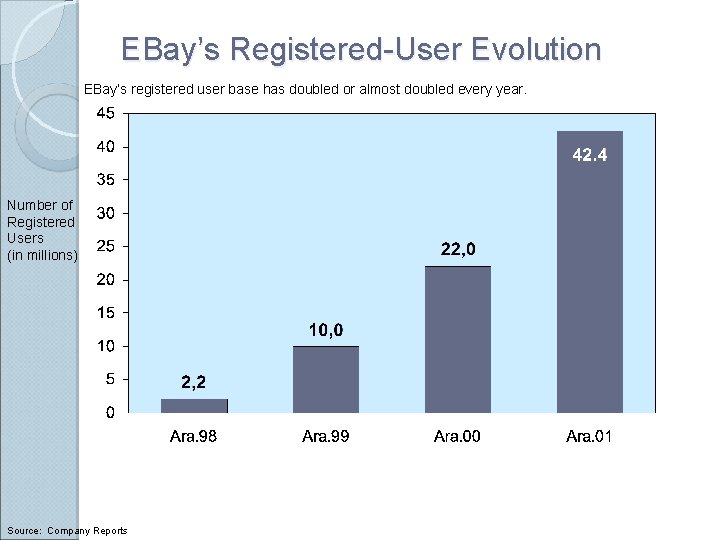
EBay’s Registered-User Evolution EBay’s registered user base has doubled or almost doubled every year. Number of Registered Users (in millions) Source: Company Reports
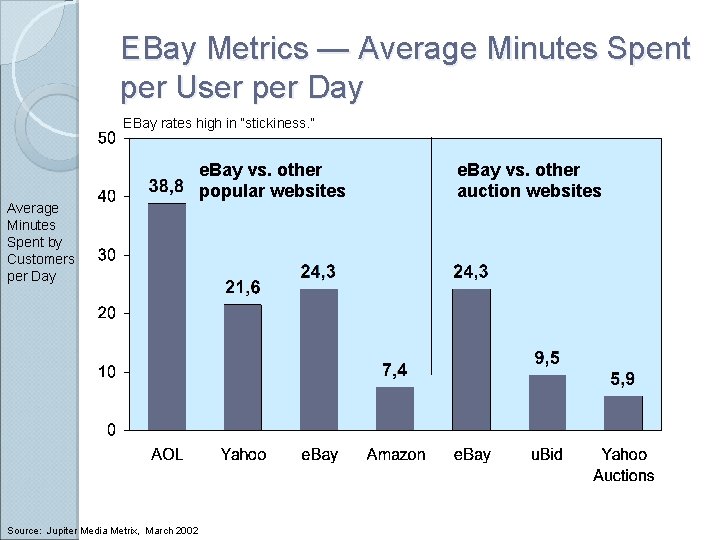
EBay Metrics — Average Minutes Spent per User per Day EBay rates high in “stickiness. ” Average Minutes Spent by Customers per Day Source: Jupiter Media Metrix, March 2002 e. Bay vs. other popular websites e. Bay vs. other auction websites

Customer Metrics — Conclusion ◦ Each set of metrics – financial, customer-based and implementation – gives managers information on different aspects of performance. Financial metrics assess the bottom-line performance of the business Customer-based metrics measure the health of the business’s customer assets Metrics that measure the implementation of the marketing program explain what actions need to be taken to strengthen the customer base and, ultimately, the financial results
- Slides: 24