
Performance Measures Metrics at University of Glasgow Library
Performance Measures & Metrics at University of Glasgow Library Jacqui Dowd SCONUL Workshop University of Westminster 17 th November 2009
The Driving Force for Performance Measurement • Environmental Changes – Rapid growth in the use and application of technology – Increased customer expectations in quality & responsiveness of services – “Competition” from other sources • Economic Constraints – Justification in spending over £ 9 million on the Library – Increasing competition for resources – Cost savings and/or reallocation • Accountability and Justification
The Challenge Traditional library statistics are no longer sufficient: • Focused on inputs, collections, acquisitions, expenditures – how big, how many and how much • No longer describe the library’s function or business • May not be aligned with the Library/University’s aims & plans • Do not define or measure service quality
Metrics The Library needs metrics that: • Describe the impact, outcomes and value from the user’s perspective • Indicate what difference we make • Measure progress/achievement Metrics that can be used to: • Improve & develop new and existing services • Identify changing patterns in use and needs • Market and promote services and facilities • Ensure decision making is based on evidence and not assumption
The Full Picture Traditional statistics + KPIs (National & Local) + Qualitative data from Focus Groups & User Surveys including NSS, ISB, University’s Surveys of First Year Student Experience & Staff Attitude and Lib. QUAL+ = The Beginnings of a Balanced Scorecard

What is a Balanced Scorecard? “The balanced scorecard is a strategic planning and management system used to align business activities to the vision and strategy of the organization, improve internal and external communications, and monitor organizational performance against strategic goals. ” Balanced Scorecard Institute
Balanced Scorecard The Balanced Scorecard • Has a blend of traditional statistics and newly defined measures to provide a quick and comprehensive picture of the Library’s performance • Has clearly defined measurements with specific targets indicating success, partial success and failure.

Balanced Scorecard Glasgow’s Balanced Scorecard is aligned to the Library’s Operational Plan & has four perspectives • User • Financial • Internal Processes • Staff Development
Balanced Scorecard Each Perspective has: • Defined strategic objectives • A Key Performance Indicator per objective • Assigned responsibility to a named post/department There is also space to record the level of success in achieving the KPIs & a commentary to explain the level of achievement if required.
User Perspective Strategic Objectives • Maximise client satisfaction with library resources and services • Optimise access to information resources and services for students and researchers • Create a supportive environment for University researchers to discover, locate and access information • Facilitate the development of informed and independent learners
User Perspective KPI examples • KPI U-1 a Seat hours per week per FTE user to exceed RLUK median (SCONUL 1 e) • KPI U-2 b Lib. QUAL+ Information Control: average staff/Pg perceived service level score to be greater than SCONUL average and greater than 6. 8 • KPI U 4 The number of e-journal titles available to increase annually by at least 10%
Financial Perspective Strategic Objectives • Secure appropriate funding to maintain and expand services to the University community • Attract additional funding for service innovation • Use effective and accountable financial processes
Financial Perspective KPI examples • KPI F-1 a Information expenditure per FTE student to be no lower than 95% of RLUK median (SCONUL) • KPI F-2 Library Materials Budget to increase by at least relevant inflation level • KPI F-3 b Library expenditure on Information Provision to be no less than 49% of total Library expenditure and greater than the RLUK median (SCONUL) • KPI F-5 a Cost per download for e-journals to be lower than the previous year

Internal Processes Perspective Strategic Objectives • Optimise processes by which we determine priorities and allocate resources to achieve strategic outcomes • Streamline internal processes through continuous improvement • Re-engineer internal processes to meet current and anticipated client need
Internal Processes Perspective KPI examples • KPI I-1 a Average number of days between receipt of order in Book Acquisitions and order on Millennium not to exceed 7 • KPI I-2 95% of items to be shelved within 24 hours of return or in-house during staffed hours • KPI I-4 100% of E-course material requests, if received within guideline periods and covered by our copyright licence, to be available by the required date • KPI I-5 Percentage of eligible first time issues from the Main Library via Self Service machines to be no less than 70%
Staff Development Perspective Strategic Objectives • Recruit, develop and sustain a highly skilled, flexible and competent workforce • Maintain an environment which encourages innovation and action • Invest in appropriate and innovative use of technologies and facilities
Staff Development Perspective KPI examples • KPI S-1 a At least 95% of staff on Grade 4 or above to have a Personal Development Plan • KPI S-1 c At least five staff to have received upgrade/accelerated increment • KPI S-2 a At least 60% of staff to have taken part in one or more training activity arising from P&DR • KPI S-2 b Expenditure on training and development to be at least 1% of salary expenditure
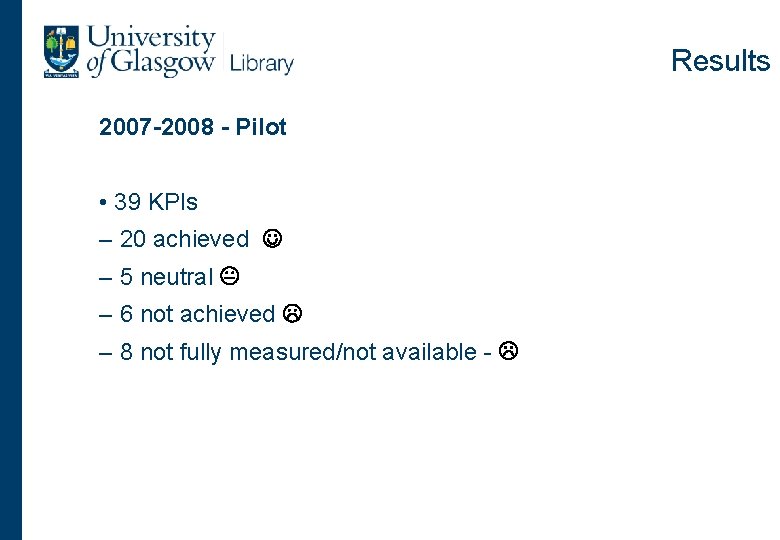
Results 2007 -2008 - Pilot • 39 KPIs – 20 achieved – 5 neutral – 6 not achieved – 8 not fully measured/not available -
Current Position 2008 – 2009 • 42 KPIs- Library & Archive Services merged • User Perspective – 13 0 f 14 Targets met (KPI U-5 Information Literacy: The number of person hours received by users in skills sessions should be no less than the RLUK median) Financial, Internal Processes & Staff Development Perspectives - results not yet fully available 2009 – 2010 • 36 KPIs • Reconvened group reviewed the KPIs
Current Position 2009 – 2010 • 36 KPIs – Reviewed – the KPIs Revised targets – Set new targets for new objectives and priorities – Removed superseded targets
Disadvantages Dangers & Pitfalls • Too many metrics • Too much time and labour – the cost of collection • Difficult to choose metrics that are: • • Relevant to objectives • Measurable • Stable from one year to the next • Comprehensive Timely • e. g. SCONUL Statistics
Advantages The Balanced Scorecard • Encourages a broader look at activities covering a range of Library services • Not just traditional measures – but still has to have quantitative measures • Demonstrates that the Library’s services and facilities reflect the University’s strategic goals • Comparable over time • Provides a comprehensive picture of the Library performance • Allows us to commend success • Identifies shortfalls
Metrics & Measures that Matter The quantitative and qualitative data we have currently has been used to support/achieve: • The Physical refurbishment to provide new & innovative study space • Increase in funding to improve information access by purchasing more E-Journal titles and backfiles • Increase opening hours
- Slides: 23