
Performance measurement systems BSC 1 Strategy 2 Basic
Performance measurement systems - BSC 1
Strategy 2
Basic Business Strategies 1.
Basic Business Strategies 2. 4
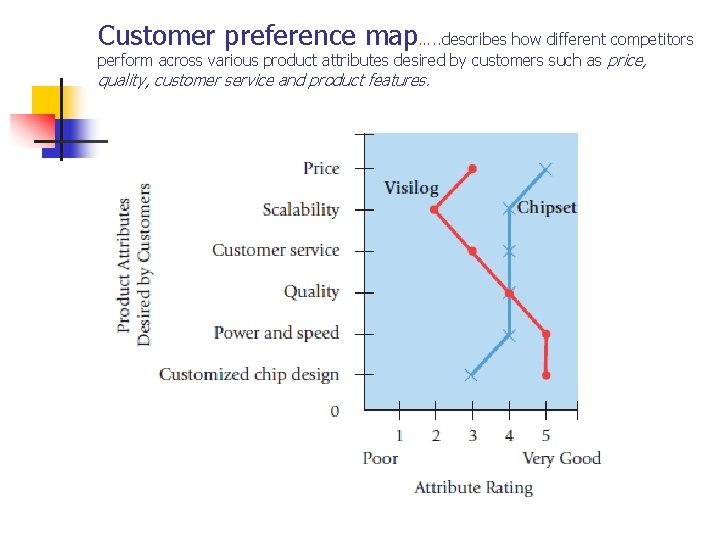
Customer preference map…. . describes how different competitors perform across various product attributes desired by customers such as price, quality, customer service and product features.
Conventional PMSs are criticized for; 1. Being biased towards financial indicators; 2. Providing lagging indicators; 3. Being less flexible; 4. Being non-related to strategies; 5. Being short-term oriented; 6. Promoting sub-optimization
Reasons for the development of BSC • Prior to 1980 too much emphasis on Ø Ø Ø • Ignorance of other dimensions important to compete in the global market place Ø Ø Ø 7
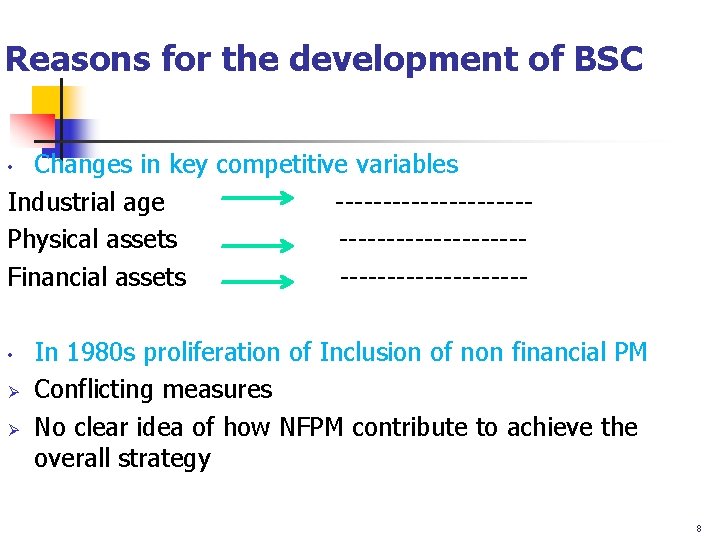
Reasons for the development of BSC Changes in key competitive variables Industrial age ----------Physical assets ----------Financial assets ---------- • • Ø Ø In 1980 s proliferation of Inclusion of non financial PM Conflicting measures No clear idea of how NFPM contribute to achieve the overall strategy 8
Reasons for the development of BSC cont. With the increasing emphasis on Mkt. competition, innovations, change and strategic aspects of managing business, limitations of conventional PMS have led to develop new models. Ø Ø n n The BSC proposed by Kaplan & Norton (1992) is the most well-known strategic PMS today. It attempts to overcome weaknesses of conventional PMS by; ------------------------------------------------------9
Most organizations have problem of executing their strategy. • Less than 10% of strategies effectively formulated are effectively executed. - Fortune Magazine n “Our problem is not about the strategy itself but about our execution of it”. -Tony Hayward, CEO, BP n “I’d rather have a mediocre strategy that is well executed than a brilliant strategy executed poorly. ”- Jamie Dimon, CEO, J. P. Morgan Chase n Companies on average realize only 60% of the financial performance of their strategies promise. . . more than one-third of executives surveyed placed the figure at less than 50%. Harvard Business Review Source: Presentation by Kaplan, R (2007)
The Balanced Scorecard § § The balanced scorecard translates an organization’s mission and strategy into a set of performance measures that provides the framework for implementing its strategy It is called the balanced scorecard because it balances the use of financial and nonfinancial performance measures to evaluate performance 11
n BSC reduces manager’s emphasis on short-run financial performance Why?
BSC Advocates looking at the business from four different perspectives by seeking to provide answers to the following four basic questions: 1. 2. 3. 4. How do customers see us? ------What must we excel at? ------Can we continue to improve and create value? -------How should we appear to our shareholders? -------

14
• • To implement the BSC the major objectives for each of the 4 perspectives should be articulated and these objectives should be translated into specific performance measures. A critical assumption of BSC is that each performance measure is part of a cause-and-effect relationship.
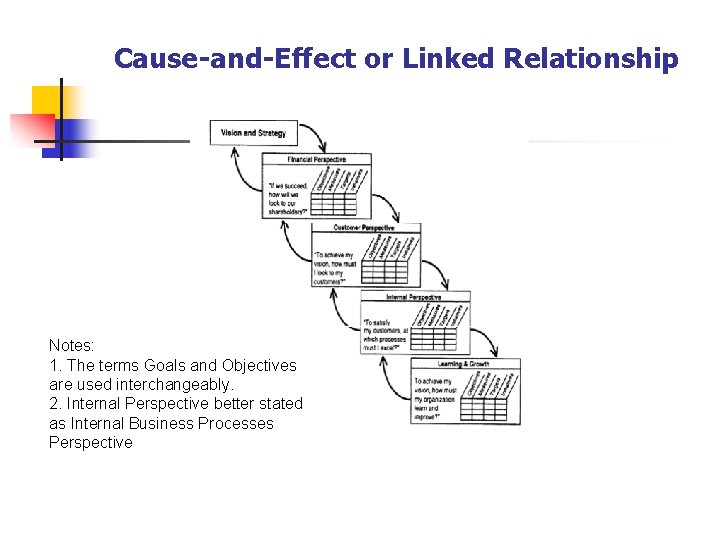
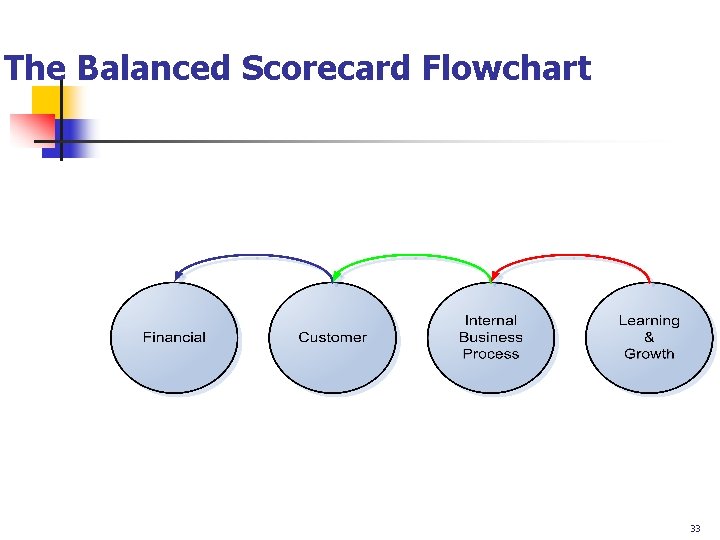
Cause-and-Effect or Linked Relationship Notes: 1. The terms Goals and Objectives are used interchangeably. 2. Internal Perspective better stated as Internal Business Processes Perspective
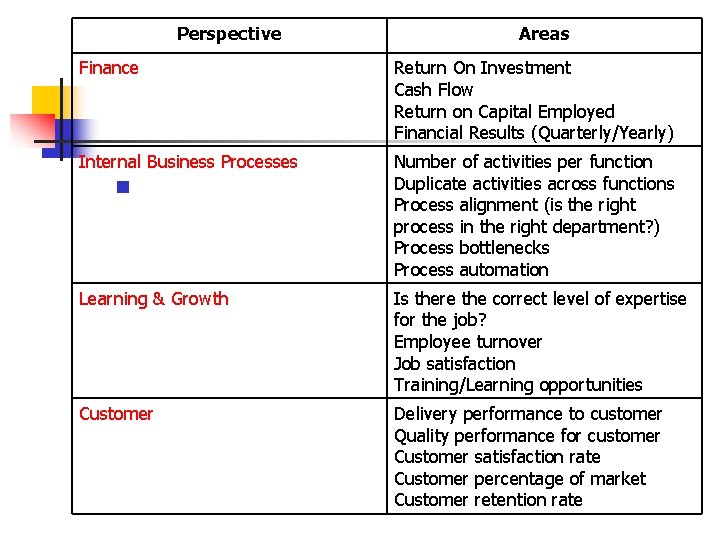
Perspective Areas Finance Return On Investment Cash Flow Return on Capital Employed Financial Results (Quarterly/Yearly) Internal Business Processes Number of activities per function Duplicate activities across functions Process alignment (is the right process in the right department? ) Process bottlenecks Process automation n Learning & Growth Is there the correct level of expertise for the job? Employee turnover Job satisfaction Training/Learning opportunities Customer Delivery performance to customer Quality performance for customer Customer satisfaction rate Customer percentage of market Customer retention rate
Components of BSC perspectives Ø Ø Goals: Based on our strategy, what are the key areas that we must work on? Measures: What are the yardsticks that we can use to define our success in these key areas? Targets: What specific results using these yardsticks should we aim to achieve? Initiatives: What actions do we plan for to achieve these results?
Types of Measures Ø Ø Outcome Measures: n ‘Lagging indicators’ n e. g: Driver Measures/Performance Drivers): n ‘Leading indicators’
Types of Measures continued Ø Ø v External Measures: e. g. Internal Measures: e. g. Companies must strike a balance between defining their external and internal measures of performance. e. g. Avoid external results altogether and mistakenly believe that good internal measures are sufficient.
The Financial Perspective n n Evaluates the profitability of the strategy implementation and execution The other three perspectives eventually feed back into this dimension 21
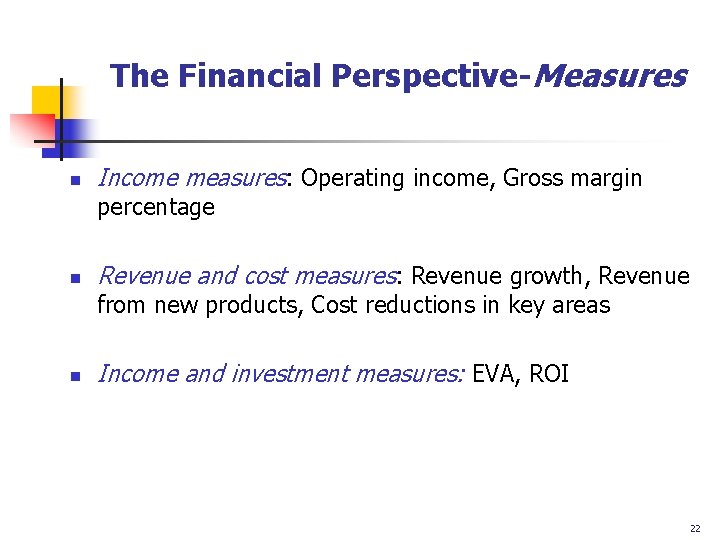
The Financial Perspective-Measures n Income measures: Operating income, Gross margin percentage n Revenue and cost measures: Revenue growth, Revenue from new products, Cost reductions in key areas n Income and investment measures: EVA, ROI 22
The Customer Perspective n Identifies targeted customer and market segments and measures the company’s success in these segments 23
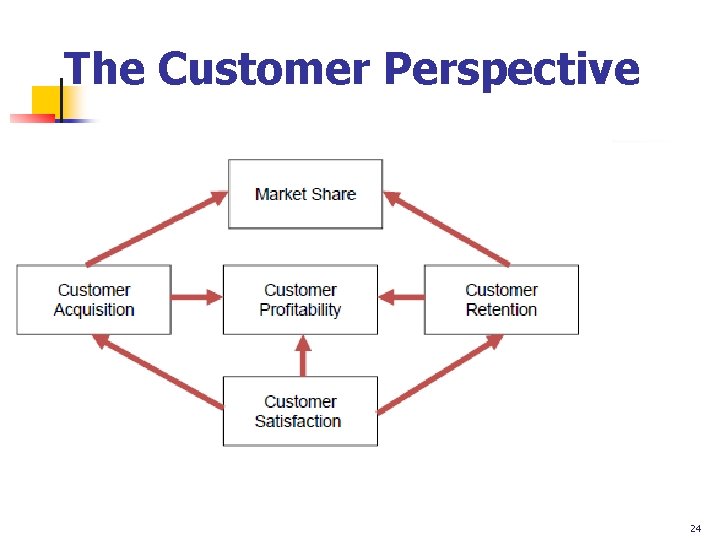
The Customer Perspective 24
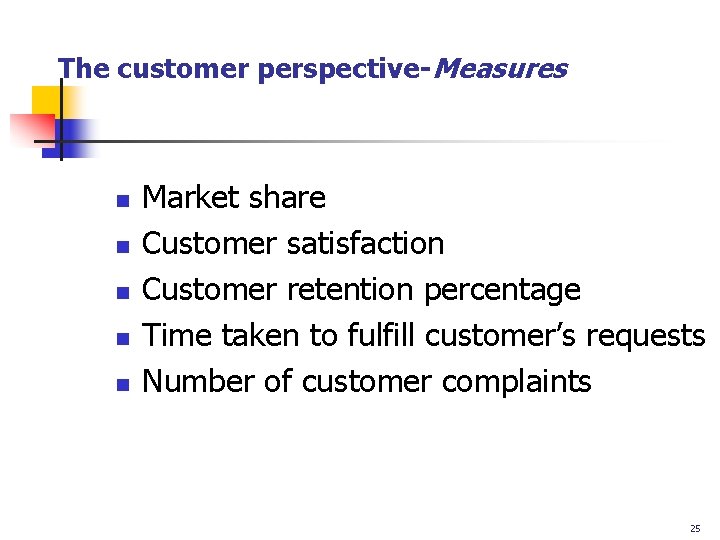
The customer perspective-Measures n n n Market share Customer satisfaction Customer retention percentage Time taken to fulfill customer’s requests Number of customer complaints 25
The Internal Business Perspective n n Focuses on internal operations that create value for customers that, in turn, furthers the financial perspective by increasing shareholder value Includes three sub processes: 1. 2. 3. Innovation Operations Post-sales service 26
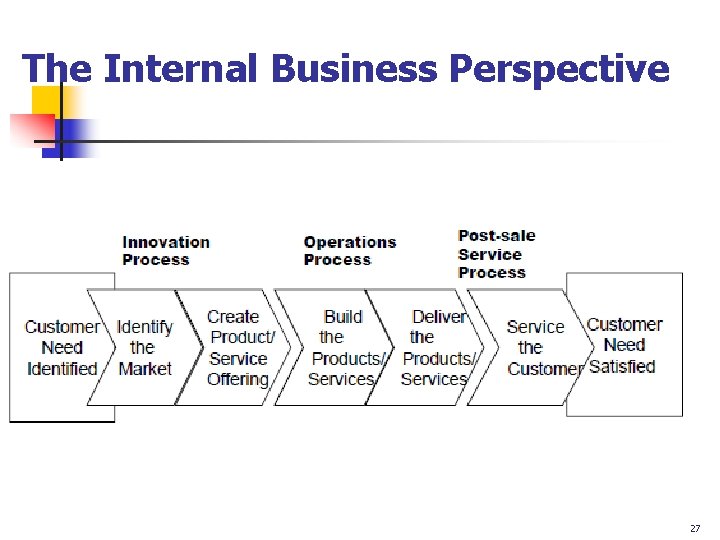
The Internal Business Perspective 27
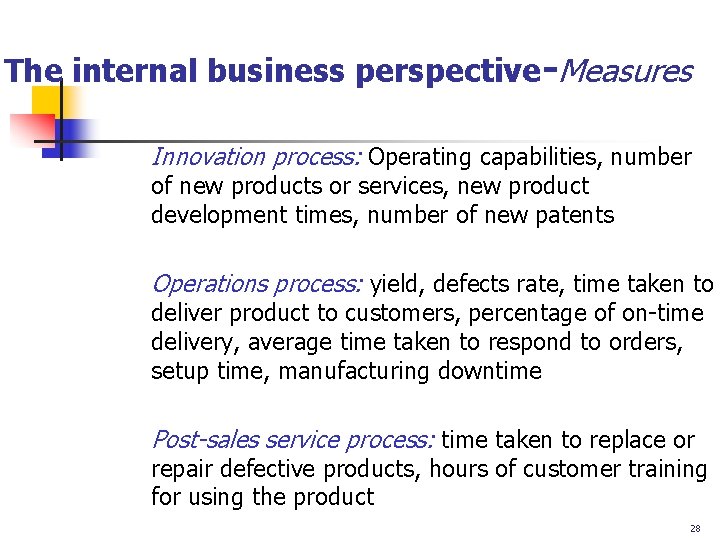
The internal business perspective-Measures Innovation process: Operating capabilities, number of new products or services, new product development times, number of new patents Operations process: yield, defects rate, time taken to deliver product to customers, percentage of on-time delivery, average time taken to respond to orders, setup time, manufacturing downtime Post-sales service process: time taken to replace or repair defective products, hours of customer training for using the product 28
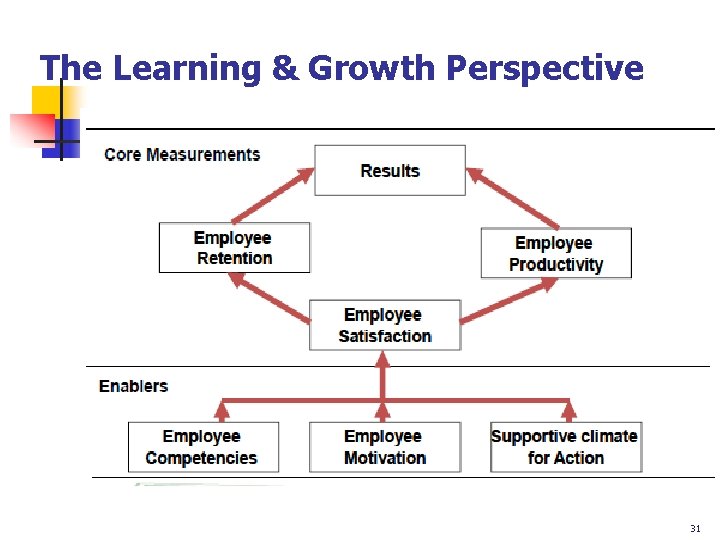
The Learning & Growth Perspective n Identifies the capabilities the organization must excel at to achieve superior internal processes that create value for customers and shareholders 29
The Learning & Growth Perspective Principle sources of learning and growth n People n Systems n Organizational procedures 30
The Learning & Growth Perspective 31
The learning and growth perspective-Measures n Employee measures: employee education & skill level, employee satisfaction rating, employee turnover rates, percentage of employee suggestions implemented n Technology measures: information system availability, percentage of processes with advanced controls. 32
The Balanced Scorecard Flowchart 33
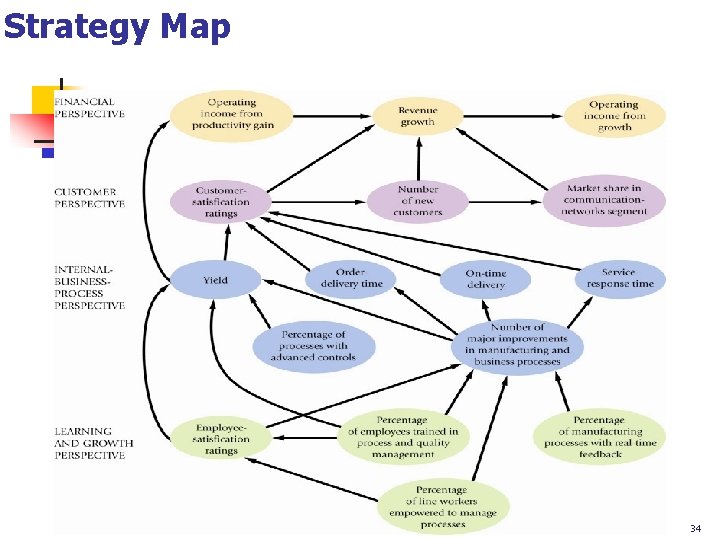
Strategy Map 34
Crafting and Implementing a Balanced Scorecard 1. Define Strategy: What do we want to achieve and how do we accomplish this? 2. Define Measures of Strategy: What specifically should we be working on to support the strategy?
Crafting and Implementing a Balanced Scorecard continued Cause-Effect Relationship among Measures Perspective Measures
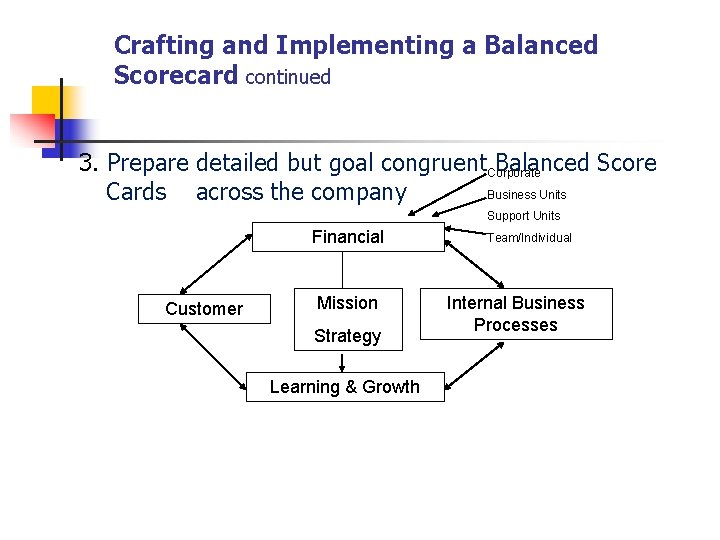
Crafting and Implementing a Balanced Scorecard continued 3. Prepare detailed but goal congruent. Corporate Balanced Score Business Units Cards across the company Support Units Financial Customer Mission Strategy Learning & Growth Team/Individual Internal Business Processes
Crafting and Implementing a Balanced Scorecard continued 4. Integrate Measures into the Management System -The BSC must be integrated with the company’s structure, practices, culture e. g Performance appraisal and rewards must be based on achieving over-all BSC measures, not just financial results. 5. Review Measures and Results Regularly - Keep measures aligned to changes in strategy - Improve measurement
Pitfalls with use of balanced scorecard 1. Too few measures or too many measures 2. Incorrect alignment of drivers in the internal and learning and growth perspectives to the desired outcomes in the financial and customer perspectives 3. Senior management not committed 4. One senior manager tries to build the scorecard alone 5. Scorecard responsibilities do not filter down 6. Scorecard treated as a one off event or as a systems project
Case Study n n La Quinta Corporation manufactures corrugated cardboard boxes. It competes and plans to grow by selling high-quality boxes at a low price and by delivering them to customers quickly after receiving customers’ orders. There are many other manufacturers who produce similar boxes. La Quinta believes that continuously improving its manufacturing processes and having satisfied employees are critical to implementing its strategy in 2018. n Contd…. .
n n Required: Is La Quinta’s 2018 strategy one of product differentiation or cost leadership? Explain briefly. Mesa Corporation, a competitor of La Quinta, manufactures corrugated boxes with more designs and color combinations than La Quinta at a higher price. Mesa’s boxes are of high quality but require more time to produce and so have longer delivery times. Draw a simple customer preference map for La Quinta and Mesa using the attributes of price, delivery time, quality, and design. Indicate two measures you would expect to see under each perspective in La Quinta’s balanced scorecard for 2018. Use a strategy map to explain your answer.
- Slides: 41