
Performance Measurement and Responsibility Accounting Chapter 9 Power
Performance Measurement and Responsibility Accounting Chapter 9 Power. Point Editor: Anna Boulware Wild and Shaw Managerial Accounting 5 th Edition Copyright © 2016 Mc. Graw-Hill Education. All rights reserved. No reproduction or distribution without the prior written consent of Mc. Graw -Hill Education.
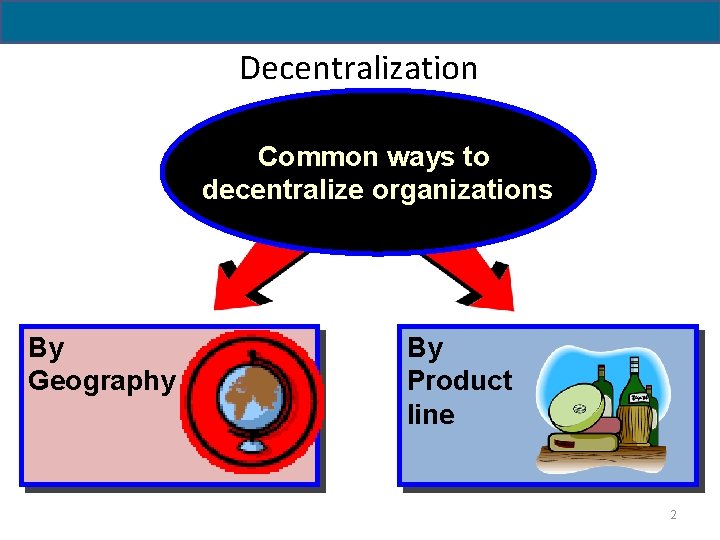
Decentralization Common ways to decentralize organizations By Geography By Product line 2
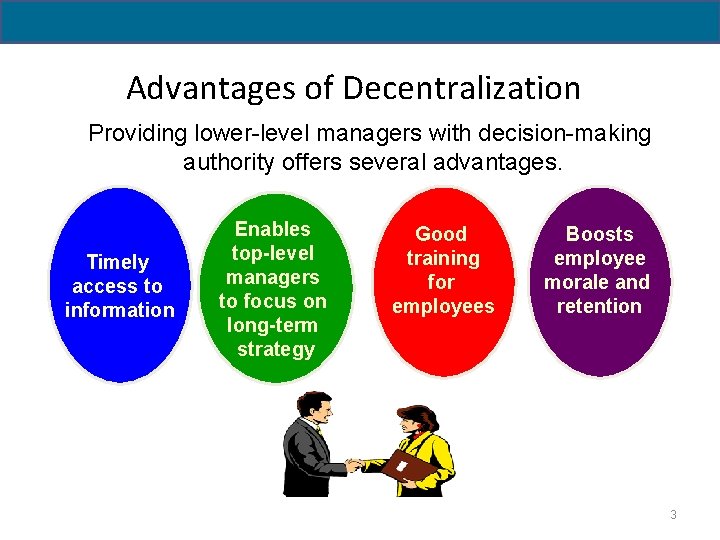
Advantages of Decentralization Providing lower-level managers with decision-making authority offers several advantages. Timely access to information Enables top-level managers to focus on long-term strategy Good training for employees Boosts employee morale and retention 3
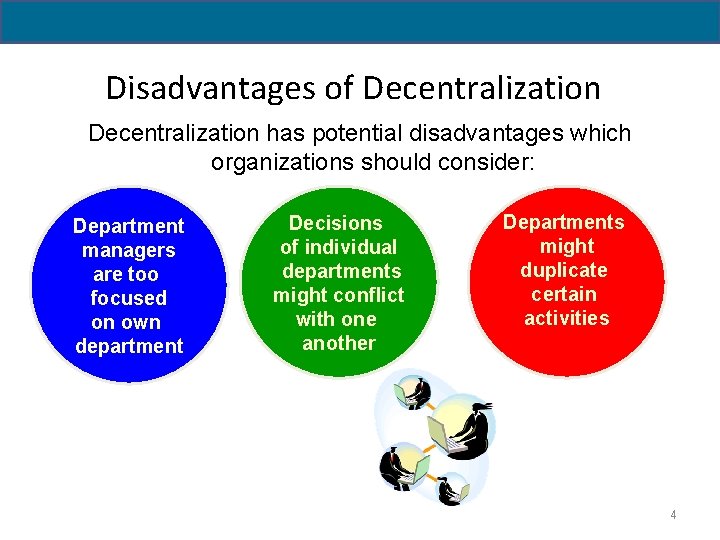
Disadvantages of Decentralization has potential disadvantages which organizations should consider: Department managers are too focused on own department Decisions of individual departments might conflict with one another Departments might duplicate certain activities 4
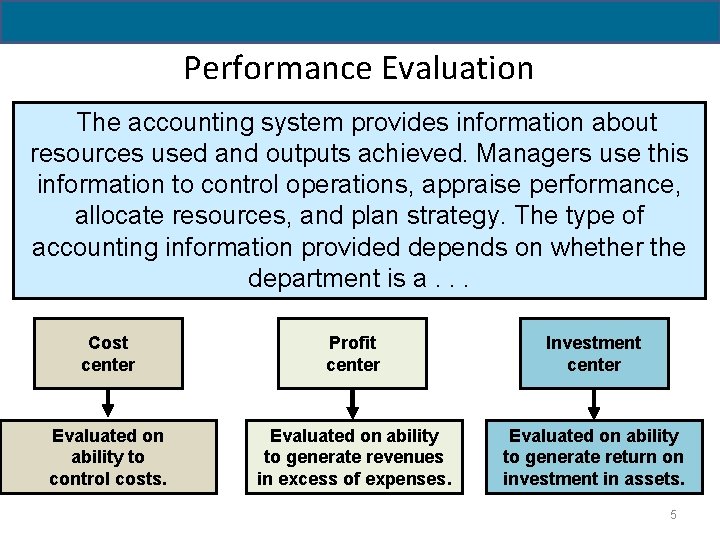
Performance Evaluation The accounting system provides information about resources used and outputs achieved. Managers use this information to control operations, appraise performance, allocate resources, and plan strategy. The type of accounting information provided depends on whether the department is a. . . Cost center Profit center Investment center Evaluated on ability to control costs. Evaluated on ability to generate revenues in excess of expenses. Evaluated on ability to generate return on investment in assets. 5
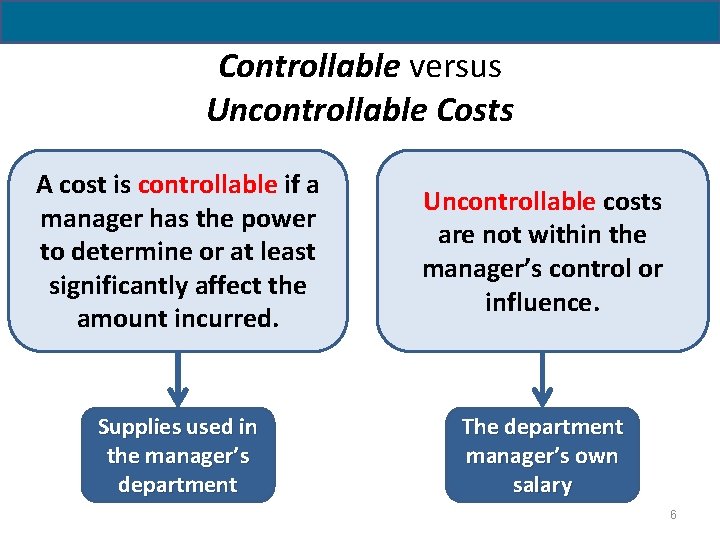
Controllable versus Uncontrollable Costs A cost is controllable if a manager has the power to determine or at least significantly affect the amount incurred. Uncontrollable costs are not within the manager’s control or influence. Supplies used in the manager’s department The department manager’s own salary 6
9 -P 1: Responsibility Accounting 7
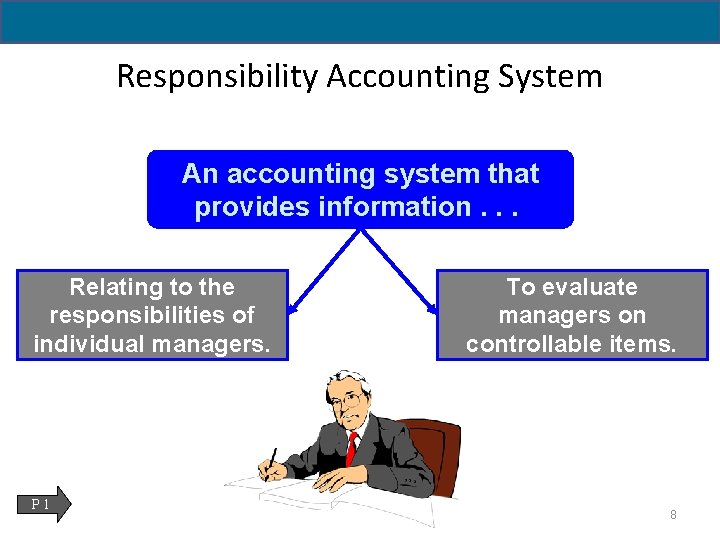
Responsibility Accounting System An accounting system that provides information. . . Relating to the responsibilities of individual managers. P 1 To evaluate managers on controllable items. 8

Successful implementation of responsibility accounting may use organization charts with clear lines of authority and clearly defined levels of responsibility. P 1 9
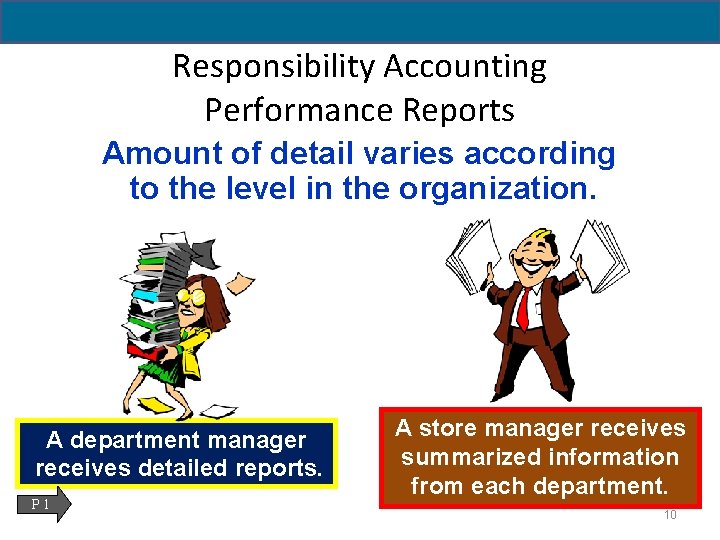
Responsibility Accounting Performance Reports Amount of detail varies according to the level in the organization. A department manager receives detailed reports. P 1 A store manager receives summarized information from each department. 10
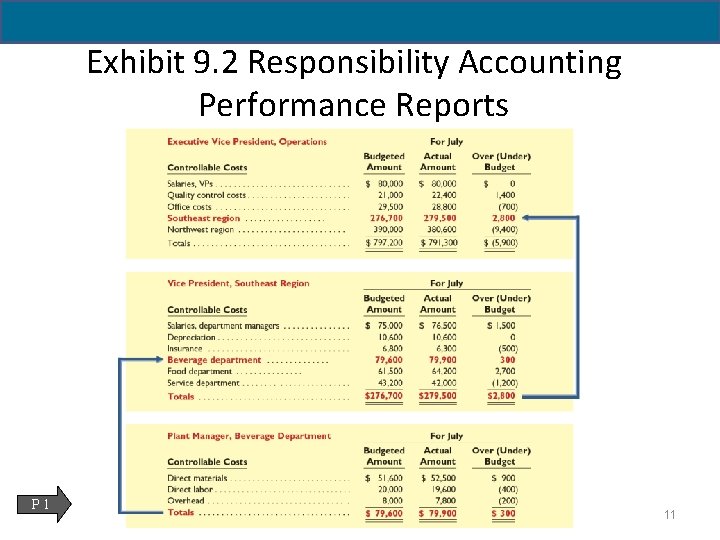
Exhibit 9. 2 Responsibility Accounting Performance Reports P 1 11
9 -C 1: Direct and Indirect Expenses 12

Direct and Indirect Expenses Direct expenses are incurred for the sole benefit of a specific department. Indirect expenses benefit more than one department and are allocated among departments benefited. C 1 Salary of employee who works in only one department. Multiple departments share rent, electricity, and heat. 13
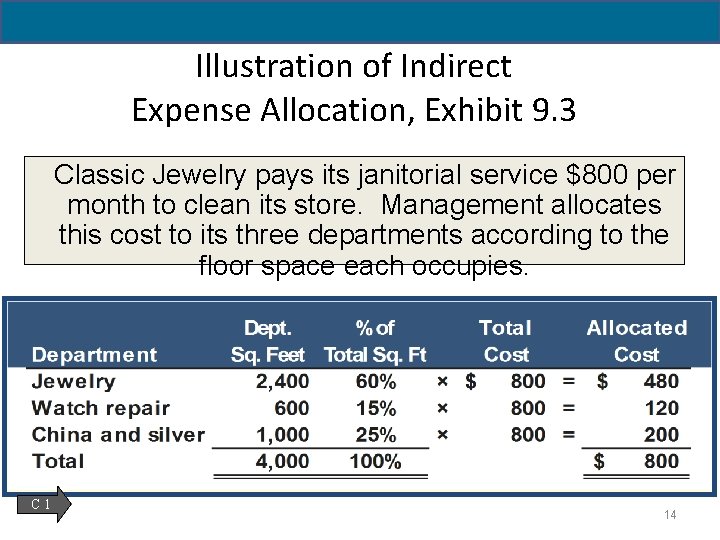
Illustration of Indirect Expense Allocation, Exhibit 9. 3 Classic Jewelry pays its janitorial service $800 per month to clean its store. Management allocates this cost to its three departments according to the floor space each occupies. C 1 14
9 -P 2: Allocation of Indirect Expenses 15
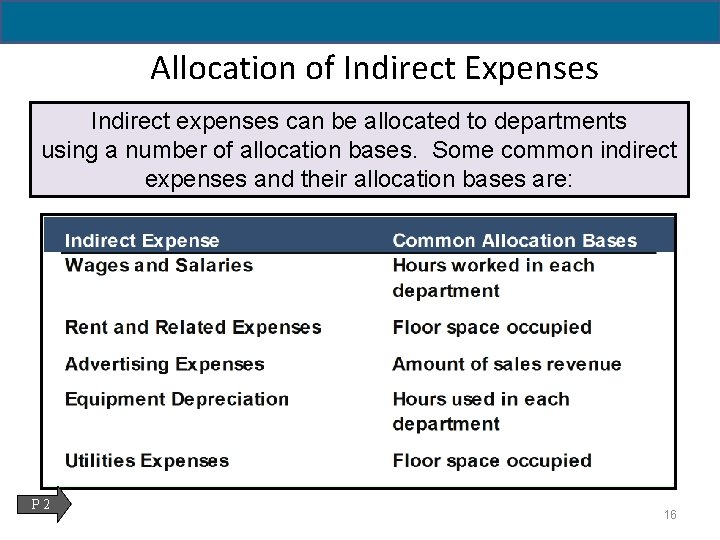
Allocation of Indirect Expenses Indirect expenses can be allocated to departments using a number of allocation bases. Some common indirect expenses and their allocation bases are: P 2 16
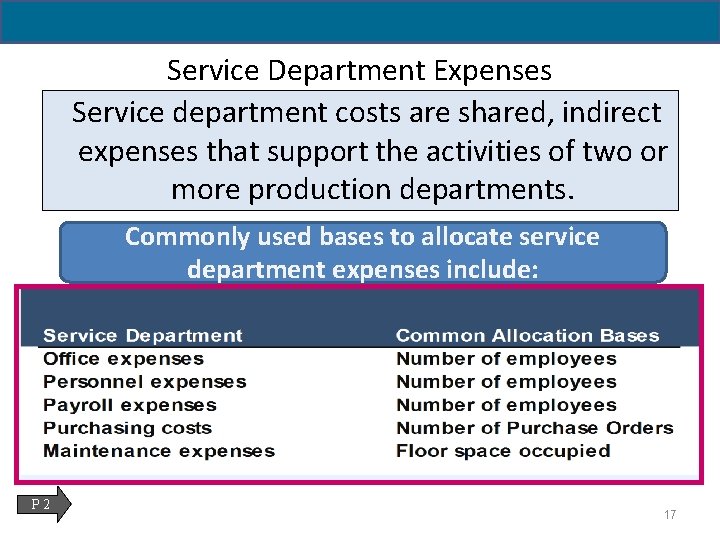
Service Department Expenses Service department costs are shared, indirect expenses that support the activities of two or more production departments. Commonly used bases to allocate service department expenses include: P 2 17
9 -P 3: Departmental Income Statements 18
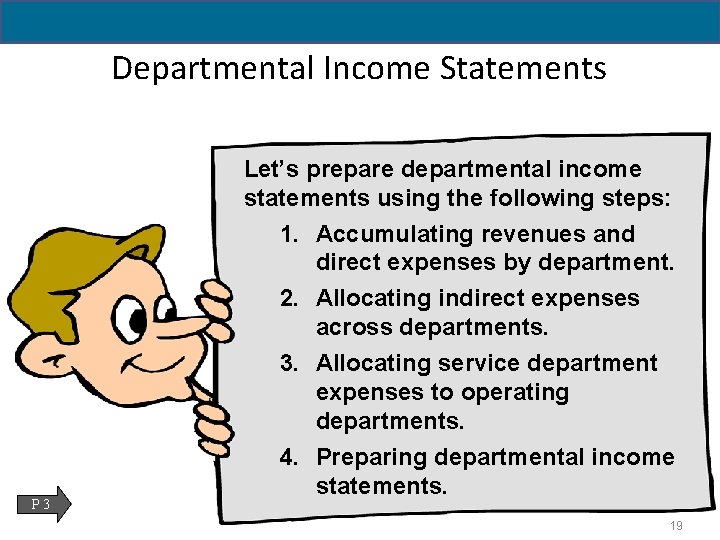
Departmental Income Statements Let’s prepare departmental income statements using the following steps: 1. Accumulating revenues and direct expenses by department. 2. Allocating indirect expenses across departments. 3. Allocating service department expenses to operating departments. P 3 4. Preparing departmental income statements. 19
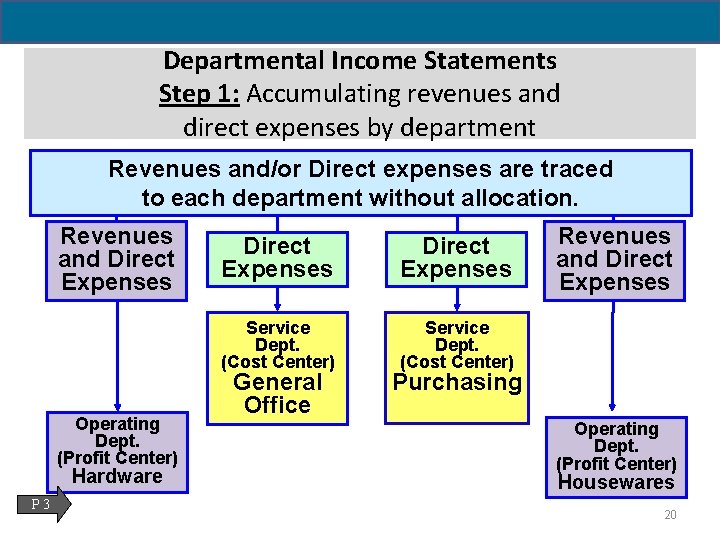
Departmental Income Statements Step 1: Accumulating revenues and direct expenses by department Revenues and/or Direct expenses are traced to each department without allocation. Revenues and Direct Expenses Operating Dept. (Profit Center) Hardware P 3 Direct Expenses Service Dept. (Cost Center) General Office Revenues and Direct Expenses Purchasing Operating Dept. (Profit Center) Housewares 20
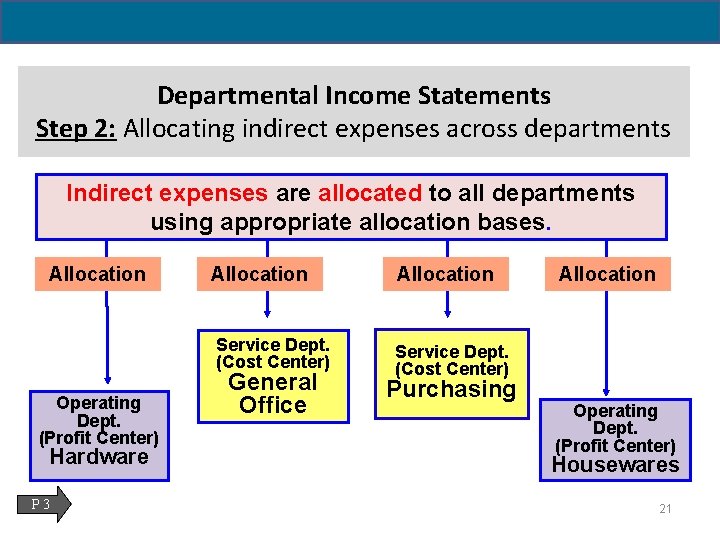
Departmental Income Statements Step 2: Allocating indirect expenses across departments Indirect expenses are allocated to all departments using appropriate allocation bases. Allocation Operating Dept. (Profit Center) Hardware P 3 Allocation Service Dept. (Cost Center) General Office Purchasing Allocation Operating Dept. (Profit Center) Housewares 21
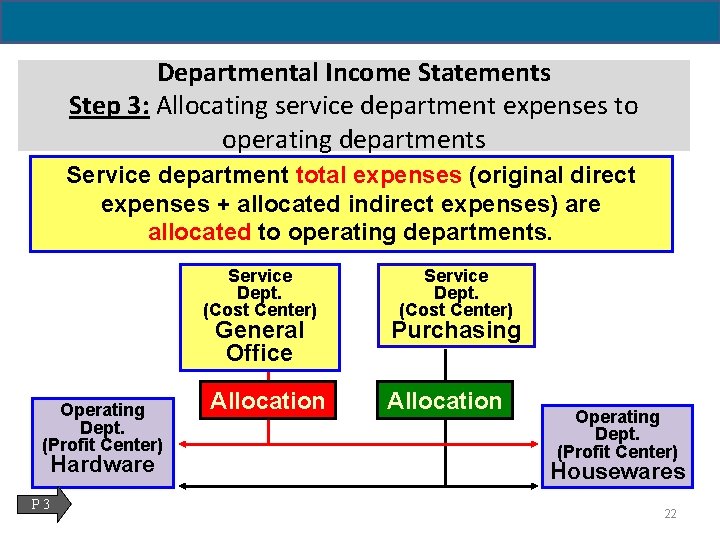
Departmental Income Statements Step 3: Allocating service department expenses to operating departments Service department total expenses (original direct expenses + allocated indirect expenses) are allocated to operating departments. Service Dept. (Cost Center) Operating Dept. (Profit Center) Hardware P 3 Service Dept. (Cost Center) General Office Purchasing Allocation Operating Dept. (Profit Center) Housewares 22
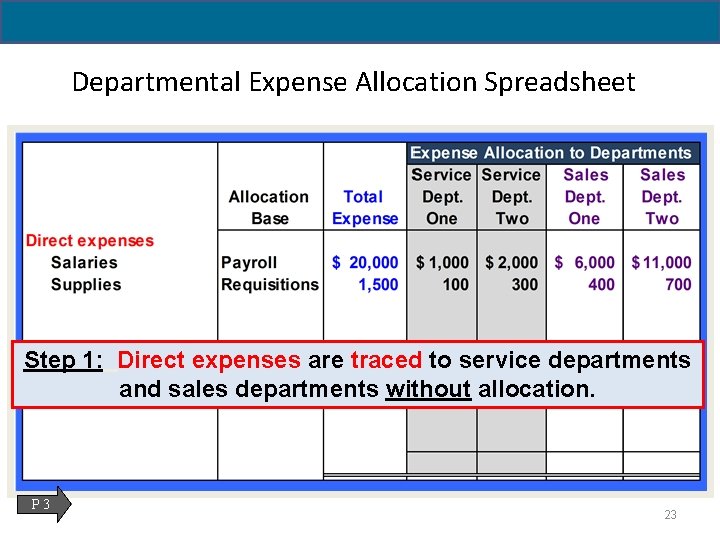
Departmental Expense Allocation Spreadsheet Step 1: Direct expenses are traced to service departments and sales departments without allocation. P 3 23
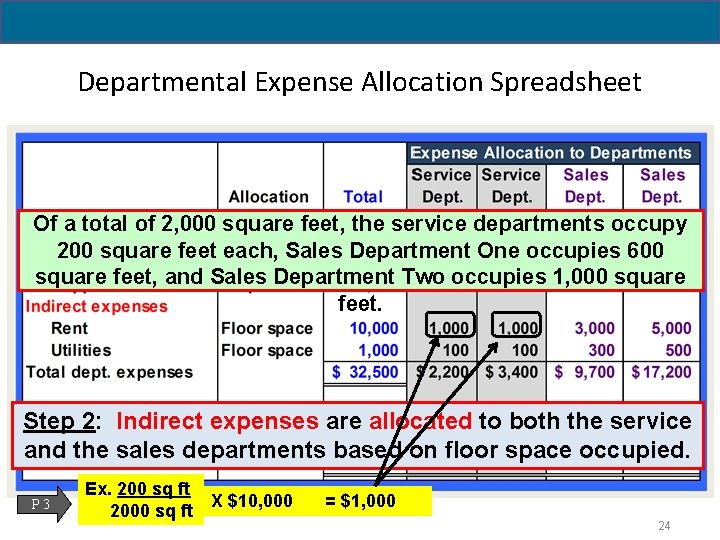
Departmental Expense Allocation Spreadsheet Of a total of 2, 000 square feet, the service departments occupy 200 square feet each, Sales Department One occupies 600 square feet, and Sales Department Two occupies 1, 000 square feet. Step 2: Indirect expenses are allocated to both the service and the sales departments based on floor space occupied. P 3 Ex. 200 sq ft 2000 sq ft X $10, 000 = $1, 000 24
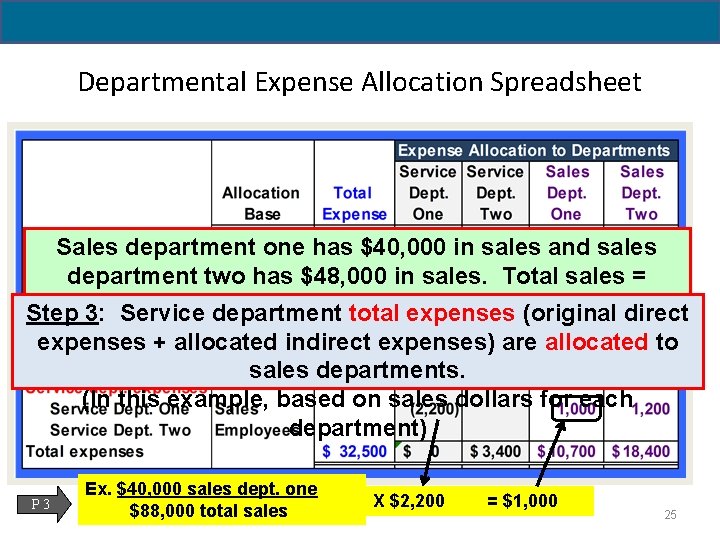
Departmental Expense Allocation Spreadsheet Sales department one has $40, 000 in sales and sales department two has $48, 000 in sales. Total sales = $88, 000 Step 3: Service department total expenses (original direct expenses + allocated indirect expenses) are allocated to sales departments. (In this example, based on sales dollars for each department) P 3 Ex. $40, 000 sales dept. one $88, 000 total sales X $2, 200 = $1, 000 25
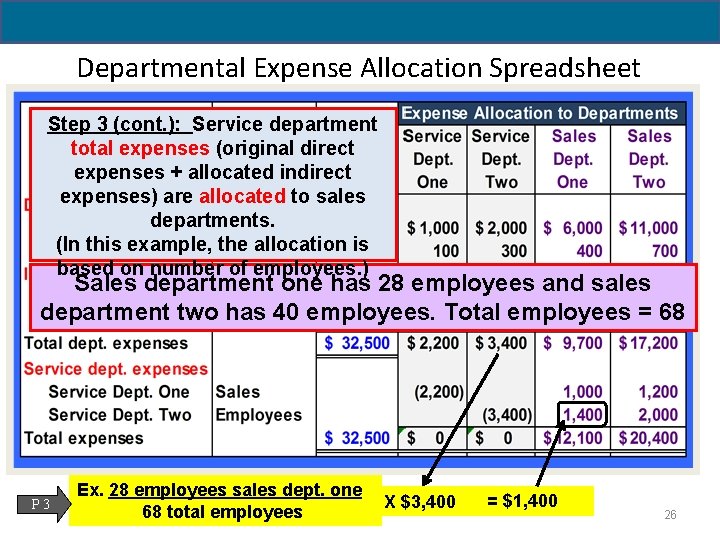
Departmental Expense Allocation Spreadsheet Step 3 (cont. ): Service department total expenses (original direct expenses + allocated indirect expenses) are allocated to sales departments. (In this example, the allocation is based on number of employees. ) Sales department one has 28 employees and sales department two has 40 employees. Total employees = 68 P 3 Ex. 28 employees sales dept. one 68 total employees X $3, 400 = $1, 400 26
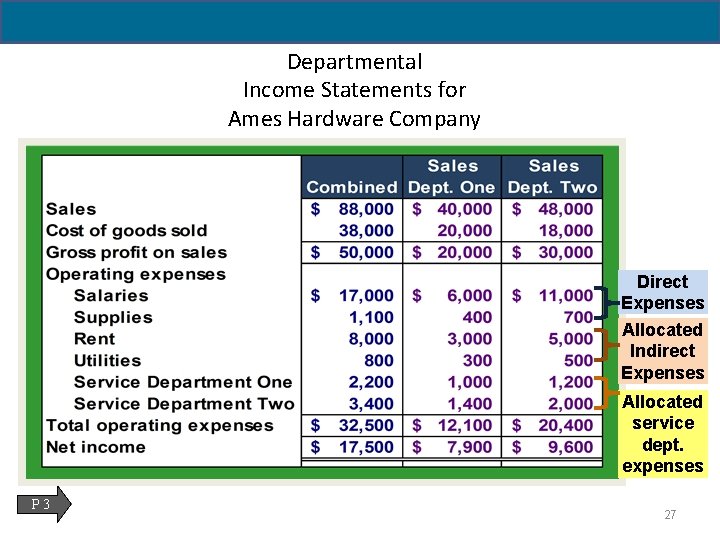
Departmental Income Statements for Ames Hardware Company Direct Expenses Allocated Indirect Expenses Allocated service dept. expenses P 3 27
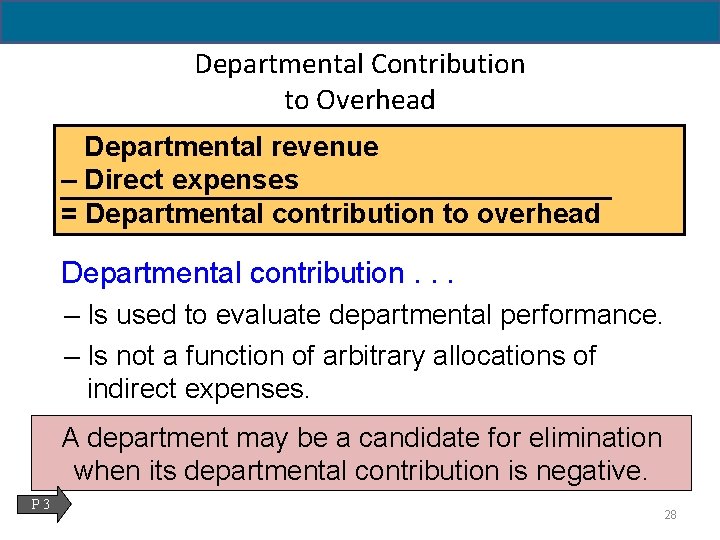
Departmental Contribution to Overhead Departmental revenue – Direct expenses = Departmental contribution to overhead Departmental contribution. . . – Is used to evaluate departmental performance. – Is not a function of arbitrary allocations of indirect expenses. A department may be a candidate for elimination when its departmental contribution is negative. P 3 28
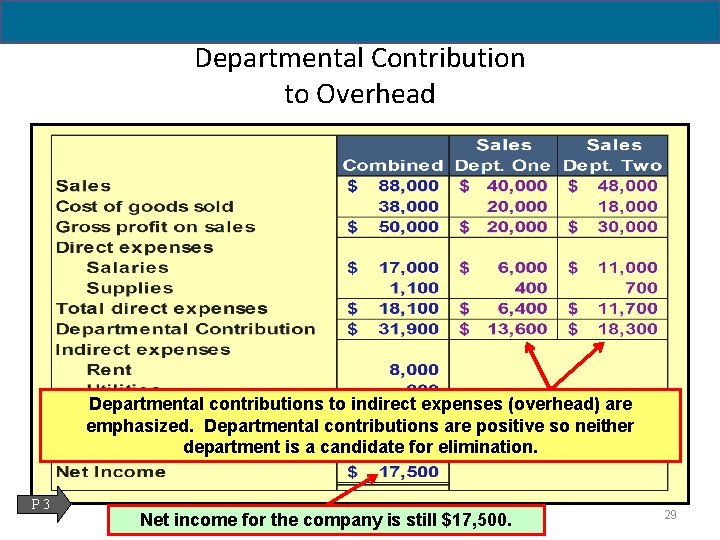
Departmental Contribution to Overhead Departmental contributions to indirect expenses (overhead) are emphasized. Departmental contributions are positive so neither department is a candidate for elimination. P 3 Net income for the company is still $17, 500. 29
9 -A 1: Evaluating Investment Center Performance 30
Evaluating Investment Center Performance Investment center managers are responsible for generating profit and for the investment of assets. They will be evaluated based on their ability to generate enough operating income to justify the investment in assets used to generate the operating income. Two performance measures are: • Investment Center Return on Assets • Investment Center Residual Income A 1 31
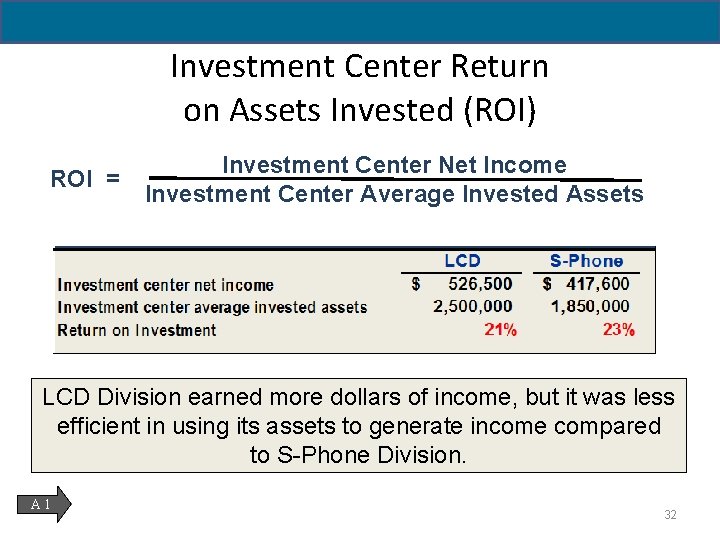
Investment Center Return on Assets Invested (ROI) ROI = Investment Center Net Income Investment Center Average Invested Assets LCD Division earned more dollars of income, but it was less efficient in using its assets to generate income compared to S-Phone Division. A 1 32
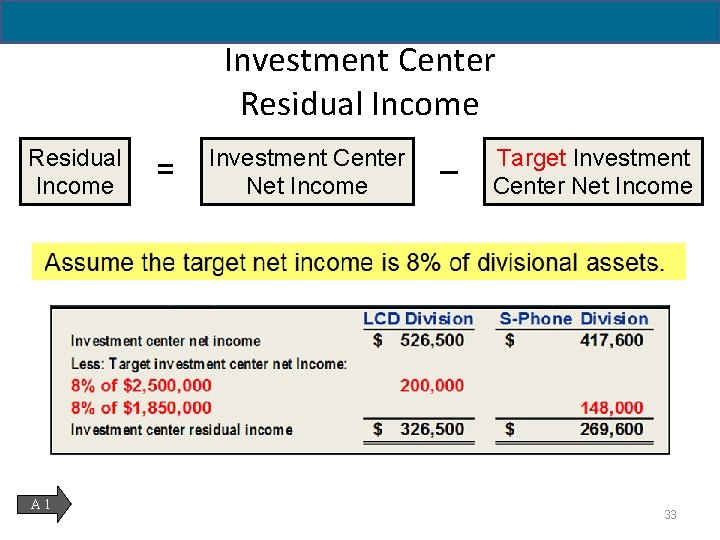
Investment Center Residual Income A 1 = Investment Center Net Income – Target Investment Center Net Income 33
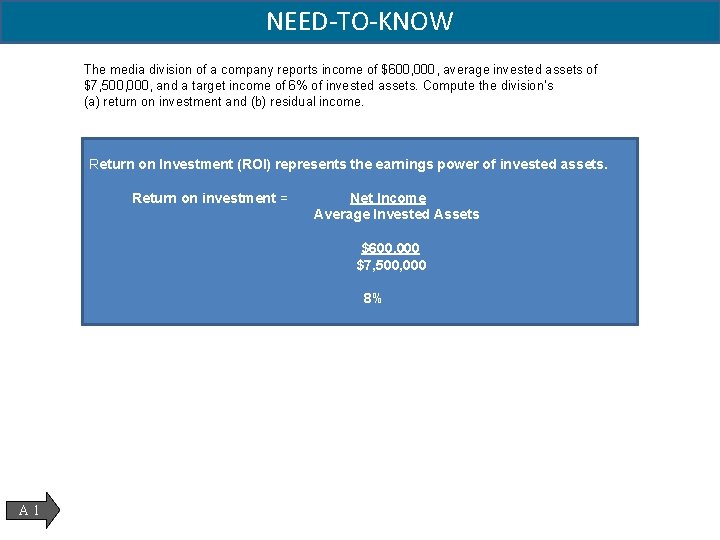
NEED-TO-KNOW The media division of a company reports income of $600, 000, average invested assets of $7, 500, 000, and a target income of 6% of invested assets. Compute the division’s (a) return on investment and (b) residual income. Return on Investment (ROI) represents the earnings power of invested assets. Return on investment = Net Income Average Invested Assets $600, 000 $7, 500, 000 8% A 1
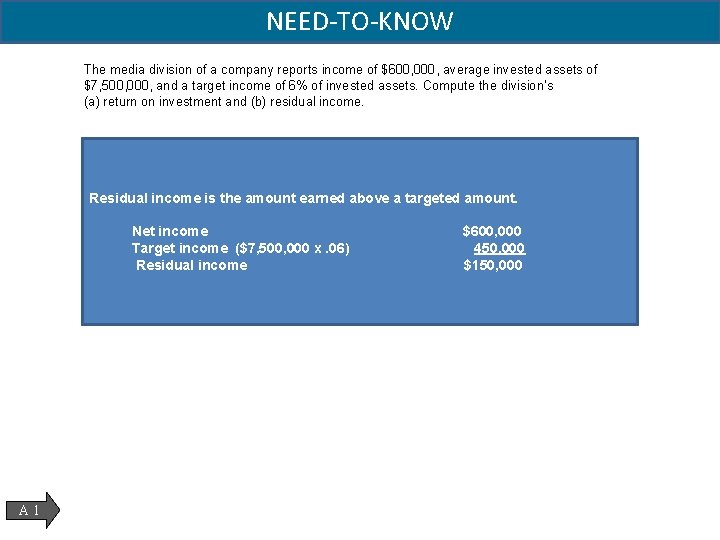
NEED-TO-KNOW The media division of a company reports income of $600, 000, average invested assets of $7, 500, 000, and a target income of 6% of invested assets. Compute the division’s (a) return on investment and (b) residual income. Residual income is the amount earned above a targeted amount. Net income Target income ($7, 500, 000 x. 06) Residual income A 1 $600, 000 450, 000 $150, 000
9 -A 2: Investment Center Profit Margin and Investment Turnover 36
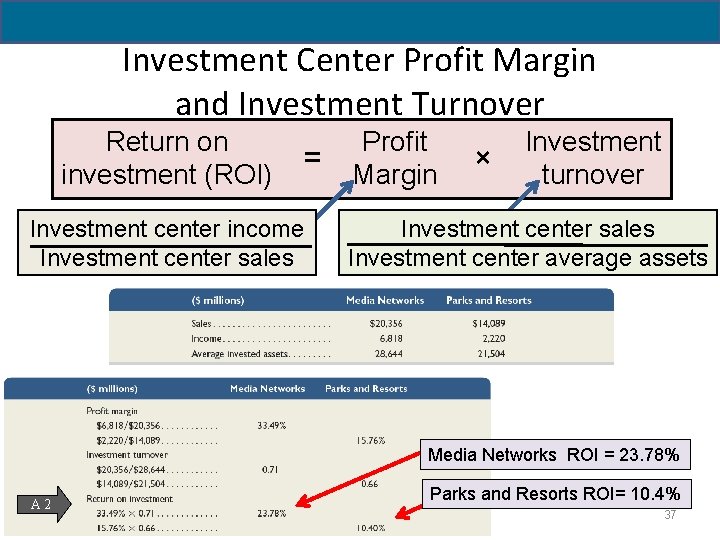
Investment Center Profit Margin and Investment Turnover Return on investment (ROI) = Investment center income Investment center sales Profit Margin × Investment turnover Investment center sales Investment center average assets Media Networks ROI = 23. 78% A 2 Parks and Resorts ROI= 10. 4% 37
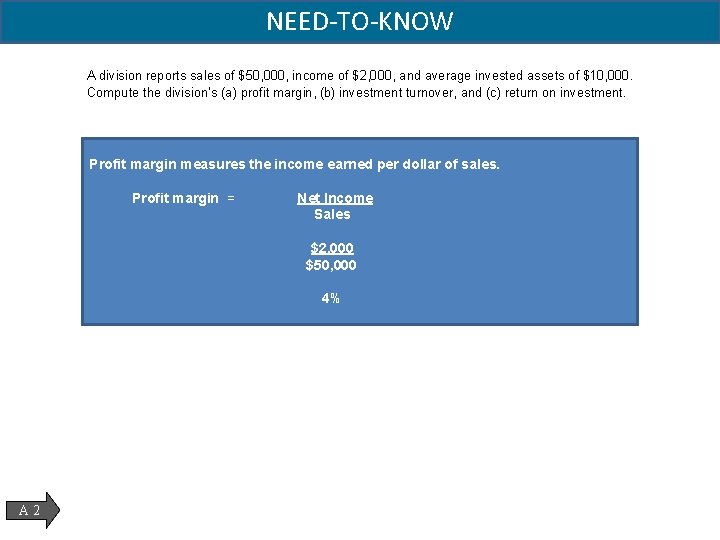
NEED-TO-KNOW A division reports sales of $50, 000, income of $2, 000, and average invested assets of $10, 000. Compute the division’s (a) profit margin, (b) investment turnover, and (c) return on investment. Profit margin measures the income earned per dollar of sales. Profit margin = Net Income Sales $2, 000 $50, 000 4% A 2
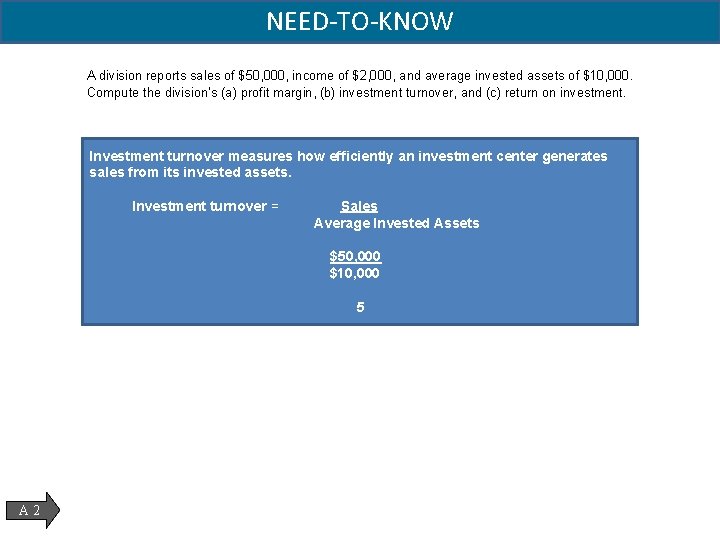
Need NEED-TO-KNOW to Know (24 -2 b) A division reports sales of $50, 000, income of $2, 000, and average invested assets of $10, 000. Compute the division’s (a) profit margin, (b) investment turnover, and (c) return on investment. Investment turnover measures how efficiently an investment center generates sales from its invested assets. Investment turnover = Sales Average Invested Assets $50, 000 $10, 000 5 A 2
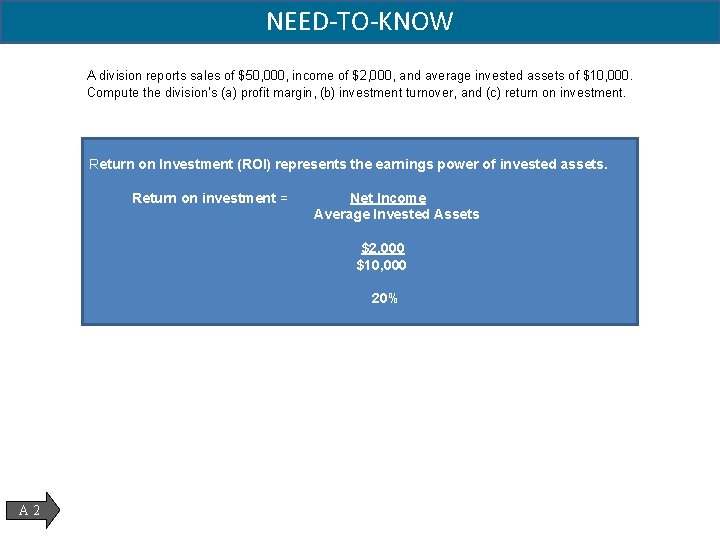
Need NEED-TO-KNOW to Know (24 -2 c) A division reports sales of $50, 000, income of $2, 000, and average invested assets of $10, 000. Compute the division’s (a) profit margin, (b) investment turnover, and (c) return on investment. Return on Investment (ROI) represents the earnings power of invested assets. Return on investment = Net Income Average Invested Assets $2, 000 $10, 000 20% A 2
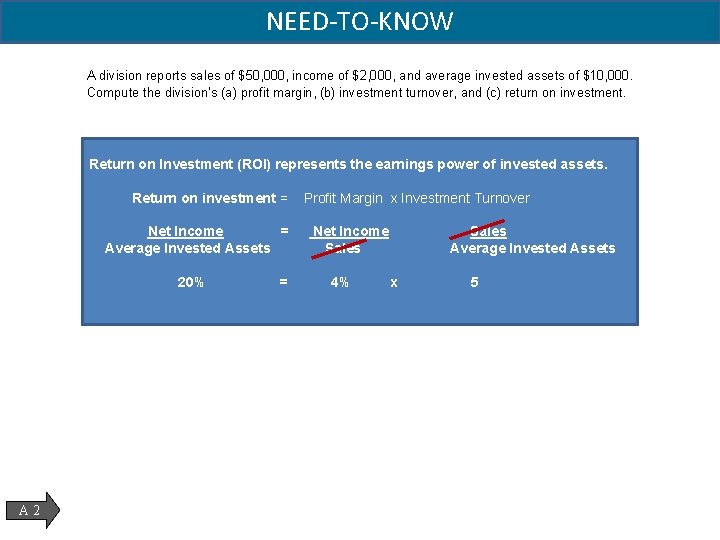
Need NEED-TO-KNOW to Know (24 -2 d) A division reports sales of $50, 000, income of $2, 000, and average invested assets of $10, 000. Compute the division’s (a) profit margin, (b) investment turnover, and (c) return on investment. Return on Investment (ROI) represents the earnings power of invested assets. Return on investment = Net Income = Average Invested Assets 20% A 2 = Profit Margin x Investment Turnover Net Income Sales 4% Sales Average Invested Assets x 5
9 -A 3: Nonfinancial Performance Evaluation Measures 42
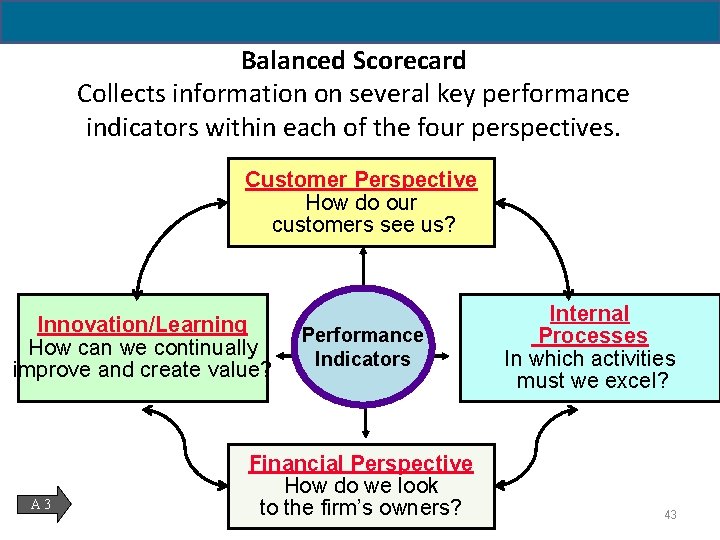
Balanced Scorecard Collects information on several key performance indicators within each of the four perspectives. Customer Perspective How do our customers see us? Innovation/Learning How can we continually improve and create value? A 3 Performance Indicators Financial Perspective How do we look to the firm’s owners? Internal Processes In which activities must we excel? 43
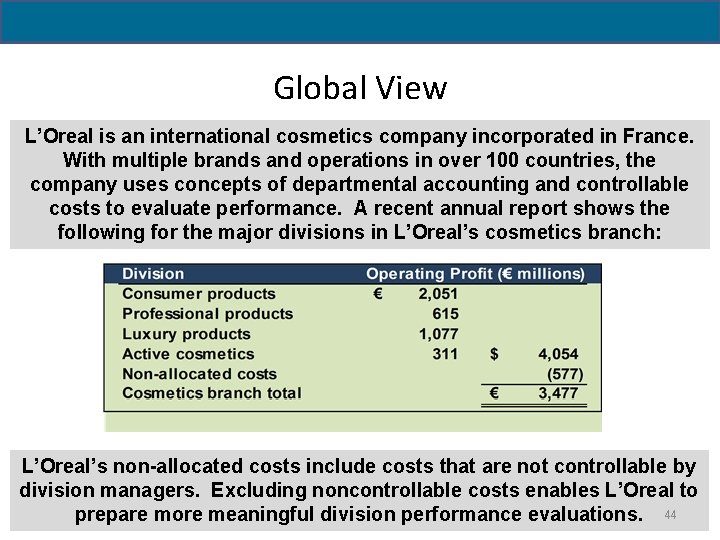
Global View L’Oreal is an international cosmetics company incorporated in France. With multiple brands and operations in over 100 countries, the company uses concepts of departmental accounting and controllable costs to evaluate performance. A recent annual report shows the following for the major divisions in L’Oreal’s cosmetics branch: L’Oreal’s non-allocated costs include costs that are not controllable by division managers. Excluding noncontrollable costs enables L’Oreal to prepare more meaningful division performance evaluations. 44
9 -A 4: Cycle Time and Cycle Efficiency 45
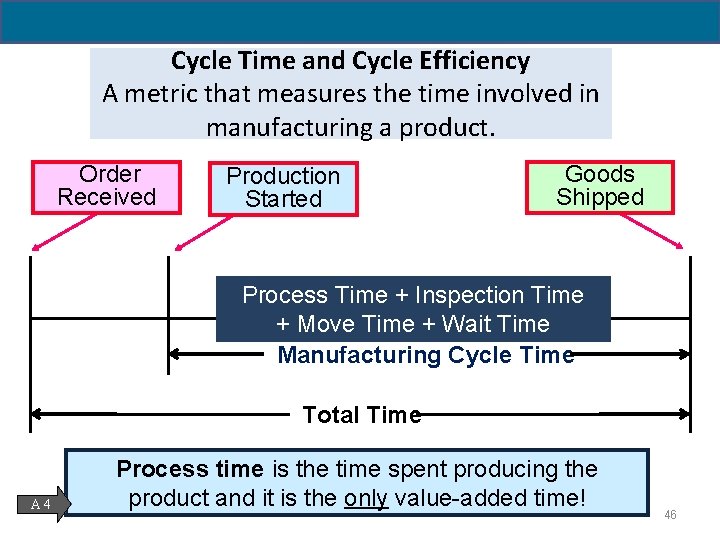
Cycle Time and Cycle Efficiency A metric that measures the time involved in manufacturing a product. Order Received Production Started Goods Shipped Process Time + Inspection Time + Move Time + Wait Time Manufacturing Cycle Time Total Time A 4 Process time is the time spent producing the product and it is the only value-added time! 46
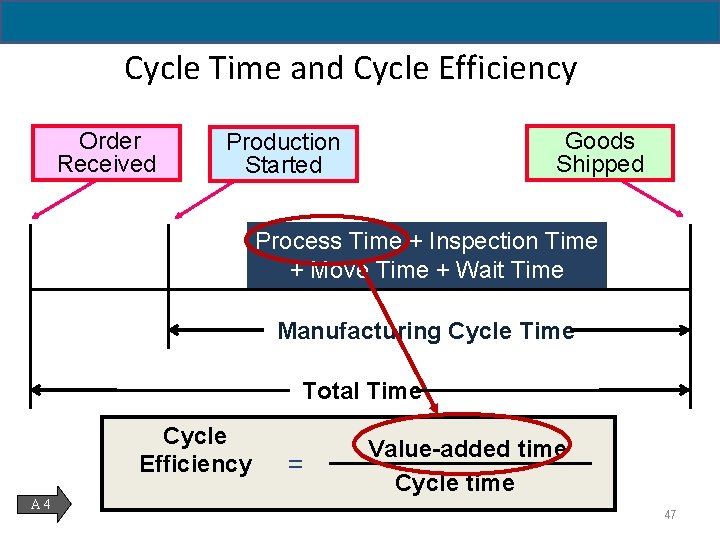
Cycle Time and Cycle Efficiency Order Received Goods Shipped Production Started Process Time + Inspection Time + Move Time + Wait Time Manufacturing Cycle Time Total Time Cycle Efficiency A 4 = Value-added time Cycle time 47
9 -C 2 (Appendix 9 A): Transfer Pricing 48
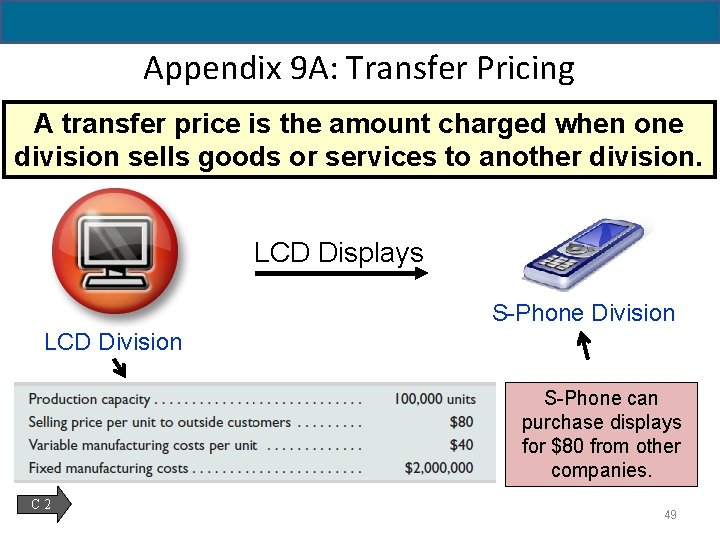
Appendix 9 A: Transfer Pricing A transfer price is the amount charged when one division sells goods or services to another division. LCD Displays S-Phone Division LCD Division S-Phone can purchase displays for $80 from other companies. C 2 49
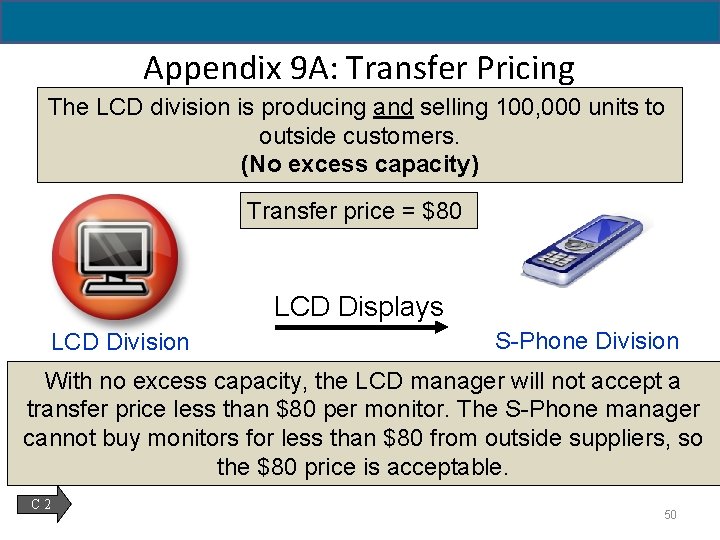
Appendix 9 A: Transfer Pricing The LCD division is producing and selling 100, 000 units to outside customers. (No excess capacity) Transfer price = $80 LCD Displays LCD Division S-Phone Division With no excess capacity, the LCD manager will not accept a transfer price less than $80 per monitor. The S-Phone manager cannot buy monitors for less than $80 from outside suppliers, so the $80 price is acceptable. C 2 50
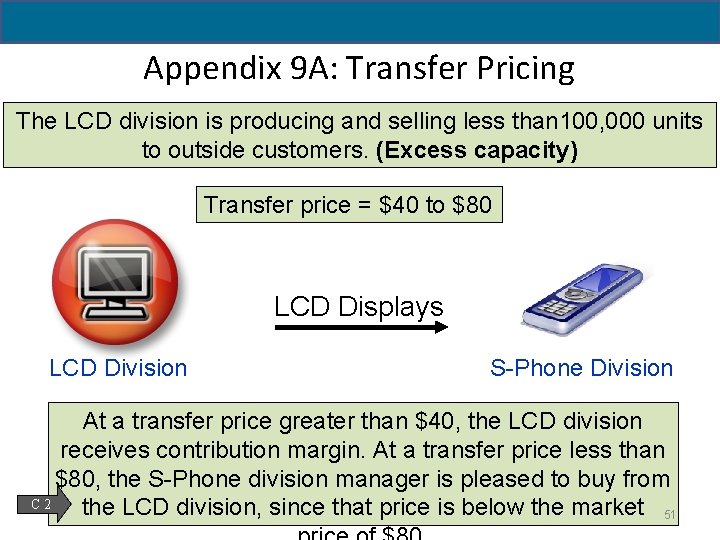
Appendix 9 A: Transfer Pricing The LCD division is producing and selling less than 100, 000 units to outside customers. (Excess capacity) Transfer price = $40 to $80 LCD Displays LCD Division S-Phone Division At a transfer price greater than $40, the LCD division receives contribution margin. At a transfer price less than $80, the S-Phone division manager is pleased to buy from C 2 the LCD division, since that price is below the market 51
9 -C 3 (Appendix 9 B): Joint Costs and Their Allocation 52
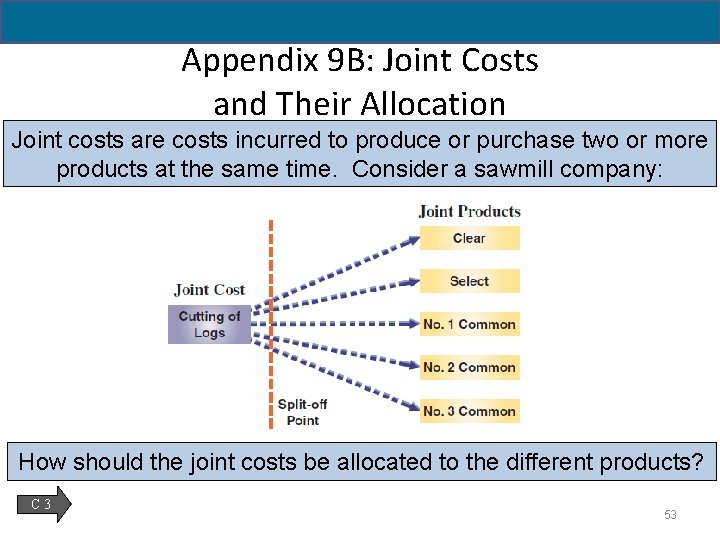
Appendix 9 B: Joint Costs and Their Allocation Joint costs are costs incurred to produce or purchase two or more products at the same time. Consider a sawmill company: How should the joint costs be allocated to the different products? C 3 53
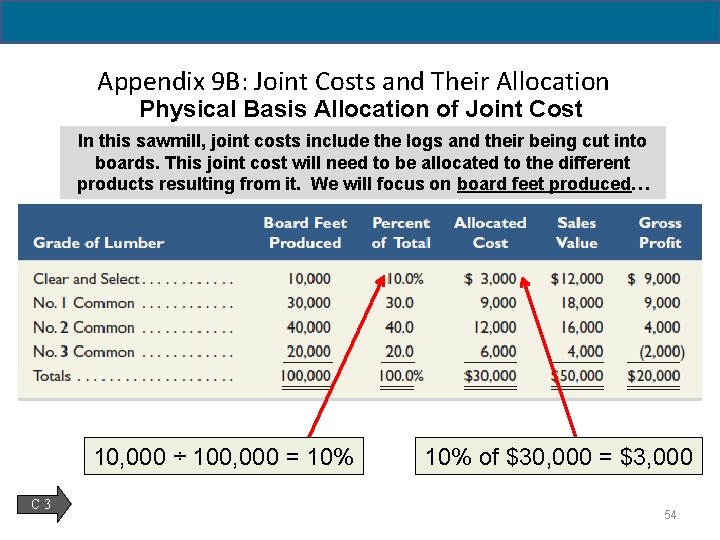
Appendix 9 B: Joint Costs and Their Allocation Physical Basis Allocation of Joint Cost In this sawmill, joint costs include the logs and their being cut into boards. This joint cost will need to be allocated to the different products resulting from it. We will focus on board feet produced… 10, 000 ÷ 100, 000 = 10% C 3 10% of $30, 000 = $3, 000 54
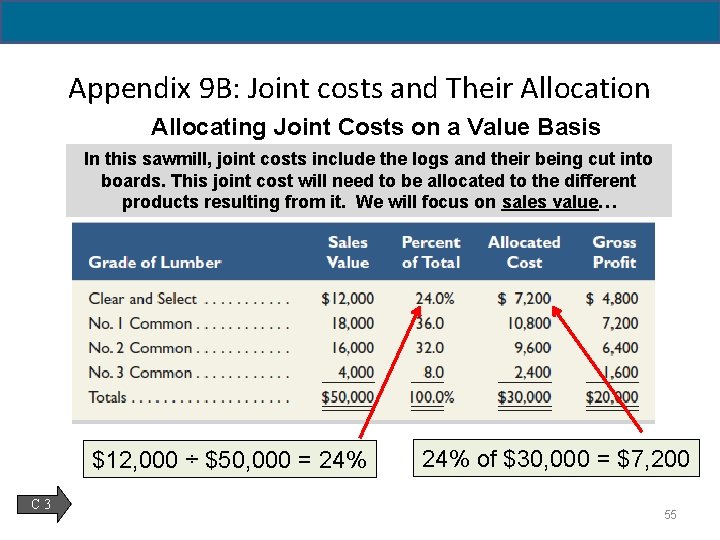
Appendix 9 B: Joint costs and Their Allocation Allocating Joint Costs on a Value Basis In this sawmill, joint costs include the logs and their being cut into boards. This joint cost will need to be allocated to the different products resulting from it. We will focus on sales value… $12, 000 ÷ $50, 000 = 24% C 3 24% of $30, 000 = $7, 200 55

End of Chapter 9 56
- Slides: 56