
Performance Measurement and Financial Reporting Prof Riccardo Tiscini




- Slides: 22
Performance Measurement and Financial Reporting Prof. Riccardo Tiscini A. Y. 2013 -2014
IAS 2 Inventories
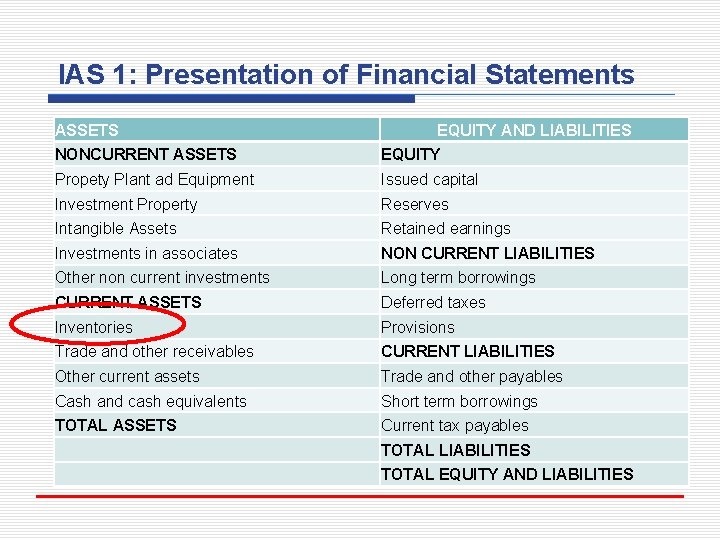
IAS 1: Presentation of Financial Statements ASSETS EQUITY AND LIABILITIES NONCURRENT ASSETS EQUITY Propety Plant ad Equipment Issued capital Investment Property Reserves Intangible Assets Retained earnings Investments in associates NON CURRENT LIABILITIES Other non current investments Long term borrowings CURRENT ASSETS Deferred taxes Inventories Provisions Trade and other receivables CURRENT LIABILITIES Other current assets Trade and other payables Cash and cash equivalents Short term borrowings TOTAL ASSETS Current tax payables TOTAL LIABILITIES TOTAL EQUITY AND LIABILITIES
IAS 2: Inventories Inventory refers to goods or other items a firm owns and holds for sale or further processing CLASSIFICATION Merchandise Goods held for sale by a retailer or wholesaler Raw materials Input to be transformed Work-in-process Inventory Partially completed factors Finished goods Goods held for sale
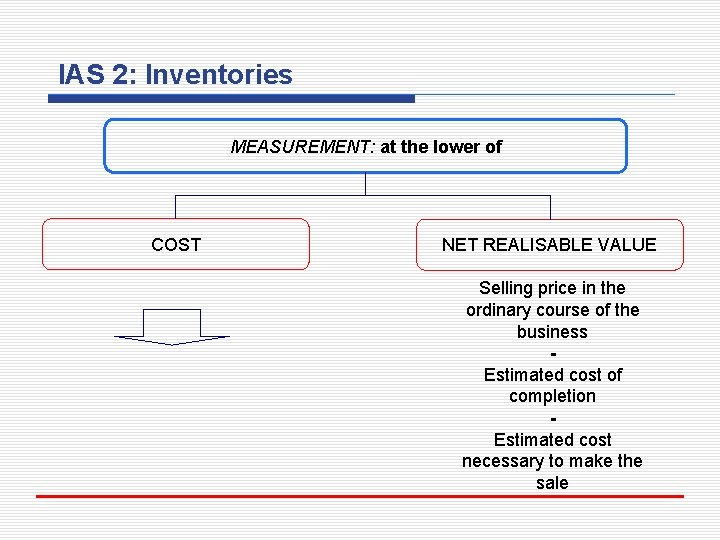
IAS 2: Inventories MEASUREMENT: at the lower of COST NET REALISABLE VALUE Selling price in the ordinary course of the business Estimated cost of completion Estimated cost necessary to make the sale
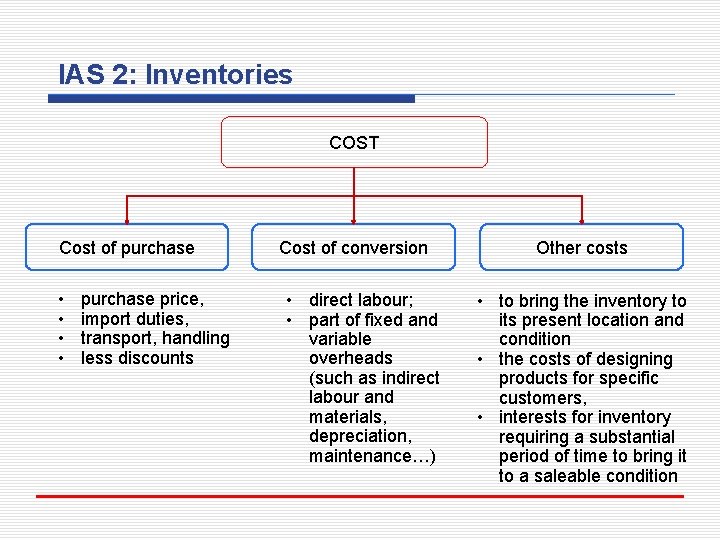
IAS 2: Inventories COST Cost of purchase • • purchase price, import duties, transport, handling less discounts Cost of conversion • direct labour; • part of fixed and variable overheads (such as indirect labour and materials, depreciation, maintenance…) Other costs • to bring the inventory to its present location and condition • the costs of designing products for specific customers, • interests for inventory requiring a substantial period of time to bring it to a saleable condition
IAS 2: Inventories INVENTORY EQUATION Beginning inventory + Purchases Cost of goods available for sale or use - Cost of good sold ? = Ending Inventory ?
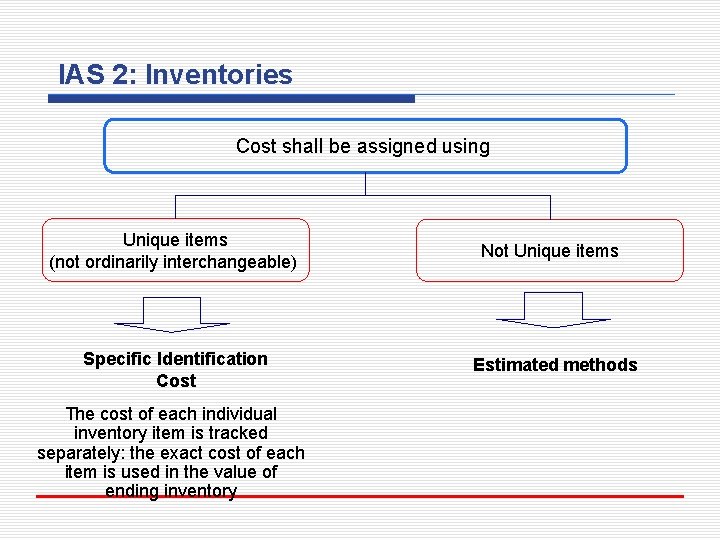
IAS 2: Inventories Cost shall be assigned using Unique items (not ordinarily interchangeable) Specific Identification Cost The cost of each individual inventory item is tracked separately: the exact cost of each item is used in the value of ending inventory Not Unique items Estimated methods
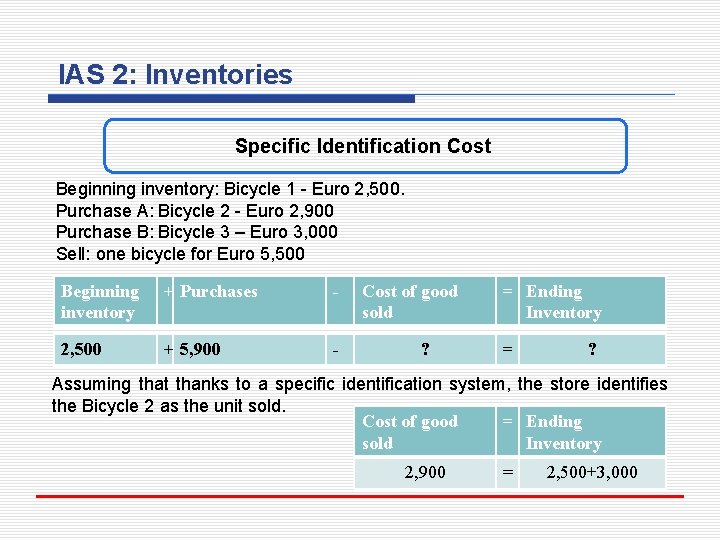
IAS 2: Inventories Specific Identification Cost Beginning inventory: Bicycle 1 - Euro 2, 500. Purchase A: Bicycle 2 - Euro 2, 900 Purchase B: Bicycle 3 – Euro 3, 000 Sell: one bicycle for Euro 5, 500 Beginning inventory + Purchases - 2, 500 + 5, 900 - Cost of good sold ? = Ending Inventory = ? Assuming that thanks to a specific identification system, the store identifies the Bicycle 2 as the unit sold. Cost of good = Ending sold Inventory 2, 900 = 2, 500+3, 000
IAS 2: Inventories ESTIMATED METHODS First In First Out FIFO Last In First Out LIFO It assumes that the units moving out are the ones that came in first. The units moving out are the ones which came in most recently. The units remaining will therefore be regarded as representing the latest units purchased The units remaining will therefore be regarded as representing the earliest units purchased. Weighted Average Cost Under the WAC costflow assumption, a firm calculates the average of the costs of all goods available for sale/for use during the accounting period, including the cost of beginning inventories
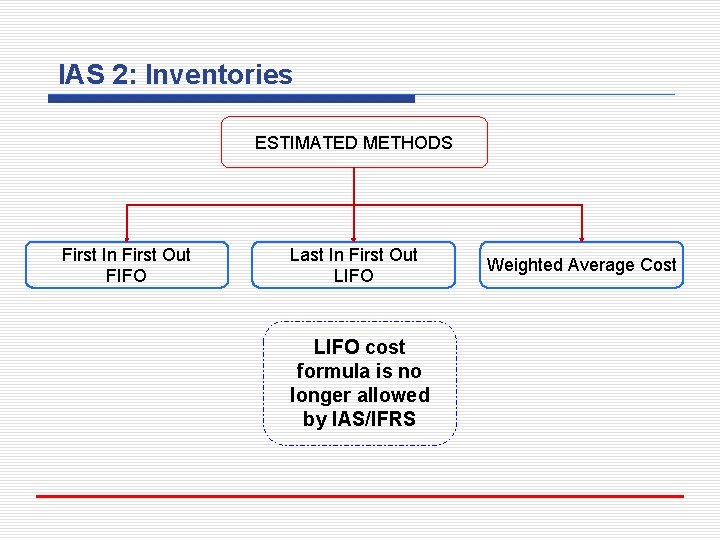
IAS 2: Inventories ESTIMATED METHODS First In First Out FIFO Last In First Out LIFO cost formula is no longer allowed by IAS/IFRS Weighted Average Cost
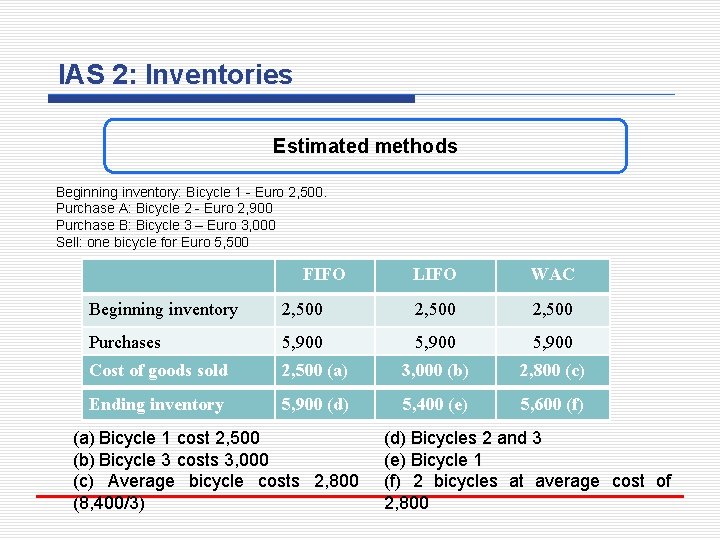
IAS 2: Inventories Estimated methods Beginning inventory: Bicycle 1 - Euro 2, 500. Purchase A: Bicycle 2 - Euro 2, 900 Purchase B: Bicycle 3 – Euro 3, 000 Sell: one bicycle for Euro 5, 500 FIFO LIFO WAC Beginning inventory 2, 500 Purchases 5, 900 Cost of goods sold 2, 500 (a) 3, 000 (b) 2, 800 (c) Ending inventory 5, 900 (d) 5, 400 (e) 5, 600 (f) (a) Bicycle 1 cost 2, 500 (b) Bicycle 3 costs 3, 000 (c) Average bicycle costs 2, 800 (8, 400/3) (d) Bicycles 2 and 3 (e) Bicycle 1 (f) 2 bicycles at average cost of 2, 800
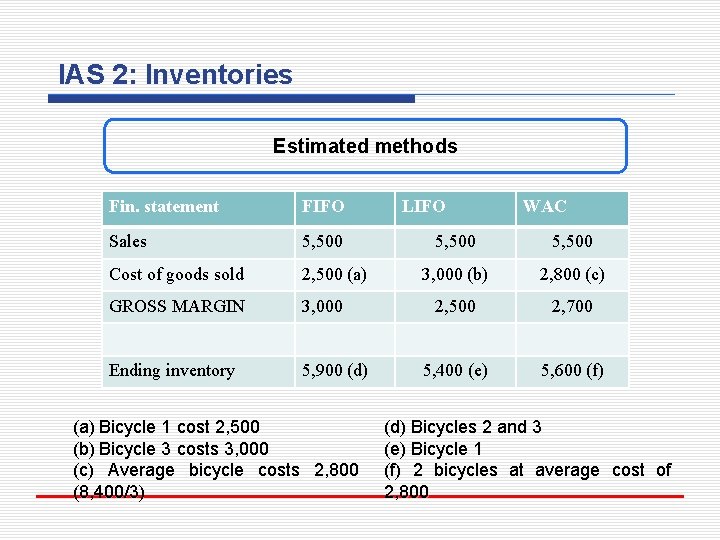
IAS 2: Inventories Estimated methods Fin. statement FIFO Sales 5, 500 Cost of goods sold 2, 500 (a) GROSS MARGIN 3, 000 Ending inventory 5, 900 (d) (a) Bicycle 1 cost 2, 500 (b) Bicycle 3 costs 3, 000 (c) Average bicycle costs 2, 800 (8, 400/3) LIFO WAC 5, 500 3, 000 (b) 2, 800 (c) 2, 500 2, 700 5, 400 (e) 5, 600 (f) (d) Bicycles 2 and 3 (e) Bicycle 1 (f) 2 bicycles at average cost of 2, 800
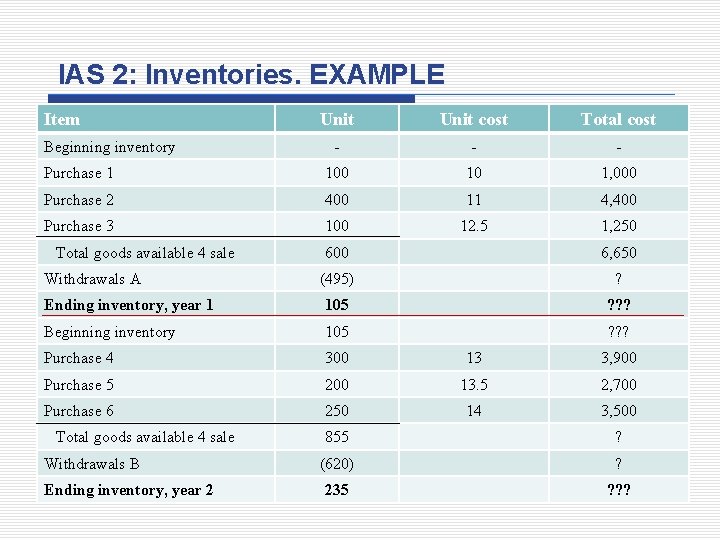
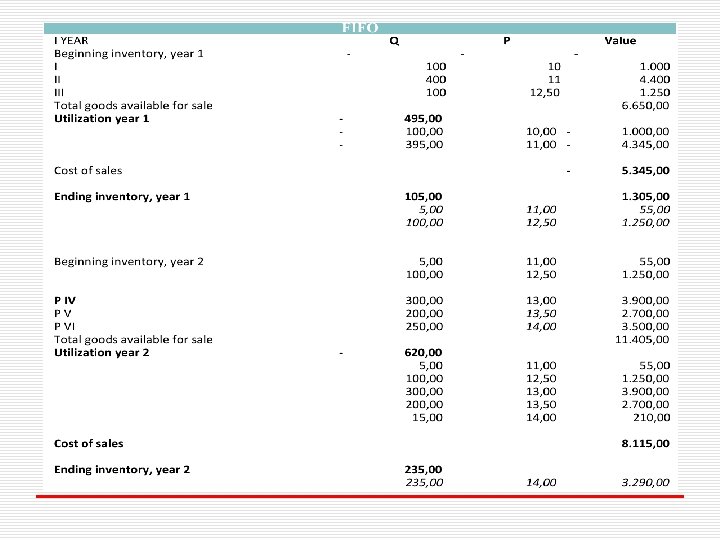
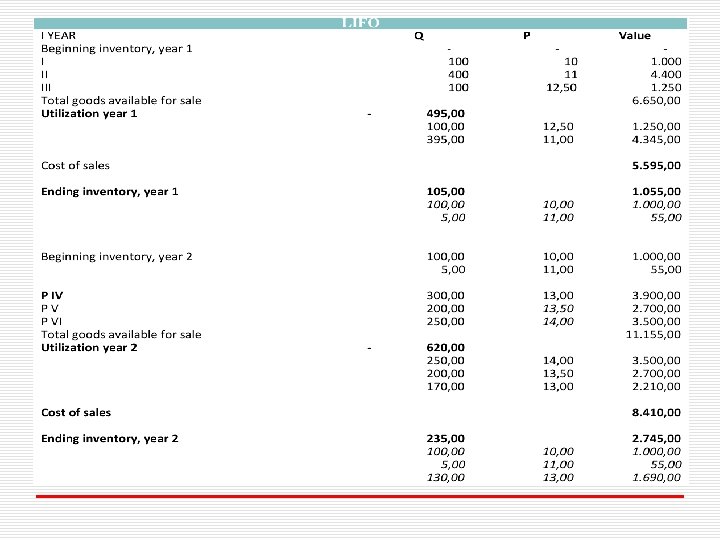
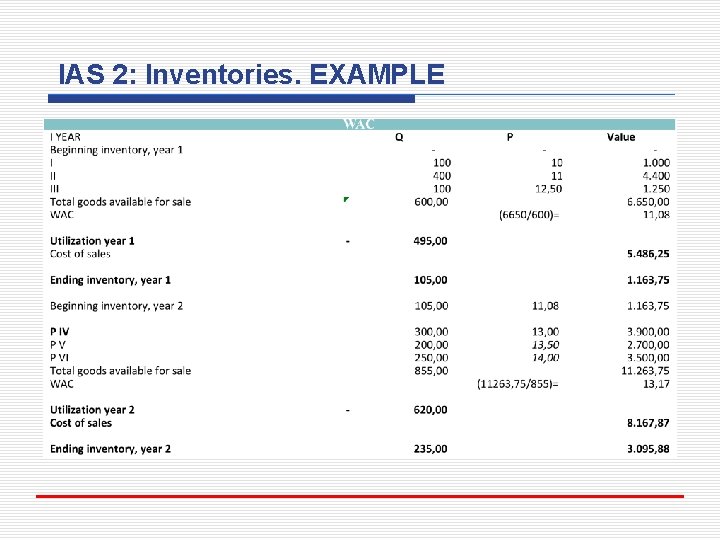
IAS 2: Inventories. EXAMPLE Item Unit cost Total cost - - - Purchase 1 100 10 1, 000 Purchase 2 400 11 4, 400 Purchase 3 100 12. 5 1, 250 Beginning inventory Total goods available 4 sale 600 6, 650 (495) ? Ending inventory, year 1 105 ? ? ? Beginning inventory 105 ? ? ? Purchase 4 300 13 3, 900 Purchase 5 200 13. 5 2, 700 Purchase 6 250 14 3, 500 Withdrawals A Total goods available 4 sale Withdrawals B Ending inventory, year 2 855 ? (620) ? 235 ? ? ?
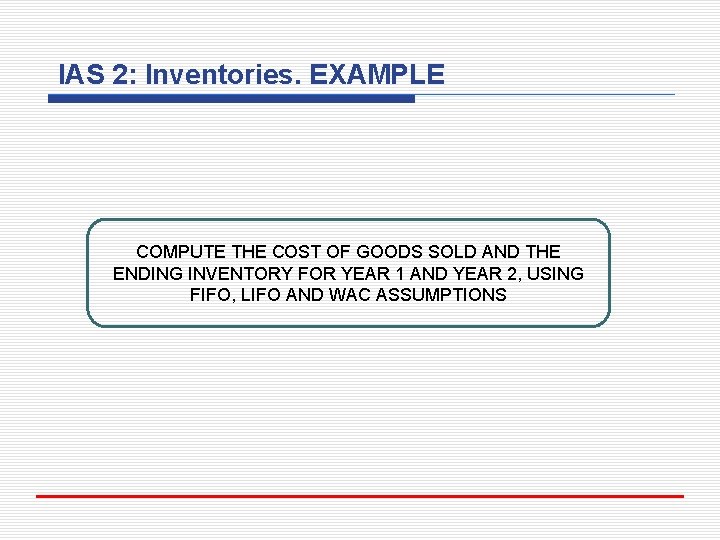
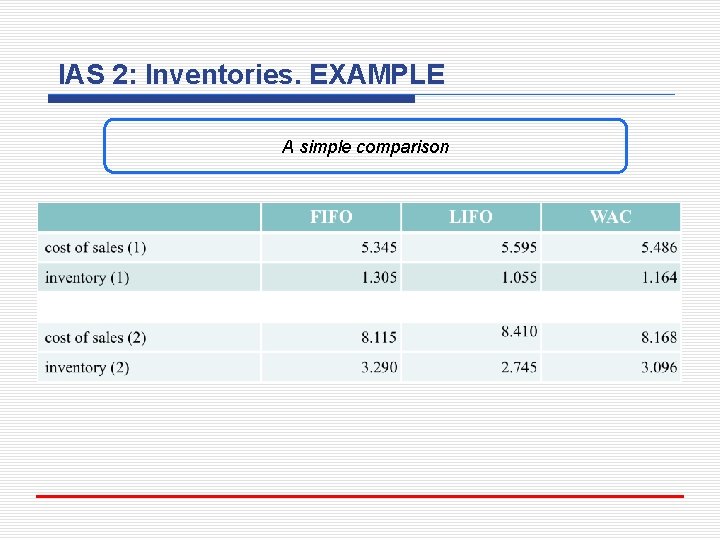
IAS 2: Inventories. EXAMPLE COMPUTE THE COST OF GOODS SOLD AND THE ENDING INVENTORY FOR YEAR 1 AND YEAR 2, USING FIFO, LIFO AND WAC ASSUMPTIONS
IAS 2: Inventories. EXAMPLE
IAS 2: Inventories. EXAMPLE
IAS 2: Inventories. EXAMPLE
IAS 2: Inventories. EXAMPLE A simple comparison
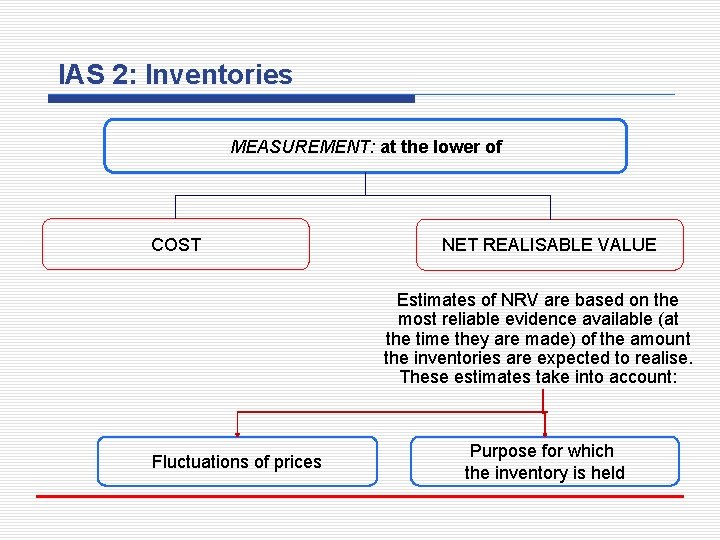
IAS 2: Inventories MEASUREMENT: at the lower of COST NET REALISABLE VALUE Estimates of NRV are based on the most reliable evidence available (at the time they are made) of the amount the inventories are expected to realise. These estimates take into account: Fluctuations of prices Purpose for which the inventory is held
IAS 2: Inventories. Valuation subsequent to acquisition Both IFRS and US GAAP require firms to initially record inventories at acquisition cost. The market value of inventories may change, however, while the firm holds the inventory awaiting its sale to customers INCREASE IN MARKET VALUE DECREASE IN MARKET VALUE Neither IFRS nor US GAAP permit firms to remeasure inventories upward to an amount exceeding their acquisition cost. Both IFRS and US GAAP require firms to write down inventories when their replacement cost, or market value declines below acquisition cost.
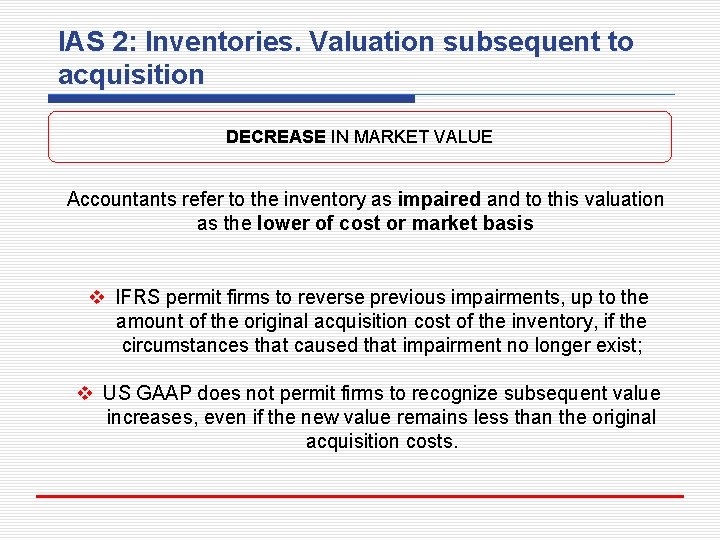
IAS 2: Inventories. Valuation subsequent to acquisition DECREASE IN MARKET VALUE Accountants refer to the inventory as impaired and to this valuation as the lower of cost or market basis v IFRS permit firms to reverse previous impairments, up to the amount of the original acquisition cost of the inventory, if the circumstances that caused that impairment no longer exist; v US GAAP does not permit firms to recognize subsequent value increases, even if the new value remains less than the original acquisition costs.