
Performance Management Using the Balanced Scorecard Approach Office
Performance Management Using the Balanced Scorecard Approach Office of Quality Management Office of Research Services National Institutes of Health May 2004 1
For more information on Performance Management in the Office of Research Services: http: //www. nih. gov/od/ors/od/oqm/pm/index_pm. htm Or Contact: Amy Culbertson Culberta@ors. od. nih. gov (301) 594 -9616 Acknowledgments This training was developed by the Balanced Scorecard for Government, Inc. , in collaboration with the Office of Quality Management. 2
Training Objectives • Understand the ORF/ORS history with Performance Management • Review the basics of the Balanced Scorecard (BSC) approach • Understand the Role of the PMP “Teams” • Become familiar with the ORF/ORS Performance Management Plan (PMP) • Understand value propositions and strategy statements • Review how to develop objectives for the four BSC perspectives • Learn how to link objectives through strategy maps 3
ORF/ORS History with Performance Management 4
Performance Management’s Roots in ORF/ORS • Started with ORS Leadership and theme of how do we demonstrate to customers that we are providing good value • They are getting what they pay for • We are matching demand with needs • Under Deputy Director’s guidance, applied simplified concept of ABC to our organizations • Two day retreat occurred in which the first Services Hierarchy was established • Provided framework to describe the services we deliver to NIH • Help us cost from inputs to outcomes • Then needed a way to track how we are doing • Started with the Service Area Reviews (SARs) • Subset of service providers presented review of their operations every three years 5
Performance Management’s Roots in ORF/ORS • Germ for more frequent measurement and improvement came from discussions between the NIH Associate Director for Research Services and the OQM Director, and a subsequent trip to London to the Defense Evaluation Research Agency • • Came back and decided to do what was known as the Annual Self Assessments (ASA) here • • Began as a pilot in April 2001 with just 1/4 of the discrete services Held the first conference in October 2001 Modified approach based on customer inputs and organization needs Went to organization-wide implementation in FY 02 • • • Science and engineering organization in England that is similar to ORS They would meet with customers annually to evaluate how they did on their objectives, review their plans for the future Managers were rewarded based on their accomplishments All 42 Service Groups involved in the effort All groups presented at the second conference in November 2002 Organization-wide implementation continued during the next year (Jan 2003 - Jan 2004) • • • All ORS and ORF Service Groups were involved in the effort Some new groups formed due to changes in the Services Hierarchy One-third of the Groups presented at the third conference in January 2004 6
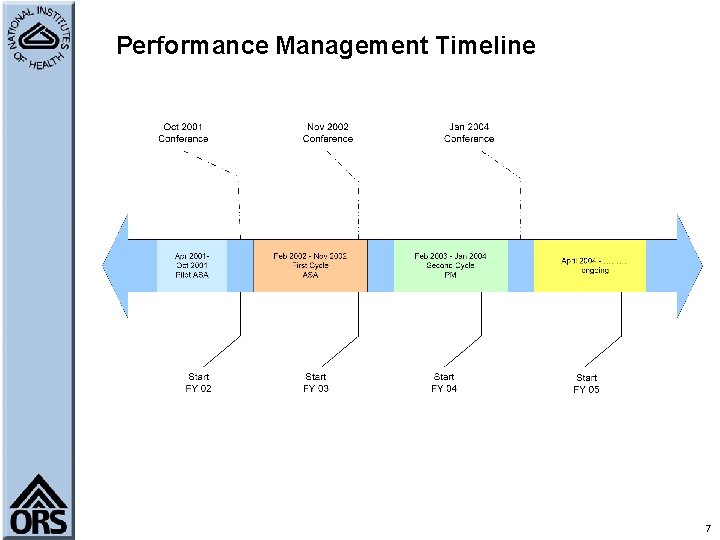
Performance Management Timeline 7

The Performance Management Process and Continual Improvement (P-D-C-A cycle) New teams are here ACT PLAN Step 4 Implement Change Step 1 Review/ Establish PMP Step 2 Develop/ Enhance Measures A few are here CHECK DO Step 3 Measure & Analyze Most teams are here 8
Purpose of Performance Mangement • Implement a culture in ORF/ORS that manages and improves through the use of performance data • Gauge extent to which we are delivering what customers want and need • Use data to make process improvements • Plan how to invest in people and tools to be innovative and competitive • Understand reasons for change in costs and funding needs • Making funding allocation decisions based on data-based business case 9
Performance Management - What’s in it for me? • Provides opportunities to better understand your mission/function/job • Gives you tools to accurately assess your customers’ needs, satisfaction, and know how to improve service delivery to them • Provides opportunities to influence operational processes and decisions • Encourages addressing issues related to cross-functional service delivery that can cause grief for all involved • Provides a vehicle to showcase what you do and the value you deliver to NIH customers • Strives to integrate the budgeting process with future program needs based on data so you have the resources you need • Increases your skills in strategic planning, performance measurement, data collection/analysis, and process improvement • Provides an opportunity to best prepare your area for competitive sourcing initiatives that may impact you 10
Basics of the Balanced Scorecard (BSC) Approach 11
Who made this up? • Dr. Robert Kaplan and Dr. David Norton • Research at Harvard University • Research showed that organizations were… – Placing too much emphasis on financial measures - (not in balance) – Downsizing to address short-term financial problems - (reactive not proactive) – Responding to Wall Street analysts, not customers 12
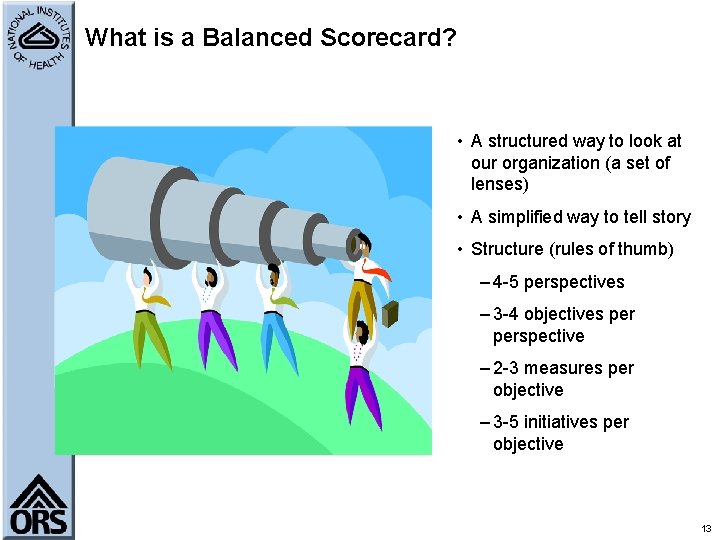
What is a Balanced Scorecard? • A structured way to look at our organization (a set of lenses) • A simplified way to tell story • Structure (rules of thumb) – 4 -5 perspectives – 3 -4 objectives perspective – 2 -3 measures per objective – 3 -5 initiatives per objective 13
What is a Balanced Scorecard? (cont. ) At the highest level, it is a framework that helps organizations translate strategy into operational objectives that drive both behavior and performance. 14
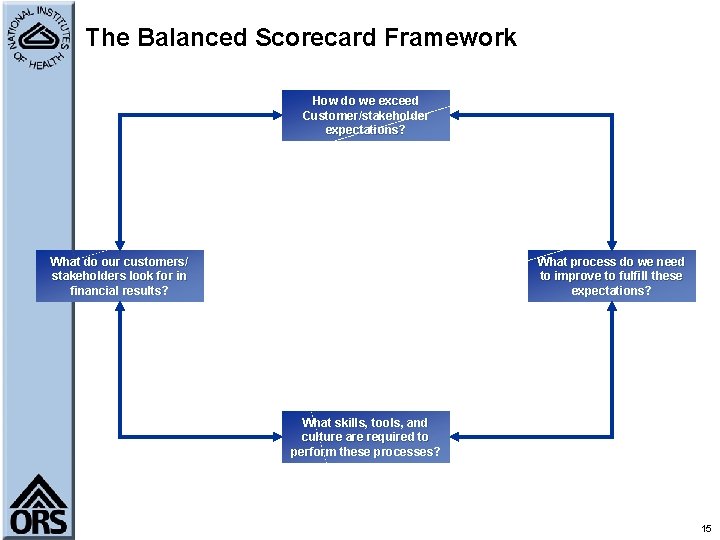
The Balanced Scorecard Framework How do we exceed Customer/stakeholder expectations? What do our customers/ stakeholders look for in financial results? What process do we need to improve to fulfill these expectations? What skills, tools, and culture are required to perform these processes? 15

The Balanced Scorecard for Your Organization How do we exceed Customer/stakeholder expectations? Customer What do our customers/ stakeholders look for in financial results? Financial Internal Strategy What process do we need to improve to fulfill these expectations? Learning What skills, tools, and culture are required to perform these processes? 16
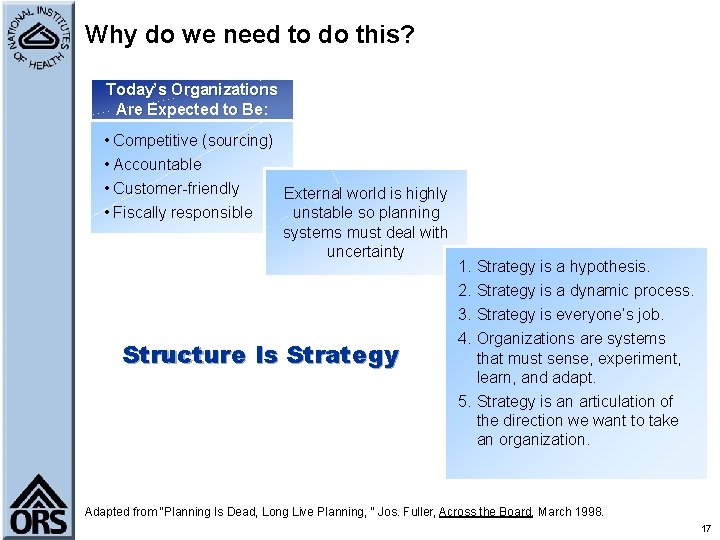
Why do we need to do this? Today’s Organizations Are Expected to Be: • Competitive (sourcing) • Accountable • Customer-friendly External world is highly unstable so planning • Fiscally responsible systems must deal with uncertainty Structure Is Strategy 1. Strategy is a hypothesis. 2. Strategy is a dynamic process. 3. Strategy is everyone’s job. 4. Organizations are systems that must sense, experiment, learn, and adapt. 5. Strategy is an articulation of the direction we want to take an organization. Adapted from “Planning Is Dead, Long Live Planning, “ Jos. Fuller, Across the Board, March 1998. 17
What Roles Do the PM “Teams” Play? • Team Leader - a manager or senior member of your staff who takes the responsibility for applying PM in the organization; • Team Members - typically 4 -8 staff members who understand the complexities of your current work environment. Team members provide functional expertise to assist the team leader in development and implementation of your PMP; • Consultant - Either OQM staff or contractor assigned to each team to provide technical assistance and coaching on the process, tools and methodology; • OQM Staff – In addition to provide consultation to teams, OQM assists teams at key points during development and implementation, and interface with Senior Management on the overall progress of the PM effort. 18
The ORF/ORS Performance Management Plan (PMP) 19
What is the PMP? • The Performance Management Plan (PMP) is your business roadmap • Lists the name of your Service Group and Discrete Services from the Services Hierarchy maintained by OBSF • Describes your value to the NIH • Defines how you implement your value (your strategy) • Highlights your performance objectives • Identifies how you measure achievement on objectives • Lays out targets for delivering performance 20

The PMP Template 21
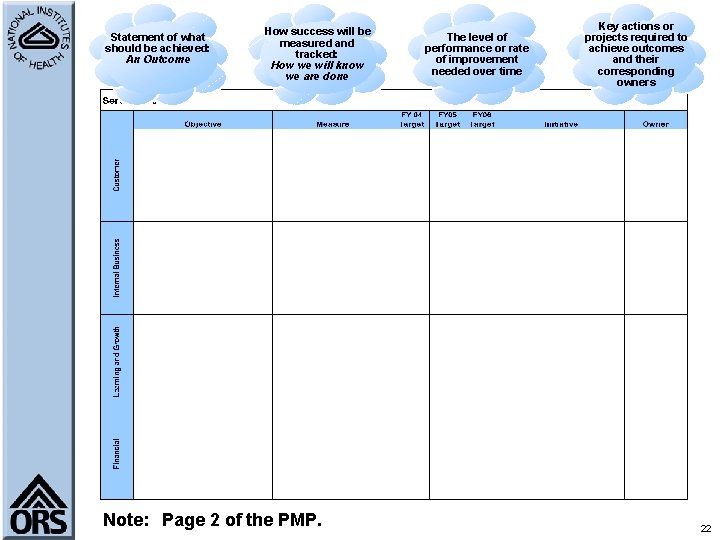
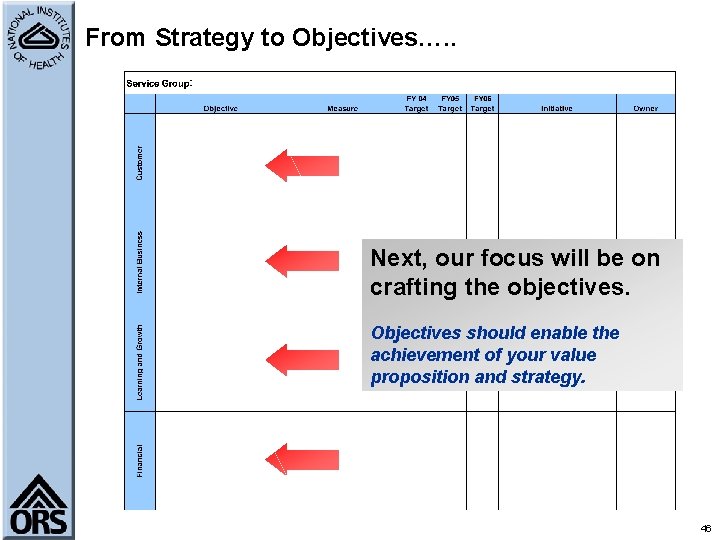
Statement of what should be achieved: An Outcome How success will be measured and tracked: How we will know we are done Note: Page 2 of the PMP. The level of performance or rate of improvement needed over time Key actions or projects required to achieve outcomes and their corresponding owners 22
Value Proposition and Strategy Statements 23
Value Proposition The Value Proposition should be established with the Research Community in mind and should be derived using the following formula: Value = Product and/or service attributes + image + relationship The value proposition should establish why we do what we do, and what impact does it have on the community for whom we provide our services. 24
What is the value proposition for your Service Group? • What is the contribution that we make to the NIH Research Community and other interested parties? – Customers – Stakeholders • It is a theory that must be tested 25
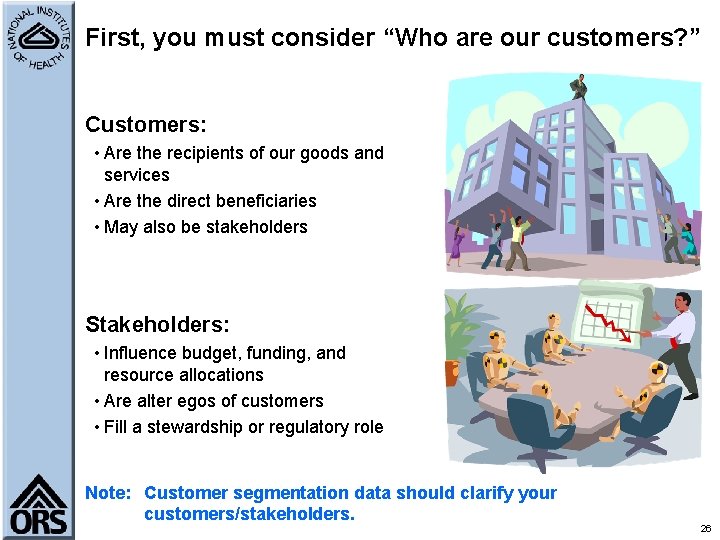
First, you must consider “Who are our customers? ” Customers: • Are the recipients of our goods and services • Are the direct beneficiaries • May also be stakeholders Stakeholders: • Influence budget, funding, and resource allocations • Are alter egos of customers • Fill a stewardship or regulatory role Note: Customer segmentation data should clarify your customers/stakeholders. 26
EXAM PLE Customers Stakeholders • The NIH Institutes • ORS program managers • ORS service providers • ORS administrators • ORS Advisory Committee • IWG and MBWG • FARB • DHHS • OMB/GAO/Congress • OSHA • JCAHO/AAALAC 27
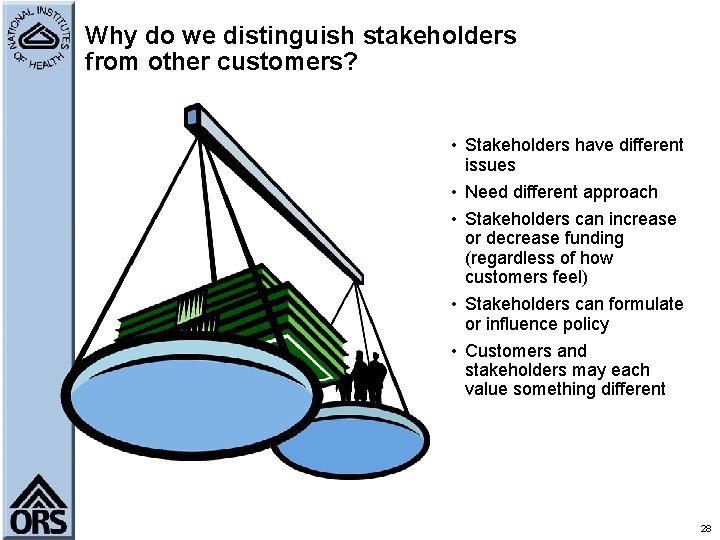
Why do we distinguish stakeholders from other customers? • Stakeholders have different issues • Need different approach • Stakeholders can increase or decrease funding (regardless of how customers feel) • Stakeholders can formulate or influence policy • Customers and stakeholders may each value something different 28
What do customers really want? • What value do we provide to customers? • What would happen to customers if we were no longer around? • How much are customers willing to pay for our products/services? • What is our obligation to customers? • What can we do to ensure their support? • What can we do to better educate them? 29
What do stakeholders really want? • What do our stakeholders value? • How does what they value differ from what our customers value? • What is our obligation to stakeholders? • What can we do to ensure their support? • What can we do to better educate them? 30
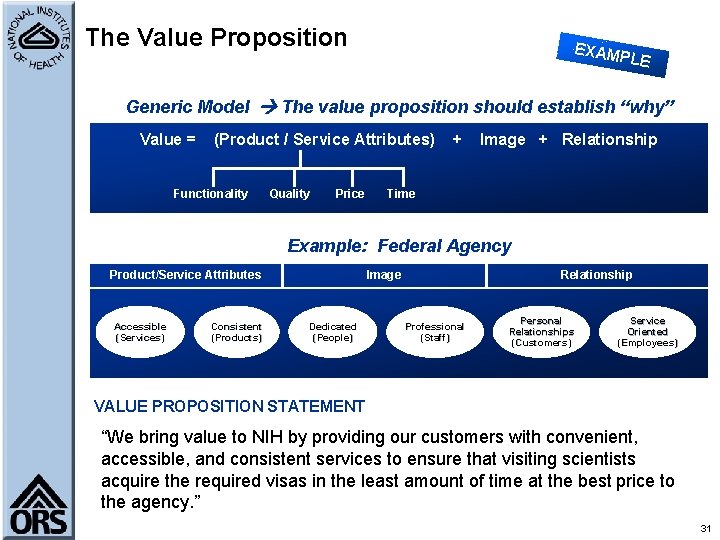
The Value Proposition EXAM PLE Generic Model The value proposition should establish “why” Value = (Product / Service Attributes) Functionality Quality Price + Image + Relationship Time Example: Federal Agency Product/Service Attributes Accessible (Services) Consistent (Products) Image Dedicated (People) Relationship Professional (Staff) Personal Relationships (Customers) Service Oriented (Employees) VALUE PROPOSITION STATEMENT “We bring value to NIH by providing our customers with convenient, accessible, and consistent services to ensure that visiting scientists acquire the required visas in the least amount of time at the best price to the agency. ” 31
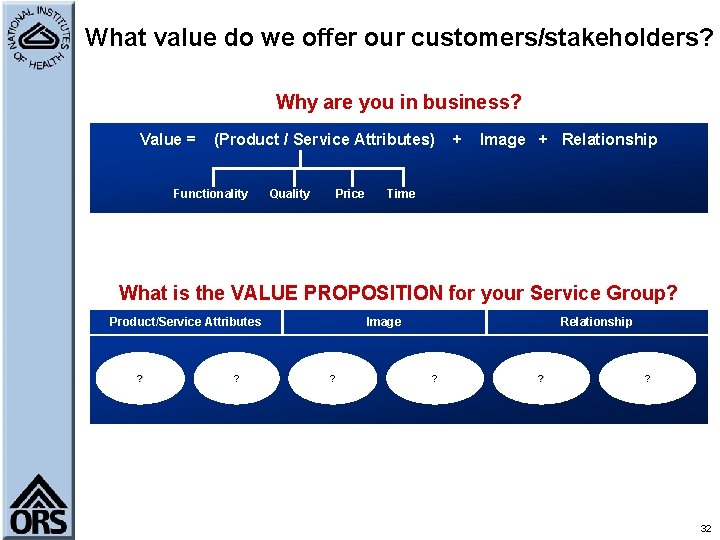
What value do we offer our customers/stakeholders? Why are you in business? Value = (Product / Service Attributes) Functionality Quality Price + Image + Relationship Time What is the VALUE PROPOSITION for your Service Group? Product/Service Attributes ? ? Image ? Relationship ? ? ? 32
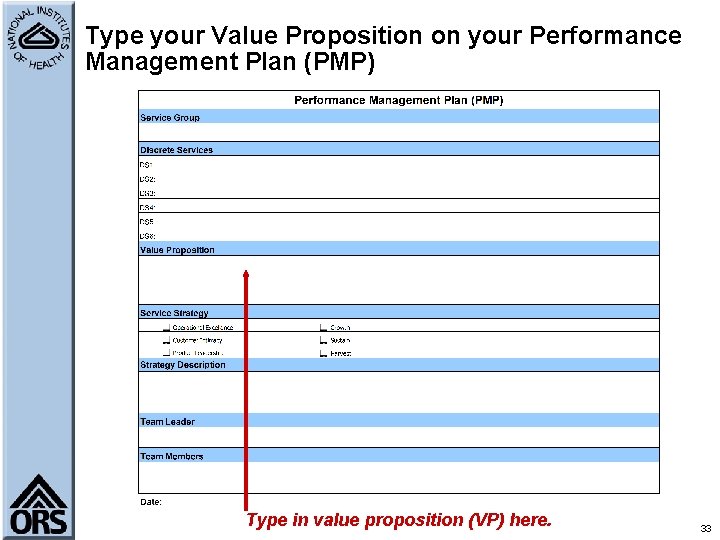
Type your Value Proposition on your Performance Management Plan (PMP) Type in value proposition (VP) here. 33
What is strategy? Think of Strategy as a Way to Get to Your Destination Strategy 34
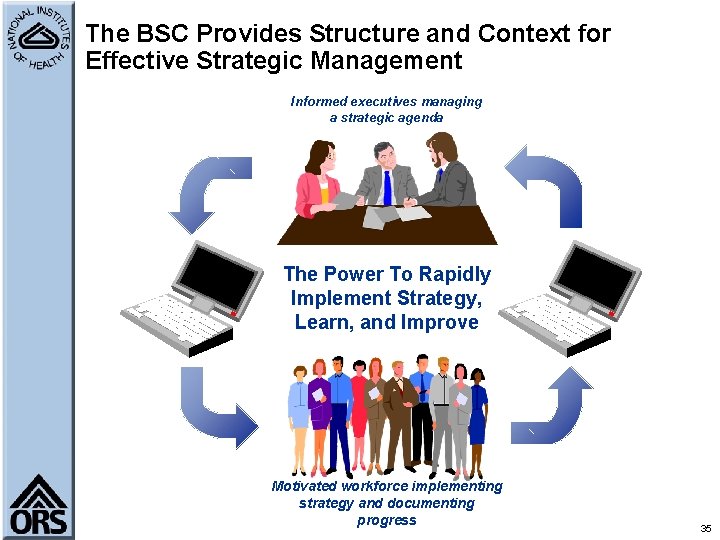
The BSC Provides Structure and Context for Effective Strategic Management Informed executives managing a strategic agenda The Power To Rapidly Implement Strategy, Learn, and Improve Motivated workforce implementing strategy and documenting progress 35
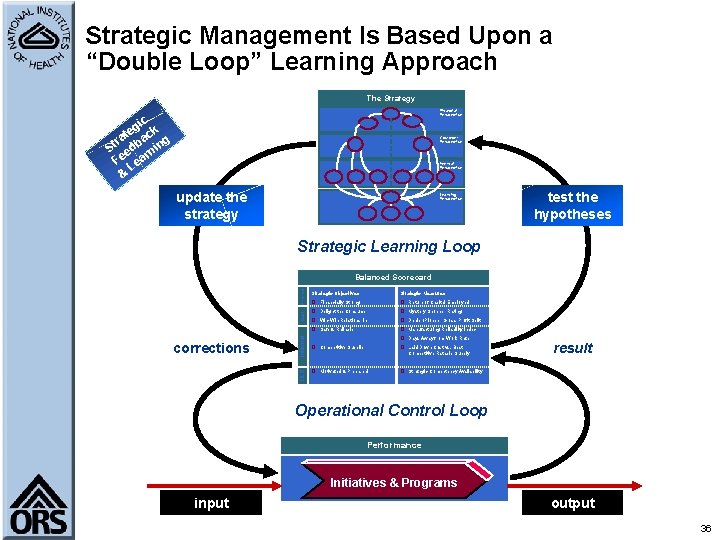
Strategic Management Is Based Upon a “Double Loop” Learning Approach The Strategy Financial Perspective ic eg ck t ra a g St edb nin r Fe ea L & Customer Perspective Internal Perspective update the strategy Learning Perspective test the hypotheses Strategic Learning Loop L&G corrections Internal Cust Financial Balanced Scorecard Strategic Objectives Strategic Measures Financially Strong Return of Capital Employed Delight the Consumer Mystery Shopper Rating Win-Win Relationship Dealer/Pioneer Gross Profit Split Safe & Reliable Manufacturing Reliability Index Days Away from Work Rate Competitive Supplier Laid Down Cost vs. Best Competitive Ratable Supply Motivated & Prepared result Strategic Competency Availability Operational Control Loop Performance Initiatives & Programs input output 36
Ways to Characterize Strategy • Michael Porter (author of Competitive Strategy )says there are three general ways to characterize strategy in organizations: • Operational Excellence • Customer Intimacy • Product Leadership • Fee for Service Organizations should also think about where your business is in terms of: • Growth • Sustain • Harvest 37
Operational Excellence Is Customer Service Excellence Your Service Attributes Your Product Attributes • Availability • Cost • Responsiveness • Quality • Convenience • Competence • Timeliness • Reliability • Handling of Problems 38
Customer Intimacy Is Customer Quality Relationships • Understand their business • Empower them • Know their needs • Share with them • Provide complete solutions • Our team knows their team • Quality of the relationship • Follow up and feed back 39
Product Leadership is Customer Needs Filled With New Solutions • Culture for risk taking • Entrepreneurial vs. bureaucracy • Team player over experience • Exist on limited planning and analysis • Fast reaction times to conditions • Open Mindedness (avoid Not Invented Here Syndrome) • Service and products always state-of-art • Creativity over formula • Engineered for speed • Knowledge management “First” initiative • A budget for failure (Command of Capital) 40
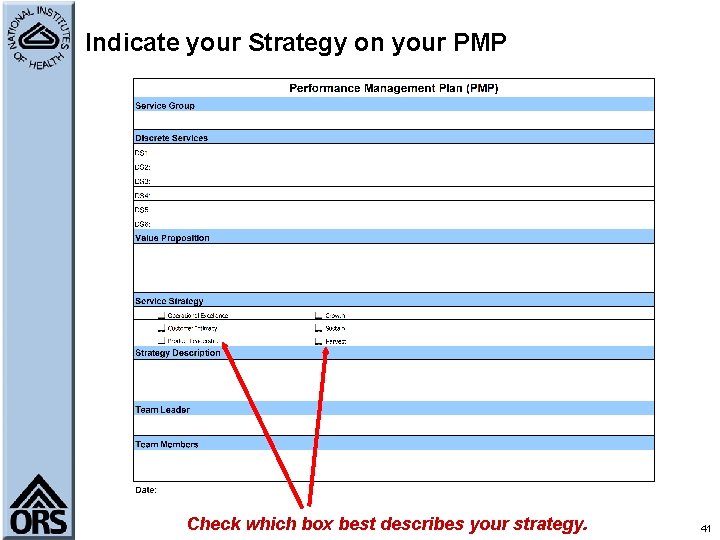
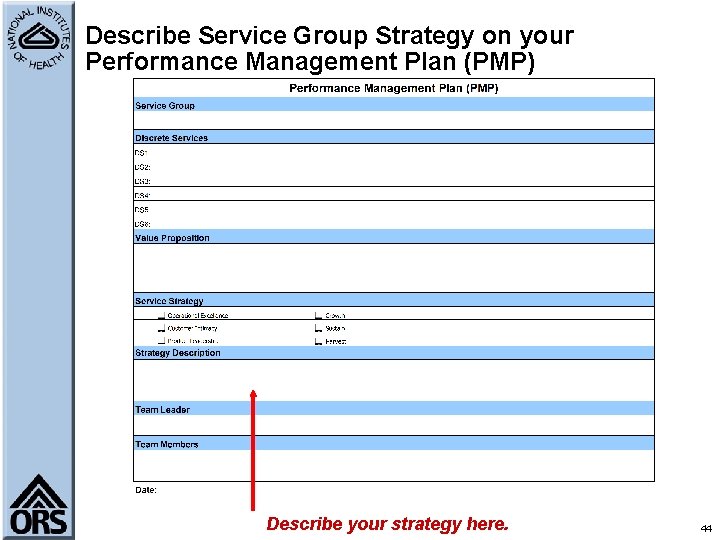
Indicate your Strategy on your PMP Check which box best describes your strategy. 41
Elaborate on Your Strategy • Think more deeply about your strategy choices – Write your own strategy statement – May help to develop a strategy map • What may help with expanding your thinking on strategy? – What demands are the customers or “chain of command” placing on the Service Group? – Are your customer demands for services changing dramatically? – Has the environment changed to require new products/services, or service levels, from your group? – Are there expectation for reduced unit cost? – What is the future direction of your Service Group? 42
Operational Excellence Strategy • “ We will pursue our strategy of operational excellence by providing more timely information to our customers through automation. We will educate our customers regarding regulations and requirements through rigorous training programs. Our focus will be on enabling our professional, experienced staff to provide more dedicated customer-service time. ” 43
Describe Service Group Strategy on your Performance Management Plan (PMP) Describe your strategy here. 44
How to Develop Objectives for the Four BSC Perspectives 45
From Strategy to Objectives…. . Next, our focus will be on crafting the objectives. Objectives should enable the achievement of your value proposition and strategy. 46
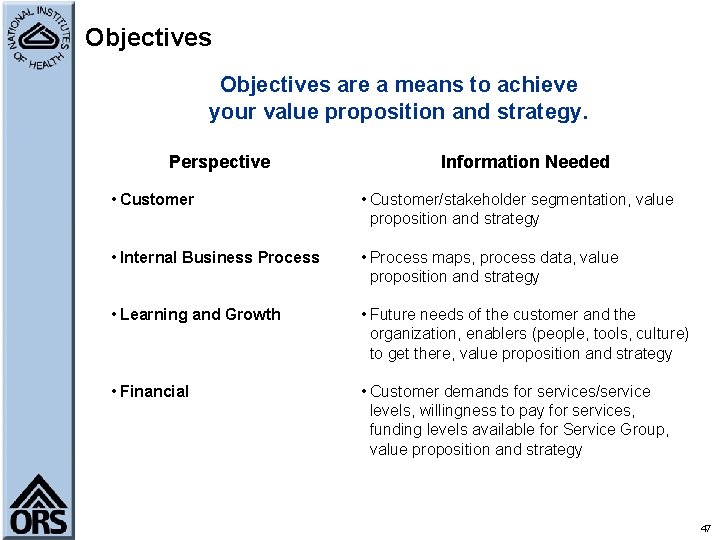
Objectives are a means to achieve your value proposition and strategy. Perspective Information Needed • Customer/stakeholder segmentation, value proposition and strategy • Internal Business Process • Process maps, process data, value proposition and strategy • Learning and Growth • Future needs of the customer and the organization, enablers (people, tools, culture) to get there, value proposition and strategy • Financial • Customer demands for services/service levels, willingness to pay for services, funding levels available for Service Group, value proposition and strategy 47
Crafting Objectives By Perspective Customer Internal Processes Financial Learning & Growth 48
Performance Objectives for the Customer Perspective 49
What Do Our Customers Really Want? (Outcome or “end-state”) What are we really trying to accomplish as a Service Group? What outcomes are we offering customers with our Service Group/Discrete Service offerings? What will our customer base look like 5 -7 years from now? What will our customer needs be in the future? 50
Customer Objectives ORS a nd OR F EXAM PLE OBJEC TIVES • Provide integrated transparent access to the most relevant information via the most effective information sources for NIH researchers and staff • Improve education of customers on portfolio of services offered by Events Management • Be readily available to our customers to provide information, customer service, and resolve issues regarding transportation and parking services • Improve communication with customers • Meet customer needs by providing the right mix of specialized research support services • Improve customers’ business decisions • Improve as single-source contact on ORS-wide administrative processes • Increase responsiveness to customers’ varying needs • Increase customer satisfaction with our products and services 51
Customer Objectives (cont. ) ORS a nd OR F EXAM PLE OBJEC TIVES • Improve response to customer requests • Improve objectivity and neutrality in dealing with customer complaints • Improve customers’ ability to make informed decisions • Be indispensable in service quality • Decrease the probability of weaponized vehicles from entering the NIH Bethesda campus • Provide an environment that is safe and secure for personnel and others while at NIH facilities • Provide a fire safe work environment for all NIH facilities • Respond consistently and reliably to customers • Improve availability and reliability of guidance and expertise 52

Performance Objectives for the Internal Business Process Perspective 53
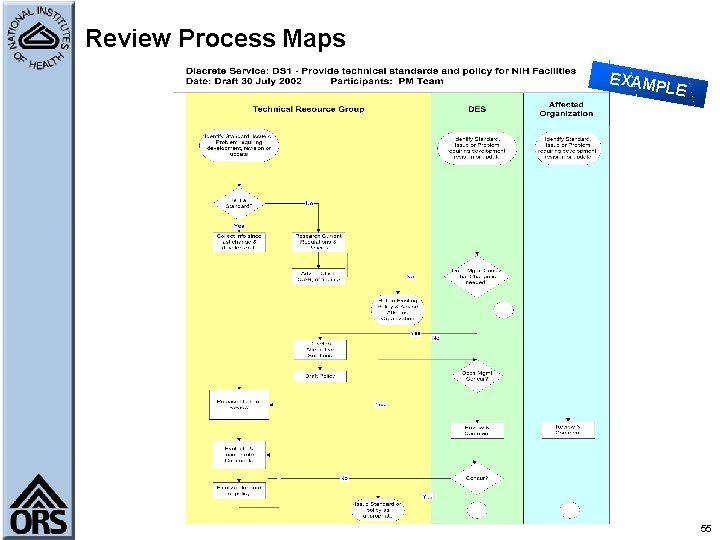
What is Your Value Chain? How do we get new demand? Where does it come from? What processes do we need to perform very well? (process maps) How do we complete the work? (deployment flowcharts) How do we deliver it to our customers? How can we improve our processes to meet attributes identified in the value proposition? 54
Review Process Maps EXAM PLE 55
Internal Business Processes • What is the value we offer to our customers? (How do we create value for our customers, stakeholders, employees) through our processes? • What key processes do we need to focus on? • What aspects of the processes are important (e. g. , predictable performance, efficient, safe) 56
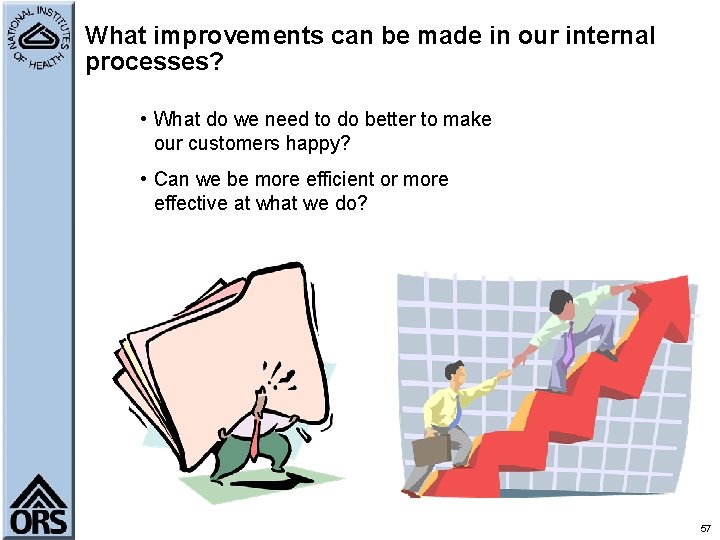
What improvements can be made in our internal processes? • What do we need to do better to make our customers happy? • Can we be more efficient or more effective at what we do? 57

Internal Business Process Objectives ORS a nd OR F EXAM P OBJEC LE TIVES • Maintain or improve turn around time for filling requests with accuracy • Improve timeliness and accuracy of the scheduling process • Increase benchmarking reviews to better understand competitors offerings and costs • Hold Vendors Accountable (require regular inspections and reports; setting goals to meet improvements; decrease the gap between actual performance and goals set in contract) • Improve quality and delivery of rate packages • Accurately bill and pay for rent, leased space and membership services • Adopt best practices and infuse new technology • Improve vendor/contractor performance • Improve access to information • Increase consistency in the delivery of our products and services • Adjust production capabilities to meet changing demands • Increase timeliness of service • Right the first time, every time. Be consistent. 58

Internal Business Process Objectives (cont. ) ORS a nd OR F EXAM P OBJEC LE TIVES • Improve smooth transition of new automated systems • Meet and/or exceed timeframes established by law • Improve capability to handle fluctuation in service demand • Refocus service offerings based on complaint patterns • Rework service agreements into performance-based service contracts • Improve service response time • Provide quicker “turn around time” (complete cases faster) • Improve effectiveness of radioactive waste pick-up scheduling process • Increase the consistency in guard service delivery to minimize disruption to the NIH community • Minimize the disruption of the NIH design and construction process while ensuring all fire-safety requirements are met • Improve best value analysis through-out design and construction of facilities • Improve coordination and timely updating of environmental and emergency plans • Improve internal resources requirements planning 59

Performance Objectives for the Learning & Growth Perspective 60
Learning & Growth The formula for this perspective is a function of: People, Tools, and Climate Learning and Growth objectives are a function of future customer and organizational needs. 61
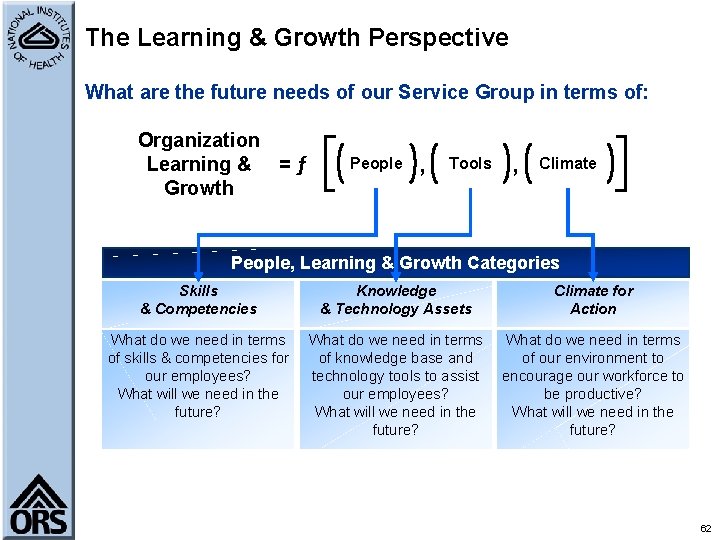
The Learning & Growth Perspective What are the future needs of our Service Group in terms of: Organization Learning & = ƒ Growth People , Tools , Climate People, Learning & Growth Categories Skills & Competencies Knowledge & Technology Assets Climate for Action What do we need in terms of skills & competencies for our employees? What will we need in the future? What do we need in terms of knowledge base and technology tools to assist our employees? What will we need in the future? What do we need in terms of our environment to encourage our workforce to be productive? What will we need in the future? 62
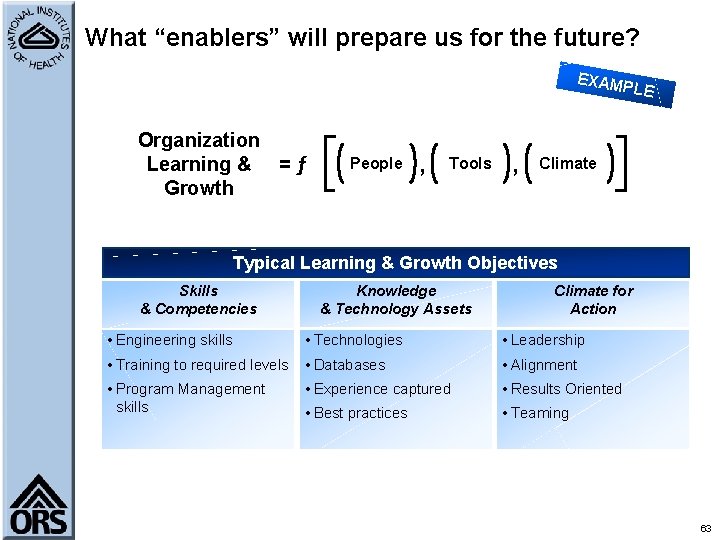
What “enablers” will prepare us for the future? EXAM PLE Organization Learning & = ƒ Growth People , Tools , Climate Typical Learning & Growth Objectives Skills & Competencies Knowledge & Technology Assets Climate for Action • Engineering skills • Technologies • Leadership • Training to required levels • Databases • Alignment • Program Management skills • Experience captured • Results Oriented • Best practices • Teaming 63
What do our employees need to help us achieve our goals? What skills need to be addressed? What will the knowledge and skill needs be over the next 5 -7 years? Do we need to train/recruit/contract out? 64
Learning & Growth Objectives ORS a nd OR F EXAM PLE OBJEC TIVES • Support continuous, shared staff learning and improvement • Increase sense of trust and partnership with customers • Encourage a “caring environment” • Invest and deploy technology solutions so that we are responsive to the transportation needs of the NIH community • Cross train staff to ensure no interruption of services in the absence of a staff member • Improve Institutional knowledge of customer business • Maintain or enhance competencies for the future • Increase knowledge of customer needs • Improve accountability of workforce • Increase technical competency of staff • Increase staff participation in professional training • Ensure high level of integrity among staff members 65
Learning & Growth Objectives (cont. ) ORS a nd OR F EXAM PLE OBJEC TIVES • Redistribute clerical work • Improve communications among staff members • Use innovative technology to enhance skills and improve performance • Be experts in best practices for project analysis and quality assessment • Build a climate of trust • Be the benchmark for design and construction project services 66

Performance Objectives for the Financial Perspective 67
Financial This perspective is typically composed of the following elements: • Funding (Revenue) • Cost (expenses) • Demonstrated savings What will our financial requirements be in the future? It is always about the value we offer to the organization. 68
What do our financial stakeholders expect from us? Can we do this now? How can we contribute? Can we increase revenue? What cost savings can we realize? What obligation do we have in our spending activities? How do we manage the gap between customer demand funding levels? 69
Financial Objectives ORS a nd OR F EXAM PLE OBJEC TIVES • Minimize unit cost for custom research assistance at a defined level of service (# of custom research jobs per budget) • Minimize the unit cost for providing parking services on campus (# of assisted parked cars per budget) • Maintain invoice processing costs (associated with leased properties) (# of invoices processed per budget) • Minimize the unit cost for animal diagnostic services (# of submissions per budget) • Minimize the unit cost of providing building security services on campus (# of visitors/employees per budget) • Minimize unit cost of conducting preliminary background checks (# background checks per budget) 70
Financial Objectives (cont. ) ORS a nd OR F EXAM P OBJEC LE TIVES • Achieve cost savings from reduced rework and reprocessing • Lower ORS expenses through early intervention • Invest in automation to lower our overhead costs • Lower our lease costs • Lower the square-footage requiring retro-fit • Improve Customer's understanding of financial parameters of lease • Avoid costly mistakes 71

Generating and Finalizing Objectives New Teams…. . • Recommend about 2 sessions with the Performance Management (PM) Team and your consultant • Identify pool of objectives • Narrow objectives to critical few in each perspective • Consultant can lead team through use of “identification and selection” procedure to gather Team’s input and consolidate the list of objectives • Enter objectives onto the Service Group’s Performance Management Plan (PMP) 72
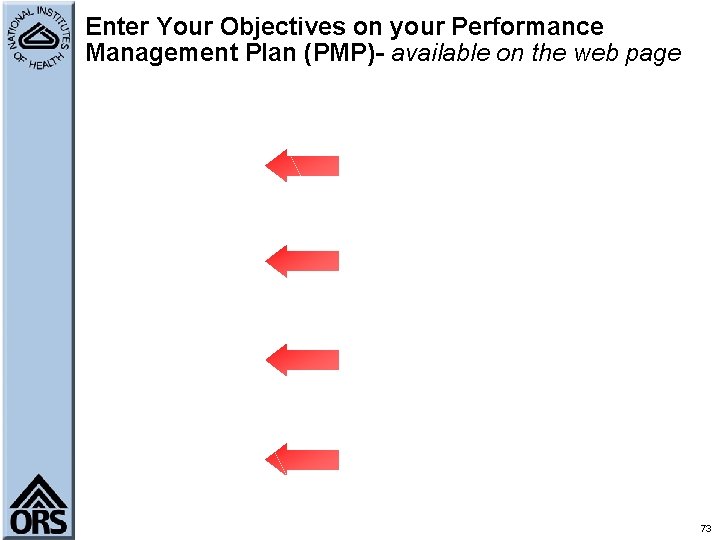
Enter Your Objectives on your Performance Management Plan (PMP)- available on the web page 73
Resist The Urge To Jump Ahead • At this point most people jump into measures…and when they get there, they start listing all of the “action items” • There is one last step before moving to measures… 74
Define Objectives 75
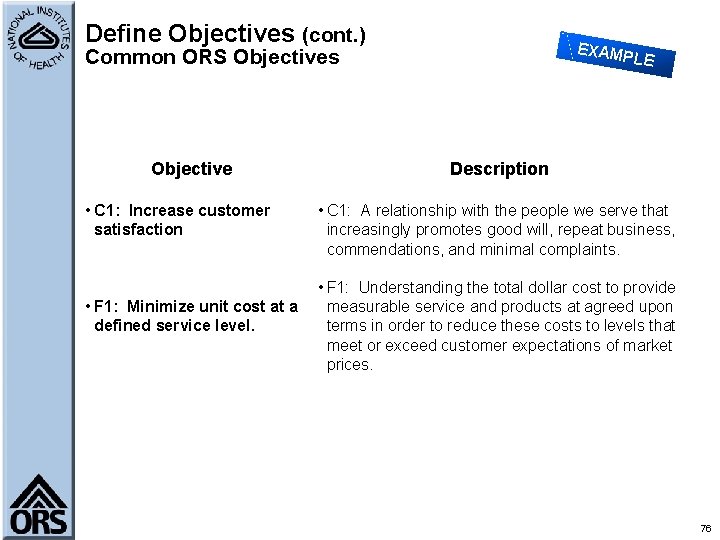
Define Objectives (cont. ) EXAM PLE Common ORS Objectives Objective • C 1: Increase customer satisfaction • F 1: Minimize unit cost at a defined service level. Description • C 1: A relationship with the people we serve that increasingly promotes good will, repeat business, commendations, and minimal complaints. • F 1: Understanding the total dollar cost to provide measurable service and products at agreed upon terms in order to reduce these costs to levels that meet or exceed customer expectations of market prices. 76
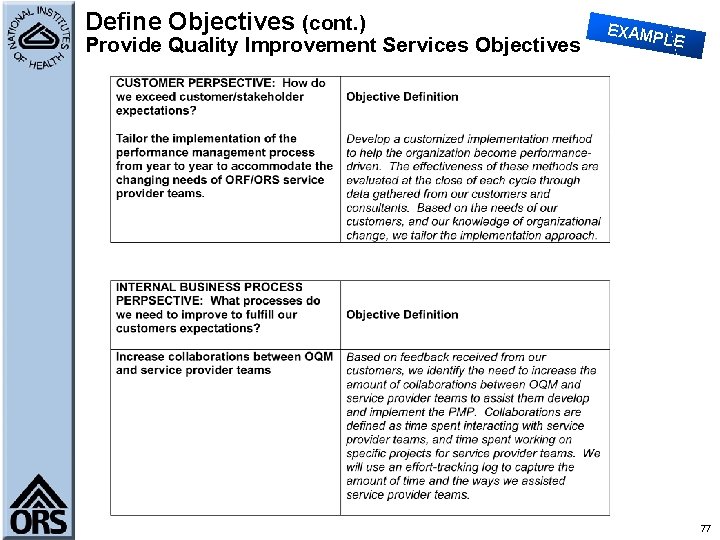
Define Objectives (cont. ) Provide Quality Improvement Services Objectives EXAM PLE 77
Summary This training has given you new information that your Team can use to develop your PM roadmap: A good PMP will “tell the story” of your Service Group. • Value Proposition • Strategy • Objectives – Customer – Internal Business Process – Learning and Growth – Financial 78
Linking Performance Objectives with the Strategy Map 79
Strategy Mapping…What is it? ? • A pictorial representation of your whole strategy (how all of your objectives fit together) • A way to decide which objectives are the most critical ones • A tool that helps you validate your objectives • A tool that can help you validate your measures • A tool that can help you manage your strategy 80
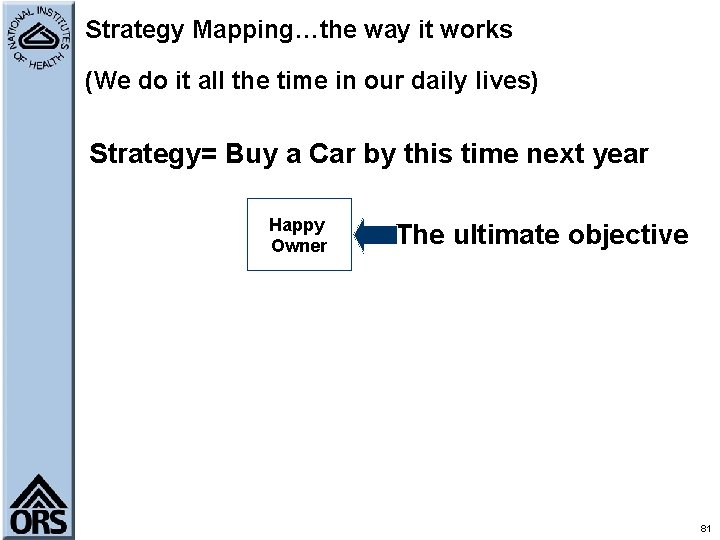
Strategy Mapping…the way it works (We do it all the time in our daily lives) Strategy= Buy a Car by this time next year Happy Owner The ultimate objective 81
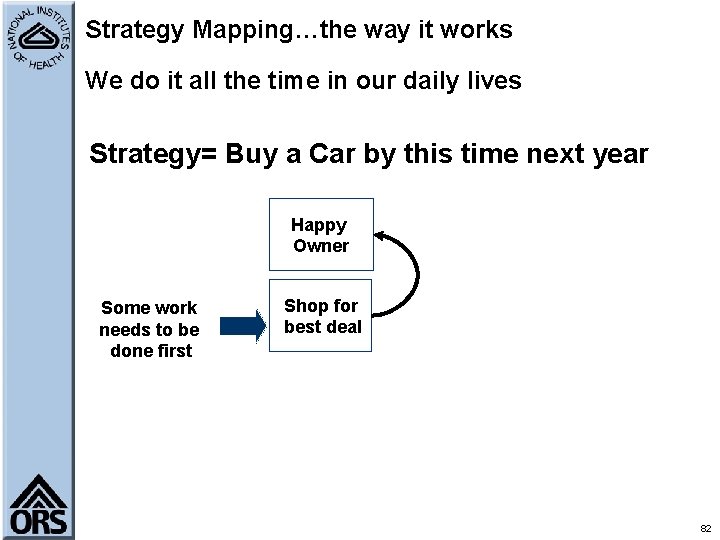
Strategy Mapping…the way it works We do it all the time in our daily lives Strategy= Buy a Car by this time next year Happy Owner Some work needs to be done first Shop for best deal 82
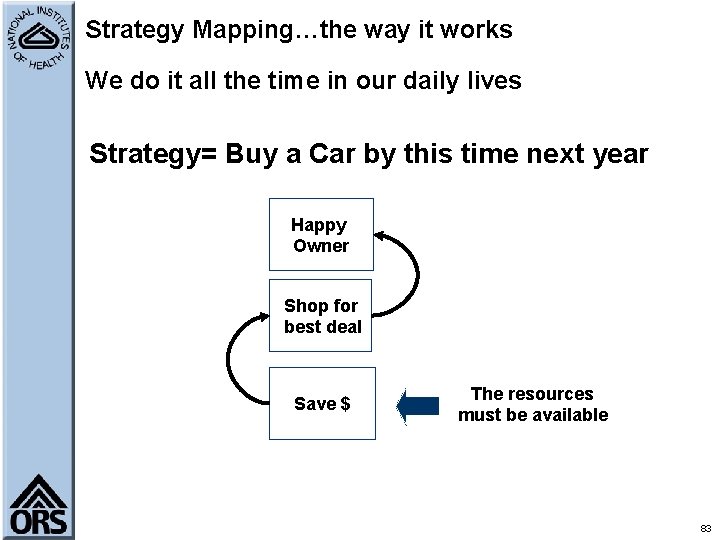
Strategy Mapping…the way it works We do it all the time in our daily lives Strategy= Buy a Car by this time next year Happy Owner Shop for best deal Save $ The resources must be available 83
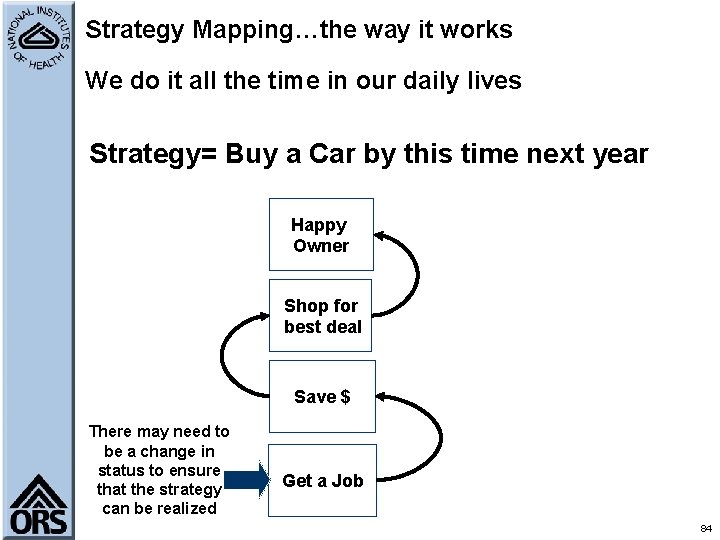
Strategy Mapping…the way it works We do it all the time in our daily lives Strategy= Buy a Car by this time next year Happy Owner Shop for best deal Save $ There may need to be a change in status to ensure that the strategy can be realized Get a Job 84
Strategy Mapping- An ORS Example 85
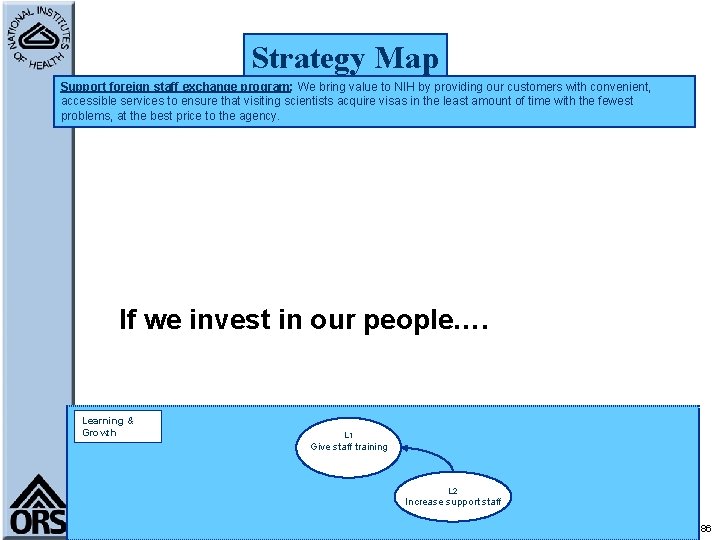
Strategy Map Support foreign staff exchange program: We bring value to NIH by providing our customers with convenient, accessible services to ensure that visiting scientists acquire visas in the least amount of time with the fewest problems, at the best price to the agency. If we invest in our people…. Learning & Growth L 1 Give staff training L 2 Increase support staff 86
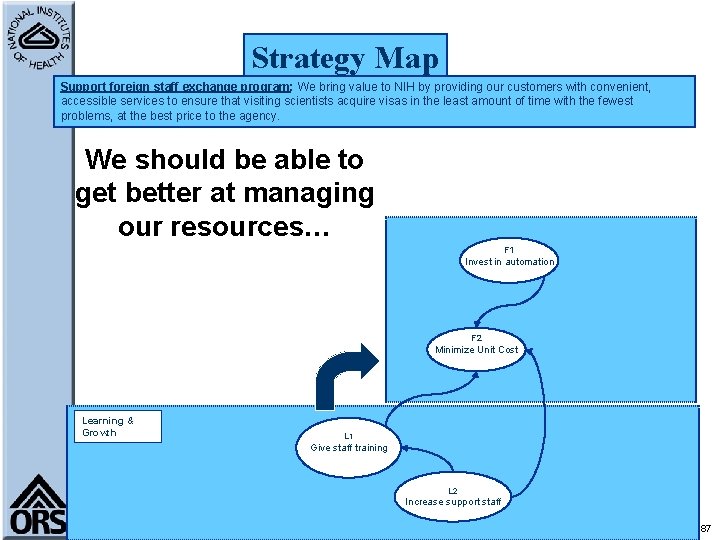
Strategy Map Support foreign staff exchange program: We bring value to NIH by providing our customers with convenient, accessible services to ensure that visiting scientists acquire visas in the least amount of time with the fewest problems, at the best price to the agency. We should be able to get better at managing our resources… F 1 Invest in automation F 2 Minimize Unit Cost Learning & Growth L 1 Give staff training L 2 Increase support staff 87
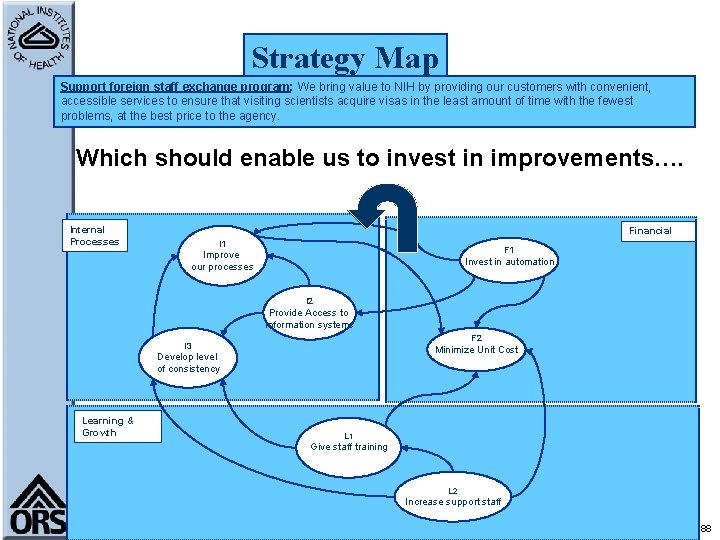
Strategy Map Support foreign staff exchange program: We bring value to NIH by providing our customers with convenient, accessible services to ensure that visiting scientists acquire visas in the least amount of time with the fewest problems, at the best price to the agency. Which should enable us to invest in improvements…. Internal Processes Financial I 1 F 1 Improve our processes Invest in automation I 2 Provide Access to information systems F 2 I 3 Minimize Unit Cost Develop level of consistency Learning & Growth L 1 Give staff training L 2 Increase support staff 88
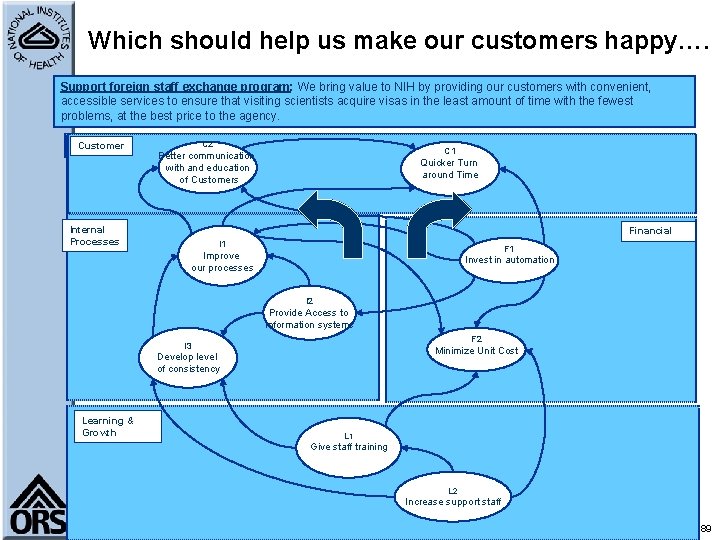
Which should help us make our customers happy…. Support foreign staff exchange program: We bring value to NIH by providing our customers with convenient, accessible services to ensure that visiting scientists acquire visas in the least amount of time with the fewest problems, at the best price to the agency. Customer C 2 C 1 Better communication with and education of Customers Internal Processes Quicker Turn around Time Financial I 1 F 1 Improve our processes Invest in automation I 2 Provide Access to information systems F 2 I 3 Minimize Unit Cost Develop level of consistency Learning & Growth L 1 Give staff training L 2 Increase support staff 89
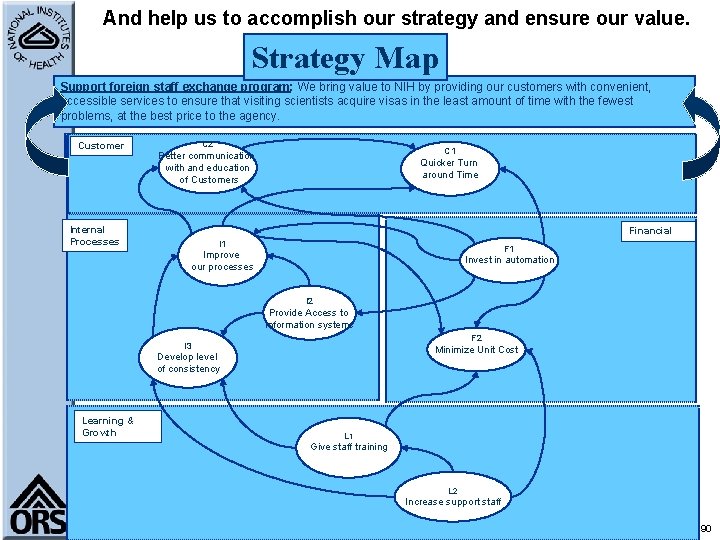
And help us to accomplish our strategy and ensure our value. Strategy Map Support foreign staff exchange program: We bring value to NIH by providing our customers with convenient, accessible services to ensure that visiting scientists acquire visas in the least amount of time with the fewest problems, at the best price to the agency. Customer C 2 C 1 Better communication with and education of Customers Internal Processes Quicker Turn around Time Financial I 1 F 1 Improve our processes Invest in automation I 2 Provide Access to information systems F 2 I 3 Minimize Unit Cost Develop level of consistency Learning & Growth L 1 Give staff training L 2 Increase support staff 90
Summary • Talked about how performance management started in ORS/ORF • Covered the basics of the Balanced Scorecard approach • Discussed the roles of Performance Management team members • Reviewed the Performance Management Plan (PMP) that is your business roadmap • Discussed how to develop a value proposition, strategy, and performance objectives • Reviewed how to use the strategy map to show the relationships among your performance objectives 91
- Slides: 91