
Performance Management Introduction Applicability to Public Health These
Performance Management Introduction & Applicability to Public Health
These slides were developed through a cooperative agreement with the Centers for Disease Control and Prevention’s (CDC’s) Office of State, Tribal, Local, and Territorial Support (OSTLTS), through the National Public Health Improvement Initiative (NPHII) with funding from the Affordable Care Act Capacity Building Assistance to Improve Public Health Infrastructure Investments. Disclaimer: The guidance provided in this tool is that of the authors and does not necessarily represent the official position of or endorsement by the Centers for Disease Control and Prevention.
What is Performance Management? “Performance management is the practice of actively using performance data to improve the public's health. This practice involves the strategic use of performance measures and standards to establish performance targets and goals. ” Source: From Silos to Systems: Using Performance Management to Improve Public Health Systems – prepared by the Public Health Foundation for the Performance Management National Excellence Collaborative, 2003
What is Performance Management? A systematic process by which an organization involves its employees in improving the effectiveness of the organization and achieving the organization’s mission and strategic goals. By improving performance and quality, public health systems can save lives, cut costs, and get better results. Enables health departments to be more: Efficient Effective Transparent Accountable
What is Performance Management? Core practices and processes generally include: goal setting financial planning operational planning data collection consolidation of data analysis reporting of data quality improvement evaluation of results monitoring of key performance indicators others? ? ? The focus of these performance management activities is to ensure that goals are consistently met in an effective and efficient manner by an organization, a department, or an employee.
The Importance of Performance Management Ways that performance management can positively influence a public health agency include: better return on dollars invested in health greater accountability for funding and increases in the public’s trust reduced duplication of efforts better understanding of public health accomplishments and priorities among employees, partners, and the public increased sense of cooperation and teamwork increased emphasis on quality, rather than quantity improved problem-solving
Performance Management Federal Government Perspective The Accountable Government Initiative - an Update on Our Performance Management Agenda states that performance management efforts for 2011 are focused on six strategies that have the highest potential for achieving meaningful performance improvement within and across Federal agencies: 1. Driving agency top priorities 2. Cutting waste 3. Reforming contracting 4. Closing the Information Technology gap 5. Promoting accountability and innovation through open government 6. Attracting and motivating top talent Source: Memorandum for the senior executive service; Jeffrey D. Zients, Federal Chief Performance Officer and Deputy Director for Management, Office of Management and Budget; 9/14/2010
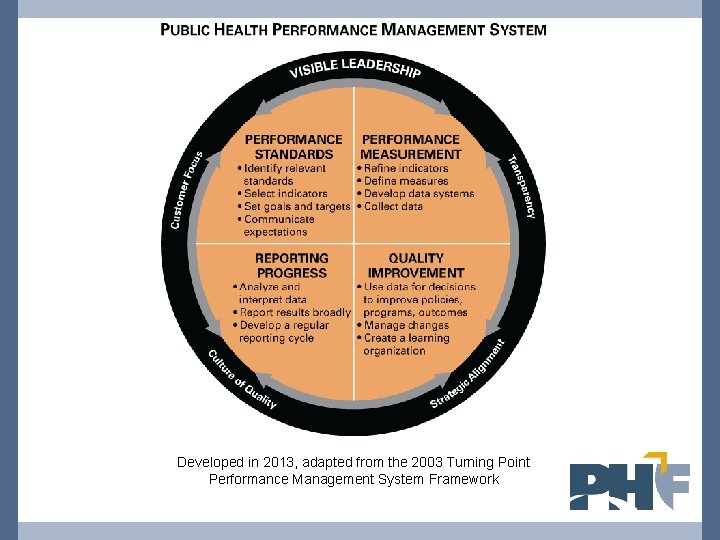
Developed in 2013, adapted from the 2003 Turning Point Performance Management System Framework
Performance Standards may be set based on national, state or scientific organizations, by benchmarking against similar organizations, or by other methods. Example in practice: Healthy People 2020 objective of a 10% improvement in the cases of pertussis among children under 1 year of age(National Notifiable Diseases Surveillance System) and reduce severe allergic reactions to food among adults with a food allergy diagnosis to 21% from 29. 3% (Food Safety Survey) Source: www. Healthly. People. gov
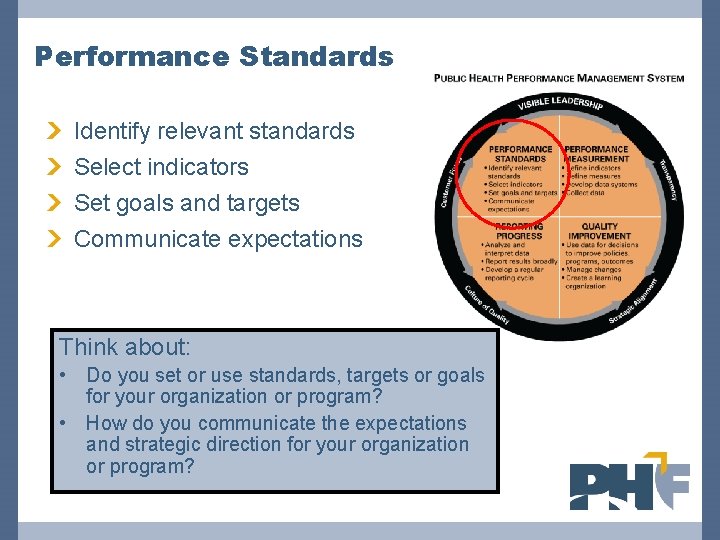
Performance Standards Identify relevant standards Select indicators Set goals and targets Communicate expectations Think about: • Do you set or use standards, targets or goals for your organization or program? • How do you communicate the expectations and strategic direction for your organization or program?
Performance Measurement It is important to set criteria and establish scope (programmatic vs. state) Example in practice: New Hampshire used the following criteria to select final measures: Data should be available for several years to show trends. Data should be reliable, in that we are confident in the accuracy of the data and that it measures what is intended to measure. The measures should reflect new and growing initiatives. The measures should be a good indicator of whether or not a program or intervention is working. Source: Improving the Public’s Health in New Hampshire, 2005. http: //www. dhhs. nh. gov/dphs/iphnh/documents/report. pdf
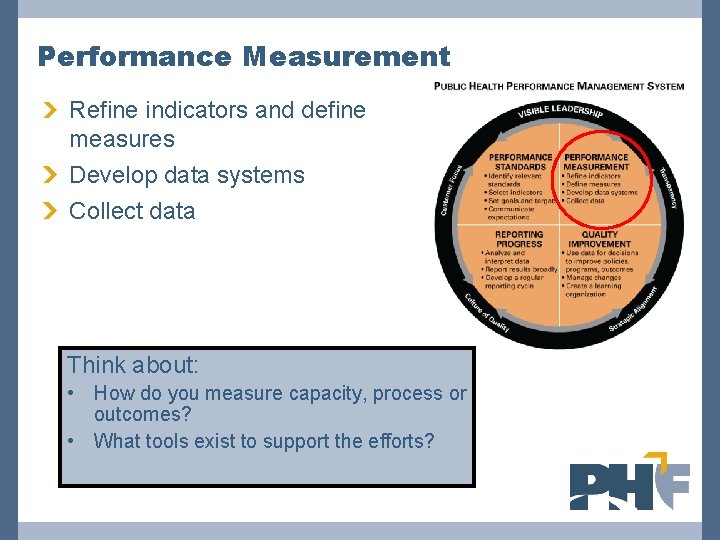
Performance Measurement Refine indicators and define measures Develop data systems Collect data Think about: • How do you measure capacity, process or outcomes? • What tools exist to support the efforts?
Reporting Progress is how a public health agency tracks and reports progress depending upon the purpose of its performance management system and the intended users of performance data. A robust reporting system makes comparisons to national, state, or local standards or benchmarks to show where gaps may exist within the system.
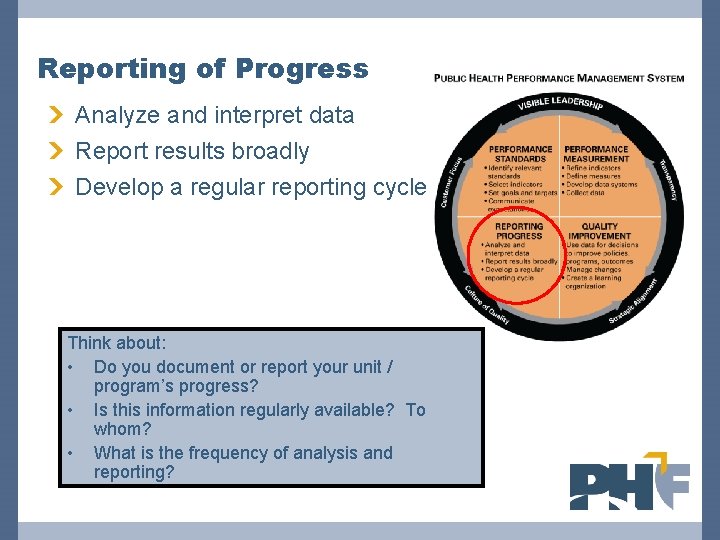
Reporting of Progress Analyze and interpret data Report results broadly Develop a regular reporting cycle Think about: • Do you document or report your unit / program’s progress? • Is this information regularly available? To whom? • What is the frequency of analysis and reporting?
Quality Improvement (QI) is the establishment of a program or process to manage change and achieve quality improvement in public health policies, programs, or infrastructure based on performance standards, measures, and reports. Most Commonly Used QI Tools Brainstorming, Flow Chart, SIPOC+CM, Cause and Effect Diagram, Five Whys, Solution and Effect Diagram, Check Sheets, Pareto Charts, Pie Charts, Run Charts, Control Chart, Force Field Analysis, Nominal Group Technique
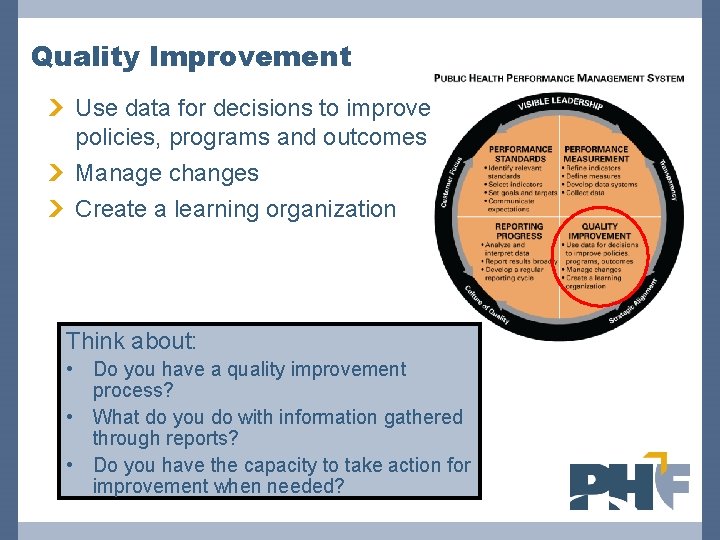
Quality Improvement Use data for decisions to improve policies, programs and outcomes Manage changes Create a learning organization Think about: • Do you have a quality improvement process? • What do you do with information gathered through reports? • Do you have the capacity to take action for improvement when needed?
Visible Leadership - Senior management commitment to a culture of quality that aligns performance management practices with the organizational mission, regularly takes into account customer feedback, and enables transparency about performance against targets between leadership and staff.
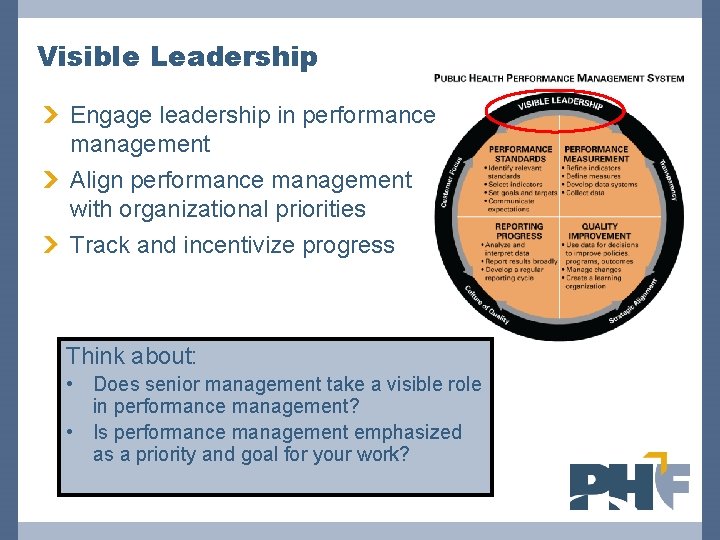
Visible Leadership Engage leadership in performance management Align performance management with organizational priorities Track and incentivize progress Think about: • Does senior management take a visible role in performance management? • Is performance management emphasized as a priority and goal for your work?
Performance Management Successes/Barriers: Performance Standards Success Factors Risk Factors Choose standards by themes to be cross-cutting Difficult to develop standards Training Lack of program goals Scrutinize regularly Tension between goals vs. program focus Use QI tools/methods to align and prioritize Align standards with policies Strategic plan alignment Lack of meaningful vision Funder driven standards vs. department driven standards Poor decision making Measurement becomes the standard
Performance Management Successes/Barriers: Performance Measurement Success Factors Results focus Mission Data Routine part of work Leadership interest Experience teaches Training internally SMART measures developed through collaborating and listening Risk Factors Lack of clarity about what and how to measure Measures not connected to objectives Difficult to capture in one place Data overload – too much data gathering without prioritization
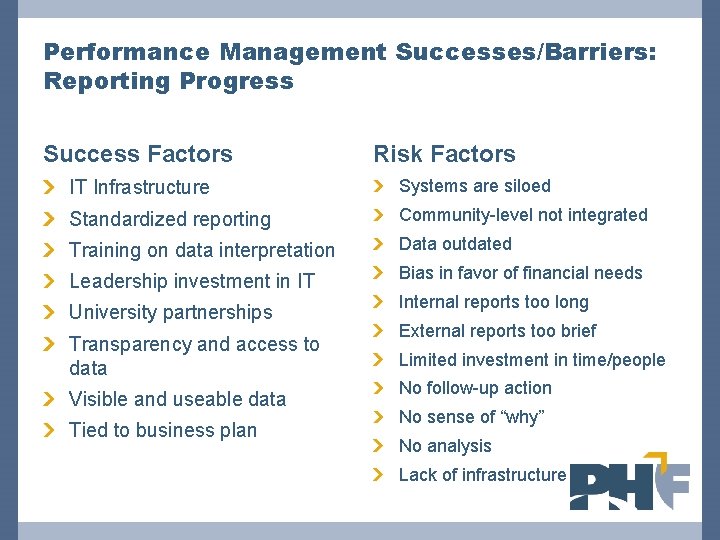
Performance Management Successes/Barriers: Reporting Progress Success Factors Risk Factors IT Infrastructure Systems are siloed Standardized reporting Community-level not integrated Training on data interpretation Data outdated Leadership investment in IT Bias in favor of financial needs University partnerships Transparency and access to data Visible and useable data Tied to business plan Internal reports too long External reports too brief Limited investment in time/people No follow-up action No sense of “why” No analysis Lack of infrastructure
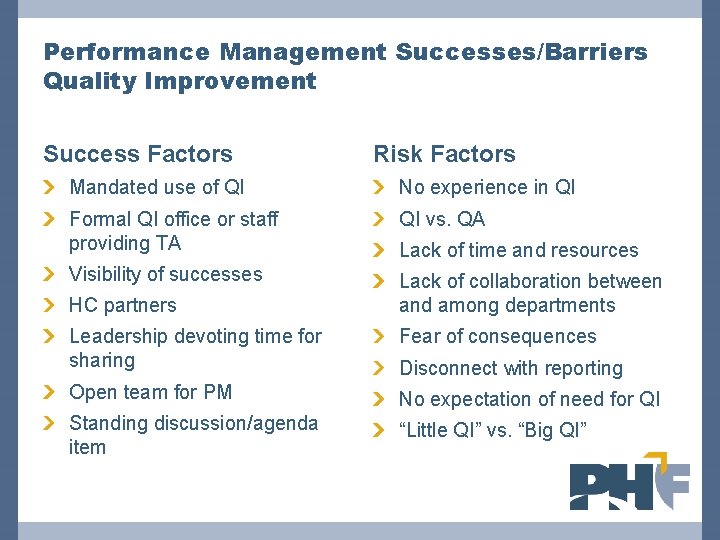
Performance Management Successes/Barriers Quality Improvement Success Factors Risk Factors Mandated use of QI No experience in QI Formal QI office or staff providing TA QI vs. QA Visibility of successes Lack of collaboration between and among departments HC partners Lack of time and resources Leadership devoting time for sharing Fear of consequences Open team for PM No expectation of need for QI Standing discussion/agenda item “Little QI” vs. “Big QI” Disconnect with reporting
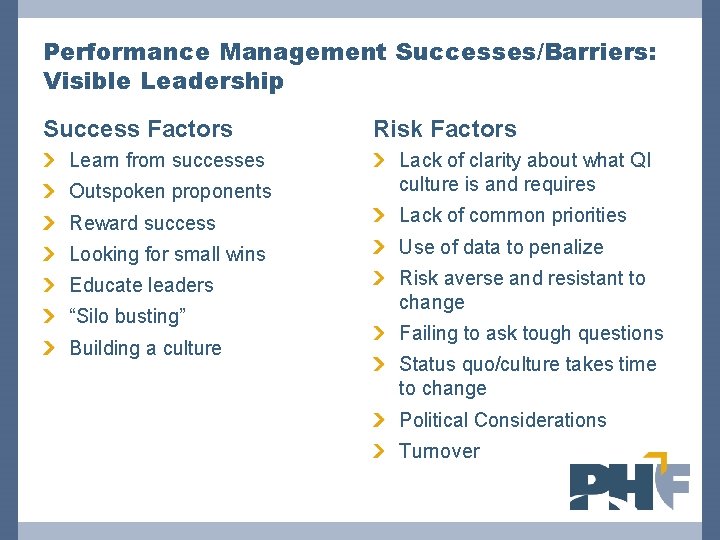
Performance Management Successes/Barriers: Visible Leadership Success Factors Learn from successes Risk Factors Outspoken proponents Lack of clarity about what QI culture is and requires Reward success Lack of common priorities Looking for small wins Use of data to penalize Educate leaders Risk averse and resistant to change “Silo busting” Building a culture Failing to ask tough questions Status quo/culture takes time to change Political Considerations Turnover
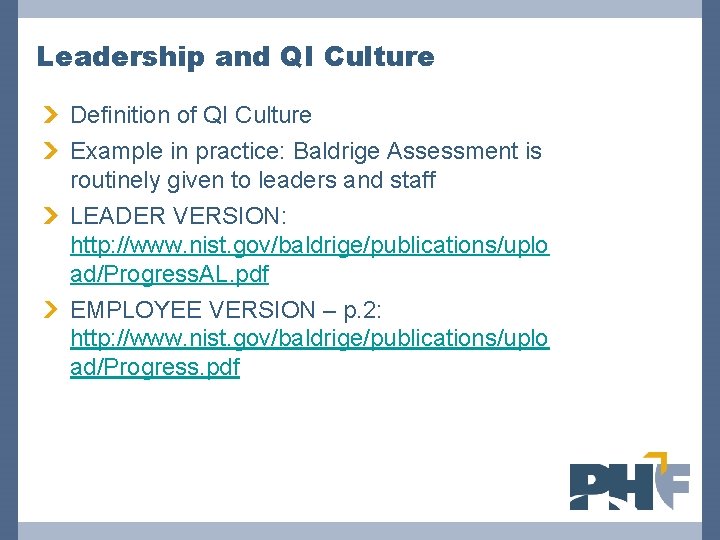
Leadership and QI Culture Definition of QI Culture Example in practice: Baldrige Assessment is routinely given to leaders and staff LEADER VERSION: http: //www. nist. gov/baldrige/publications/uplo ad/Progress. AL. pdf EMPLOYEE VERSION – p. 2: http: //www. nist. gov/baldrige/publications/uplo ad/Progress. pdf
Performance Management in Public Health Today QI Definition in Public Health Journal of Public Health Management Practice (JPHMP) January/February 2010 issue focused exclusively on QI in public health http: //journals. lww. com/jphmp/toc/2010/01000 Public Health Initiatives National Public Health Performance Standards Program (NPHPSP) RWJF’s Multi-state Learning Collaborative (MLC) CDC’s Winnable Battles National Public Health Improvement Initiative (NPHII) National Prevention Strategy (June 2011) Public Health Accreditation Board QI Practice Exchange Accreditation Domain 9 required documentation
Questions to ask your organization Who are the stakeholders in Performance Management? What important things happened over the past 12 -18 months and how did the team perform? What important issues does the team face? Are there things that the organization/work group/program is doing that it should not be doing or that it could modify? Are there things that the team is neglecting to do that it should do? What things could the team do that would help you perform better?
- Slides: 26