
Performance Management and Appraisal Chapter 9 Copyright 2009
- Slides: 39
Performance Management and Appraisal Chapter 9 Copyright © 2009 Pearson Education, Inc. publishing as Prentice Hall 1
Basic Concepts in Performance Management • Performance appraisal means evaluating an employee’s current and/or past performance relative to performance standards • Performance Management is the entire, integrated process of continuously identifying, measuring and developing performance and aligning performance with strategic goals Copyright © 2009 Pearson Education, Inc. publishing as Prentice Hall 2
Defining the Employee’s Goals and Work Efforts • Employee performance standards should make sense in terms of the company’s broader goals • Managers should appraise employees based on achieving the specific goals he or she expects to be measured • Problems arise when measurable goals are not set due to the complexity of the task Copyright © 2009 Pearson Education, Inc. publishing as Prentice Hall 3
Why Appraise Performance? • Appraisals provide important input used by supervisors to make promotion and salary raise decisions • The appraisal lets the boss and subordinate develop a plan for correcting deficiencies and reinforce what the subordinate does right • Appraisals serve as a useful career-planning tool providing opportunity to review the employee’s plans Copyright © 2009 Pearson Education, Inc. publishing as Prentice Hall 4
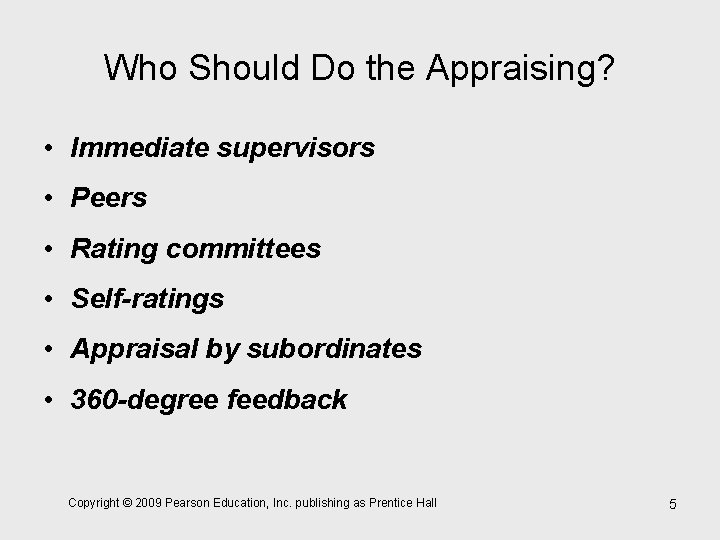
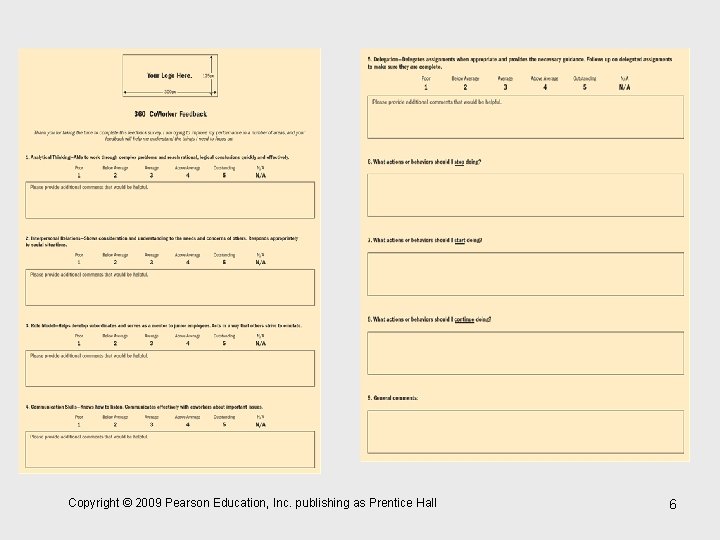
Who Should Do the Appraising? • Immediate supervisors • Peers • Rating committees • Self-ratings • Appraisal by subordinates • 360 -degree feedback Copyright © 2009 Pearson Education, Inc. publishing as Prentice Hall 5
Copyright © 2009 Pearson Education, Inc. publishing as Prentice Hall 6
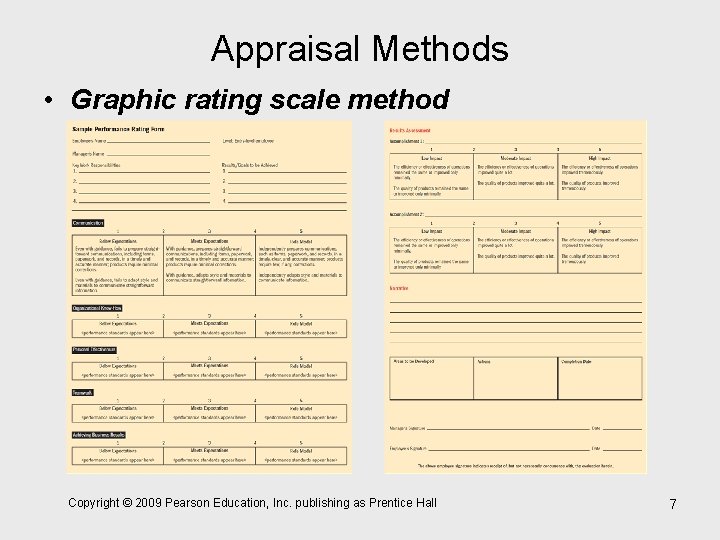
Appraisal Methods • Graphic rating scale method Copyright © 2009 Pearson Education, Inc. publishing as Prentice Hall 7
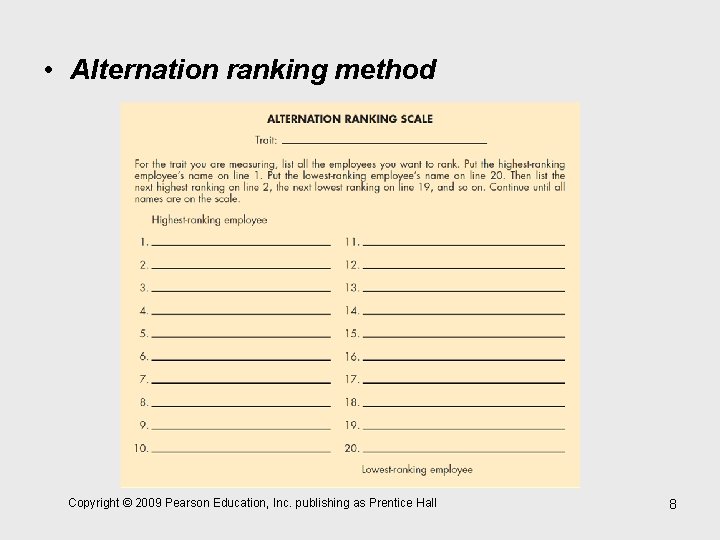
• Alternation ranking method Copyright © 2009 Pearson Education, Inc. publishing as Prentice Hall 8
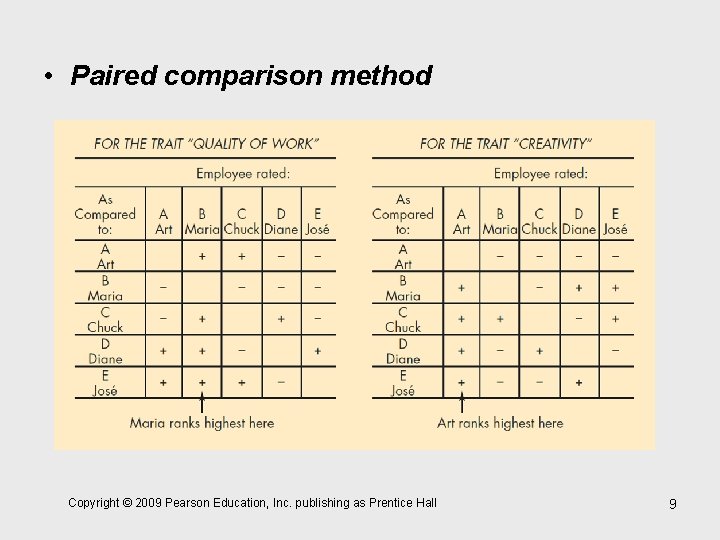
• Paired comparison method Copyright © 2009 Pearson Education, Inc. publishing as Prentice Hall 9
• Forced distribution method – Places predetermined percentages of subordinates in performance categories – Similar to a professor “grading on a curve” – Features a 20/70/10 split – Drawbacks include perceptions of unfairness Copyright © 2009 Pearson Education, Inc. publishing as Prentice Hall 10
• Critical incident method – Requires keeping record of uncommonly good or undesirable examples of employee behavior and reviewing it with the employee at predetermined times – Usually supplements a ranking system – Helps keep supervisors focused on more than the last few weeks for evaluation Copyright © 2009 Pearson Education, Inc. publishing as Prentice Hall 11
• Behaviorally anchored rating scales (BARS) – Combines benefits of critical incidents and quantitative ratings by anchoring a quantified scale with specific examples of good and poor performance Copyright © 2009 Pearson Education, Inc. publishing as Prentice Hall 12
Appraisal Forms in Practice • Management by objectives method 1. Set the organization’s goals and establish organization wide plan to achieve them 2. Set department’s goals through a joint effort between department heads and superiors 3. Discuss departmental goals with all subordinates and ask them to develop their own individual goals Copyright © 2009 Pearson Education, Inc. publishing as Prentice Hall 13
Appraisal Forms in Practice, cont. 4. Define expected results by department heads and subordinates setting short-term performance targets 5. Conduct performance reviews and measure results 6. Department heads to provide feedback through performance reviews and meetings with subordinates Copyright © 2009 Pearson Education, Inc. publishing as Prentice Hall 14
• Computerized and Web-based performance appraisals • Electronic performance monitoring Copyright © 2009 Pearson Education, Inc. publishing as Prentice Hall 15
The Appraisal Feedback Interview • Preparing for the appraisal interview – Give the subordinate at least a week’s notice – Study his or her job description, compare performance to standards and review files of previous appraisals – Chose a private place where you will not be interrupted and schedule enough time to complete the interview Copyright © 2009 Pearson Education, Inc. publishing as Prentice Hall 16
Conducting the Interview • Main goal is to reinforce satisfactory performance or diagnose and improve unsatisfactory performance • Get agreement before the subordinate leaves on how things will improve and by when • Ensure the process is fair • Deal with defensiveness • Be wary of “impression management” tactics Copyright © 2009 Pearson Education, Inc. publishing as Prentice Hall 17
Dealing with Common Appraisal Problems, cont. • Halo effect • Central tendency • Leniency or strictness • Bias Copyright © 2009 Pearson Education, Inc. publishing as Prentice Hall 18
Avoiding Legal Issues in Performance Appraisal • Base the performance appraisal criteria on documented job analyses • Communicate performance standards to employees in writing at the beginning of the period • Base appraisals on separate evaluations of each of the job’s performance dimensions • Include an employee appeals process Copyright © 2009 Pearson Education, Inc. publishing as Prentice Hall 19
Avoiding Legal Issues in Performance Appraisal, cont. • One appraiser should never have absolute authority to determine a personnel action • Document all information bearing on a personnel decision in writing • Train supervisors to use appraisal instruments Copyright © 2009 Pearson Education, Inc. publishing as Prentice Hall 20
Performance Management • Performance management is a continuous process of identifying, measuring and developing the performance of employees • Employers are migrating to performance management because of the following: – Total quality – Appraisal issues – Strategic planning Copyright © 2009 Pearson Education, Inc. publishing as Prentice Hall 21
Total Quality • Based on W. Edwards Deming’s work Total Quality indicates that problems occur because of the system, not the employee • Per Deming, an employee’s performance is a function of things like training, communication, tools and supervision than individual motivation • Instead of focusing on problems, Deming’s philosophy uses continuous collegial feedback and when necessary changes to the system to improve performance Copyright © 2009 Pearson Education, Inc. publishing as Prentice Hall 22
Appraisal Issues • Issues with traditional appraisals are numerous and include timing as well as employees and managers feeling that often the appraisal is not just useless but tense and counterproductive Copyright © 2009 Pearson Education, Inc. publishing as Prentice Hall 23
Strategic Planning • The challenge is not designing good strategies it is getting employees to execute them • Strategic goals go unmet for several reasons – The company does not bother to track performance – Strategies and goals are poorly communicated to employees – Employees are not assigned clear tasks and responsibilities Copyright © 2009 Pearson Education, Inc. publishing as Prentice Hall 24
• Performance management avoids issues with strategic planning by encouraging employees to set goals that make sense and are provided with continuous feedback with corrective action taken as needed Copyright © 2009 Pearson Education, Inc. publishing as Prentice Hall 25
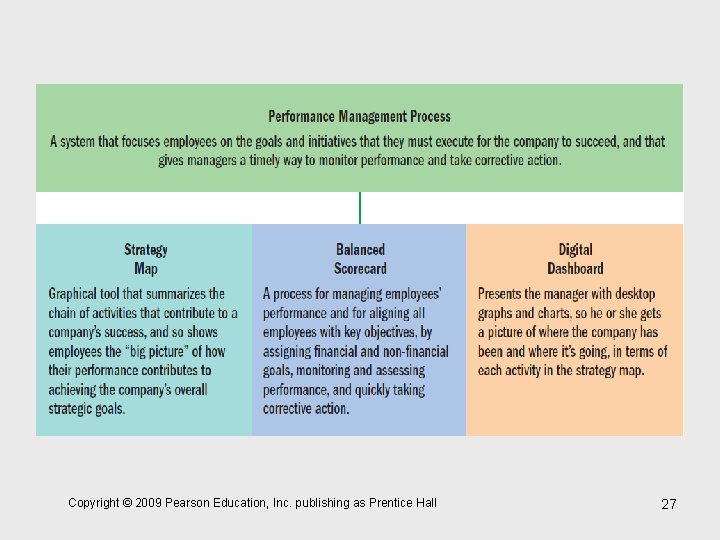
Information Technology-Supported Performance Management • Strategy maps • Balanced scorecards • Digital dashboards • Performance management software Copyright © 2009 Pearson Education, Inc. publishing as Prentice Hall 26
Copyright © 2009 Pearson Education, Inc. publishing as Prentice Hall 27
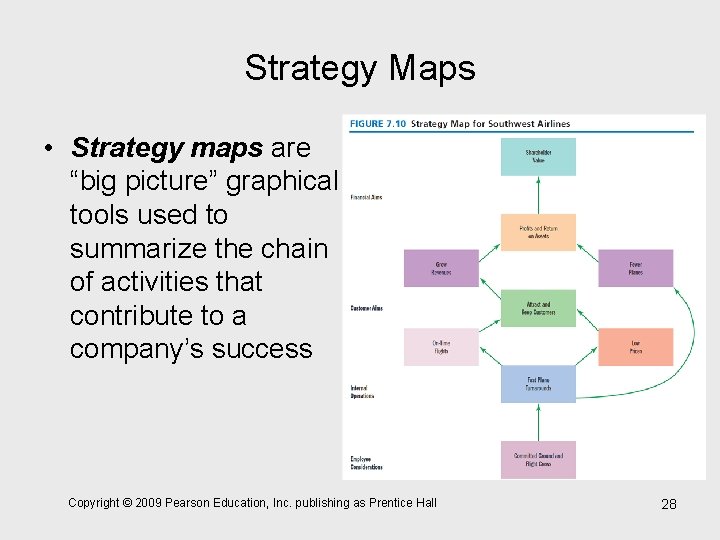
Strategy Maps • Strategy maps are “big picture” graphical tools used to summarize the chain of activities that contribute to a company’s success Copyright © 2009 Pearson Education, Inc. publishing as Prentice Hall 28
The Balanced Scorecard • The Balanced Scorecard is not a scorecard but a process for assigning financial and nonfinancial goals to the chain of activities required to achieve the company’s strategic goals and continuously monitor the results Copyright © 2009 Pearson Education, Inc. publishing as Prentice Hall 29
Digital Dashboards • The Digital Dashboard presents the manager with desktop graphs and charts so he or she can get a sense of where the company has been and where it is going in terms of activity created by the strategy map Copyright © 2009 Pearson Education, Inc. publishing as Prentice Hall 30
Performance Management Software • Software systems designed to help managers monitor, integrate and analyze information created from strategy maps and balanced scorecards Copyright © 2009 Pearson Education, Inc. publishing as Prentice Hall 31
Career Management • Career Management is a process for enabling employees to better understand develop their career skills and interests in order to use them most effectively within the company and after they leave the firm • Career Development is the lifelong series of activities that contribute to a person’s career exploration, establishment, success and fulfillment Copyright © 2009 Pearson Education, Inc. publishing as Prentice Hall 32
• Career Planning is the deliberate process where someone establishes an action plan to attain specific career goals based on his or her on personal SWOT analysis Copyright © 2009 Pearson Education, Inc. publishing as Prentice Hall 33
The Employee’s Role in Career Planning • Identify skills and aptitudes • Identify high-potential occupations • Change jobs if necessary • Find and utilize a mentor Copyright © 2009 Pearson Education, Inc. publishing as Prentice Hall 34
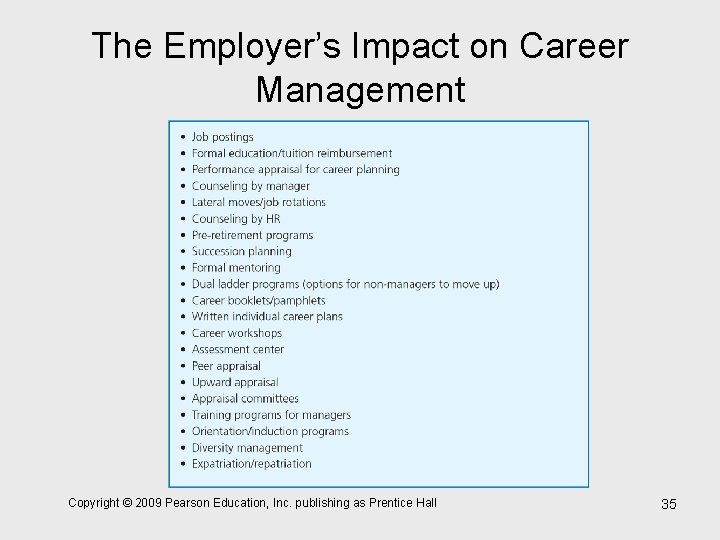
The Employer’s Impact on Career Management Copyright © 2009 Pearson Education, Inc. publishing as Prentice Hall 35
Gender Issues in Career Development • Men versus women – breaking through the “glass ceiling” • Studies have concluded that fast-track programs, individual career counseling and career planning workshops are less available to all women • Minority women are at risk: Only a small percentage of women of color hold professional and managerial private-sector positions Copyright © 2009 Pearson Education, Inc. publishing as Prentice Hall 36
Managing Promotions and Transfers • Seniority versus competence • Lateral moves or transfers – Can be due to downsizing – Usually do not result in greater rate of pay – Employees seek out transfers for advancement opportunity and non-career reasons like better hours, work location, etc. Copyright © 2009 Pearson Education, Inc. publishing as Prentice Hall 37
Retirement Counseling • Successful retirement counseling can help employees and employers • The workforce is growing older and less younger replacements are available - how will pending retirements affect the company? • Effective retirement counseling not only assists employees but enables the employer to retain retiring talent in some capacity Copyright © 2009 Pearson Education, Inc. publishing as Prentice Hall 38
Retirement Counseling, cont. • Minimize retirement effects on company by creating a culture that honors experience • Modify selection procedures and offer flexible work • Create a phasedretirement system Copyright © 2009 Pearson Education, Inc. publishing as Prentice Hall 39