
Performance Lawn Equipment Snow Blower Prototype Decision Analysis
Performance Lawn Equipment Snow Blower Prototype Decision Analysis
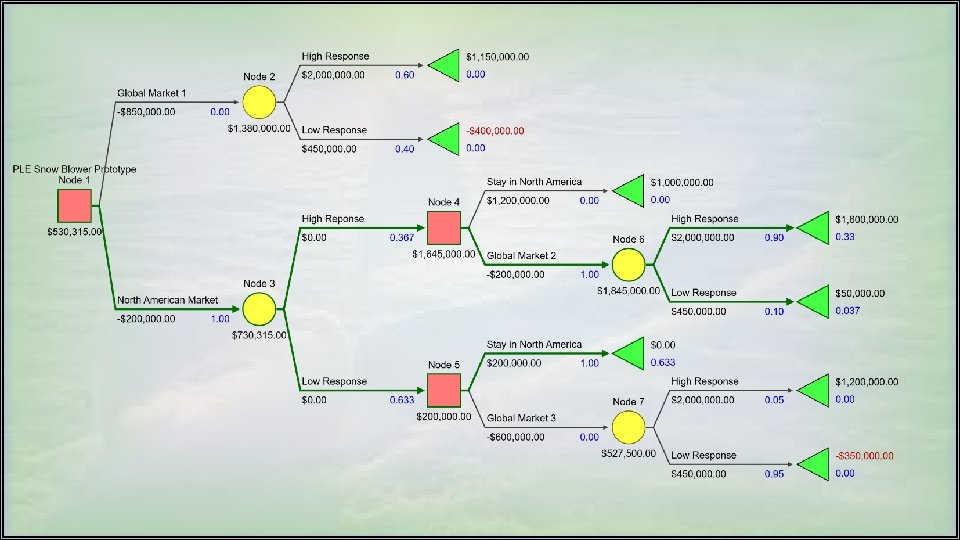
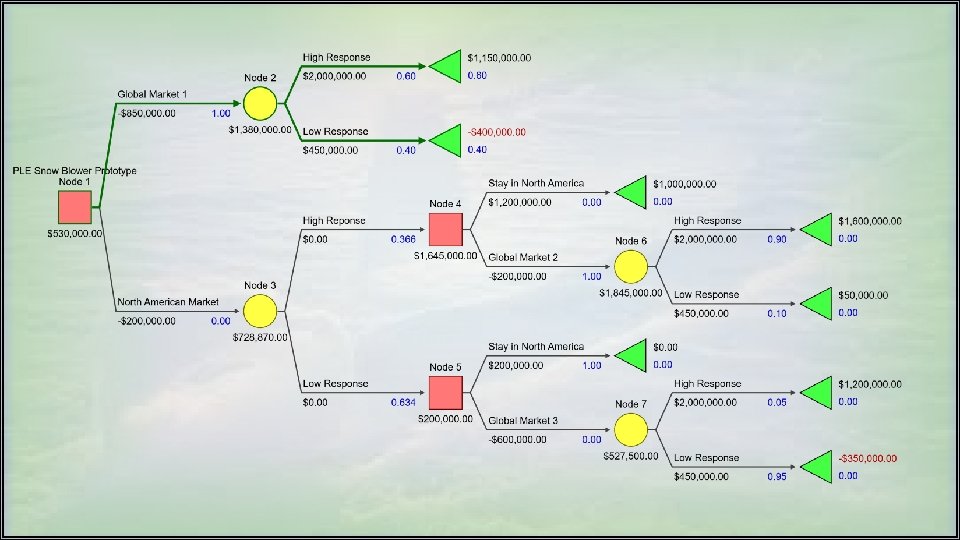
Summary: PLE has developed a prototype for a new snow blower for the consumer market. This can exploit the company’s expertise in small-gasoline-engine technology and balance seasonal demand cycles in the North American and European markets to provide additional revenues during the winter months. Initially, PLE faces two possible decisions: introduce the product globally at a cost of $850, 000 or evaluate it in a North American test market at a cost of $200, 000. If it introduces the product globally, PLE might find either a high or low response to the product. Probabilities of these events are estimated to be 0. 6 and 0. 4, respectively. With a high response, gross revenues of $2, 000 are expected; with a low response, the figure is $450, 000. If it starts with a North American test market, it might find a low response or a high response with probabilities 0. 3 and 0. 7, respectively. This may or may not reflect the global market potential. In any case, after conducting the marketing research, PLE next needs to decide whether to keep sales only in North America, market globally, or drop the product. If the North American response is high and PLE stays only in North America, the expected revenue is $1, 200, 000. If it markets globally (at an additional cost of $200, 000), the probability of a high global response is 0. 9 with revenues of $2, 000 ($450, 000 if the global response is low). If the North American response is low and it remains in North America, the expected revenue is $200, 000. If it markets globally (at an additional cost of $600, 000), the probability of a high global response is 0. 05, with revenues of $2, 000 ($450, 000 if the global response is low).
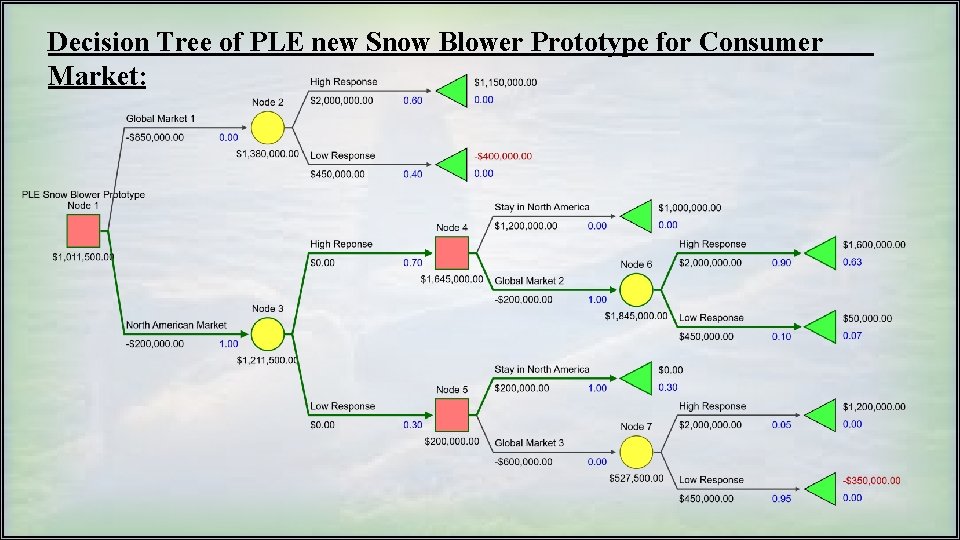
Decision Tree of PLE new Snow Blower Prototype for Consumer Market:
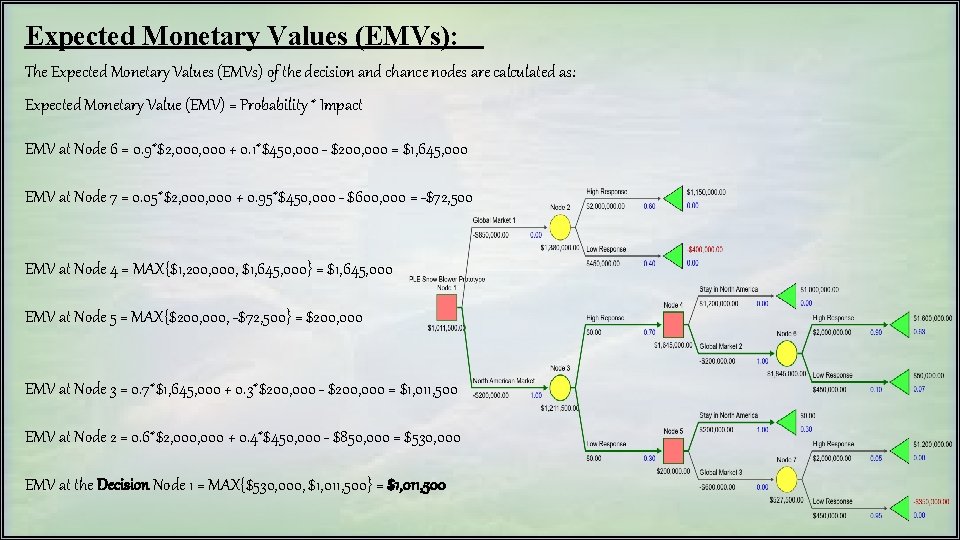
Expected Monetary Values (EMVs): The Expected Monetary Values (EMVs) of the decision and chance nodes are calculated as: Expected Monetary Value (EMV) = Probability * Impact EMV at Node 6 = 0. 9*$2, 000 + 0. 1*$450, 000 - $200, 000 = $1, 645, 000 EMV at Node 7 = 0. 05*$2, 000 + 0. 95*$450, 000 - $600, 000 = -$72, 500 EMV at Node 4 = MAX{$1, 200, 000, $1, 645, 000} = $1, 645, 000 EMV at Node 5 = MAX{$200, 000, -$72, 500} = $200, 000 EMV at Node 3 = 0. 7*$1, 645, 000 + 0. 3*$200, 000 - $200, 000 = $1, 011, 500 EMV at Node 2 = 0. 6*$2, 000 + 0. 4*$450, 000 - $850, 000 = $530, 000 EMV at the Decision Node 1 = MAX{$530, 000, $1, 011, 500} = $1, 011, 500
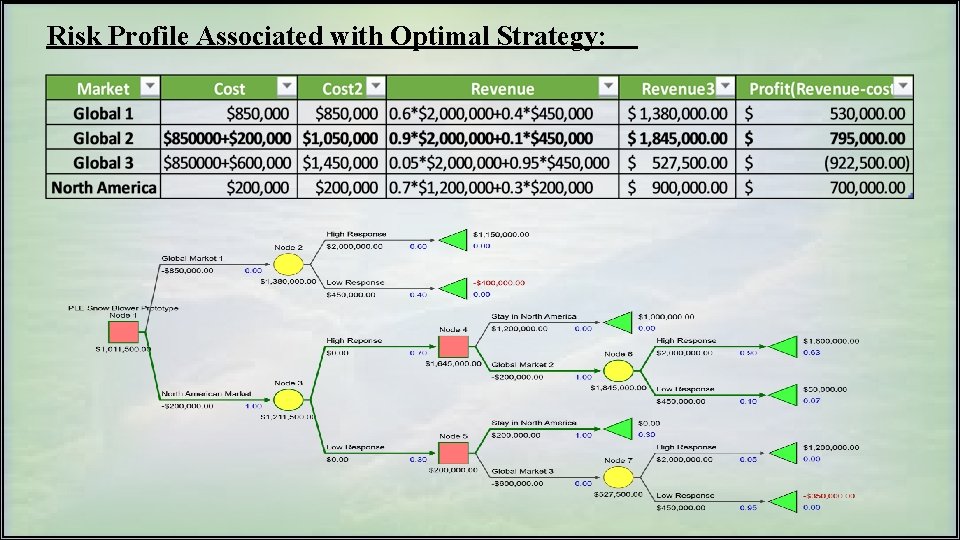
Risk Profile Associated with Optimal Strategy:
Optimal Strategy: The Optimal Strategy to market the PLE prototype for a new snow blower for the consumer market is to introduce it to the North American test market first, if the response is high, market globally with an additional cost of $200, 000 and if the response is low, then stay in North American Market with the initial cost of $200, 000. The maximum expected profit using this strategy is $1, 011, 500 Recommendations: Based on the sensitivity analysis of this optimal strategy to changes in the probability estimates (as illustrated in the following slides), it is recommended that the new snow blower should be introduced to the North American only if the probability of high response in this market is greater than 0. 367. In case of probability of high response lower than 0. 367, the company should consider launching the product globally with an expected profit of $530, 000.
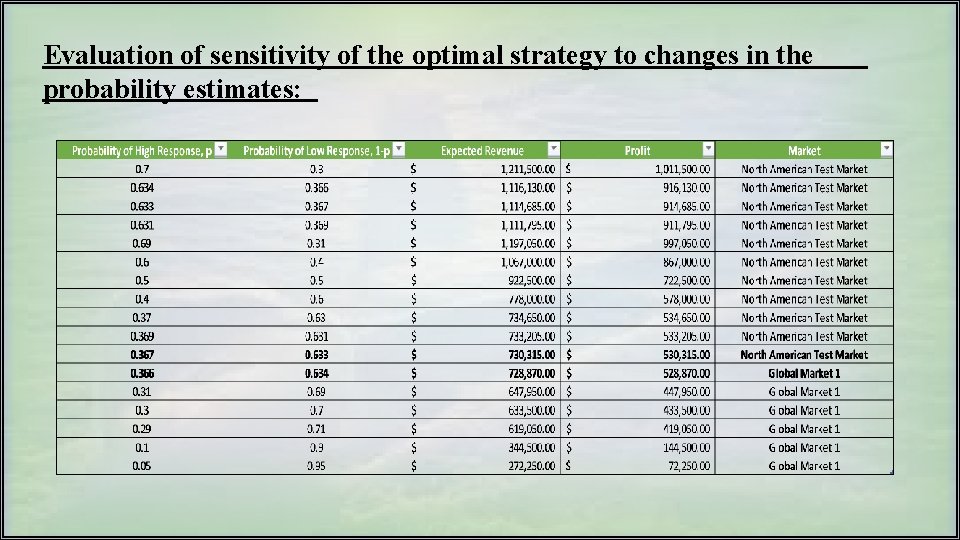
Evaluation of sensitivity of the optimal strategy to changes in the probability estimates:
- Slides: 9