
Performance Excellence in Academia Malcolm Baldrige Education Criteria
Performance Excellence in Academia: Malcolm Baldrige Education Criteria Richard Schuttler, Ph. D. Associate Dean Doctoral Programs University of Phoenix

Traditional Audit Baldrige Self-Assessment Detect & Correct Understand & Improve Selective Holistic Less Context Dependent Standards Non-prescriptive Deductive & Inductive Close-ended ? ? Open-ended ? ?
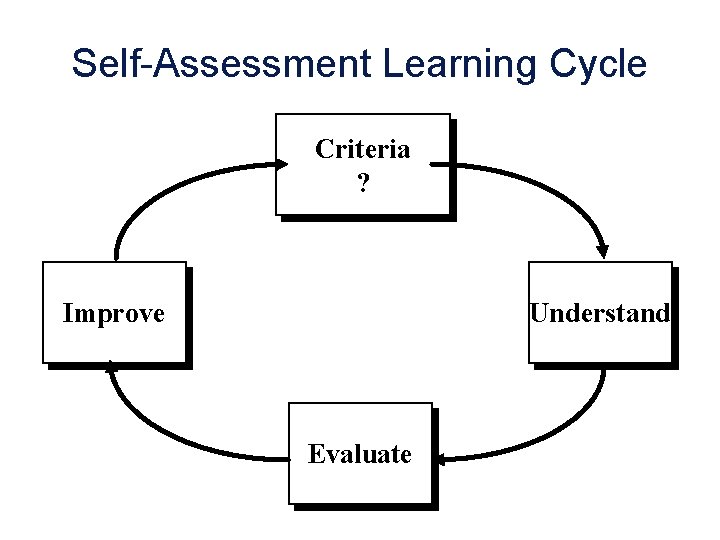
Self-Assessment Learning Cycle Criteria ? Improve Understand Evaluate
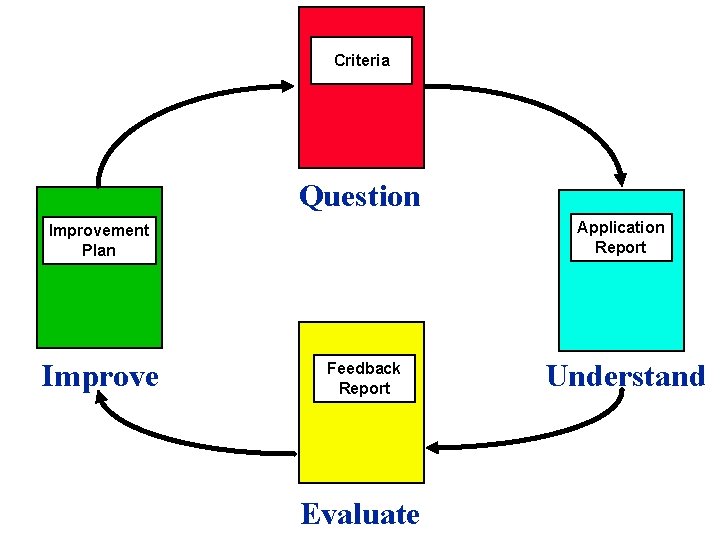
Criteria Question Application Report Improvement Plan Improve Feedback Report Evaluate Understand
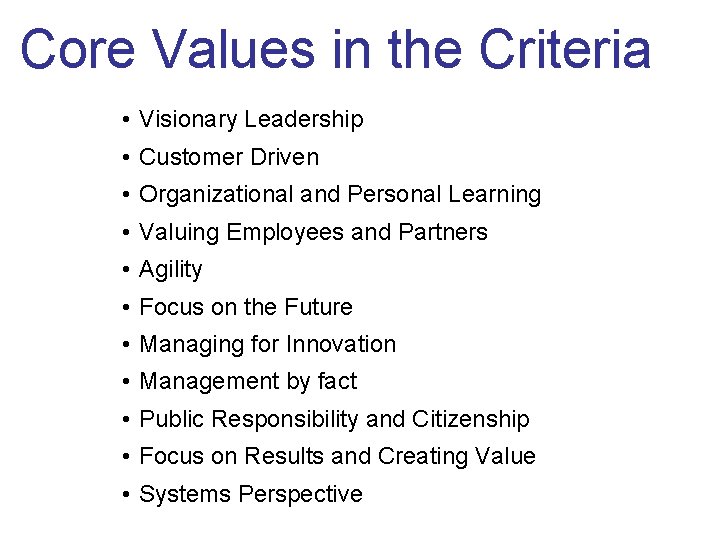
Core Values in the Criteria • Visionary Leadership • Customer Driven • Organizational and Personal Learning • Valuing Employees and Partners • Agility • Focus on the Future • Managing for Innovation • Management by fact • Public Responsibility and Citizenship • Focus on Results and Creating Value • Systems Perspective
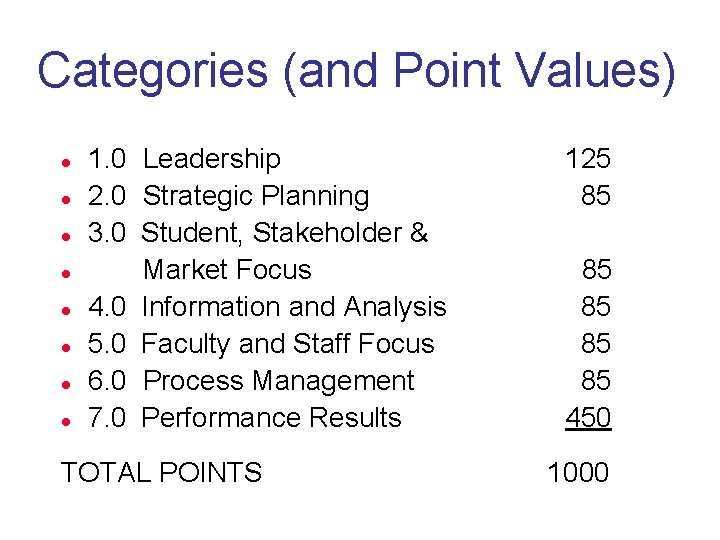
Categories (and Point Values) l l l l 1. 0 Leadership 2. 0 Strategic Planning 3. 0 Student, Stakeholder & Market Focus 4. 0 Information and Analysis 5. 0 Faculty and Staff Focus 6. 0 Process Management 7. 0 Performance Results TOTAL POINTS 125 85 85 85 450 1000
Baldrige Criteria Framework A Systems Perspective 3 Student, Stakeholder, & Market Focus
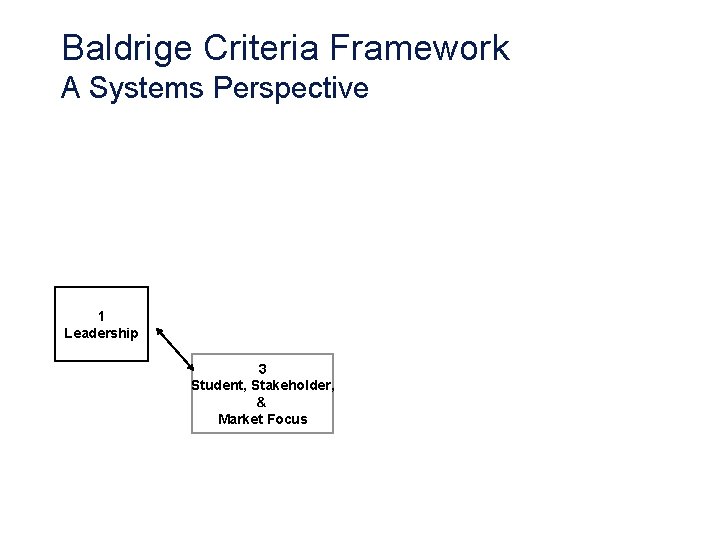
Baldrige Criteria Framework A Systems Perspective 1 Leadership 3 Student, Stakeholder, & Market Focus
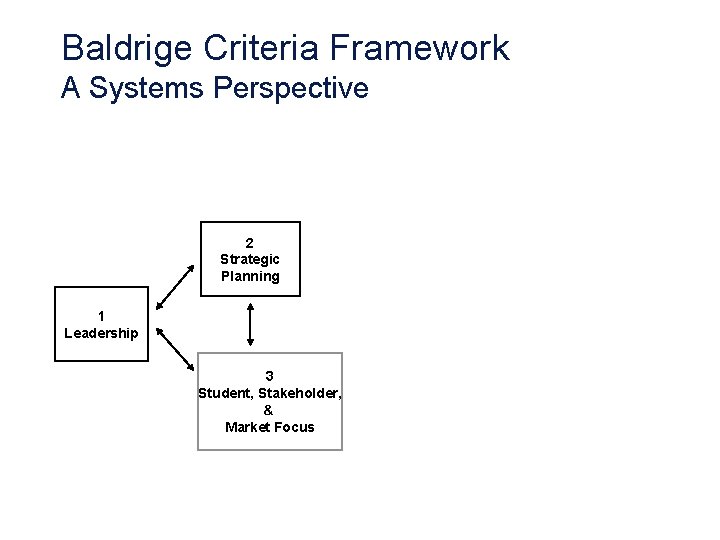
Baldrige Criteria Framework A Systems Perspective 2 Strategic Planning 1 Leadership 3 Student, Stakeholder, & Market Focus
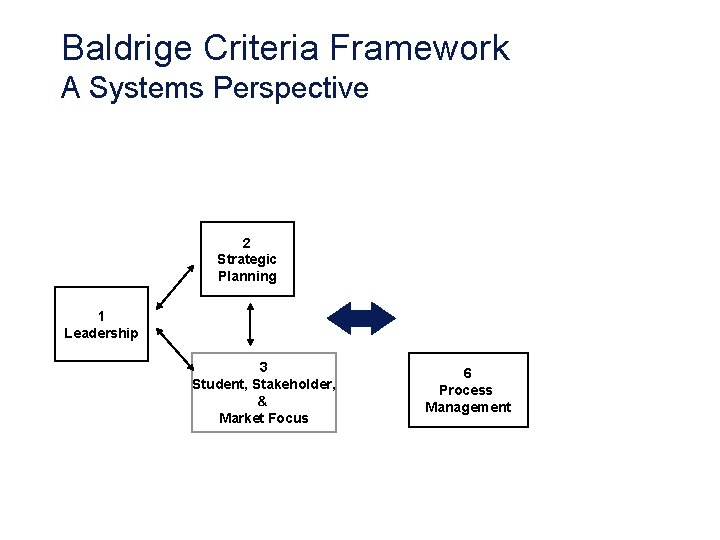
Baldrige Criteria Framework A Systems Perspective 2 Strategic Planning 1 Leadership 3 Student, Stakeholder, & Market Focus 6 Process Management
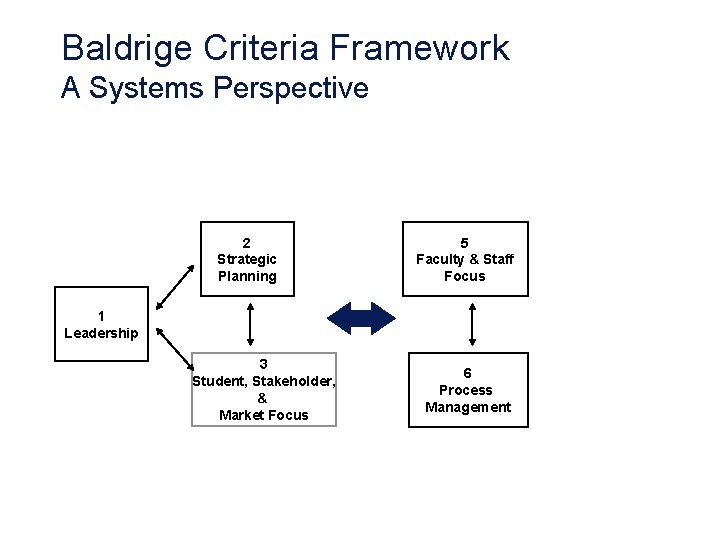
Baldrige Criteria Framework A Systems Perspective 2 Strategic Planning 5 Faculty & Staff Focus 1 Leadership 3 Student, Stakeholder, & Market Focus 6 Process Management
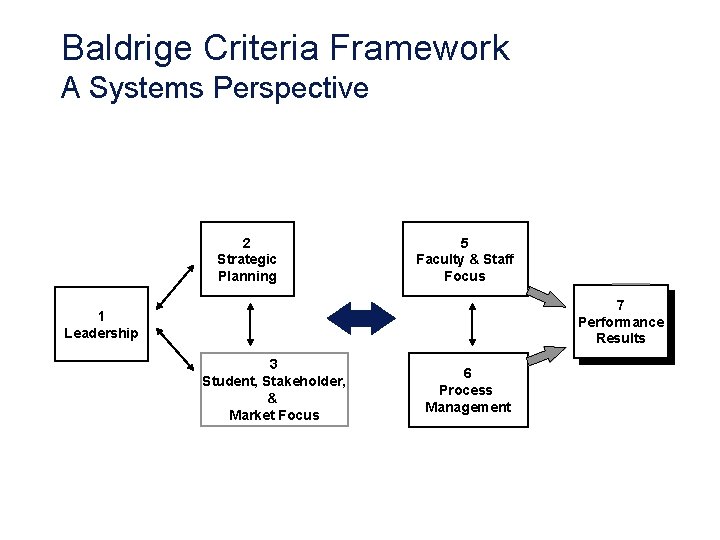
Baldrige Criteria Framework A Systems Perspective 2 Strategic Planning 5 Faculty & Staff Focus 7 Performance Results 1 Leadership 3 Student, Stakeholder, & Market Focus 6 Process Management
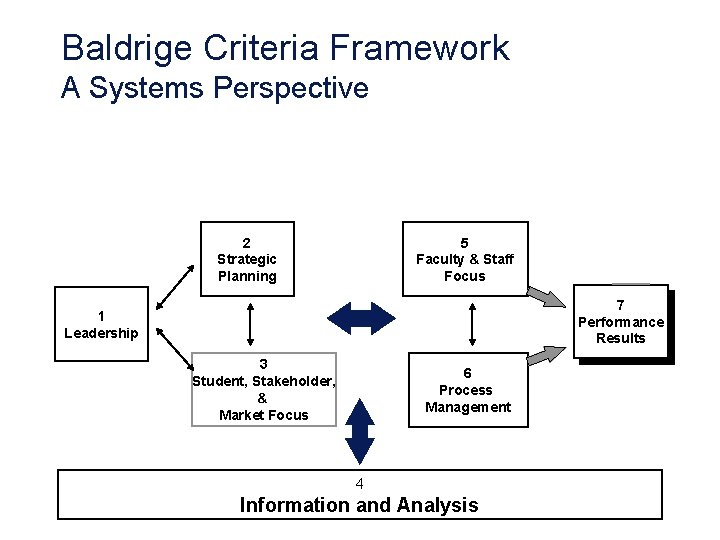
Baldrige Criteria Framework A Systems Perspective 2 Strategic Planning 5 Faculty & Staff Focus 7 Performance Results 1 Leadership 3 Student, Stakeholder, & Market Focus 6 Process Management 4 Information and Analysis
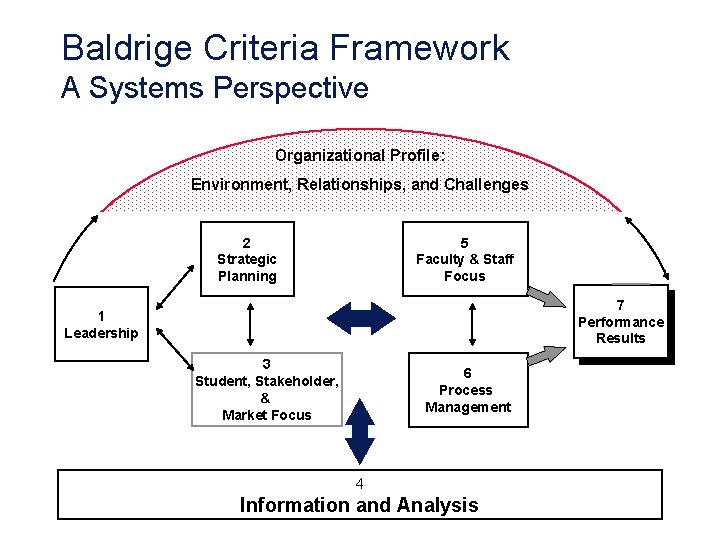
Baldrige Criteria Framework A Systems Perspective Organizational Profile: Environment, Relationships, and Challenges 2 Strategic Planning 5 Faculty & Staff Focus 7 Performance Results 1 Leadership 3 Student, Stakeholder, & Market Focus 6 Process Management 4 Information and Analysis
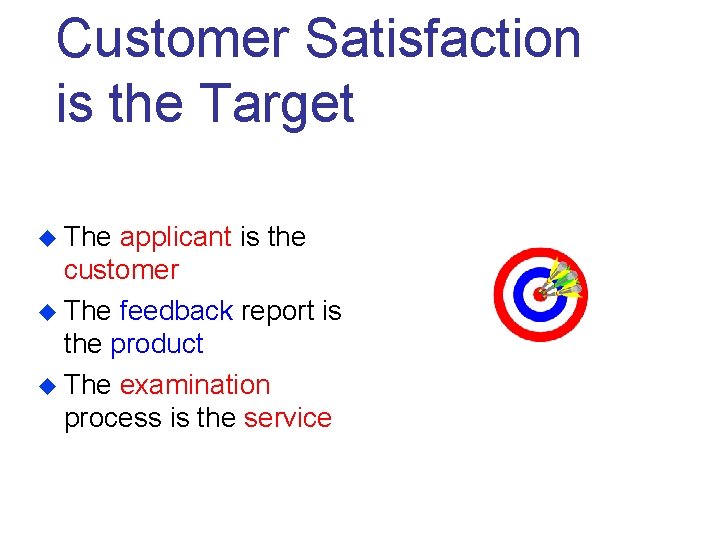
Customer Satisfaction is the Target u The applicant is the customer u The feedback report is the product u The examination process is the service
Characteristics of the Criteria · Directed toward specific key results · Non-prescriptive and adaptable · Supports a systems perspective to maintaining organization-wide goal alignment · Supports goal-based diagnosis · Include interrelated (process-to-results) learning cycles – Some Items have key direct relationships (e. g. , 5. 3 to 7. 3) · Emphasize alignment and integration · Part of a diagnostic system
Approach/Deployment FApproach/Deployment responses permit diagnosis of the organization’s most important processes
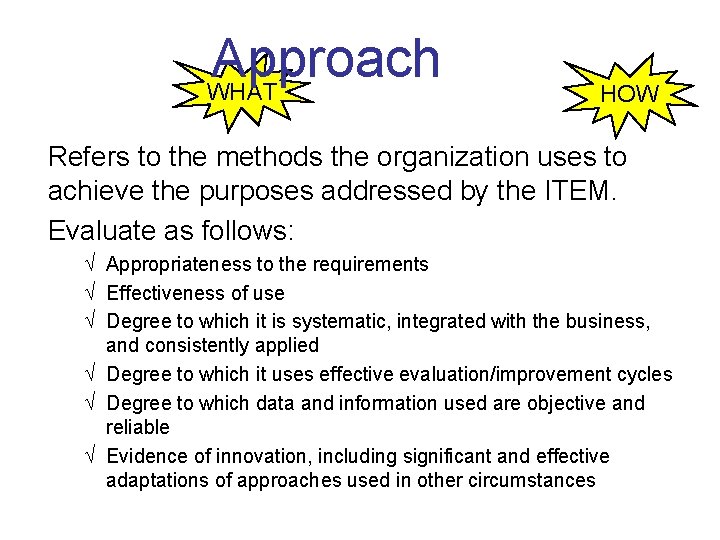
Approach WHAT HOW Refers to the methods the organization uses to achieve the purposes addressed by the ITEM. Evaluate as follows: Ö Appropriateness to the requirements Ö Effectiveness of use Ö Degree to which it is systematic, integrated with the business, and consistently applied Ö Degree to which it uses effective evaluation/improvement cycles Ö Degree to which data and information used are objective and reliable Ö Evidence of innovation, including significant and effective adaptations of approaches used in other circumstances
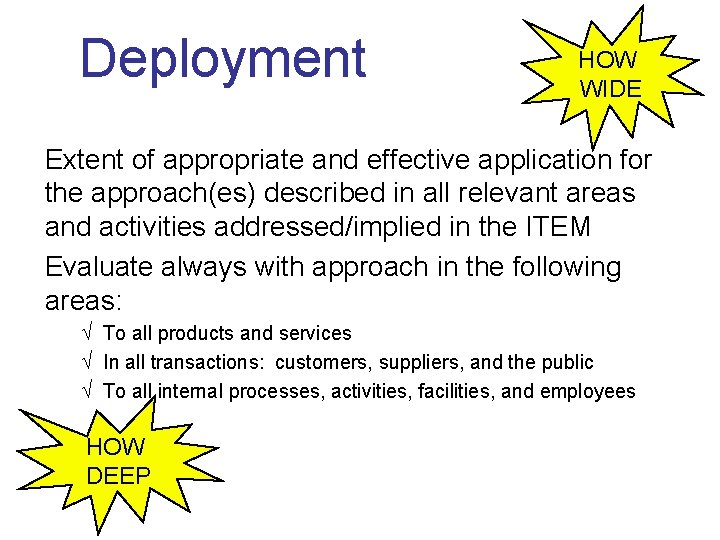
Deployment HOW WIDE Extent of appropriate and effective application for the approach(es) described in all relevant areas and activities addressed/implied in the ITEM Evaluate always with approach in the following areas: Ö To all products and services Ö In all transactions: customers, suppliers, and the public Ö To all internal processes, activities, facilities, and employees HOW DEEP
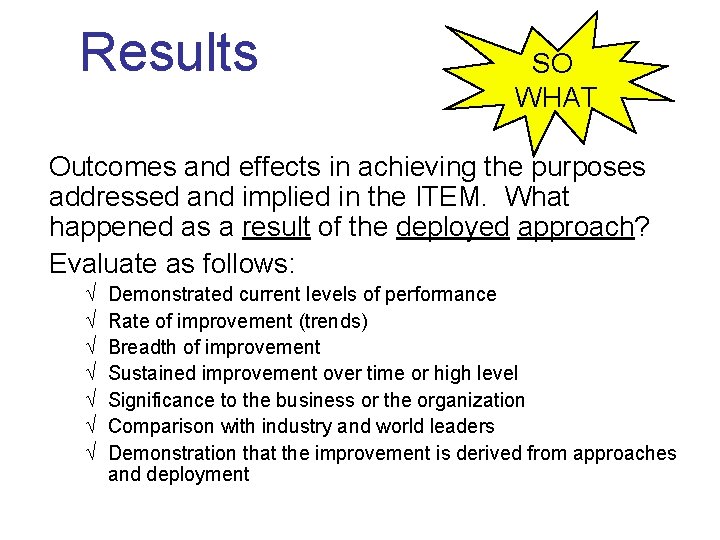
Results SO WHAT Outcomes and effects in achieving the purposes addressed and implied in the ITEM. What happened as a result of the deployed approach? Evaluate as follows: Ö Ö Ö Ö Demonstrated current levels of performance Rate of improvement (trends) Breadth of improvement Sustained improvement over time or high level Significance to the business or the organization Comparison with industry and world leaders Demonstration that the improvement is derived from approaches and deployment
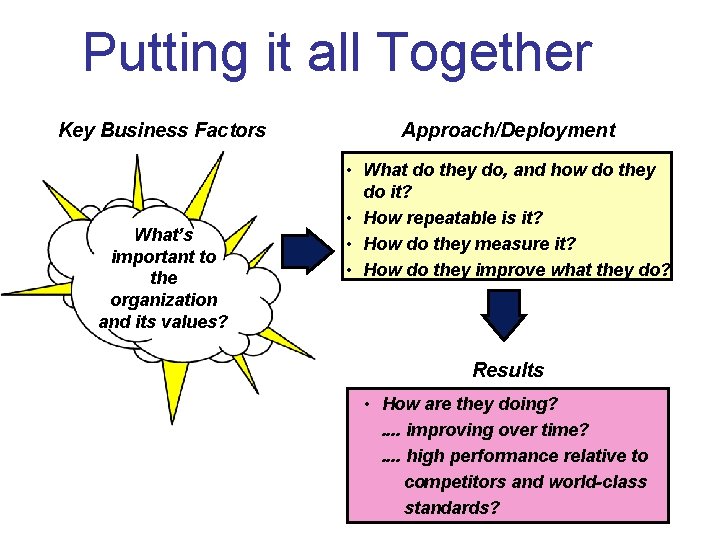
Putting it all Together Key Business Factors What’s important to the organization and its values? Approach/Deployment • What do they do, and how do they do it? • How repeatable is it? • How do they measure it? • How do they improve what they do? Results • How are they doing? . . improving over time? . . high performance relative to competitors and world-class standards?
Business Overview Why is it important? 1. It is the organization’s starting point for self assessment 2. It focuses on the organization’s key business performance requirements 3. It focuses on key business results 4. It is used by Examiners and judges to review the application 5. It puts the application into perspective
Elements of the Business Overview 1. Basic description of the organization 2. Customer and market requirements 3. Supplier and partnering relationships 4. Competitive situation 5. Business directions
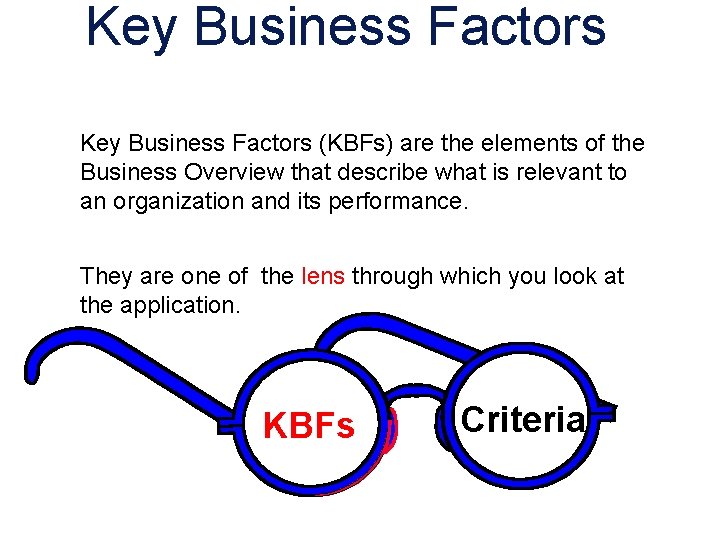
Key Business Factors (KBFs) are the elements of the Business Overview that describe what is relevant to an organization and its performance. They are one of the lens through which you look at the application. KBFs Criteria
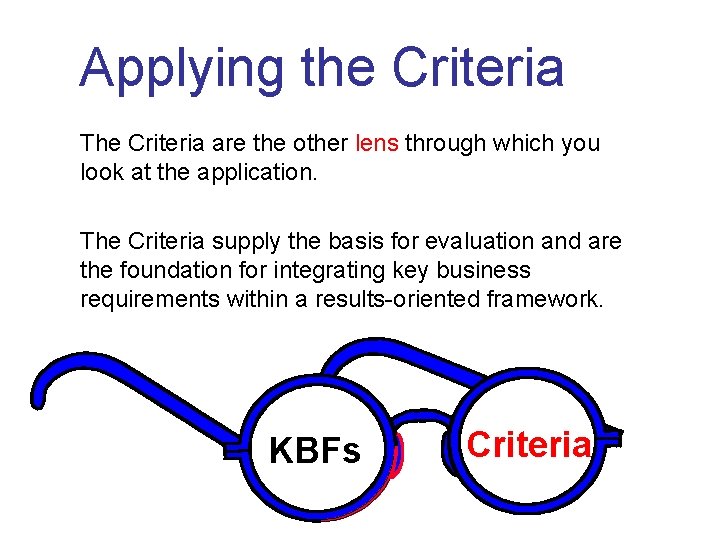
Applying the Criteria The Criteria are the other lens through which you look at the application. The Criteria supply the basis for evaluation and are the foundation for integrating key business requirements within a results-oriented framework. KBFs Criteria
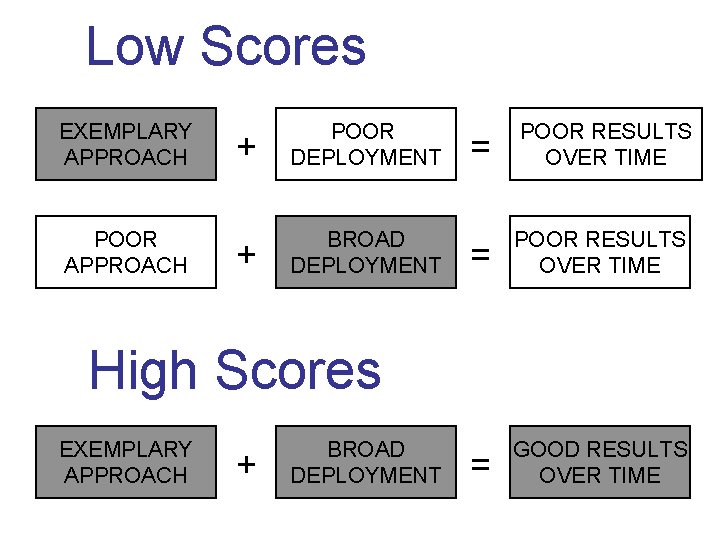
Low Scores EXEMPLARY APPROACH POOR APPROACH + POOR DEPLOYMENT + BROAD DEPLOYMENT = POOR RESULTS OVER TIME = GOOD RESULTS OVER TIME High Scores EXEMPLARY APPROACH + BROAD DEPLOYMENT
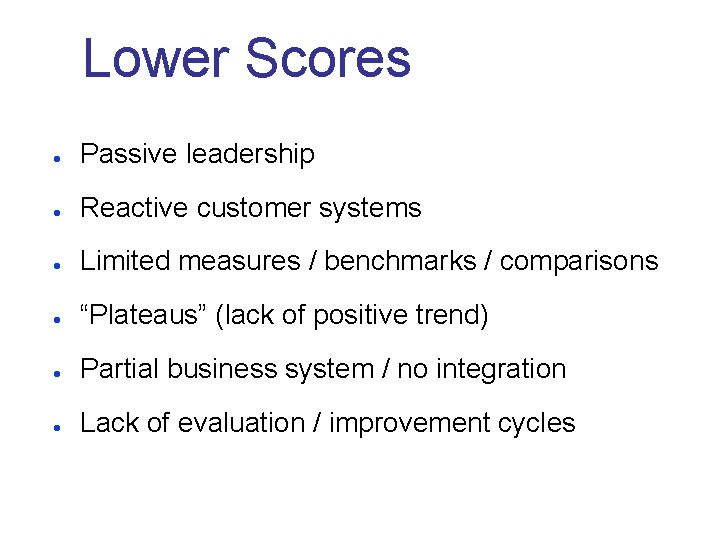
Lower Scores l Passive leadership l Reactive customer systems l Limited measures / benchmarks / comparisons l “Plateaus” (lack of positive trend) l Partial business system / no integration l Lack of evaluation / improvement cycles
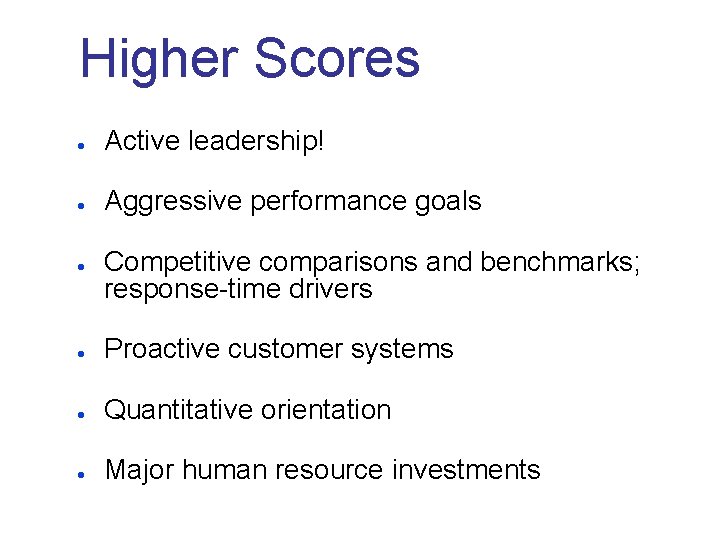
Higher Scores l Active leadership! l Aggressive performance goals l Competitive comparisons and benchmarks; response-time drivers l Proactive customer systems l Quantitative orientation l Major human resource investments
Look for Key Linkages The seven Categories are interrelated and must be considered together when evaluating Identifying linkages between Categories and Items is one of the ways to test for systemic approach, deployment and results Look for linkages • Between the business overview (Key Business Factors) and each Item • Between Criteria Items (look at the notes)
The Feedback Report · Sent to ALL applicants · Consist of an integration of the most important comments from the consensus report and Site Visit report (where available) · Cover the basic objectives of each Item · Primarily include points for which there is consensus among the Examiners · Are augmented by Judge’s edits · Are never merely a collection of comments · Are used by the applicants

“You must be the change you wish to see in the world. ” Gandhi

- Slides: 32