
Performance Evaluation of Wi Max Systems Metehan Dikmen
- Slides: 24
Performance Evaluation of Wi. Max Systems Metehan Dikmen and Mehmet Şafak Hacettepe University Dept. of Electrical and Electronics Engineering 06532 Beytepe, Ankara, Turkey
Outline • • Motivation Physical layer IEEE 802. 16 extensions Wi. Max System Model – – – Randomization FEC Modulation Interleaving OFDM • Simulation – AWGN channel – Rayleigh fading channel • Results and Conclusions
Motivation • Wireless. MAN provides network access to buildings through exterior antennas communicating with BSs • Offers an alternative to cabled access networks, – e. g. , fiber optic links, coaxial systems using cable modems, and digital subscriber line (DSL) links • Have the capacity to provide high-rate network connections over broad geographic areas without costly infrastructure required in deploying
Motivation • Supports different transport technologies, including IPv 4, IPv 6, Ethernet • The standard achieves high data rates in part via FEC and OFDM techniques • Has a long transmission range because – regulations allow high power transmissions – the use of directional antennas produces focused signals • Transmission range and data rate vary significantly depending on the frequency
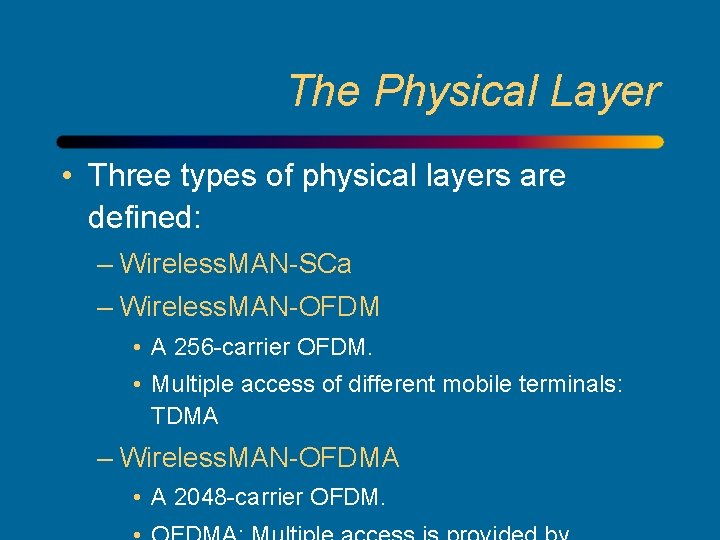
The Physical Layer • Three types of physical layers are defined: – Wireless. MAN-SCa – Wireless. MAN-OFDM • A 256 -carrier OFDM. • Multiple access of different mobile terminals: TDMA – Wireless. MAN-OFDMA • A 2048 -carrier OFDM.
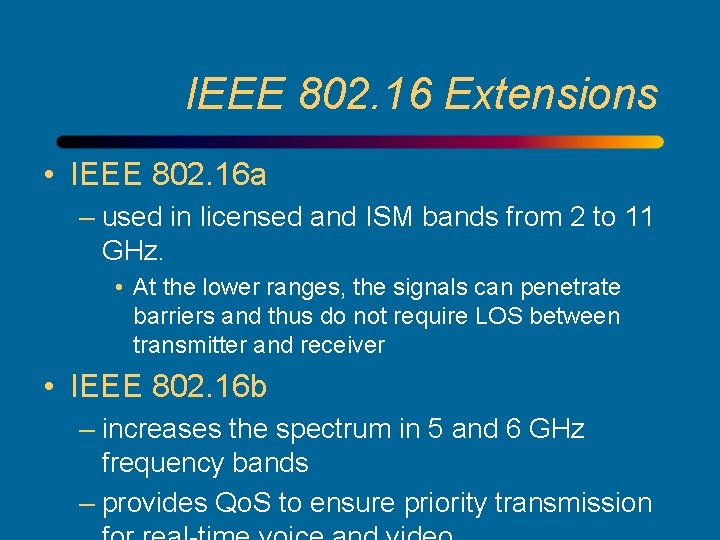
IEEE 802. 16 Extensions • IEEE 802. 16 a – used in licensed and ISM bands from 2 to 11 GHz. • At the lower ranges, the signals can penetrate barriers and thus do not require LOS between transmitter and receiver • IEEE 802. 16 b – increases the spectrum in 5 and 6 GHz frequency bands – provides Qo. S to ensure priority transmission
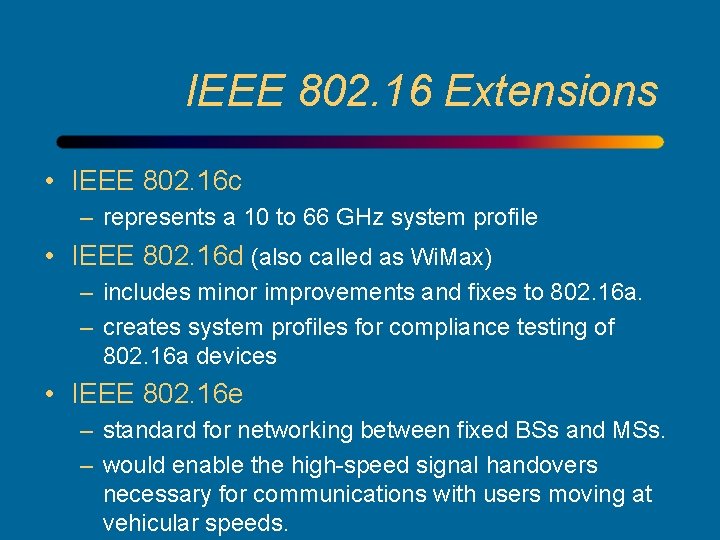
IEEE 802. 16 Extensions • IEEE 802. 16 c – represents a 10 to 66 GHz system profile • IEEE 802. 16 d (also called as Wi. Max) – includes minor improvements and fixes to 802. 16 a. – creates system profiles for compliance testing of 802. 16 a devices • IEEE 802. 16 e – standard for networking between fixed BSs and MSs. – would enable the high-speed signal handovers necessary for communications with users moving at vehicular speeds.
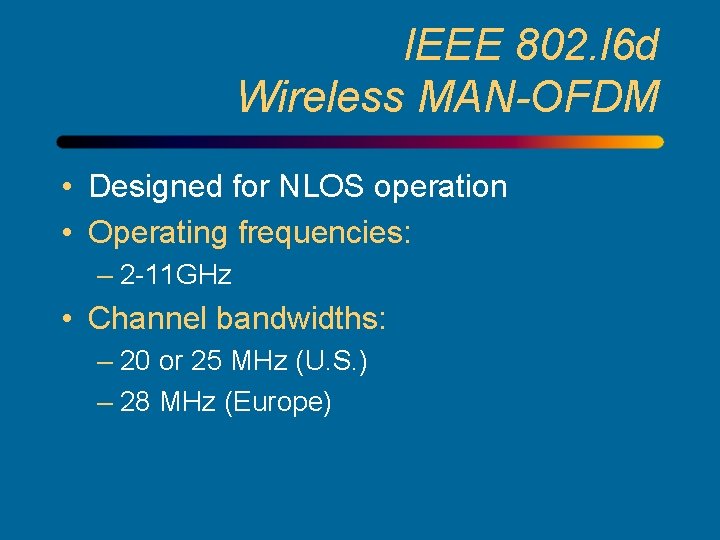
IEEE 802. l 6 d Wireless MAN-OFDM • Designed for NLOS operation • Operating frequencies: – 2 -11 GHz • Channel bandwidths: – 20 or 25 MHz (U. S. ) – 28 MHz (Europe)
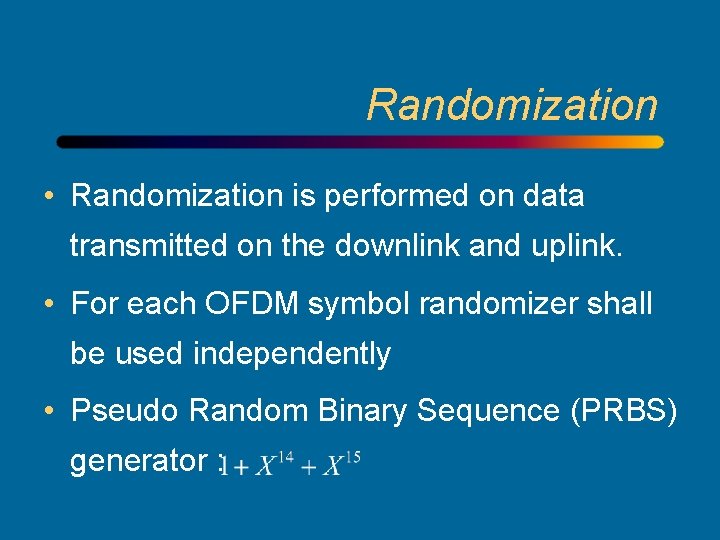
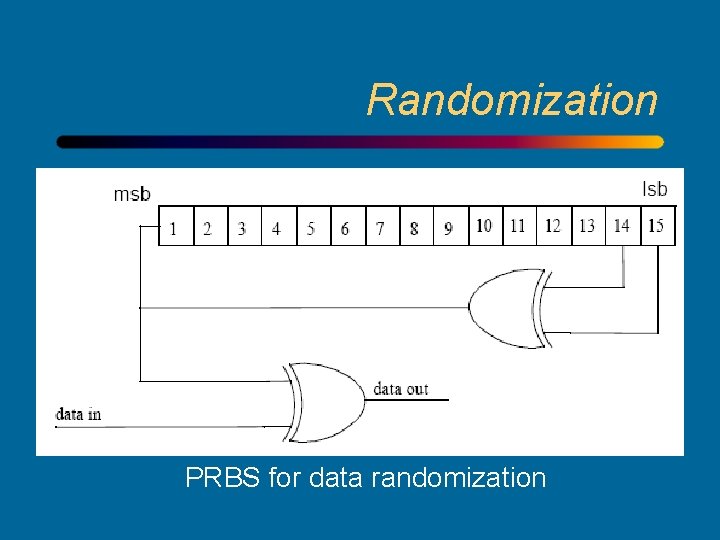
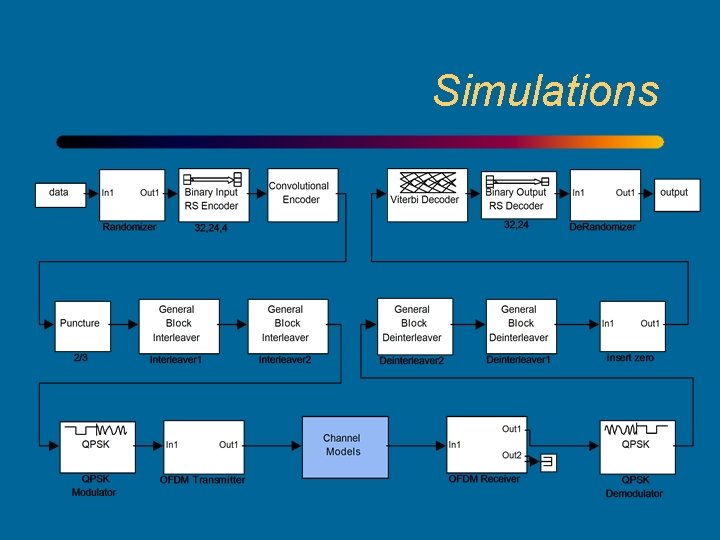
Randomization • Randomization is performed on data transmitted on the downlink and uplink. • For each OFDM symbol randomizer shall be used independently • Pseudo Random Binary Sequence (PRBS) generator :
Randomization PRBS for data randomization
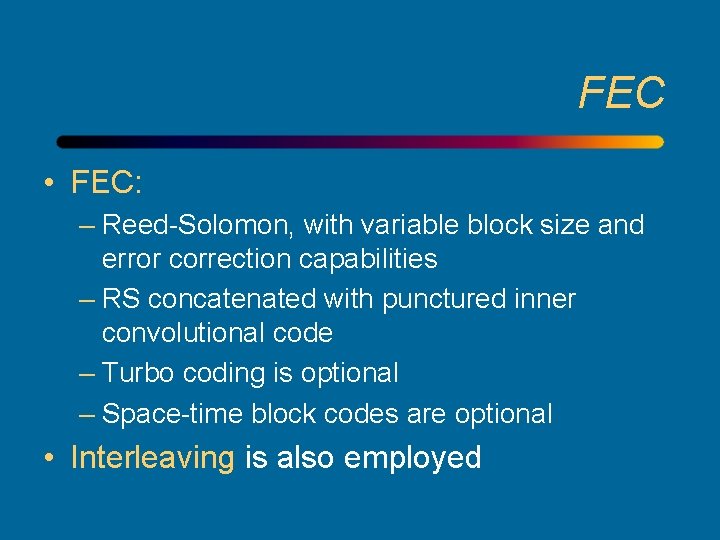
FEC • FEC: – Reed-Solomon, with variable block size and error correction capabilities – RS concatenated with punctured inner convolutional code – Turbo coding is optional – Space-time block codes are optional • Interleaving is also employed
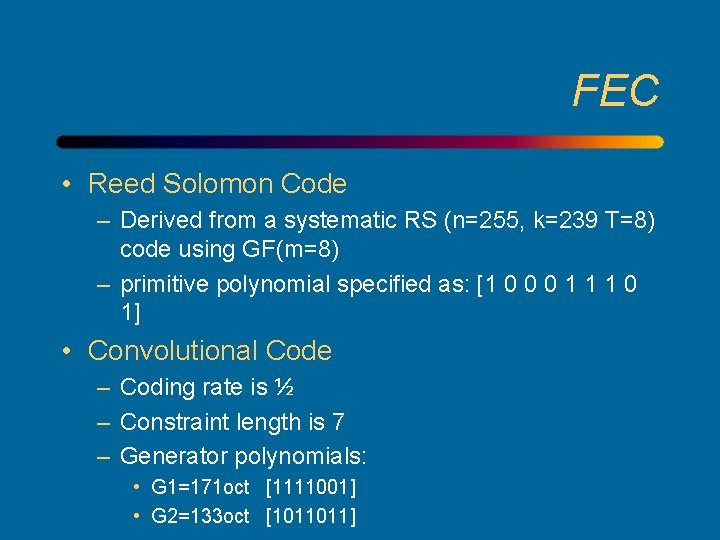
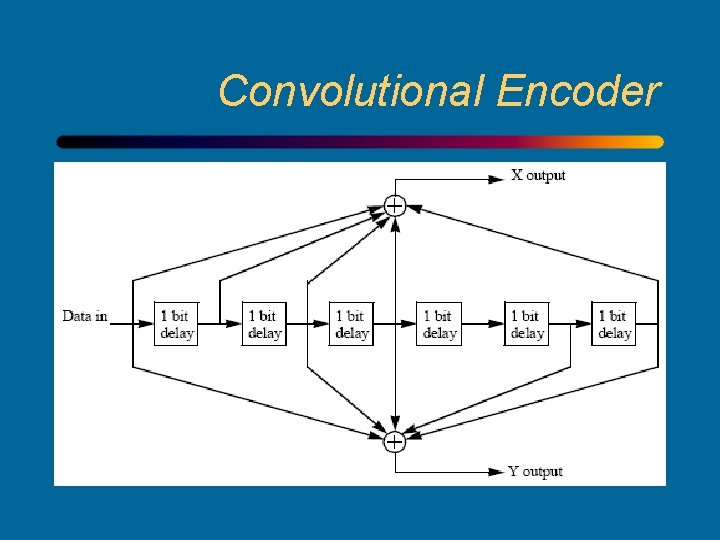
FEC • Reed Solomon Code – Derived from a systematic RS (n=255, k=239 T=8) code using GF(m=8) – primitive polynomial specified as: [1 0 0 0 1 1 1 0 1] • Convolutional Code – Coding rate is ½ – Constraint length is 7 – Generator polynomials: • G 1=171 oct [1111001] • G 2=133 oct [1011011]
Convolutional Encoder
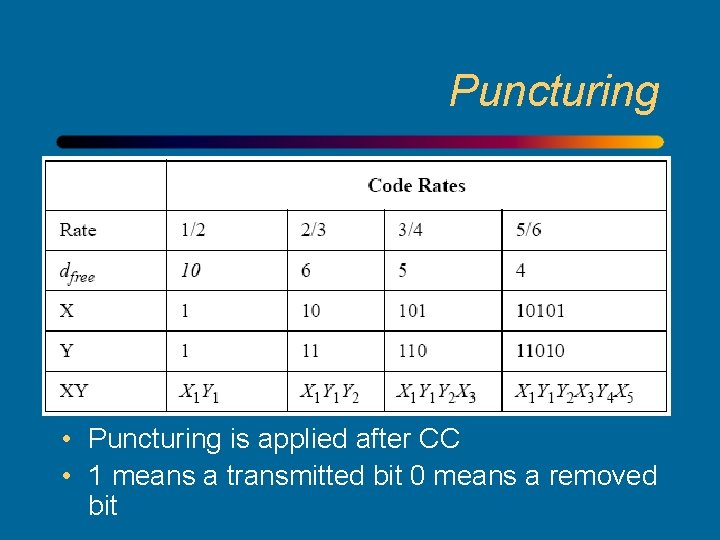
Puncturing • Puncturing is applied after CC • 1 means a transmitted bit 0 means a removed bit
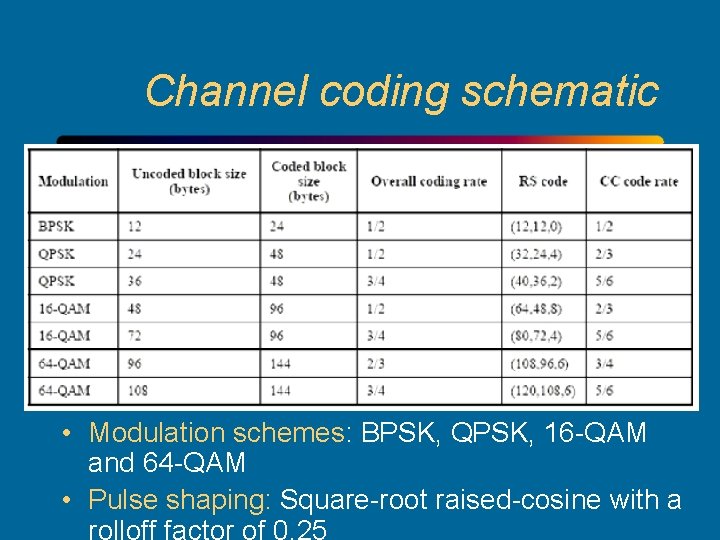
Channel coding schematic • Modulation schemes: BPSK, QPSK, 16 -QAM and 64 -QAM • Pulse shaping: Square-root raised-cosine with a rolloff factor of 0. 25
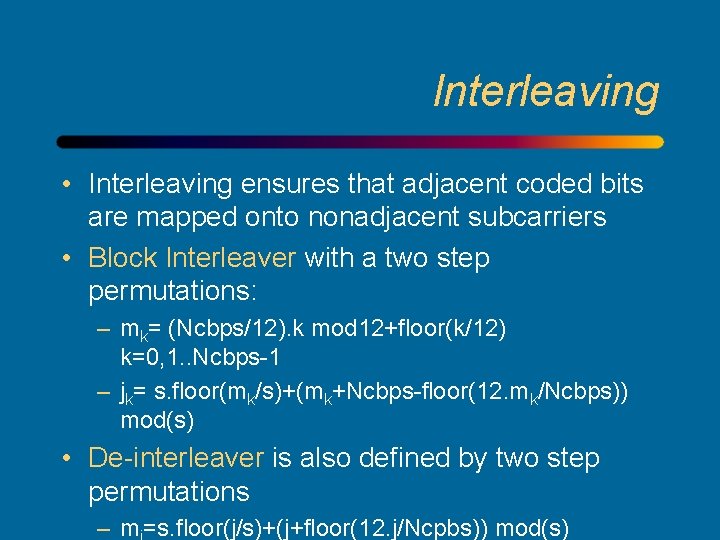
Interleaving • Interleaving ensures that adjacent coded bits are mapped onto nonadjacent subcarriers • Block Interleaver with a two step permutations: – mk= (Ncbps/12). k mod 12+floor(k/12) k=0, 1. . Ncbps-1 – jk= s. floor(mk/s)+(mk+Ncbps-floor(12. mk/Ncbps)) mod(s) • De-interleaver is also defined by two step permutations – m =s. floor(j/s)+(j+floor(12. j/Ncpbs)) mod(s)
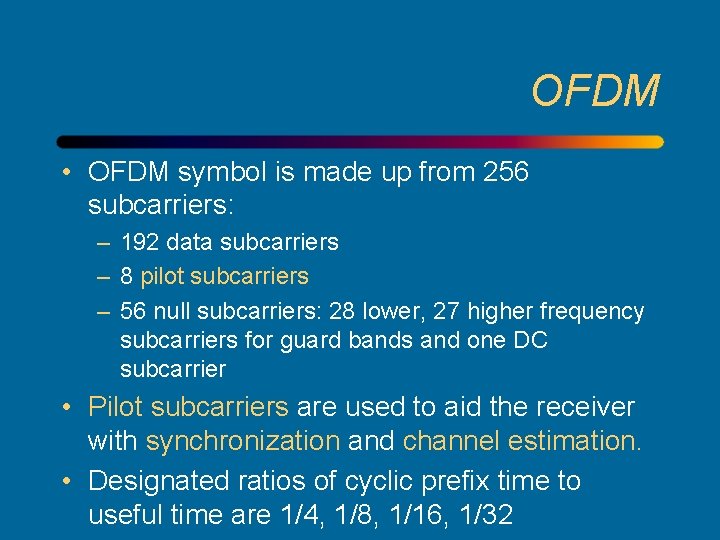
OFDM • OFDM symbol is made up from 256 subcarriers: – 192 data subcarriers – 8 pilot subcarriers – 56 null subcarriers: 28 lower, 27 higher frequency subcarriers for guard bands and one DC subcarrier • Pilot subcarriers are used to aid the receiver with synchronization and channel estimation. • Designated ratios of cyclic prefix time to useful time are 1/4, 1/8, 1/16, 1/32
Simulations
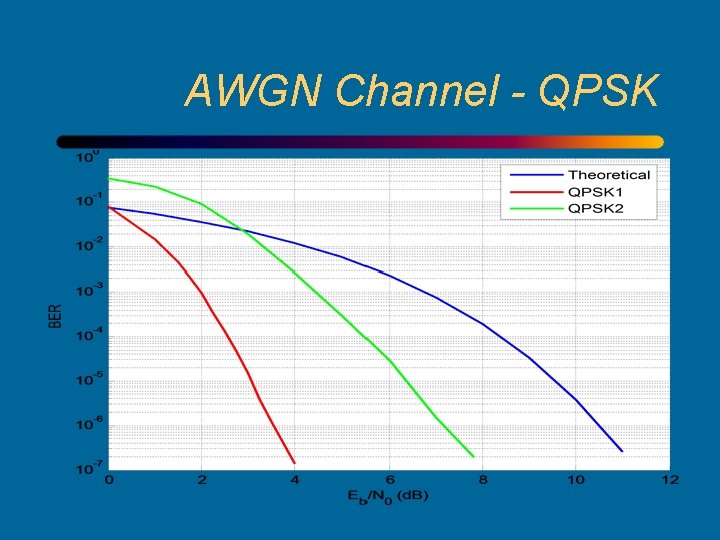
AWGN Channel - QPSK
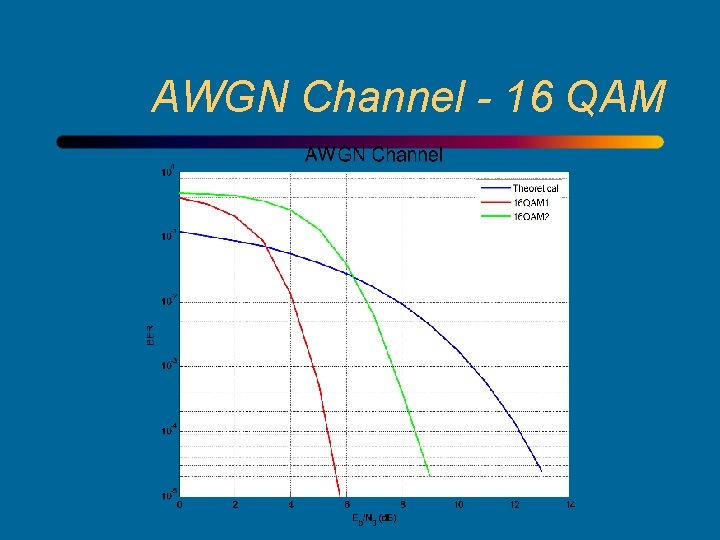
AWGN Channel - 16 QAM
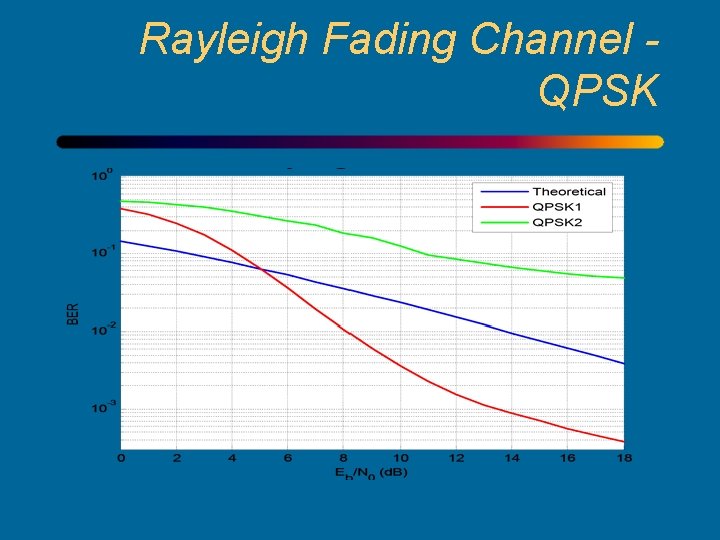
Rayleigh Fading Channel QPSK
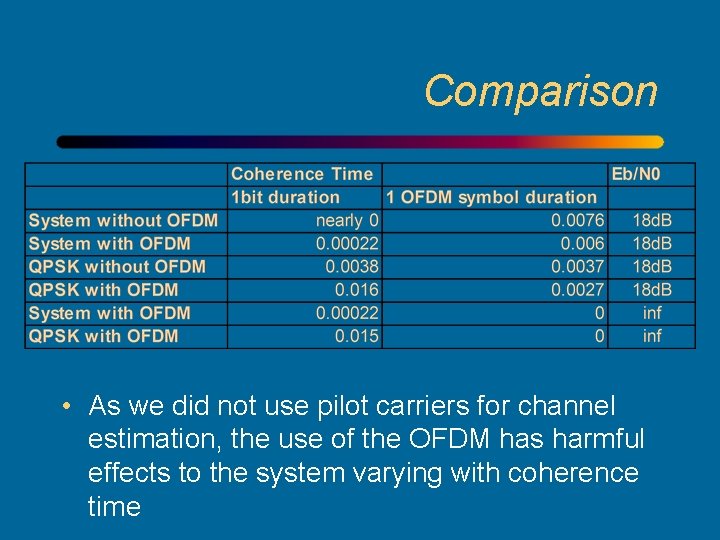
Comparison • As we did not use pilot carriers for channel estimation, the use of the OFDM has harmful effects to the system varying with coherence time
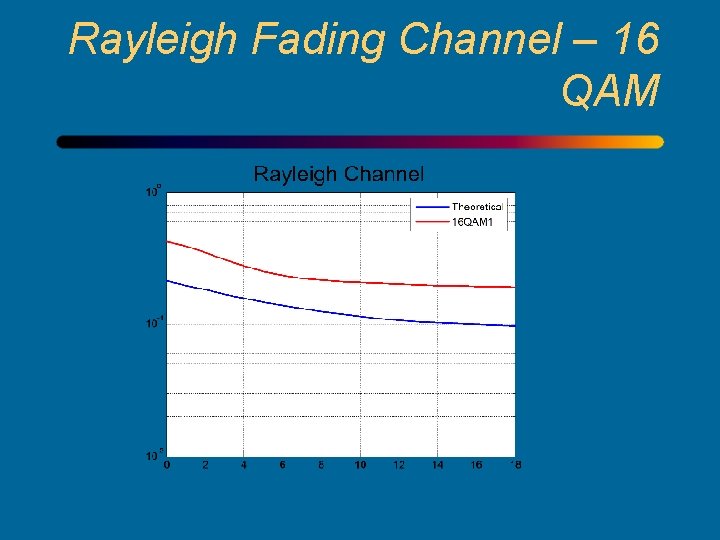
Rayleigh Fading Channel – 16 QAM
Results and Conclusions • If we use OFDM without channel estimation we are encounter with serious problems in Rayleigh fading channels • Increasing the coherence time makes this worse because of the burst errors • It is obvious that QAM is useless in a Rayleigh fading because of its dependence on amplitude • Our next step will be channel estimation