
Performance Evaluation of Codebooks Proposed for IEEE 802
Performance Evaluation of Codebooks Proposed for IEEE 802. 16 m Amendment IEEE 802. 16 Presentation Submission Template (Rev. 9) Document Number: IEEE C 80216 m-09_0588 Date Submitted: 2009 -03 -07 Source: David Mazzarese, Bruno Clerckx, Kwanhee Roh, Wang Zhen, Heewon Kang Keun Chul Hwang, Soon-Young Yoon, Hokyu Choi, Jerry Pi, Jiann-An Tsai Samsung Electronics Alexei Davydov, Guangjie Li, Yang-seok, Gregory Morozov Intel Corporation Yang Tang, Zhigang Rong, Jianmin Lu Huawei Technologies d. mazzarese@samsung. com alexei. davydov@intel. com YTang@huawei. com Venue: IEEE 802. 16 m Session#60, Vancouver, Canada IEEE 80216 m-09_0012, “Call for Contributions for P 802. 16 m Amendment Text Proposals”. Base Contribution: IEEE C 80216 m-09_0577 Purpose: Discussion and approval Notice: This document does not represent the agreed views of the IEEE 802. 16 Working Group or any of its subgroups. It represents only the views of the participants listed in the “Source(s)” field above. It is offered as a basis for discussion. It is not binding on the contributor(s), who reserve(s) the right to add, amend or withdraw material contained herein. Release: The contributor grants a free, irrevocable license to the IEEE to incorporate material contained in this contribution, and any modifications thereof, in the creation of an IEEE Standards publication; to copyright in the IEEE’s name any IEEE Standards publication even though it may include portions of this contribution; and at the IEEE’s sole discretion to permit others to reproduce in whole or in part the resulting IEEE Standards publication. The contributor also acknowledges and accepts that this contribution may be made public by IEEE 802. 16. Patent Policy: The contributor is familiar with the IEEE-SA Patent Policy and Procedures: <http: //standards. ieee. org/guides/bylaws/sect 6 -7. html#6> and <http: //standards. ieee. org/guides/opman/sect 6. html#6. 3>. Further information is located at <http: //standards. ieee. org/board/pat-material. html> and <http: //standards. ieee. org/board/pat >.
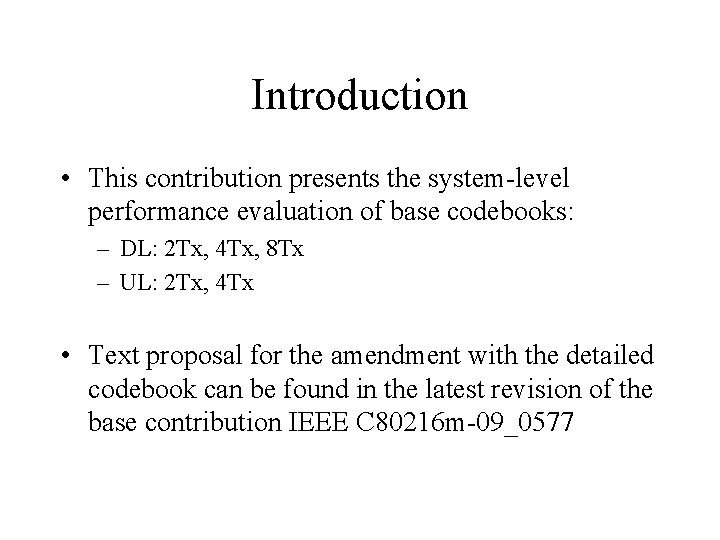
Introduction • This contribution presents the system-level performance evaluation of base codebooks: – DL: 2 Tx, 4 Tx, 8 Tx – UL: 2 Tx, 4 Tx • Text proposal for the amendment with the detailed codebook can be found in the latest revision of the base contribution IEEE C 80216 m-09_0577
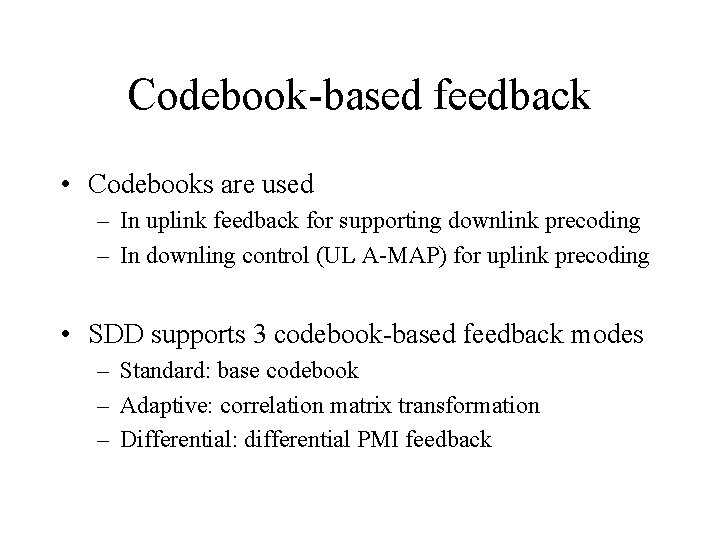
Codebook-based feedback • Codebooks are used – In uplink feedback for supporting downlink precoding – In downling control (UL A-MAP) for uplink precoding • SDD supports 3 codebook-based feedback modes – Standard: base codebook – Adaptive: correlation matrix transformation – Differential: differential PMI feedback

Base Codebook Analysis
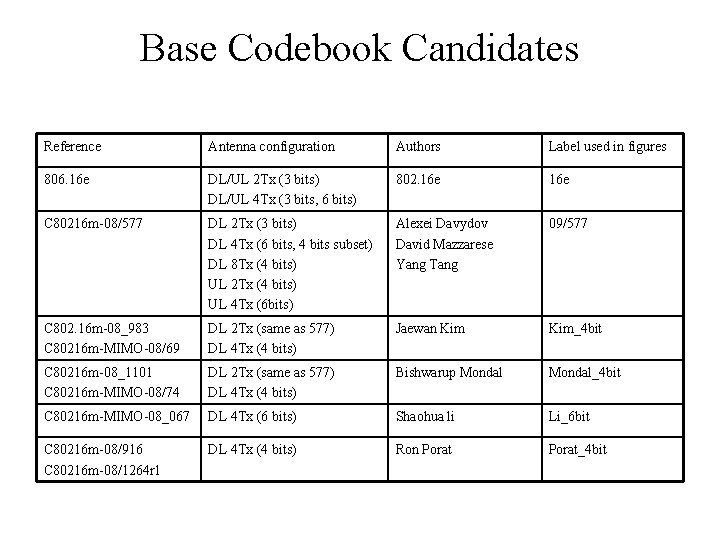
Base Codebook Candidates Reference Antenna configuration Authors Label used in figures 806. 16 e DL/UL 2 Tx (3 bits) DL/UL 4 Tx (3 bits, 6 bits) 802. 16 e C 80216 m-08/577 DL 2 Tx (3 bits) DL 4 Tx (6 bits, 4 bits subset) DL 8 Tx (4 bits) UL 2 Tx (4 bits) UL 4 Tx (6 bits) Alexei Davydov David Mazzarese Yang Tang 09/577 C 802. 16 m-08_983 C 80216 m-MIMO-08/69 DL 2 Tx (same as 577) DL 4 Tx (4 bits) Jaewan Kim_4 bit C 80216 m-08_1101 C 80216 m-MIMO-08/74 DL 2 Tx (same as 577) DL 4 Tx (4 bits) Bishwarup Mondal_4 bit C 80216 m-MIMO-08_067 DL 4 Tx (6 bits) Shaohua li Li_6 bit C 80216 m-08/916 C 80216 m-08/1264 r 1 DL 4 Tx (4 bits) Ron Porat_4 bit
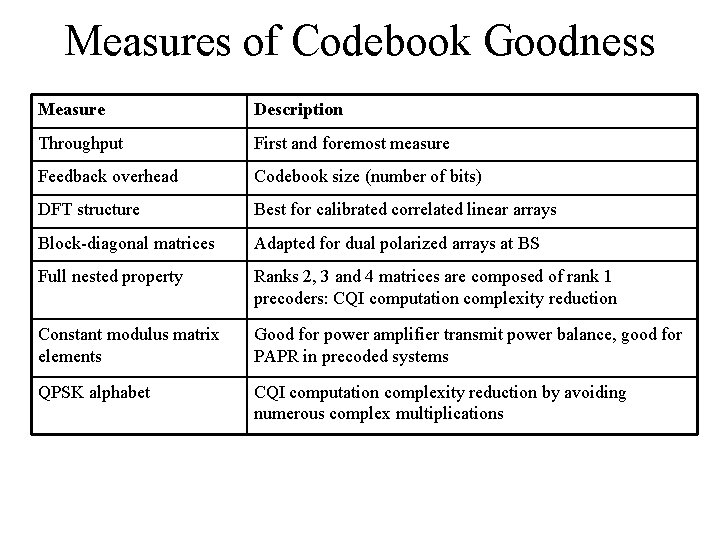
Measures of Codebook Goodness Measure Description Throughput First and foremost measure Feedback overhead Codebook size (number of bits) DFT structure Best for calibrated correlated linear arrays Block-diagonal matrices Adapted for dual polarized arrays at BS Full nested property Ranks 2, 3 and 4 matrices are composed of rank 1 precoders: CQI computation complexity reduction Constant modulus matrix elements Good for power amplifier transmit power balance, good for PAPR in precoded systems QPSK alphabet CQI computation complexity reduction by avoiding numerous complex multiplications
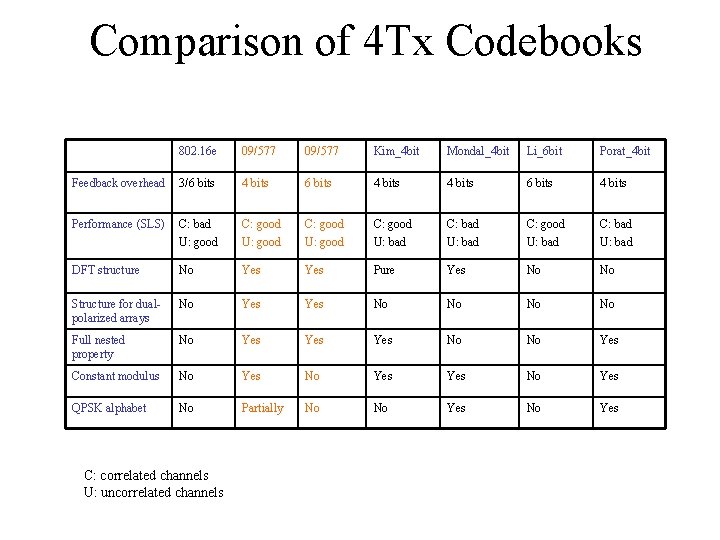
Comparison of 4 Tx Codebooks 802. 16 e 09/577 Kim_4 bit Mondal_4 bit Li_6 bit Porat_4 bit Feedback overhead 3/6 bits 4 bits 6 bits 4 bits Performance (SLS) C: bad U: good C: good U: bad C: bad U: bad DFT structure No Yes Pure Yes No No Structure for dualpolarized arrays No Yes No No Full nested property No Yes Yes No No Yes Constant modulus No Yes Yes No Yes QPSK alphabet No Partially No No Yes C: correlated channels U: uncorrelated channels

Performance Evaluation
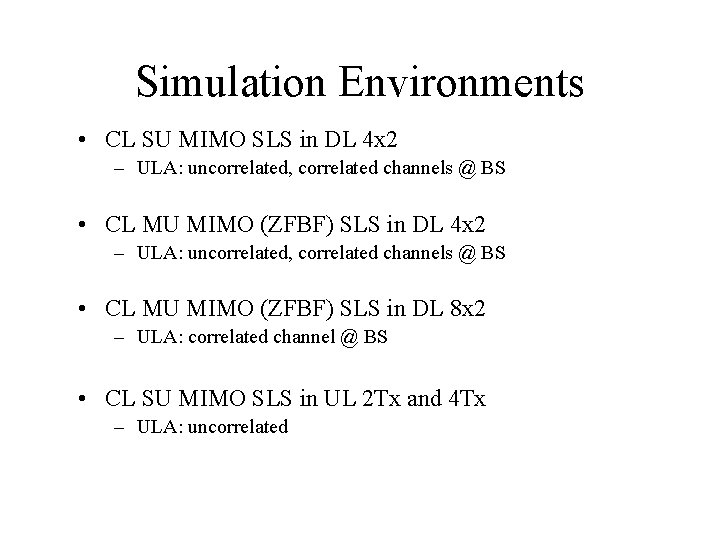
Simulation Environments • CL SU MIMO SLS in DL 4 x 2 – ULA: uncorrelated, correlated channels @ BS • CL MU MIMO (ZFBF) SLS in DL 8 x 2 – ULA: correlated channel @ BS • CL SU MIMO SLS in UL 2 Tx and 4 Tx – ULA: uncorrelated
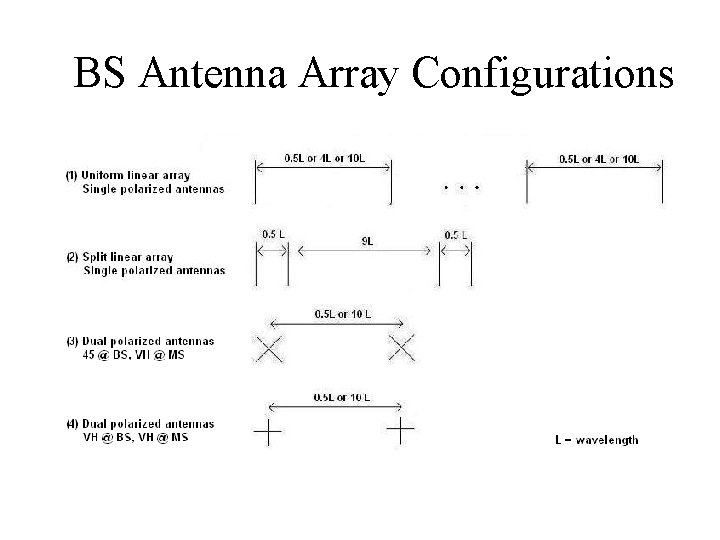
BS Antenna Array Configurations
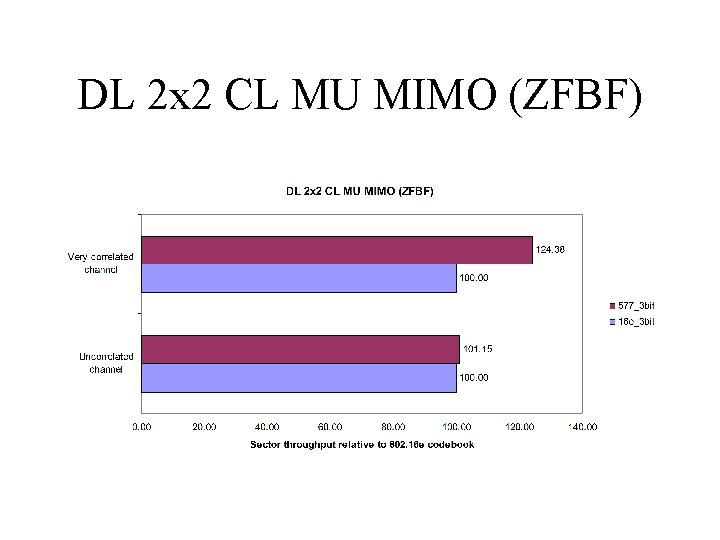
DL 2 x 2 CL MU MIMO (ZFBF)
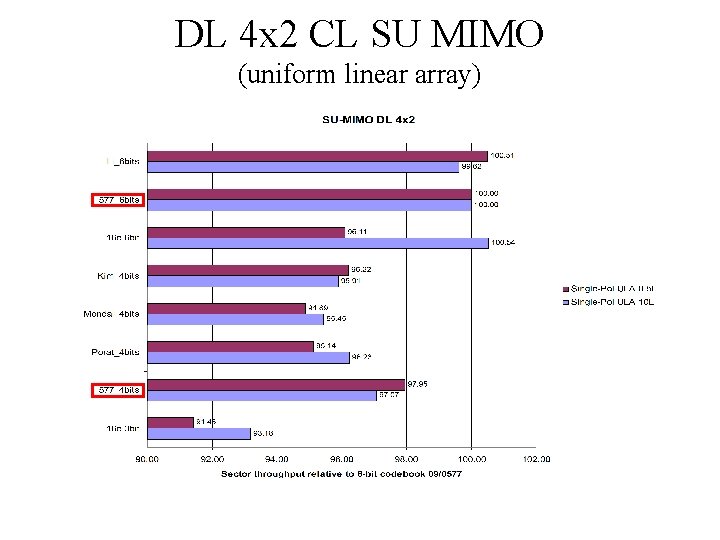
DL 4 x 2 CL SU MIMO (uniform linear array)
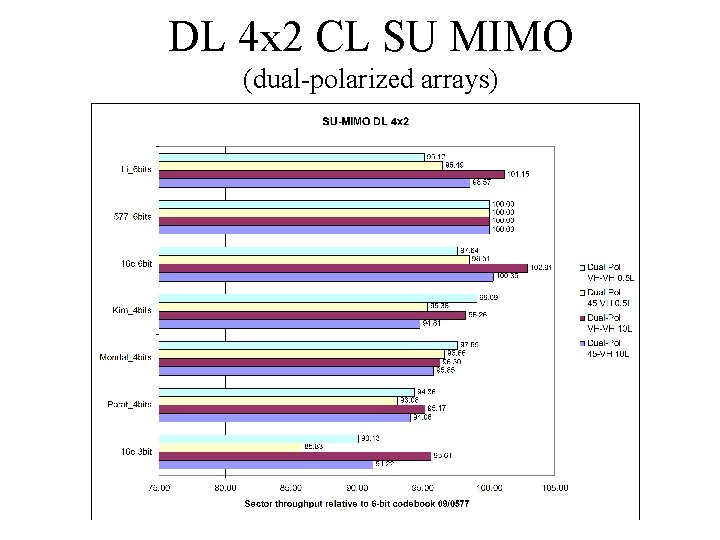
DL 4 x 2 CL SU MIMO (dual-polarized arrays)
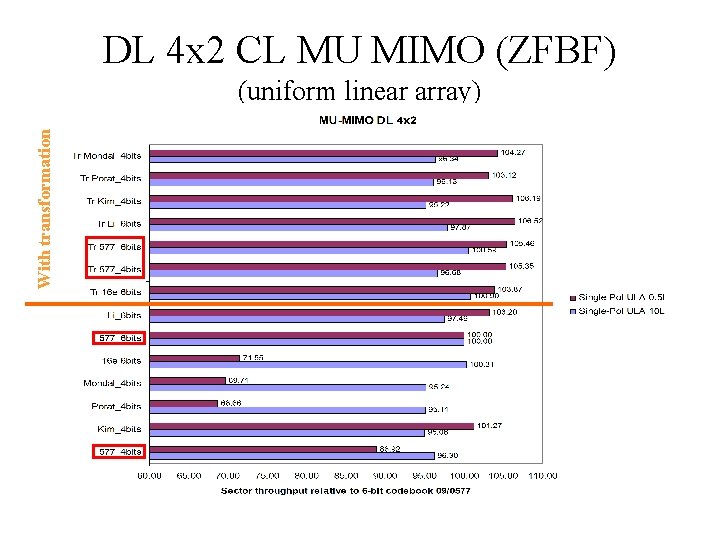
DL 4 x 2 CL MU MIMO (ZFBF) With transformation (uniform linear array)
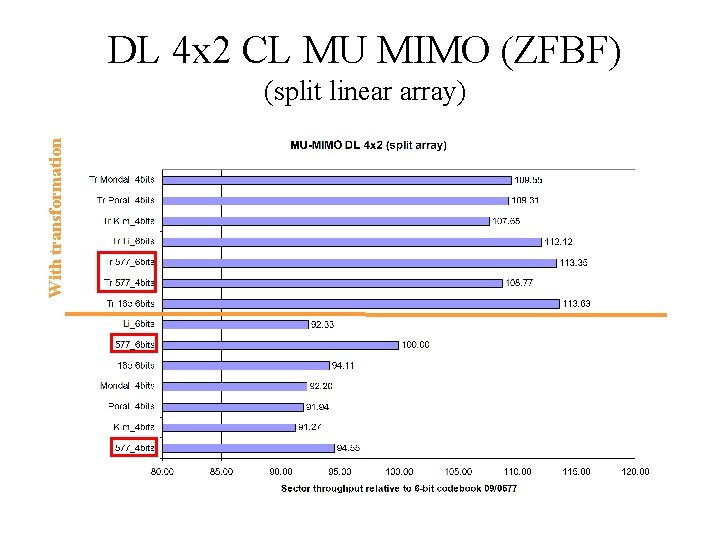
DL 4 x 2 CL MU MIMO (ZFBF) With transformation (split linear array)
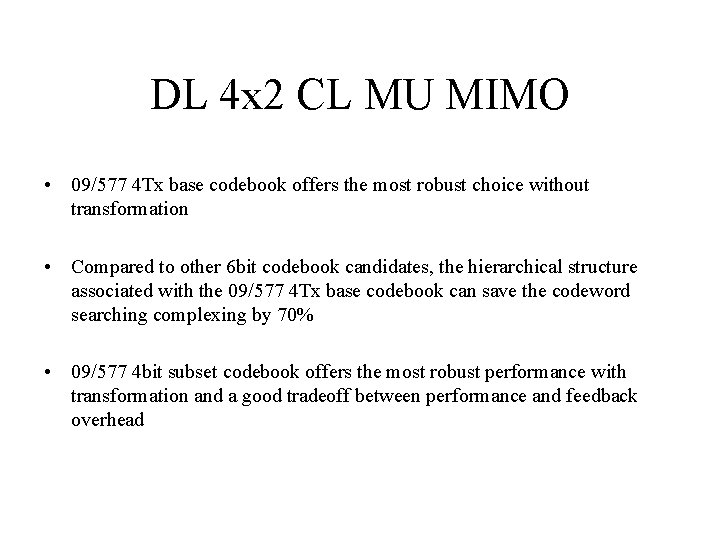
DL 4 x 2 CL MU MIMO • 09/577 4 Tx base codebook offers the most robust choice without transformation • Compared to other 6 bit codebook candidates, the hierarchical structure associated with the 09/577 4 Tx base codebook can save the codeword searching complexing by 70% • 09/577 4 bit subset codebook offers the most robust performance with transformation and a good tradeoff between performance and feedback overhead
DL 8 x 2 CL MU MIMO • Cf C 80216 m-09_0442
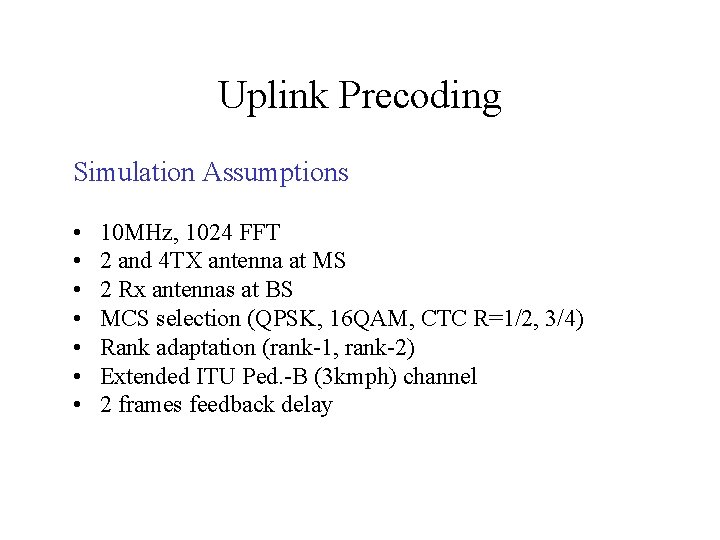
Uplink Precoding Simulation Assumptions • • 10 MHz, 1024 FFT 2 and 4 TX antenna at MS 2 Rx antennas at BS MCS selection (QPSK, 16 QAM, CTC R=1/2, 3/4) Rank adaptation (rank-1, rank-2) Extended ITU Ped. -B (3 kmph) channel 2 frames feedback delay
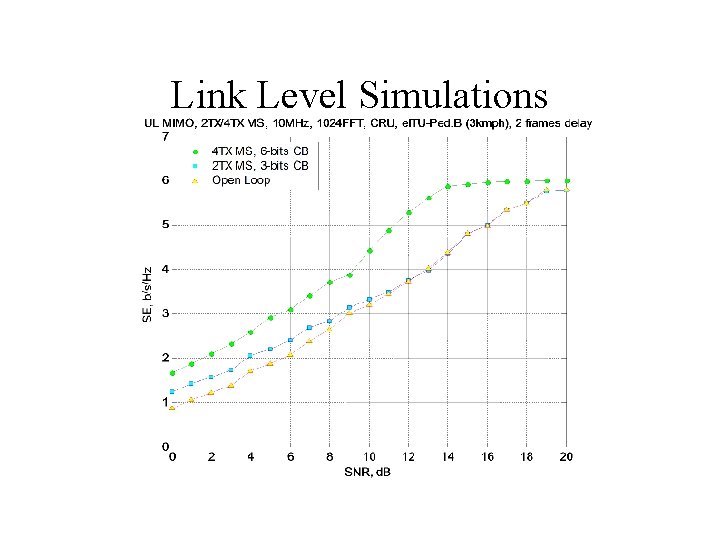
Link Level Simulations
Proposed Amendment Text • Cf latest revision of C 80216 m-09_0577
Appendix Downlink System-Level Simulation Assumptions
![Number of Antennas Antenna configuration 2 transmitter, 2 receiver [2 Tx, 2 Rx] 4](http://slidetodoc.com/presentation_image_h2/11b404b1b4f9a32169d15184dcaeec0a/image-22.jpg "Number of Antennas Antenna configuration 2 transmitter, 2 receiver [2 Tx, 2 Rx] 4")
Number of Antennas Antenna configuration 2 transmitter, 2 receiver [2 Tx, 2 Rx] 4 transmitter, 2 receiver [4 Tx, 2 Rx] 4 transmitter, 4 receiver [4 Tx, 4 Rx] ULA: 0. 5 lambda; 4 lambda, 10 lambda Split Linear Array, Dual Polarized Array MIMO Scheme 1. Closed-loop single user with dynamic rank adaptation 2. Zero-forcing multiple user MIMO Schedule from 1 to 2 users dynamically based on the same rank-1 PMI feedback. No SU/MU mode adaptation. Channel Modified Ped-B 3 km/h Channel correlation Scenario PAPR Antenna Calibration 1. Uncorrelated Channel : 4 lambda antenna spacing, angular spread of 15 degrees 2. High correlated channel: 0. 5 lambda antenna spacing, angular spread of 3 degree 1. No constraint on per-antenna power imbalance 2. Limitation of per-antenna power imbalance by scaling in every subframe 1. 2. Ideal antenna calibration (mandatory) Uncalibrated antennas (optional) Random phase on each transmit antenna + Random delay between each pair of adjacent transmit antennas (uniformly distributed between 0 and N samples) Fixed for one drop
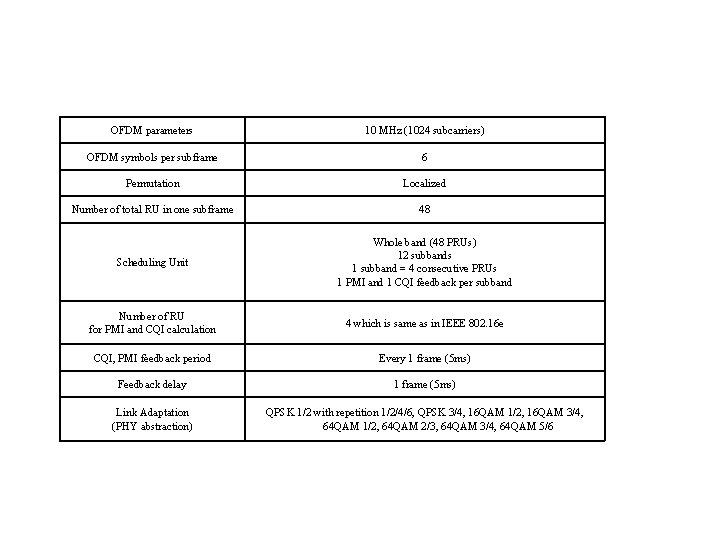
OFDM parameters 10 MHz (1024 subcarriers) OFDM symbols per subframe 6 Permutation Localized Number of total RU in one subframe 48 Scheduling Unit Whole band (48 PRUs) 12 subbands 1 subband = 4 consecutive PRUs 1 PMI and 1 CQI feedback per subband Number of RU for PMI and CQI calculation 4 which is same as in IEEE 802. 16 e CQI, PMI feedback period Every 1 frame (5 ms) Feedback delay 1 frame (5 ms) Link Adaptation (PHY abstraction) QPSK 1/2 with repetition 1/2/4/6, QPSK 3/4, 16 QAM 1/2, 16 QAM 3/4, 64 QAM 1/2, 64 QAM 2/3, 64 QAM 3/4, 64 QAM 5/6
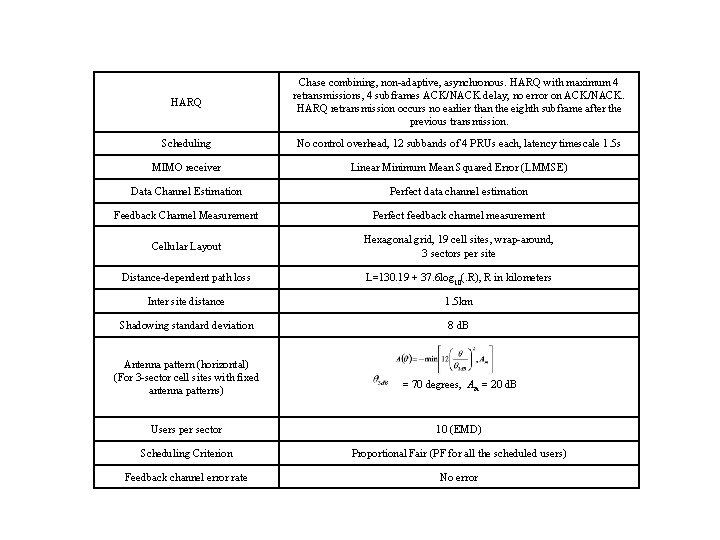
HARQ Chase combining, non-adaptive, asynchronous. HARQ with maximum 4 retransmissions, 4 subframes ACK/NACK delay, no error on ACK/NACK. HARQ retransmission occurs no earlier than the eighth subframe after the previous transmission. Scheduling No control overhead, 12 subbands of 4 PRUs each, latency timescale 1. 5 s MIMO receiver Linear Minimum Mean Squared Error (LMMSE) Data Channel Estimation Perfect data channel estimation Feedback Channel Measurement Perfect feedback channel measurement Cellular Layout Hexagonal grid, 19 cell sites, wrap-around, 3 sectors per site Distance-dependent path loss L=130. 19 + 37. 6 log 10(. R), R in kilometers Inter site distance 1. 5 km Shadowing standard deviation 8 d. B Antenna pattern (horizontal) (For 3 -sector cell sites with fixed antenna patterns) = 70 degrees, Am = 20 d. B Users per sector 10 (EMD) Scheduling Criterion Proportional Fair (PF for all the scheduled users) Feedback channel error rate No error
- Slides: 24