
Performance Development Program Overview While no single conversation
- Slides: 24
Performance Development Program Overview While no single conversation is guaranteed to change the trajectory of a career, an organization, a relationship or a life – any single conversation can. ~ Susan Scott
Today’s session will help you to: • Understand the changes which have led to a revamped Performance and Development Cycle. • Understand your role and responsibilities related to the steps of the transition process for the Performance and Development Cycle (PDC). • Understand the timelines for the 2018 -19 PDC and how it relates to the launch of the new online tool to support the PDC at UOIT. • Identify opportunities for your future growth and development.
What got us here… Industry changes in performance management best practice: • • Decrease in the practice of annual reviews. Removal of rating scales. Shift towards continuous coaching, feedback and dialogue. Continual and collaborative approach to performance development. UOIT specific changes: • Feedback from focus groups and survey. • Job Evaluation process – elimination of A/T and P/M categories.
What we learned… 1. Annual review was referred to as a “report card” with the focus on “performance review” rather than “performance development”. 2. Timeline driven. 3. Administratively intense for managers and employees. 4. Ambiguity with terminology. 5. Rating scale was interpreted and applied inconsistently. 6. Lack of accountability. 7. Skill gap in the areas of coaching/feedback/confrontation. 8. People were fearful, defensive and confused about the performance management program and therefore not positively engaged.
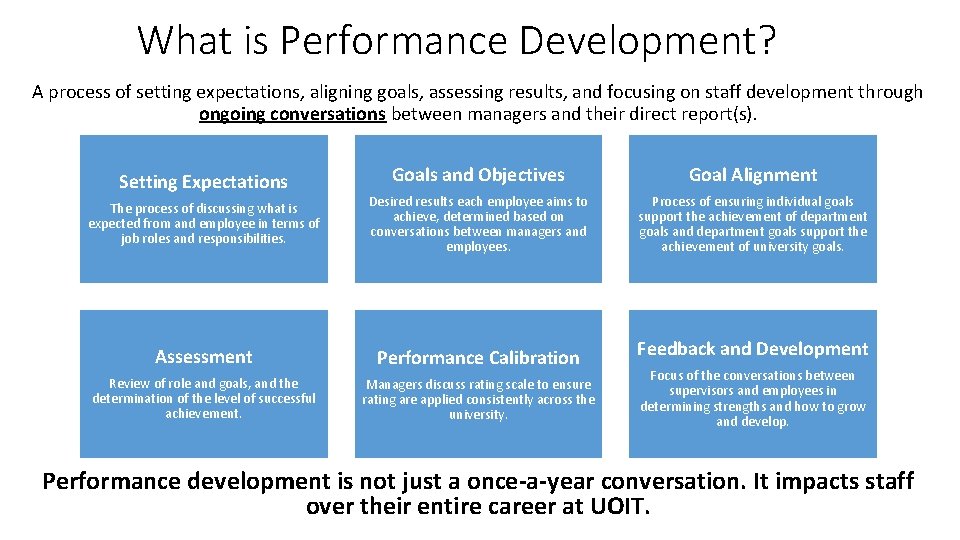
What is Performance Development? A process of setting expectations, aligning goals, assessing results, and focusing on staff development through ongoing conversations between managers and their direct report(s). Goals and Objectives Goal Alignment The process of discussing what is expected from and employee in terms of job roles and responsibilities. Desired results each employee aims to achieve, determined based on conversations between managers and employees. Process of ensuring individual goals support the achievement of department goals and department goals support the achievement of university goals. Assessment Performance Calibration Review of role and goals, and the determination of the level of successful achievement. Managers discuss rating scale to ensure rating are applied consistently across the university. Setting Expectations Feedback and Development Focus of the conversations between supervisors and employees in determining strengths and how to grow and develop. Performance development is not just a once-a-year conversation. It impacts staff over their entire career at UOIT.
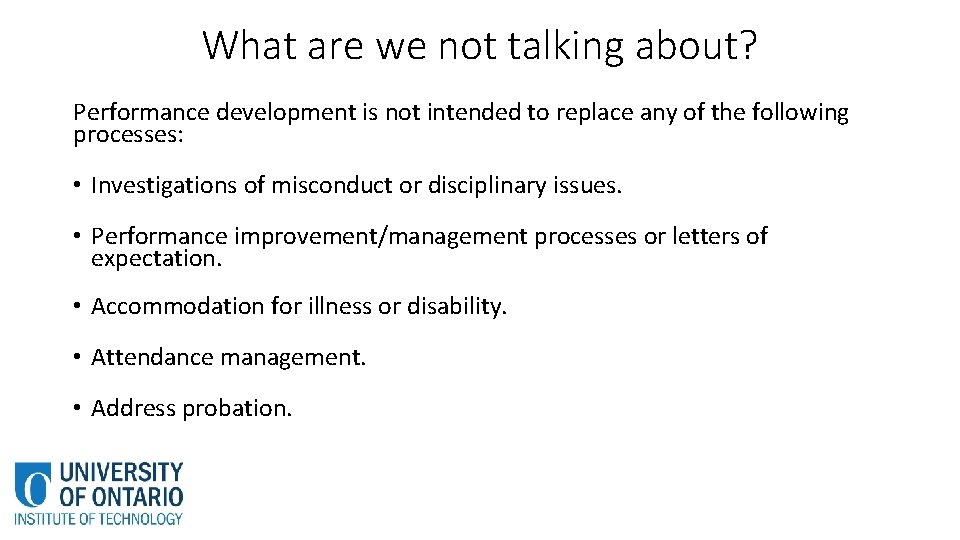
What are we not talking about? Performance development is not intended to replace any of the following processes: • Investigations of misconduct or disciplinary issues. • Performance improvement/management processes or letters of expectation. • Accommodation for illness or disability. • Attendance management. • Address probation.
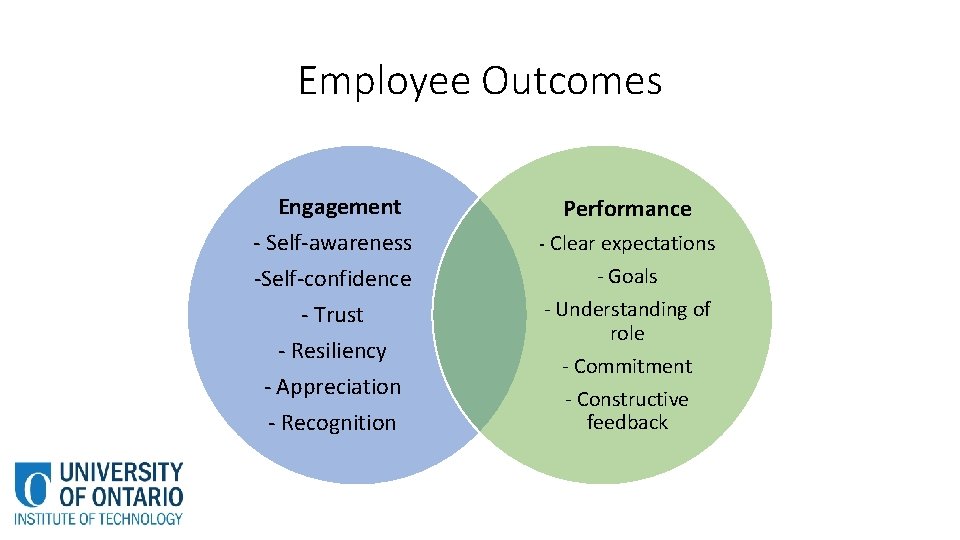
Employee Outcomes Engagement - Self-awareness -Self-confidence - Trust - Resiliency - Appreciation - Recognition Performance - Clear expectations - Goals - Understanding of role - Commitment - Constructive feedback
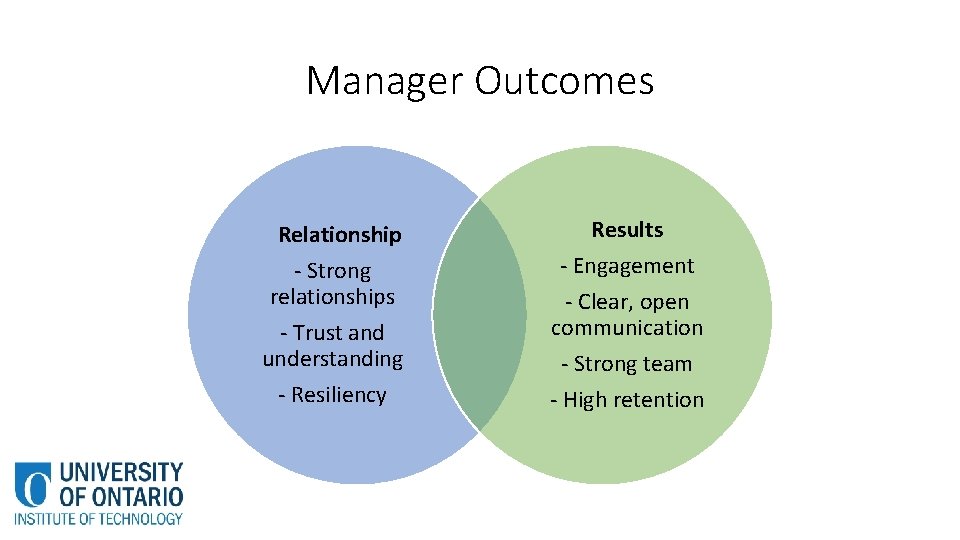
Manager Outcomes Relationship - Strong relationships - Trust and understanding - Resiliency Results - Engagement - Clear, open communication - Strong team - High retention
Vision… • UOIT strives to be an organization in which managers have meaningful, constructive, regular conversations with their employees that positively impact performance, productivity and development. • We want Performance Conversations that Matter and a plan that will be an ongoing, forward-looking, collaborative process in which managers develop employees considering the university’s values and strategy. • Dialogue will focus on individual goals for performance, competency development*, learning and career progression.
Objectives: 1. Develop an online tool to track performance. 2. Establish a performance culture which supports ongoing, futurefocused dialogue and feedback, and is focused on “performance development” rather than “performance review”. 3. Provide support for managers and staff to ensure they are equipped to engage in meaningful coaching/feedback/confrontation conversations about performance and development. 4. Increase employee engagement and performance.
What are we doing… • Revamping performance management program for administrative staff in Levels 1 -13. • Using a new platform – Cornerstone on Demand (CSOD). • Running first round with pilot group. • Goal Setting (September 2018) • Changing the Performance and Development Cycle timelines • Launch with Goal Setting to all full-time continuing administrative staff (April 2019).
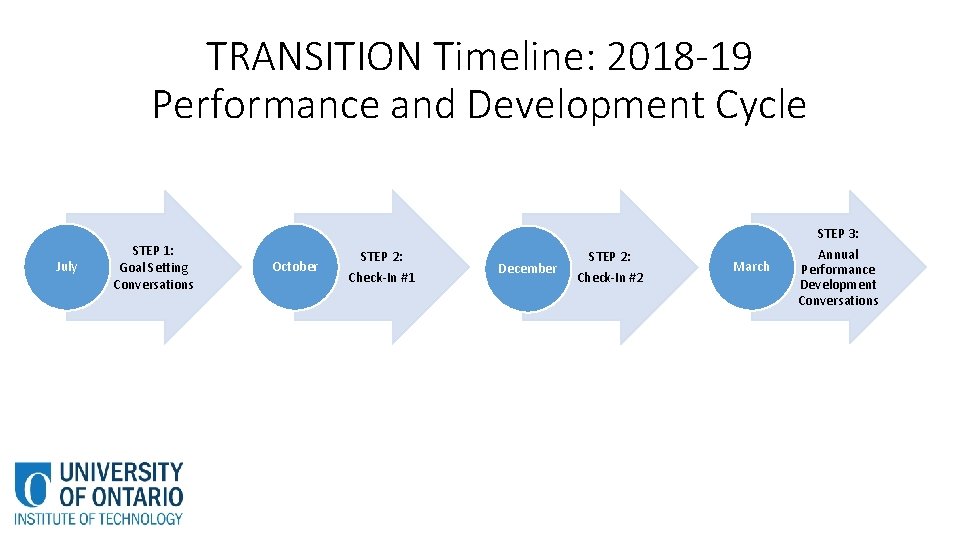
TRANSITION Timeline: 2018 -19 Performance and Development Cycle July STEP 1: Goal Setting Conversations October STEP 2: Check-In #1 December STEP 2: Check-In #2 March STEP 3: Annual Performance Development Conversations
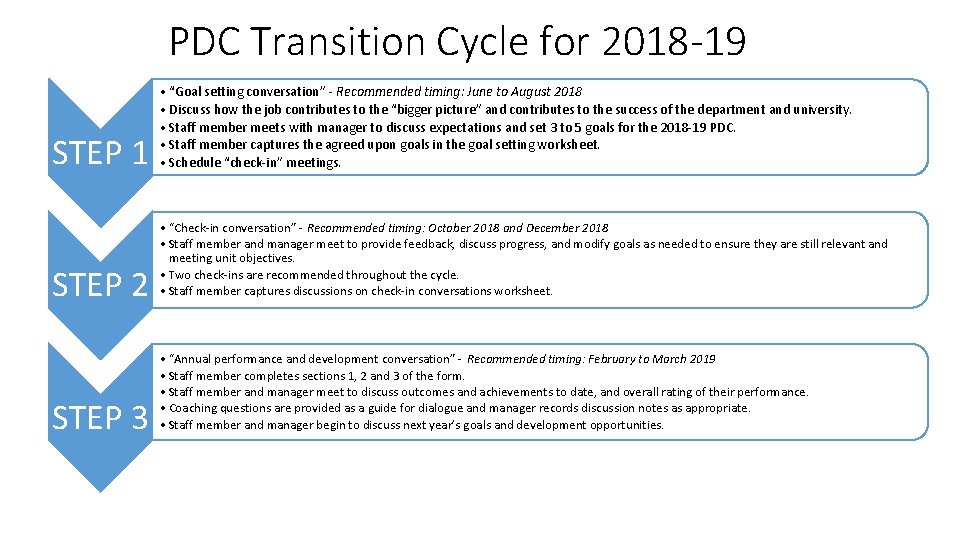
PDC Transition Cycle for 2018 -19 STEP 1 STEP 2 STEP 3 • “Goal setting conversation” - Recommended timing: June to August 2018 • Discuss how the job contributes to the “bigger picture” and contributes to the success of the department and university. • Staff member meets with manager to discuss expectations and set 3 to 5 goals for the 2018 -19 PDC. • Staff member captures the agreed upon goals in the goal setting worksheet. • Schedule “check-in” meetings. • “Check-in conversation” - Recommended timing: October 2018 and December 2018 • Staff member and manager meet to provide feedback, discuss progress, and modify goals as needed to ensure they are still relevant and meeting unit objectives. • Two check-ins are recommended throughout the cycle. • Staff member captures discussions on check-in conversations worksheet. • “Annual performance and development conversation” - Recommended timing: February to March 2019 • Staff member completes sections 1, 2 and 3 of the form. • Staff member and manager meet to discuss outcomes and achievements to date, and overall rating of their performance. • Coaching questions are provided as a guide for dialogue and manager records discussion notes as appropriate. • Staff member and manager begin to discuss next year’s goals and development opportunities.
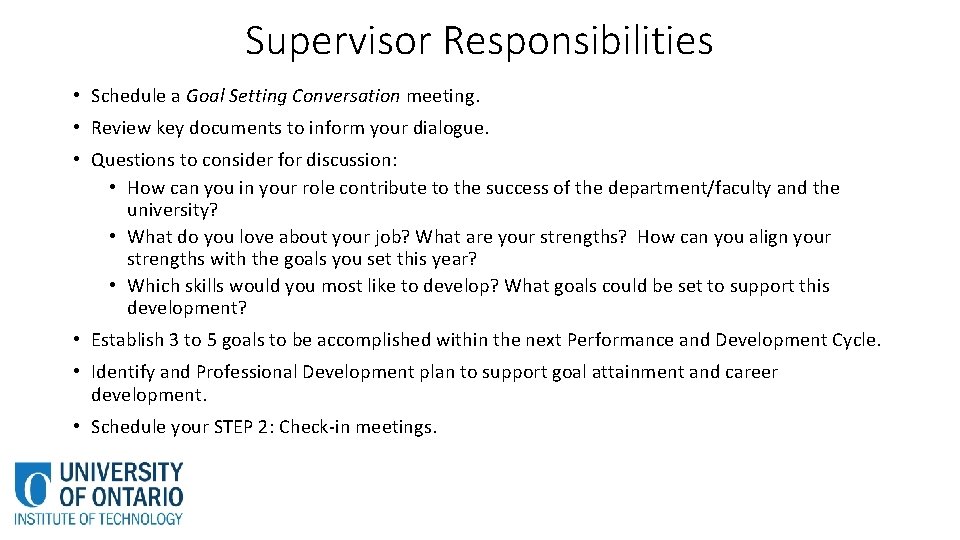
Supervisor Responsibilities • Schedule a Goal Setting Conversation meeting. • Review key documents to inform your dialogue. • Questions to consider for discussion: • How can you in your role contribute to the success of the department/faculty and the university? • What do you love about your job? What are your strengths? How can you align your strengths with the goals you set this year? • Which skills would you most like to develop? What goals could be set to support this development? • Establish 3 to 5 goals to be accomplished within the next Performance and Development Cycle. • Identify and Professional Development plan to support goal attainment and career development. • Schedule your STEP 2: Check-in meetings.
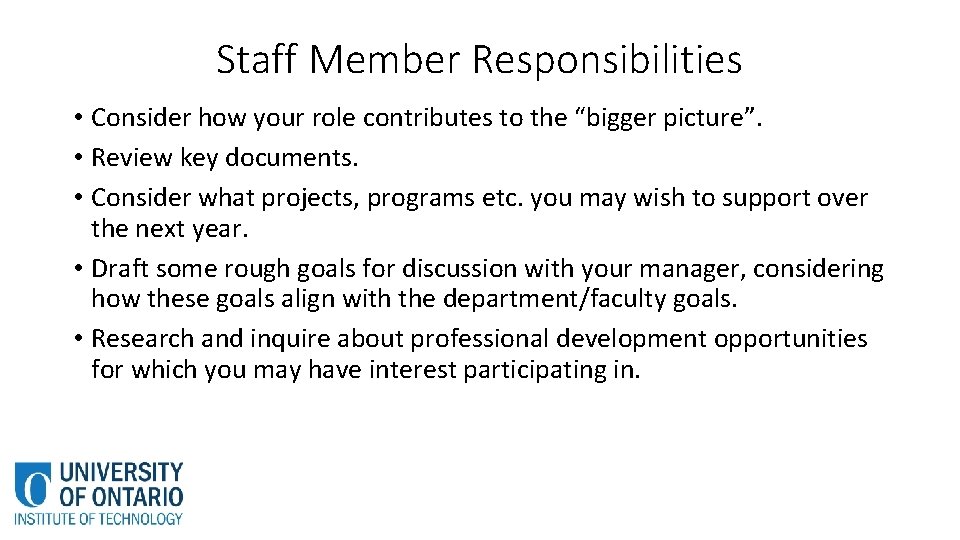
Staff Member Responsibilities • Consider how your role contributes to the “bigger picture”. • Review key documents. • Consider what projects, programs etc. you may wish to support over the next year. • Draft some rough goals for discussion with your manager, considering how these goals align with the department/faculty goals. • Research and inquire about professional development opportunities for which you may have interest participating in.
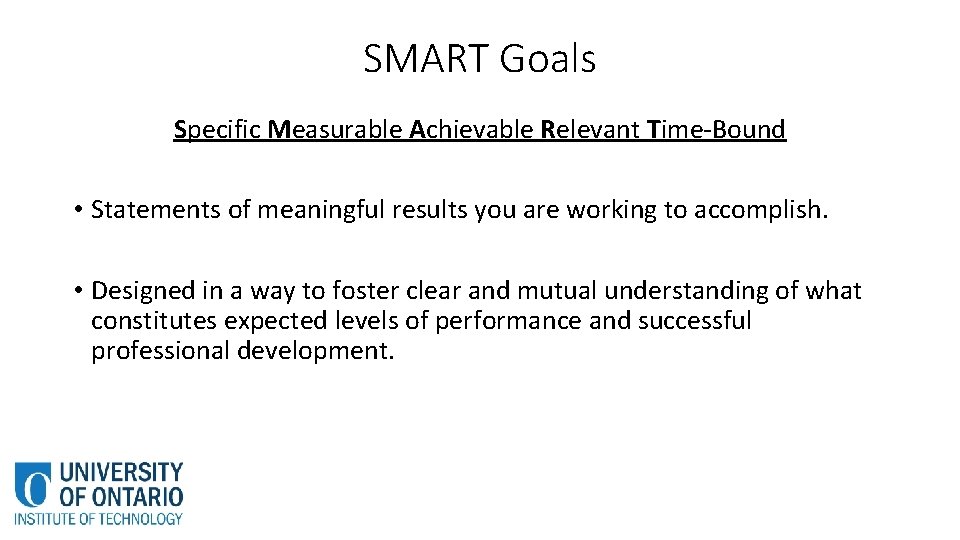
SMART Goals Specific Measurable Achievable Relevant Time-Bound • Statements of meaningful results you are working to accomplish. • Designed in a way to foster clear and mutual understanding of what constitutes expected levels of performance and successful professional development.
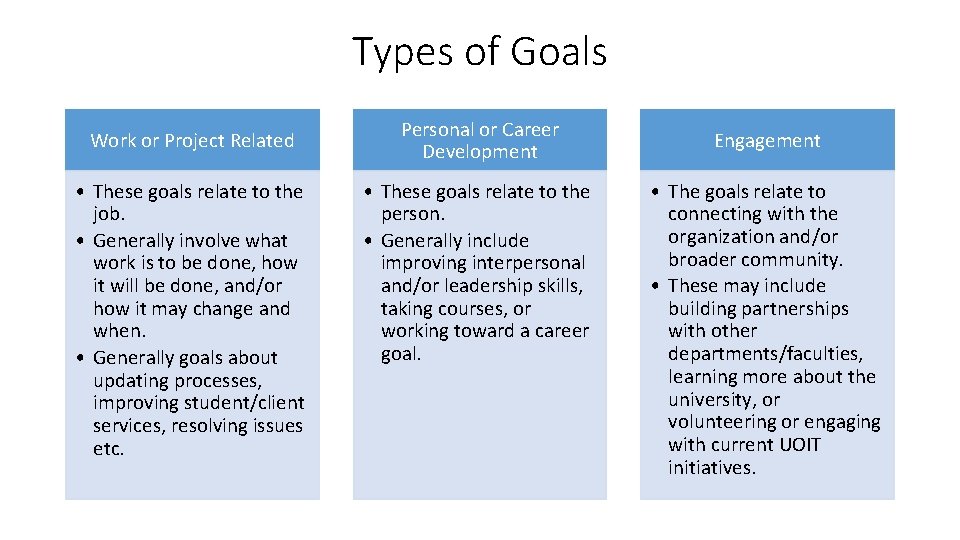
Types of Goals Work or Project Related • These goals relate to the job. • Generally involve what work is to be done, how it will be done, and/or how it may change and when. • Generally goals about updating processes, improving student/client services, resolving issues etc. Personal or Career Development • These goals relate to the person. • Generally include improving interpersonal and/or leadership skills, taking courses, or working toward a career goal. Engagement • The goals relate to connecting with the organization and/or broader community. • These may include building partnerships with other departments/faculties, learning more about the university, or volunteering or engaging with current UOIT initiatives.
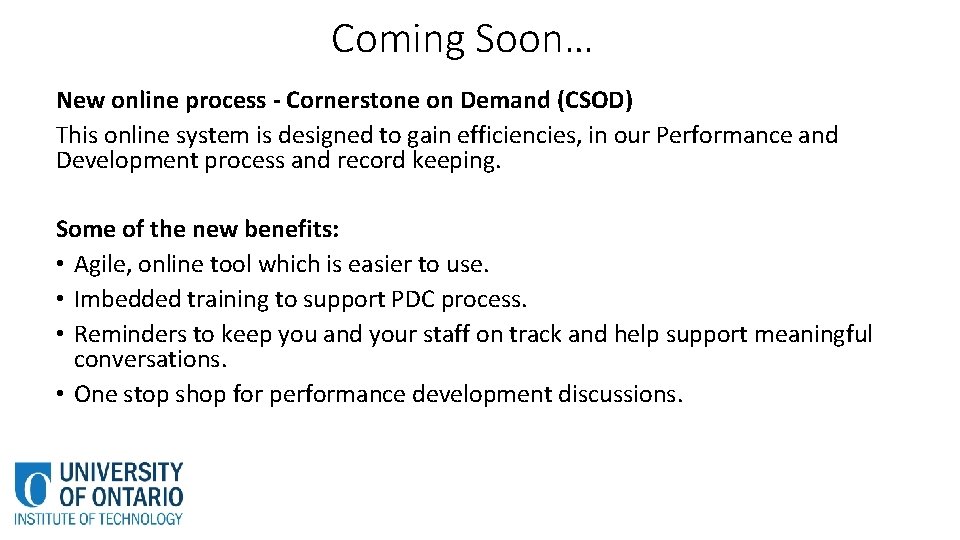
Coming Soon… New online process - Cornerstone on Demand (CSOD) This online system is designed to gain efficiencies, in our Performance and Development process and record keeping. Some of the new benefits: • Agile, online tool which is easier to use. • Imbedded training to support PDC process. • Reminders to keep you and your staff on track and help support meaningful conversations. • One stop shop for performance development discussions.
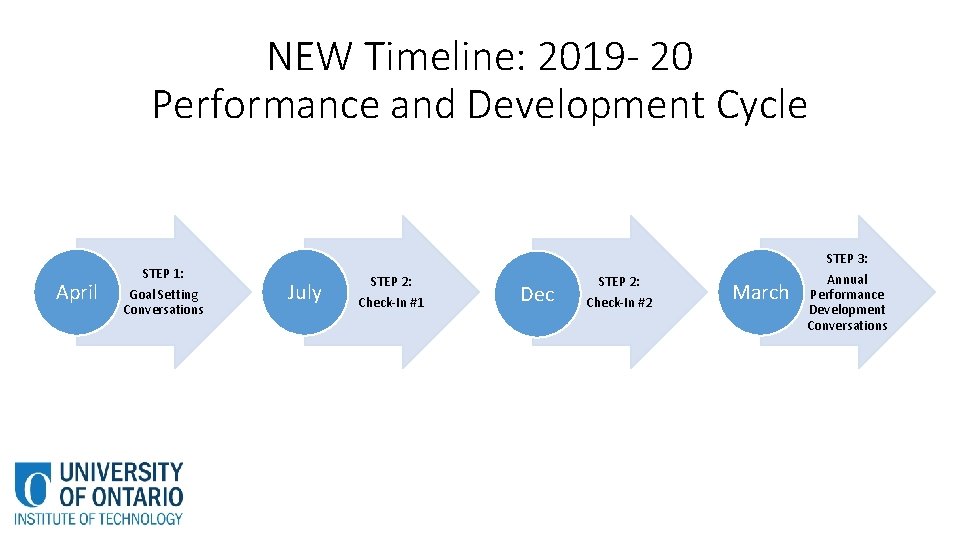
NEW Timeline: 2019 - 20 Performance and Development Cycle April STEP 1: Goal Setting Conversations July STEP 2: Check-In #1 Dec STEP 2: Check-In #2 March STEP 3: Annual Performance Development Conversations
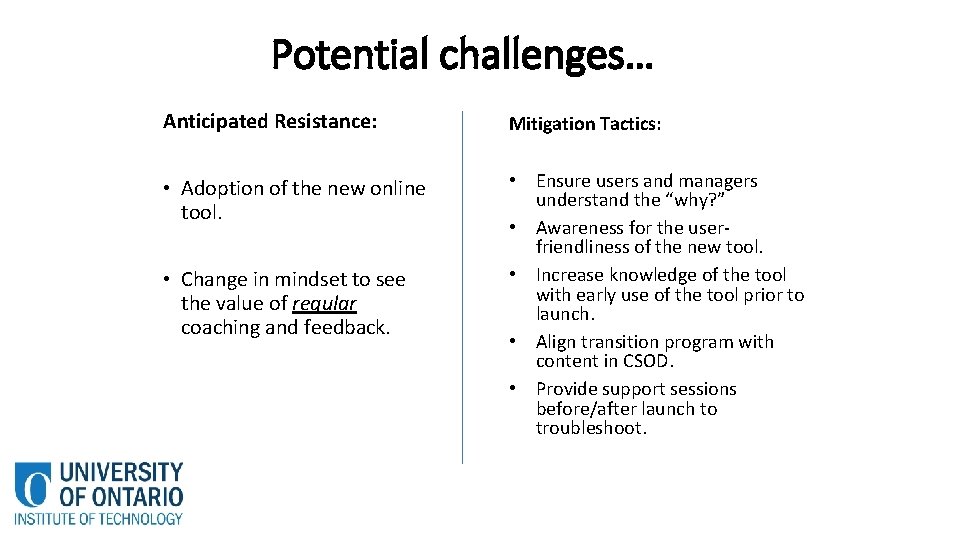
Potential challenges… Anticipated Resistance: Mitigation Tactics: • Adoption of the new online tool. • Ensure users and managers understand the “why? ” • Awareness for the userfriendliness of the new tool. • Increase knowledge of the tool with early use of the tool prior to launch. • Align transition program with content in CSOD. • Provide support sessions before/after launch to troubleshoot. • Change in mindset to see the value of regular coaching and feedback.
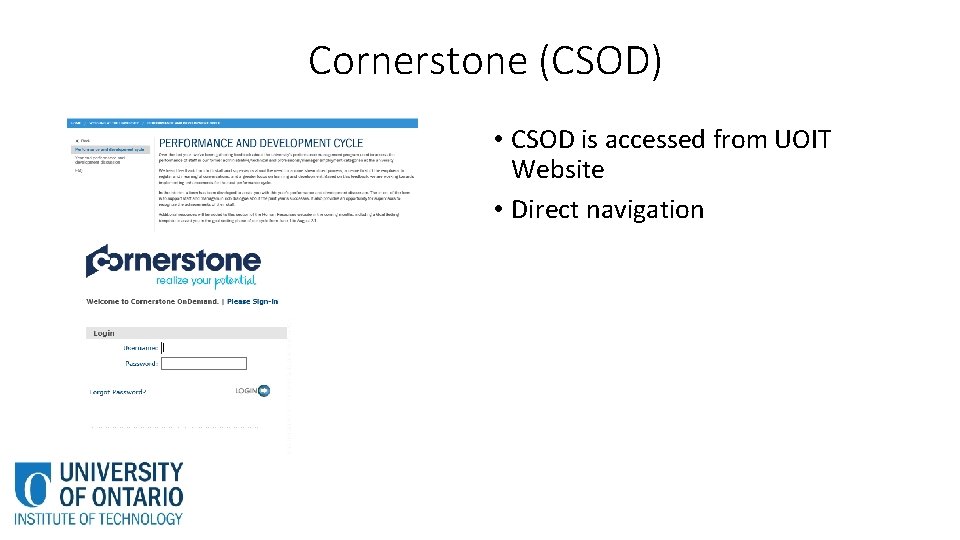
Cornerstone (CSOD) • CSOD is accessed from UOIT Website • Direct navigation
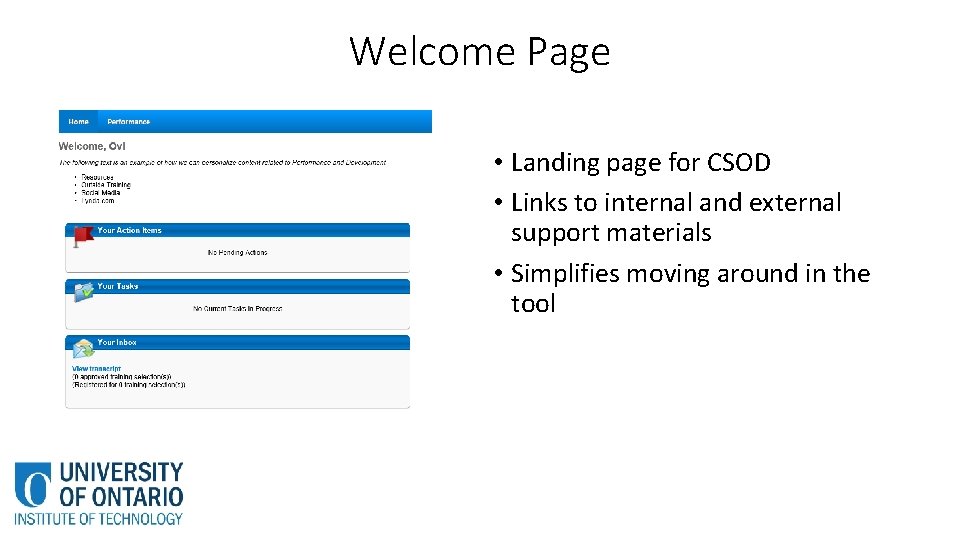
Welcome Page • Landing page for CSOD • Links to internal and external support materials • Simplifies moving around in the tool
Thank You! Questions?