
Performance Degradation in the Presence of Subnormal FloatingPoint
Performance Degradation in the Presence of Subnormal Floating-Point Values Orion Lawlor, Hari Govind, Isaac Dooley, Michael Breitenfeld, Laxmikant Kale Department of Computer Science University of Illinois at Urbana-Champaign http: //charm. cs. uiuc. edu Workshop on Operating System Interference in High Performance Applications 2005 1
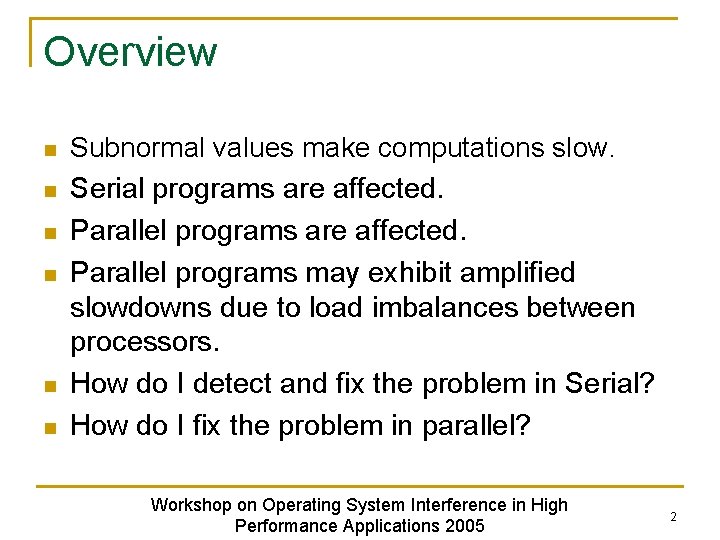
Overview n n n Subnormal values make computations slow. Serial programs are affected. Parallel programs may exhibit amplified slowdowns due to load imbalances between processors. How do I detect and fix the problem in Serial? How do I fix the problem in parallel? Workshop on Operating System Interference in High Performance Applications 2005 2
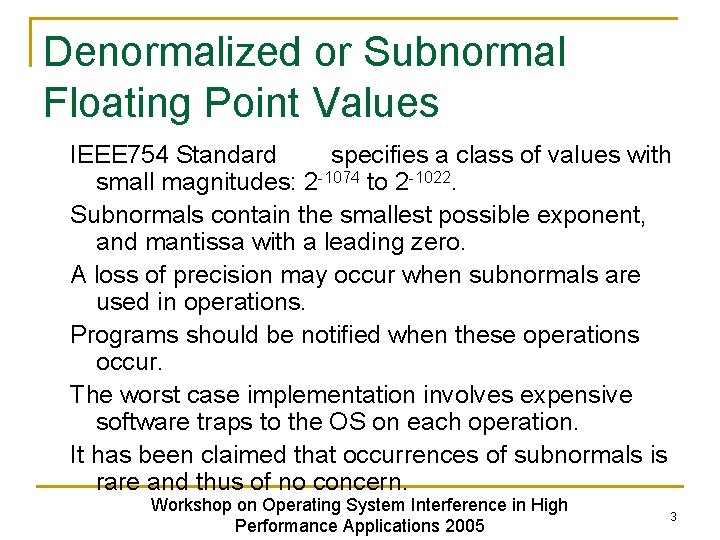
Denormalized or Subnormal Floating Point Values IEEE 754 Standard specifies a class of values with small magnitudes: 2 -1074 to 2 -1022. Subnormals contain the smallest possible exponent, and mantissa with a leading zero. A loss of precision may occur when subnormals are used in operations. Programs should be notified when these operations occur. The worst case implementation involves expensive software traps to the OS on each operation. It has been claimed that occurrences of subnormals is rare and thus of no concern. Workshop on Operating System Interference in High Performance Applications 2005 3
Subnormals are Bad “Underflows occur infrequently, but when they do occur, they often come in convoys. Whatever causes one underflow will usually cause a lot more. So occasionally a program will encounter a large batch of underflows, which makes it slow. ” W. Kahan IEEE 754 R minutes from September 19, 2002 Workshop on Operating System Interference in High Performance Applications 2005 4
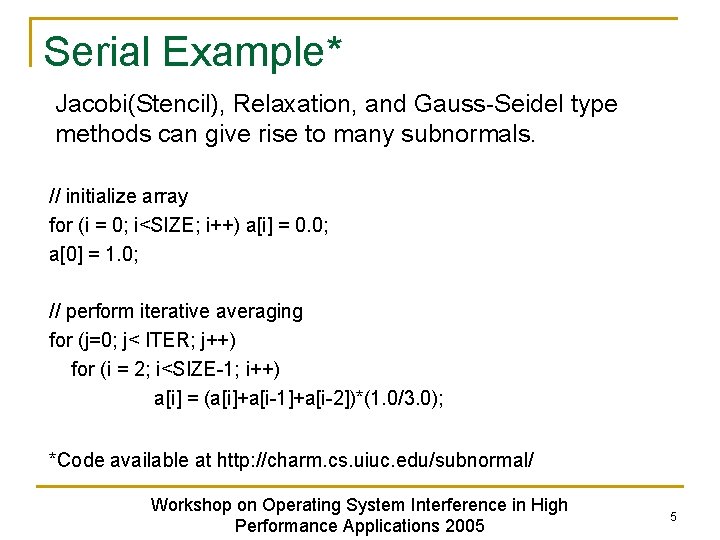
Serial Example* Jacobi(Stencil), Relaxation, and Gauss-Seidel type methods can give rise to many subnormals. // initialize array for (i = 0; i<SIZE; i++) a[i] = 0. 0; a[0] = 1. 0; // perform iterative averaging for (j=0; j< ITER; j++) for (i = 2; i<SIZE-1; i++) a[i] = (a[i]+a[i-1]+a[i-2])*(1. 0/3. 0); *Code available at http: //charm. cs. uiuc. edu/subnormal/ Workshop on Operating System Interference in High Performance Applications 2005 5
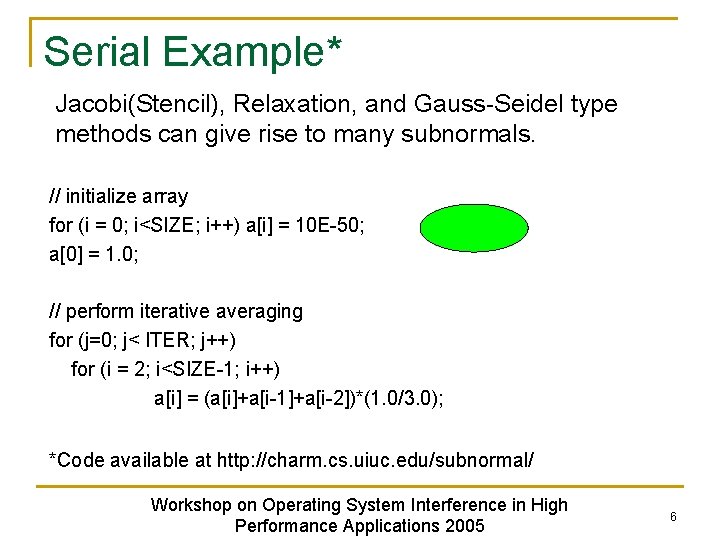
Serial Example* Jacobi(Stencil), Relaxation, and Gauss-Seidel type methods can give rise to many subnormals. // initialize array for (i = 0; i<SIZE; i++) a[i] = 10 E-50; a[0] = 1. 0; // perform iterative averaging for (j=0; j< ITER; j++) for (i = 2; i<SIZE-1; i++) a[i] = (a[i]+a[i-1]+a[i-2])*(1. 0/3. 0); *Code available at http: //charm. cs. uiuc. edu/subnormal/ Workshop on Operating System Interference in High Performance Applications 2005 6
Serial Test : Worst Case Slowdown Workshop on Operating System Interference in High Performance Applications 2005 7
Serial Test : Worst Case Slowdown Workshop on Operating System Interference in High Performance Applications 2005 8
Serial Test : Worst Case Slowdown Workshop on Operating System Interference in High Performance Applications 2005 9
Serial Test : Worst Case Slowdown Workshop on Operating System Interference in High Performance Applications 2005 10
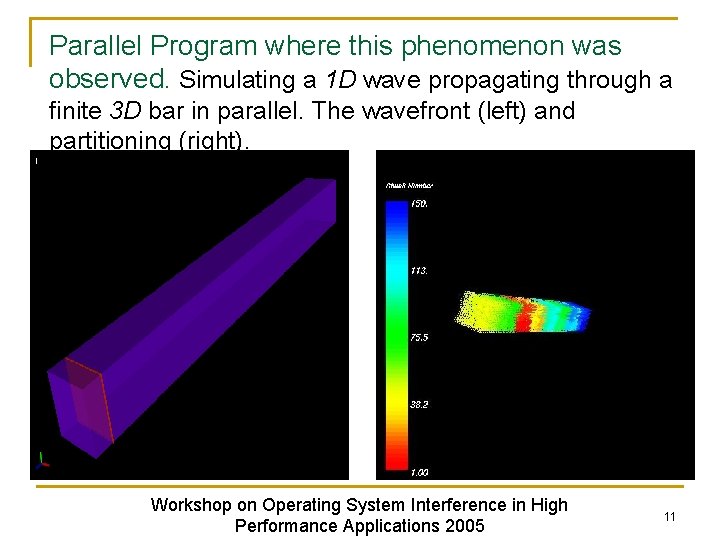
Parallel Program where this phenomenon was observed. Simulating a 1 D wave propagating through a finite 3 D bar in parallel. The wavefront (left) and partitioning (right). Workshop on Operating System Interference in High Performance Applications 2005 11
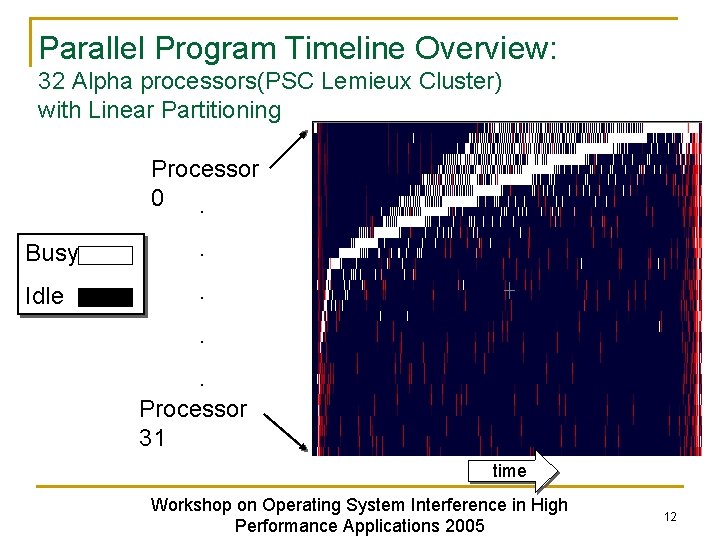
Parallel Program Timeline Overview: 32 Alpha processors(PSC Lemieux Cluster) with Linear Partitioning Processor 0. Busy . Idle . . . Processor 31 time Workshop on Operating System Interference in High Performance Applications 2005 12
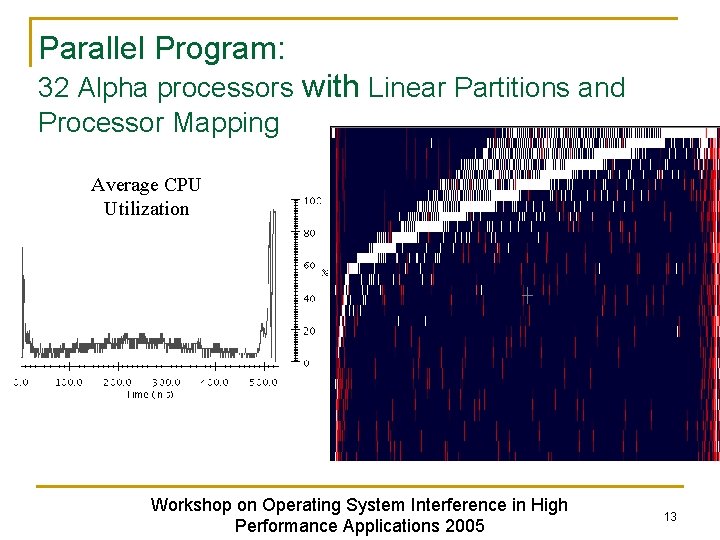
Parallel Program: 32 Alpha processors with Linear Partitions and Processor Mapping Average CPU Utilization Workshop on Operating System Interference in High Performance Applications 2005 13
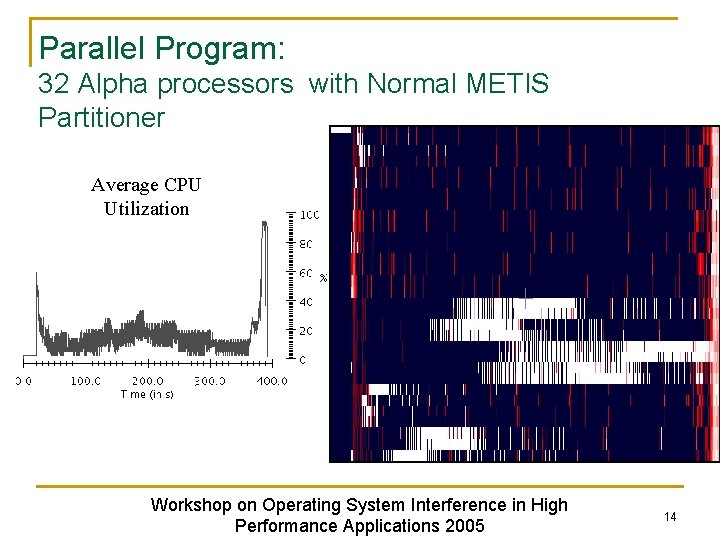
Parallel Program: 32 Alpha processors with Normal METIS Partitioner Average CPU Utilization Workshop on Operating System Interference in High Performance Applications 2005 14
Flushing Subnormals to Zero n n Some processors have modes that flush any subnormal to zero. No subnormal will ever be produced by any floating-point operation. Available on some processors. Can be enabled by: q q Compiler flags Explicit code Workshop on Operating System Interference in High Performance Applications 2005 15
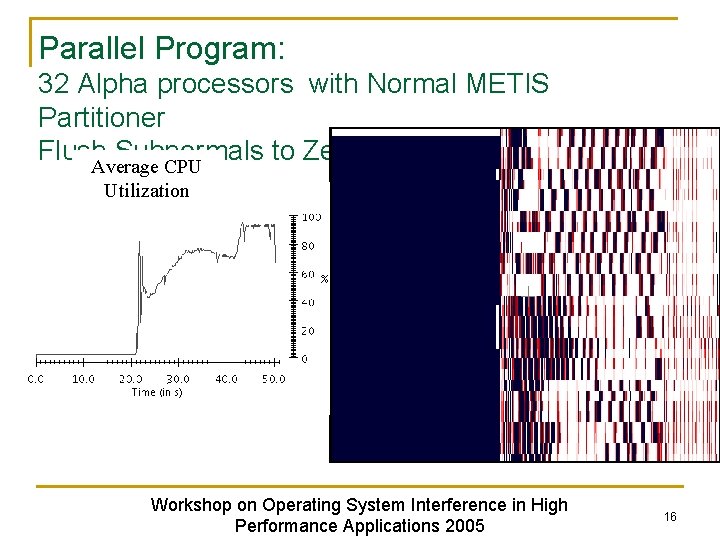
Parallel Program: 32 Alpha processors with Normal METIS Partitioner Flush Subnormals to Zero Average CPU Utilization Workshop on Operating System Interference in High Performance Applications 2005 16
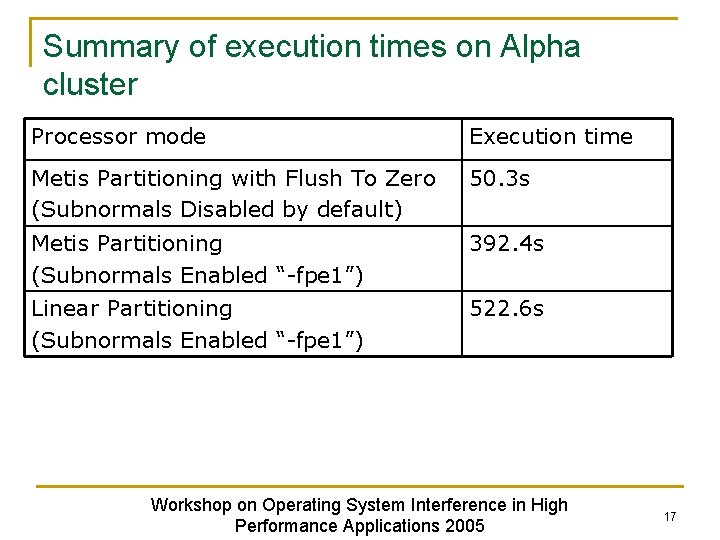
Summary of execution times on Alpha cluster Processor mode Execution time Metis Partitioning with Flush To Zero (Subnormals Disabled by default) 50. 3 s Metis Partitioning (Subnormals Enabled “-fpe 1”) 392. 4 s Linear Partitioning (Subnormals Enabled “-fpe 1”) 522. 6 s Workshop on Operating System Interference in High Performance Applications 2005 17
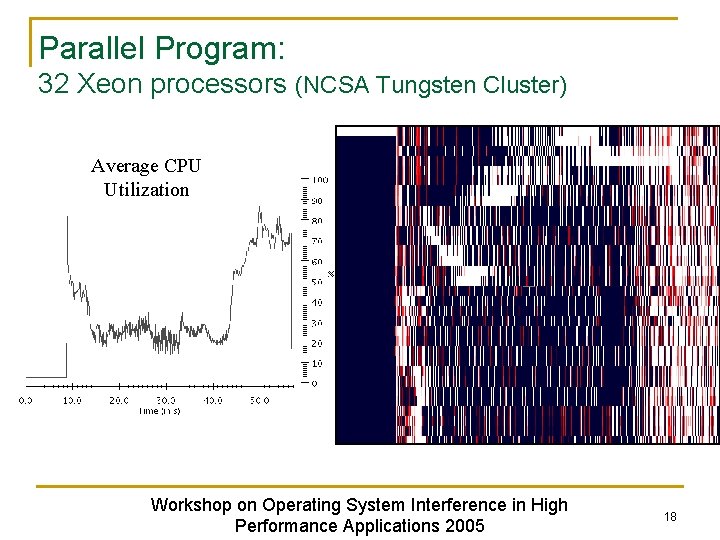
Parallel Program: 32 Xeon processors (NCSA Tungsten Cluster) Average CPU Utilization Workshop on Operating System Interference in High Performance Applications 2005 18
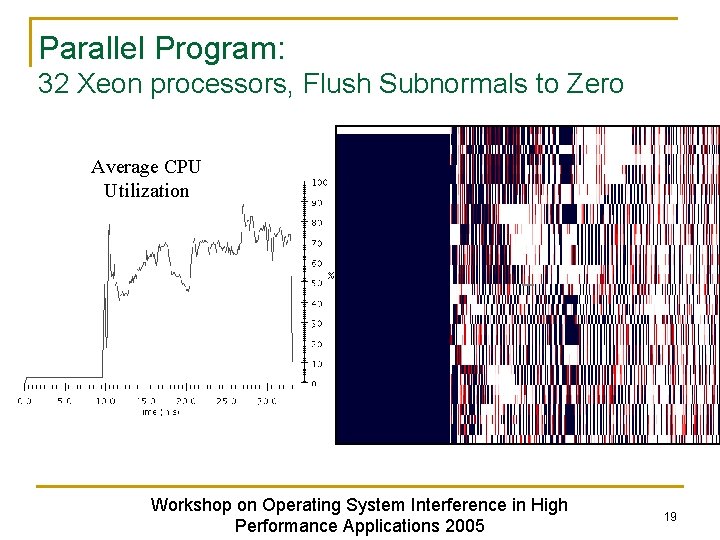
Parallel Program: 32 Xeon processors, Flush Subnormals to Zero Average CPU Utilization Workshop on Operating System Interference in High Performance Applications 2005 19
The Anatomy of The Parallel Problem n n Each processor can only proceed one step ahead of its neighbors. If the program uses any global synchronization, it will be significantly worse than the asynchronous. If one processor is slow, it will interfere with the progress of the rest of the processors. Essentially a load imbalance occurs between the processors. Systems built with message driven execution, virtualization / migratable objects, or loadbalancing may fix the parallel interference. Workshop on Operating System Interference in High Performance Applications 2005 20
Par. FUM: A Parallel Framework for Unstructured Mesh Applications n Makes parallelizing a serial code faster and easier q q q Handles mesh partitioning and communication Load balancing (via Charm++) Parallel Incremental Mesh Modification: n n q q q Adaptivity Refinement Visualization Support Collision Detection Library High Processor Utilization even for Dynamic Physics codes Workshop on Operating System Interference in High Performance Applications 2005 21
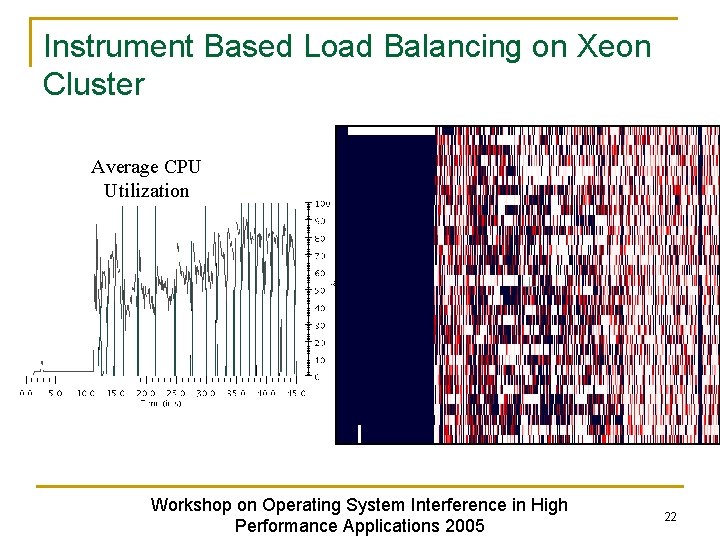
Instrument Based Load Balancing on Xeon Cluster Average CPU Utilization Workshop on Operating System Interference in High Performance Applications 2005 22
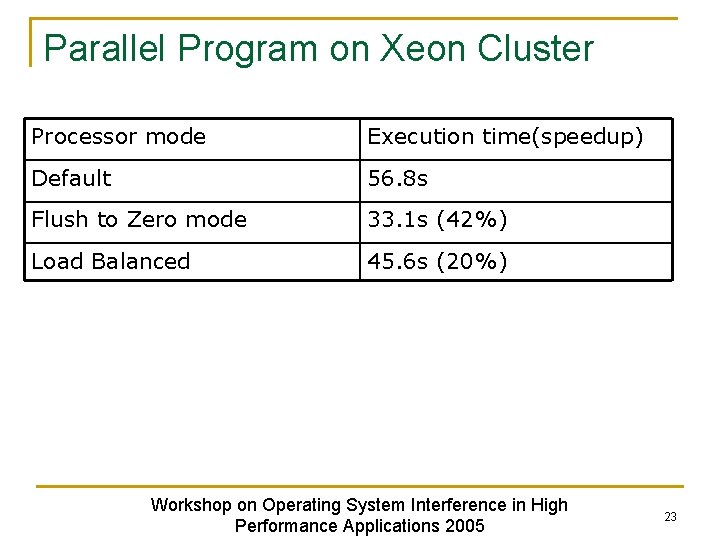
Parallel Program on Xeon Cluster Processor mode Execution time(speedup) Default 56. 8 s Flush to Zero mode 33. 1 s (42%) Load Balanced 45. 6 s (20%) Workshop on Operating System Interference in High Performance Applications 2005 23
How do I detect subnormals? n n Some compilers give an option which generates code that counts all occurrences of subnormals. E. g. DEC’s “-fpe 1” option Many compilers have options to generate IEEE compliant code. Try using such a flag and compare the results to a version with a non-IEEE compliant version. Explicitly scan through your data and count number of denormals. This method may yield false positives. It may be possible to monitor OS traps to determine if any floating-point exception handling code is Workshop on Operating System Interference in High executing. 24 Performance Applications 2005
How do I elminate these slowdowns? n n Use a computer system where the operations are less impacted by subnormals. Scale/translate data to different range if possible. Use a compiler option or additional code to put the processor in a mode where subnormals are flushed to zero(FTZ). If your numerical code cannot tolerate FTZ, then in parallel use some type of load balancing to on distribute the. Interference subnormals Workshop Operating System in High across Performance Applications 2005 25
Conclusion n n Subnormals are increasingly slower on modern processors. Parallel applications will have greatly amplified slowdowns due to the interference caused by one processor’s slowdown. These factors may no longer be as negligible as previously thought. We believe there are probably many other applications with similar slowdowns. Workshop on Operating System Interference in High Performance Applications 2005 26
Thank You Parallel Programming Lab at University of Illinois http: //charm. cs. uiuc. edu Additional Resources and Results: http: //charm. cs. uiuc. edu/subnormal/ Workshop on Operating System Interference in High Performance Applications 2005 27
- Slides: 27