
Performance Comparison between The Click Modular Router and
Performance Comparison between The Click Modular Router and the Net. FPGA Router Author: Leonardo Linguaglossa, Alfio Lombardo, Diego Reforgiato, Giovanni Schembra Publisher/Journal: International Journal of Computer Networks & Communications (IJCNC) Vol. 3, No. 5, Sep 2011 Presenter: Yu-Hsiang Lin Date: 2018/11/21 Department of Computer Science and Information Engineering National Cheng Kung University, Taiwan R. O. C.
Abstract l l l We had a preference for the Click Modular Router platform due its flexibility and the fact that it claimed to have equal or higher performance than native forwarding if used with its polling drivers. Net. FPGA is an open networking platform accelerator that enables researchers and instructors to build working prototypes of high-speed, hardwareaccelerated networking systems. Overall, The Net. FPGA router performance outperforms the Click router performance. National Cheng Kung University CSIE Computer & Internet Architecture Lab 2
The Click Modular Router l l Software router Click routers are built from fine-grained components, each component is a packet-processing module called element which is written in c++. A configuration script has to be written in the Click language, and to create the right connection between elements. Two different packet transfer mechanisms are supported by Click, the push and the pull one. In a push connection the packet transfer is initiated by the source element, which passes it to the downstream element. The pull connection, on the other hand, works in the dual way: in this case it is the downstream element that initiates the packet transfer, asking the upstream element to send it a packet. National Cheng Kung University CSIE Computer & Internet Architecture Lab 3

Net. FPGA-1 G l Hardware Router National Cheng Kung University CSIE Computer & Internet Architecture Lab 4
Evaluation l Report all the comparative tests we have performed following the guidelines of the documents RFC 1242 and RFC 2544. üThroughput üFrame Loss Rate üOverloaded Behavior üRestart Behavior üSingle Frame Behaviour üFTP/HTTP File Transfer National Cheng Kung University CSIE Computer & Internet Architecture Lab 5
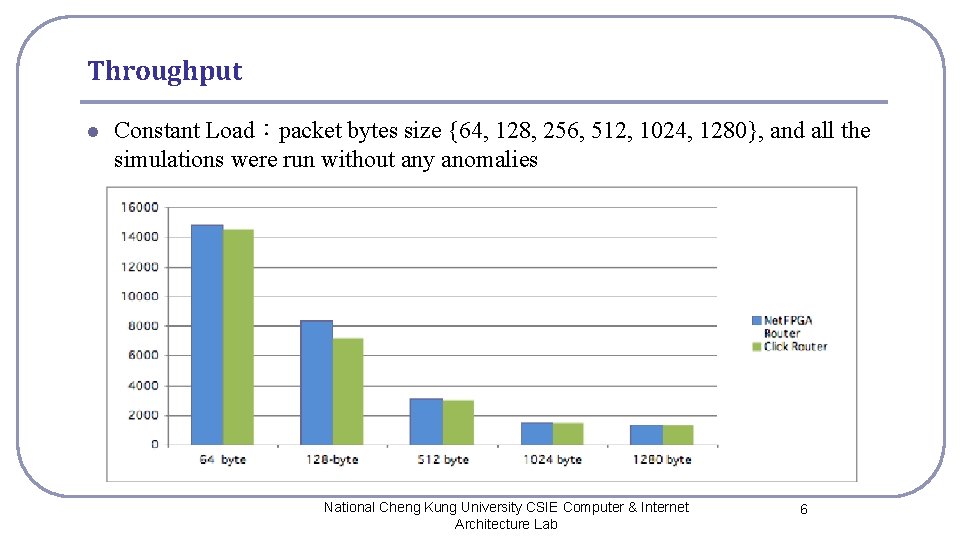
Throughput l Constant Load:packet bytes size {64, 128, 256, 512, 1024, 1280}, and all the simulations were run without any anomalies National Cheng Kung University CSIE Computer & Internet Architecture Lab 6
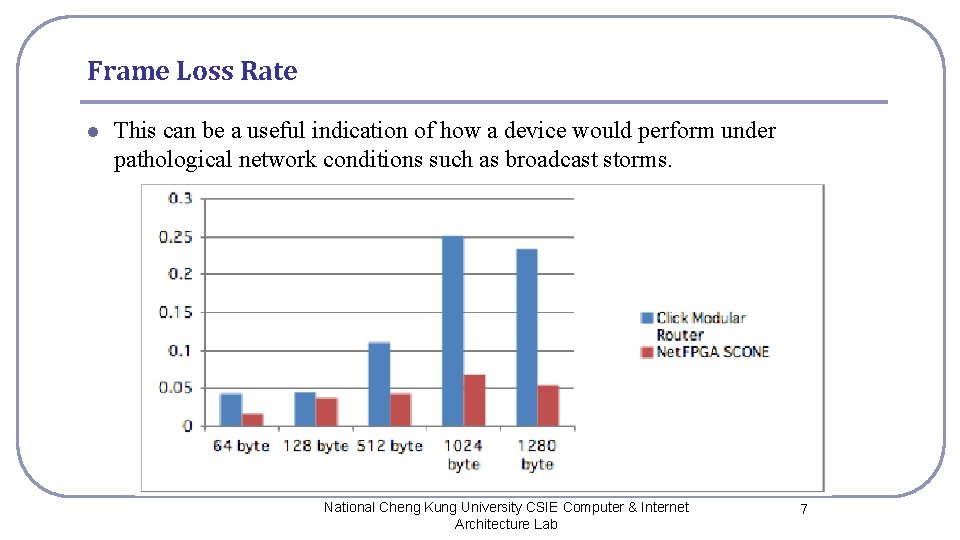
Frame Loss Rate l This can be a useful indication of how a device would perform under pathological network conditions such as broadcast storms. National Cheng Kung University CSIE Computer & Internet Architecture Lab 7
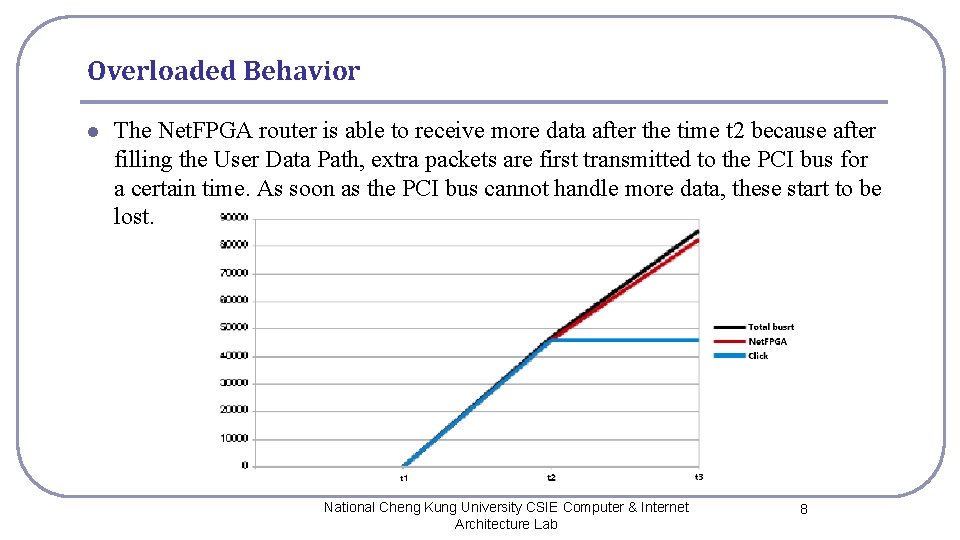
Overloaded Behavior l The Net. FPGA router is able to receive more data after the time t 2 because after filling the User Data Path, extra packets are first transmitted to the PCI bus for a certain time. As soon as the PCI bus cannot handle more data, these start to be lost. National Cheng Kung University CSIE Computer & Internet Architecture Lab 8
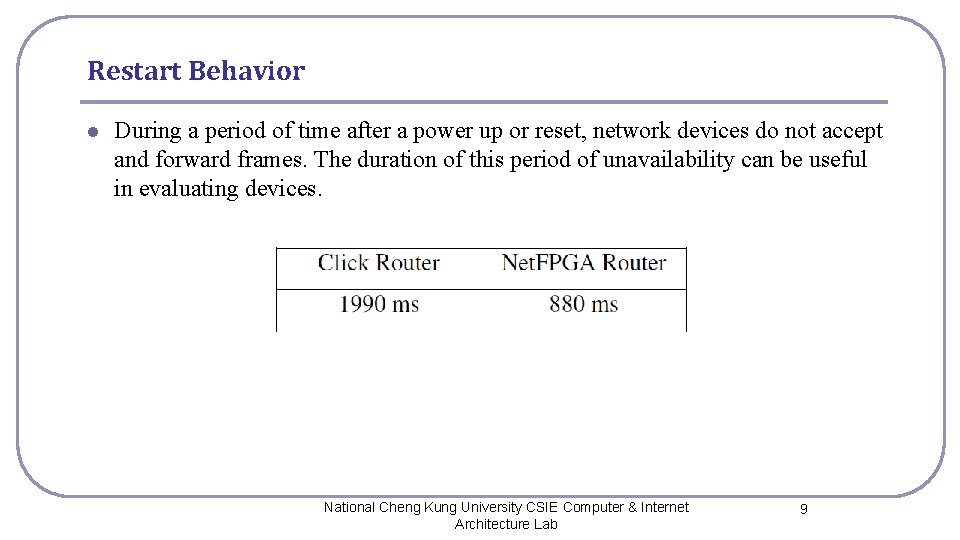
Restart Behavior l During a period of time after a power up or reset, network devices do not accept and forward frames. The duration of this period of unavailability can be useful in evaluating devices. National Cheng Kung University CSIE Computer & Internet Architecture Lab 9
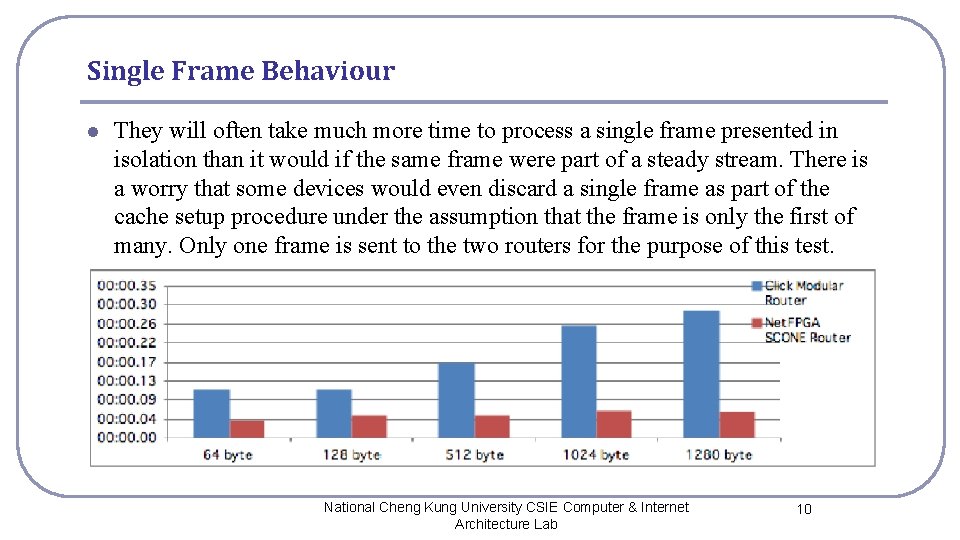
Single Frame Behaviour l They will often take much more time to process a single frame presented in isolation than it would if the same frame were part of a steady stream. There is a worry that some devices would even discard a single frame as part of the cache setup procedure under the assumption that the frame is only the first of many. Only one frame is sent to the two routers for the purpose of this test. National Cheng Kung University CSIE Computer & Internet Architecture Lab 10
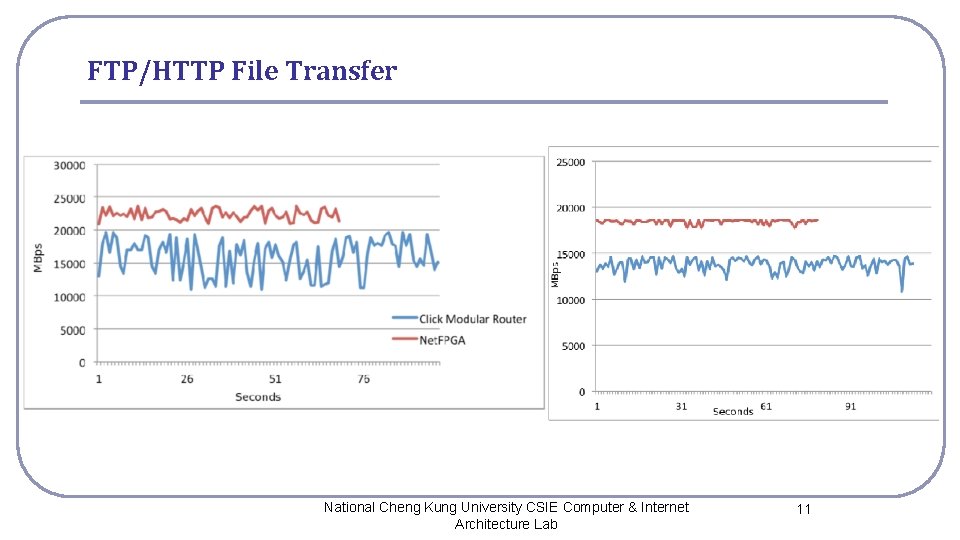
FTP/HTTP File Transfer National Cheng Kung University CSIE Computer & Internet Architecture Lab 11
- Slides: 11