
Performance based funding Global Fund to fight AIDS
Performance based funding Global Fund to fight AIDS, Tuberculosis and Malaria – progress and challenges Kirsi Viisainen, MD, Ph. D Clermont-Ferrand, 11 May, 2011
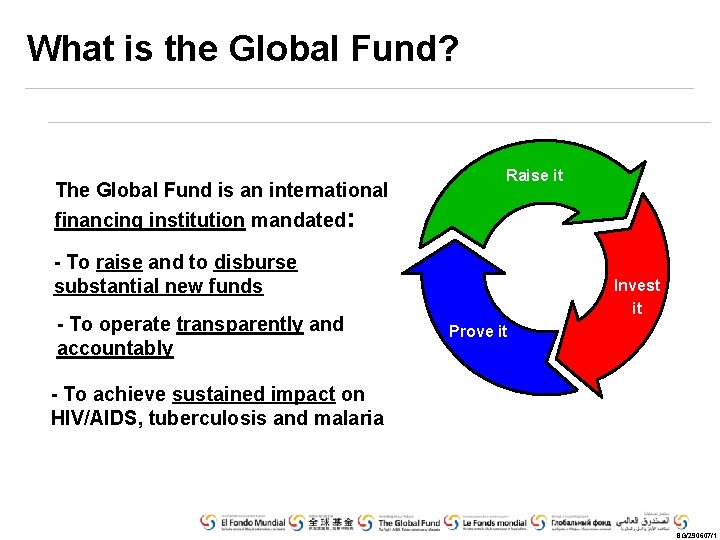
What is the Global Fund? The Global Fund is an international financing institution mandated: Raise it - To raise and to disburse substantial new funds - To operate transparently and accountably Invest it Prove it - To achieve sustained impact on HIV/AIDS, tuberculosis and malaria BG/290607/1
Why we do PBF at the Global Fund • Performance based funding is one of founding principles of the Global Fund (2003) “In making its funding decisions, the Global Fund will … focus on performance by linking resources to the achievement of clear, measurable and sustainable results”. • Paris Declaration on effective aid (2005): One of Five Principles (Managing for Results) : “Managing for results means managing and implementing aid in a way that focuses on the desired results and uses information to improve decision-making” • One of three major priorities in Accra Action Agenda (2008) “Achieving development results – and openly accounting for them – must be at the heart of all we do. “
What type of PBF do we do at the Global Fund Performance-based funding (PBF) ensures funding decisions are based on a transparent assessment of results against time-bound targets. What it is - All funding decision based on tranparent rating of results against targets Investment in capacity building and in M&E (5 -10%) Measurement of services delivered to people and impact Reallocation of funding Systematic application (> 890 grants in 150 countries) What it is not - Not buying results directly, but aim to promote improved performance - Not results based financing e. g. of health workers focuses on PBF between Global Fund and Principal Recipient in country - No direct in-country results based management (limited country presence)

How is performance based funding done at the Global Fund
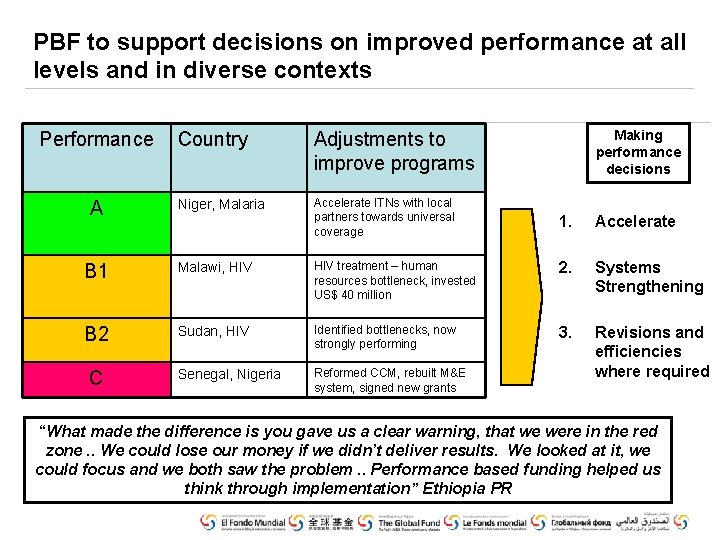
PBF to support decisions on improved performance at all levels and in diverse contexts Performance A Country Adjustments to improve programs Niger, Malaria Accelerate ITNs with local partners towards universal coverage Making performance decisions 1. Accelerate B 1 Malawi, HIV treatment – human resources bottleneck, invested US$ 40 million 2. Systems Strengthening B 2 Sudan, HIV Identified bottlenecks, now strongly performing 3. Senegal, Nigeria Reformed CCM, rebuilt M&E system, signed new grants Revisions and efficiencies where required C “What made the difference is you gave us a clear warning, that we were in the red zone. . We could lose our money if we didn’t deliver results. We looked at it, we could focus and we both saw the problem. . Performance based funding helped us think through implementation” Ethiopia PR
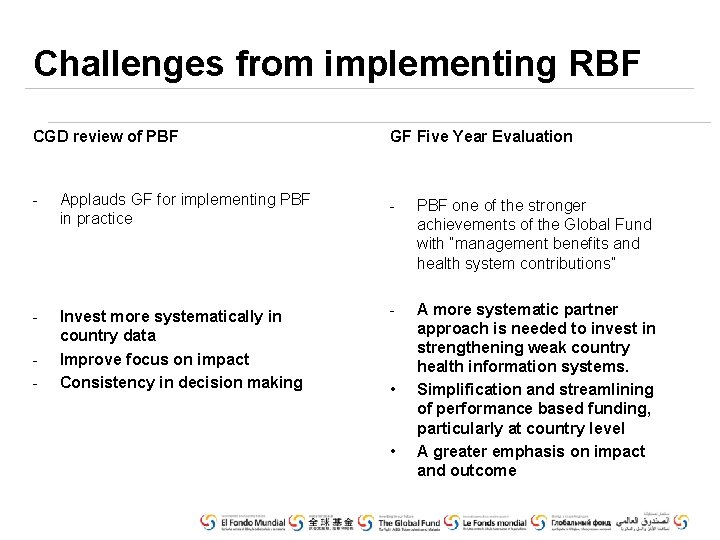
Challenges from implementing RBF CGD review of PBF GF Five Year Evaluation - Applauds GF for implementing PBF in practice - PBF one of the stronger achievements of the Global Fund with “management benefits and health system contributions” - Invest more systematically in country data Improve focus on impact Consistency in decision making - A more systematic partner approach is needed to invest in strengthening weak country health information systems. Simplification and streamlining of performance based funding, particularly at country level A greater emphasis on impact and outcome - • •
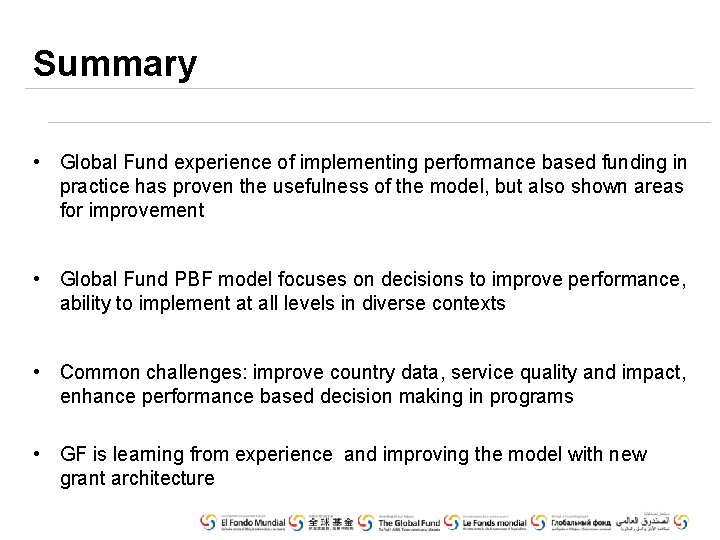
Summary • Global Fund experience of implementing performance based funding in practice has proven the usefulness of the model, but also shown areas for improvement • Global Fund PBF model focuses on decisions to improve performance, ability to implement at all levels in diverse contexts • Common challenges: improve country data, service quality and impact, enhance performance based decision making in programs • GF is learning from experience and improving the model with new grant architecture
- Slides: 8