
Performance Assessment for California Teachers PACT Stanford University
- Slides: 33
Performance Assessment for California Teachers PACT Stanford University - CFLP STARTALK Teacher Program July 25 - July 29, 2011 Helene Chan San Jose State University
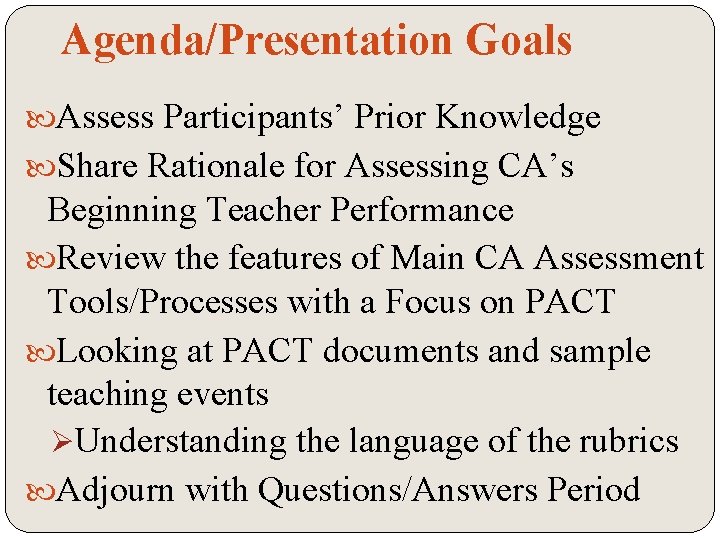
Agenda/Presentation Goals Assess Participants’ Prior Knowledge Share Rationale for Assessing CA’s Beginning Teacher Performance Review the features of Main CA Assessment Tools/Processes with a Focus on PACT Looking at PACT documents and sample teaching events ØUnderstanding the language of the rubrics Adjourn with Questions/Answers Period
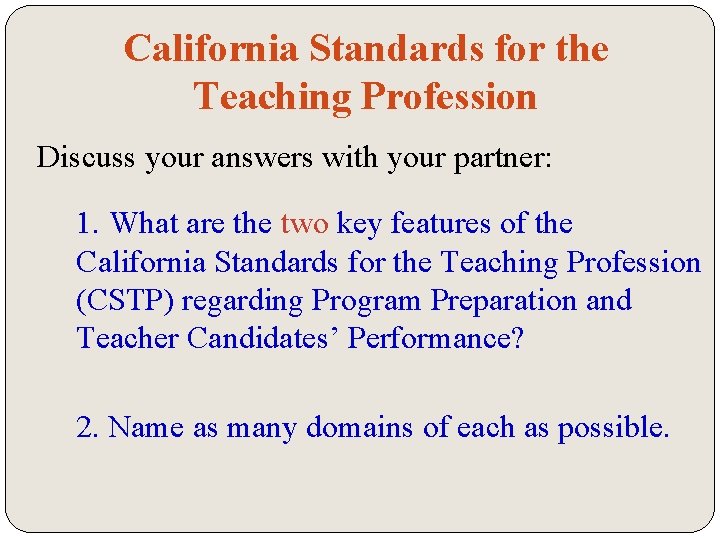
California Standards for the Teaching Profession Discuss your answers with your partner: 1. What are the two key features of the California Standards for the Teaching Profession (CSTP) regarding Program Preparation and Teacher Candidates’ Performance? 2. Name as many domains of each as possible.
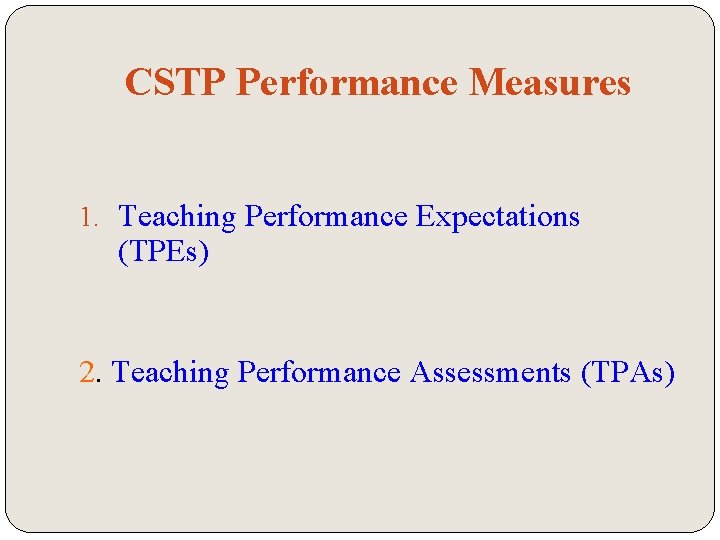
CSTP Performance Measures 1. Teaching Performance Expectations (TPEs) 2. Teaching Performance Assessments (TPAs)
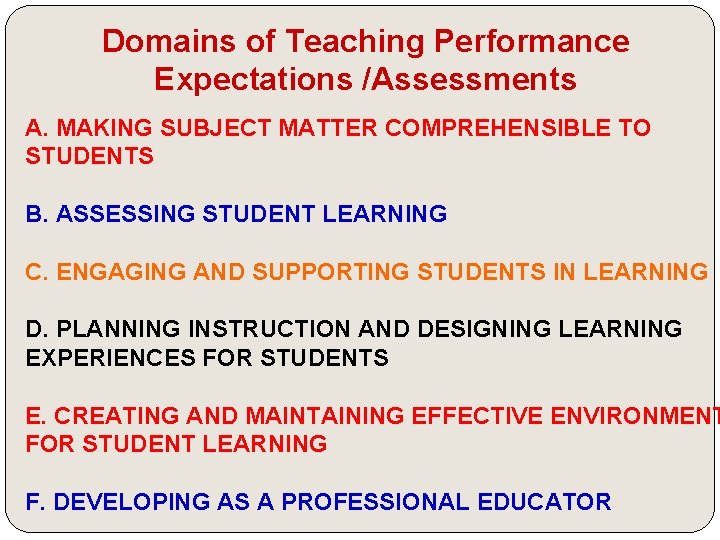
Domains of Teaching Performance Expectations /Assessments A. MAKING SUBJECT MATTER COMPREHENSIBLE TO STUDENTS B. ASSESSING STUDENT LEARNING C. ENGAGING AND SUPPORTING STUDENTS IN LEARNING D. PLANNING INSTRUCTION AND DESIGNING LEARNING EXPERIENCES FOR STUDENTS E. CREATING AND MAINTAINING EFFECTIVE ENVIRONMENT FOR STUDENT LEARNING F. DEVELOPING AS A PROFESSIONAL EDUCATOR
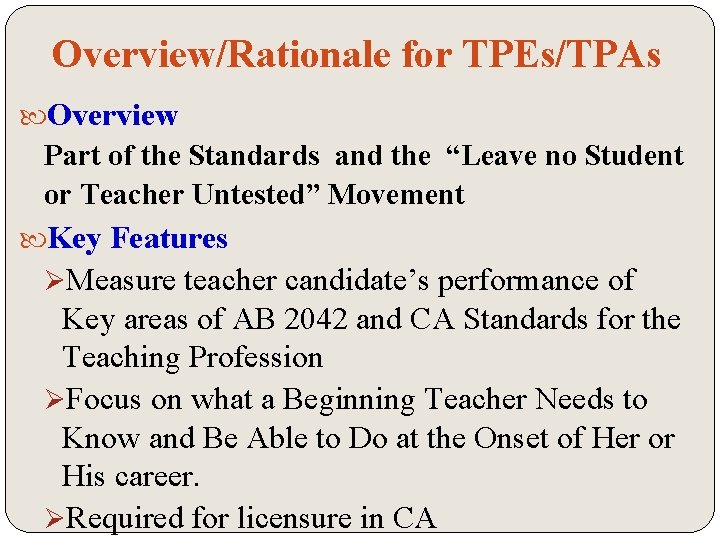
Overview/Rationale for TPEs/TPAs Overview Part of the Standards and the “Leave no Student or Teacher Untested” Movement Key Features ØMeasure teacher candidate’s performance of Key areas of AB 2042 and CA Standards for the Teaching Profession ØFocus on what a Beginning Teacher Needs to Know and Be Able to Do at the Onset of Her or His career. ØRequired for licensure in CA
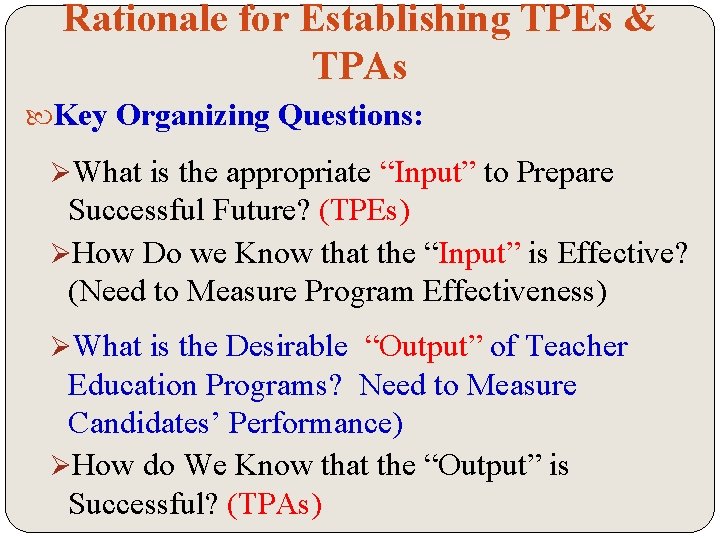
Rationale for Establishing TPEs & TPAs Key Organizing Questions: ØWhat is the appropriate “Input” to Prepare Successful Future? (TPEs) ØHow Do we Know that the “Input” is Effective? (Need to Measure Program Effectiveness) ØWhat is the Desirable “Output” of Teacher Education Programs? Need to Measure Candidates’ Performance) ØHow do We Know that the “Output” is Successful? (TPAs)
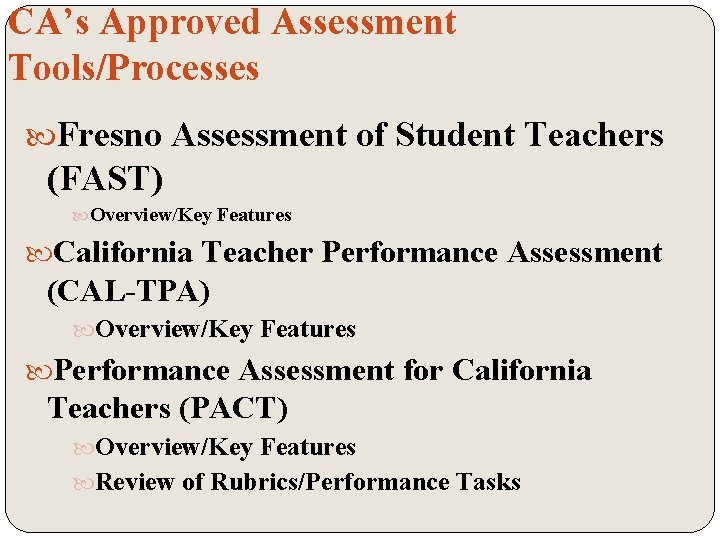
CA’s Approved Assessment Tools/Processes Fresno Assessment of Student Teachers (FAST) Overview/Key Features California Teacher Performance Assessment (CAL-TPA) Overview/Key Features Performance Assessment for California Teachers (PACT) Overview/Key Features Review of Rubrics/Performance Tasks
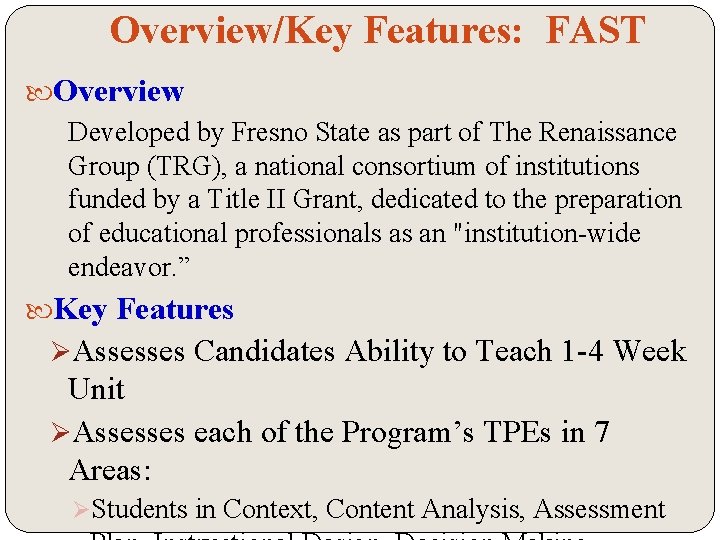
Overview/Key Features: FAST Overview Developed by Fresno State as part of The Renaissance Group (TRG), a national consortium of institutions funded by a Title II Grant, dedicated to the preparation of educational professionals as an "institution-wide endeavor. ” Key Features ØAssesses Candidates Ability to Teach 1 -4 Week Unit ØAssesses each of the Program’s TPEs in 7 Areas: ØStudents in Context, Content Analysis, Assessment
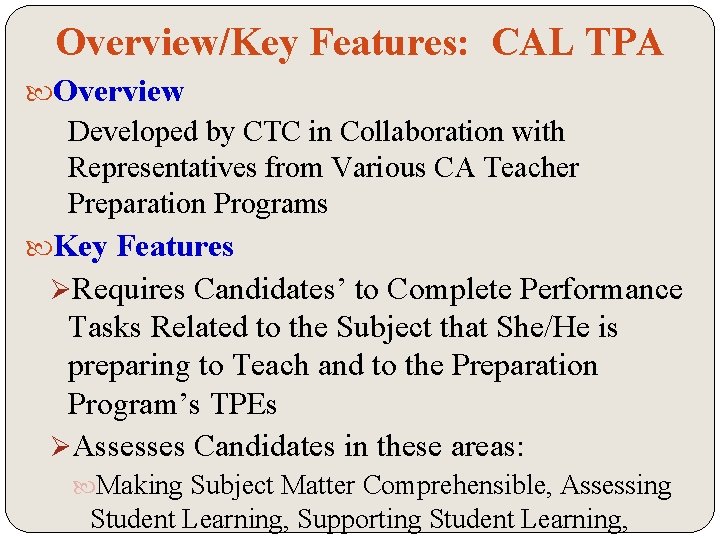
Overview/Key Features: CAL TPA Overview Developed by CTC in Collaboration with Representatives from Various CA Teacher Preparation Programs Key Features ØRequires Candidates’ to Complete Performance Tasks Related to the Subject that She/He is preparing to Teach and to the Preparation Program’s TPEs ØAssesses Candidates in these areas: Making Subject Matter Comprehensible, Assessing Student Learning, Supporting Student Learning,
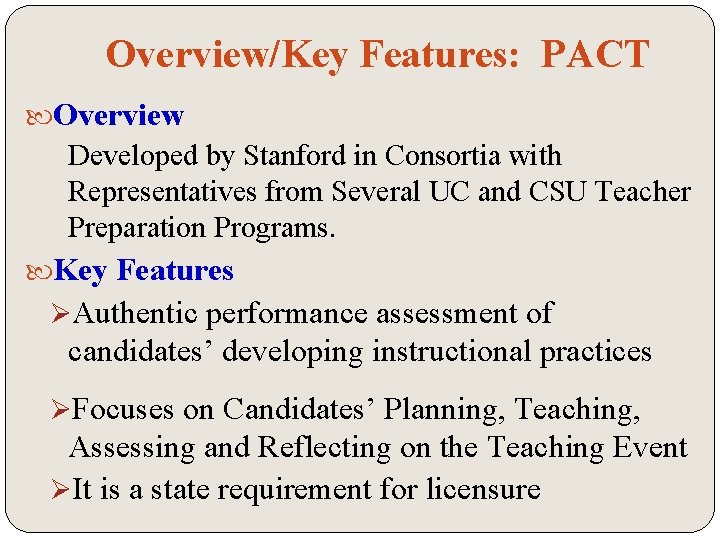
Overview/Key Features: PACT Overview Developed by Stanford in Consortia with Representatives from Several UC and CSU Teacher Preparation Programs. Key Features ØAuthentic performance assessment of candidates’ developing instructional practices ØFocuses on Candidates’ Planning, Teaching, Assessing and Reflecting on the Teaching Event ØIt is a state requirement for licensure
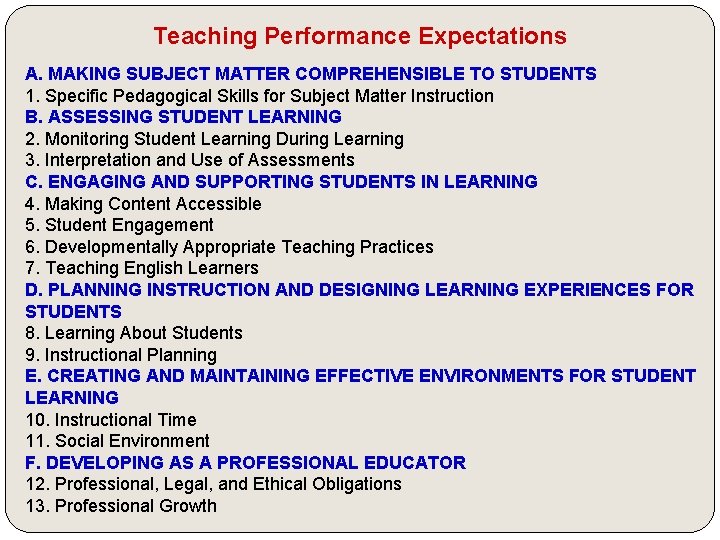
Teaching Performance Expectations A. MAKING SUBJECT MATTER COMPREHENSIBLE TO STUDENTS 1. Specific Pedagogical Skills for Subject Matter Instruction B. ASSESSING STUDENT LEARNING 2. Monitoring Student Learning During Learning 3. Interpretation and Use of Assessments C. ENGAGING AND SUPPORTING STUDENTS IN LEARNING 4. Making Content Accessible 5. Student Engagement 6. Developmentally Appropriate Teaching Practices 7. Teaching English Learners D. PLANNING INSTRUCTION AND DESIGNING LEARNING EXPERIENCES FOR STUDENTS 8. Learning About Students 9. Instructional Planning E. CREATING AND MAINTAINING EFFECTIVE ENVIRONMENTS FOR STUDENT LEARNING 10. Instructional Time 11. Social Environment F. DEVELOPING AS A PROFESSIONAL EDUCATOR 12. Professional, Legal, and Ethical Obligations 13. Professional Growth
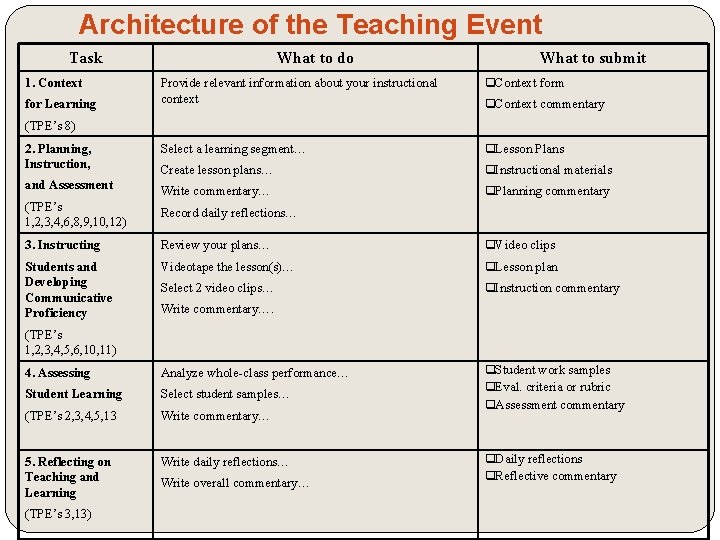
Architecture of the Teaching Event Task 1. Context What to do What to submit Provide relevant information about your instructional context q. Context form 2. Planning, Instruction, Select a learning segment… q. Lesson Plans Create lesson plans… q. Instructional materials and Assessment Write commentary… q. Planning commentary (TPE’s 1, 2, 3, 4, 6, 8, 9, 10, 12) Record daily reflections… 3. Instructing Review your plans… q. Video clips Students and Developing Communicative Proficiency Videotape the lesson(s)… q. Lesson plan Select 2 video clips… q. Instruction commentary for Learning q. Context commentary (TPE’s 8) Write commentary…. (TPE’s 1, 2, 3, 4, 5, 6, 10, 11) 4. Assessing Analyze whole-class performance… Student Learning Select student samples… (TPE’s 2, 3, 4, 5, 13 Write commentary… 5. Reflecting on Teaching and Learning Write daily reflections… (TPE’s 3, 13) Write overall commentary… q. Student work samples q. Eval. criteria or rubric q. Assessment commentary q. Daily reflections q. Reflective commentary
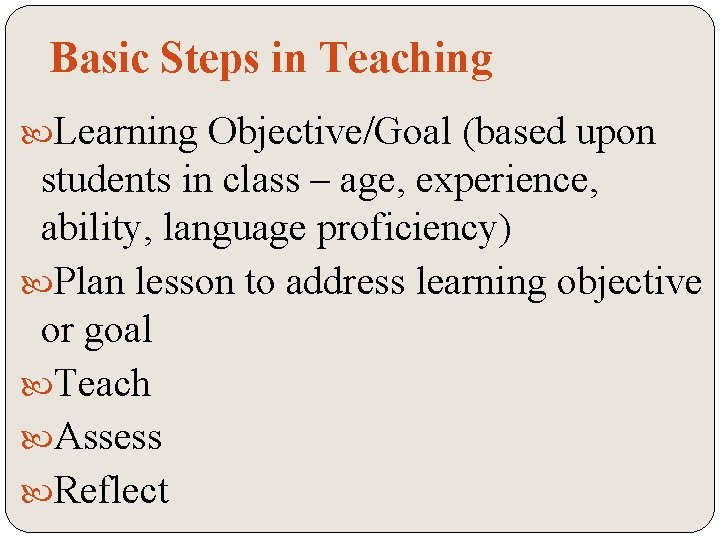
Basic Steps in Teaching Learning Objective/Goal (based upon students in class – age, experience, ability, language proficiency) Plan lesson to address learning objective or goal Teach Assess Reflect
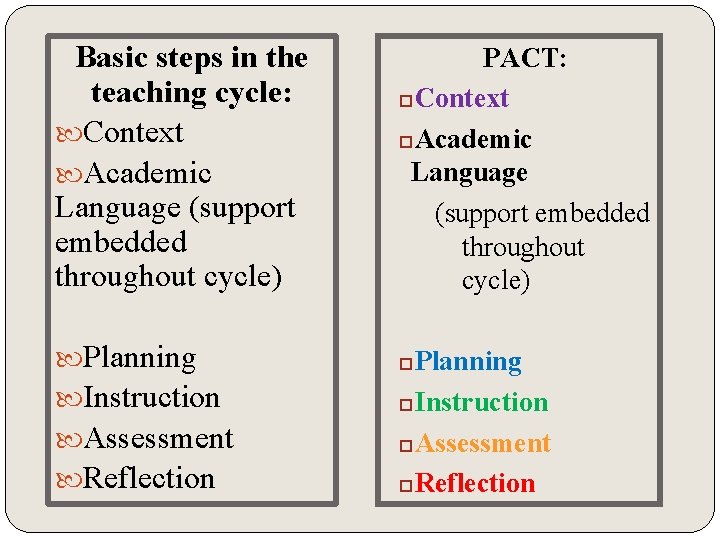
Basic steps in the teaching cycle: Context Academic Language (support embedded throughout cycle) Planning Instruction Assessment Reflection PACT: Context Academic Language (support embedded throughout cycle) Planning Instruction Assessment Reflection
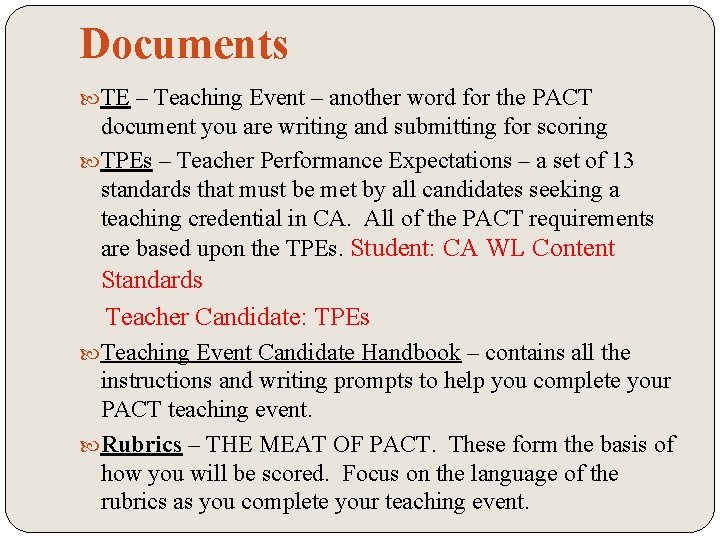
Documents TE – Teaching Event – another word for the PACT document you are writing and submitting for scoring TPEs – Teacher Performance Expectations – a set of 13 standards that must be met by all candidates seeking a teaching credential in CA. All of the PACT requirements are based upon the TPEs. Student: CA WL Content Standards Teacher Candidate: TPEs Teaching Event Candidate Handbook – contains all the instructions and writing prompts to help you complete your PACT teaching event. Rubrics – THE MEAT OF PACT. These form the basis of how you will be scored. Focus on the language of the rubrics as you complete your teaching event.
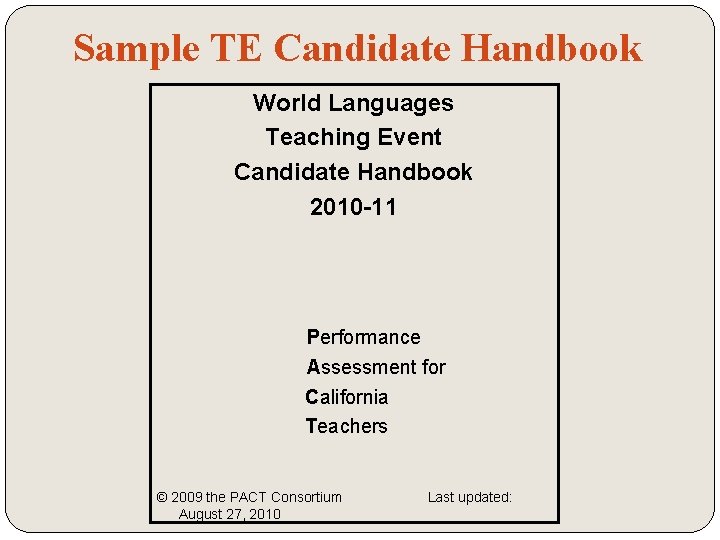
Sample TE Candidate Handbook World Languages Teaching Event Candidate Handbook 2010 -11 Performance Assessment for California Teachers © 2009 the PACT Consortium August 27, 2010 Last updated:
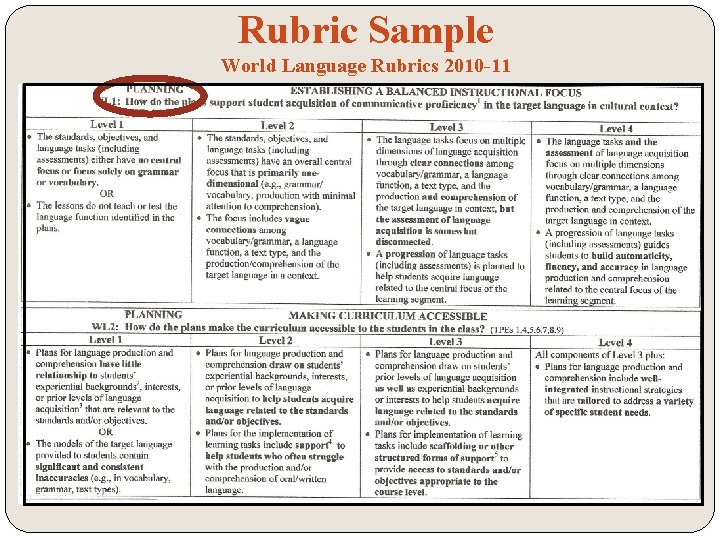
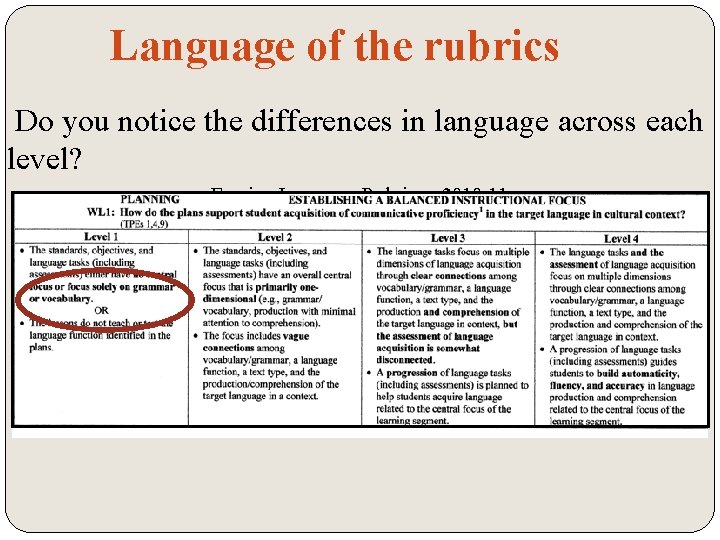
Rubric Sample World Language Rubrics 2010 -11
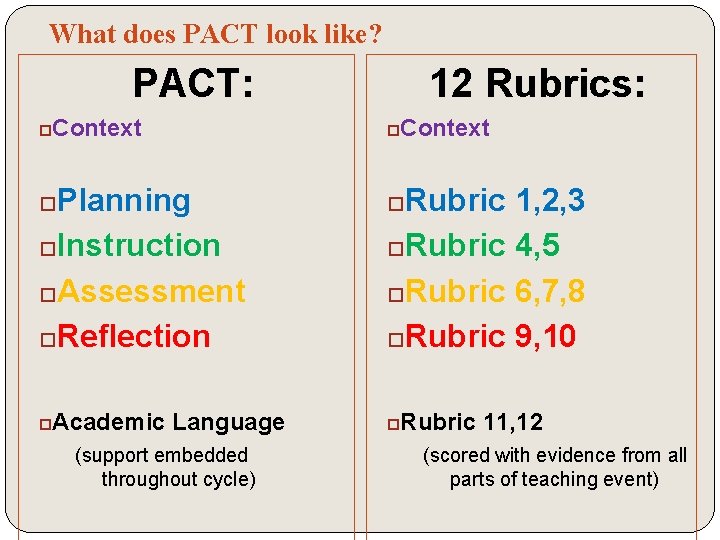
What does PACT look like? PACT: Context Planning Instruction Assessment Reflection Academic Language (support embedded throughout cycle) 12 Rubrics: Context Rubric 1, 2, 3 Rubric 4, 5 Rubric 6, 7, 8 Rubric 9, 10 Rubric 11, 12 (scored with evidence from all parts of teaching event)
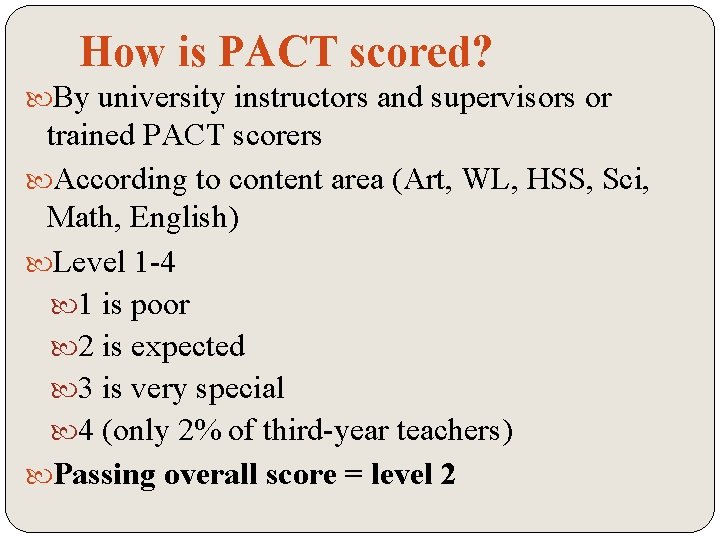
How is PACT scored? By university instructors and supervisors or trained PACT scorers According to content area (Art, WL, HSS, Sci, Math, English) Level 1 -4 1 is poor 2 is expected 3 is very special 4 (only 2% of third-year teachers) Passing overall score = level 2
Language of the rubrics Do you notice the differences in language across each level? Foreign Language Rubric 2010 -11
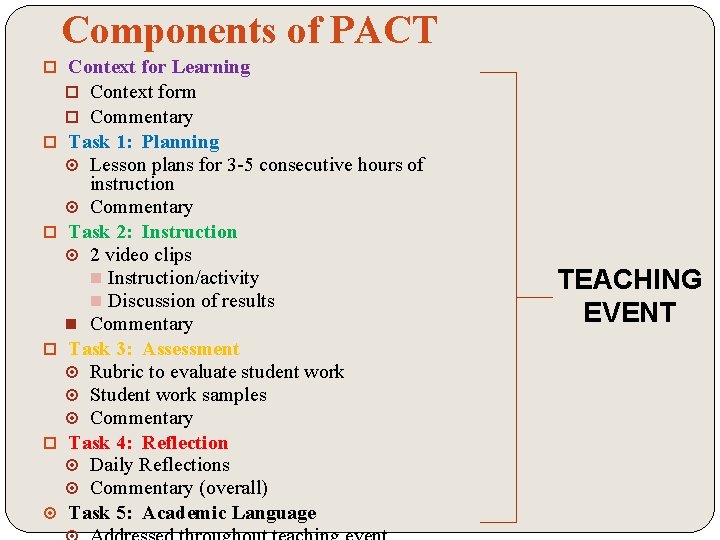
Components of PACT Context for Learning Context form Commentary Task 1: Planning Lesson plans for 3 -5 consecutive hours of instruction Commentary Task 2: Instruction 2 video clips Instruction/activity Discussion of results Commentary Task 3: Assessment Rubric to evaluate student work Student work samples Commentary Task 4: Reflection Daily Reflections Commentary (overall) Task 5: Academic Language TEACHING EVENT
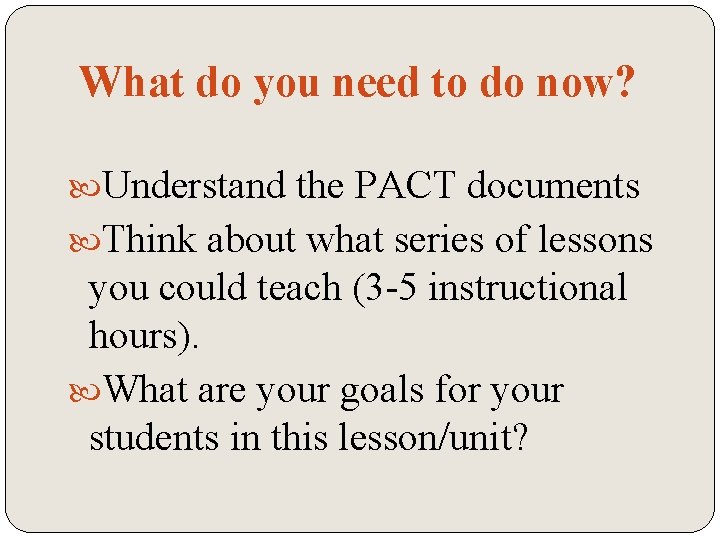
What do you need to do now? Understand the PACT documents Think about what series of lessons you could teach (3 -5 instructional hours). What are your goals for your students in this lesson/unit?
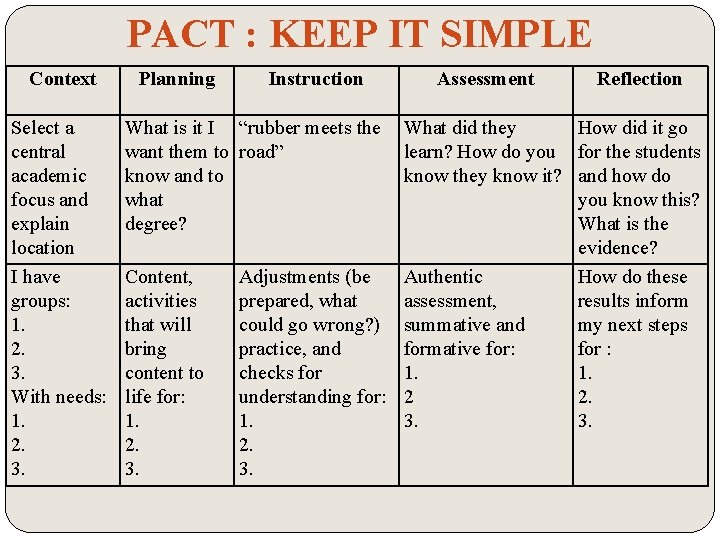
PACT : KEEP IT SIMPLE Context Select a central academic focus and explain location I have groups: 1. 2. 3. With needs: 1. 2. 3. Planning Instruction What is it I “rubber meets the want them to road” know and to what degree? Content, activities that will bring content to life for: 1. 2. 3. Assessment Reflection What did they How did it go learn? How do you for the students know they know it? and how do you know this? What is the evidence? Adjustments (be Authentic How do these prepared, what assessment, results inform could go wrong? ) summative and my next steps practice, and formative for: for : checks for 1. 1. understanding for: 2 2. 1. 3. 3. 2. 3.
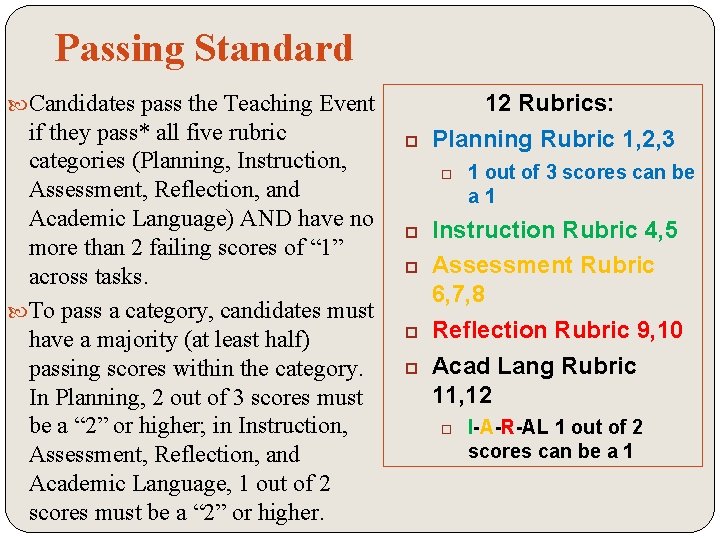
Passing Standard Candidates pass the Teaching Event if they pass* all five rubric categories (Planning, Instruction, Assessment, Reflection, and Academic Language) AND have no more than 2 failing scores of “ 1” across tasks. To pass a category, candidates must have a majority (at least half) passing scores within the category. In Planning, 2 out of 3 scores must be a “ 2” or higher; in Instruction, Assessment, Reflection, and Academic Language, 1 out of 2 scores must be a “ 2” or higher. 12 Rubrics: Planning Rubric 1, 2, 3 1 out of 3 scores can be a 1 Instruction Rubric 4, 5 Assessment Rubric 6, 7, 8 Reflection Rubric 9, 10 Acad Lang Rubric 11, 12 I-A-R-AL 1 out of 2 scores can be a 1
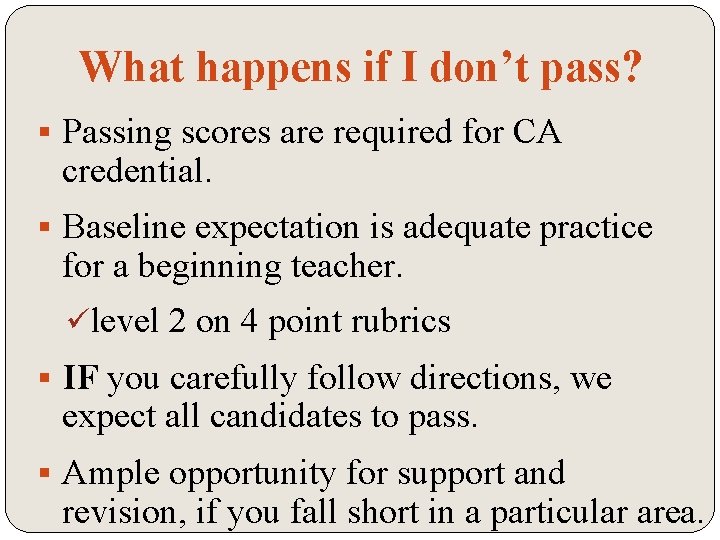
What happens if I don’t pass? § Passing scores are required for CA credential. § Baseline expectation is adequate practice for a beginning teacher. ülevel 2 on 4 point rubrics § IF you carefully follow directions, we expect all candidates to pass. § Ample opportunity for support and revision, if you fall short in a particular area.
Role of the University Methods Instructor Plan course syllabi that reflects both TPEs and TPAs (UBD) Model each of the domains of the TPA during the course Plan Candidate assignments which provide practice in addressing each of the domains Focus course assessments on Candidates’ Performance--Employ the
Role of the University Supervisor With the Teaching Performance Expectations and the Student Teacher Final Evaluation in mind, ensure that the candidate has opportunities for appropriate experiences in the classroom. Confer regularly with the student teacher and cooperating teacher. Observe the student teacher in the
Role of the University Supervisor Provide student teacher with periodic guidance, help and constructive criticism. Review unit and lesson plans with the student teacher. Confer with the cooperating teacher about the student teacher’s progress Write a summative evaluation of the student teacher’s performance.
Role of the Cooperating Teacher Provide the student teacher an orientation to the class. Introduce the student teacher to the class (context) and explain that the student teacher will serve as a teacher Explain class goals and basic routines. Provide the student teacher with a curriculum syllabus, textbook, and other such material needed to get started
Role of the Cooperating Teacher Help student teacher identify the special learning needs of students. Confer with the student teacher to plan the scope and schedule of the student teacher’s responsibilities. Use the Teaching Performance Expectations and the Student Teacher Evaluation as guidelines for planning appropriate experiences throughout the semester Review lesson and unit plans with the
Role of the Cooperating Teacher Observe the student teacher, confer regularly to provide guidance, help, and feedback. Communicate regularly with the university supervisor about the student teacher’s progress. Provide the university supervisor with a final evaluation of the student teachers’
Questions/Comments/Reflections Participants’ Reflections: TPEs/TPAs Assessment Tools/Processes Personal Experiences in Supporting Candidates Other Comments/Reflections