
Performance Appraisal Study Unit 7 INTRODUCTION Appraisal done

- Slides: 24
Performance Appraisal Study Unit 7
INTRODUCTION Appraisal done individually or as work team: • Individually appraisal: – Single employee’s performance – Measure against pre-determined standards • Team appraisal – More complex due to multidimensional nature of teams 5/22/2021
… INTRODUCTION Informal Appraisals: • Observation, memory, hearsay, intuition, private networks • Social context & org politics influence appraisal Formal Appraisals: • Rational, more accurate, fair & useful to all 5/22/2021
… INTRODUCTION Difference between performance and effectiveness: • Performance: – What the worker actually does – Can be observed – Includes those actions that are relevant to the organisation’s goals, and – Can be measured in terms of each individual’s proficiency (level of contribution) • Effectiveness: – The evaluation of the results of performance – Is “beyond” the influence or control of the individual (E. g. the number of promotions an individual (has) received over the past three years) 5/22/2021
… INTRODUCTION Appraisals of employees should be based on performance (rather than effectiveness) Def of Performance Appraisal: • The evaluation of an individual’s work performance in order to arrive at objective personnel decisions. • THUS: Does not appraise the employee…rather the performance Using personal judgments (subjective) involves interpretation/discernment of the situation • Almost always part of appraisal process!! 5/22/2021
… INTRODUCTION Appraisals can help the org: • Enhances the quality of organisational decisions, ranging from pay raises to promotions to discharges • The quality of individual decisions, ranging from career choices to the development of future strengths, can be enhanced • It can affect the employee’s views of and attachment to his/her organisation • It provides a rational, legally defensible basis for personnel decisions 5/22/2021
… INTRODUCTION Employer reasons for appraisal: • Individual differences in performance makes a difference • Documentation & feedback on appraisal needed for legal defence • Provides a rational basis for constructing a bonus/merit system • Operationalise strategic goals & clarify performance expectations – Can include teamwork & can appraise teams 5/22/2021
… INTRODUCTION Employee reasons for appraisal: • Performance feedback is needed & desired • Performance improvement necessitates assessment • Fairness = differences in performance can be measured and has an impact on the outcomes • Assessment & recognition motivates improved performance 5/22/2021
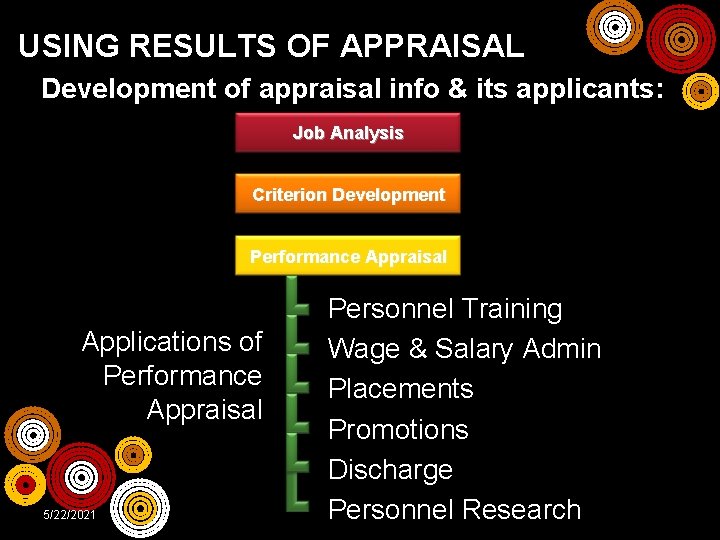
USING RESULTS OF APPRAISAL Development of appraisal info & its applicants: Job Analysis Criterion Development Performance Appraisal Applications of Performance Appraisal 5/22/2021 Personnel Training Wage & Salary Admin Placements Promotions Discharge Personnel Research
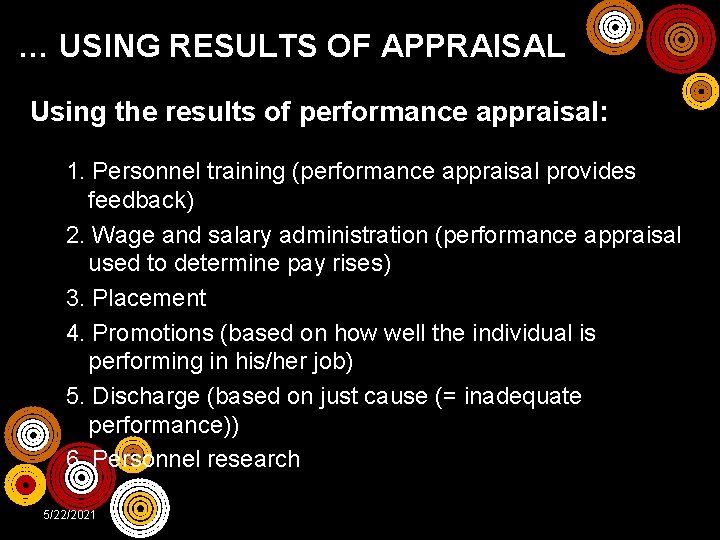
… USING RESULTS OF APPRAISAL Using the results of performance appraisal: 1. Personnel training (performance appraisal provides feedback) 2. Wage and salary administration (performance appraisal used to determine pay rises) 3. Placement 4. Promotions (based on how well the individual is performing in his/her job) 5. Discharge (based on just cause (= inadequate performance)) 6. Personnel research 5/22/2021
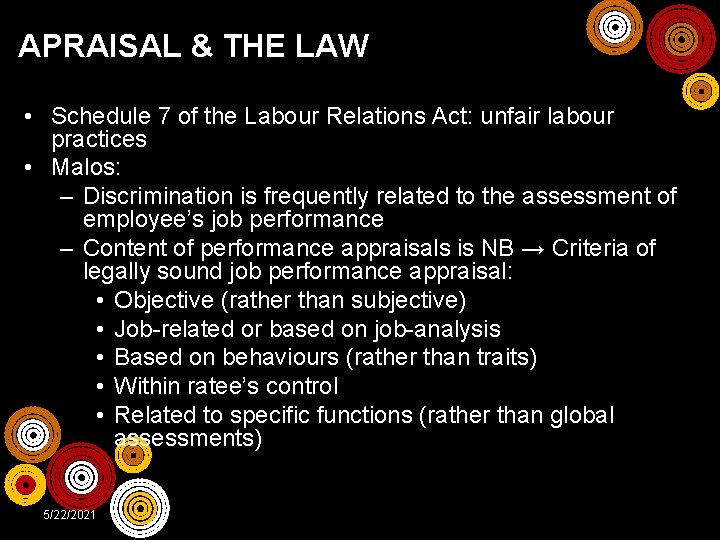
APRAISAL & THE LAW • Schedule 7 of the Labour Relations Act: unfair labour practices • Malos: – Discrimination is frequently related to the assessment of employee’s job performance – Content of performance appraisals is NB → Criteria of legally sound job performance appraisal: • Objective (rather than subjective) • Job-related or based on job-analysis • Based on behaviours (rather than traits) • Within ratee’s control • Related to specific functions (rather than global assessments) 5/22/2021
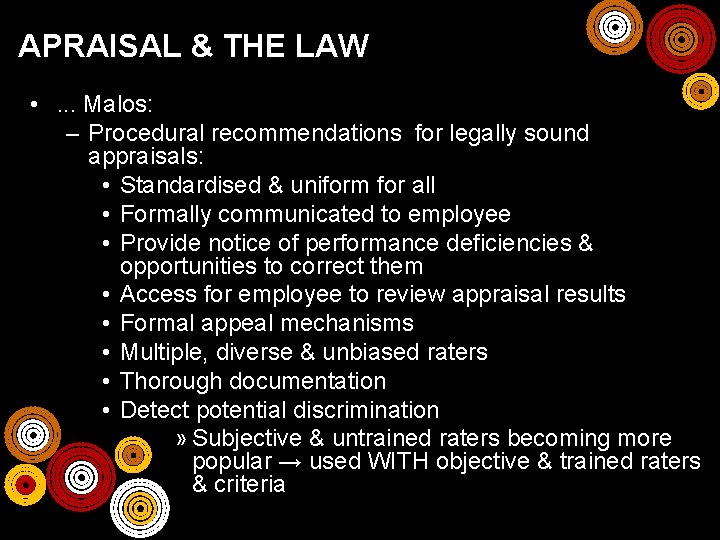
APRAISAL & THE LAW • . . . Malos: – Procedural recommendations for legally sound appraisals: • Standardised & uniform for all • Formally communicated to employee • Provide notice of performance deficiencies & opportunities to correct them • Access for employee to review appraisal results • Formal appeal mechanisms • Multiple, diverse & unbiased raters • Thorough documentation • Detect potential discrimination » Subjective & untrained raters becoming more popular → used WITH objective & trained raters & criteria
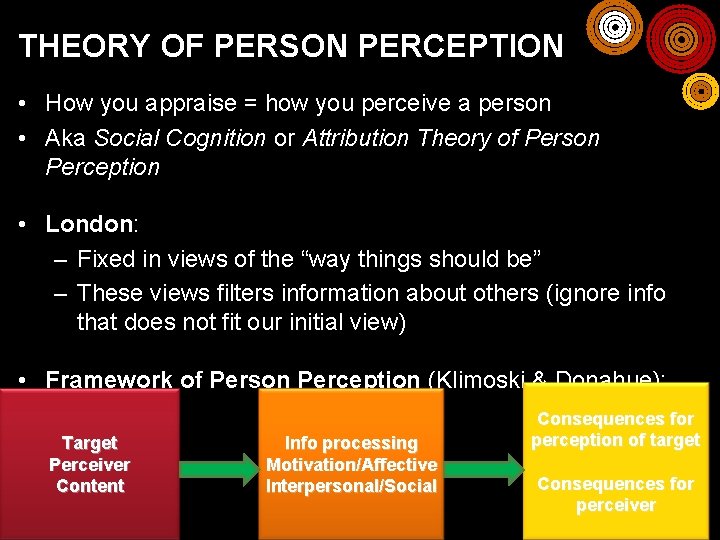
THEORY OF PERSON PERCEPTION • How you appraise = how you perceive a person • Aka Social Cognition or Attribution Theory of Person Perception • London: – Fixed in views of the “way things should be” – These views filters information about others (ignore info that does not fit our initial view) • Framework of Person Perception (Klimoski & Donahue): Target Perceiver Content Info processing Motivation/Affective Interpersonal/Social Consequences for perception of target Consequences for perceiver
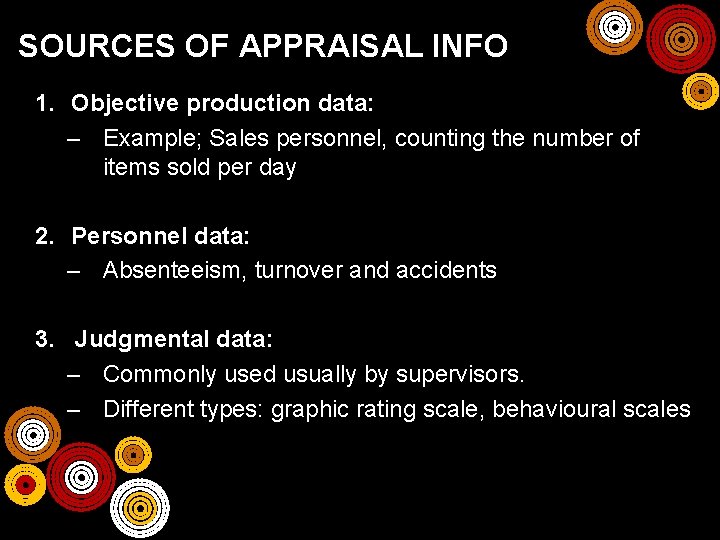
SOURCES OF APPRAISAL INFO 1. Objective production data: – Example; Sales personnel, counting the number of items sold per day 2. Personnel data: – Absenteeism, turnover and accidents 3. Judgmental data: – Commonly used usually by supervisors. – Different types: graphic rating scale, behavioural scales
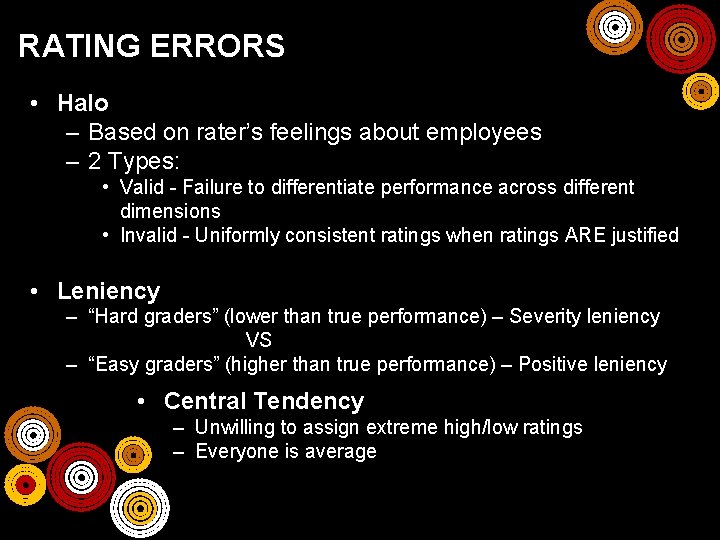
RATING ERRORS • Halo – Based on rater’s feelings about employees – 2 Types: • Valid - Failure to differentiate performance across different dimensions • Invalid - Uniformly consistent ratings when ratings ARE justified • Leniency – “Hard graders” (lower than true performance) – Severity leniency VS – “Easy graders” (higher than true performance) – Positive leniency • Central Tendency – Unwilling to assign extreme high/low ratings – Everyone is average
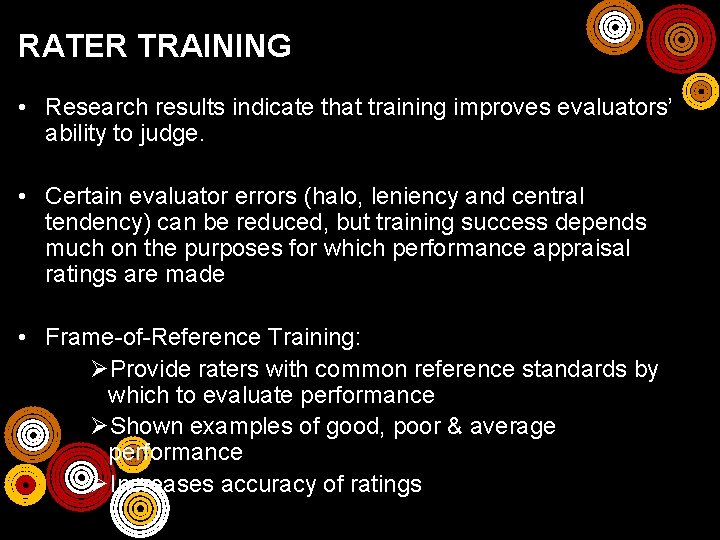
RATER TRAINING • Research results indicate that training improves evaluators’ ability to judge. • Certain evaluator errors (halo, leniency and central tendency) can be reduced, but training success depends much on the purposes for which performance appraisal ratings are made • Frame-of-Reference Training: ØProvide raters with common reference standards by which to evaluate performance ØShown examples of good, poor & average performance ØIncreases accuracy of ratings
RATER MOTIVATION • Reasons for not being motivated are: – No rewards from the organisation for accurate appraisals and few, if any, sanctions for inaccurate appraisals. – Motivated to obtain valued rewards for their subordinates, such as promotions and salary increases. – Raters are motivated to give inflated ratings because the ratings received by subordinates are a reflection of the rater’s (own) job performance. – They tend to inflate their ratings because they wish to avoid the negative reactions that accompany low ratings.
CONTEXTUAL PERFORMANCE • Organisational citizenship / Extra-Role perfromance • Examples: – Persist with enthusiasm & extra effort – Volunteer for activities not related to own job description – Helping & cooperating with others – Endorsing, supporting & defending org objectives • Appraisals should include contextual factors also • Need to assess employees’ contributions to org welfare
SELF- & PEER APPRAISAL • Self-Assessments: – Appraise own performance – Mostly have higher opinions about own performance than others – Less positive leniency when used to getting frequent feedback from supervisors – Fewer halo errors present – recognise own strengths & weaknesses – Of greater value when used for development (rather than administrative purposes)
SELF- & PEER APPRAISAL • Peer Assessments: – Appraise your fellows – 3 Techniques: • Peer nomination – Nominate those group members high on • • specific dimension Peer ratings – Each member rates all others according to a set of performance dimensions Peer ranking – Ranks others from best to worst on all dimensions – Usually high degree of inter-rater reliability
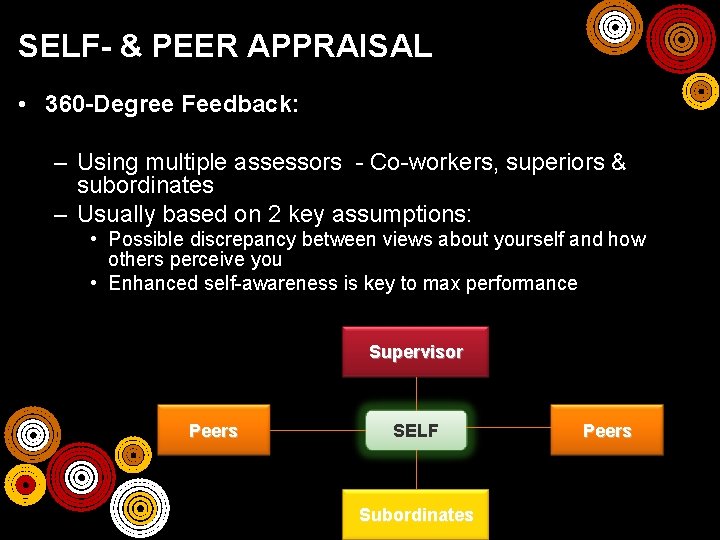
SELF- & PEER APPRAISAL • 360 -Degree Feedback: – Using multiple assessors - Co-workers, superiors & subordinates – Usually based on 2 key assumptions: • Possible discrepancy between views about yourself and how others perceive you • Enhanced self-awareness is key to max performance Supervisor Peers SELF Subordinates Peers
APPRAISAL FEEDBACK • The feedback interview typically has two main objectives: 1. To review major job responsibilities and to gauge how well the employees has met them. 2. For future planning, or to identify goals which the employee will try to meet before the next review (both employee and supervisor should be involved) • 2 Factors influencing feedback: 1. Credibility – Can my supervisor legitimately evaluate 2. performance? Power – Can my supervisor control valued rewards? • Feedback has two properties: 1. Information - Feedback can tell the employee how to perform better 2. Motivation - Increases his/her desire to perform well
… APPRAISAL FEEDBACK How can performance appraisal be conducted in a more “humane” way? (20) 1. Preparation 2. Evaluation of own performance by the employee (see CD) 3. Introductory discussion (warm up) 4. Study the job description 5. Gathering of information from the employee 6. Establish goals 7. Evaluate performance; not other personal characteristics 8. Effective listening skills. 9. Build on the person’s strengths 10. Provide continual feedback
QUESTIONS? ? ?