
Performance and Scalability Apriori Implementation Apriori R Agrawal
Performance and Scalability: Apriori Implementation
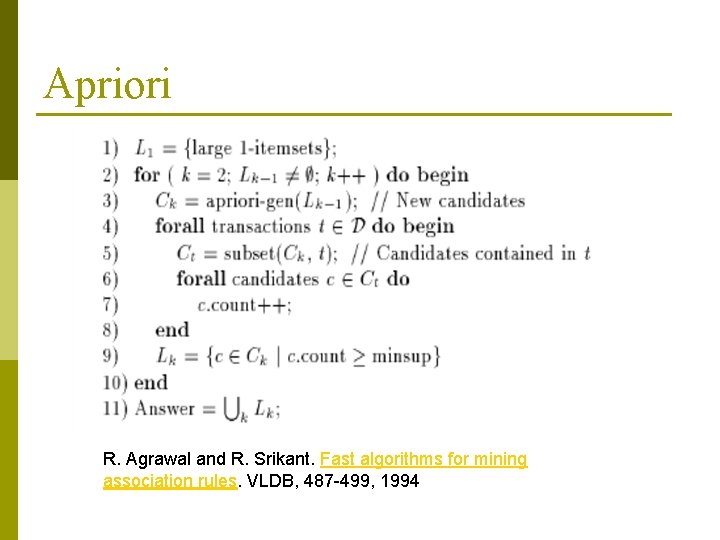
Apriori R. Agrawal and R. Srikant. Fast algorithms for mining association rules. VLDB, 487 -499, 1994
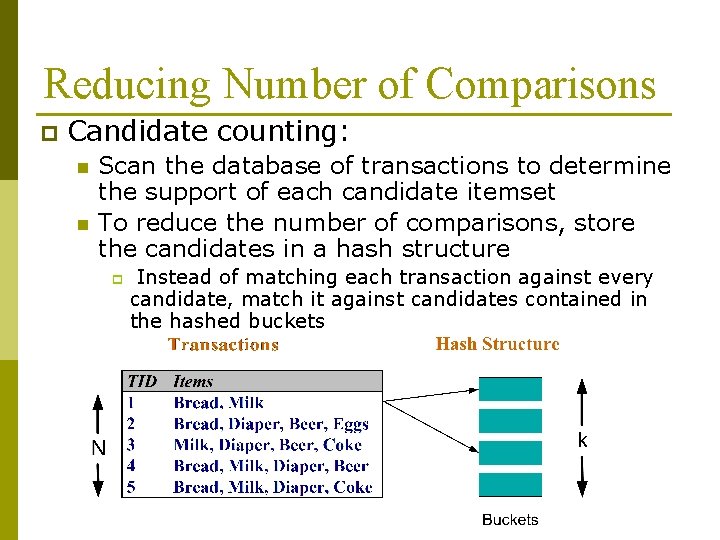
Reducing Number of Comparisons p Candidate counting: n n Scan the database of transactions to determine the support of each candidate itemset To reduce the number of comparisons, store the candidates in a hash structure p Instead of matching each transaction against every candidate, match it against candidates contained in the hashed buckets
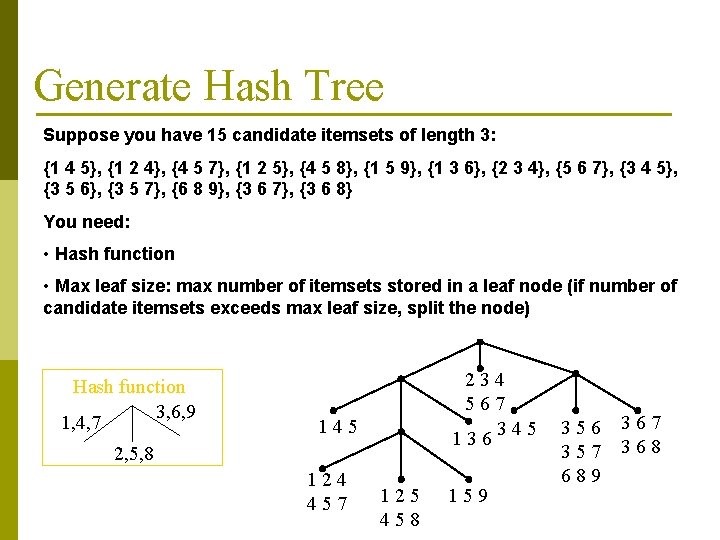
Generate Hash Tree Suppose you have 15 candidate itemsets of length 3: {1 4 5}, {1 2 4}, {4 5 7}, {1 2 5}, {4 5 8}, {1 5 9}, {1 3 6}, {2 3 4}, {5 6 7}, {3 4 5}, {3 5 6}, {3 5 7}, {6 8 9}, {3 6 7}, {3 6 8} You need: • Hash function • Max leaf size: max number of itemsets stored in a leaf node (if number of candidate itemsets exceeds max leaf size, split the node) Hash function 3, 6, 9 1, 4, 7 234 567 345 136 145 2, 5, 8 124 457 125 458 159 356 357 689 367 368

Association Rule Discovery: Hash tree Hash Function 1, 4, 7 Candidate Hash Tree 3, 6, 9 2, 5, 8 234 567 145 136 345 Hash on 1, 4 or 7 124 125 457 458 159 356 357 689 367 368
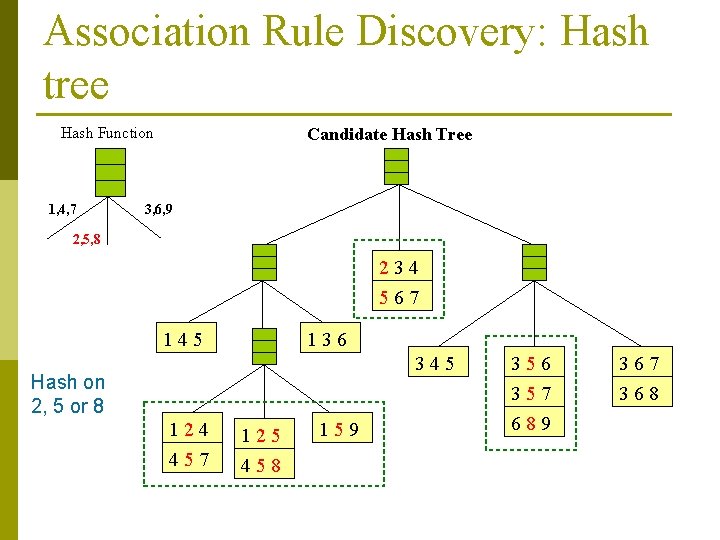
Association Rule Discovery: Hash tree Hash Function 1, 4, 7 Candidate Hash Tree 3, 6, 9 2, 5, 8 234 567 145 136 345 Hash on 2, 5 or 8 124 125 457 458 159 356 357 689 367 368
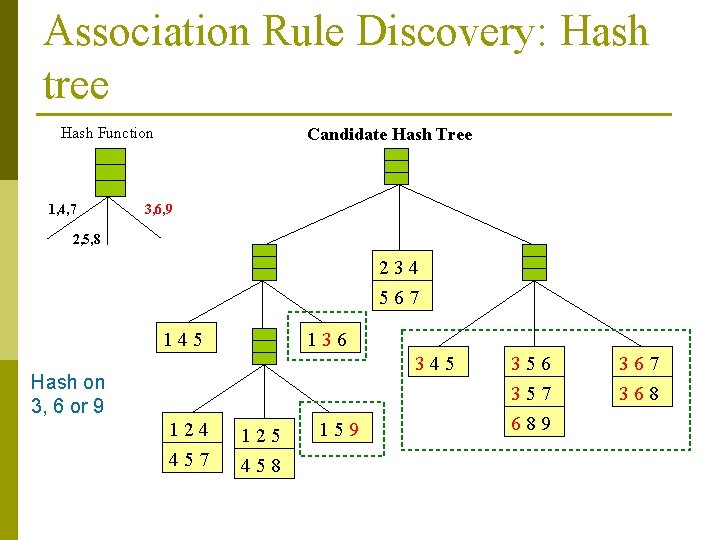
Association Rule Discovery: Hash tree Hash Function 1, 4, 7 Candidate Hash Tree 3, 6, 9 2, 5, 8 234 567 145 136 345 Hash on 3, 6 or 9 124 125 457 458 159 356 357 689 367 368
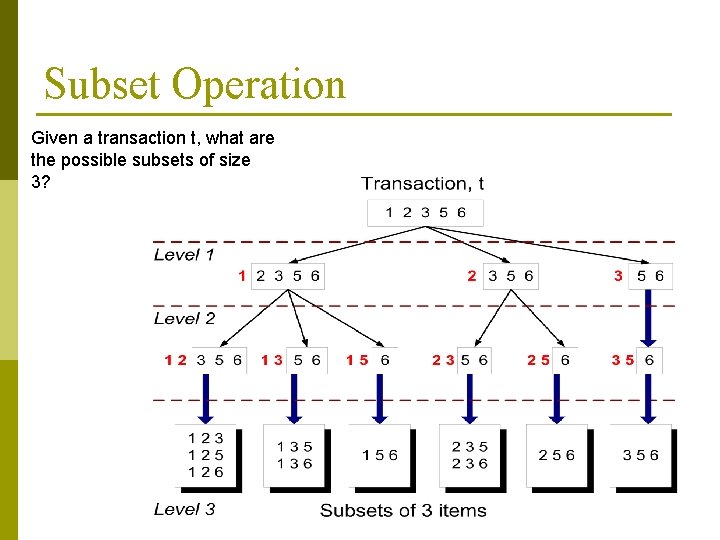
Subset Operation Given a transaction t, what are the possible subsets of size 3?
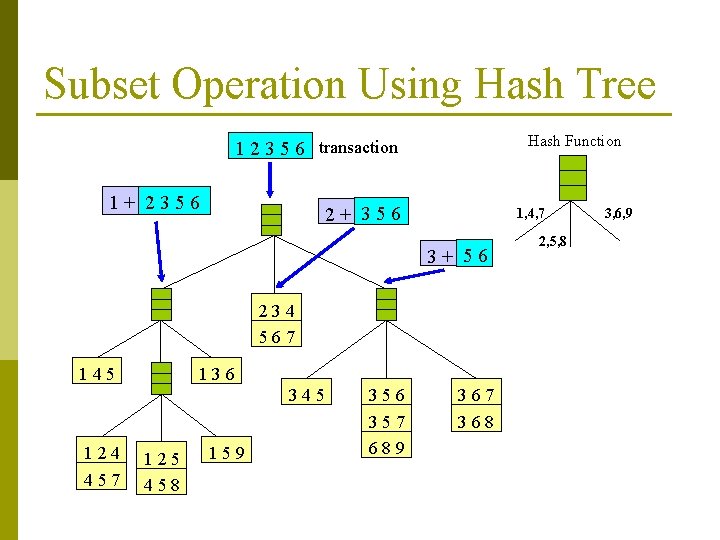
Subset Operation Using Hash Tree Hash Function 1 2 3 5 6 transaction 1+ 2356 2+ 356 1, 4, 7 3+ 56 234 567 145 136 345 124 457 125 458 159 356 357 689 367 368 2, 5, 8 3, 6, 9
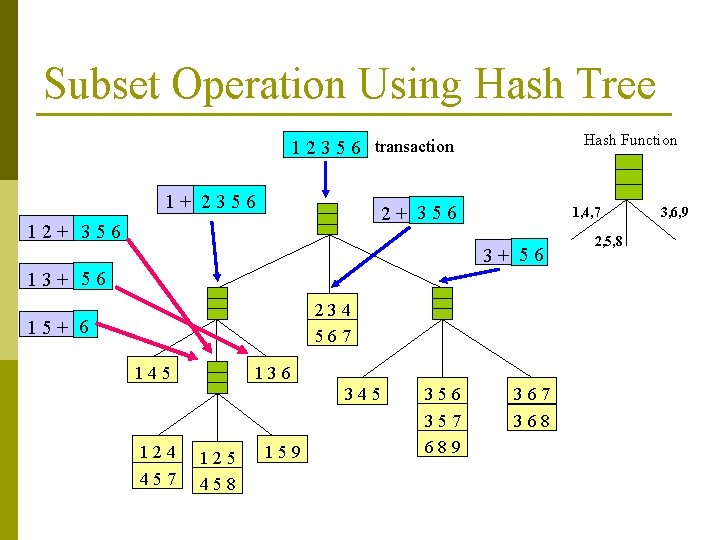
Subset Operation Using Hash Tree Hash Function 1 2 3 5 6 transaction 1+ 2356 2+ 356 1, 4, 7 3+ 56 13+ 56 234 567 15+ 6 145 136 345 124 457 125 458 159 356 357 689 367 368 2, 5, 8 3, 6, 9
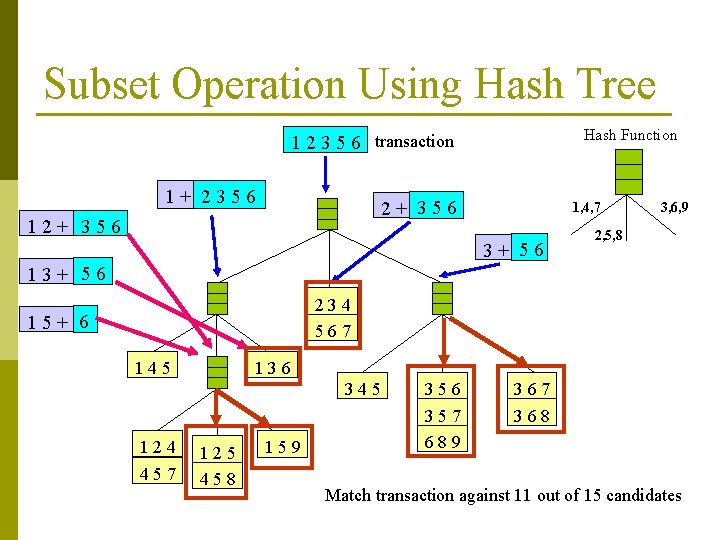
Subset Operation Using Hash Tree Hash Function 1 2 3 5 6 transaction 1+ 2356 2+ 356 1, 4, 7 3+ 56 3, 6, 9 2, 5, 8 13+ 56 234 567 15+ 6 145 136 345 124 457 125 458 159 356 357 689 367 368 Match transaction against 11 out of 15 candidates
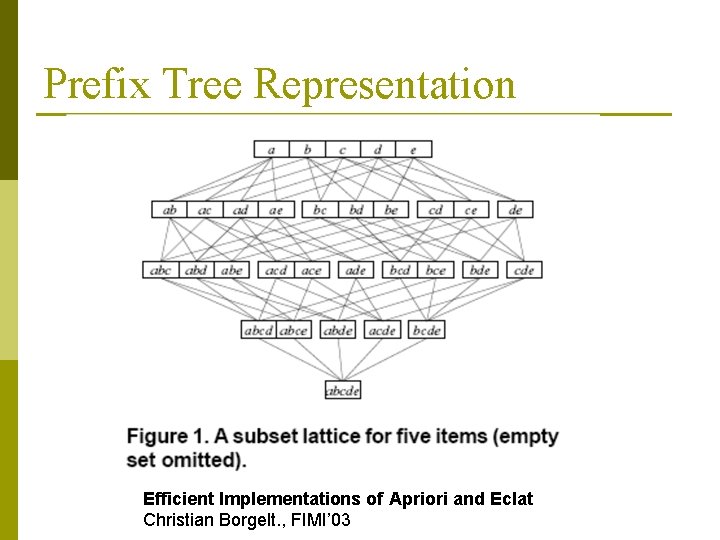
Prefix Tree Representation Efficient Implementations of Apriori and Eclat Christian Borgelt. , FIMI’ 03

Prefix Tree
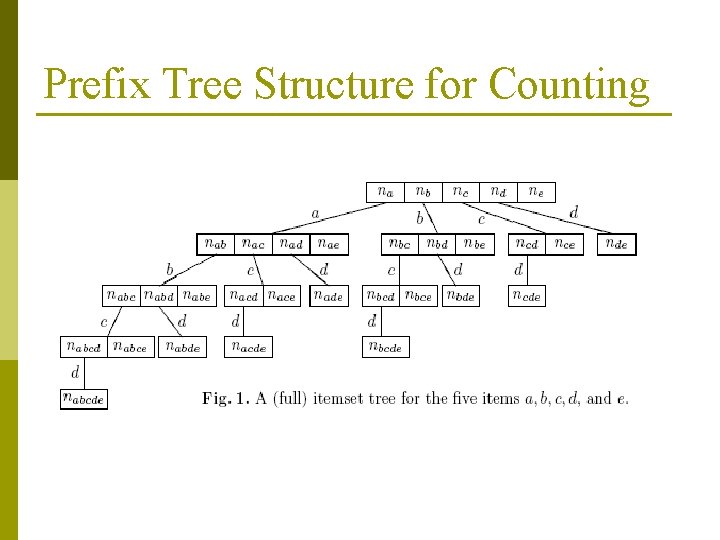
Prefix Tree Structure for Counting
Other key optimization p Recording the items n p Why is this relevant? Transaction Tree n n Organize transaction into trees Count through two trees
Important websites: p FIMI workshop n Not only Apriori and FIM p n p http: //fimi. cs. helsinki. fi/ Christian Borgelt’s website n p FP-tree, ECLAT, Closed, Maximal http: //www. borgelt. net/software. html Ferenc Bodon’s website n http: //www. cs. bme. hu/~bodon/en/apriori/
References: Christian Borgelt, Efficient Implementations of Apriori and Eclat, FIMI’ 03 p Ferenc Bodon, A fast APRIORI implementation, FIMI’ 03 p Ferenc Bodon, A Survey on Frequent Itemset Mining, Technical Report, Budapest University of Technology and Economic, 2006 p
Scalability How to handle very large dataset? p The dataset can not be stored in the main memory p Performance of out-of-core datasets/Performance of in-core datasets p
Partition: Scan Database Only Twice p Any itemset that is potentially frequent in DB must be frequent in at least one of the partitions of DB n Scan 1: partition database and find local frequent patterns n p Scan 2: consolidate global frequent patterns A. Savasere, E. Omiecinski, and S. Navathe. An efficient algorithm for mining association in large databases. In VLDB’ 95
DHP: Reduce the Number of Candidates p A k-itemset whose corresponding hashing bucket count is below the threshold cannot be frequent n Candidates: a, b, c, d, e n Hash entries: {ab, ad, ae} {bd, be, de} … n Frequent 1 -itemset: a, b, d, e n ab is not a candidate 2 -itemset if the sum of count of {ab, ad, ae} is below support threshold p J. Park, M. Chen, and P. Yu. An effective hashbased algorithm for mining association rules. In SIGMOD’ 95
Sampling for Frequent Patterns p Select a sample of original database, mine frequent patterns within sample using Apriori p Scan database once to verify frequent itemsets found in sample, only borders of closure of frequent patterns are checked n p Example: check abcd instead of ab, ac, …, etc. Scan database again to find missed frequent patterns p H. Toivonen. Sampling large databases for association rules. In VLDB’ 96
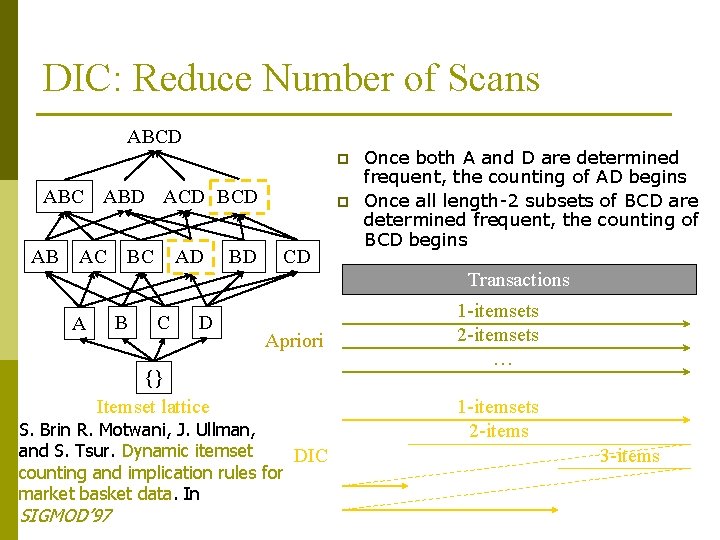
DIC: Reduce Number of Scans ABCD p ABC ABD ACD BCD AB AC BC AD BD p CD Once both A and D are determined frequent, the counting of AD begins Once all length-2 subsets of BCD are determined frequent, the counting of BCD begins Transactions B A C D Apriori {} Itemset lattice S. Brin R. Motwani, J. Ullman, and S. Tsur. Dynamic itemset DIC counting and implication rules for market basket data. In SIGMOD’ 97 1 -itemsets 2 -itemsets … 1 -itemsets 2 -items 3 -items
- Slides: 22