
Performance Analysis of Complementary Code Keying CCK Modulation
- Slides: 1
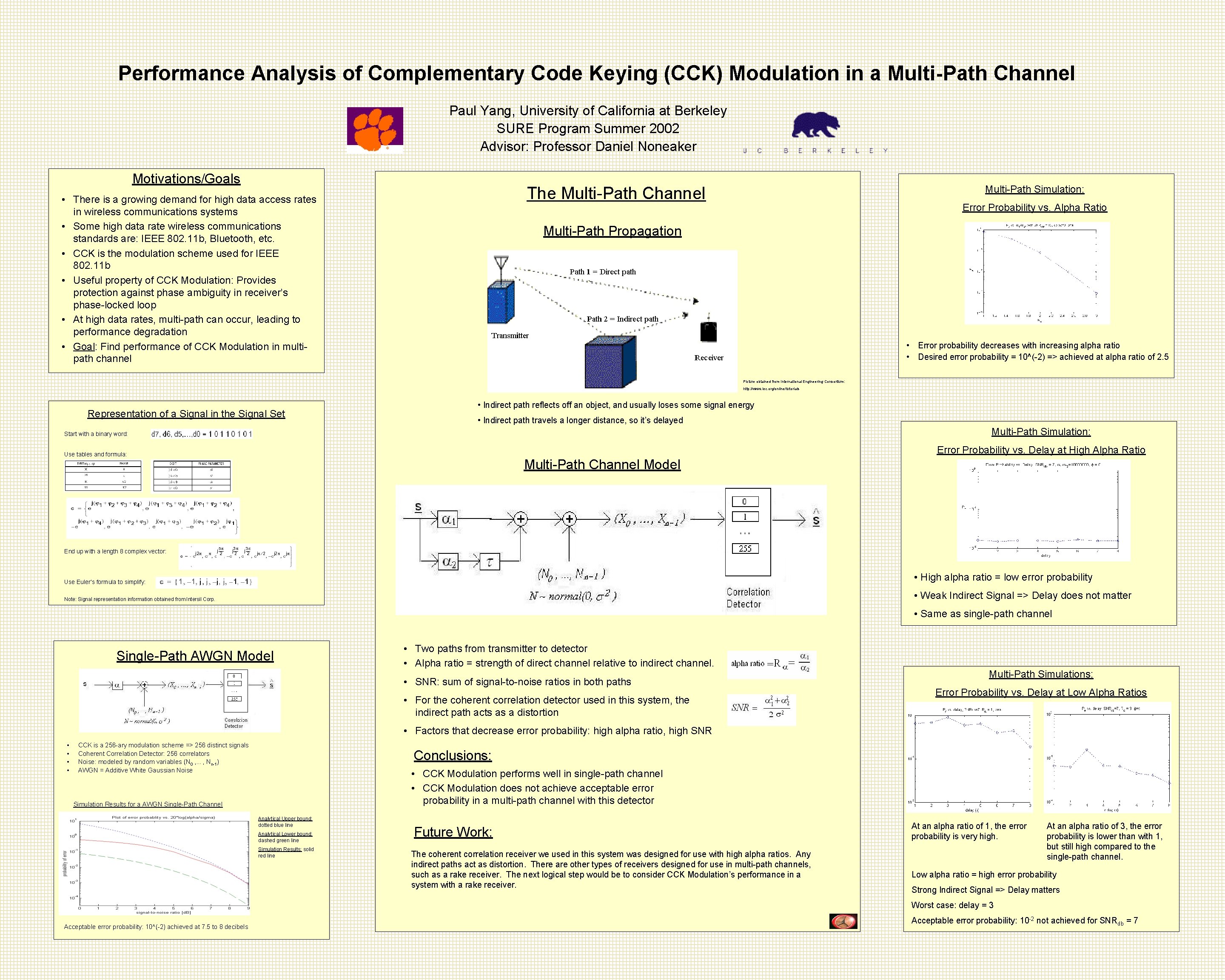
Performance Analysis of Complementary Code Keying (CCK) Modulation in a Multi-Path Channel Paul Yang, University of California at Berkeley SURE Program Summer 2002 Advisor: Professor Daniel Noneaker Motivations/Goals Multi-Path Simulation: The Multi-Path Channel • There is a growing demand for high data access rates in wireless communications systems • Some high data rate wireless communications standards are: IEEE 802. 11 b, Bluetooth, etc. • CCK is the modulation scheme used for IEEE 802. 11 b • Useful property of CCK Modulation: Provides protection against phase ambiguity in receiver’s phase-locked loop • At high data rates, multi-path can occur, leading to performance degradation • Goal: Find performance of CCK Modulation in multipath channel Error Probability vs. Alpha Ratio Multi-Path Propagation • Error probability decreases with increasing alpha ratio • Desired error probability = 10^(-2) => achieved at alpha ratio of 2. 5 Picture obtained from International Engineering Consortium: http: //www. iec. org/online/tutorials Representation of a Signal in the Signal Set • Indirect path reflects off an object, and usually loses some signal energy • Indirect path travels a longer distance, so it’s delayed Start with a binary word: Multi-Path Simulation: Use tables and formula: Error Probability vs. Delay at High Alpha Ratio Multi-Path Channel Model End up with a length 8 complex vector: • High alpha ratio = low error probability Use Euler’s formula to simplify: • Weak Indirect Signal => Delay does not matter Note: Signal representation information obtained from Intersil Corp. • Same as single-path channel Single-Path AWGN Model • Two paths from transmitter to detector • Alpha ratio = strength of direct channel relative to indirect channel. • SNR: sum of signal-to-noise ratios in both paths • For the coherent correlation detector used in this system, the indirect path acts as a distortion Multi-Path Simulations: Error Probability vs. Delay at Low Alpha Ratios • Factors that decrease error probability: high alpha ratio, high SNR • • CCK is a 256 -ary modulation scheme => 256 distinct signals Coherent Correlation Detector: 256 correlators Noise: modeled by random variables (N 0 , …, Nn-1) AWGN = Additive White Gaussian Noise Conclusions: • CCK Modulation performs well in single-path channel • CCK Modulation does not achieve acceptable error probability in a multi-path channel with this detector Simulation Results for a AWGN Single-Path Channel Analytical Upper bound: dotted blue line Analytical Lower bound: dashed green line Simulation Results: solid red line Future Work: The coherent correlation receiver we used in this system was designed for use with high alpha ratios. Any indirect paths act as distortion. There are other types of receivers designed for use in multi-path channels, such as a rake receiver. The next logical step would be to consider CCK Modulation’s performance in a system with a rake receiver. At an alpha ratio of 1, the error probability is very high. At an alpha ratio of 3, the error probability is lower than with 1, but still high compared to the single-path channel. Low alpha ratio = high error probability Strong Indirect Signal => Delay matters Worst case: delay = 3 Acceptable error probability: 10^(-2) achieved at 7. 5 to 8 decibels Acceptable error probability: 10 -2 not achieved for SNRdb = 7