
Perfluorinated Chemicals in Cosmetics gdelpozoufl edu G del
- Slides: 1
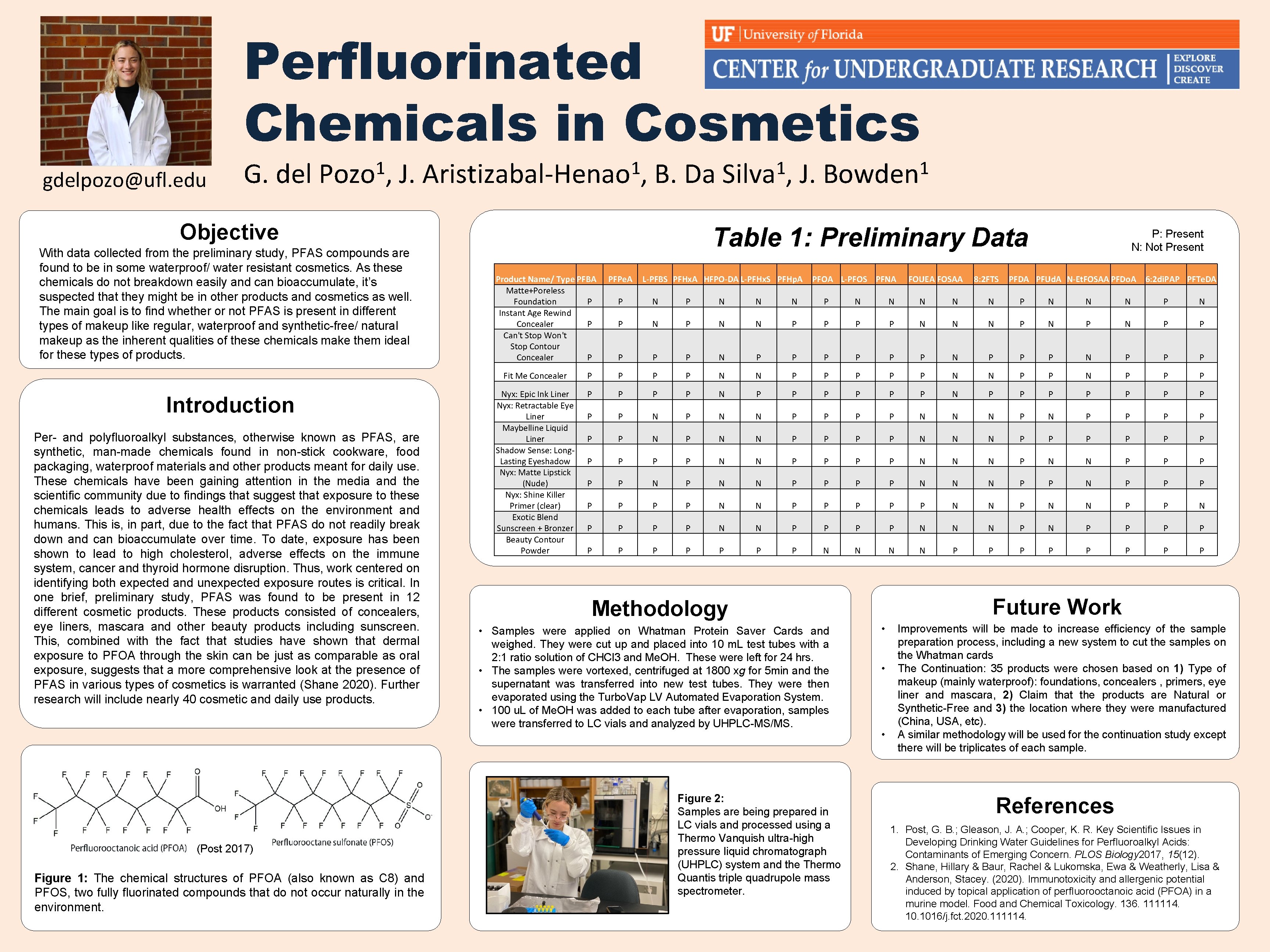
Perfluorinated Chemicals in Cosmetics gdelpozo@ufl. edu G. del 1 Pozo , J. 1 Aristizabal-Henao , B. Da Objective With data collected from the preliminary study, PFAS compounds are found to be in some waterproof/ water resistant cosmetics. As these chemicals do not breakdown easily and can bioaccumulate, it’s suspected that they might be in other products and cosmetics as well. The main goal is to find whether or not PFAS is present in different types of makeup like regular, waterproof and synthetic-free/ natural makeup as the inherent qualities of these chemicals make them ideal for these types of products. Introduction Per- and polyfluoroalkyl substances, otherwise known as PFAS, are synthetic, man-made chemicals found in non-stick cookware, food packaging, waterproof materials and other products meant for daily use. These chemicals have been gaining attention in the media and the scientific community due to findings that suggest that exposure to these chemicals leads to adverse health effects on the environment and humans. This is, in part, due to the fact that PFAS do not readily break down and can bioaccumulate over time. To date, exposure has been shown to lead to high cholesterol, adverse effects on the immune system, cancer and thyroid hormone disruption. Thus, work centered on identifying both expected and unexpected exposure routes is critical. In one brief, preliminary study, PFAS was found to be present in 12 different cosmetic products. These products consisted of concealers, eye liners, mascara and other beauty products including sunscreen. This, combined with the fact that studies have shown that dermal exposure to PFOA through the skin can be just as comparable as oral exposure, suggests that a more comprehensive look at the presence of PFAS in various types of cosmetics is warranted (Shane 2020). Further research will include nearly 40 cosmetic and daily use products. (Post 2017) Figure 1: The chemical structures of PFOA (also known as C 8) and PFOS, two fully fluorinated compounds that do not occur naturally in the environment. 1 Silva , J. 1 Bowden Table 1: Preliminary Data Product Name/ Type PFBA Matte+Poreless Foundation P Instant Age Rewind Concealer P Can't Stop Won't Stop Contour Concealer P PFPe. A L-PFBS PFHx. A HFPO-DA L-PFHx. S PFHp. A PFOA L-PFOS PFNA FOUEA FOSAA 8: 2 FTS P: Present N: Not Present PFDA PFUd. A N-Et. FOSAA PFDo. A 6: 2 di. PAP PFTe. DA P N N N P N P N N P P N N N P N P P P N P P P Fit Me Concealer P P P P N N P P P Nyx: Epic Ink Liner Nyx: Retractable Eye Liner Maybelline Liquid Liner Shadow Sense: Long. Lasting Eyeshadow Nyx: Matte Lipstick (Nude) Nyx: Shine Killer Primer (clear) Exotic Blend Sunscreen + Bronzer Beauty Contour Powder P P P P N P P P N N P P N N N P P P P P N N P P N N N P P P N P N N P P N N N P P P P N N P P P P N N N P P P N N P P P P Future Work Methodology • Samples were applied on Whatman Protein Saver Cards and weighed. They were cut up and placed into 10 m. L test tubes with a 2: 1 ratio solution of CHCl 3 and Me. OH. These were left for 24 hrs. • The samples were vortexed, centrifuged at 1800 xg for 5 min and the supernatant was transferred into new test tubes. They were then evaporated using the Turbo. Vap LV Automated Evaporation System. • 100 u. L of Me. OH was added to each tube after evaporation, samples were transferred to LC vials and analyzed by UHPLC-MS/MS. Figure 2: Samples are being prepared in LC vials and processed using a Thermo Vanquish ultra-high pressure liquid chromatograph (UHPLC) system and the Thermo Quantis triple quadrupole mass spectrometer. • • • Improvements will be made to increase efficiency of the sample preparation process, including a new system to cut the samples on the Whatman cards The Continuation: 35 products were chosen based on 1) Type of makeup (mainly waterproof): foundations, concealers , primers, eye liner and mascara, 2) Claim that the products are Natural or Synthetic-Free and 3) the location where they were manufactured (China, USA, etc). A similar methodology will be used for the continuation study except there will be triplicates of each sample. References 1. Post, G. B. ; Gleason, J. A. ; Cooper, K. R. Key Scientific Issues in Developing Drinking Water Guidelines for Perfluoroalkyl Acids: Contaminants of Emerging Concern. PLOS Biology 2017, 15(12). 2. Shane, Hillary & Baur, Rachel & Lukomska, Ewa & Weatherly, Lisa & Anderson, Stacey. (2020). Immunotoxicity and allergenic potential induced by topical application of perfluorooctanoic acid (PFOA) in a murine model. Food and Chemical Toxicology. 136. 111114. 1016/j. fct. 2020. 111114.