
Perfectionism Whats So Bad About Being So Good
Perfectionism: What’s So Bad About Being So Good The Kortschak Center for Learning and Creativity Presented by: David Safarian
Stats about Perfectionism • 66% of college students in one study said they were perfectionists (Merrell, et al. , 2008) • 21% of men and 26% of women seeking counseling at a college counseling center reported that perfectionism was “quite distressing” or “extremely distressing” to them (Ashby, et al. , 2012) • 92% of people consider themselves a perfectionist in at least one domain of life (Stoeber, et al. , 2013)
Perfectionism Defined • Perfectionism is a personality characteristic defined by striving for flawlessness and setting exceedingly high standards for performance accompanied by tendencies for overly critical self-evaluation and concerns about negative evaluations by others (Stoeber, Hoyle, Last, 2013, p. 178).
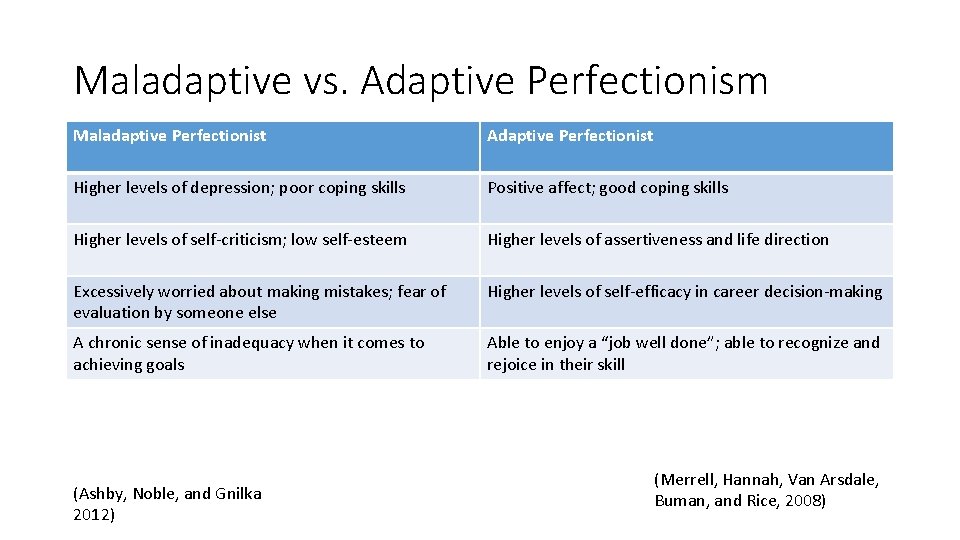
Maladaptive vs. Adaptive Perfectionism Maladaptive Perfectionist Adaptive Perfectionist Higher levels of depression; poor coping skills Positive affect; good coping skills Higher levels of self-criticism; low self-esteem Higher levels of assertiveness and life direction Excessively worried about making mistakes; fear of evaluation by someone else Higher levels of self-efficacy in career decision-making A chronic sense of inadequacy when it comes to achieving goals Able to enjoy a “job well done”; able to recognize and rejoice in their skill (Ashby, Noble, and Gnilka 2012) (Merrell, Hannah, Van Arsdale, Buman, and Rice, 2008)
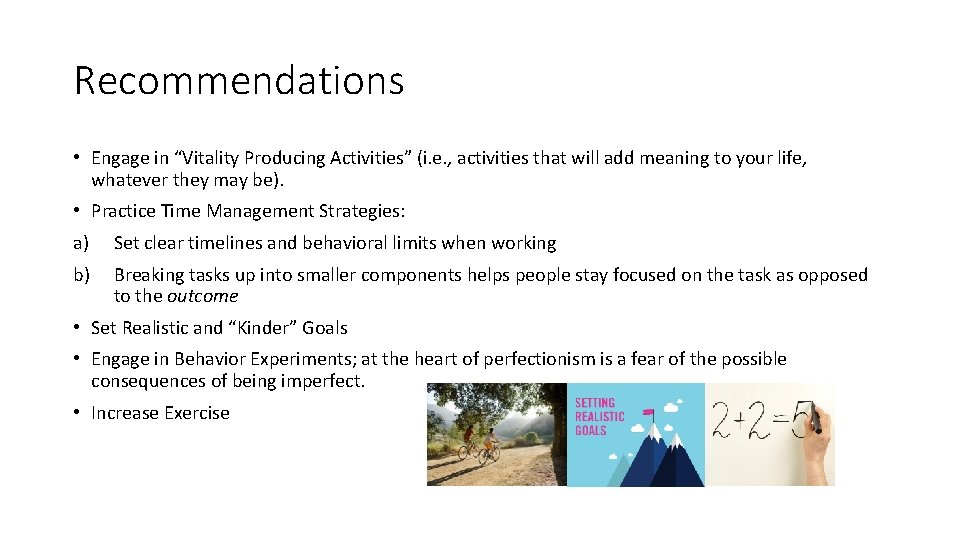
Recommendations • Engage in “Vitality Producing Activities” (i. e. , activities that will add meaning to your life, whatever they may be). • Practice Time Management Strategies: a) Set clear timelines and behavioral limits when working b) Breaking tasks up into smaller components helps people stay focused on the task as opposed to the outcome • Set Realistic and “Kinder” Goals • Engage in Behavior Experiments; at the heart of perfectionism is a fear of the possible consequences of being imperfect. • Increase Exercise
Some Recommendations • Challenge Negative Thoughts “Doing well isn’t good enough, I have to do better!” “If I don’t get an A, I don’t deserve to be here” “If I get it wrong – they will think badly of me” “If I don’t do the best I will let them (parents, teachers, others) down and they wont approve of me” “I have to do an excellent essay or else they’ll know I’m a fraud”
References Ashby, J. , Noble, C. , and Gnilka, P. (2012). Multidimensional perfectionism, depression, and satisfaction with life: Differences among perfectionists and tests of a stress mediation model. Journal of College Counseling, volume 15, p. 30 -143. Retrieved from: http: //search. proquest. com. libproxy 1. usc. edu/docview/1030745175? pqorigsite=summon&accountid=14749 Counseling and Psychological Services (2011). Learn to manage perfectionism. Retrieved from: http: //sydney. edu. au/current_students/counselling/download-docs/learn-to-deal-withperfectionism. pdf Merrell, R. , Hannah, D. , Van Arsdale, A. , Buman, M. , and Rice, K. (2008). Emergent themes in the writing of perfectionists. Psychotherapy Research, 21(5), p. 510 -524. DOI: 10. 1080/10503307. 2011. 587468 Stoeber, J. , Hoyle, A. , and Last, F. (2013). The consequences of perfectionism scale: Factorial structure and relationships with perfectionism, performance perfectionism, affect, and depressive symptoms. Measurement and Evaluation in Counseling and Development, 46(3), p. 178 -191. DOI: 10. 1177/0748175613481981
- Slides: 7