
PERFECT COMPETITION MONOPOLY AND MONOPOLISTIC COMPETITION ESSENTIALS OF

- Slides: 12
PERFECT COMPETITION, MONOPOLY AND MONOPOLISTIC COMPETITION
ESSENTIALS OF MARKET � 1. A market is a place, it may be region, town, city, state, country or whole world. � 2. Market refers to existence of both buyers and sellers. � 3. The commodity or service is essential for transactions. � 4. Both buyers and sellers are aware about the market conditions i. e. price. � 5. One price for a commodity or service at a given time.
CLASSIFICATION OF MARKET �Time �Place �Competition
TYPES OF MARKET � 1. Perfect competition – It is a market where there are large number of buyers and sellers selling homogenous commodity. � 2. Monopoly – It is a market structure in which there is a single seller who has no close substitutes and has a considerable influence on the price. � 3. Monopolistic competition – It is a market situation in which there are many sellers selling differentiated goods. � 4. Oligopoly – it is a market situation in which there are few sellers selling either homogeneous or differentiated goods.
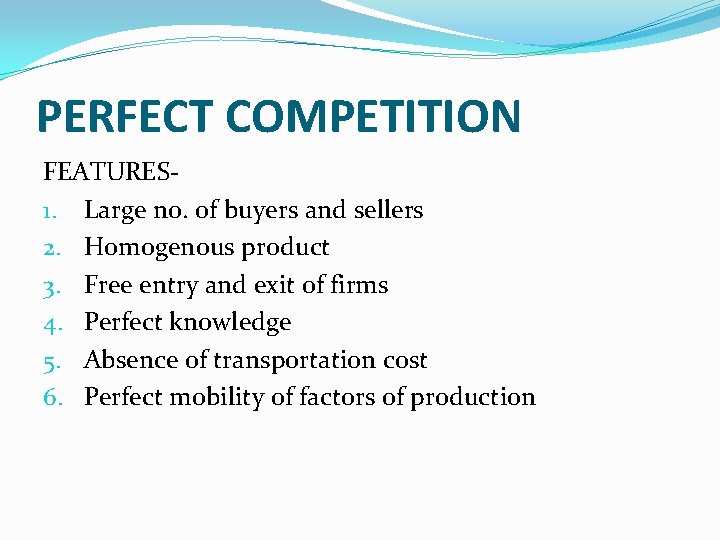
PERFECT COMPETITION FEATURES 1. Large no. of buyers and sellers 2. Homogenous product 3. Free entry and exit of firms 4. Perfect knowledge 5. Absence of transportation cost 6. Perfect mobility of factors of production
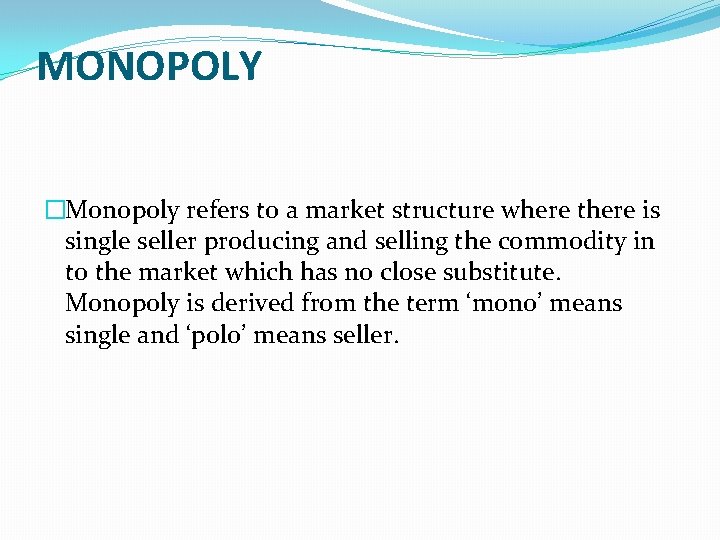
MONOPOLY �Monopoly refers to a market structure where there is single seller producing and selling the commodity in to the market which has no close substitute. Monopoly is derived from the term ‘mono’ means single and ‘polo’ means seller.
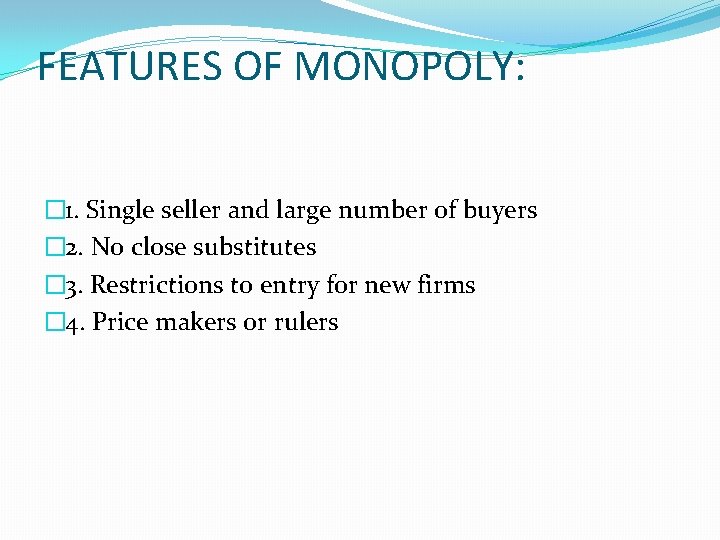
FEATURES OF MONOPOLY: � 1. Single seller and large number of buyers � 2. No close substitutes � 3. Restrictions to entry for new firms � 4. Price makers or rulers
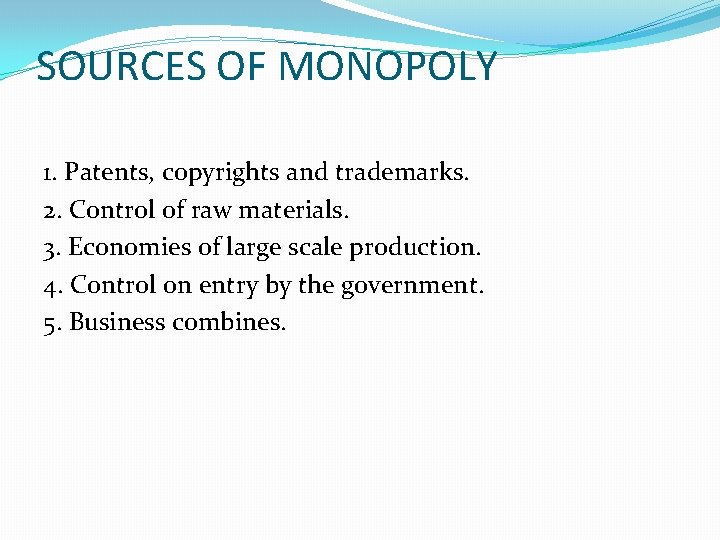
SOURCES OF MONOPOLY 1. Patents, copyrights and trademarks. 2. Control of raw materials. 3. Economies of large scale production. 4. Control on entry by the government. 5. Business combines.
FEATURES OF MONOPOLISTIC COMPETITION 1. Large number of buyers and sellers 2. Differentiated product 3. Transportation cost is incurred 4. Freedom to enter and exit the market 5. Non-price competition
OLIGOPOLY �Introduction �The term oligopoly is derived from the word ‘olig’ means few and ‘poly’ means seller. �Thus oligopoly refers to the market where there are few sellers. They produce and sell such goods which are differentiated or homogeneous product, but the former is called imperfect oligopoly and the later is called perfect oligopoly. Examples – Cold drinks industry, mobile service industry, automobile industry etc.
CHARACTERISTICS OF OLIGOPOLISTIC COMPETITION 1. Interdependence 2. Advertisement and selling costs 3. Indeterminate demand curve 4. Group behaviour 5. Sticky prices
THANK YOU