
Percy Bysshe Shelley 1792 1822 Quest for Poetic
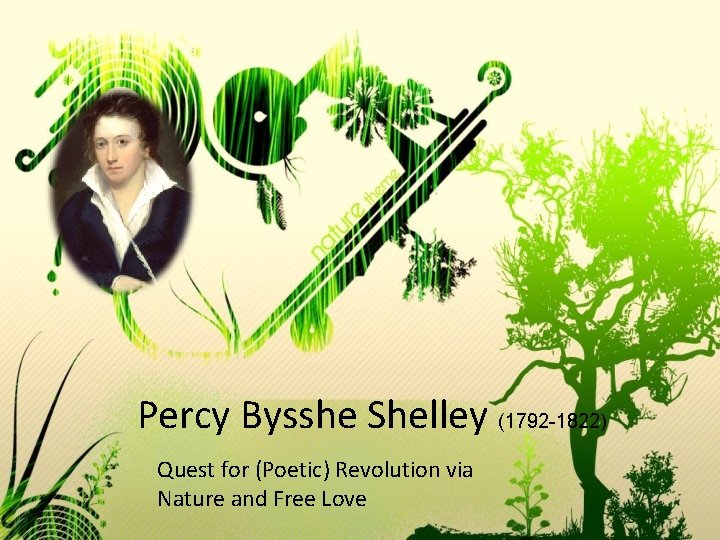
Percy Bysshe Shelley (1792 -1822) Quest for (Poetic) Revolution via Nature and Free Love
How’s your poetry reading so far? 1. Which poems do you like the best? 2. How do you overcome the difficulties of reading poetry? 3. Do you like the Romantic poets? Do you find them too passionate? Can you relate to their passionate quest for poetry, love, nature and revolution? Quest: a long search for something that is difficult to find, or an attempt to achieve
Outline • • Introduction: Shelley—His Life and Idealism To a Skylark (1820) (compared with « Nightingale » Ode) Quiz Ode to the West Wind (1819) (next week: compared with « To Autumn» Ode) • Short Lyrics (to be compared) – “To —— [Music, when soft voices die]” (1821) – “When the Lamp is Shattered (1821)” • Next Week
Film Clips: How the Romantics are connected • Six Degrees of Percy Bysshe Shelley • Byron (BBC) Part 8 (4: 41 « What makes you write? » ) Part 9 (8: 55 Shelley’s death) • The Romantics (part)– – “The Necessity of Atheism” – (Coleridge – Kubla Khan) – 16: 00 Shelley –: “A God made by man…” – Free love –Harriet 21: 00 elopement with Mary and Claire – 24: 00 Byron – Childe Harold Pilgrimage; 34: 00 Keats – 53: 28 – Shelley, seeing his own double, his death
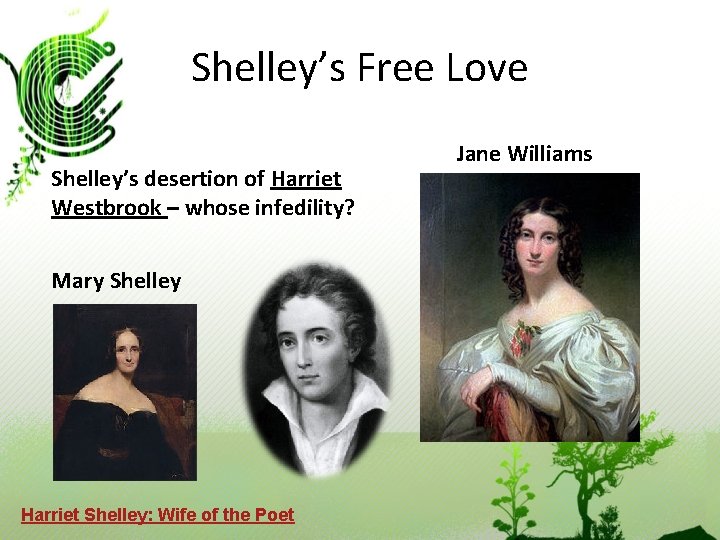
Shelley’s Free Love Shelley’s desertion of Harriet Westbrook – whose infedility? Mary Shelley Harriet Shelley: Wife of the Poet Jane Williams
![Shelley: Bio • 1811 – [age 19] eloped married Harriet Westbrook (age 16). •](http://slidetodoc.com/presentation_image_h/2689fd14ab8b1c6ca10ac03fbe04c3cf/image-6.jpg "Shelley: Bio • 1811 – [age 19] eloped married Harriet Westbrook (age 16). •")
Shelley: Bio • 1811 – [age 19] eloped married Harriet Westbrook (age 16). • 1814 - abandoned his pregnant wife and Byron divorced child to run away with Mary Godwin. his wife and left England for good. • 1816 – met Byron in Italy • 1816 - married Mary, following the suicide of Harriet Westbrook. • 1822 – drowned in a sudden storm while sailing back from Livorno to Lerici. . He was unrecognised in his lifetime, earning around £ 40 for his writing over the duration of his entire life.
Shelley’s Idealism • Atheism: Expelled from Oxford for producing a pamphlet called, “The Necessity of Atheism” • Works promoting his ideals: – “Poetical Essay on the Existing State of Things” (1811), a long, strident anti-monarchical and anti -war poem. – several essays on Vegetarianism , writing that eating meat is “subversive to the peace of human society. ” -- admired by C. S Lewis, Karl Marx, Gandhi (for his non-violence in protest and political action).
To a Skylark: Summary • 21 stanzas divided into 3 parts: – 1 -6: 1) strain of unmeditated art compared to different things; – 7 -12: 2) «What thou art we know not » --further comparison. – 13 -18: 3) teach us your thoughts and origins of your music, though we can only sing sad songs. – 19 -21: 4) teach me half your gladness. • What is the poem’s main idea? • To what is the skylark and its music
To a Skylark: Discussion Questions • What is the poem’s main idea? • To what is the skylark and its music compared? How can a bird be compared to so many things? Can you find something close to it? • How is the ways Shelley relate to skylark different from or similar to Wordsworth or Coleridge or Byron?
To a Skylark: Note – the first 4 lines are metered in trochaic trimeter, the fifth in iambic hexameter (Alexandrine). The rhyme scheme: ABABB – Compared with « Ode to Nightgale » – Nightingale—of dark night; skylark—bright sky. – The nightingale inspires Keats to feel “a drowsy numbness” of happiness that is also like pain, and that makes him think of death; the skylark inspires Shelley to feel a frantic, rapturous joy that has no part of pain. (source: Spark Notes)
Ode to the West Wind: Discussion Questions The poem marked & paraphrased – Terza rima (tercets in iambic pentameter with an interlaced rhyme scheme--aba, bcb, cdc) ending with a concluding couplet (intensified climax) – 5 parts divided into two parts: invocation to the wind a plead to the wind. • What is the poem’s main idea? • To what does the speaker compare the west wind and its influences? • What does the speaker plead for the wind to do?
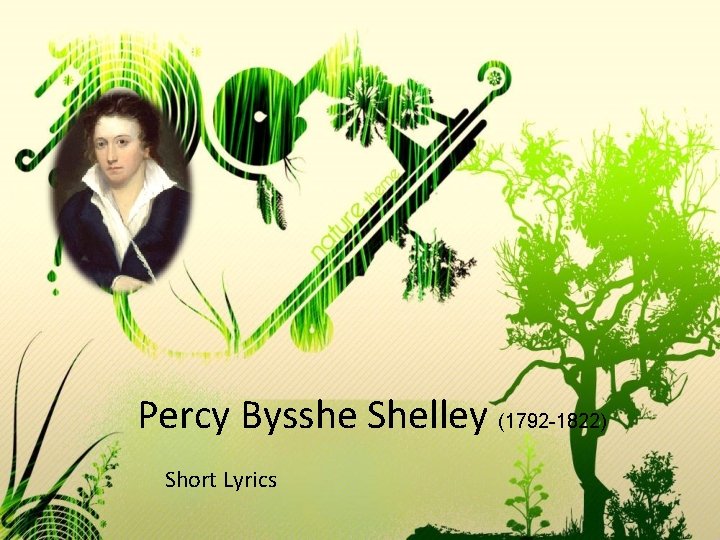
Percy Bysshe Shelley (1792 -1822) Short Lyrics
How are they different from each other in their views of the love represented and lover’s responses? « WHEN THE LAMP IS SHATTERED » « MUSIC, WHEN SOFT VOICES DIE »
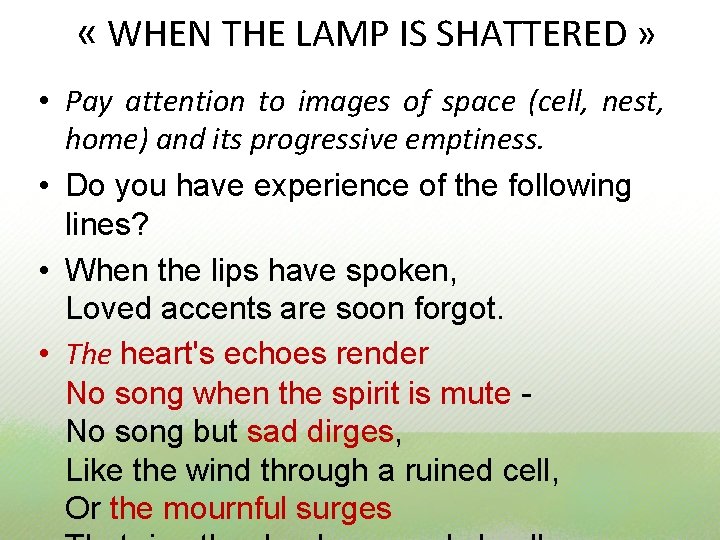
« WHEN THE LAMP IS SHATTERED » • Pay attention to images of space (cell, nest, home) and its progressive emptiness. • Do you have experience of the following lines? • When the lips have spoken, Loved accents are soon forgot. • The heart's echoes render No song when the spirit is mute No song but sad dirges, Like the wind through a ruined cell, Or the mournful surges
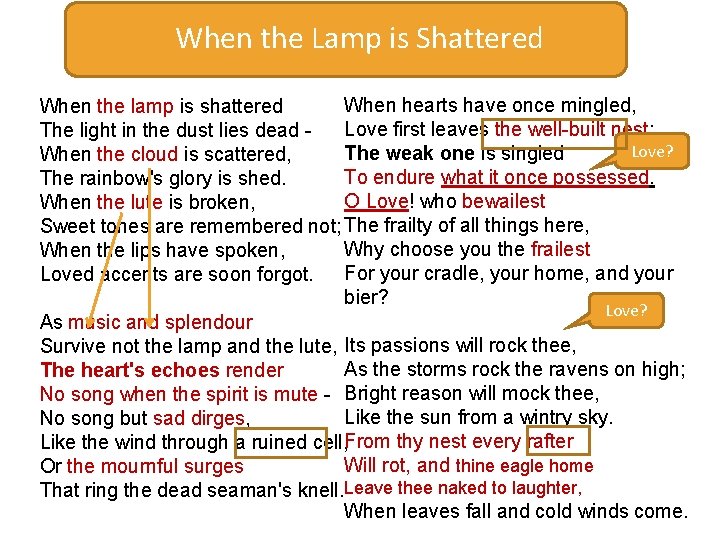
When the Lamp is Shattered When hearts have once mingled, When the lamp is shattered Love first leaves the well-built nest; The light in the dust lies dead Love? The weak one is singled When the cloud is scattered, To endure what it once possessed. The rainbow's glory is shed. O Love! who bewailest When the lute is broken, Sweet tones are remembered not; The frailty of all things here, Why choose you the frailest When the lips have spoken, For your cradle, your home, and your Loved accents are soon forgot. bier? Love? As music and splendour Survive not the lamp and the lute, Its passions will rock thee, As the storms rock the ravens on high; The heart's echoes render No song when the spirit is mute - Bright reason will mock thee, Like the sun from a wintry sky. No song but sad dirges, Like the wind through a ruined cell, From thy nest every rafter Will rot, and thine eagle home Or the mournful surges That ring the dead seaman's knell. Leave thee naked to laughter, When leaves fall and cold winds come.
- Slides: 15