
Perceptual adaptation to foreignaccented speech How to get
- Slides: 3
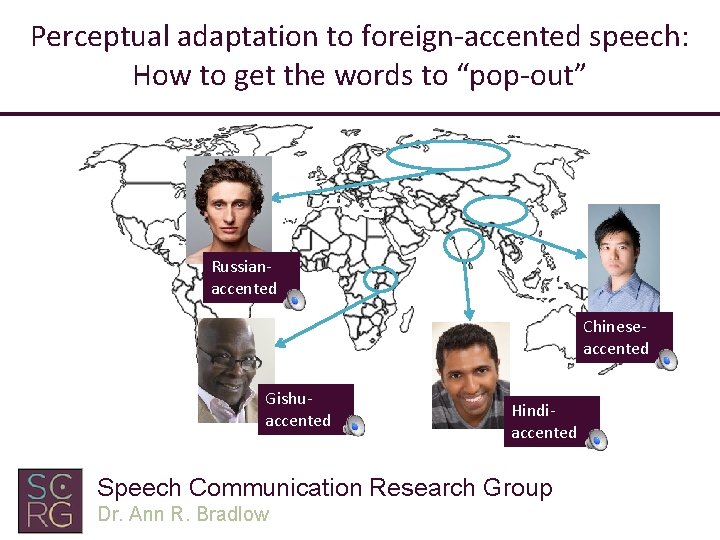
Perceptual adaptation to foreign-accented speech: How to get the words to “pop-out” Russianaccented Chineseaccented Gishuaccented Hindiaccented Speech Communication Research Group Dr. Ann R. Bradlow
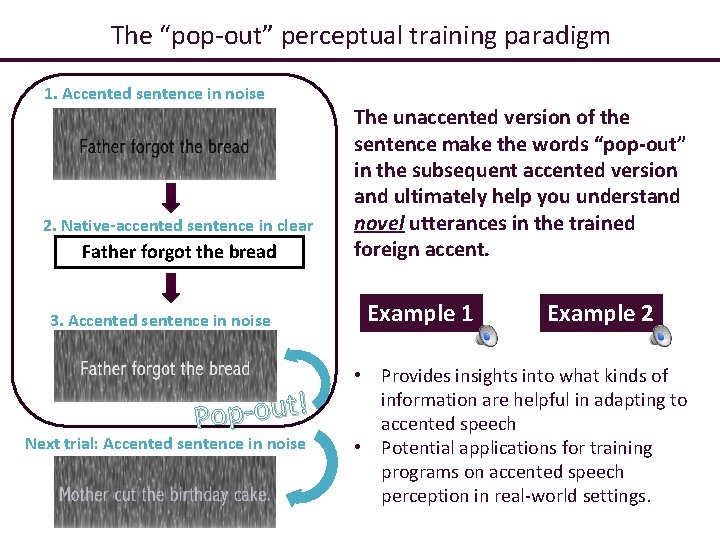
The “pop-out” perceptual training paradigm 1. Accented sentence in noise 2. Native-accented sentence in clear Father forgot the bread 3. Accented sentence in noise Pop-out! Next trial: Accented sentence in noise The unaccented version of the sentence make the words “pop-out” in the subsequent accented version and ultimately help you understand novel utterances in the trained foreign accent. Example 1 Example 2 • Provides insights into what kinds of information are helpful in adapting to accented speech • Potential applications for training programs on accented speech perception in real-world settings.
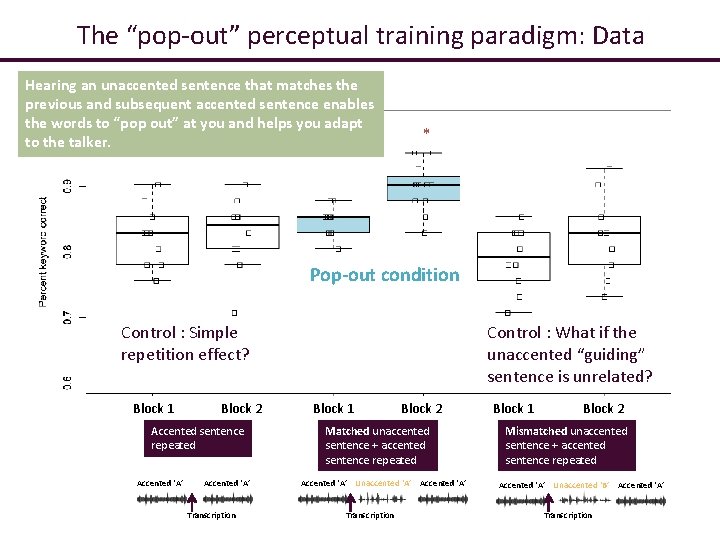
The “pop-out” perceptual training paradigm: Data Hearing an unaccented sentence that matches the previous and subsequent accented sentence enables the words to “pop out” at you and helps you adapt to the talker. * Pop-out condition Control : Simple repetition effect? Block 1 Block 2 Accented sentence repeated Accented ‘A’ Transcription Control : What if the unaccented “guiding” sentence is unrelated? Block 1 Block 2 Matched unaccented sentence + accented sentence repeated Accented ‘A’ Unaccented ‘A’ Accented ‘A’ Transcription Block 1 Block 2 Mismatched unaccented sentence + accented sentence repeated Accented ‘A’ Unaccented ‘B’ Accented ‘A’ Transcription