
Perceptionlogic thinking process 2 0 INTRODUCTION 2 4

- Slides: 46
Perception-logic & thinking process
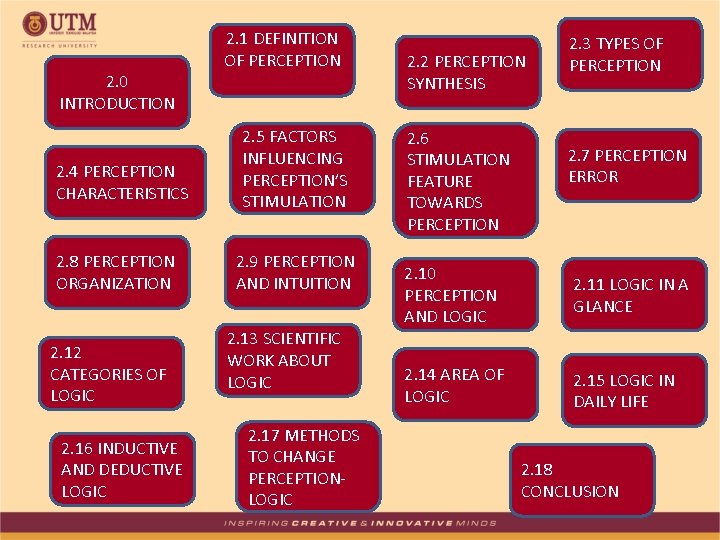
2. 0 INTRODUCTION 2. 4 PERCEPTION CHARACTERISTICS 2. 8 PERCEPTION ORGANIZATION 2. 12 CATEGORIES OF LOGIC 2. 16 INDUCTIVE AND DEDUCTIVE LOGIC 2. 1 DEFINITION OF PERCEPTION 2. 5 FACTORS INFLUENCING PERCEPTION’S STIMULATION 2. 9 PERCEPTION AND INTUITION 2. 13 SCIENTIFIC WORK ABOUT LOGIC 2. 17 METHODS TO CHANGE PERCEPTIONLOGIC 2. 2 PERCEPTION SYNTHESIS 2. 6 STIMULATION FEATURE TOWARDS PERCEPTION 2. 3 TYPES OF PERCEPTION 2. 7 PERCEPTION ERROR 2. 10 PERCEPTION AND LOGIC 2. 11 LOGIC IN A GLANCE 2. 14 AREA OF LOGIC 2. 15 LOGIC IN DAILY LIFE 2. 18 CONCLUSION
Introduction • Perception – the most important element in thinking process/cognitive process • Creative and critical thinking involve perceptual ability – to interrelate, to receive and to supplement • Wide and flexible perception – easy to be creative and critical thinker
• Gestalt – perception is a conscious process involving individual reaction towards stimulus from environment. • According to Edward de Bono (1969), thinking is a process that happened in 2 phases: – 1 st phase: perception – 2 nd phase: logic
Definition of perception • Perception is the first phase of thinking process. Second phase is logic. Perception influence what seen by logic. In short, perception determine logic. (Edward de Bono, 1969) • Perception is the process in which sensory experiences are organized and made meaningful. (Newman, 1983) • Perception is a process where a human knows about objects and objective events through sensation. (Chaplin, 1985) • Perception is an active cognitive process including the process of choosing, organizing and interpreting stimulus. (Solso, 1991)
• Perception is a process whereby a person interpret stimulus sensation and gives meaning to it. It is also a conscious and reaction of an individual towards stimulus, which is their personal nature. Perception is also a meaningful pole. Actually it does not happened automatically, but it takes a long time, which include interpretation and proper understanding. (Mohd. Salleh, 1995) • Perception is interpretation of what is seen by eyes, or in other way perception is meaning given to what is seen by eyes. (Abdullah and Ainon, 1996) • It is a process in which brain received information from senses, restructuring it back and give meaning to it. (Boon and Ragbir, 1998)
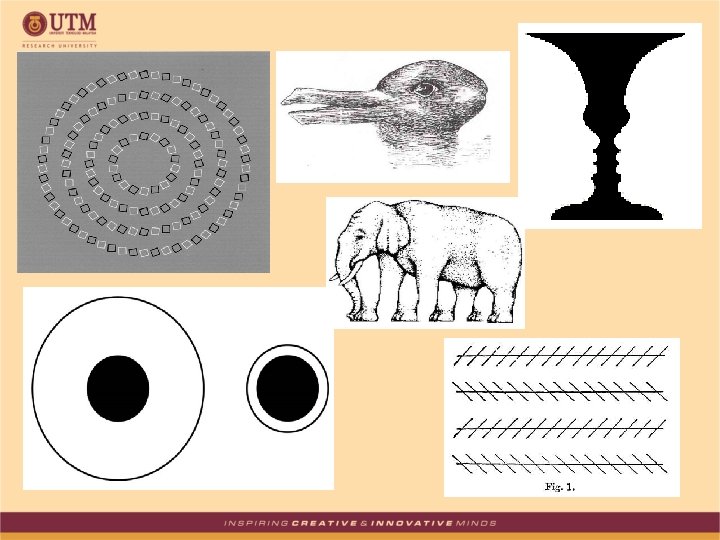
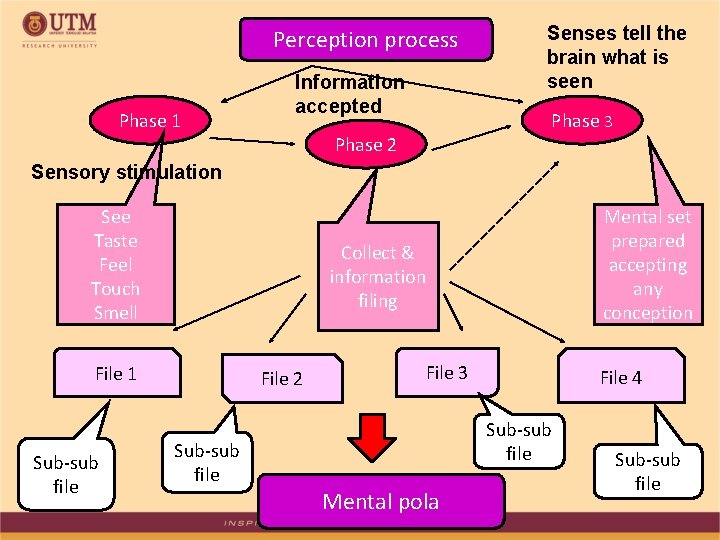
Perception synthesis • Perception process enable us understand our environment. • Observing process happened in two phases: – 1 st phase: eyes send information to the brain – 2 nd phase: brain tells the eyes what is seen (refer to next figure)
HOW COGNITIVE-PERCEPTION PROCESS CREATES MENTAL POLE IN OUR MIND?
Perception process Phase 1 Information accepted Senses tell the brain what is seen Phase 3 Phase 2 Sensory stimulation See Taste Feel Touch Smell Collect & information filing File 1 Sub-sub file Mental set prepared accepting any conception File 2 File 3 File 4 Sub-sub file Mental pola Sub-sub file
• Thinking involved two important process (Ainon & Abdullah, 1995): – Biology – Perception • Perception is a pole set about any concept and meaning that resembles in our mind. • These set of poles we get from surveillance, observation and direct participation of our surroundings.
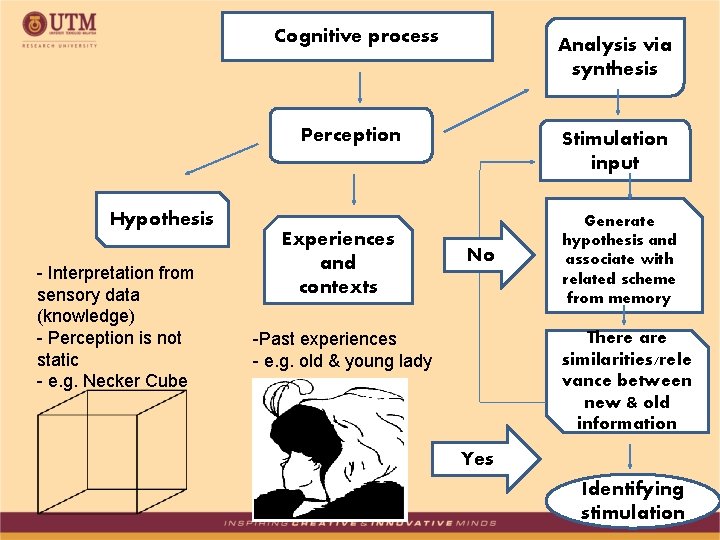
Cognitive process Analysis via synthesis Perception Stimulation input Hypothesis - Interpretation from sensory data (knowledge) - Perception is not static - e. g. Necker Cube Experiences and contexts No -Past experiences - e. g. old & young lady Generate hypothesis and associate with related scheme from memory There are similarities/rele vance between new & old information Yes Identifying stimulation
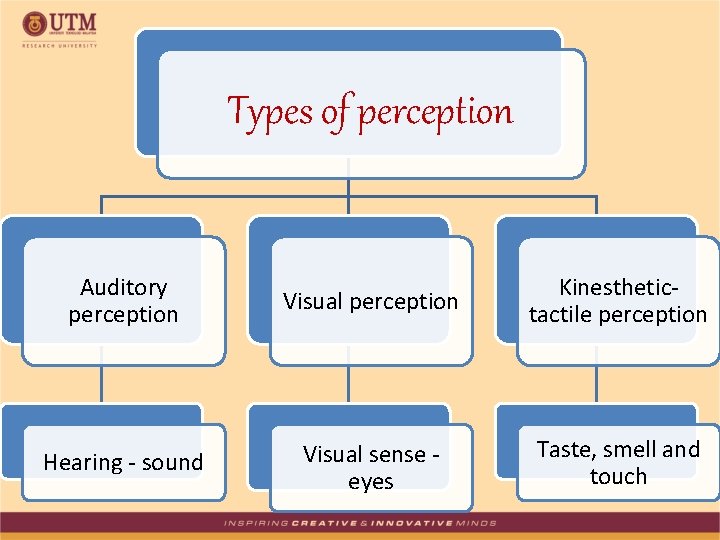
Types of perception Auditory perception Visual perception Kinesthetictactile perception Hearing - sound Visual sense eyes Taste, smell and touch
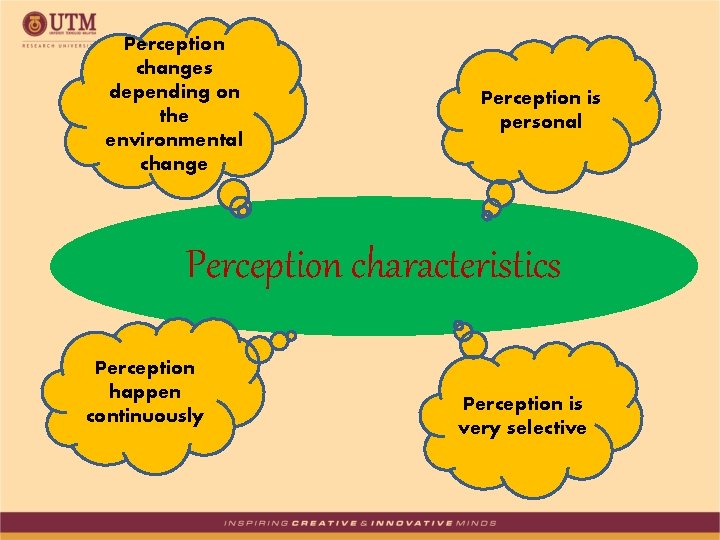
Perception changes depending on the environmental change Perception is personal Perception characteristics Perception happen continuously Perception is very selective
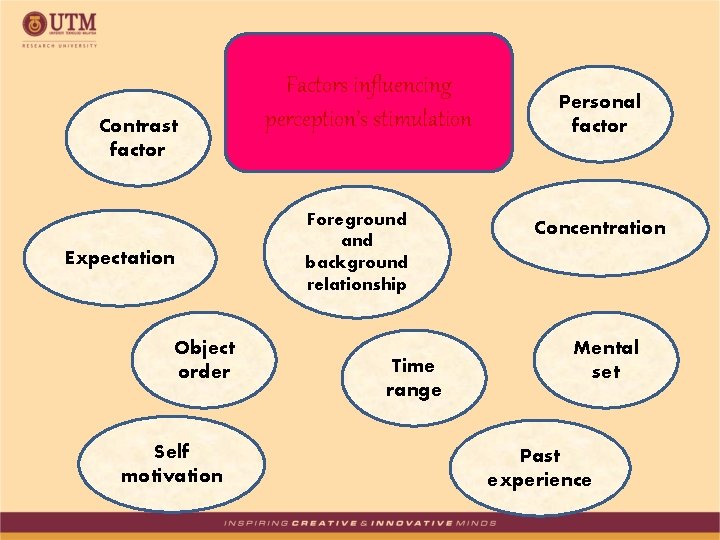
Contrast factor Expectation Object order Self motivation Factors influencing perception’s stimulation Foreground and background relationship Time range Personal factor Concentration Mental set Past experience
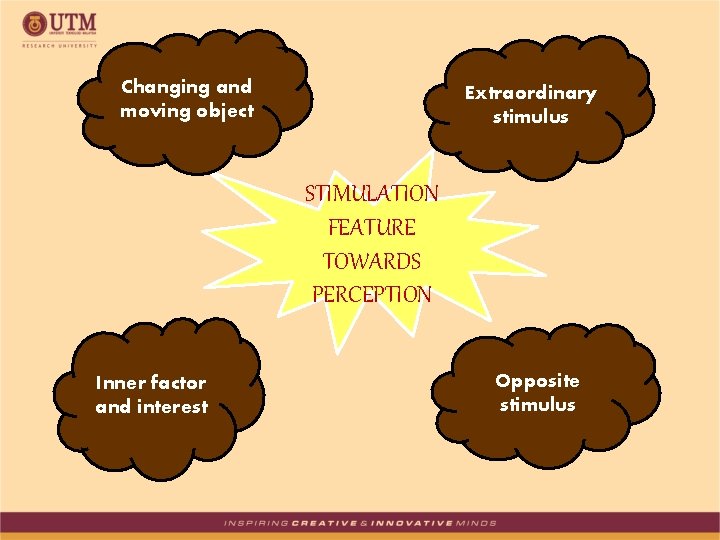
Changing and moving object Extraordinary stimulus STIMULATION FEATURE TOWARDS PERCEPTION Inner factor and interest Opposite stimulus
Perception error • Human is created with weaknesses – spiritually, emotionally, intellectually, and physically. • Richard (1989) – human weaknesses in translating perception happened because of the total prediction power while human is translating input received through their environment.
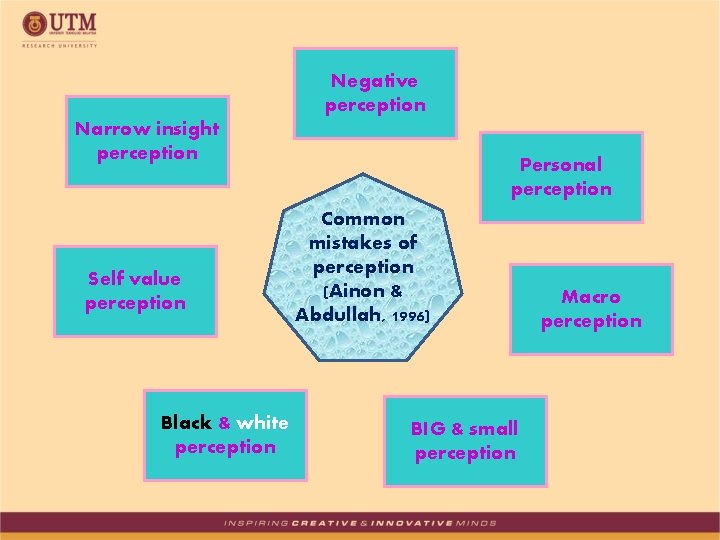
Negative perception Narrow insight perception Self value perception Black & white perception Personal perception Common mistakes of perception (Ainon & Abdullah, 1996) BIG & small perception Macro perception
Perception organization • Perception enable us to look for certain information only. • Then information was kept in memory – become experience • As a human, we have to be clever to organize perception, to be suitable for creative and critical thinking.
• It is important in a process of problem solving and decision making. • Creative thinking can generate many ideas and solving in different perspectives. • Creative thinking techniques: need to be learnt – Expand perception in viewing and solving problems – Widen observation towards something better
Perception and intuition • Other than senses, divine revelation and intelligence, intuition is also a way of thinking. • Intuition is experience gained without a certain thinking process. • Intuition works subconsciously. • Perception of the possibilities inherent in a situation. – (Carl Jung) • Intuition use subconscious mind for information to come and go.
• Intuition functioned in perception. • Perception – translating; intuition – widen the dimension of perception • Intuition helps to: v. How perception can be translated correctly? v. How was it built? v. What is the implication to other situation? v. How should we react? v. What is the new idea that can we derive in our mind?
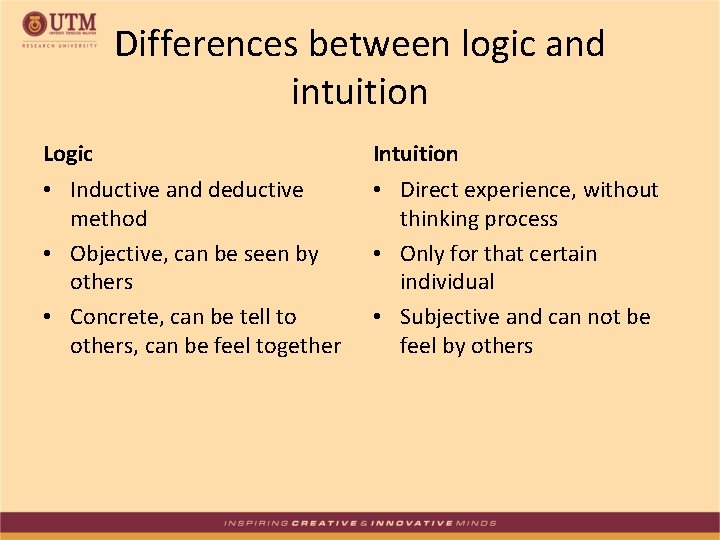
Differences between logic and intuition Logic Intuition • Inductive and deductive method • Objective, can be seen by others • Concrete, can be tell to others, can be feel together • Direct experience, without thinking process • Only for that certain individual • Subjective and can not be feel by others
Perception and logic • Perception and logic interdependent each other. • Perception – collecting pole; logic – set of assumption for the poles • Logic is useful for: v. Looking into relationship of cause and effect v. Making conclusion for something v. To defend argument for the purpose of supporting or rejecting any ideas
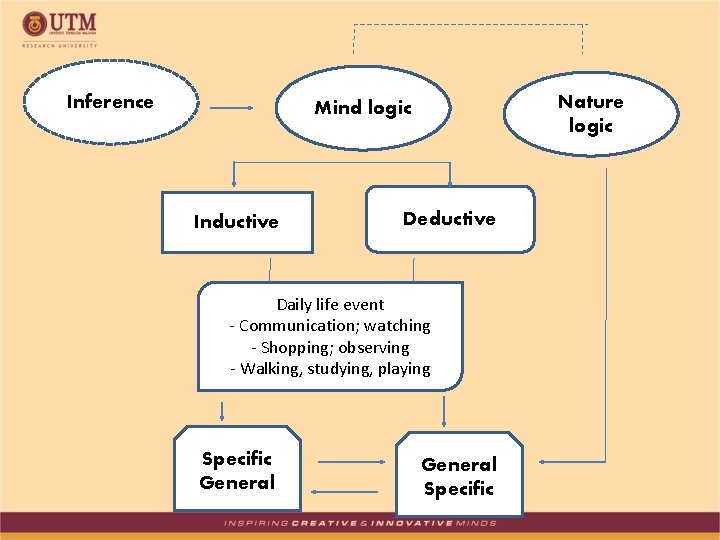
Inference Nature logic Mind logic Inductive Deductive Daily life event - Communication; watching - Shopping; observing - Walking, studying, playing Specific General Specific
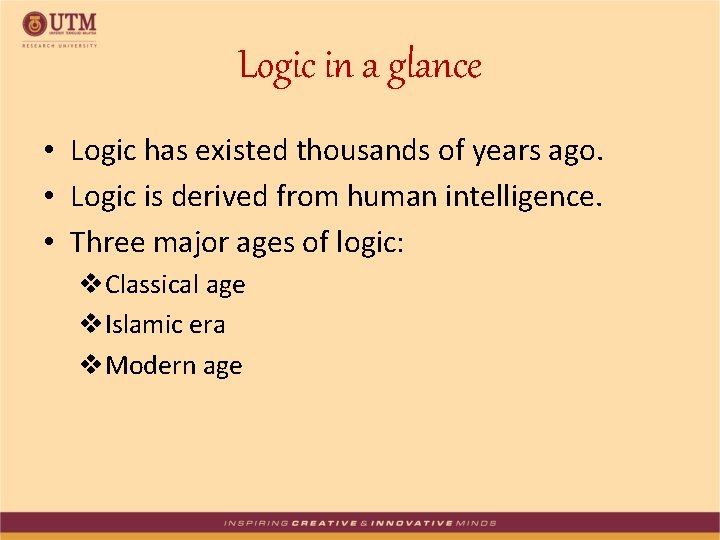
Logic in a glance • Logic has existed thousands of years ago. • Logic is derived from human intelligence. • Three major ages of logic: v. Classical age v. Islamic era v. Modern age
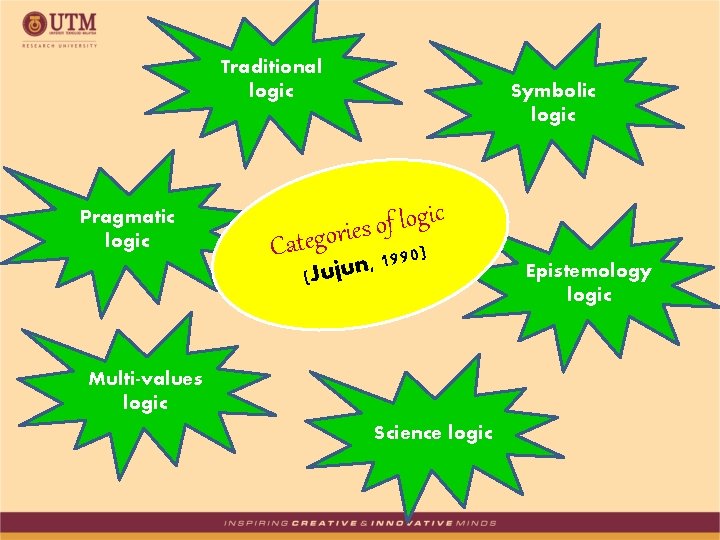
Traditional logic Pragmatic logic Symbolic logic c i g o l f o egories Cat ) 0 9 9 1 , ujun (J Multi-values logic Science logic Epistemology logic
Scientific work about logic • Scientific work contributed to the traditional logic • Scientific work of Greece have been translated by Islamic scholars: al-Farabi • Improve to suit with Islam, and not confusing Islam practitioner • Western also translated Islamic books into English
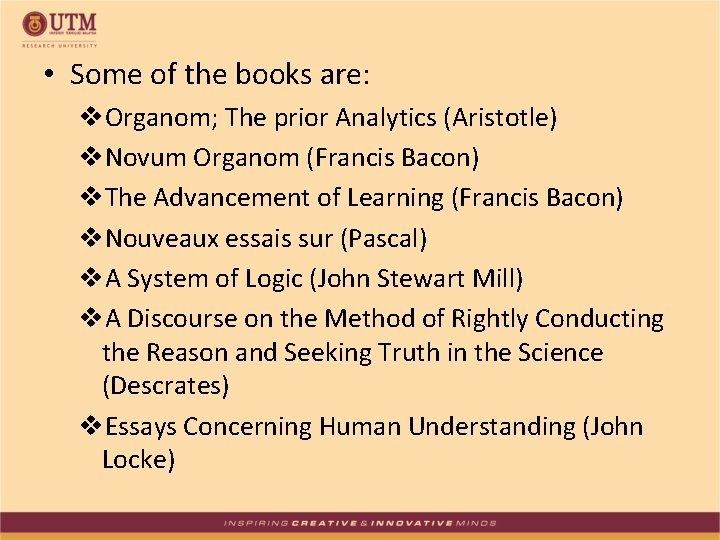
• Some of the books are: v. Organom; The prior Analytics (Aristotle) v. Novum Organom (Francis Bacon) v. The Advancement of Learning (Francis Bacon) v. Nouveaux essais sur (Pascal) v. A System of Logic (John Stewart Mill) v. A Discourse on the Method of Rightly Conducting the Reason and Seeking Truth in the Science (Descrates) v. Essays Concerning Human Understanding (John Locke)
Area of logic • Logic is a tool or basis for other knowledge area (Bolton, 1976). • “Logic is the head of knowledge, whoever did not learnt about logic, their knowledge could not be believed” – Imam al-Ghazali • Knowledge with strong logic basis are religion, philosophy, applied and natural science, language, mathematics, calculus, space, geometry, moral, politics, computer science etc.
Classical age • • Logic called as pure logic Since 600 B. C. , Heraclitus age Aristotle create very useful logic basis Scholars in Classical age: – Heraclitus – Socrates – Plato – Pythagoras
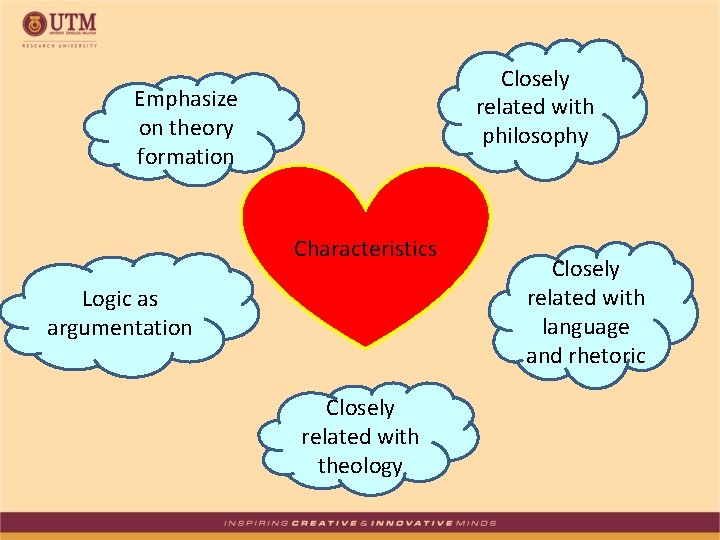
Closely related with philosophy Emphasize on theory formation Characteristics Logic as argumentation Closely related with theology Closely related with language and rhetoric
Islamic era • Logic in golden age of Islam is influenced by classical age • Translated by scholars – al-Farabi, al-Kindi • Given new dimension in scientific research • Scholars: – Ibn Sina – Ibn Haitham – Imam al-Ghazali
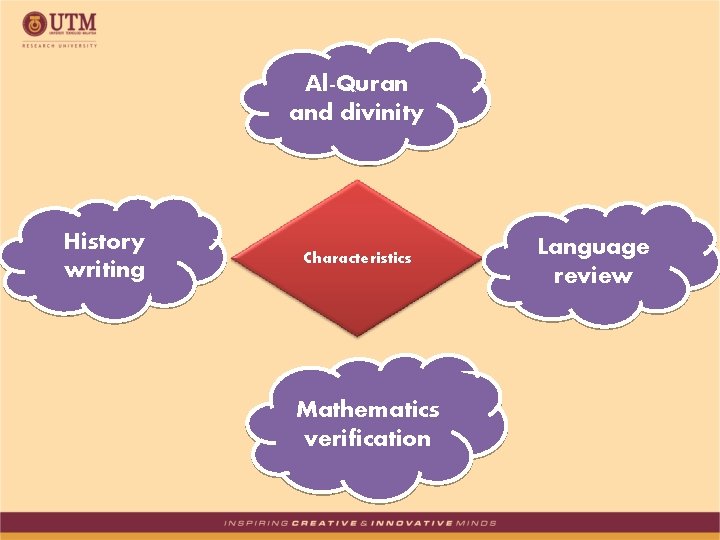
Al-Quran and divinity History writing Characteristics Mathematics verification Language review
Modern age • Scholars trying to find alternative to improve • Rene Descartes discover more dynamic logic system – dialectic • Now logic is more scientific and empirical • Scholars: – Galileo – Newton – Pascal
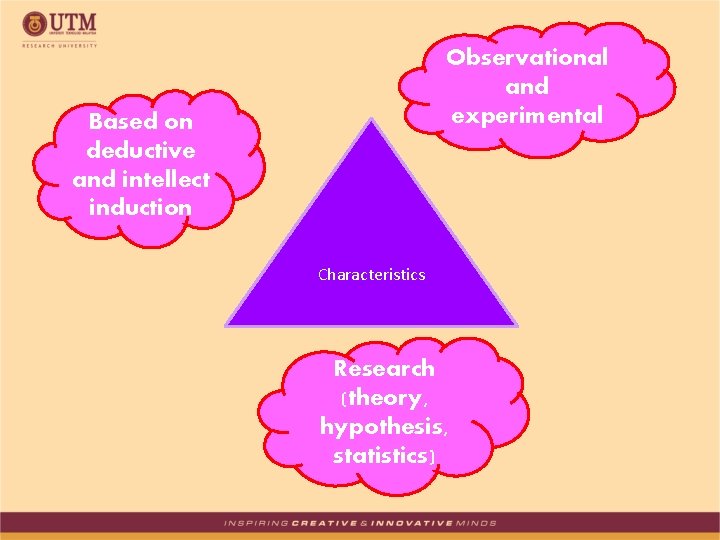
Observational and experimental Based on deductive and intellect induction Characteristics Research (theory, hypothesis, statistics)
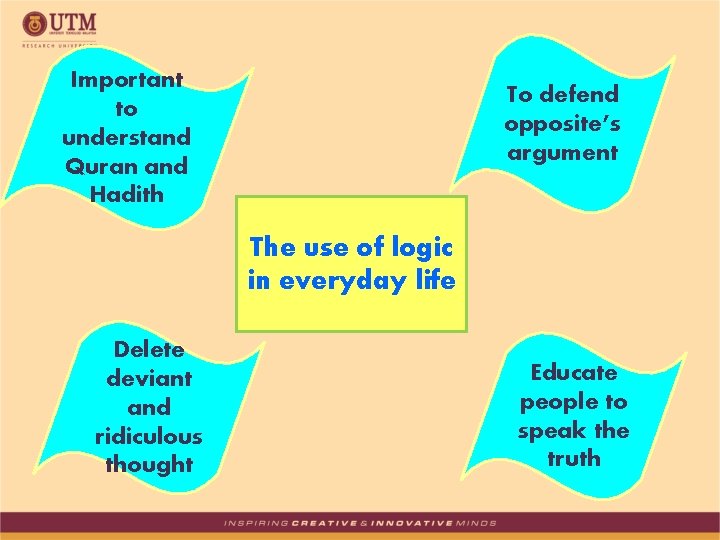
Logic in daily life • Logic as guideline while thinking and decision making process. • Logic can determine what is wrong and what is right. • Weaknesses of logic: what is correct in logic is not necessarily correct in the real situation. • But logic mistakes is small compared to perception mistakes. • Creation of universe can not be explained by logic.
Important to understand Quran and Hadith To defend opposite’s argument The use of logic in everyday life Delete deviant and ridiculous thought Educate people to speak the truth
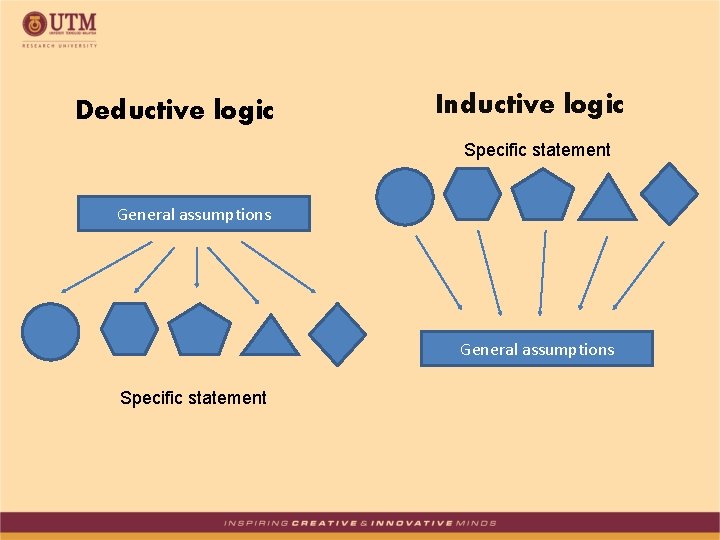
Deductive and inductive logic • Deductive logic: some set of general assumptions that produce one specific statement (syllogism – one conclusion built from minor and major premises) • Inductive logic: one specific statement built from some set of general assumptions
Deductive logic Inductive logic Specific statement General assumptions Specific statement
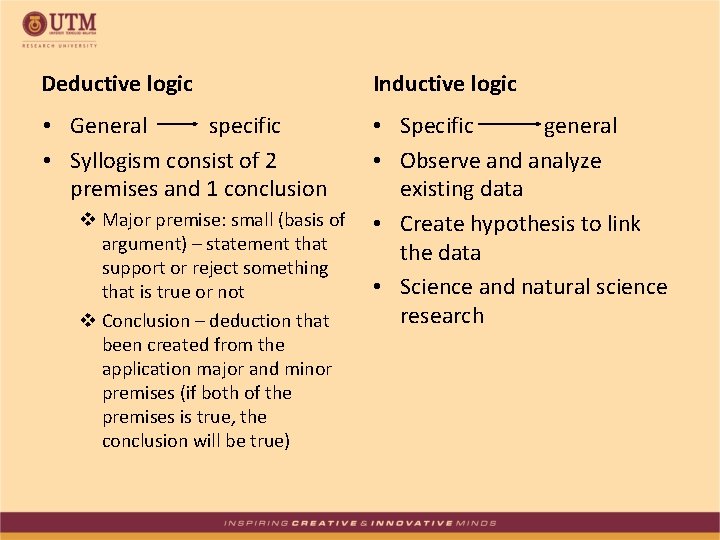
Deductive logic Inductive logic • General specific • Syllogism consist of 2 premises and 1 conclusion • Specific general • Observe and analyze existing data • Create hypothesis to link the data • Science and natural science research v Major premise: small (basis of argument) – statement that support or reject something that is true or not v Conclusion – deduction that been created from the application major and minor premises (if both of the premises is true, the conclusion will be true)
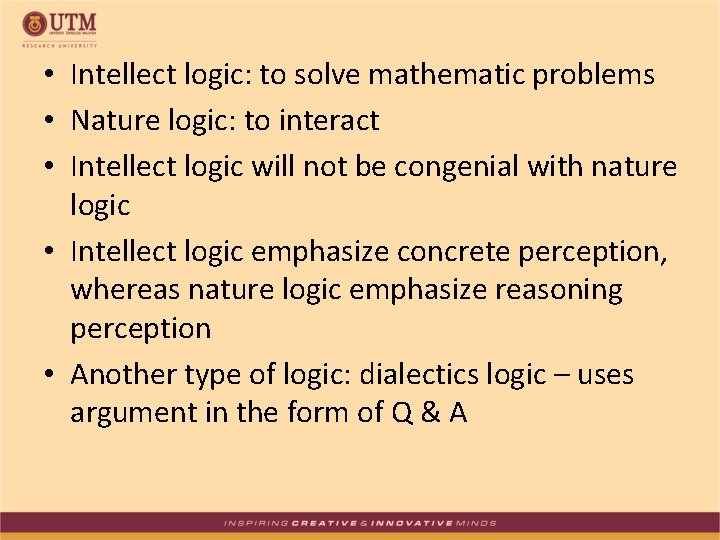
• Intellect logic: to solve mathematic problems • Nature logic: to interact • Intellect logic will not be congenial with nature logic • Intellect logic emphasize concrete perception, whereas nature logic emphasize reasoning perception • Another type of logic: dialectics logic – uses argument in the form of Q & A
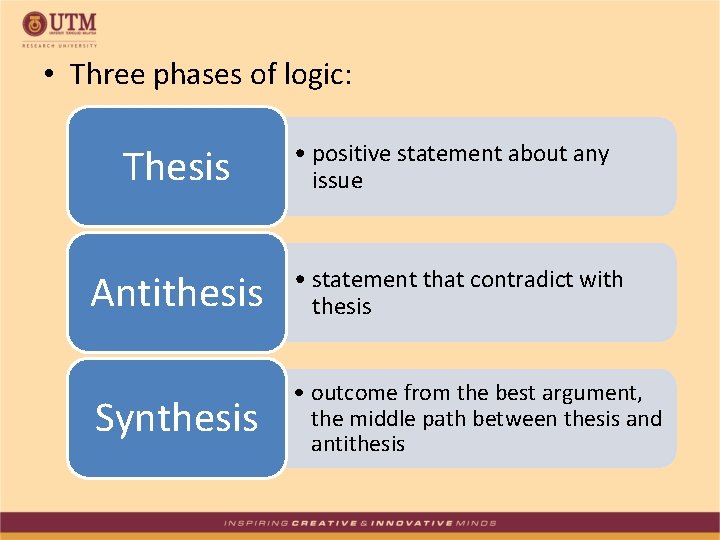
• Three phases of logic: Thesis • positive statement about any issue Antithesis • statement that contradict with thesis Synthesis • outcome from the best argument, the middle path between thesis and antithesis
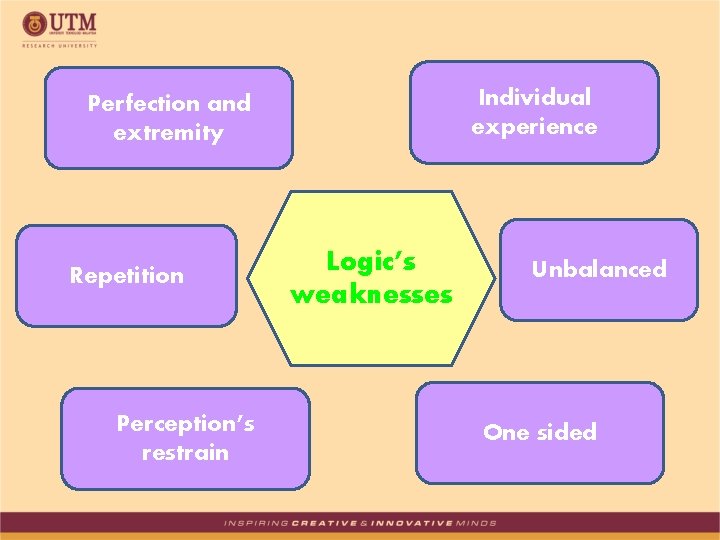
Individual experience Perfection and extremity Repetition Perception’s restrain Logic’s weaknesses Unbalanced One sided
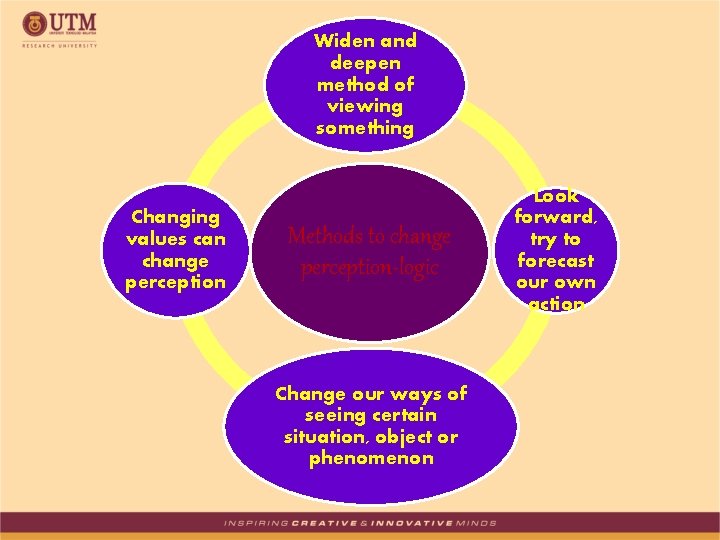
Widen and deepen method of viewing something Changing values can change perception Methods to change perception-logic Change our ways of seeing certain situation, object or phenomenon Look forward, try to forecast our own action
Conclusion • Every human being has perception. • Perception enable human to know a lot – things, events, objects. • Good and positive perception is beneficial for human. However, bad perception can also bring goodness. • Perception MUST BE and HAVE TO BE controlled. • Controller – intellect, lust and faith!